[♫ music ♫] My name is Jason Downs, and I was part of the team that discovered the locality that has produced a number of interesting species on southern Ellesmere Island in the Devonian period, which is a period of time that lasts from about 405 million years ago to about 360 million years ago. And this site on southern Ellesmere Island in the Canadian Arctic, has produced exciting Devonian species, like Tiktaalik roseae. So here's a paleo map of Earth during the Late Devonian period, 370 million years ago.
So, in the Late Devonian. This pin, and actually this shoreline here, represent not only Pennsylvania, where we doing work locally, but also Ellesmere Island. So it was the same shoreline here.
And if this is the equator, one of the things that you can notice is that not only are we not in an arctic position anymore, here in the Late Devonian, but we're actually southern hemisphere and within a tropical region. That highlights that Tiktaalik roseae was not living in an arctic-type setting, it was living in a tropical setting and presumably southern hemisphere, rather than northern. So, this is the valley that we were working on southern Ellesmere Island, right near Bird Fjord, which is one of these glacially carved valleys.
We camped up valley, but this notch there is the one that we put into this hill, and that's where Tiktaalik roseae was recovered. This is the island. So this is southern Ellesmere Island here.
So here's Bird Fjord here. And so it's this valley, leading up here, that's where we camped and that is NV2K17, which is the Tiktaalik roseae's locality. Tiktaalik roseae occupies a very important place in the history of life.
This is the finned vertebrate more closely related limbed vertebrates than any other discovered. And so what that means is that Tiktaalik occupies a very interesting evolutionary position if we are interested in questions like the origin of the limb from former fins, the origin of vertebrate terrestriality, the move of vertebrates out of aquatic environments and into terrestrial environments for the first time. And so, this animal made quite a splash when it was published for the first time in 2006.
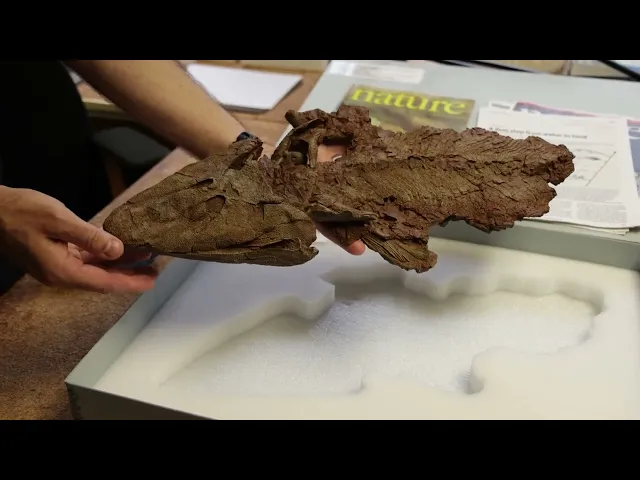
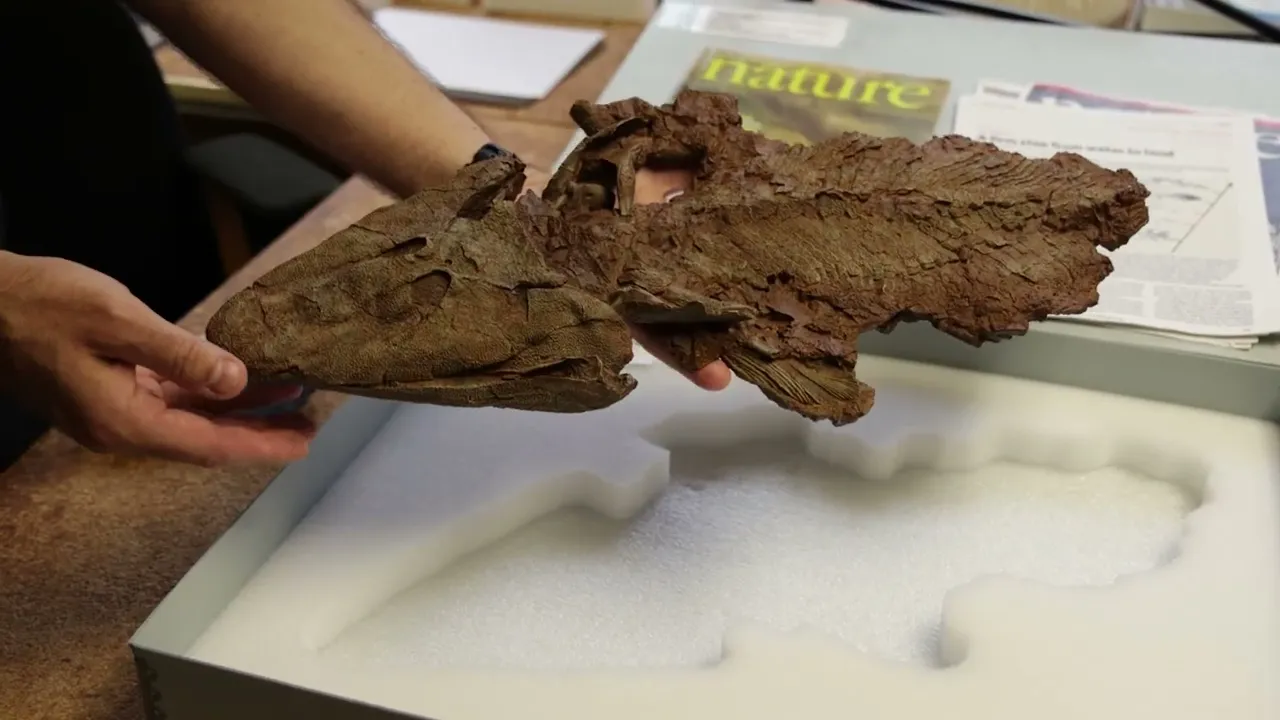
And I'd like to show off some of the anatomy that is especially exciting about this animal in the transition between aquatic and terrestrial environments. What we're looking at now is the type-specimen of Tiktaalik roseae, and when we say type-specimen what we mean is that this is the specimen that carries the name. So for future discoveries, in order to recognize whether those discoveries belong to the species or not, we would come back to the type-specimen.
And this here is the type-specimen of Tiktaalik roseae. I mentioned that Tiktaalik is an animal in the transition between aquaticism and terrestriality within vertebrates. And this bears out when we start to look at aspects of its anatomy.
What I think you might first notice when you look at this specimen, this is the skull here and we're looking at it in top-down view, what we call a dorsal view. This is the tip of the snout, here. These are the eye openings here.
And I think what really should jump out at you is that we have a very triangular shaped head, and the head is squashed flat relative to aspects of Tiktaalik's ancestry. Tikaalik's ancestors had a head that was more torpedo like, more conical. And what we have here is this flattening of the skull that we associate with the origin of terrestriality.
Not only has the skull flattened, but the eyes have rotated up from the sides of the skull, onto the top of the skull. So that now the eyes are sitting up here on the top of the skull, giving Tiktaalik a great view above it, but less of a satisfactory view to the sides and in front of it. We presume that Tiktaalik probably spent a lot of its time on the bottom of these vegetation-choked freshwater channels.
And by spending time at the bottom, and having eyes rotated up to the top of its head, it had this ability to view potential prey items that might be swimming over it. It's possible that the earliest limbs with fingers and toes were actually an adaptation to navigate these vegetation-choked waterways like those that Tiktaalik roseae lived in. So we've got this highly specialized skull here relative to its ancestry, triangle-shaped, squashed flat, eyes rotated up onto the top of its head, very crocodilian-like much more so than fish-like.
But if we move our perspective caudally towards the tail, what we notice are things that we associate with fish and aquaticism and aspects of the primitive members of this lineage. One of the things you notice is that the body is covered with mineralized scales. As we move up into limbed vertebrates, those scales are lost, such that the most primitive limbed vertebrate has no mineralized scales at all.
So the fact that we've got these mineralized scales paired with this triangular flattened head, with eyes on top, again, is showing the transitional nature of the fossil. We've got this aspect of primitive anatomy, the mineralized scales, and more specialized anatomy here in the flattened skull. These are shoulder elements here.
And each of the elements that I'm pointing to are part of the dermal skeletal shoulder. Aspects of the shoulder that we don't have in our shoulder. This is the cleithrum bone.
This is the anocleithrum bone. These are bones that have been lost as we move up into limbed vertebrates. So having this highly dermal skeletal shoulder, again, is showing that connection to the ancestry of the lineage.
Tiktaalik is a finned animal, as I mentioned previously, and we can see here the rays that support the fin. So this is an animal without fingers and toes, it doesn't have limbs, it has fins. So, with a dermal shoulder, mineralized scales, and fins, matched with this highly specialized skull, again, it's all suggestive of of this species in the transition.
One last feature to note is that the head of Tiktaalik roseae is disconnected from the shoulder. In fish, there is a series of bones that connect the shoulder to the dermal elements of the. .
. connect the head to dermal elements of the shoulder. That's why we say that fish don't have a neck.
Fish can't move their head relative to their shoulder, relative to their body. Tiktaalik has disconnected its head from its shoulder. It has a neck.
And therefore may have some more cranial mobility, mobility of the head relative to the shoulder, then did animals that we might find in the ancestry. So we've got a neck, we've got a flattened skull, we've got dorsally positioned eyes, in combination with these primitive features: mineralized scales, fins, and a heavily dermal skeletal shoulder. I've flipped over this type-specimen of Tiktaalik roseae now to look at some of the ventral features, or the features of the animal's underside.
These are the lower jaws here. Again, highlighting this triangular-type skull. But now we're seeing into the roof of its mouth.
Some of the pieces that are attached inside here are actually parts of the gill skeleton. And this is important to highlight that all of the skeletal anatomy that we associate with gill breathing is still here in Tiktaalik, including these grooved branchial elements. That groove would have housed blood vessels that are associated with gill breathing.
So, Tiktaalik, we would expect to have some sort of air sack, whether or not it was using it in a respiratory fashion. We can think about air breathing in Tiktaalik simply because of it phylogenetic position, or its position in the history of life in the relationships among vertebrates. But it's also continuing to show all of the skeletal anatomy that would be needed to preform successful gill breathing.
It's suspected that Tiktaalik spent most of its time underwater, breathing with gills, though possibly had the ability to move into the terrestrial space, for shorts periods of time, and breath with a respiratory air sack. As we move here further back, I use the term "caudally" to mean toward the tail, we see some aspects of the shoulder here on the under side. And this part of the shoulder is actually the part that would be the one represented by our shoulder as human beings.
These are the coracoid bones of the Tiktaalik shoulder. We have coracoid in our shoulder. We don't have those dermal elements, but we do have these cartilage-based endoskeletal elements.
We also see some bones of the pectoral appendage here scattered around here on the underside. This is a radius bone here, one of the bones of our forearm. This I believe to be an ulna bone.
One here as well. That's the other bone of our forearm. The fact that Tiktaalik has a humerus, here's the humerus here.
Humerus, radius, ulna – it's showing those same bones that we have in our arm, which highlights this relative close relationship between Tiktaalik roseae and limbed vertebrates. As we move further toward the tail, this series of elements that you're seeing are the ribs of Tiktaalik, these elongated elements. And then, among them, we can see the inside of the scale jacket that we saw in the alternate view.
Recent CT scanning of this specimen has also revealed a vertebral column that runs through this type-specimen, one that's not visible to us in microscopic external view, but one which has been revealed by recent CT work.