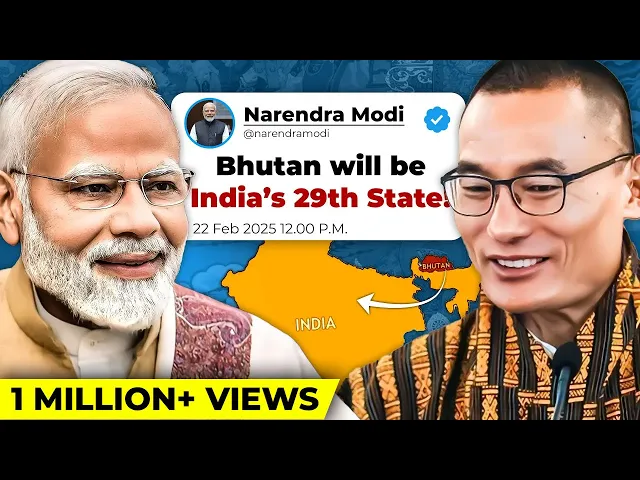
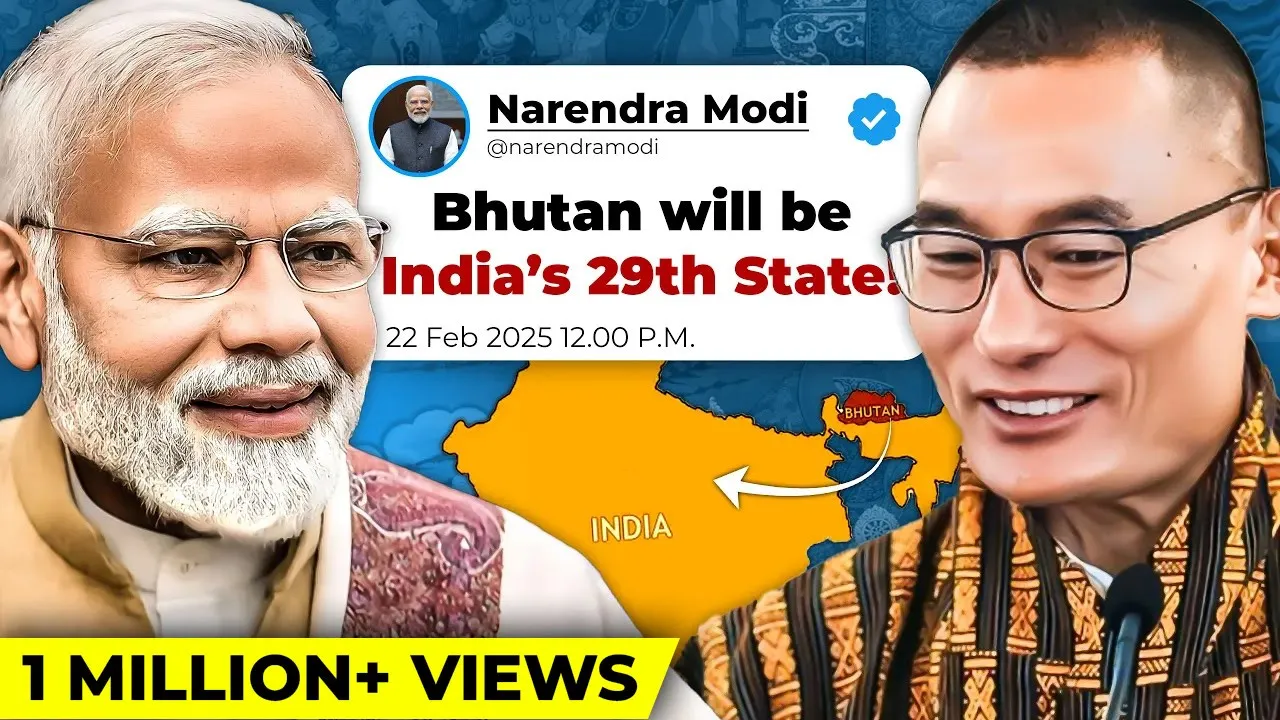
If I tell you that Bhutan is going to be the next state of India, will you believe me? What do you mean? See, during the time of independence, we had a chance to make Bhutan a part of India.
But Edwina Arr. . .
Nehru had different plans. Now, Nehru was more interested in giving away Indian territory than making it a part of India. So what can we do, brother?
But after 70 years, now such speculation is being made again that like Sikkim, Bhutan can also merge with India. Now, why are such speculations being made? Because in the last few months, the closeness between India and Bhutan is increasing rapidly.
In fact, in just the last month, Bhutan's Prime Minister has visited India dozens of times. Bhutan's Prime Minister is now saying that India has molded him. But the better question would be, how did India mold me to serve my country?
So, is Modi being referred to as his elder brother and mentor? Not only that, Bhutan has rejected many Chinese institutions. And is distancing itself from China.
So, now the question arises, why did Bhutan get so close to India? Why is it increasing? Is it really possible that Bhutan will become India's next state like Sikkim?
And if yes, then should India really merge Bhutan with India? What will be the impact of this? Let's know the answer to all these questions in detail in this video.
See, now many people on social media are saying that Bhutan should merge with India like Sikkim. Now, how realistic is this? To understand this, we will have to see how Sikkim became a part of India in 1975.
And what were the geopolitical dynamics of that time? In the early periods of the 18th century, Eastern Himalayas, in which Sikkim, Bhutan, Nepal, and Tibet were included, this area was divided into many independent kingdoms. These kingdoms were usually in conflict with each other for their borders, trade control, and political influence.
The impact of this political instability was also affecting the boundaries of Sikkim, which was slowly shrinking. Sikkim was a small Buddhist kingdom, which was established by Phunstong Namgyal in 1642. As it was a small territory, sometimes Nepal tried to occupy it, and sometimes Tibet tried to control it.
Between 1775 and 1788, the Gorkha army attacked Sikkim many times, and occupied a large part of it, including today's Darjeeling and Kalimpong. For this reason, the king of Sikkim, who was called Chogyal, was forced to flee to Tibet, and asked for help from Dalai Lama. Tibet tried to push the Nepalese forces back at that time, but it was unsuccessful.
After this, Sikkim asked for help from the British East India Company, which means that chicken were asking for help from KFC. Anyway, the East India Company itself wanted to increase its influence in the Himalayan regions, and there were two main reasons for this. First, that their trade route would be strong in the Himalayan regions, and second, that if they didn't control the Himalayan regions, then Russian power could enter this region, which could become a threat to the Britishers in the future.
And for this reason, the Britishers decided to help Sikkim, and fought the Anglo-Nepalese war against Nepal. The Britishers won, and in 1816, signed the Sugali of Titalia from Nepal, in which the areas of Sikkim occupied by Nepal were vacated again. But ironically, in 1835, the Britishers refused to return the Darjeeling that they had taken on lease.
And because of this, the kings of Sikkim, the monarchs of Sikkim got angry, and came against the Britishers. This tension reached its peak in 1861, after which, ultimately, the Britishers sent their army on Sikkim. And forcefully, the Treaty of Tumlang was signed, in which the autonomy of Sikkim was reduced.
The Britishers made Sikkim a protectorate state, which meant that Sikkim would have some autonomy, but the defence and foreign affairs would be in the hands of the Britishers. Then in 1947, when India got independence, most of the princely states either merged in India or in Pakistan. But Nehru was not in favor of annexing Sikkim.
Whereas Sardar Patel was still in favor of making Sikkim a part of India. On the other hand, China was working on a new geopolitical strategy, which was called the Palm and Five Fingers Policy. According to this policy, China considered Tibet as its right hand, and Sikkim, Arunachal Pradesh, Bhutan, Nepal, and Ladakh as its five fingers.
China believed that they would all become a part of China in the future. And because of this, China had made several invasions on Tibet. This fear had also started troubling Sikkim, because in history, Sikkim had already been invaded many times.
It was just India, which did not try to annex Sikkim. Because of this, Sikkim's people had a positive soft corner towards India. In 1959, when 14th Dalai Lama fled from Tibet and came to India, and India gave him a refuge.
Then Sikkim's rulers realized that staying connected to India, can bring security and stability for them. Anyway, slowly time passed, and Sikkim started seeing growing discontent against the monarchy. Because of feudal control and inequality, anti-monarchy protests started taking place on a large scale till 1970.
In 1973, there was a huge protest, in which thousands of people surrounded the royal palace. After this, Chogyal had no option left, and he asked for help from India. India sent its army to protect the king of Sikkim from the protesters.
India somehow settled this matter, and in return, asked Sikkim's monarch to adopt democracy and hold elections. After which, elections were held in 1974. In which, Sikkim state congress won.
This party was on the side of merger with India, because they believed that India had been providing them security like Sikkim's guardian father. Connecting with India will also help in trade and economic growth. Because of this, a new constitution was adopted this year, and monarchy's role was limited to just a titular role.
In April 1975, a referendum was held, in which 97. 5% people voted for merger with India. India accepted this merger, and 36th constitutional amendment was passed in Indian parliament.
In which, Sikkim became India's 22nd state. After which, India allowed Sikkim in Lok Sabha and Rajya Sabha, and after this, Sikkim has become an integral part of India. But now the question arises, if Sikkim can become a part of India after independence, then why Bhutan couldn't become a part of India?
See, Bhutan's history is very similar to Sikkim's. Infact, till India's independence, Bhutan's position was just like Sikkim's. Britishers didn't have any direct control over Bhutan's internal matters.
But the defence and foreign relations, both were in Britain's hands. But where Sikkim became India's state, Bhutan became a different country. Now, to understand why Bhutan didn't become India's part, we need to take a rough idea of its past.
So, let's take that. In ancient times, Bhutan was divided into small kingdoms, like India. Now, these kingdoms were under the cultural and political influence of Tibet.
In 7th century, Buddhism came to Bhutan from Tibet. And an Indian King, Sindhu Raja, promoted it. Then, in 16th century, a man named Drkpa Nagvang Namgyal came.
See, the pronunciation of name can be different. So, when this man came, he unified these small kingdoms and made Bhutan a country. And what is the benefit of doing this?
The benefit is that, the political influence of Tibet on Bhutan, liberates Bhutan. Now, everything was fine. But in 1700s, Mughal Empire attacked Bengal's Kujbihar kingdom.
Cooch bihar was at the border of Bhutan. So, the ruler there, asked for help from Bhutan's King. Bhutan banished the Mughals from there.
But then, Bhutan gained control over Cooch bihar. And it was made a dummy state. After this, two factions were formed in Cooch bihar.
One, which was in Bhutan's support. Second, which was asking help from Britishers to banish Bhutanese. Till then, Britishers had gained control over Bengal.
And wanted to increase their reach in North Bengal. So, they intervened in Cooch bihar. And the Bhutani army was banished from there.
Britishers made a puppet ruler there. And left from there. After this, Britishers gradually, started putting pressure on Bhutan as well.
They put an offer in front of Bhutan. If Bhutan allows timber trade, then British Empire will not harass Bhutan. Britain was a big power.
And such an offer should have been accepted. So, they accepted the offer. But they were afraid that this could compromise their sovereignty.
Then, Britishers, started putting aggressive control on Duar region, which was in North of Assam. In response to this, Bhutan attacked Sikkim, which was under Britain's control till then. The hope was that, Britishers will get scared and retreat from Duar region.
But Britain was a big empire. So, they were not afraid. And this happened.
The opposite happened. In 1865, Anglo-Bhutan war happened. In which Bhutan lost to Britishers.
After this, Britishers got treaty of Sinchula signed from Bhutan. In this, Bhutan had to give Duar region to Britishers. At this time, there was a lot of tension on the selection of a new leader in Bhutan.
Two groups were fighting each other. One group was in support of Britishers. And the other group was in support of Tibet.
Because of this, Bhutan was in a situation of civil war. And at this time, there was a leader named Yugen Vangchuk, who emerged. Vangchuk removed his political rivals.
By 1885, Bhutan was again unified. Now, everything was fine. But then a new twist came.
And this time, not Bhutan, but Tibet attacked Sikkim. Sikkim was a protectorate of Britishers. So, Britain didn't like this.
So, Britain asked Bhutan to make Tibet understand. What they are doing is not right. In this situation, Yugen Vangchuk adopted the role of a mediator.
And he sent his advisor Yugen Dorji to Tibet. In 1904, Dorji reached Tibet with the British mission. And he signed the British-Tibet agreement there.
In 1907, Yugen Vangchuk became the king of Bhutan. And this is where the monarchy of modern Bhutan begins. Along with that, the Dorji family also gets the highest position in the government, which is called Gonzim.
Now, China does not like this British-Tibet agreement of 1904 at all. In 1910, China attacks Tibet. And after this attack, the 13th Dalai Lama has to flee from there and come to India.
Now, this incident was a big warning for Bhutan, Sikkim and Nepal. It was being seen that if Tibet can come under China's control, then Nepal and Bhutan can also come under China's target. Now, for their security, Bhutan signed a treaty with British India in 1910.
It is also called the Treaty of Punakha. According to this treaty, the British will not interfere in Bhutan's internal matters at all. But the Britishers will control Bhutan's foreign relations and defense.
In 1926, before the death of Yugen Vangchuk, he was worried that the British could remove his family from power. So, in 1924, he asked the Britishers for an assurance. The assurance was that Vangchuk family's rule will continue in Bhutan.
Then in 1932, there was a question of autonomous government in India. Then the Britishers decided that Bhutan will be given an option to maintain its autonomy. On which Bhutan referred to the treaty of 1910 and said that Bhutan does not want to be a part of any Indian princely state.
Then in 1947, Bhutan wrote a letter to Lord Mountbatten. In that letter, it was confirmed that Bhutan does not want to be a part of India. Nehru, agreeing to this, said that Bhutan and Sikkim can be treated as other princely states.
And because of this, in February 1948, a standstill agreement was signed. In which it was said that until there is no final decision in both the countries, the status quo will be maintained. Then in April 1948, Nehru called Bhutan for a meeting.
In this meeting, Nehru put forward two proposals to Bhutan. The first proposal was that Bhutan should merge in India and become a state of India. But in this case, Bhutan's autonomy will be maintained.
And the second proposal was that Bhutan should sign a treaty with India in which Bhutan's defence and foreign affairs should come under India's control. Bhutan accepted the second offer from both these offers. And finally, on 9 August 1949, India-Bhutan treaty was signed.
Which is the foundation of India-Bhutan relations till date. Now according to this treaty, India has accepted Bhutan as an autonomous state. Which will be under India's protection.
And now after 70 years, the tension has increased again. Many people are hoping that Bhutan can take the path of Sikkim and merge in India. Let's know why and how in the next chapter.
See, Bhutan is a country which has been India's most trusted neighbor. India has also been helping Bhutan as a guardian father. Bhutan has been given more priority than its neighbors despite its small size.
In fact, due to this reason, when Narendra Modi was elected as the Prime Minister in 2014, he made his first official visit to Bhutan. Basically, a message was tried to give, especially to China, that how important Bhutan is for us. A big part of this country's economy is based on tourism and hydropower export.
Which also has the biggest contribution of India. Bhutan's total GDP is 70%. Trade with India is going on with the help of India.
And this is increasing year by year. India funds major hydropower projects of Bhutan. And also buys electricity from them.
This is the biggest source of income for Bhutan. Apart from this, India has provided many economic packages to Bhutan. In fact, recently India has also talked about providing Bhutan economic assistance of 100 million dollars.
Apart from this, India is developing many types of infrastructure in Bhutan. India has provided assistance in everything from defence to communication in Bhutan. In its budget also, India has reserved 22 ,000 crore rupees for Bhutan.
Due to the overall role of India in Bhutan's economy, many Bhutanese have positive sentiments for India. In fact, many times Bhutan's Prime Minister has openly shown deep gratitude for India in the United Nations. They have been with us from the very beginning of our development journey.
And have remained steadfast in their support and friendship. Bhutan's Prime Minister himself grew up in India. And many times has given India the credit of his upbringing.
I was born in India. That's a secret you didn't share with many. 1965, I was born in Kalimpong.
My father was serving in Kalimpong. When my parents were serving, because I was born there, right? And what moulded me to serve my king, my country and my people, would have been not necessarily Pittsburgh and Harvard, but Dr Graham's homes in Kalimpong in West Bengal.
I studied 11 years in India. And you ask me how 4 years in America has moulded me. On the other hand, in recent years, India and Bhutan's relations have also increased rapidly.
Bhutan's Prime Minister is also having frequent visits to India. This year, that is, it has not even been 2 months, and Bhutani PM has come to India many times. He has also dived into the Mahakumbh.
And at the same time, he has also told Modi in Hindi that he is his elder brother. Respected Prime Minister, my elder brother, you have led India on the path of progress in just 10 years with your wisdom, courage and compassion. While a few years ago, this closeness was seen on the other side.
According to some experts, a potential reason behind this sudden increase in closeness could also be a sign of a merger with India. You must be thinking that the country that has been making its empire for the past 75 years, why would it suddenly want to become a part of India today? So see, in today's geopolitical environment, there are some signals that point to this that Bhutan could be interested in becoming a part of India somewhere.
A big reason for this could be China's aggression. In the last few years, China has been claiming its rights on Bhutan's disputed territories. In 2017, during the Doklam standoff, India helped Bhutan and forced China to back off.
If this hadn't happened, China would have probably taken over Doklam. But since then, China has been putting pressure on Bhutan to come out of India's influence and become closer to China. But Bhutan has always been India's close ally partner.
In fact, Bhutan had also rejected China's deal in which China was talking about giving Bhutan more land in the North. But in return, China wanted Doklam. Because this could have become a security threat to India.
Despite this, today, China is illegally building roads and settlements on Bhutan's borders and disputed areas. The second reason is that Bhutan had officially adopted democracy in 2008. Bhutanese of the new generation, who are more globalized and economically aware, want Bhutan's economic development to be fast.
They think that by becoming a part of India, they will get more job opportunities, infrastructure development will be fast, and they will get a big market. By becoming a state of India, they will get the same rights that the people of Sikkim once had. Today, Sikkim is a developed state.
Tourism and economy are moving ahead in both. Perhaps, Bhutanese people also want this kind of future. So see, the way Sikkim had become a part of India when it needed it, Bhutan also seems to be in the same situation today.
Of course, this should only be the decision of Bhutan and its people. And India should see this whole issue as a big brother. Although, there is no such thing officially, but due to China's intentions, the situation can slowly become what it was in the case of Sikkim.
What do you think about this issue? You can tell us through the comments. Should this happen or not?
You can tell us through the comments. Also, you can support us through Patreon. com and UPI, whose address you can find in the link above the screen or in the description and pinned comment.
Also, don't forget to watch the other video on the screen. We will meet again in the next episode.