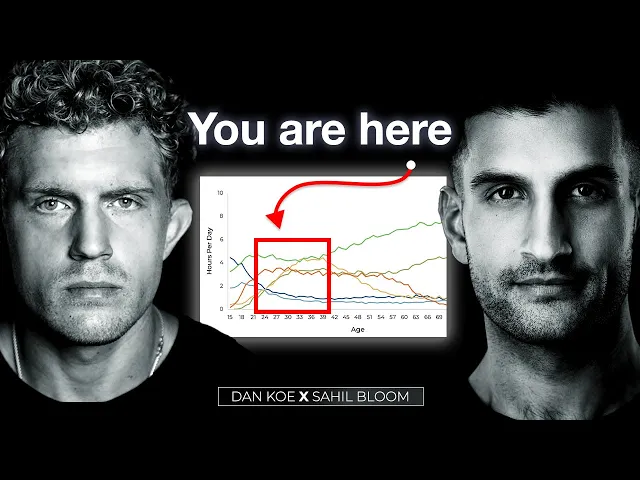
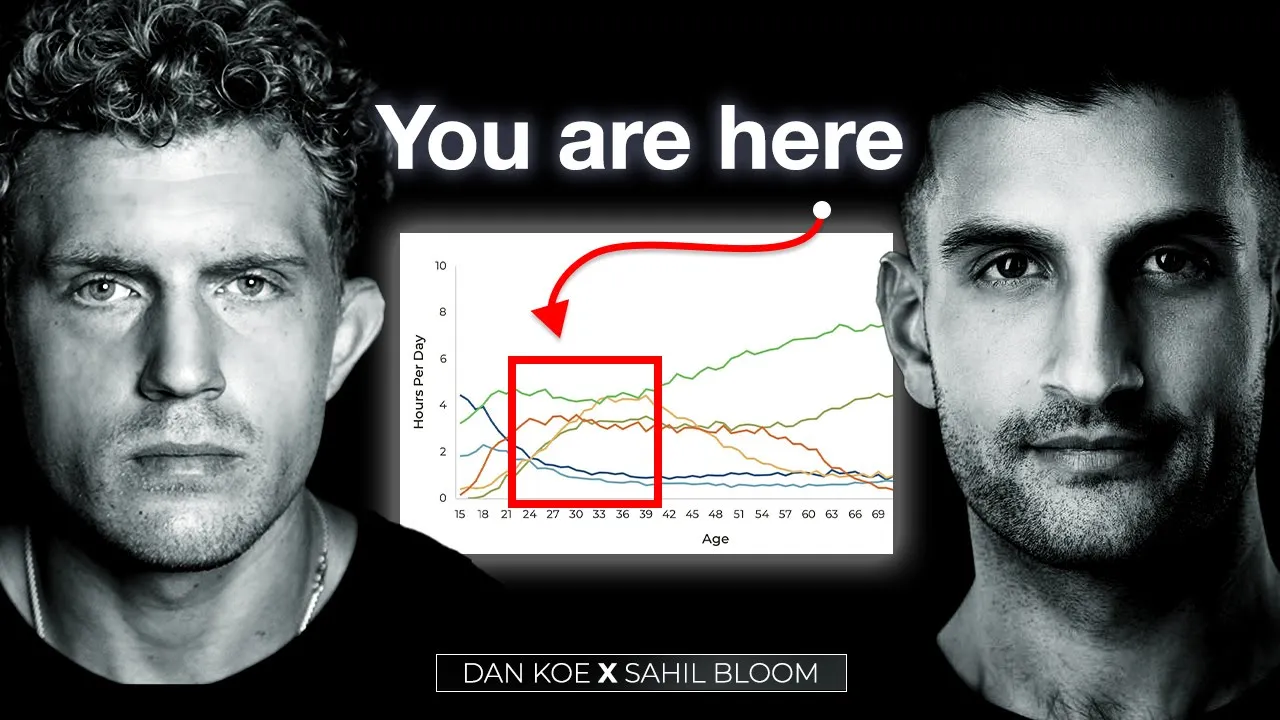
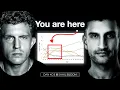
So I'm going to throw a graph up on the screen. So he'll you'll be familiar with this. You can't see it. But for those that are listening it is a graph that shows your time spent with specific people over time. It starts with time with your family, and it shows that it sharply decreases after you reach age 20. Time spent with your children peaks in the early years of their lives, then sharply decreases. Time with friends peaks around 18, then normalizes to a baseline. Time with coworkers is steady during working years, Then declines after retirement
or when you stop, and then time with yourself seems to slowly increase. Aside from when it's kind of stable, in your 20s. So to start here, this is the start of your book. The five types of wealth. And it is also one of your most popular threads. This part specifically on the concept of the time billionaire. So what is the importance of this to you? Why start the book with this? Why is this so popular? I'll let you run with it. This is fundamentally About an understanding that not all time is created equal. That is
a mass of impactful idea for all of our lives. The ancient Greeks knew this. They had two different words for time. They had chronos, which was the idea that time is quantitative linear time from point A to point B, or time at a time B, and then they had kairos, which was the idea that there were certain moments in time that had higher importance. They were more textured than other moments. That is fundamentally what we're talking about here. It's kairos time. It's the idea that there are windows during the course of your life that matter
More for these specific relationships, for these specific people in your world. And that understanding when you were in one of those kairos time windows is essential for actually taking advantage of it, for actually capitalizing on those specific moments. Awesome. So what's the problem here? What, around. I mean, there could clearly be an implied problem with each of these areas. So time with coworkers, time with children, time with family. Do you see? And then the overarching one of time alone with yourself, let's focus on those two. Let's just focus on family and time alone with yourself.
We'll start with family. What happens here? What happens with that sharp decline. And is that a problem? The premise here is that the majority of the time that you spend with your family, which is defined in that time, you survey data as parents and siblings, is essentially experienced during your childhood years. I think there's some statistic, like 95% of the time you have with your parents is in the first 18 years of your life, because then you go off and you're living your own life. You have other things, and you're never going to get that
amount of time back with them. The reason this is a problem, or the reason that, it sparks so much In such an emotional and visceral reaction from people when they see it, is because it brings to life that concept. It smacks you in the face with the fact that the amount of time you have left with the people you care about most in the world is dwindling. It is impermanent, it is finite, and you don't think about that on a daily basis. It takes a chart like this to bring it to life for you, in
a real and visceral and visual way you experience as a young person in particular time as this thing that you just don't think about. Time is effectively irrelevant to you. When you were young, you think about time. If you were to map actually a graph of the amount that someone thinks about time over the course of their life, it would basically be zero until the very end, when it's the only thing that they matter that matters. But it's too late. Then you're dead, right? It would have like probably these little blips where you thought about
it when someone in your life died and you'd have this little blip where for a second you thought about it, and then it went back to zero and you thought about it. None of these graphs are trying to punch you in the face with this realization that time is your most precious asset, that you are a time billionaire. That idea that you literally Have billions of seconds in your lives, that time is your most precious asset. But you're not relating to yourself that way. You are not engaged in the activities that take advantage of the
fact that time is your most precious asset. The question that I love to come and ask to young people is, would you trade lives with Warren Buffett? He's worth $130 billion. He has all of the things that you say that you want in life. He has all the money. He has access to anyone in the world. He flies around on private jets. He stays in mansions. He reads and learns for a living. Sounds great, but you wouldn't trade lives with him because he's 95 years old. There's no way you would agree to trade the amount
of time that he has left for all of the money that he has. And on the flip side, he would give anything, anything to be in your shoes. So, you know, in talking that way, in answering that question, that your time has literally incalculable value. And yet on a daily basis, how much time are you sitting around scrolling on this thing, comparing yourself to other people, worrying about bullshit, thinking about dumb things, you know, stressing over things that have no impact on your life. Wasting away that precious incalculably valuable time. Beautifully said. Is there the
thing that comes to my mind here is once people hear this, once they get the, like, brutal awareness of what's happening, it dwindles. Like it just goes away. After they finish listening to this podcast or watching it. Is there a practice? A system, something you can do to keep that top of mind and make the most of your time? So what you're referring to is what I would say is probably the most dangerous drug that we have in our lives, which is the drug of dopamine from information gathering. Dopamine from information is a dangerous drug,
because it convinces you that the information gathering is the good thing. You get the dopamine hit from reading Atomic Habits and you say, oh, I'm good at habits now because I read Atomic Habits, but you haven't done anything. You haven't gone and actually acted on the information that you gathered. And so what I try to do throughout the entire book and through any idea that I'm sharing, is hit you with the information, but then also on the back end immediately with the action. And so for this principle, you get hit with this realization. Understand that
time is your most precious asset. You need to treat it as such. The first action I would take for anyone out there is to do what I think of, and what I refer to as my energy calendar. Exercise. Take a Monday. You just went through a Monday. Color code your calendar according to whether an activity was energy creating, meaning it lifted you up. Market green energy neutral. Market yellow. Energy draining actually made you feel physically drained. Market red. Do that for a week this coming week. Do that at the end of the week. Zoom out
and look at this. You will have a very clear visual picture of the types of activities That are creating energy in your world versus draining energy from it. Your goal as a human being is to spend more time on energy creators and energy drains, because your outcomes will follow your ability to do that. When you are leaning into things that are truly creating energy in your life, that are you're feeling a pull towards your outcomes. Go ten 100 x when you're trying to spend time on things that are draining your energy, your outcomes are always
going to be one x. You're always going to have those 1 to 1 traits that you're going to keep you on that life treadmill that everyone wants you to stay on. Yes, the I know people in the audience or whoever's listening is asking this now. And it was something I was asking myself in a previous life is. With those tasks that you mark as energy draining or the things that are kind of a those things could be a necessity in your life, right now. What can you do about those? How do you think about those?
If there's something you have to do every day? What's your advice? So there's a couple things I would say. First off question the idea that you have to do anything. Just ask the question. I'm not saying it's going to change the answer, but question it a little bit, because there are a lot of things that we default to saying, I have to do that, that if you really dig a little bit deeper, you can slightly change the way that you do it. I'll give you an example that I, in my previous life I worked in
finance. I worked in 80 to 100 hours a week finance job, very traditional. The first time I did this energy calendar, I was still working in that job, and I found that phone calls and zoom meetings were the most energy draining thing in my life, and my calendar was filled with them every single day. Tons of back to back 30 minute phone calls and zooms, very energy draining. I asked myself that question do I really need to do these things in the current format that they exist in? And the answer was some of them? No.
Some of them I was able to do while out on a walk. And it turns out that that slight adjustment of going from sitting at my desk, doing a phone call or zoom to going on a walk and doing it, made them energy creating. Because I love being outside, I'm much more creative when I walk. Simple adjustment that took something from being energy draining to energy creating that change the outcomes. I was significantly more attentive on those calls. I was more present with the people. I was more thoughtful with them. The outcomes of those calls
improved. So asking the question, does it truly need to exist in the current format, where it is energy draining is a helpful exercise because sometimes the answer is no, and you can make a slight adjustment that will change its energy profile in your life. The second thing in the second layer, I would say, is you are never going to remove energy creating tasks or energy draining tasks from your life. Rather, you are never going to remove energy draining tasks from your life. What you can do is batch them more effectively in your calendar. The thing
about energy draining tasks that's particularly damning is that they have a tendency to bleed into the energy creators. So if you have like a really fun podcast conversation that you're excited about, really creating energy, but it's stacked with like four energy arenas in between, on the other sides of it, you're going to experience the good thing as a lot more negative than it actually is. What you can do is try to batch those energy drains into windows during the day where you're saying, like, okay, my afternoons are going to suck. My Thursday afternoon is going
to be my call day. I know I really don't like doing calls. It's energy draining for me, but I have to do them. So I'm going to batch all my calls into a Thursday afternoon, or I'm going to batch my email processing from 4 to 5 p.m. every single day. That's going to be when I really crank. What you're doing when you make that shift is you're engaging what's called Parkinson's Law. It's the idea that work expands to fill the time allotted for its completion. So if you give yourself four hours to do emails, you'll
take four hours. If you condense it into a single hour block, you'll crank through the entire inbox in an hour. Leveraging that on your behalf to condense some of these energy drains into shorter windows than you previously would have been comfortable with, is a really good way to free up space and actually, like, breathe life into your calendar. Yes, at For the People. Okay, I think it's an amazing thing. I never did this one in my previous life where you're saying that we can reframe where the energy draining task can turn into energy creating tasks.
If we think about how to kind of alchemist those things or turn them in to do them in a different way for the tasks that people are trying to escape. Because a lot of my audience, they're, either young and they want to do something good in their future, something that they enjoy doing in their future and what they're doing now. It could be school, it could be part time job, it could be whatever they're doing. It seems like a common thing for a lot of people is like, hey, I'm not in this situation that I
want to be in. I want to talk about that. Where how do you, cope with that when you're trying to change? Because I feel like a lot of people get trapped in their head, and that prevents them from getting out faster. The way that you escape the bad is by doubling down on more of the good. If you think about the actual path to getting out of the life that you don't like, it's not by like a eject button out of the bad life. And then you go build the good life. It's you find a
way to build the good life while you're still here. Then you hit the eject button on the bad part because you've already built the good. That is what I did, by the way. Like I had started sowing the seeds of this entire new world that I was building before I hit the eject button on the thing that was sucking the life out of me. That is really the common thread that you see among people who have changed their life. They find a way to create structure around building the good while they are still living the
bad. And if you can do that, you start creating evidence of your ability to live and build a life on the good, and then it becomes much easier and more comforting, and you feel security to hit eject on the bad life that you're living. Plus, you have more energy around that whole experience When you're working on the thing that's going to change your life alongside it. And so what I would say is for that person that feel stuck, that feels lost, that feels, you know, trapped in their current life, find a way to dedicate 30
minutes or 60 minutes a day to building the life that you actually want to live. And you know, the push back or say like, well, I don't have time for it. You have to decide what you want more. Yeah. I recently had a conversation with a 27 year old who was telling me that he was in this situation working 9 to 5. He hates wants to go build something of his own, go create this life and, he said, I don't have time to to go build that new thing. And I said, like, walk me through
your day. And he walked me through his day. And basically at the end of his day, he has this hour and a half hour block of like Netflix and chill effectively. And so I told him, why don't you take 30 minutes of that and deploy it into starting to build this new life that you're trying to build, you know, start working on the new thing. And he said, no, I can't. I need that time to unwind. And what I asked him and what I'll say now is, do you need to unwind more than you need
to change your life? And I don't mean that to be harsh, I just mean it purely tactically. You have to decide if you are willing to do the hard thing necessary to go and create the change that you want to create that is going to require pain and struggle. You are going to have to do the hard thing now that you don't want to do, to get to the other side of this, that is going to require you to endure the pain of not having the amount of time that you want to unwind. It's a
sacrifice necessary. You have to create that structure in your life where you currently are, in order to build that life you want that exists on the other side of it. I feel like a lot of people got this false idea in their head that They, in order to start working 40 to 80 hours a week on the thing that they want to build, they have to just start working 40 to 80 hours. When people don't have that time, they think that an hour is too short in the morning or 30 minutes is too short in
the morning. And what they need to realize, in my opinion, is that everyone starts that way. There are things you can do, and it's just up to you to find those things. So transitioning out of time wealth. Let's dig into social and you start that chapter with the question, who will be sitting at the front row of your funeral? Is there a story around this that made you want to put that that hits hard like that? Like what? Where are you hitting me in the feels so hard right when I start that chapter. What what
made that question the thing you want to put there? I think it comes across in the book, but I am a big believer in visualization, and particularly in mental time travel, like the idea that you can zoom out from your present state and envision yourself in the future and use that as a tool to adjust your actions in the present. And that is the empowering piece it is. What does that future visualization tell me about what I am doing in the present, whether I need to adjust those actions Because the actions you were taking in
the present are creating that future, whether it's a good one or a bad one. They're shaping that. That visualization in particular is about recognizing who those people are in your life that occupy that really special place and recognizing whether or not in the present you are taking actions to let them know, to invest in those relationships in the same way that you invest in anything, to let them know that they hold that special place in your life, to cherish them, and to be that front row person to someone else in. Relating to this and tying
back into the time chapter. I don't know if we touched on it or we nailed it down. Like practically. Is there that practice or did I miss it? Is there that practice of remembering this where it's like, you only have so much time that you're spending with these people in your life, are they going to be at your funeral? How do you merge those two together? The number one thing with yeah, at the time, as it relates to these people, is to make the tiny investment today in those relationships. This is the call to action
is like send the text, send the one little text. When you're thinking about the person that has a ripple effect into the future. And the the mindset shift here that's important is If I told you to do that when it comes to your money, you know that's true. You know that investing $10 today is better than zero, than investing $100 today is better than ten. That because it's going to compound into the future. But you don't think about that when it comes to relationships. You don't have that in your mind that the tiny little investment
today is going to stack and compound in the future in that relationship, that taking the one second to text your friend that you were thinking about, taking the, you know, ten minutes out of your day to call your mom while you're driving to the office to, you know, tell your sibling some funny story or memory that you have. Do that tiny thing today and that stacks and compounds in that relationship into the future. And the reason this is so important is because relationships are fundamentally the key to healthy aging. The Harvard study of Adult Development
is this amazing study done over the course of 85 plus years. They followed the lives of 1300 original participants, plus another 700 of their descendants. They found that the single greatest predictor of physical health at age 80 was relationship satisfaction. At age 50, it wasn't, you know, your blood pressure, it wasn't cholesterol, it wasn't smoking, your drinking habits. It was how you felt about your relationships that determined how you aged, how well you aged. So what better reason to invest in those relationships, to take them as seriously as anything that you take in your life?
I've noticed you're extremely good at this and beyond. I mean beyond just like very personal relationships, like family. One thing I admire about you is just when I randomly get a text, like randomly in the month, it's like, hey dude, how are you doing? How's this going? Is that like something that came naturally to you, or is it a skill that you had to develop? Because I can imagine it just does so much for you in more than just relationships. Like, dude, I'm there for you at any time simply because you're just like, hey dude,
how are you doing? Yeah, I think because I didn't do it for so long. And then I started to think about it and have this mindset shift. I now have really tried to build a practice around it, and it's not like I have some list. I, you know, everyone now is like, okay, what's the implementation? I need a CRM for people in my life, and it's going to tell me and it's going to send auto text to those people. That's not really the point. I want to actually think about these people and actually have something
That I want to share with them. And, you know, what you find in life is that the best things in life come when you are giving with no expectation of return. And I will say this is a mutual admiration podcast, because one of the things that I have long admired about you is that you genuinely have helped me on several occasions when I really didn't have much to offer you in return. At that moment. And you had, you said like, oh, do don't worry. Like I'm super happy to help. Don't worry about it. And what
I have found over and over again is that the people that are like that by default tend to have the best returns in life, and I don't know how it happens. Call it karma, call it whatever you want. But for some reason, the people who give with no expectation of return end up having the best returns. And I really want to try to be one of those people. I want to try to be one of the people that, friends can call on, that people can text when they, are down and out when they're struggling, and
I'm there for them. And you can't always do that, but you can try to make it a value that you hold close. And when you do, you just end up on the best journeys. I like I, I've definitely written this or said this before, and I think I do write it in the book that everyone always tells you to like, focus on the journey rather than the destination. It's this cliche like, oh yeah, focus on the journey, not the destination. And I sort of disagree. My whole thing is focus on the people because when you
surround yourself with inspiring, kind, positive, some big thinking people, you end up finding yourself on the best, most brilliant journeys and you land at the best destinations. But it's the people. It's not picking the perfect path. It's not picking the perfect journey. It's the it's the really what comes from surrounding yourself with those people who lift you up. And there's actually silence around that. I mean, the Pygmalion effect is this scientific phenomenon that you actually rise to the level of expectations that other people have for you. So if you're surrounding yourself with those big thinkers,
people that encourage you to do more, that you're capable, that you can take those things on, you actually rise to the level of those expectations. So surrounding yourself with those people, finding that tribe is actually good for your life and for your professional outcomes. I have two places I want to take this. The first one, it seems like maybe it's only on social media, but I've kind of noticed it when I talk with the younger generation in general. Is maybe it's not that they feel lonelier than ever, or they seem lonelier than ever they do
online, but they're just not too social. I feel like a lot of people find it difficult to make those good friends, or find that right person, or find a person that's worthwhile to invest energy into. So that's a two part question. We'll start with why, why or why do people feel more lonely and lack a lot of the social skills that they know they need to live a better life? And then the second part, which I can reiterate when the time comes, is how? How do you choose? How do you find the right people, not
just a bunch of people to flood your life? Why, this thing, This thing has, you know, I'm for those who aren't watching this, I'm. I'm holding up a phone. Social media and technology have conspired against us in many ways. I mean, this technology that has, made us more connected to the world than ever before has, made us less connected to the people sitting right in front of us. And we have slowly but steadily lost our ability to truly interact, to create these textured relationships with people. And I think that that comes from a couple things.
Number one, it's much easier to just sit at home And interact with your friends on Snapchat, social media, whatever. That's what's contributing to these terrifying stats we're seeing in youth. You know, teenagers in the US are spending 70% less time in person with their friends than they were two decades ago, 70% crazy. That is really the contributor. It's that type of interaction that you can just do at home. The other thing is social media and your phones have made you press the eject button way too fast on relationships. The second relationships get a little tough
the second they come out of the honeymoon phase, if you will. You just hit the eject button because you have 100 options right at your fingertips. And this applies to romantic relationships and to friendships that like as soon as it gets hard, you don't have to endure the heart. You don't have to go through it because you can press eject and have 100 options at your fingertips. And the fundamental reality with relationships, particularly romantic but also friendships, is that the best relationships are built through shared struggle. They're built through sitting in the mud with people,
through that growth that comes from that shared struggle, actually, scientifically releases oxytocin, creates feelings of love and connection. So the second something gets hard, if your default is to press eject, you are never by default going to get through the struggle That builds that depth of connection. You are just going to be on the surface with everyone that you interact with. So I think structurally that is actually leading to this self-fulfilling prophecy of lack of connection, lack of depth. You press the eject button, you go to the next surface relationship. And surface relationships are fine
when times are good, like during the summer when it's warm and sunny and things are good and your life is going well. But if you have surface relationships and things go bad, you are in a lot of trouble because you're going to call on people and they're not going to be there for you. They're going to be gone. They're, you know, they're tourists, not locals. So as soon as the weather gets bad, poof, they're gone. They flood flooded out of town. They're somewhere else. That, the thing about that is it really does all come back
to the phone because, even to the second part, like how do you pick? How do you find the right people? How do you find the select group of people? And when you aren't, you how do I put this? Like, you can obviously use the phone to interact with them, but if you have that tight knit group of people that are in your life, you're going to find it extremely hard to maintain those connections if you're allowing so many people into it. Like you can't just ghost or hit the eject button on a real relationship, that
relationship that you have in real life. So yeah, I want to yeah. I mean, this is also just where I, I think we've lost the plot a little bit on some of the like, health optimization stuff, on the impact that it has on social life. This is going to be there's going to be some people that don't like me saying this, but the whole no alcohol, zero alcohol thing. I have questions about whether it is a net negative for society. The reason I say that is because the no alcohol movement as a thing that gets
likes on social media, creates this binary picture where either you drink none Or you are a degenerate binge drinker and it's only one or the other. The actual amount of shades of gray that existed in between those two is pretty significant. There are a whole lot of people who are able to go out and have a couple drinks a week, have one drink a week, have a few drinks a week, and have no, like massive negative impact on how they live their life or their sleep. Frankly, like one beer. Yes, it will impact your sleep
slightly, but like let's let's be honest, it's not like all of a sudden you have zero sleep or something like that. And the impact that it has on your social life when you go to zero and now you say, well, I don't really feel comfortable going to the bar to meet up with that friend. And they still drink, so I'm not going to see that person. I have questions about whether that actually has more of a net negative on society. Knowing what we know about the impact on social connection, on health, in the long run.
And so I do think there is like there is something to be said for just being able to grab a beer with a friend doesn't need to be a beer. Could it be nonalcoholic? Could it be something else? Sure. But like humans have been gathering around the idea of alcohol for a long time, it sort of has the Lindy effect. And so for me, I'm still going to get together and have like a drink with my friends, you know, once a month, once a week, Whatever the thing might be. I don't need to go more
than that. I used to drink way too much. I've swung way back, but I've found this happy medium that works for me. And I think more people in the coming years will find the same. This happened to me. So in college I obviously drank a lot, at least for the first, two years. And then I kind of battled back and forth because I was in the middle of not necessarily leaving a friend group behind, but kind of outgrowing a lot of what they did. And like, I just went down a different path. There's nothing wrong
with either path. It's just we split ways and then you go online And you hear all of these different polarizing takes of like, oh, okay, this guy that I respect is like, hey, zero alcohol. It has no place in your life. Other people are like, you can manage two drinks, whatever it may be. And I had my own struggle with that. Now, that's not me saying that I was, an alcoholic of types. It was just like I couldn't find that balance. Like when I did drink, even if it was every two weeks, every month, every
three months, it would either be all or nothing, because I couldn't find that happiness or that enjoyment of just having one drink with a friend. And so that is potentially a battle that people have to go through if they one started out heavy drinking and are trying to. Yeah, I think it just depends on your on where you are, your personality, your own thing. And I think what this fundamentally comes down to is not just blindly accepting dogmas one way or another, like, frankly, don't listen to what I say, what you say, what anyone tells
you to do. Find what works for you, take advice from people, but then put it through your own lens, your own set of filters, and find what works for you in your life. I've swung to both ends of that spectrum. I, in my old life, when I was going down a darker path, I was drinking seven nights a week. It wasn't good for me, probably 14 drinks a week. And, that impacted my health in a lot of ways, physical and mental. And, then I swung to zero, and I've now found a place where I can
have, you know, one drink a week, maybe one drink every two weeks. And it's great. It allows me to reconnect with someone that I love. I only do it on special occasions when I'm catching up with someone I care about. And it's a good place for me in my life. But you need to find what works for you. Yes, and to tie this in, maybe a good place to have that drink would be at, the Life Dinner. This is one concept that really stuck out to me. So I'm going on a year and a half
with my girlfriend now. It's incredible. Loving it. The thing that I'm realizing is with something so long term and commitment, one commitment is awesome. Like just being able to know and everything else. All other options are gone. There's a entire podcast in that itself, but what's the life dinner? I want some strategies to just keep that relationship tight. Yeah, the idea of the Life dinner Is to create a fixed monthly date where you and your partner get together and actually have a cadence around connecting on some of the bigger picture things in your relationship and
in your life. This is a creation of, an investor named Brad Feld. And the whole idea is that early on, it's very easy for there to be a sort of natural cadence around doing this on a regular, ongoing basis. You're like, catching up around things. You, sort of have these conversations on a daily basis. But as life starts to get more complicated, as you both have Responsibilities, maybe as you have kids, as you get married, it becomes harder and harder to make sure that you are zooming out and thinking about the bigger picture things in
each of your lives and in your partnership together. The life dinner creates a structure around which you can do this. So for a life dinner you get together, you have this date at your favorite place once a month, and each of you sort of comes with a set of things that you're thinking about, you know, challenges, opportunities, visions for the future, etc. and each of you has an opportunity to talk about your side, and then you come together to address whatever problems you need to face together. You take all of these sort of me Versus
you things and turn it into an US versus problem thing. It becomes this sort of collaborative and synergistic experience, the pushback and why this goes viral on social media. Whenever I've talked about it is everyone gets up in arms. All of these detractors get so mad saying like, you shouldn't have to create a structure to talk about things in your relationship. Your relationships are going to die if you need to create a structure around it. And my response always is like, if you do this on an ongoing basis, once you have kids and once you're
married, I am so happy for you. That's amazing. But I would guess that that is not true. I think it is very difficult to actually create a structure to zoom out. The reason I think it's so difficult is you don't do this with yourself. How often do you take time on a daily basis in your own life, and work to zoom out and think about the bigger picture? Things in just your life? No one does that. You never create the space in your life to do that. So why can we expect that we'll do that
naturally in our relationship? Your conversations in a relationship end up being the short term daily things, because that's the life you're living in, the weeds. You're living first person view and your video game. This is all about zooming out, seeing the bigger field, seeing the forest so that you can actually strategically make sure that you're walking In the direction of the place where you're trying to go. I love, I don't understand, I love routines, so I love rituals. And in terms of structuring things in that way, it just allows you to break out of the
normal day to day to zoom out and see things from the bigger picture, as you said. But to those who think that just because it's systemized in something that is supposed to be quote unquote authentic, that doesn't render it irrelevant, it can be an incredible tool to make things more authentic. But that's actually an interesting point. I just as a macro point, even just hearing you say that I'm having This like mental model going in my mind that, on social media, people equate structure with, inauthentic, like, like Brian Johnson, everyone gets so mad at like,
all of the structure and routines that he has. And they're like, well, he's not living his life. If he has all this structure and these routines, he's actually living his best life. I spent time with him on this book. He's like incredibly happy. He loves what he's doing, really, really loves it. Immersed in it. It's just that it doesn't match the map that you have for what your life should look like, or what you want it to look like. Your map does not match his terrain, if you will. And so you're taking your idea of
the fact that structure doesn't create happiness, and applying it to someone who very much feels that structure creates happiness. And the point is, do what works for you. I like I'm not forcing you to do a life dinner. It works for me. My wife and I have found a ton of benefit in it. I think you would find a ton of benefit in it. I think many people would. But if you wouldn't, if you already do this on an ongoing basis, or if you think your relationships perfect, don't try it like I'm not forcing Anyone
to do anything. The thing with this is that the people that think they don't have a routine, just have a routine of not having a routine, right? It's it's so true because that's what we do, right? Or that's what our mind loves. It wants the routine. Of course, there's the dangers of this, where if you get trapped in a routine that either you didn't create or one that you just don't like, then yeah, that becomes a problem. But most famous creatives think of Darwin. How did he produce 19 books in his lifetime? It's because he
had a routine that allowed his mind. It opened his mind up to have the creative ideas, To not focus on the day to day. And so there's something to say with that. Speaking of Darwin and ideas, mental wealth. Some people die at 25 and aren't buried until 75. What does that mean to you? I want to always hits me hard whenever I think about it. This is the idea that. Most people walk down this path that isn't really theirs. They're handed this default path, this default definition of success, These default settings of meaning as the
as David Foster Wallace once said, and accept them as their own and march blindly down that path, and they wake up in 50 years and maybe wonder what the hell they just did with their one life that they got a shot at. And the call to action in the entire mental wealth section is to say, you are the hero in your hero's journey. That is not a grandiose statement. That is true. You get one shot at all of this. So engage in something that matters to you and that doesn't mean that you have to go
burn the boats and go build your own business. It might mean that you are going to engage in your purpose of providing for the people that you love, and you're going to do that by showing up to your factory job every single day. You're going to do that by showing up with energy to the job that you don't like, so that you can do the things that you like on the weekends, whatever it is, live your path, find your version of this hero's journey and go out and create it. Take the actions on a daily
basis. Don't accept the blind version. Create a life around the things that you truly care about, not what other people tell you. You should. I have a rather polarizing belief, And I'll try to tie in every part of it because I want to hear your take on it. So I think everyone will refined it this much. Yeah, I wouldn't say that. I think everyone should be an entrepreneur for the rest of their life. I think everyone should try it. The reason I say that is with this whole some people die at 25 and aren't buried
until 75. A major thing happens there for a lot of people is they get out of school. They've they've kind of lost their source of challenge. They aren't going to grade ten, 11, 12. They aren't learning new things. And once they get into a job, they learn for quite a bit of time, They potentially go up some form of a ladder. And then after that, it kind of just drops off a cliff. And then all of these responsibilities start to pile on, start to you start to get the family, you start to get the bills.
And that novelty and challenge that leads to the good dopamine leads to that feeling of progression, leads to needing to develop your skill set in your mind to match that new level that you're trying to reach. I think a lot of that is solved by going off and doing your own thing and kind of jumping into the unknown, so I don't know if that's even a, feasible solution for everyone to do, but I do like the thought of everyone should at least try entrepreneurship. The layer that I'll add to that. I love that idea. The
layer that I'll add to it is that you can try entrepreneurship while working in a stable job. Entrepreneurship is fundamentally about creating something. It's about being enterprising. It's about experimenting. It's about creating value. When there was no expectation of you to do that. It's about taking on new things, being curious, identifying problems. I mean, fundamentally, entrepreneurship is about identifying problems, creating solutions and then scaling those solutions. You can do that in your 9 to 5 job. You don't have to burn the boats and leave to be an entrepreneur. If you are working at a big
company and you are, you know, getting promoted, you're getting your annual inflation pay raise for doing your job description, but you decide you want to be more entrepreneurial every day for a week. Keep a blank notepad where you identify problems that you see in the company with you know your coworkers with your problems. Your bosses are experiencing problems. Customers are experiencing. Start brainstorming some solutions to those and bring them to the table and actually go and execute on them and bring that value to people. I guarantee you will start seeing an acceleration in your trajectory
within that company, because the number of people Who are willing to take the initiative to be entrepreneurial in a normal day to day job effectively zero, you will stand out. You will be top 10% within your company. And when you're top 10% in your company, you'll start making a whole lot more money and your trajectory will go like this. So entrepreneurship as an idea can be executed in a lot of different formats. It can be quitting, starting something from scratch that is truly yours, or it can be executed within a company and you're going and
building and going and creating scalable solutions to problems that you find. But I do agree with you. Like, I think that that process is a really important thing for engaging your mind. Agency. One thing that my, co-founder Matt mentioned to me at the start is when we started hiring, he was like, all of these people are extremely high agency because being a small company, he it was mostly referrals and network because he knew a bunch of like ten engineers that he wanted to get on. And that started to take me down the rabbit hole of
what agency is why it's so important, especially going into the future of AI and other things of that nature, but just solving problems, dude, like in any area of your life, not even entrepreneurship, like time, social, physical, financial, mental, all of these things, they're just scattered with problems there as you go about your day, whenever you notice boredom, anxiety, Overwhelm, stress, all of these different things, it's an opportunity to create a solution for yourself, which could then be either passed on to other people or your family or your friends. And that feeling of exchange, whether
it's for money or not, is such a rewarding thing that comes from that process. Do you have, wait, how do you identify and solve problems like it in general? Too? Good question. I mean, I think of, I really think that like blank sheet exercises and, walking through your day with an eye towards things that created friction in your life Or in other's lives is a really good way of just identifying problems. The first thing I normally try to do is just identify, because what happens is you get into this tendency of like, okay, I found
one. Let me try to come up with a solution when really like let me just open the aperture, see all the problems I can identify, and then I can pick the problem that I feel like is most solvable. If you go down the rabbit hole on the first problem you find, you close your eyes to seeing the problem that you actually might be able to solve more efficiently or effectively. So, just doing the blank sheet exercise of identifying the different problems is sort of a first step from there, I think it's just about figuring out
like, what is the sort of, limiting factor in that situation. Like when you identify a problem, usually it's that, okay, there's some sort of bottleneck or some sort of issue or some sort of kink in the hose that's not allowing this thing to work in the way that it should. And is there a way that I can actually undo that kink? Like, is that hose bent and I can actually just straighten it out? That as kind of a deconstructed way is how I would generally think about it, in terms of learning to solve a problem,
like, because once you identify a problem, if you don't know how to solve it, you need to learn something. When I go about learning, the way I think about learning is starting with a project. So starting with the problem and actually just trying to start solving it, because then what that does is it frames your mind with that problem. So you can start to identify what's necessary in the things that you're learning. Do you have a specific way that you like to learn things fast, or is it like a constant in your life? Just learning.
I'm a big believer in the Feynman Technique, which is this derivative of Richard Feynman, American theoretical physicist, won the Nobel Prize in quantum electrodynamics. But what he was known for was his ability to convey Very complex topics in simple terms, to teach them to others. And that was sort of his way of learning, was through teaching to people who were uninitiated on the concepts. That idea is that teaching is the most powerful form of learning that you cannot teach something effectively if you don't deeply understand it. So my method of learning follows that principle, which
is I default to teaching as quickly as possible. If I read something, or if you and I have a conversation, I think something's interesting. The first thing I'm going to go do is try to explain it to another friend who didn't have any context on it. And what I notice and what I observe in their reaction As I do that is, where do I have gaps in my own understanding of that concept? Where did I see, like their interest piqued or where did I see them get confused? Then I can go study to fill in
those gaps, and I can come back and try to do it again. And what you create is this sort of iterative loop of teach, learn, teach, learn that leads to this depth of knowledge very, very quickly. If you just try to go study in a whole and then you come back and try to teach the thing, you may have like compounded all of this knowledge that is not useful for actually creating actionable insight on the topic. And so the teach, learn loop and doing it quickly is what I have found to be the most effective
way. I want to take a quick tangent here because what the way that I realized this for learning was just building an audience for me because you can technically teach anything. Right. I don't know if you should teach everything, but you can share what you're learning to see if you can understand it and you put it in writing or video or whatever it may be. For you. How how has building an audience in general benefited you? Because it's just it's a hot topic nowadays. I have found that My quality of thinking tracks very directly with,
the quality of my writing, and I cannot write clearly if I'm not thinking clearly on a topic. And so I use writing and the teaching that comes through with my writing as my way of more deeply thinking and getting to that level of clarity on a topic. So when you see me expanding on something in a newsletter, my newsletter is my favorite piece of writing that I do every single week. That is all about me refining and deepening and sharpening my sword on a specific topic. And I, you know, during the week leading up to
me writing the newsletter, I'm talking about it with people That wouldn't understand it to see, like, what are the questions they have, where they want more, where are they understanding it? Where are they not? So that I can go deeper on it so that I can deepen my own thinking on the topic that has made me, I feel at certain times, like I am living out my own version of, the people that I like looked up to earlier in life. I mean, I like and I don't say this in a braggadocious way at all. I
say it as an empowering one, that anyone can do this because, like five years ago, I would watch Ryan Holiday on like a podcast or a talk and I would have this sensation like, how can one person have so much knowledge stored in their brain about so many different things? The way that he pulls from different quotes, different stories, different frameworks, different models? How can one person have all of that? And now I find myself doing that. And I'm not saying I'm on the same level as him, but if I go listen to myself and
I didn't know who I was, and I was pulling out Feynman technique and energy, like all of these different things, I would sort of have that same reaction that like, oh, this person has this, all this stuff floating in their head that they're able to go draw upon and that is not built through any magic. I'm not smarter. I don't have any particular like, sorcery, and I don't think Ryan does. It is built through a daily craft, executed over and over and over again for several years, and that daily craft is writing. It is actually
forcing yourself to sit down and put words to paper to clarify your thought. And so if I have gotten anything out of all of my content creation and building it, is that my level of thought on topics has just deepened and level of thought being deeper helps you in every area of life. I mean, my relationships, my ability to connect with smarter people. I'm much more interesting to smart, exciting, like successful people now than I was when I was on a safe, stable track. Because I'm doing something different, and because my actual level of thinking
on interesting questions and topics is much deeper than it ever would have been. What I admire about how you built an audience is it didn't seem like you conform to a specific niche. It just seemed like even though I know your background, it's very impressive. And I would love to see you write about that more personally, because I want to learn more about it. But in terms of like sharing what you learned, that seemed to just be your strategy. What what are your thoughts on Niching down in general? And, just sharing. Like how did that
go? Yeah, the reason I didn't do that. So everyone tells you when you're starting out, like pick a lane, you know, niche down, pick a lane. That's the most common advice. The reason I rejected that was because I have always known that the only way I'm going to be successful at anything is if I can do it consistently for like five years or ten years. You know, my grandfather, when I was a kid, told me, you'll achieve much more by being consistently reliable than by being occasionally extraordinary. And that has always stuck with me, because
the idea there is that it's just showing up and punching the clock. It's just doing the work on a daily basis. Not flashy, not elegant, not like the perfect work, but just showing up. And so when I started doing the content creation, that was the frame of reference that I had, which was I need to be able to do this for ten, ten years, every single day. What would I do if I knew I had to do this every day for the next ten years? Well, I certainly wouldn't niche down because I don't think I
can create niche down content for ten years. And what I know about the way that the world works is that you get defined by your niche. Like if you create around one niche, you are that guy. It is very hard to then expand from there. I could go from broad to more narrow. It's very hard to go from narrow to broad because if you become known as being the, You know, private equity finance thread writer, it's hard to go from there to like, I'm going to talk about life wisdom. No, you're the you're this guy.
This is what the algorithm is going to reward you for. So from a very early point, I made sure that the things that I wrote about were things that I just, I cared about whatever I was thinking about on a daily basis. I was going to write about it. And look, if you go and look at some of my most viral things from my years, it has run the gamut. I mean, I like one of my most viral threads on Twitter, is writing about honeybees. I had a honeybee infestation at my house and I, like,
went down the rabbit hole on honey bees. And it was fun and interesting. And it was like, okay, this interesting thing, I've written about business, I've written about finance, I've written about, you know, mental models, whatever, like life principles. This book, frankly, is like it's like five self-help books in one, right? Like it's it's all of these different areas because I care about all of these. I didn't want to write the one book on the single area. I wanted to write about how it all comes together in your life. And, that has just been way
more fun for me. I think it is slower, frankly. I think I would have a bigger platform If I had picked a lane and just stuck to it. And so when I see people that have been really successful, picking a lane, I see that they've grown much faster than me, frankly. Like, Cody Sanchez is a friend of mine, amazing at, like, she identified her thing, like buying boring businesses, and she every single day just hammers it and crushes it, creates incredible content around it and, makes some people mad. And some people love her. And she's
built an enormous platform across all these different places. And, I could have done that. Right. Like, I have a background in that stuff. Not boring businesses, but buying businesses. But I don't care about it enough. It's not authentic to me. And so I couldn't have done it consistently enough to have success with it. On that one thing with your strategy, why did you start? Because another thing that I found or I mean, it's pretty obvious you don't sell anything. I mean, maybe you have like, connections on the back end and whatever it may be. What
what was the initial drive? I was stuck at home and had time. I, I mean, the initial start, honestly, like, I was working a high paying job in finance and, Covid hit. I was stuck at home. I had nothing to do. I wasn't commuting, I wasn't working quite as much, I wasn't traveling, and I was bored, and I had a Twitter account. I was like, all this crazy stuff was happening in the world of finance and business and all my friends were texting me because I was their finance friend to try to understand it. So
I was like, well, let me give a shot at like explaining these things in simple terms to see if I can kind of break it down. And a few of those things started going viral. And then I was like, oh, this is pretty cool. Maybe I'm creating value for people. I'll keep doing this and I've always, Been someone that has gotten a lot of energy from feeling like I had, value to give others, like creating an impact in some way. And I don't say that in like, a perfectly altruistic way. Like, look, I like money.
I'm not saying like, I don't care about making money. I've just always been able to ground that in the desire to create value for others. I have this suspicion that if I can create a whole lot of value for tons of people out in the world, that I'll do just fine financially. And, that was really what I grounded that early pursuit in. I wasn't planning to quit my job. There was no chance I was going to leave a job to go tweet. Right? Like it makes no sense. I had a great job. Things were going
well. And that journey is what's led me to where I am today. There was no motivation. And I even still to this day, this book is the first thing that I'm like, selling that I've actually ever gone out and been like, here, buy this thing that I created that I spent the last three years of my life on. It's why I feel so passionately about it is like I have given away everything for free for three straight, five, four straight years, basically. So now I have a thing that I put my heart into over several
years, and I really care about it, and I really want it to create the impact that I envision in the world. You relating to that and talking about the financial wealth, type of wealth, it you listed five levels of money or like ways of thinking about money. One quote that I'm going to butcher by Walt Disney is like, you start, you start creating to make money, and then you start making money to create. So the perception of it kind of shifts where a lot of my audience, and myself, I started on social media mainly because
I wanted to make money. Right. It was like a lead generation mechanism for my freelance business at the time, and then slowly pivoted over time. So with that, what were those five levels? Because I want to start to break those down a bit. Yeah. The five levels of financial wealth are basically the steps that I would think that most people would go through to get from the level of like baseline, trying to meet your basic needs on through the level of financial independence that is like true, you know, escape velocity has been reached. So if
you think about that path, it's basically from at the baseline level, you are just trying to meet your basic needs. If that's the case for you, you're probably not listening to this. Maybe you are, but you're probably not because you're really, like, struggling to get by basic shelter, food, etc. as you work your way up, what you have is an accumulation of assets, And those assets start throwing off income. You get further to the top and the furthest at the top level. Five is when the assets are producing sufficient income to afford any level of
luxuries that you want. It's paying all of your expenses. You're able to do anything that you want to do, and you never have to work again, because the assets are producing the necessary income to cover all of that. That is like true overabundant financial wealth. Level four and level three. Stepping back from that is when your assets Are producing sufficient income to cover like basic needs, or then like basic plus, sort of level one luxuries. Those are like the rungs that I would say most of us are chasing. Level five is like an extreme level
of wealth that very few people will ever achieve. Sure, it could be something that you want to go after, but level three, where you have assets that are paying some of your basic needs, is sort of a start. A financial independence level four is true financial independence. You could shut everything off and you would have sufficient income, cash flows coming off your assets to cover a lifestyle that you are currently living Makes sense for. There's so many different things I want to tie together here, where you start that chapter with what is your definition of
enough? And when I read that, what came to mind for me is like, I don't know, because for me, money is at least in what I do. It may not be this case for a lot of people, but money for me is deeply intertwined with and a reflection of the value that I give. So it's very rewarding. And it's kind of like the more I make, the more I can kind of see that. And so it's like, do I want to ever shut that off in a sense? Because then if I consider this my life's
work, I don't have to start stop working for any means. And I could work for free in some way. I just see it as like, I'm not getting that feedback mechanism, and I'm not the best at investing. I'm not making that much to the point where I probably reached level four and can shut everything off, so I'm sure there's some room to go there. How do you reconcile those two things of like, I'm doing something that I deeply love money is a wealth. It helps. I kind of have to make it quite a bit in
order to feed the team. Pay the team? Of course. It's the company's money. You get the point. How do you reconcile that with like, what is your definition of enough? The concept of enough, of understanding your definition of enough financially is all about recognizing what is in a life. That is my enough life. It's about actually visualizing the lifestyle that you have personally, when you would feel like I don't need to chase more money for the sake of money, I don't need to chase that thing, that version of more, because I'm living the life that
I feel like is my enough life that for you is going to be different for me. For me, my enough life has like two houses. I mean, you know, I have a great main home that I'm in right now. I would love to have a second home because I love to entertain people. I love to bring people together. I want to create experiences. It's not about luxury. I'm not. I don't care about long driveway or gated communities. I want to be able to bring people I love together. So it doesn't have to be Spartan. This
is not talking about like, oh, you're enough. Life has to be, like really barebones and Spartan, and you need to be like, you know, expenses minimization. No, it's about living the life that you really want. It's your enough life. The point is, beyond that, pursuing more has to be grounded in something deeper than just money. So when you talk about what you just said, that pursuit of more, it's not about giving up your ambition at that point. Once you've reached your version of enough, it's about grounding the pursuit of more in that ambition, in your
purpose, the thing that you're trying to go build, you're trying to create an impact in the world. You are going to make a lot of money on the back of that, but it's not going to be because you were trying to make money. It's going to be because you were trying to create value for others. I would argue that most of the richest, most successful people in the world right now are not actually motivated by money. Elon Musk, I don't think, give two shits about money. I think what he really cares about is trying to
get humanity to be an interplanetary species and save humanity. In some ways, as grandiose and crazy as that sounds, I think that's what he really cares about. And he is making a whole lot of money while he does that pursuit. But it's not because he's trying to make money, it's because he deeply cares about the purpose and about the vision. There is nothing wrong with the pursuit of more if it is grounded in something more meaningful and money. There very much is something wrong with the pursuit of more. If it is purely grounded in money
because you will run yourself off a cliff, you will lose sight of everything else, and you will find yourself In the land of the rich yet miserable inhabitants who are numerous. And we all know them. You know, it's the 50 year old man who has $100 million, but also has three ex-wives and four kids who never talk to him. And everyone will pat him on the back and say, yeah, you won the game, but is that really a game that you care to win? That's a good question, and I think about that quite a bit
because like with business and with social media, you're constantly like dancing this line between people who are like, okay, money is evil, money is great, right? There's no in between, it seems. And with all of that, What I've found, especially when studying people like Elon Musk, my mindset on it previously, I didn't know whether or not those people, the billionaires, were evil or not, but it was like I was trying to figure it out. And now the more I look and the more I see what Elon's doing, he doesn't seem like a materialistic person at
all. He follows Walt Disney's quote that I butchered earlier quite well of making money to create. He shifted from creating to make money to making money to create because he needs that. You need the resources to reach the specific level that you want to, in order to provide and even make progress in humanity. Nowadays, it's kind of a necessary thing. What a lot of people in general struggle with is like, okay, how do I become in control of the amount of money that I make? Because in order, let's say their hypothetical enough number is pretty
far up. They're substantially more than what they're making right now. In order to do that, I'm assuming they need certain skills, and everyone has their list of skills that will make X amount of money. Do you have any big picture skills, meta skills, or just even very soft skills in general that help with the income generation portion? I really think that storytelling and salesmanship are the two most important skills for life. The more and more I've thought about this, I come back to those two and it's it's because fundamentally, life is about sales. Life is
about being able to sell yourself, your ideas, your vision, etc. to whatever stakeholder it is you're facing. I mean, look, dating and getting married is about sales. You have to sell yourself to prospective mates. Friendship is about sales. You're selling yourself to friends. Your businesses are about sales. You have to sell yourself to customers. You have to sell yourself to your bosses, your colleagues, whatever you're always selling. So people that can do that well are people who can story tell very effectively. It's people who can take a whole bunch of data in and have a
story come out on the other side. And one thing that I've learned from spending time with some of the most successful CEOs in the world is they're not the smartest people in their organizations. They're not. They are the best storytellers. They are the best at taking a seemingly disparate way out pool of data and turning it into something that makes sense. You can hone that skill. You can get better at that. The best way that I found for honing your storytelling skill Is when you tell a story, when you are getting your reps, when you're
practicing, take note of the things that make the other person's eyes light up. Take note of what makes the person lean in. During this whole conversation, I was making mental notes of the things that I said when I saw you. Kind of like your eyes got a little wider, or you smiled a little bit, or you had a reaction to something. Those are things that the next time I talk about these topics, I probably want to lean in on. I probably want to like, really articulate those points a little bit better than I did today,
because I know that they're the things that are really sticking with you. That is how you get better at these things. It's the rep and then it's iterating on the rep. It's not about just reps. It's not about pounding your head into the wall. It's about getting smarter with each time that you do. Awesome. I think that's a good place to end it, because I'll I'll touch on that a bit where whenever I mention that as well, I say marketing and sales because you need to know how to tell a story, and you need to
get over the hump of thinking that marketing and sales are evil in in some distorted lens where it's not about value exchange or offering something that will actually benefit people. So before we go plug the book, man, sell us on it. Let's show this show the salesmanship skills. We're all here. Yeah. Look, I've spent the last three years of my life writing this book. I was very much not supposed to write this book. I am not an author. I am not capable of doing that type of thing. The story that I told myself for the
vast majority of my life was that I was not the type of person that could do these things. I was not smart enough. And this book that I'm releasing into the world is me formally rewriting that story that I used to tell myself. It is me proving to the world and to myself that I am capable of doing these things, and that I can share these ideas with the world and that they can create an impact. And this book is going to be a tool for you to rewrite the story that you tell about yourself.
It is going to arm you with the ideas, with the questions, and with the principles that is going to enable you to craft your own story, to start rejecting the defaults and to start living by design. So I can't wait to hear from you. I would love for you to pick up a copy of the book. It's available everywhere. Books are sold. Amazon, Barnes and Noble target all over, all over the world. It's going to be translated into 19 languages as far as I know right now. I'm just blown away by the response, and I
just can't wait to see how people take the ideas and run with them. Congrats, man. It's a massive accomplishment. Thank you for sending me the early copy. Even though I bought ten still. Wait, I appreciate you buying ten. You got to keep them out. Yeah. Go buy now. I wait, when's the releasing officially? Tuesday. Oh, February. Okay. It'll be. I got to get this thing out. Yeah. It'll be. Yeah, yeah. Cool, man. Thank you for coming on. Where can people find you? Everyone can find me. I saw bloom on every major platform. You can find
more info on the book at the Five Types of wealth.com. Awesome. Thank you. Man. We'll do another one sometime, but I look forward to doing it in person. Yeah, really? See you soon, brother.