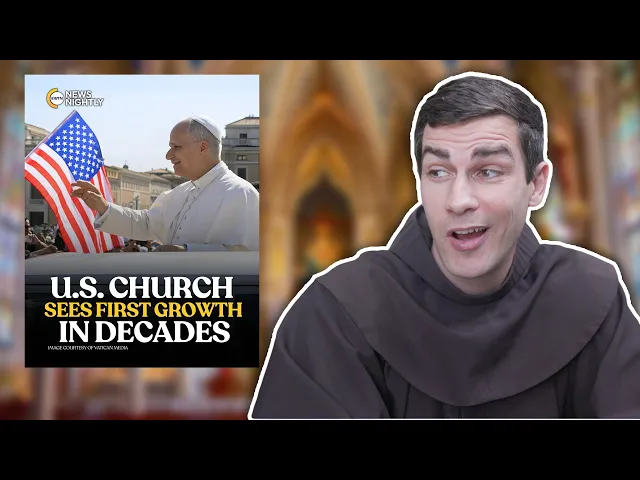
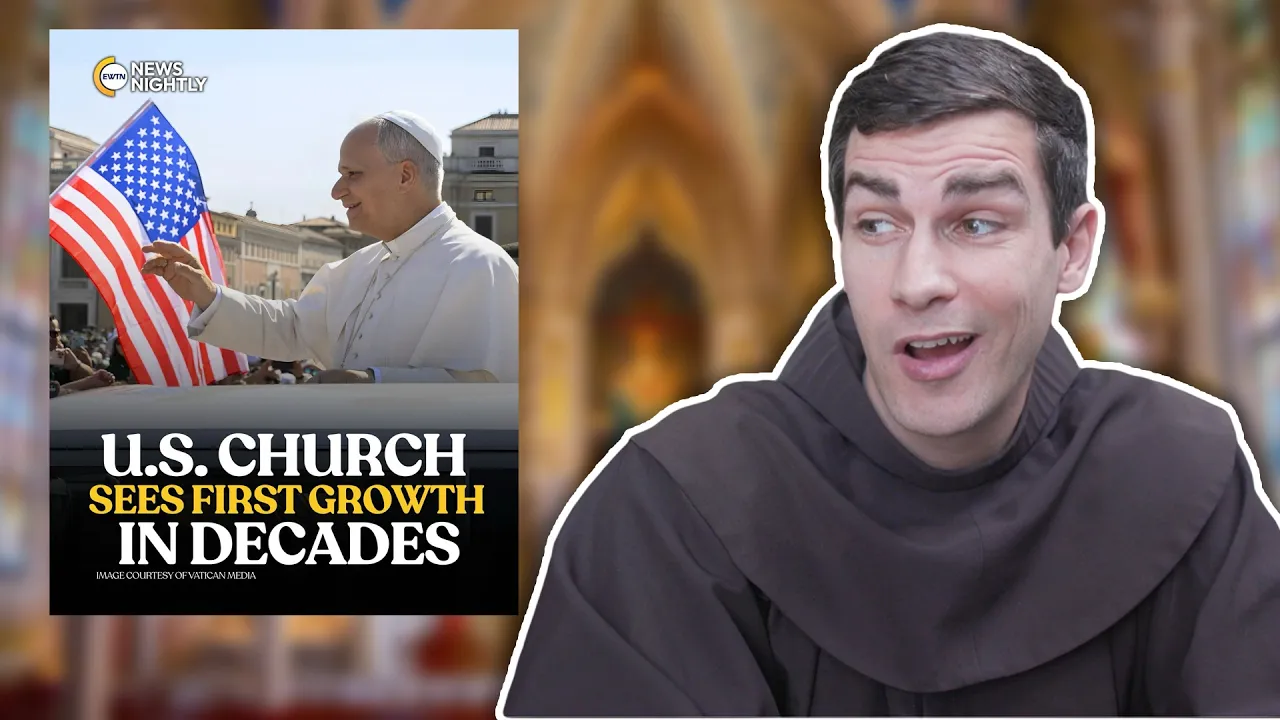
The Catholic Church is having a moment right now. In what seems to be a complete reversal of where we were 20 years ago, the Church is actually growing in the United States. Parishes and campus ministries are reporting record number of people entering the Church, vocations are up across the board, and conferences like SEEK and NCYC are beginning to outgrow major venues.
Most surprising of all is that these increased numbers are not from older generations, but younger ones. Recent reporting has suggested that Gen Z, those aged 13 to 28, are actually the most consistent Church goers across all denominations. What the what?
I was on this channel not three years ago talking about how we needed to take seriously our evangelization efforts lest we fade to obscurity, that people would not just show up on our doorsteps looking to join the Church… and then they all just showed up? Now, I don’t think our problems are magically fixed and we can just quit our efforts—even with recent increases most people are still not living as disciples of Jesus and the largest generation of priests and religious are already starting to retire or pass away, so we still have a lot of work to do—but there are signs of hope. The Catholic Church is absolutely having a moment right now.
But why? What is fundamentally different about the Church and world today than, say, 10 years ago when we were still in free fall and millennials were leaving the Church in droves? Why is Gen Z different?
I think there are three reasons, each with its own hope and challenge, and I’ll admit, the last one is a bit of a controversial one. 1. Cynicism and anxiety about the world.
Among the most defining features of Gen Z is their cynicism and anxiety about the world around us. This is not to say y’all don’t have wonderful qualities. Your humor is unmatched.
You’re incredibly creative. You are transforming the workplace and discussions around mental health in ways my generation only hoped to. You do a lot of things really well… But you are soooo cynical and anxious.
Whereas my generation grew up in a largely peaceful, globally thriving world, leading us to believe that the world was generally good and could make us ultimately happy, this was never the case for you. You grew up in a post-9/11 world. You’ve seen multiple recessions, a global pandemic, the dismantling of the American political system and destabilization of the civil world order, and the worst era of Star Wars movies.
To add gasoline to the flames, social media has amplified fringe voices, forced us to stay constantly connected while leaving us isolated, bombarded us with negativity, and made people afraid of becoming the next meme. As you would say, we’re cooked. For better or for worse, Gen Z just isn’t buying the hopeful story anymore.
There is no trust in organizations, no motivation to be a part of the rat race, no hope that the world will work itself out. That ship has sailed. If we’re going to be happy, it’s not going to come from something as broken as this world.
And that’s the key right there. While I would still like to challenge you all to be a little more hopeful and to see that there are a lot of good things and people in the world, the cynicism and anxiety that you possess has caused you to break free of the shallow promises that the world has been feeding us for millennia, and to look for meaning elsewhere. In something that has been proven to last.
In something that has stood up to criticism and still moves forward. In something not of human making but from beyond. Yes, in Jesus Christ and his Church.
But not just the Church in general, in the Catholic and Orthodox Churches, institutions with history, with foundations, with transcendent liturgies and ancient practices, traditions so old we’ve often forgotten where they came from. This is not just a TikTok trend that will captivate the world and be gone tomorrow, this is something that matters, that gives our lives stability and purpose, and challenges us to deeper holiness. The Church is a steady ship guiding us where we need to be, a strong levy against the crashing waves, a peaceful shelter from the chaotic world.
It is in Jesus Christ that this generation has finally found someone to trust, and so for the first time, they can relax. Why are so many people joining the Church today? Well, at least in part, because the world has proven itself incapable of providing lasting happiness and people are looking for something deeper, stronger, and more reliable.
But there is another reason. 2. Access to information and community.
When I was growing up, if you wanted to learn about the Catholic Church, you had to go to a Catholic Church. Sure, there were books, but we didn’t like reading back then either and there was no way to stumble into good materials. Today, social media rules our attention and the algorithm is king.
More than in any time in history, you can access millions of hours of good, inspiring, helpful content about our faith from anywhere in the world. For better or for worse, you can find yourself introduced to Christian content and sucked down a rabbit hole, even if that’s not what you were looking for. On this channel alone, I have nearly 700 videos.
At the time of making this video, there are 146 Catholicism in Focus videos, explaining some part of our faith in simple language. I also have an Instagram and TikTok account that produce different types of videos, showing insights into my life and offering hopeful images of the Church. Of course, my channel isn’t the only or even most significant one.
You’ve got the OG, Bishop Barron, who has over 1700 videos, Ascension presents over 1800. Fr. Mike’s podcast is one of the most listened to in the US.
Katie McGrady is killing it with her radio show. Just the fact that there is a Catholic celebrity culture is wild to me now, that there are national and international figures besides the pope that kids can look up to, that normalize the church, present it as cool, and make it accessible to anyone. This has allowed conferences like SEEK and NCYC to be not just small informational sessions teens are forced to go to by their DREs, but exciting, faith-filled encounters that attract thousands of people each year.
Things like this just didn’t exist a generation ago, at least not to this scale, not to this level of excitement. If you’ve ever been to a conference like this, heard inspiring talks with thousands of people around you, you know that it can change you. The internet and Catholic conferences have attracted new audiences, connected people to the Church, and enlivened us like never before.
It has made the Church visible and accessible in a way that it just wasn’t before, making it attractive in a way it just wasn’t before. Why are many people joining the Church today? Because for many, they’re seeing what it can be, in all its splendor, for the first time.
Then again, not everyone is attracted to it for the same, or even good, reasons, which is why we need to be wary of the third reason the Church is growing. 3. The Church can be a Political hideout As much as I want to believe that the first two reasons are driving our growth, and that people are coming to us because they want to be disciples of Jesus Christ, there is at least some evidence to suggest that politics plays a part.
Particularly among men, the Catholic Church offers conservative friendly cover in the culture wars. Data suggest that Gen Z, especially Gen Z men, are more conservative than Millennials were at the same age. And for some of them, what initially attracts them to the Church isn’t its teachings on mercy, solidarity, or social justice, but its clarity around sexuality, gender, authority, and traditional family life.
Which, don’t get me wrong, are not bad things. These are legitimate teachings of the Church. The Church should be a moral voice that challenges a confused and often incoherent culture.
If people are drawn in by the truth the Church speaks, that’s a good thing. As long as that attraction ultimately leads to conversion in Jesus Christ, and doesn’t merely provide political cover for positions they already hold. What concerns me—and what I think we need to be honest about—is when people take the name Catholic…but do not convert their hearts.
When someone comes into the Church because of political agreement on certain issues, but seems interested only in using the Church to bolster their position in the culture wars, rather than being shaped by the fullness of Catholic teaching. In those cases, politics doesn’t get converted by faith—faith gets subordinated to politics. You see it when Catholicism is embraced enthusiastically right up until the Church challenges them.
When the conversation turns to immigration, economic justice, racism, care for the poor, or the radical demands of the Beatitudes, suddenly the Church is “confused,” “compromised,” or “too political. ” This is a not a straw man or rare hypothetical. I have experienced this more than a few times, and it is something worth being aware of.
Some people are more interested in the political capital the Church possesses than they are in a life with Jesus. Why are so many people joining the Church today. At least in part, it’s because of politics.
And so what do we do with this information? How do we seize the moment that we’re in? We must build upon what already attracts them to us to provide a full picture of the Church.
For those running from a chaotic world and looking for stability, maybe that means leaning into traditional liturgical styles, devotional practices, and clarity in teaching, offering a reliable place to get their footing… And then we offer the challenge to see that there are parts of the world that are actually good and given reason for hope, and that faith can grow through innovation not just tradition. Meet them where they are, and challenge them to go further. For those enamored with Catholic celebrity culture and online resources, let’s continue to bolster our media efforts and grow our conferences so that more people than ever can encounter inspirational figures… And then we offer the challenge to move from fans of celebrities to followers of Jesus, from consumers of content to committing to an embodied lifestyle.
We meet them where they are, an challenge them to go further. For those seeking moral clarity in culture wars, we must not back down from difficult conversations or hide from our stances on conservative issues. Maybe this is the moment where we even emphasize them more than other things… And then we offer the challenge to see the whole picture, to not just baptize our politics but to actually transform us to want and love all that God does, and to go beyond the desire to win a culture war to a desire to win hearts.
No matter what initially attracts someone to a life in Jesus, conversion is always necessary. It’s exciting that so many people are showing up to our doors, but we’re not just looking for warm bodies with bank accounts and influence, we’re looking to form missionary disciples, people who put Jesus above all and begin to think like God does, not the world. None of us shows up perfectly ready to live this life.
No one is a saint from the moment of their baptism. That’s fine. The fact that people are showing up incomplete is not only to be expected but welcomed.
Trust that God will continue to move within their hearts and work, yourself, to be an example of the fullness of God’s teachings.