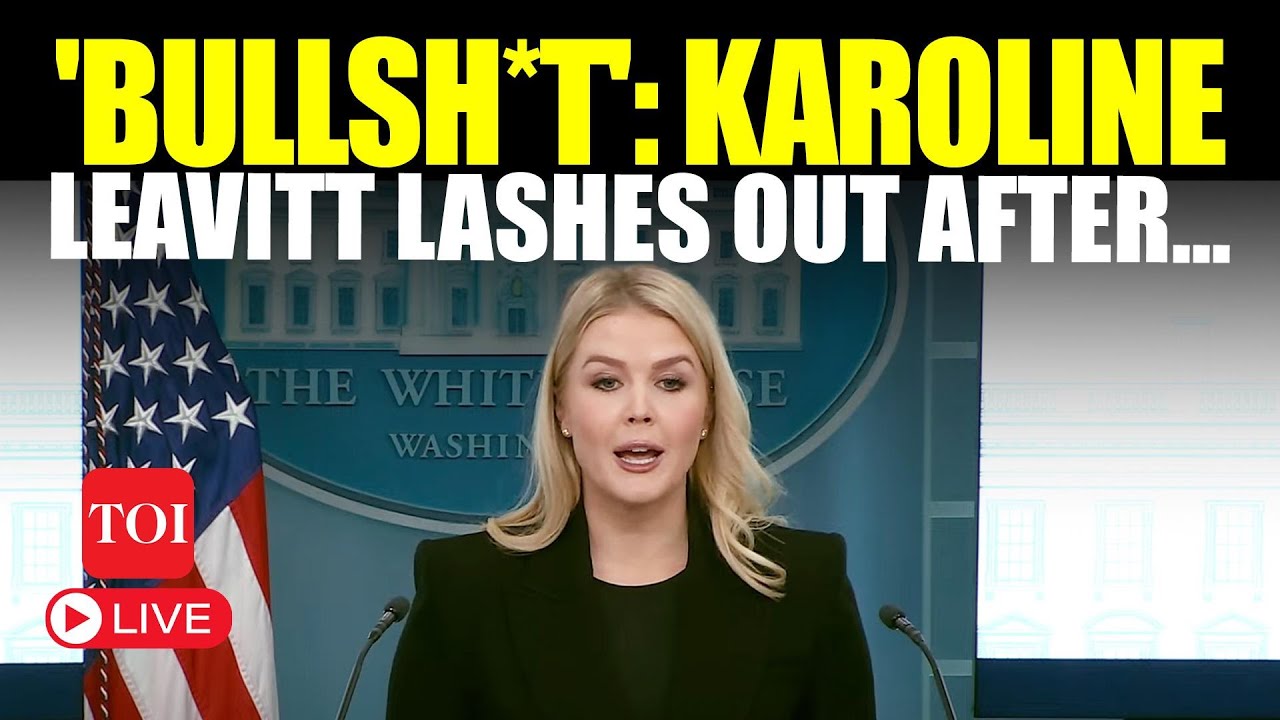
When Caroline Levitt sat down for the interview, she expected a debate; what she didn't expect was a moment so explosive it would bring down one of the most recognizable TV hosts overnight. It happened live, not in some pre-recorded segment where producers could step in, edit things out, or smooth over the rough edges. No, this was raw, unfiltered, and happening in real-time.
Caroline Levitt had been invited onto *The Morning Current*, a political talk show known for its sharp debates and even sharper hosts. The man across from her, veteran journalist Paul Danning, had made a career out of pushing buttons. His interviews were aggressive, his style relentless.
He wasn't just there to moderate; he was there to win. And today, his opponent was a young rising conservative voice who refused to back down. The segment started predictably.
Paul pressed Caroline on her stance regarding media bias, accusing conservative outlets of peddling misinformation while claiming networks like his were simply correcting the record. She countered with facts, listing instances where mainstream news had misrepresented stories, omitted key details, or outright misled the public. It was tense but professional.
For a moment, it seemed like just another spirited debate. But then something changed. Paul leaned forward, his expression tightening.
His tone, once measured, took on an edge. He was no longer debating; he was attacking. "People like you," he said, his voice laced with frustration, "are the reason this country is backsliding.
You push this fake narrative of victimhood, pretending conservatives are being silenced, when in reality, you're the ones silencing everyone else. " The studio went silent. Caroline blinked, her posture still composed, but her eyes sharpened.
She had handled aggressive interviews before, but this was different. She let the moment hang in the air before responding. "Excuse me?
" Paul didn't back down; in fact, he doubled down. "You act like free speech is under attack, but what you really want is control—your people. .
. " He stopped himself, but it was too late. The damage was done.
The energy in the studio shifted. The producers, once passively observing, now exchanged glances. The crew members stiffened, waiting to see what would happen next.
And Caroline—she didn't shout, she didn't interrupt; she didn't need to. She simply said, "Would you like to clarify what you mean by 'your people'? " The tension was thick enough to cut with a knife.
Paul hesitated just for a second, but a second was all it took. The cameras were still rolling, and the internet was watching. Paul Danning wasn't a man who backed down easily; his entire career had been built on controlling the conversation, steering it where he wanted.
But this time, he had lost the reins. The moment those two words, "your people," left his mouth, something shifted. It wasn't just a poor choice of phrasing; it was the implication behind it—the kind of phrase that could be dissected, twisted, and replayed a thousand times over.
And Caroline knew it. She sat back, folding her hands in her lap, giving him the space to either correct himself or sink deeper. Paul inhaled sharply.
"I meant conservatives," he said too quickly. "People like you who push an agenda of grievance instead of progress. " Caroline tilted her head slightly.
"So just to be clear," she said, her voice measured, "when you said 'your people,' you weren't referring to anything beyond political ideology? " Paul's lips pressed into a thin line. He had been in the game long enough to know a trap when he saw one.
If he pushed back, he risked confirming the very thing people were already thinking. If he admitted it was a mistake, he looked weak. So instead, he shifted the goalposts.
"Oh, come on, Caroline! Don't play the victim here," he let out a dry chuckle. "This is exactly what I'm talking about—this bad faith outrage.
You know exactly what I meant, but instead of engaging with the actual argument, you'd rather twist my words and make it about you. " Caroline didn't flinch; she wasn't going to let him redirect. "I don't need to twist anything, Paul.
Your words speak for themselves. " A flicker of something crossed his face—irritation, maybe even a hint of regret—but he was too deep in it now. He couldn't afford to backpedal, so he made a fatal mistake.
"You know what? Maybe if conservatives spent less time playing the victim and more time actually contributing something to society, we wouldn't be having this conversation. " There it was: a blanket statement delivered with arrogance, live on air.
The silence that followed was suffocating, not just in the studio but on the other side of the screen, where thousands—soon to be millions—were watching. Even Paul seemed to realize it the second it left his mouth. His lips parted as if to soften the blow, but it was too late.
Caroline let the words hang for a moment before responding. "Are you saying conservatives don't contribute to society? " Paul exhaled, rolling his shoulders back.
"I'm saying this constant whining about being canceled is exhausting. " Caroline nodded slowly, her expression unreadable, but her silence said everything. The damage had been done, and within minutes, the clip would explode across the internet.
It didn't take long. The moment the segment ended, the first clips hit social media: a 15-second snippet of Paul Danning's words, "Maybe if conservatives spent less time playing the victim and more time actually contributing something to society," spread like wildfire—no context, no prelude, just that sentence. Within an hour, the hashtags started trending: #FirePaulDanning, #MediaBiasExposed, #CarolineWasRight.
Some took it at face value, blasting Paul for what they saw as outright disrespect; others scrambled to defend him, claiming it was a misinterpretation. But the full-length clip didn't help his case; if anything, it made it worse. Political commentators on both sides pounced.
Some condemned him outright, while others spun it as yet another example of selective outrage. But no matter the stance, one thing was clear: people were watching. And then the sponsors got involved.
By midday, three major advertisers for The Morning Current had suspended their partnerships, releasing carefully worded statements about reviewing their commitments to the network. By evening, five more had followed. It was damage control mode at the highest level.
Paul, for his part, stayed silent, at least for now. But the network? They had a crisis on their hands.
And Caroline? She didn't have to say a word; she simply retweeted the clip, adding nothing but a thinking face emoji. But the storm wasn't over yet, because now the network had to make a decision.
Inside the headquarters of NBS News, the network behind The Morning Current, executives were in full-blown crisis mode. The outrage wasn't dying down; it was intensifying. Viewers were flooding the network's email inbox demanding action.
Advertisers weren't just pausing sponsorships anymore; they were pulling out entirely. And to make matters worse, other networks had started piling on, using Paul Danning's comments as a case study on media arrogance. By mid-morning, an emergency meeting was called.
The network had two choices: defend Paul and risk more fallout, or cut ties and protect their reputation. For years, Paul had been one of their star personalities, a veteran with a reputation for hard-hitting interviews. But now, he was a liability.
At 3:00 p. m. , an official statement was released: "Paul Danning has been placed on indefinite suspension while we conduct an internal review of yesterday's broadcast.
NBS News remains committed to respectful and fair journalism. " It was corporate speak for "we're seeing how bad this gets before we throw him overboard. " But the internet had zero patience for half measures.
The suspension wasn't enough; people wanted termination. And Caroline? She wasn't leading the charge, but she wasn't stopping it either.
Later that evening, she appeared on another show where she was asked directly, "Do you think Paul Danning should be fired? " She paused, then said, "I think people in positions of influence should be held accountable for their words. " It was measured, strategic, and devastating.
Because the next morning, NBS News made its final decision. At 9:15 a. m.
, they announced: "Effective immediately, Paul Danning is no longer affiliated with NBS News. We thank him for his years of service and wish him the best in his future endeavors. " The media world erupted.
Some called it justice; others called it an overreaction. But one thing was certain: Paul Danning was finished, and the conversation was only getting started. Paul Danning was gone, but the controversy was far from over.
His firing split the country in two. One side saw it as a long-overdue reckoning, proof that media figures couldn't talk down to half the country and get away with it anymore. To them, Paul's comments weren't just offensive; they were revealing—a glimpse into the condescending attitude that had defined mainstream media for decades.
The other side called it cancel culture at its worst: "So a man loses his job for one comment, a single misstep? What happened to debate? What happened to context?
" Right-wing commentators took full advantage. Headlines on conservative outlets painted Caroline Levitt as the woman who took down Paul Danning. Fox News, The Daily Wire, and Newsmax ran segment after segment dissecting the firing.
Meanwhile, left-leaning figures tried to distance themselves from Paul, but some were quietly uneasy. Even those who disagreed with him recognized the implications: if a veteran journalist could be fired overnight, who was next? And then Paul broke his silence.
Late one evening, he released a pre-recorded video statement on social media. His face looked tired; his tone was calm but firm. "I was fired because I spoke the truth.
The media doesn't want truth; they want compliance. If you step out of line, you're gone. If you challenge the narrative, they erase you.
This isn't about me; it's about all of us. " The video racked up millions of views within hours. His supporters rallied, calling for boycotts against NBS News.
His critics pushed back, arguing that this wasn't some grand conspiracy; he had simply crossed a line. And Caroline? She kept quiet.
She didn't gloat; she didn't engage in the drama. She let the world argue for her. But this wasn't just about Paul anymore; this was about the future of media itself.
The dust was settling, but the questions Paul Danning's firing had raised weren't going anywhere. In the days that followed, every major media outlet ran think pieces and panel discussions on what had just happened. Was this justice or was it censorship?
Some saw it as a long-overdue moment of accountability, a message that elite media figures weren't untouchable anymore. They argued that Paul's firing wasn't about free speech; it was about professionalism. "Words have weight.
When a journalist crosses a line, they face the consequences. Simple as that. " Others weren't so sure.
They warned that the real danger wasn't Paul Danning losing his job, but what it meant for the future. "Are we punishing people for their mistakes or are we erasing people for having the wrong opinions? " The debate stretched far beyond Paul and Caroline.
It became about the power of viral outrage, the role of social media in shaping reality, the fragile state of public discourse. And as for Paul? He was out, but he wasn't done.
Within a month, he launched his own independent show on YouTube, branding himself as a truth teller silenced by the establishment. His audience? Larger than ever.
Caroline? She moved on, but her name would always be tied to this moment. She hadn't just debated a TV host; she had changed the game.
So, what does this mean for the rest of us? Was this justice served or a dangerous precedent? Did Paul's.
. . Firing, restore accountability, or did it prove that public pressure controls the media?
And most importantly, who decides what crosses the line? One thing is certain: this won't be the last time a moment like this happens. And when it does, the question remains: whose side will you be on?
What do you think? Should Paul have been fired, or was this an example of cancel culture going too far? Let us know in the comments, and don't forget to subscribe for more stories that make you think.