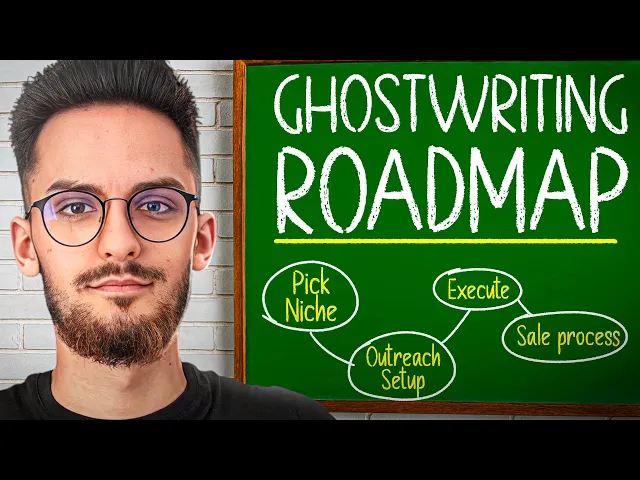
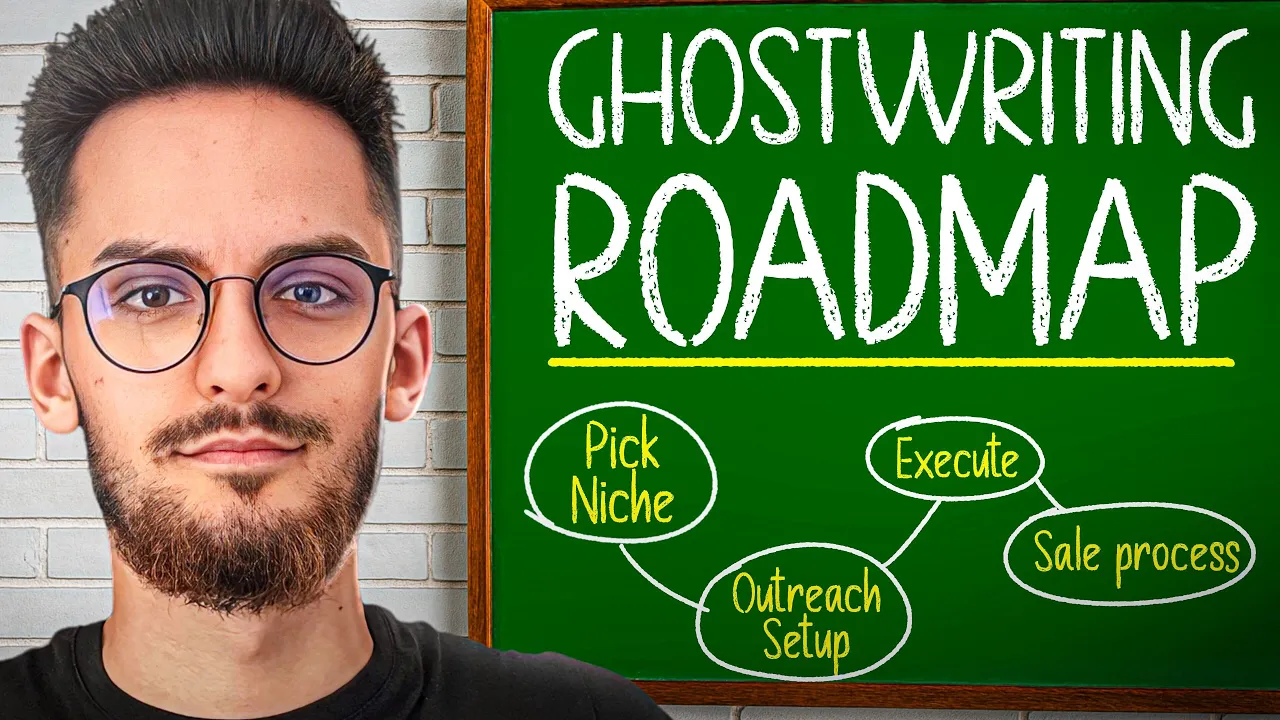
I'm about to show you how to become a full-time ghost writer in just the space of four weeks. I know this works because we've helped people like David Congre hit $170,000 a year in income as a ghostriter and even people like Jason Robertson who went from struggling to grow his business to being on pace to now hit $200,000 a year just with ghostriting. So stay tuned because in this video I will show you the exact step-by-step process that can get you similar results and that can fast track your way to success. So the fourweek plan
to become a full-time ghost rider. We will slowly go through each week right here um and cover the main steps that needs to be taken every single week so you can successfully do it. Okay. So let's start off with week number one which will be mostly about picking a niche and setting up your um outreach platform. Okay. And let's dive deeper into niche selection here. So, finding the right niche that is for you and can help you uh actually become a full-time ghost rider isn't something you just think about and go with because of your
passion or because you enjoy it, right? If it were that easy, anyone could just choose a topic and become a ghost rider. But you should also take into consideration that the market doesn't like what you want, right? of the market. If the market says different, if you're interested in a niche that's already hot and already working well for ghostriters, then you can certainly get into it. But if the market says otherwise, there's nothing you can do. So, you should first of all use any kind of leverage you have. So, at the same time, you're not
bound to your past experience or case studies. If the niches are not highaying, they don't provide expensive services and they're not a growing uh rapidly, they're not growing rapidly as a market. Because at the same time, if you've been working in finance for the last 20 years or you've been in healthcare for the last 8 years or you've worked with like e-commerce store owners and you have a track record of results of helping those people, then that's exactly what the kind of leverage you should use. Okay? But again, if your experience leads to a niche
that isn't high paying, that doesn't provide expensive services and that is not growing rapidly as rapidly as a market, then you're not bound to it, right? Like if for instance, if if if you've been a pet shop owner, right? You don't necessarily have to go into pet shop owners and and write books for them just because you've been there because I can promise you that niche is not isn't any of these right here. Okay? So I need you to stop being just a ghostriter because this is too broad and puts you in a saturated market.
The only reason why you would want to go broad with things is when you have a local presence or authority and you can target all types of businesses, right? So for instance, if you are a um like we worked with a mayor for instance, right? And of course, like it made sense for us to reach out to people in the state where he was a mayor because most people would know him, you know, just from from day-to-day life and news and stuff like that. So that's the type of locality you can or authority you can
leverage. Um, but other than that, I mean, there's no reason for you to go abroad unless you have something like this going on. Okay, here are four of my favorite niches at the moment. We have healthcare professionals. This one is very good. Health care professionals always have stories to tell and complex topics that they need simplified. They always want books. They always want to share their studies. So, they're usually going to need a ghostriter. Now, the second um niche is finance companies because finance companies are resourceful in terms of cash and they also have a
lot of business advice to share, a lot of new strategies, a lot of um you know just investing guidelines. So, they're always going to need a ghost rider. Third one is business coaches and consultants. Right. So, business coaches and consultants is a very good niche here because um it's just an ever growing market. This one I would just be careful with in terms of what kind of coaches we go out for because there are a lot of coaches that are broke and they're not going to be able to afford a five figure project for a
book, right? But there are coaches that have been in the space for 20, 30, 40 years and those people are the perfect fit. Okay? And then lastly, we have real estate professionals, right? So real estate professionals uh everyone wants to be Ryan Sarah Hunt, right? So having a book is going to give them that ego boost of being like a a top realtor in their area. So if you go for older folks, people that have experience, they definitely have the the wealth to invest in a book, then that definitely is a good one. So yeah,
just pick one that suits you and is proven to work and just stick with it. All right. Now, next up, once we have the niche, we're going to create a package or offer that is worth four to five figures. Most ghost writers are stuck with generic approaches and outreach messages that don't offer any value upfront. And by offering value, I do not mean free advice. I mean, showing them that you genuinely understand their core market struggles. Right? What does that mean? Well, if you do actual research and you look on Reddit, you look on online
forums, you cold call people and you ask about their opinion, you go to a local networking event and you speak with people, you need to figure out why they need your service. What problem is it solving? And is it directly helping their business, right? Just giving you an example, a finance business owner, why do they need your service? Well, first of all, to sell more and second of all, maybe having a book is going to position them as an authority to potentially exit the business in the future. What problem is this solving? Well, it's solving
the problem of um of authority. It's solving the problem of of complexity in their business as well. And is this directly helping their business? Yes. Right. And if you look at pet shop owners, why they need your service? Only if they truly like have a need for it and like like a desire, not a need. Sorry. What problem is it solving? Nothing really. Just maybe sharing some experience for like a super small niche that's not going to amount to anything anyways. Is it directly helping their business? Not really, right? I mean, maybe. Uh because people
could be more trust like they can trust someone with a book more than someone that doesn't have a book, but come on. Like it's it just doesn't fall in line with with the line of business, right? So, you need to make sure that by doing the research, you figure these things out. And stop thinking in terms of deliverables, right? Start thinking in terms of what are the results that you're writing delivers. For example, cyber security companies, right? They need to simplify complex topics. So the average audience can understand what what they're talking about. Business coaches
and consultants, the example we covered earlier, they need more speaking events, more digital clout, more leads and sales to thrive as a company. Finance companies, they need to show their competitors who the boss is so they can gain partnerships and sell companies as I was saying earlier, right? So you really need to understand these things. do your research really like I would much rather have you spend like five days out of seven of this week just literally doing research on your niche and this is going to be super uh super helpful. Make sure your offer
hits the sweet spot. Okay, make sure it is realistic for you to deliver it. Make sure it is valuable enough to justify the five figure pricing and then make sure it solve solves a real business problem um in that person's life and company. Okay. Now, next up, we have setting up your LinkedIn profile. So, LinkedIn is where we found the most success for ghost riders. Um, just because it's full of it's packed with individuals. It's packed with leads that are in a business mindset. They're ready to collaborate that they're ready to to work on their
projects and on their personal growth. So, it's just a better place for you to find these people. Now, some profile optimization essentials. Make sure you have a professional headsh shot um and a banner that speaks to your niche. Okay? So don't don't use like old pictures that are like with you in a club or something, okay? Don't do any of that. Just have a professional headsh shot and use a banner that speaks to your niche. Now the headline formula is very simple. You just want to insert your niche and say that hey I'm I'm a
real estate ghostriter, healthcare ghostriter, cyber security ghostriter, so on and then helping target clients achieve specific outcome. helping finance leaders sell their companies um faster or helping business coaches land five times more speaking events where they can sell on stage or a very specific outcome that you know they need. Now the about section I highly recommend uh since you're a writer, right? I highly recommend just making like a mini sales letter of your services and using that in your about section. Okay? And you want to focus it on client results as well if you have
any. So, you want to like just do like a classic VSSL structure, but it's not going to be a video. It's just going to be a simple sales letter that you kind of uh copy paste in the about section. All right? And then LinkedIn has something that is called the featured section. So, you can literally feature your LinkedIn posts. So, I suggest posting a couple of video case studies, PDF case studies, or whatever type of resources you might have um that can that can build your social proof and post those and then feature them on
top of your profile. So, you should have like four to five feature posts on top of your profile, that's how you optimize your LinkedIn profile. You literally don't need um more than that. All right, now this is pretty much week one. And again, if I were to distribute the tasks here, I would say like you should spend like 60 to 70% of it on research and creating a package and offer. Setting up the LinkedIn profile. Come on, it's going to be like a a couple of hours uh job and then set choosing the niche can
take you a day, right? So, that's how you can balance out week number one. Now, week number two, outreach setup. So, now that we have the offer and we have the platform and we have the profile and everything, we need to start doing uh outreach. We need to start being proactive about it. It's not just about setting up the business and then waiting for clients to fall out of the sky, right? It's about um being proactive with it as well. So, how do you create an outreach message that converts? Well, the two approaches that actually
work. We have two types of outreach scripts that actually work very well for our clients. Script number one is what we call the case study/auority approach. And this is for established ghostriters mainly. This approach is for those who have good case studies and they've previously seen results in similar niches to those they are reaching out to, right? If you're already an experienced ghost riter, you had clients so far, you can literally have an approach where you're like, hey, I recently worked with this guy and helped him achieve X through ghost riding, you know, like, hey,
I recently help with I recently worked with one of the directors at Google and helped them exit the company uh and make X figures, right, through um a done for you book that helped him um do ABC, right? So, you can just leverage whatever u case study/res you have here. And then script number two is if you don't have any case studies, which most of you, I'm pretty sure they're not. You're not going to have case studies. You have the desire approach, right? And this is perfect if you're just starting out or you don't have
impressive case studies yet in a specific niche. And this is where you can just based on the research you've done in week one, you can just be like, "Hey, I specialize in helping these uh market leaders like you solve market specific problem that you figure out here during the the pro the the the out the research phase through and then the mechanism is the same. It's going to be book ghost writing, thought leadership articles, LinkedIn posts, Twitter posts or X u um more recently. But yeah, that's pretty much what you want to do. Okay. So,
you want to use these frameworks here um with the research you've done here to build an outreach message. Now, after you've built the outreach message, the next thing we not we need to take into consideration is followup, right? Because the follow-up sequence you're going to use is really where the money is at. So, what you want to do is once you start proactively reaching out to your niche on LinkedIn using this script right here, you want to follow up with the people that didn't reply to you and to the people that responded. and you had
a positive interaction with. So, they said, "Yes, I'm interested." But then when you propose a call, they're not really coming back to you, right? So, you want to wait 24 to 48 hours before your first follow-up. And the best thing with follow-ups that nobody's doing is that it can actually add value instead of pestering people, right? So, what you want to do is you want to keep follow-ups brief and you want to add value each time and new value, right? and stop using generic loweffort follow-ups like just following up or just bumping this up. Because
with each follow-up, you have the opportunity to send something that adds value like an extra case study, a testimonial from someone, work samples, research that can directly improve their business, right? Uh because remember the goal of this outreach is to eventually have a quick phone call where you can qualify them before getting them on booking a longer Zoom call, right? Um so the sequence is very simple. We send the outreach message. Uh we get people interested. After we get people interested, then we we propose a five minute call. We call them and then we qualify
them to see what they need, what they want, what kind of project they need to work on and then we book them on a longer Zoom call or where we also present our proposal to them. But with follow-ups, you can always add value um to the follow-ups, right? So you can just attach some testimonials like, "Hey, just wanted to show you what some other people said about working with me, some work samples." You can be like hey name I know like these opportunities are you you're usually skeptical about these opportunities. Haha I get it. So
here's a work sample so you can learn more about my style before uh answering my my my proposal above. Right? Even research. So hey name I've been looking at some uh some threads for the last week and I thought you might find this useful. Here's why most businesses like yours never achieve x y and z goal. And then you can send like a quick two-minute Loom video that you can just record once and you send to every single person in the pipeline. That is how you win with follow-ups. Okay, now that we have the follow-up
sequences, right? So, we have the outreach message and the follow-up sequences, we need to set up the outreach system. The main problem people are facing here is how do you actually manage to do all of this when you eventually also have clients to fulfill and an actual life to live, right? How can you actually manage this entire process? and streamlining the process is way easier than you think. And it is the same concept that you implement in your day-to-day life. Let me ask you this. Why do you hire a kid to mow the lawn? Well,
because you don't have time for it. First things first, the value you put into other things is higher than if you mow the lawn by yourself. And then number three is you know how to do it, but you just know it's not efficient with your time. So, you would rather just pay $20 for it and get the job done. Well, if you do this, then you need to understand that hiring someone to do the outreach for you is the same thing because doing outreach is not a high value activity. It's not something like yes, it
is the main revenue generator in your business, but it's not something that it takes you six years to master, right? It's literally super easy. You can just find outreach specialists from the Philippines for as little as $3 an hour that can take care of prospecting for you. If I would present you with the opportunity to spend $10 a day on getting your prospecting done for you, would that be worth it? So you don't have to spend like more hours a day searching leads, qualifying them, vetting them, being in the trenches while you also have to
take care of everything else in your life. I think you would take the risk, right? And you can find them already trained with experience. And all it takes is just to train them on your specific uh service and on your specific strategy, of course, because they will have experience maybe with LinkedIn, maybe with the platforms, but they're not going to have experience around what you do specifically, right? The best platform to find these people is online jobs.ph. And the quality of the workers here is far more superior than Facebook groups and other free job board
platforms like Upwork, right? We've heard clients being like, "Well, why don't we just hire from Upwork?" Go hire from Upwork and see for yourself, right? I mean, I'm not going to blame anyone, but the quality just isn't where it has to be. Okay? So, I would much rather use this platform. It is paid. You have to pay like $60 to access the platform, but it's money well spent. It's just like buying the machine to model on. So, then you can hire a kid to do it every single time, right? That's how I would see this
investment. What I would do here is I would focus on having like just job posting, you know, explaining the role, explaining what they have to do, like they have to send outreach messages, do the follow-ups, and incentivize people to send their phone number so you can call them. And I would focus on having at least 10 to 15 interviews until you choose the best possible candidate, right? So, that's what you want to do. And this is how you can solve most of your problems here, right? because you now you don't have to do it yourself
because I'm pretty sure coming into this training you were like oh here's another method of adding 5 hours of work per day to my day when I have so much to do anyways this is not going to be it right you just have to build it once in week one and part of week two and then once that's done you can just hire someone and they will constantly do everything for you right which brings us to week number three executing your outreach campaign so at the moment we have our niche right we have our offer
package we have our professional profile we have our outreach scripts, the follow-up sequences with the resources attached, and our outreach specialist ready to go uh and to put it all into practice. Now, how do you put it all into action? Well, your specialist will need to be sending 80 to 100 DMs on LinkedIn every single day. That may sound like a lot, especially to those who are currently doing 10 a day because that's what your time allows you to do to do. But this is what it takes to actually become a successful ghost rider. And
this is why delegating it to someone that can that can dedicate two to three hours a day to do it is more efficient and less and less costly than doing it yourself. What I would suggest doing as well is leveraging the paid version of LinkedIn. Okay, so not LinkedIn premium but LinkedIn Sales Navigator core. Okay, it's like uh $100 a month and it is much faster and more effective to find your ideal clients. And by doing this with an outreach specialist to help you, all you need to do is to just to train them once.
And after that, it only takes 10 minutes a day to manage them, right? And that 10 minutes a day includes assisting them with conversations when needed, overseeing quality of their work, and making sure they do their job properly. Okay? So, that's what you need to do in terms of onboarding the outbound specialist and making sure it's all put to action. You just send 80 to 100 messages a day to leads in your niche with the outreach message you've built together. The outreach specialist of course has to follow up with those leads every 28 to 24
to 48 hours and that is pretty much it. Now what results to expect? Well, these are the typical response rates that we're seeing with our clients. So this is here is like a like an average scenario. It's not pessimistic, but it's not optimistic either, right? So the reply rate is around 10%. Which means out of 80 to 100 DMs you send, you will get like 8 to 10 replies every single day. Uh the positive response rate is 30%. So out of eight to 10 um positive responses per day, you should expect to get maybe two
uh maybe between one and three positive responses, people that are interested, right? And then the booking rate from outreach is 0.78%. Right? So out of every maybe 110 120 messages sent, you should be able to book an appointment. your third week and every week onwards should be focused on staying consistent with outreach, right, with the with the outbound specialist and trying to figure out what is working and optimizing the outreach message for them, right? So, while they do the work and you do your 10 minutes a day of due diligence, you also want to check
these metrics and make sure they're always in the green. Okay? If if your metrics are lower than these on the screen, if they're not significantly lower, like if you have an 8% response rate and 0.6 booking rate, that's still manageable. That's still going to get you to your goals. But if your response rate is like 3% and your booking rate is 0.2, then you want to do something about it. You want to change the messaging, maybe jump back into doing more research, maybe checking the other one specialist to see if they're doing their work. Who
knows, right? So you want to do all of these things. So once you start doing this and once you optimize the numbers and it looks like this, it's pretty obvious that you will start having calls booked, right? And what I need you to do on that five minute initial phone call is I just need you to basically call them and qualify for three things. I need you to qualify for finances first of all to see like if they're actually have the budget. You just need to ask like what budget they're expecting to spend on the
project. Uh what's their expectation? Right? And just see if that aligns with what you're looking for. I need you to qualify them in terms of their mission. If they're just window shopping and the idea sounds good, but they don't really have a need or desire for it and and so on, then of course like you're not going to make a sale. So, you want to stop the conversation there. But if they actually have a mission and they've been thinking about it for a while, they know why they're doing it, they have a they have a
like like a sales goal or whatever, then that's all good to go. And the third one is you just want to qualify for energy, right? If you feel like that person is is fun to speak with and they resonate well with you and you resonate well with them, uh that's a good sign, right? If you just find type A personality, egotistical people, people that generally you don't enjoy working with, I would just skip the the hassle of booking them into a longer Zoom call, right? And once you find out these three things, then you just
want to be like, "Okay, look, so I appreciate the conversation. It seems like we can really do something together. So, how about we just schedule a bit of a longer Zoom call where I can walk you through my process, how it works, and I can also show you a couple of testimonials, samples, and case studies if needed to make a decision. And then, of course, everyone that's going to be a good fit, most mostly like almost everyone's going to say yes. And you can just book them in on the longer Zoom call. Since you started
booking appointments, let's move on to week four, which is the sales process. All right, so now that we've booking calls, right, we need the sales process in place. As you can see, based on our typical results, you should be seeing some sales calls coming in after a full week or two of outreach, right? And this is in the average case scenario. Getting on sales calls is probably the scariest part of the process, right? Because you don't want to be a salesman. You just want to do your work as a freelancer and that's it. Here's the
truth. We all hate selling. I absolutely I it's my least favorite part of business, right, when it comes to selling. But it is needed for a healthy business. It's kind of like the exercise at the gym that you don't really like doing, but you still have to do it to complete your your sets for the day, right? I know we all have that exercise like for the people that are going to the gym, right? Or if you're working in a 9 to5, you know that one thing that you really hate doing that your boss makes
you do, how come you can do it for your boss, but you cannot do it for your business, right? That's that's the way you should look at it. And if you're smart enough, there are ways to be authentic with your sales process, which can make things a bit more comfortable for you. And this is where a lot of ghostriters mess up because they get their hands on a crappy script from a YouTube guru and they just try reading it on the call and acting like they're professional and they try to like hypnotize people with it,
hoping that they're going to get the right answers and the call's going to go exactly how they were imagining it's going to go. Spoiler alert, it's not going to work. Okay? We've had people come from those types of environments and move into what we do and they've seen significantly better results. Right? So, let's quickly go over everything you should know to get this right. In terms of mastering the sales call, you have three phases of it, right? You have um for where first of all, before the three phases, you need to take the frame and
position yourself as an authority. If you are not positioning yourself as an authority, then the call is going to be run by the client. And if the client decides that what you do isn't the fit for them, then there is no way for you to kind of turn it back and and try to convince them, you know, that it's it is a good fit. And at the same time, when you're taking the frame and people can see that you you can lead, right? That's going to position you as a way better expert and it's going
to make everything feel more authentic. Right? Now after you you take the frame and you position yourself as an authority, we have the phase one which is discovery where you have to find out their deepest pain points and inefficiencies. Here you ask questions like about their goals. You ask questions about um what they're looking to do, what they've tried so far, why it hasn't worked, why they're dissatisfied with their current results, you know, just finding out what is missing in their life and in their business. Once you find these inefficiencies, right, you c you go
to the pitch phase. And this is where most people go wrong. Instead of having a presentation deck or going through a website or whatever, you literally just want to listen to the inefficiencies and you want to pitch the outcome they want, not the service, right? How will your service fix their pain point outlined in the discovery phase? Like if someone says they're struggling with um time to do it, right? Focus on the fact that your service is done for you and it can save them time. If someone was burned in the past by another freelancer,
focus on how your service is better and why this is not going to happen and focus on case studies, right? So you just want to like mold the pitch around the discovery phase instead of having the same pitch every single time. Because what happens is if you come out of a deep conversation in discovery and you just go to a presentation, people are going to feel like, okay, yeah, okay. So we had this deep conversation and now let me just show you what I showed to show to another 100 people in the hopes that they're
going to pay me money. Right? That's the vibe they get. And sometimes that's not good at all. Okay? And then last part is the smokec screen phase. And eight eight out of 10 sales calls we have smoke screens at the end that are hiding the real concern of that person and you need to know and understand how to tackle them and leverage specific frameworks to uncover the real concern and there's no handling of that concern if you don't know what it is right if if someone says I need to think about it well you don't
really have an objection there it's a smoke screen because what do they need to think about like what's coming up for them that makes them want to think about it what's the bottleneck what's the problem right so you that's why you need to figure those out. And as a little bonus here, I want to show you how to overcome the top three smoke screens in an industry, which is I want to speak with more writers. Send me an email and I'll get information and I need to speak with my partner. Okay, so here's how you
can handle these three smoke screens so you can get to um your sales goal efficiently. If someone says, I want to speak with more writers before making a decision, it's very simple. You just want to be like, I can totally understand that name. So, I guess what were you hoping to see with other writers that you didn't see on this call today? And this is where they will just throw the objection at you because if you find the perfect partner, right, you're not going to go on more dates just to be sure. Like, if you
fall in love, you fall in love, right? You're not going to be like, "Wait, hold on. Before we engage in a relationship, I need to go on five more dates to see if the other person has more to offer." Right? So, usually this right here means that they have a problem. they there's something that they don't trust about your service or you. So asking this question is going going to uncover that. Okay. Um and if they say that's just how they make decisions or that they just want to see more pricing options, I mean that
tells a lot about them because it means they're just window shoppers and they're not really serious and it's very hard to close at this point. But if they genuinely have a concern and they do not want to move forward because of it, this is how you uncover what that is. And then of course you can at least then have the real conversation. Okay, the other one is send me an email with the information and I'll get back to you. Like, no one needs an email with the information. Why? Because you just literally spend 40 minutes
with them on Zoom showing them all the information they need. So, what more information can someone need, right? And here's where we want to be like, I'm a bit confused, name, we just spent the last uh 50 minutes talking about everything. I don't really have anything that I can put together in an email that would be new information for you. Um, unless you think we missed something or you don't understand a specific part of the process and they will just throw the objection at you if they truly like if they're just trying to run away
because of a fear concern, right? They're just going to throw the objection at you like you know look uh like I understand the process but I just need to think about it, right? And then you you kind of go and you handle that or hey um I I need to I need I just need to speak with my partner and then it kind of moves on into another small screen, right? So, um, that's pretty much it. Or in some cases, they will realize that you're right. Trust me, in some cases, people are just so used
to bad, uh, sales tactics and, uh, freelancers that are not like up to date with sales uh, philosophies that they're just used to receive an email proposal. But for real, why do you need an email proposal? You already know what you're doing. You already know what you sell, right? So why would you need to waste a couple of days and potentially have that person change their mind where you can just make the sale right there and then? Right? So if you say this, so people are just going to realize that uh it's right now in
terms of the partner objection, right? This one is a little bit longer as you can see because this is a bit harder to overcome because it's another person here. So it can get a bit more emotional. It can get a bit more defensive, you know. So let me go through it. The first thing that we want to do is you want to isolate the objection. So you want to make sure if the partner is involved in the decision or if it's just a actual smoke screen. So you can be like, I see. So can I
ask, is it more so a case of them being involved in the decision-m process and financially or do you just want to be respectful and get their opinion on things as well? Now, if they are involved in the decision and they literally need to pay money out of their partner's account, nothing you can do, right? You can propose a follow-up time where the partner can join as well and just redo the pitch with the partner as well. This is the best way to go about the situation unless you feel like they're using the partner thing
as an objection. With some people, you're just going to feel it. So, if you feel it, then you go forward with the process as I'm about to show you. But if it's genuinely a case of, hey, look, I just need to get my partner's approval, then, okay, let's follow up a time. let's book a follow-up u where we can uh where we can chat and we can actually sit down with your partner and go through everything and make sure that they get the hang of it as well. Now, if they just say, "I just want
to be respectful and let them know." You want to be like, "Oh, okay." And also, obviously, you mentioned that one of the goals here is to, and then you want to insert their goals, right? Uh, so you mentioned that one of the goals here is to sell the company in a couple of years. I assume you just talk with them overall about wanting to do something like this. How are they feeling about that? Like, are they supportive at all? Are are they okay with like is your partner okay with you putting in the work to
sell the company with this book or or not really? And here the point is to get a buy in that the partner wants them to be successful. Whether this is like a spouse or a business partner, right? Um, and most people will just say, "Yeah, yeah, they're supportive. You know, they we talked about it. He knows that I'm doing this." And so on. Okay. And then, all right, well, what if you talk to them in a couple of hours and they're like, "Oh, that's complete waste of time. You shouldn't spend a single dollar from the
investment budget on it." And he's just going to be like a bit skeptical about it. Like, well, what are you planning to do then? And here you don't let them walk away until they come up with an alternative solution of paying the invoice. Okay? Other answers are not going to work. If they say, "Well, I just don't do it." Then then you want to move back to booking a follow-up with the partner. So, we make sure that the partner is on board as well. Okay? But if they're going to be like, "Oh, you know what?
I'm just going to find a way to do it. I'm just going to borrow money. I'm just going to use my personal card. I'm just going to do any of that." Right? Then that's what we're looking for here. Okay? So if they will say no, just to clarify, you will still find a way to do it regardless because it's your responsibility to sell the company in six years, right? Yes. Okay. And what if they say yes? And that then you just let them tell you that they'll do it, you know, because most for the most
part if they're going to be like, well, if my partner says yes, I'm just going to go ahead and do it. Okay. Awesome. So even if they're going to want it or not, you are the one that has to make it work and you will do it uh and sell the company no matter what, right? Yes. Can I be upfront with you name? Yes. We've been talking about the fact the finances are there for you to do this and regardless of what happens with your partner apparently uh in this conversation you will still find a
way to do it for you so that you can sell the company. Now as you already know when growing a business and taking a big step like this because ultimately you're going to sell a multi-million dollar company you have to become a different person and you need to think like the person that is already successful. So can I challenge you on that? and they're going to be like, "Oh, well, what do you mean challenge?" And then I want to challenge you on the way you make decisions because I'm trying to connect the dots here on
why do you need to talk to your partner about a decision that's completely yours and that has been on your mind for the last 5 years, right? And at this point, most people will just cave in and agree with you because it's the reality. And otherwise, if they don't, then partner isn't the real thing holding them back, right? If they say like, "Well, no, I still have to speak with them and I still have to do this and I still have to do that." then you can just be like you can just break the ice
and you can be like yeah okay look so here's the thing um I just want to be transparent with you so can you be can you please be transparent with me as well what exactly is coming up for you like is it the finances is it me is it the the service is it the product is it like what exactly is it that's coming up and then they're just going to tell you the real concern okay and you can then go on and handle it but this is how you want to handle the smoke screens
okay this is very um a helpful part of it because most of you will set this up properly, you will start booking calls and then you will not close deals because you're not going through this type of stuff and you're going to wonder why you've had 20 sales calls and none of them closed. Okay, so that's why I kind of put a lot more focus here on the sales process. Now, after the initial four weeks once you have the system that works, it's all about repeating the cycle consistently to keep the business running, right? Just
keep the other one specialist doing the prospecting, keep doing the sales calls, keep maintaining your clients and build relationships. And on top of that, continuously optimize the system with what is working. If you figure out an angle that works better, you know, like after you speak with 50 leads, maybe you're going to figure out that they were looking for something else. Maybe you're going to figure out that a specific painoint is there that you didn't find through your uh generic research. So you want to change the pattern and start using the information and the data
you have from these people. Uh outreach can never stop, okay? Even when you have clients because even if you have clients, your pipeline might go dry in a couple of months. So I would much rather have you have like a surplus of calls and an actual pipeline even if you have to cancel some of them because you don't have time rather than stopping it and taking it from scratch in a few months. Okay. So, as mentioned earlier, there's one way to ensure this. If you cannot be consistent yourself, don't beat yourself up for it and
stop looking for easy the easy way out. There is no easy way out. Okay? Just hire someone to do it for you and you'll still get the job done. But there is no strategy that you can do that is going to take you 5 minutes a day or 10 minutes a day and get you clients. Okay? So, I hope this made sense. This is literally the four-week plan that you can implement starting right now to build a ghostriting career. And this is the exact same system we implement for our clients. And as you can see,
it gets results, right? So Carolyn here, she made her first $5,000 in 35 days. Bridget got three retainers for email writing and she quit her 9 to5 in just a couple of months. Ashley closed 6,000 project in just two weeks after starting. And David now is he's writing books. He's on pace to hit $170,000 a year. Or he's not on pace. He already did it. Um but he just did it in four in five months. And if this seems a bit complicated, it's because it is. Hiring someone, learning sales, building an offer, doing the research,
it is super complicated, right? And if it was super easy to implement something like this, everyone would have an army of outbound specialists pumping calls in their calendars. But I can understand your concern like, "Okay, Dennis, you told me all these things and it's helpful, but how do I actually do it?" Well, if you're a ghostriter with some experience and you want our help to literally take this all off your hands um and implement it directly into your business, then the link in the description will have all the details you need to get started. Okay?
So, go ahead and book a call um with my team so we can speak because everything that I mentioned in this in this 40-minute video uh that will take you four weeks to set up, we can do it for you in two weeks with the guarantee that it's actually going to work from the first try because we have so much data and so many results from people like these guys right here, these guys and girls right here. So, it's going to be easy for us to know what's working and what's not working. Okay? Uh I
also have more extensive training that goes over everything mentioned in this video on my YouTube channel. So if you want to learn more about the sales process, if you want to learn more about finding and hiring and training the L1 specialists, you can go to my channel and check out my other trainings. Okay? And if you want to find out the most profitable book book ghost riding niches right now, so you can kind of fast track um week one, then click on the video on the screen right now and go watch that training as well.
I hope you enjoyed this video. Don't forget to subscribe if you enjoyed it and I'll see you in the next one. Cheers.