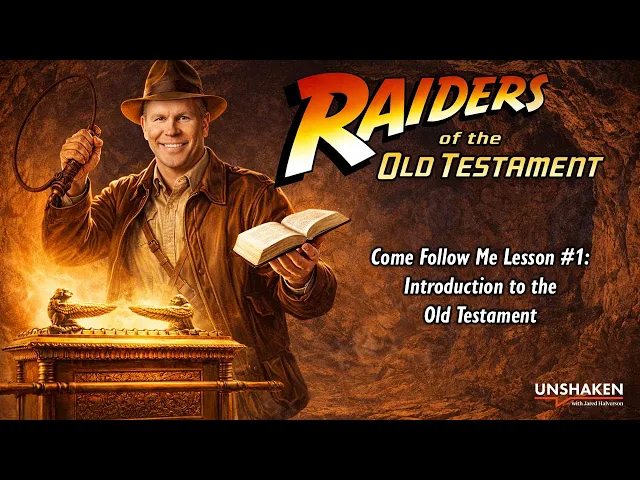
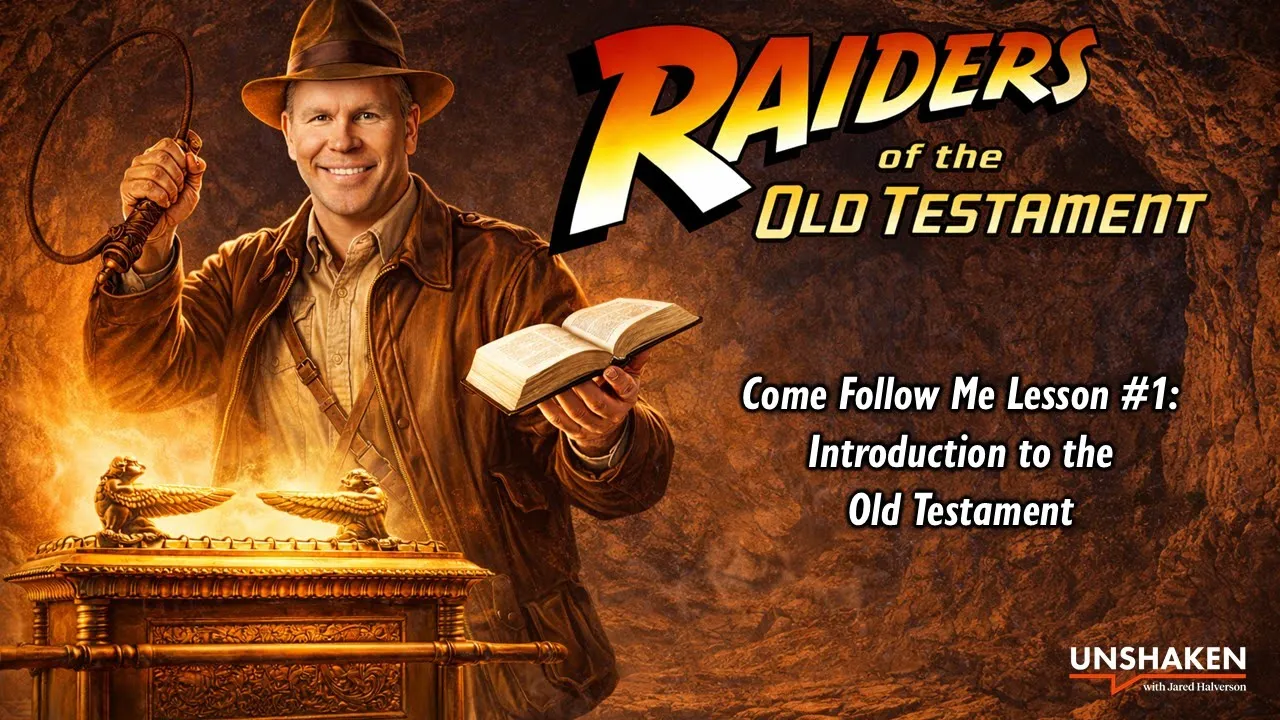
One of my childhood heroes was Indiana Jones. I mean, I loved Harrison Ford in Star Wars, but I think that was just, oh, practice for his incredible role as Indie. And honestly, give me a fedora and a whip and turn me loose on the world. I'm going to go find some buried treasure. I think I was a an aspiring archaeologist just watching movie after movie and just being swept up in the combination of action, adventure, History, and usually religion. And those four that that's like my dream. Uh, honestly, my life is not anywhere near as
adventurous uh or action-packed as Indiana Jones, but combining history and religion has been my life ever since childhood, where I had had history degree after history degree and studying religion throughout it all until here I am. My PhD is in American religious history and and and I teach religion for a living. Now, I'm not I'm not the kind Of professor that Indiana Jones was. Definitely not as popular with his students. Uh, I'm not trying to to sneak out of my office, the back door to avoid people. Uh, nor am I having the kinds of adventures
out in the jungles of of Meso America or the sands of Egypt like like Indiana Jones was. But he was an inspiration to me as a child and continues to be. Now, I know what you're thinking. There are five Indiana Jones movies, at least five that that Have been listed. To me, there's only two. And to begin with, Raiders of the Lost Arc, uh, which was I mean, it it put archaeology and history and religion on the map. Uh, the second one, Temple of Doom, to me took a step back a little bit. It was
it was a little dark to be honest as a child. But then third, came Roaring Back, bringing in Shan Connory. I mean, who's not going to love that? And to see the the this quest for the Holy Grail. Uh, talk about an epic Adventure. Uh, the fourth one is not to be named and the fifth was was okay. Uh, but but nothing in my mind can compete with the first and the third. Now, I had to search through many a government facility, but I was able to get my hands on the ark of the covenant.
Actually, thank you, Brandt, for this kind gift that you gave me a few years ago uh in in in honor of our time spent together in the Old Testament on Unshaken. But I I love This because not only does it remind me of all that I do now teaching scripture, but it is a beautiful reminder of my childhood watching Indiana Jones. Now, do you remember this scene? The whole story is the Indiana Jones has to find the the Ark of the Covenant before the Nazis can. Okay? They they were the enemy of choice back in
the in those days. and to be able to to find it. He goes through all these adventures as you recall. Go rewatch the movie. But do you Remember the scene? Why did the Nazis want the Ark of the Covenant to begin with? Well, the idea was this is the throne of God. It's being brought. I mean, you picture those those kind of ancient servants that are carrying the throne of the king. That's what's being done by the Levite priests. Okay? This is supposed to be the throne. Eventually, they're going to build the tabernacle and then
ultimately the temple of Solomon. And this is the piece Of furniture that is going to stand center stage in the holiest place in the temple, the Holy of Holies. That was meant to be the throne room of God. And everything we do to approach that holy place is is entering God's presence, parting the veil, coming in on the day of atonement. If you're the high priest, that is. And there was supposed to be, there was believed to be, there was the glory of God, the presence of God. Well, if God leads you into battle, who
could Possibly stand in your way? We saw the Israelites do that as they marched with the ark of the covenant, God at their head. They were an unstoppable force in the ancient world, right? And so, think of the Third Reich thinking that's what we need and we will conquer the world. You have this German archaeologist who's dresses up in the ro in the in the uniform of the ancient high priest to be able to open take off the lid of the ark of the covenant ready to lead the the Third the the Hitler's armies into
battle. Well, do you remember the scene? I was a little troubled by this as a child. A amazing CGI for its time. But as they remove the lid and look in, as the presence of God begins to pour out among all of these Nazi onlookers, well, they all begin to melt. H and and the presence of God destroys them all because they weren't worthy to be there. Now, here's the issue that I'm getting At. I worry that we approach the Old Testament like the Ark of the Covenant. We see it in all of its ancient
beauty and yet we are scared to death to actually open the book and look inside. Who knows what's going to be in there if I take a peek within the pages of the Old Testament? Will my face melt off? Will it destroy my my sense of scriptural understanding because it's so old and it's so historically contextualized and I don't Understand the history and the language is difficult and all these strange things are happening and prophet after prophet I don't get it and honestly there is usually a lot of frustration or at least trepidation when it
comes to our study of the Old Testament. Well, we have arrived at that moment, my friends. We have just finished the Doctrine of Covenants and going from those pages at the end of our book that are much more straightforward Relatively to go back a thousand plus pages and go back several millennia in time to start with Adam and Eve and the creation to go through the Exodus account to be able to meet prophet after prophet and wicked king after wicked king. a few righteous ones interspersed. Uh to go through the Torah, to go through the
prophets, both major and minor, though don't ever call the minor prophets that to their face. Uh to go through the wisdom literature, the Psalms and the Proverbs to be able to There is so much in the Old Testament. And admittedly, it's probably the hardest book of scripture that we've got. When I meet gospel doctrine teachers, I'll often ask them, "How long do you have the calling?" and specifically which books of scripture were you called to teach? And when they tell me the same same with early morning seminary teachers, by the way, and when they tell
me that they taught the Old Testament year, it's like, whoa, hats off to you. More power to you. You deserve hazard pay, or in this case, hazard blessings for tackling that one. It's the big book. It's the old book. And it's in some ways the hardest one to wrap our heads around. And because it's hard to wrap our heads around, sometimes it's hard to wrap our hearts around. And that's a tragedy because this Book of Scripture is foundation for every other book that follows. When we see the Book Of Mormon as another testament of Jesus
Christ, what would the Testament of Jesus Christ be? Well, most would say the New Testament. And I'd give it that pride of place. What does that make the Old Testament? I would say it's the foundational testament of Jesus Christ. Old Testament is foundation. New Testament is consummation. It's foundation versus fulfillment. But when Jesus is quoting scripture in the New Testament, what's he quoting? Old Testament. When Nephi is quoting scripture from the brass plates, what's he quoting? Old Testament. When Jesus says to the Pharisees, "Search the scriptures, for in them you think you have eternal, you
find eternal life, but they are they which testify of me." He was referring to the Old Testament. In his synagogue in Nazareth, hometown, Jesus, opens a scroll, reads a messianic prophecy, and says, "This day is this scripture Fulfilled in your ears." In other words, those verses were talking about me. And what verses was he quoting from? Isaiah in the Old Testament. I'm amazed at the number of movies that have been filmed based on the Old Testament. Most of the Veggie tales are based on stories in the Old Testament. If you're old enough and you remember
flannel board stories, so many of those are based on the Old Testament. The stories within them are so moving, so Powerful, so memorable, and we get to study them together. I hope that our time spent in the Old Testament will be a true blessing to you. As as I've mentioned already, I'm not going to retach everything I taught four years ago. That was 800 and no, excuse me, that was 204 hours we spent going chapter by chapter through,00 pages of text. Okay, that was exhilarating and exhausting for us both. That will be posted uh reposted
every week with Smaller pieces as as close to every day as I can possibly make it. Uh so you can get the full version or the bite-sized pieces. Uh but I'm not I'm not reposting all of that. Excuse me. I'm reposting all of that. I'm not re-recording all of that. Okay? If you gotten used to better film production, I'm sorry we got to go back a little bit, but maybe that's even more appropriate since we are going back thousands and thousands of years in time. But I wanted to give one new Episode to introduce our
Old Testament study to present something of an introduction to you based on Indiana Jones and Raiders of the Lost Ark. Because if the Old Testament has become a lost ark for most people, if it has become an int beautiful but intimidating thing, something meant to be kept oh locked away in a government warehouse somewhere. Uh even even Christians who believe in the Old Testament in some ways leave it out of their cannon within The canon which to them is the New Testament. There's a sense of supersessionism that we have outgrown an outdated testament and that's
not how we Latter-day Saints feel. The Old Testament is a quarter of our our a quarter of our lives will be spent studying the Old Testament. As round after round of gospel doctrine, we go through the standard works. We spend as much time in the Old Testament as we do In the Book of Mormon as far as church curriculum is concerned. And that's amazing. So, that should give us some hints that there's something important about this book and it deserves our attention. It will change our lives if we let it. If we'll have the courage
to take off the lid and actually see what's inside. Now, let me give you a little bit of intro to the Old Testament based on what we have here in the Ark of the Covenant. Now, what is the Ark of the Covenant? It's just a box really. It's meant to be a box that contains and preserves ancient Israel's greatest artifacts. I'll explain what those are in a moment. But in some ways, that's what the Old Testament is. Also, it's a box. It's a box that contains and compiles, collects the most important scriptural artifacts of ancient
Israel. We will see historical books. We'll see prophetic books. will see wisdom literature all Mixed together in this magnificent scriptural cannon. And if a cannon is a box of sorts, well, this arc of the cannon, this arc of the covenant is bringing together all kinds of different books. Bible itself means library. And so here in this canon, we have a library of books. Now keep in mind by the way that books are written by different authors at different time periods to different audiences. Therefore they have different styles and different Approaches. And we should come to
expect that in the book of and in the Old Testament as well. The book of of Isaiah a court prophet and poet doesn't read like the book of Amos who was a shepherd and gatherer of sycamore fruit. Uh Exodus is going to be a different message than Leviticus for example. And to go from from smaller books like Haggi and Zephaniah to massive books like Jeremiah uh there is there are different things. You will see Psalms which is Like an Israelite hymbook. You will see oh Leviticus which is something of a of a handbook of instruction.
You will see Proverbs which is just pathy statements of wisdom a quote book of sorts that you can build on. You will see the pessimism of Ecclesiastes. You will see the the the mourning and sorrow of lamentations. You will see sanctified tears in that book. You will see the hope of messianic prophecy throughout Isaiah and and Elsewhere. You'll see the apocalypse described in the book of Daniel. Honestly, it is it is a thrill to dive into the Old Testament to to open the lid and get into the box to pull out scroll after scroll. It's
incredible to see. Notice, by the way, genre as you go through because if we approach every single book as if it were the same genre. I mean, you don't do that with movies. You don't do that with literature. You get a sense how does This book begin? If it begins and it came to pass, that's a different beginning than once upon a time, right? And what's interesting within the Old Testament, different genres will will help us see how am I supposed to be approaching this text. There is historical narrative. Well, there's actually there's narrative non-fiction
and there's narrative fiction in the Old Testament. So that there are times where you don't have to Take every single story at face value as if this happened exactly as it's being described. We don't do that when we rate when we open a book and it starts with in a galaxy far far away, you know, long long ago in a galaxy far far away or it came up once upon a time. We we understand something's a little different about that. When we see things again like hymns, we read them somewhat differently. uh the books of
prophecy will approach in a different way than The books of wisdom. Uh eeteologies, which is a a fancy term for origin stories. And what what what is an origin story doing? Is it telling exact history or is it trying to help us make sense of a group that we're either a part of or not a part of? You'll see a lot of that in the Old Testament as well. There are fascinating things within this cannon, this compilation of scripture. So keep an eye out for differences as you go through the text. Some books you may
Love, some books you may simply endure, but endure it well. Those books are meant to help exalt you on high. Okay. Now, the other one other thing I need you to know as you take off the lid and actually look inside at this collection, if you were to look inside the original Ark of the Covenant, see my face is not melting. What would it contain? The book of Hebrews actually gives us an insight into that. uh Hebrews again this wonderful New Testament letter that is Focused on Old Testament themes. Hebrews chapter 9 4 and 5
gives us this inventory. the ark of the covenant wherein was first thing the golden pot that had mana second thing and Aaron's rod that budded and third thing which we typically think of as the first thing the ta the tables of the covenant over it the cherubams of glory shadowing the mercy seat of which we cannot now speak particularly the ending of that is intriguing by the Way it's like wait there's more to this than You're allowed to say, "Oh, yes." Wink, wink, nudge, nudge. There are truths and glories about this canonical compilation that will
only come to our understanding in time. But to think about what is being contained here. First, we remove this mercy seat. It's called, we'll come back to that concept, by the way. the cherubams, the cherubim of glory, these heavenly creatures that are overshadowing the throne of God, the Lid itself overshadowing the contents within. And what were those contents? The tables of stone that Moses brought down from Mount Si, the Ten Commandments right there within the ark. Secondly, this jar of mana, a memorial commemoration of God providing for the children of Israel through their wilderness wanderings
those 40 years before they were able to enter the promised land to get out of bondage and into a land of promise requires God Providing for us every step of the way. And he did through the miracle of the mana. And then third, a lesserk known story when several tribes of Israel were arguing over preeminence and priesthood. Each one produced a or or provided their staff, a leader of each tribe, taking their staff symbolic of authority. this scepter, so to speak. They took all 12, put them into the tabernacle, let them stay there in God's
presence overnight to see what God would do to show which Tribe he had chosen for leadership. The next day, 11 of those 12 scepters, those staffs, looked exactly the way they did the night before. But one staff, Aaron's staff, the staff of Moses and Aaron, the sign of authority for the tribe of Levi had blossomed and budded and was bearing almonds all overnight. Seemed like the Lord was trying to make things obvious. Which tribe is bearing fruit? As far as priesthood leadership is concerned, it was the Levites and none other. So Here's the thing I
want you want you to understand about those three that will help us make some sense of the Old Testament this year. What does the Old Testament contain? Well, if we look inside, have the courage to open the lid, approach the throne of God, enter his presence, ask him to provide for us what he's holding beneath, and what is he going to offer us? Let me give you a chart. I like those that will help us visualize what these three gifts Might represent. Tablets of stone, pot of mana, and Aaron's rod. What does the Old Testament
contain? Well, for the tablets of stone, here are God's commandments, his covenants to us. Pot of mana, here are his blessings that he gives his chosen people. And third, Aaron's rod. Here is guidance through prophets of God that to see what what we find in the Old Testament. If we have the courage to open its pages, you will see God's Covenant everywhere made manifest. A covenant that he refuses to break even though Israel breaks it repeatedly. One of the purposes of the Book of Mormon, according to its title page, is to remind us all of
the covenants God has made with his children. And those covenants are best expressed throughout the pages of the Old Testament. As far as these blessings, you will see God provide the most incredible blessings imaginable throughout the stories of the Old Testament. blessings of deliverance, of freedom, of a reversal of the fall, of city of a city caught up to heaven, of what might be might be considered minor miracles, bringing a an an axe that has fallen and sunk to the to the bottom of a of a pond back up so they can be used. multiplying
not loaves and fishes this time but oil and meal for a widow and her suffering son to see the kinds of things God does to provide not only mana but miracles to anyone who Needs them that the Old Testament is a reminder of the goodness of God in his providing gifts for all of us and like I said Aaron's rod you will see prophet after prophet Isaiah Jeremiah, Ezekiel, Daniel. You'll see Elisha and Elijah. You will see Amos and Hosea and Oadiah and Jonah and Micah and and so many of these prophets that will wield
a scepter of sorts on Behalf of the King of Kings. Continuing down to the next line of our chart, what will what do these three gifts represent? to borrow some alliteration which you've probably learned that I that I love. You will see principles and provisions and priesthood. To switch the letter to L, you will see law and love and leadership. The law on those tablets, the love represented by the mana God will give you every day you get hungry and need to Eat. and the leadership he will provide through prophets called of God to represent
him. What else do you see in these three gifts? A new a new P series. Remember in the proclamation, it describes the need for providing and presiding and protecting. I see all three of those in these three artifacts as well. In the tablets of stone, I see protection from the dangers of sin and the consequences of temptation. In the pot Of mana, I see a loving father who is providing for his family day by day. And in Aaron's rod, we see the gift of presiding authority as people speak as moved upon by the power of
God himself. Honestly, if you take these three tablets of stone, pot of mana, Aaron's rod, we see a God who is trying to teach us and feed us and lead us back to the promised land, to his heavenly home. In some ways, by the way, especially as I see people struggling in their faith and Navigating faith crisis, I often will remind them of what is contained in the Ark of the Covenant. Because if it's covered by the lid, which is known as the mercy seat, if God is sitting above this, covering these things with with
his grace, then broken law. If we've ever felt we've gone too far and that's why I can't come back to God, I can't come back to church. I'm having a faith crisis because I've been I've had a worthiness crisis. What covers the ten commandments? The mercy seat. Put the lid on. And Christ will is willing to take up your sins and cover them with mercy and grace. To understand those as sins of commission. I've broken the covenant. Take the 10 and anything we do against that. Those are sins of commission. But then think about the
pot of mana. Are we guilty of sins of omission? Whether we're the ones that have omitted things and we feel guilty or others that Should have done better by us have omitted that goodness and we've suffered as a result. Times when people haven't been there for us the way they should. Well, in some ways, what covers the pot of mana? Mana was God providing and God has given us our daily bread. What have we done with it? And when I don't use that divine blessing to bless other people to spread my mana to others in
need then when I have cracked the pot of mana and not Used it for its intended purpose that is covered by the mercy seat of Christ as well. Thirdly, Aaron's rod. Those of you who are leaders and have made mistakes in your leadership, whether again whether that's by commission or omission, as a leader myself at times, I am so grateful that my rod is within the ark so that it can be covered by the throne of grace as well. That there is mercy for people Trying to lead but falling short. The same is true by
the way of those of us who have suffered at the leadership of other people. Whether omission or commission, whether those leaders are parents or priesthood leaders, those sins can be covered by the grace of Christ as well. And the Old Testament teaches us that. I'm amazed by the Old Testament's accounts of broken covenant and Misused mana and rods that turn into clubs instead of scepters of righteousness. And yet God is merciful and continues to hold to his portion of the covenant as he works with us until we are able to keep ours. Those who see
the Old Testament as a different God than the kindness of Christ in the New Testament are selective in their reading and they have not taken the covenant as a whole. They Haven't read the book of Hosea, for example. They haven't read the book of Judges in one sitting enough to see just how merciful God is with his people. Read the Old Testament with an eye to the mercy seat and you will see mercy every time you open the book and look inside its pages. I hope that you will have that experience as you move forward
in the Old Testament this year. Now, one of the things that might keep you from that is What I mentioned already. It's so big. It's so old. It's so different. This is like a study abroad in a foreign country and it's a foreign language and foreign culture and the food's strange and what do how do I make sense of this? Well, let get back to the ark of the covenant and let me tell you something. Like I said, it's just a box, but it's not any old box. It is wood, but it that wood is
covered in gold. And that actually brings forward an interesting Question. Who made the ark of the covenant? Well, Moses and the ancient Israelites. But they had just escaped 400 years of slavery in Egypt. And where do a bunch of slaves come up with gold? Well, here's part of the miracle. After these 10 plagues of Egypt, Pharaoh and the Egyptians were so excited to get rid of these people that they basically gave them all kinds of jewelry on their way out. Like, please leave, get out. God softened their hearts to the point that As these slaves
asked in a way for a down payment on all the sweat equity they'd earned over the last four centuries, they were flooded with wealth by their Egyptian captors. Now, sadly, that wealth was first melted down to be made into a golden calf. We'll get to that story in the book of Exodus. But its original intent was for it to be melted down and turned into tabernacle furnishings. The ark of the covenant, the manora, the the altar of Incense, the table of showbread, beautiful things to furnish the house of God. Now that gold taken from Egypt
is is part of a concept that St. Augustine once taught. Augustine was classically trained in rhetoric. Okay, before he converted to Christianity, he was incredibly well educated. And when he converted, his education was converted, too. And he coined a phrase that I've loved ever since I heard it. He said, "Plunder the riches of Egypt." And he was referring to that story about the creation of the ark of the covenant to take the gold and and jewels from your Egyptian captives and melt it down to make it into something more magnificent, something holy to sanctify that
wealth, he compared that to education. And so when Augustine said plunder the riches of riches of Egypt, what he meant by it was get the best education you can. even from Egyptian Overseers, even from non-believing professors. Get the best education you can and then consecrate it. I used to tell this to students that I taught in graduate graduate students particularly. You are getting a magnificent education. What you do with it will be up to you. Some sadly will turn it into a golden calf. Others thankfully will turn it into tabernacle furnishings. Now what do I
mean by this for our Old Testament study This year? Well, plunder the riches of Egypt. Go get some intellectual gold and it will actually help you open the lid and make sense of what's inside. By Egyptian treasure, what do I mean? commentaries, other translations, podcasts, including this one and others. There are so many wonderful resources that will help you make sense of the Old Testament. I'll admit, it's not a book that easily offers you its treasures Through a a surface level ski. It's it's more it's more valuable than that. these like the ark of the
covenant. Think about all that Indiana Jones had to do to find it. And for us to spend that kind of effort to be able to provide that kind of work to make sense of the pages of the book of the Old Testament there are again something as simple as go online and look at the institute manual for the Old Testament. It can be such a help uh to there online on YouTube for example there's a non-Latterday saint produced program called or page called the Bible project it's wonderful and the Bible project will make stick like
line drawings to map out the chronology of each book of the Bible so if you're about to read Genesis go watch the Bible project video on Genesis and you'll see what this whole book is about. Do it again for Exodus and again for Leviticus and again for Numbers. You'll be amazed at just That 5 10 minutes of work at the start helps you situate the stories within their historical context. Makes a huge difference. There are other wonderful commentaries that are out there produced by people like me and my colleagues uh produced by people of other
faiths both Jew and Gentile to be able to make sense of this Old Testament/Hebrew Bible. There are wonderful things. You don't have to go learn Hebrew to make sense of the Old Testament. You don't have to get A PhD in the Old Testament to be able to make sense of it. That being said, those who have paid those prices are willing to help you with your Egyptian gold. So, go plunder. And in fact, one of the most beautiful changes recently made to the church handbook of instructions lets us know just how much permission we have
to be able to explore Egyptian gold from the newest handbook. And this was a a a an announcement made like mid December. Okay, so December 15th, I think is when It first appeared in the handbook and then was announced in church newsroom online on the 16th of December. Here's the new phrase uh the new statement from section 38.8.40.1 entitled editions and translations of the Holy Bible. It says this. Generally members should use a preferred or churchpublished edition of the Bible in church classes and meetings. For English speakers that would be the King James version, which
is beautiful. It is Magnificent and it is old. Okay, there's some strengths and weaknesses, some pros and cons to that. So the handbook says by sticking with this by using a preferred edition, this helps maintain clarity in discussions and consistent understanding of doctrine. Okay, we can all be on the same page literally because we're looking at the same translation. However, this is the magnificent addition to this portion. Other Bible translations may also be Used. It used to refer to that just with like home study, personal use. Now, welcome these other translations to church. Okay, the
sign on the outside of the chapel, visitors welcome, that includes visiting translations. Okay. And it specifically says this. Some individuals may benefit from translations that are doctrinally clear and also easier to understand. Living prophets and modern scripture will help us maintain doctrinal clarity, But additional translations, including more modern ones, can really help with easier understanding. I've said this before and even the four year four-year-old versions of our Old Testament lessons that we'll be turning to, I often bring in other translations for tricky passages to help us make sense of it. My approach has always been
start with the King James. If I find something that looks confusing or even just looks intriguing and I wonder what Else that might say, I'll go and look at as many other translations as I can and I'm amazed at the insight that comes, the understanding that comes. And then once the clearer syntax or the more modern v vocabulary makes sense in my mind, then I'll take that understanding back to the King James and reinfuse it with the majesty and poetry that speaks to the heart. The King James will always sound like scripture to me. I
love the these and the thouss and the speakeths And the doths, but they can be confusing, especially as we're trying to teach a rising generation or new converts that are flooding into the church that don't have the same degree of biblical literacy in a King James 1611 kind of old English. Okay, cut them some slack. Uh so youth converts people that didn't grow up with King James language or all of any of you who did but want a deeper understanding. We have discovered earlier manuscripts from than The ones that were used for the translation that
the King James did. Uh the King James translators that is we have discovered different nuance and understanding in Hebrew and Aramaic and Greek. There are great blessings that these more modern translations can give. And according to the church's own list, here's some of the best ones out there. Starting with the children, think of those eight and over, primary children. You may want to start with the new International readers version, also known as the NIV. and to begin with words that are more current uh syntax that is straightforward. Uh put it on a children's level of
reading and a child can fall in love with the actual Bible. The Veggie Tales can help. The cartoon scripture stories are wonderful. But to help children feel that they're actually in the biblical text itself, but spoken at a in at a Level they can understand, that's a great place to begin. If your children or your students or your own desire for understanding is a little older than 8, this is the recommended one ones for age 11 through 13. The New International Version, also known as the NIV. It's a wonderful translation. The NLT, which is the
New Living Translation, uh is even more oh kind of upto-date as far as word on the street. Well, that's probably putting it too low. But in terms of just Speaking the way an English speaker would would talk right now, the NLT is one of is one of the best. There is a new King James version, the NKJV, that is helpful for that age range as well. And then if you want to bump it up another level, age 14 and on, uh, this would be a little closer to those that are used to King James language
or want to approach things uh, at a at a higher level, high school, college, and on. the ESV, English Standard Bible, English Standard Version, is a wonderful one or one that is is incredibly popular in scholarly circles, the New Revised Standard Version or the NRSV is one of the best. In fact, when I really want to dig in deep into my Old Testament study, I will often pull out this resource. Here's some of my Egyptian gold. This is the new Oxford annotated Bible. So Oxford University Press helps us with this and it is based on
the New Revised Standard Version. So, One of those older age group, but then it is chalk full of footnotes and references uh not to other places of scripture necessarily like we have in our footnotes, but so often there are appendices and explanations and historical context and an introductory page or two for each book of scripture to help us make sense of it. I used this a ton four years ago when I filmed this. Uh, another one that's helpful is the Harper Collins study Bible. and to be Able to I'm not trying to advertise these just
to increase sales at at uh bookstores or whatever, but these are really helpful resources uh that not only give you the biblical text itself in easier to read translations, but also give a lot of background material that can be really helpful for us all. Uh, also if I if you want to do a lot of this online and not spend any money on on a hard copy Bible version uh that you're that you're not familiar with, Uh, there are websites like the Blue Letter Bible is a great one. Uh, Bible Hub is probably my favorite.
Uh, and to be able to go to Biblehub uh, and just search for it online. I think it's biblio.com if I remember. They changed some of the the web pages. I should have looked that up before I started speaking, but look for Bible Hub and it's amazing. You can click on on parallel translations and you can look at any verse and it shows all of those Versions I've listed from the church website as well as a ton more. Uh if you want to dabble with the the Hebrew or the Aramaic, you can look at interlinear
translations and side by side or up right above and below you'll see here's the English and here's the Hebrew. And you can click on the Hebrew and it'll give you other translations. It'll show you other verses where those that word is is mentioned in you'll see sermons from from h throughout history. You'll See commentaries online. You'll see maps. You'll see gazite. There is there's I'll put it this way. There's never been a book on earth that's been studied more than the Bible. And it deserves that pride of place. And so there are so many incredible
resources just about everywhere where you can plunder Egyptian gold. I promise it's worth the effort. Elder Renland, Elder Dale G. Renland of the Quorum of the 12 said this about these other Translations. The Lord said that he speaks to men and women after the manner of their language that they may come to understanding. That's in the first section of the Doctrine of Covenants. God wants to speak in a way that will understand him. And then Elder Renland says, "Clearly, God's children are more inclined to accept and follow his teachings when they can understand them." These
other translations can be a merciful gift, a Pot of mana themselves to help us make sense of the tablets of stone. Okay. Sister Runa, by the way, added her testimony to this in beautiful words. She said, "Our hope is that everyone will feel welcome and respected, no matter the translation they connect with and choose to use. What matters most is how the scriptures speak to our spirits and draw us closer to God as we read every day." So, you gospel doctrine teachers perhaps have the courage on Occasion to bring in another translation to clarify and
amplify what we see in the King James. uh and others. When you're hearing someone else quote scripture and it doesn't sound exactly the way you remember it, ask them what translation it is, compare strengths and weaknesses. It may speak to the mind in ways that will help it speak to the soul. Okay? Beautiful, beautiful things. Now, I I we're wrapping this lesson up, this introductory lesson up, but I Wanted to share just a couple of other things before we leave our holy, excuse me, our ark of the covenant behind. And for this, we need to
fast forward and go from Indiana Jones's first movie and skip ahead to his third. And Indiana Jones and the Last Crusade to me is one of my favorite movies of all time because they are in search of the Holy Grail, the cup of Christ according to tradition and legend that the cup he drank from at the last supper. Cup that Was again just tradition here. But this the idea of collecting blood at the crucifixion to understand the I mean is there a greater treasure to be found? And I love the way it is discovered among
its counterfeits in that movie. I I love I want to go home and rewatch this. But I want to take just a moment and know we're not m rushing forward to the New Testament next year. In some ways, the cup of Christ will be better as our symbol for The New Testament, but I want you to see something about Christ in our Old Testament study. So, let's keep Indiana Jones around for a moment to help us with that. One of the great keys to make sense of the Old Testament and to help it bring life,
bring it to life, and help it bring life to us is by learning to find the Savior throughout its pages. That is not as difficult as it might seem because the Old Testament Jesus Like I said Jesus himself said those scriptures testify of me. when he read I I've said this before some in some ways when Jesus read the Old Testament it's as if he were reading his own patriarchal blessing with messianic prophecy after messianic prophecy to see types and shadows to see sacrifice throughout the Old Testament as Amu in the Book of Mormon says
every wit of those sacrifices are meant to point forward to the great and last Sacrifice of Jesus you will see Gethsemane and Calvary, an empty tomb prefigured and prophesied about throughout the pages of the Old Testament. So look for Christ. In fact, a set of verses from 2 Corinthians. So here's Paul in the New Testament, but what was Paul's scripture? He's writing scripture in the New, but he's quoting and studying scripture from the Old. And notice what he says in 2 Corinthians 3 7 and 8. But if the ministration of death Written and engraven in
stones was glorious. Now let's unpack this. He's talking about the engraven in stones. We saw that when we took off the lid of the ark of the covenant. The the tablets of stone are in there. There in some ways is the the the footnotes or the cliffnotes version, the sparknotes of the Old Testament. And so Paul is using those tablets as a a description of the law of Moses in its entirety. Picture this as the Old Testament as a whole. And he calls it the ministration of death only because he's comparing it to Christ and
the ministration of life. But notice what he said. If that was glorious, so that the children of Israel could not steadfastly behold the face of Moses for the glory of his countenance, which glory was to be done away, how shall not the ministration of the spirit be rather glorious. Now, what Paul is trying to do is take People that were raised on the Old Testament and help them see that it was preparatory for the New, that this was foundation, but the New Testament was fulfillment. These people were so tied to the Old Testament that they
weren't open to the New. And so Paul was trying to honor what they had while helping open them to what they had not yet received. And so he's trying to compare old and new in a way that people would be open to receive The new. But notice what he said about the old. We unfortunately have the opposite problem. If those Jewish listeners were so tied to the Old Testament, they weren't open to the New. Christians today have the opposite problem. They're so tied to the New Testament, they're no longer quite as open to the Old.
Or we Latter-day Saints so tied to the Book of Mormon, we're less open to the Bible itself. And that's a problem. Okay? We need to be Open to all scripture and have all scripture open to us. So what is Paul saying to those that are hesitant to peek inside the ark and see the tablets inside? Those tablets were glorious to the point that when Moses brought them down Mount Si, he had to wear a veil to cover the glory that covered him. That's the glory of the Old Testament. You might be tempted at times to
wear to read it through a veil to protect your Eyes from the glory coming off the page. And then same chapter 2 Corinthians 3 now verses 12-4 Paul adds this. Seeing then that we have such hope that's hope in Christ that he's preaching. We use great plainness of speech, and not as Moses, which put a veil over his face, that the children of Israel could not steadfastly look to the end of that which is abolished, but their minds were blinded. For until this day remainth the same veil untaken away in the reading of The Old
Testament, which veil is done away in Christ. That is such a powerful introduction from the New Testament pointing to the Old and how we're supposed to read it. Now, the middle part of that passage was a little tricky. Maybe go check the NIV or the NRSV for that one. But what he's saying there is people, the veil was a good thing in terms of protecting people from the glory they weren't prepared for. But unfortunately, the veil can Become a barrier if we're not seeing clearly just what God is laying before us. And so Paul pivots
a bit with his metaphor and says, "It's time to take off the veil. It's time to see what God truly is laying before us." And here's the his point. If people are still reading the Old Testament with veiled eyes and veiled understandings, then they're missing the point. And the point is Jesus. Every messianic prophecy, every type and shadow. Even Jesus himself as Jehovah, the God of Abraham, Isaac, and Jacob, the gardener of Eden, the ram in the thicket for Abraham and Isaac, the the pass the Passover lamb. Jesus is everywhere throughout the Old Testament. He's
one of my favorite things to look for across these 1100 pages. If you can add Jesus to your study of the Old Testament, then the veil has been taken away. So look for him, focus on him, and the Old Testament will bring you salvation in Christ as well as the New Testament and the Book of Mormon do. Talk about companion canon, sister scripture. In fact, let me give you one verse from the Book of Mormon that will back this all up. And it's a verse, ironically, that any missionary that's tried to share the Book of
Mormon with people has had paraphrased or almost quoted to Them. It's the famous verse in Second Nephi 29 that says, "Because my word shall hiss forth, many of the Gentiles shall say, a Bible, a Bible. We have got a Bible, and there cannot be any more Bible." Remember that one? I always chuckled when people would reject the Book of Mormon along those lines and say and and then laugh with them and go, "Wow, for someone who doesn't believe the Book of Mormon, you just quoted it pretty well." And they're like, "What? I Would never quote
that book. I've already got a Bible. That's the only thing I need." Like, "Oh, there you go again." Fulfilling a prophecy from a book that you don't believe is prophetic. Now, there's some beautiful irony there. But here's the thing. If that's a verse we sometimes quote as if it were meant for others, the next verse in that passage, I think is meant for us, us Book of Mormon believers. And in fact, all of those Bible believers that want to reject the Book of Mormon and sadly New Testament believers who want to reject the Old Testament
as well. Again, what was Nephi's Bible? It was Old Testament. But think of this in terms of his next statement. But thus saith the Lord God, oh fools, they shall have a Bible, and it shall proceed forth from the Jews, my ancient covenant people. And what thank they the Jews for the Bible which they received From them. Yay, what do the Gentiles mean? Do they remember the travailes and the labors and the pains of the Jews and their diligence unto me in bringing forth salvation unto the Gentiles? Did you just hear what God called the
Bible? specifically the Old Testament, the Jewish gift to the Gentile world. The only way the Gentiles were going to be able to be brought in and adopted into the covenant God made with Abraham and Sarah. You understand this? This is How in thee and in thy seed shall all the families of the earth be blessed with the blessings of salvation. How? Through the Old Testament. through the preservation and extension of that covenant. Here we are carrying the ark of the covenant forth to a world that desperately needs it. That's what the Bible does. That's what
the Old Testament does. In fact, did you hear the language used? Think about the verbs there to those who say, "Oh, I got a Bible. I don't need anymore." It's like, "Do you even know where the Bible came from?" You Christian Gentiles, do you appreciate the Jews who gave you scriptural salvation through their Hebrew Bible? Through what we so cavalerely cast off as Old Testament in favor of new? No, it's original testament that is fulfilled in Jesus Christ, but its promises are right there before us from Genesis through Malachi. Do you Understand? Notice the verbs
that were used. Do you remember the travails and the labors and the pains to bring forth? Now, I'm hoping you women figure this out long before the men. Because what comes to a woman's mind when I use words like travail and labor and pain? Oh, you know what you brought forth when you gave birth. And what is Nephi describing here? the the house of Israel birthed a book That is meant to bring salvation to humanity and that's what we get to study in the Old Testament this year. I am so grateful for its pages. the
time you spend this year, whether it's all 204 hours that I will share with you or smaller bite-sized pieces or any other Old Testament podcast or no podcast at all and just getting straight into the text itself. It will require travail and labor and Pain. And guess what? It deserves it. Because if we are meant to receive salvation, then the least we could do is put an as much effort into receiving it as they put into creating the text that conveys it. Does that make sense? Are you sensing the invitation of Adam and Eve? Are
you feeling the hope and anticipation of the city of Enoch? Are you sensing alongside Abraham and Isaac and excuse me, Abraham and Sarah and Isaac and Rebecca and Jacob and Leah and Rachel? to see Isaiah singing handles Messiah to us. To go everywhere from Genesis to Malachi and see a creation fall, promised atonement story arc that points us all the way back home. That's what lies before us over the next 365 days. it will be worth all the time that you give it. So, let me say in conclusion What Indiana Jones said and then refute
my childhood hero. Remember every time Indiana Jones would find some precious artifact and usually have to rest it back away from the enemy that was trying to steal it and use it for some nefarious purpose. Remember what he always said? this belongs in a museum. Well, as a professor and archaeologist, that's what where he wanted to store them. Certainly not in some kind of government warehouse. That's talk about Uselessness there. Talk about losing the ark. N keep it in a in a museum so people can come and see. Well, that's one step forward. But all
respect to you, my my superior Indiana, don't keep the Old Testament in a museum. Don't let it collect dust on a shelf. Don't leave it under glass or like they sometimes do with original copies of the King James version, turn One page a day, but again preserved in a sterile, non-living environment. No, don't put the Old Testament in a museum. Bring it out. Keep it open. Keep the pages turning. learn and live these truths and you will be forever blessed with the scriptural salvation that we find there. So, back to our original idea and having
the courage to come and take off the lid to peer inside at the Magnificent gifts God has preserved for us there. Think of this verse again from the book of Hebrews. Speaking to people looking back at the Old Testament, letting them know how important it is. This is one of my favorite passages from Hebrews 4. It's verse 16. Let us therefore come boldly unto the throne of grace that we may obtain mercy and find grace to help in time of need. That's what the Old Testament is offering us. grace and mercy for every Time of
need. To find it, we'll have to approach the throne of grace. And what's the throne of grace? The lid of the ark of the covenant, also known as the mercy seat. It's what covers broken law and misused mana and and scepters that are sometimes used incorrectly. It's what covers and preserves. Cover is the Hebrew word for atone. So Christ atoneses for all of those things. Christ covers the Old Testament with his grace, with his Mercy, with his love. In fact, the Old Testament itself is covered in those things as soon as we have the eyes
to see. So do not let its age and antiquity intimidate you. Don't let its language and its foreignness keep you from embracing its message. You who served missions in foreign cultures, you know the price that is required of you to become one with them. But you did it and it changed you and you can do the same with the Old Testament this year. So my friends, here's the book before us. come boldly to it and receive all the blessings God has in store as we read his precious testament. Thanks so much for listening to Unshaken,
a proud member of the Faith Matters podcast network. You can learn more about Faith Matters and check out our other shows at faithmatters.org.