Hello and welcome to this learning presentation brought to you by Linguaskill. Today, we'll look at speaking. I'll give you some tips, then we'll look at each part of the Linguaskill Speaking test so you know how to answer the questions.
First, here's some information about the Linguaskill test. It's a computer-based multilevel test, meaning that it can be taken anywhere by test takers of all ability levels. Linguaskill assesses your English language proficiency using a variety of test questions to accurately give test takers a language proficiency level on the CEFR scale.
Tip one: Say as much as you can, but stay on topic. If you make mistakes when speaking, you won't lose marks, so say as much as you can. Don't just give one-word answers to the questions.
You should use the prompts given in the speaking tasks to give you ideas about what to say, but see if you can go further by adding extra details, perhaps giving examples and reasons. It's important that you stay on topic, however, and don't give information that is irrelevant to the question. Tip two: Use a range of grammar and vocabulary.
You should use different grammar structures, such as a range of tenses and modal verbs, and a range of different words and fixed expressions. You will get a higher score if you use a range of well-pronounced expressions and structures when you speak. Tip three: Look at the timer.
To get a good score, it is important that you give a full answer to all parts of the speaking test. Don't just give brief or one-word answers to questions. Instead, use all the time given to deliver your response.
Where possible, keep talking until the time runs out, and don't worry if you get cut off mid-sentence. There are five parts in the Linguaskill speaking test. Let's look at each part, and I'll give you some tips on how to answer the questions.
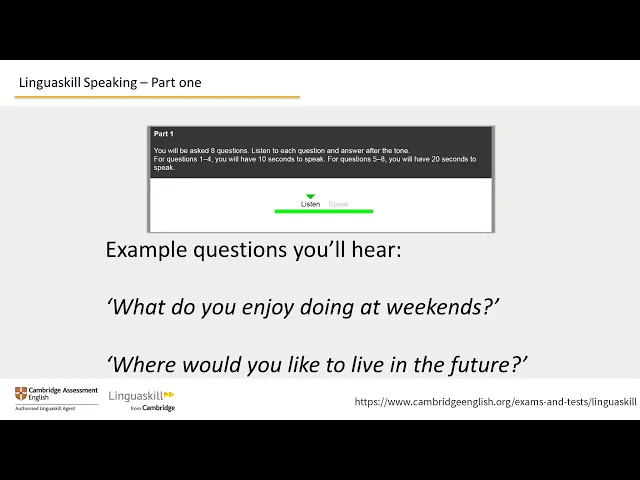
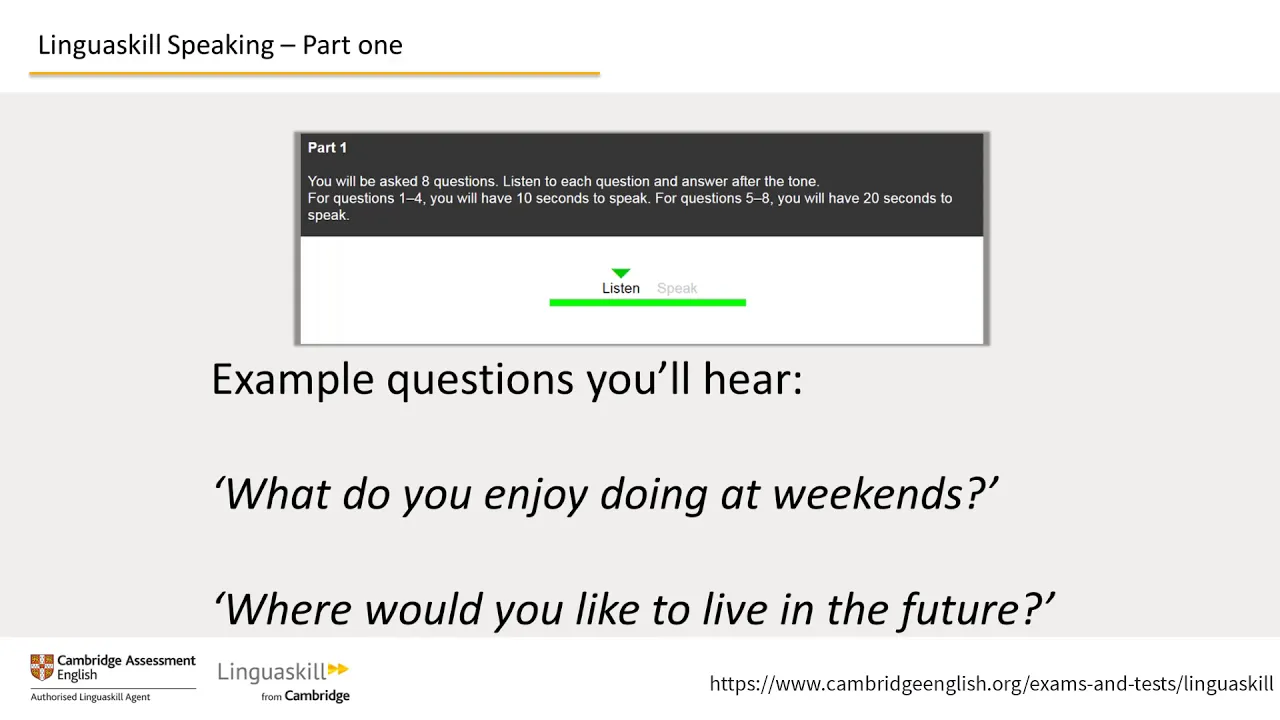
Let's look at part one of the Linguaskill speaking test. Here's what part one looks like. First, you'll hear the instructions, and then you'll hear a question.
After the beep, it's your turn to say your answer. The timer will run down, and you need to say your answer while the timer is running as anything you say after the timer stops isn't scored. There are eight questions, but they are always quite simple and will ask about your lifestyle or surroundings, or your opinions or preferences on a topic.
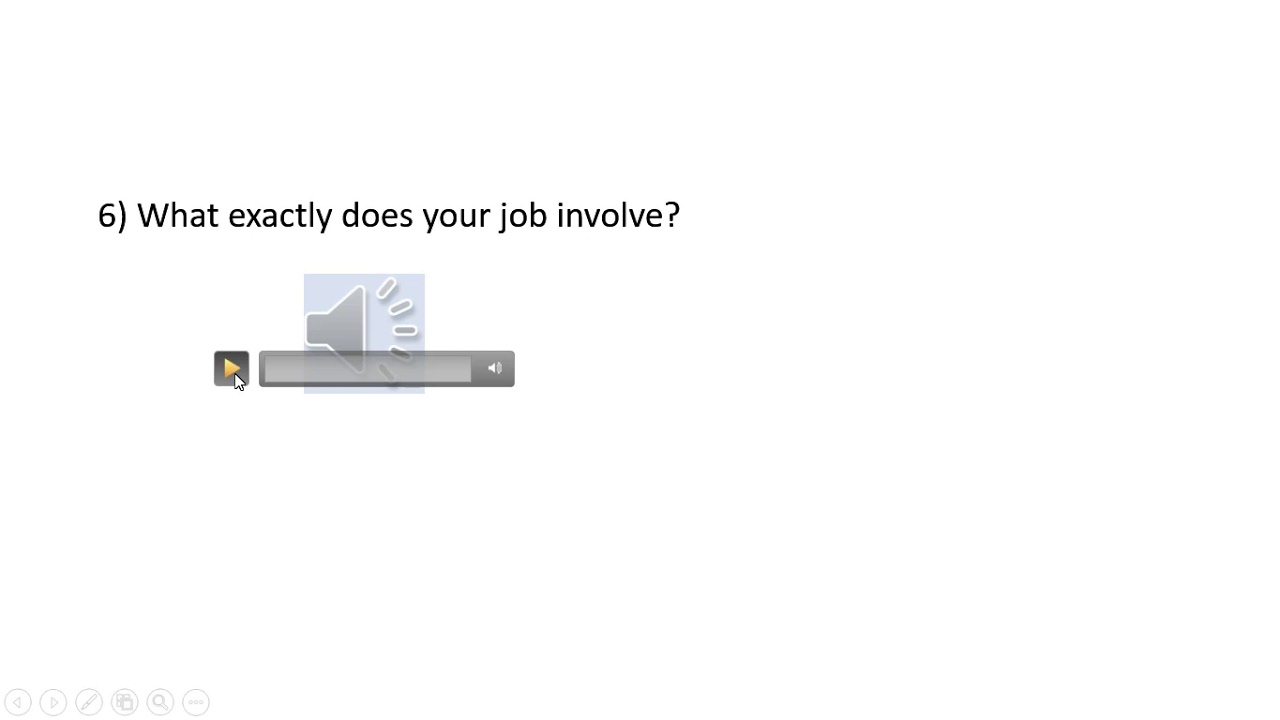
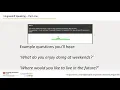
You can see some example questions here, such as: What do you enjoy doing at weekends? It's important that you give full answers and not just say "watching films", for example. A better response might be, "I usually enjoy watching films at weekends, but when the weather is good, I prefer going out for a walk with my family.
" If you see that there's still time left, try to expand on your answer, especially for questions five to eight. You should also look for opportunities to use more complex grammar structures in the questions. In the second example question, you can see that you should use future tenses in your response.
And you are also given the opportunity to use conditionals here, such as: If I could live anywhere in the future, I would choose to live by the sea. Remember, you need to accurately produce a variety of complex grammar structures with clear pronunciation if you want a higher score. Part two is simply reading aloud.
You're given ten seconds to read the sentence on screen. Again, wait for the beep before you start reading out loud. This part of the test assesses your pronunciation and intonation, so it's important to speak clearly and avoid adding contracting words.
For the sentence here, for example, make sure you say, "The library is closed", and not, "The library's closed". Here's an example of a part three task. There are many different versions, but you are always given a context to talk about and three bullet points with details to give you ideas about what to say.
In this part of the test, you are given 40 seconds to think of a response before you speak. You may want to write some notes while you think, so take a pen and paper into the test. Some test takers make a list of the main points using the prompts on screen to help give them ideas, so they can say more when it's time to speak.
You may not have thought about the topic or question before, so you may need to invent your response and use your imagination. The important thing is the accuracy and range of your spoken English, not the content, so it doesn't matter if what you say is truth or fiction. In the example here, you could try talking about a practical skill you've already learnt to give you ideas, but modify your language to pretend that you haven't, so you know about the subject in detail.
Here's an example of a part four task. This task requires you to compare and give recommendations based on the information. This time, because there is a lot of information to read, you have one minute to think of a response.
Again, use your pen and paper to make some bullet points of the key things you want to say. In this example, you should first decide which jacket you will recommend, and then write a list of positives and negatives about each jacket. In this kind of question, it's important to use language of comparing, such as "more than", "not as good as" or "better than", et cetera.
Now, let's have a look at the kind of notes you could take that may help you to keep talking when it's your turn to speak. Remember that you only have a minute to prepare and make notes, so don't write full sentences. But also remember that you need to make full sentences when you speak.
In this task, you should use language for making comparisons. But you could also use conditionals here, such as: If you decide to buy the Be Seen Jacket, you'll look great, but you might get wet when cycling in heavy rain. You will get a higher score when you use more advanced grammar structures accurately, so try to think of opportunities for complex language when preparing your notes.
Here's an example of the final part of the test. Again, you'll hear the instructions, then you have 40 seconds to read the information on screen. You may want to note down the key information on screen.
In this case, it's attitudes to technology and the Internet. Remember, you can make up your answer, and what you say doesn't have to be factual. The important thing is that you give a clear response to each question.
During the think time, look at the bullet points as these give you a general idea of the questions and run in the same order. For example, for the first question, you know the main point will be useful technology in daily life. So, you can try and think of what useful technology you use or what you know is something lots of people use every day, like a smartphone or the Internet.
You could also note down some positive or negative points. For example, the third bullet point: social media. Why do you like or dislike it?
What good or bad experiences can people have on social media? After the think time ends, you will hear short questions, each one followed by a beep, which is your signal to answer each question. This task is difficult because you have no time to prepare your answer to questions you're asked, just like a real-life interview.
But don't panic. Look at your notes and listen carefully to the questions you hear so you can answer them appropriately. If you don't understand everything or if you miss the question, try to give an answer based on the words that you do understand or on the notes you've prepared.
It's important to give a response to every question as you won't get any marks for staying silent or saying, "I don't understand the question". To help you get better at speaking, you could try using Speak & Improve. This is a free study tool that you can use when preparing for the Linguaskill speaking test or indeed any speaking test.
Your speaking is automatically scored on completion of each activity, and you are given a CFR level. Each part is similar to the parts of the Linguaskill speaking test, and the way the test works is the same, so it's a great idea to practise for Linguaskill speaking by using Speak & Improve. I hope you found this presentation useful.
You can find free study materials online at the links shown here, and there are other presentations like this in our series that you can enjoy. Good luck with your studies and good luck with your test. Goodbye.