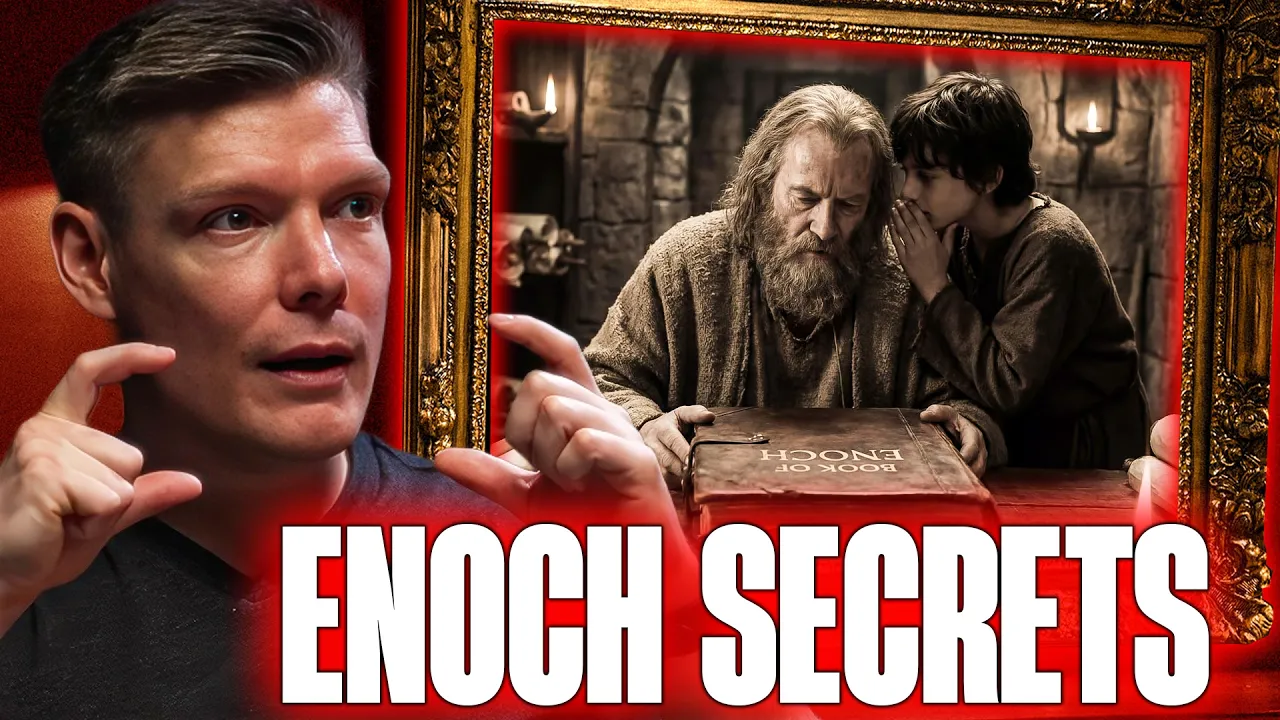
There's actually three books of Enoch. First, second, and third Enoch. The one that's typically referred to as the book of Enoch is first Enoch.
And some it's it's it's an amalgamated group of different literature. The Book of the Watchers, the Book of the Giants, uh the book of parables, these kinds of things that we all put into one book that we call First Enoch. Some of it's really old.
Uh, and actually right now on display at the Museum of the Bible, you can see a fragment of astronomical Enoch, which is on display, I think, for the first time ever. I don't think it's ever been displayed, this fragment of astronomical Enoch. But what the documents that make up what we call first Enoch are trying to extrapolate on is what's going on before the flood.
So you have in Genesis chapter 6 this very, you know, cryptic passage of the sons of God saw that the daughters of men were beautiful and they came and they slept with them and these women gave birth to these children that were the Nephilim that were the heroes of old, men of renowned. And so there's a bunch of different interpretations in the ancient world as to what this means. the um the Greek translation of the Old Testament translates Nephilim as uh gigas which is giants.
And so there's a there's one particular understanding of that. Uh and there's both a kind of naturalistic explanation that the sons of God weren't necessarily angels. But then there's another stream of interpretation that's fleshed out in something like the book of Enoch where it talks about, okay, well, who are these sons of God?
And so why were they um why why why were their their progeny? What were the Nephilim? And how did this come into being?
And so uh it kind of does this through a narrative about the great-grandfather of Noah, Enoch, and fleshes some of these things out. And this goes into like a long history of leading up to the New Testament where there's a, you know, the demons kind of show up in the New Testament. There really isn't all that much said in the Old Testament about demons.
But in some of this ancient Jewish literature that's incorporated and found in the Dead Sea Scrolls, we have some of these discussions of things like what are the demons? Well, there was a pretty strong thread of thinking within ancient Judaism that demons were disembodied spirits of the Nephilim. So, the Nephilim, if you're taking a supernatural understanding of who they are, their fathers are angels and their mothers are humans.
So, they're kind of these half supernatural, half carnal things. So when they die, their spirits don't have anywhere to go. So now they're trapped and they're wandering the earth.
They're aimless and they're constantly trying to get back into a physical form. And so they possess people and because they're not really meant to do that because they're these wayward supernatural beings, it never really works out and they end up making people do all sorts of crazy things and they're they're cursed because they're unholy. They're the the progeny of fallen angels.
And so there's all this stuff. So some of this literature is fleshing that out. Now, is that really what's going on?
I don't know. What do you think about that? I think it's very very interesting.
I think some of it makes sense. I think on things that scripture whispers about, I don't want to yell too loudly. Uh I I'm very cautious.
Um, I think it's entirely plausible given what the what we see within scripture and the fact that it's not 100% clear exactly what demons or even angels are, but that's what something like the book of Enoch is trying to flesh out. And so some of this literature what kind of falls into the category of what's called pseudopagraphical writing. So pseudo means false, right, in Greek and graph means writing.
So, it's a false writing. So, it's attributed to uh an author who's not really the author or about an author that's not necessarily meant to be thought of realistically as that author. So, Enoch um the book of Enoch almost certainly wasn't written [clears throat] pre flood in the time of Enoch.
And there's all sorts of ways that we can tease that out with even the timekeeping that it it includes is very influenced by the henistic timekeeping, the Greek timekeeping in the day. There are illusions to the book of Daniel, to the book of uh Deuteronomy and the book of Numbers, which are in the Inoian literature, which means that they're probably being written after those and especially the book of Daniel, which is in the Persian period. Uh that's quite late.
So, and even some ancient Jewish writers like Josephus who comes around at the end of the first century very beginning of the second century when he has his conversation in um in a writing of his uh where he's talking about scripture he specifically says that nothing was written before Moses. So he kind of disqualifies Enoch as being, you know, this is claiming to be written prior to there's no scripture that's written prior to that. So that's kind of his category category of of articulating that.
Uh but I mean these things are you look at the ancient world and how they're trying to flesh things out. And though they're some in some ways very ambiguous, like scripture tells us what we need to know, not always what we want to know. But I don't think that that means that we cancel out any idea of a theory or a probability or a possibility of say, you know, what is a demon?
I don't claim to totally know, but I think it's very interesting that the Jews themselves in the ancient world prior to and leading up to and during the time of Jesus, they're also discussing these things, wrestling with them and coming up with these ideas that we can read too. Interesting. And kind of like postulate on why did why did um well, how many Dead Sea Scrolls didn't make it how many of the scrolls did not make it into the Bible?
So, uh, yeah. So, I mean, part of the trickiness, like I said before, is that the Dead Sea Scrolls are kind of an umbrella category. It's like saying library, right?
Like there's a whole bunch, there's a range of literature. So, by the time in and around Jesus, the Protestant, what we have in the Protestant Old Testament was, I would argue, established as the Hebrew scriptures. So modern Orthodox Jews today, their Bible is the Tanakh, the Torah, the Naim, and the Ketvim, the law, the prophets, and the writings.
That's the same number of books that are in Protestant Old Testament. So there are other books that are also uh included in the Dead Sea Scrolls. Like I said, some of them are apocalyptic.
The war scroll is a really interesting one, which is, you know, another apocalypse. So, we have an apocalyptic book in our Bible, Revelation, right? But apocalypses weren't that uncommon in ancient Jewish writings.
In fact, Enoch is in many ways an apocalyptic book. Um, but the War Scroll is an apocalyptic book. And uh so there's different categories that are um included within the Dead Sea Scrolls, but what do you mean different?
I mean, it sounds like way I'm hearing that is there's different apocalypses. Mhm. Is is that what you're saying?
So, uh apocalypse is just a category of literature. It's like saying biography or letter or So, the one that ends up in the Bible is the book of Revelation. And that's tied to specifically the John who's, you know, traditionally associated with John uh the apostle of Jesus.
And so when we're talking about the canon of scripture, what books are or aren't included in our Bible, what the early church is doing, first of all, they have a direct connection in association with the early Jesus community. So there's a chain of custody in that there are individuals who are disciples of the disciples of Jesus. So you have guys like so the dagger I gave you is named after Irenaeus.
Irenaeus is part of a community where they're called the apostolic fathers where their own teachers are the apostles. So in one sense the earliest Jesus community has a direct line of communication with people who knew Jesus. Oh good.
And so when they're talking about, okay, you had the old covenant and there were books that were associated with the old covenant, right? God makes a covenant with Moses, you have the Torah, you have the law. God makes covenant with Israel, you have prophetic writings.
And there was an understanding in ancient Judaism that covenant and writings were in intricately connected. So Jesus comes along. He establishes the new covenant.
He establishes even like the signs of that in the last supper in the the eukarist to the Lord's table. And the apostles see themselves as kind of the arbiters of the new covenant. So the natural question for the earliest Christians who were Jews who believe in Jesus as the Messiah is okay new covenant where are the books because that understanding is is carried over.
It's an ancient Jewish understanding. God makes a promise. He makes a covenant with the people and it's followed up by books.
We have the new covenant. Where are the books? It's kind of the natural organic question that follows that.
And so very very early on the four biographies of Jesus, Matthew, Mark, Luke and John, they are uh being read as scripture. Um Justin Martyr, this early Christian writer refers to them as the memoirs of the apostles. He says when Christians gather together early in the morning, they read the memoirs of the apostles and and the letters of Paul are very early collected together and even in one single document.
So we in the late second early third century we have two collections of manuscripts uh when they're referred to as P46 and P45 and those are a grouping of the four-fold gospel cannon in Acts and Paul's letters. So like I said before most of these are circulating independently okay as like you have a copy of Paul's letter to Romans um because once again it's super expensive right I mentioned Codex Vaticanis earlier there's another one CCaticus uh which comes from the 4th century it would have taken 360 sheep to make so like no small uh commitment and effort and financial you know uh uh contribution So you would usually just have them in single books, but the four gospels we do find collections of them altogether. And whenever we have conversations of what is scripture, there's very little debate about the gospels and there's knowledge of other gospels, the gospel of Thomas, gospel of Peter, gospel of Philip, but they're always mentions in connection of saying they have no connection to the actual apostles.
We know what are the documents that have connection to the apostles. It's Matthew, Mark, Luke, and John. The Gospel of Thomas doesn't.
It's it's it's a it's a forgery. It's false. Thomas was dead by the time it was written.
So, we have early Christians talking about this stuff. And in in going back to your um original question, like when we have these conversations on canon, the the Christians are wrestling. Some books are a shoein.
The gospels we can tie directly to. Matthew, he was a disciple of Jesus. John, he was a disciple of Jesus.
Luke is a traveling companion of Paul. And Mark is intricately and closely tied to Peter. So those are kind of a shoein, right?
And then you have the letters of Paul. Those are kind of a shoe in. But then you have questions about some of the others.
And some of those questions have to do with the fact that you have other letters floating around with apostles names. So in our New Testaments, we have 1, second, and third John, right? The letters of John and first and second Peter.
Those took a little bit longer for the dust to settle on to get into what we would consider as like a closed cannon. And it it was partly because the early Christians were looking and they were looking around and they were saying, "Okay, there are other groups writing documents and they're co-opting popular figures names like Peter and like John cuz those are very, you know, key individuals in the early Jesus community. So we need to do our due diligence because we have we have first and second Peter.
We have this other writing called the Gospel of Peter. We have an Apocalypse of Peter. We have an Acts of Peter.
Let's let's make sure we know. Let's make sure we're actually reading the book that is tied to the actual Peter. And so some of these books take a little bit longer to get full wide acceptance.
And I think that's a good thing. And in terms of like books that are maybe found in the Dead Sea Scrolls that are like other um Jewish writings, uh the Jews had already fleshed a lot of that out in that they saw some of these books as very valuable, very um like key into the historical understandings of the Jewish nation, especially during the time of the Greek occupation and the Hasminian revolt. And like these were important writings.
Um, but the Jews didn't consider them scripture. And we can look at individuals like I mentioned before, Josephus who talk about this and kind of lay out guidelines and say like here's we don't have an innumerable books of uh holy scripture like the Greeks do. We have a set number and here's how we understand that set number.
And Paul says in the book of Romans that the Jews were entrusted with the oracles of God. And so part of the conversation of the Old Testament scripture is okay some people like Jerome in the 4th century who's responsible for putting together the Latin Vulgate which was the Latin copy of the Bible. It was the Bible of the church for a thousand years.
Okay. He goes back and he's a he's a very competent linguist. So, he knows Greek and Hebrew and he's going back and he's talking with rabbis and he's saying, "Okay, well, what do you consider scripture?
What are these conversations? " Um, and uh there's kind of a disagreement between him and Augustine about some Old Testament books. But, and so there are all these conversations happening, but ultimately the dust does settle and there is an established core of books and that's the 66.
the 66 that's in this Bible are the established core and there's debate about some others even leading up to the reformation which is why Luther says you know let's not worry about some of these other books that there's continual debate for that you know even some popes are not are saying that's not scripture um let's let's stick to the ones that we know the Jews themselves considered scripture and that's the central core and that's what we will hold to as the word of God. But all that to say, it's the Dead Sea Scrolls that kind of elucidate some of our understandings of that in looking at, okay, what were some of these groups reading and maybe how were they treating these books in the way that they were copying them that sheds light on some of these conversations. Are the are the other books that aren't in the Bible, are they published somewhere?
Can you get them? Oh, yeah. I mean, a Roman Catholic Bible will have what's called the duderoonical books.
Mhm. So dudero canon means second canon. Um so to give the you know the Roman Catholic church their due they would say second in reception not second in authority.
So they were officially pronounced as part of the official cannon at the council of Trent in the after the reformation. There was a counterreformation after the protestant reformation and that's when those books were officially designated as these are included in scripture. So you can get um Protestants typically typically refer to it as the apocrypha uh which is just a designation that goes back to the ancient church for books that are not canonical.
They're canonical or apocryphal. Doesn't mean all apocryphal books are heretical. They're just not part of scripture.
Um but you can read them. Yeah. First and first, second, and third Mcabes.
Um Tobit, Judith, you know, the battle of the dragon. Uh there's an extra chapter of the Psalms. These are, I think, good, useful books to read.
I would encourage everybody to read them because I do think that they they shed light on our understanding of ancient Jewish culture. And something like the Mcabes tell us about the story of Hanukkah where uh you had the Greeks, they go in and they take over Jerusalem and uh the the Greek emperor goes in and he he desecrates the temple by sacrificing a pig on the altar of God to Zeus. So like bad news bears all over the place, right?
Mhm. And uh then um Judas Mcabas uh Judas the Hammer, he goes in and he he he defeats them and he rededicates the temple to God. No matter where you're watching the Shawn Ryan Show from, if you get anything out of this at all, anything, please like, comment, and subscribe.
And most importantly, share this everywhere you possibly can.