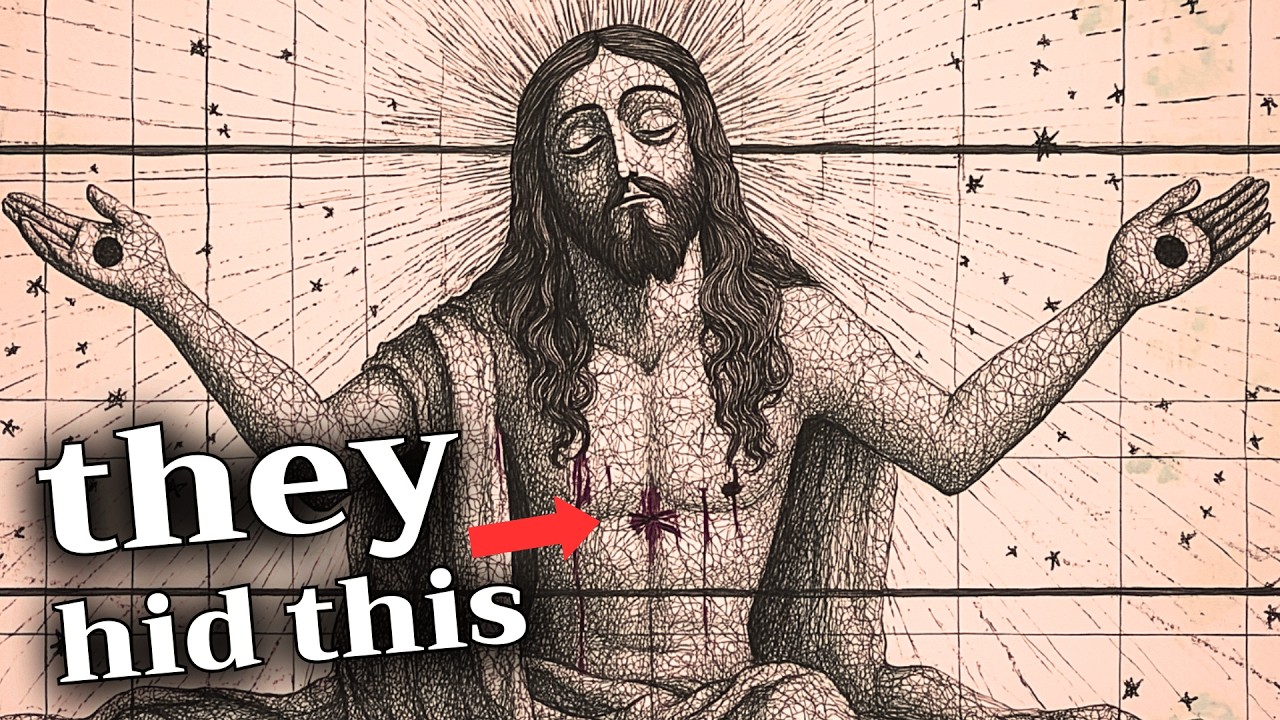
Imagine a hidden story that claims everything you thought you knew about the world's creation is a lie. The Church banished this story for centuries, keeping it hidden from curious minds. It's a tale about a mysterious being named Yaldabaoth, a twisted creator who traps humanity in a false reality and a different meaning behind the Tree of Knowledge, one that could change how we see ourselves forever.
This journey into the unknown will challenge your understanding of good and evil, reality, and the powers that control our world. Around 100 to 400 A. D.
, a significant debate was brewing among various religious groups. On one side, you had the Christian Church, which followed the familiar teachings found in the Old and New Testaments of the Bible. On the other side, there were Gnostic groups, whose beliefs sounded like something straight out of a mystical fantasy novel.
The Gnostics believed in a hidden truth about the universe, a secret that the Church didn't want to share. In On the Origin of the World, they asserted that a dark, arrogant being, not a loving God, created our world. In this story, he, also known as the Demiurge, is a creator with a big ego, thinking he's the only God around.
The Gnostics didn't see Yaldabaoth as the kind caring God described in the Bible. They saw him as a trickster, keeping people trapped in a world of ignorance and illusions. According to their version, the true power of the universe, the real divine light, originates from a place far beyond his reach, known as the Pleroma, symbolizing the fullness of light and wisdom.
This divine light, hidden from his understanding, is the true source of all spiritual knowledge. Around 367 A. D.
, the Bishop Athanasius of Alexandria decided that these Gnostic ideas were too dangerous, and he labeled their texts as heretical. He sent out letters condemning these beliefs and urging Christians to only follow the 27 books that would become the New Testament. He ordered the destruction of the Gnostic scriptures, many of which remained lost for centuries, buried in the sands of time and hidden in jars like the famous Nag Hammadi library, only discovered in Egypt in 1945.
The Gnostics believed that the Tree of Knowledge, the same one in the Garden of Eden, was a symbol of awakening, a way to break free from the trap of ignorance. The Gnostics thought the serpent was actually a hero, trying to help humans realize their own divine potential. They saw knowledge as a way to become like God, while traditional Christianity taught that eating the fruit led to humanity's fall from grace.
They asserted that the world we inhabit resembles a prison, concealing our true divine essence from us. Yaldabaoth and his angels, called archons, want to keep us here, stuck in a state of spiritual sleep. But through secret knowledge, like the teachings found in these banned texts, people could learn to wake up and see the truth.
It's like they believed there was a secret path out of the matrix long before anyone ever imagined such a thing. This idea terrified the early church leaders. They saw it as a direct challenge to their teachings, which emphasized faith in the God of the Bible and the belief that salvation came through Jesus Christ.
For the church, the idea of a hidden world filled with false gods and trapped souls was too dangerous to spread. It could undermine their authority and disrupt the unity they were trying to build among believers. We all experience moments when life seems overwhelming and finding answers seems unattainable.
In these moments, having more understanding, clarity, and guidance can make a significant difference. Banned Screts, the lost knowledge of Jesus, provides a path to clarity and peace through the hidden teachings of Jesus, and the best part is that it's currently available as a gift for you to download in the first comment posted. It could be what you need for today.
In the Gnostic story, gaining knowledge involves awakening to a concealed reality that has eluded us. For them, knowledge, often referred to as gnosis, the Greek word for insight, was the key to unlocking a deeper truth, a truth that the physical world is just a shadow of a greater spiritual realm. The Gnostics believed that the tree of knowledge aimed to awaken individuals to this concealed potential, providing an opportunity to penetrate the illusions that constrain us.
According to the Gnostic view, a loving deity did not create this world with its sufferings, temptations, and limitations. It was a prison for our spirits, a place designed to keep us from discovering our true, limitless nature. The act of eating from the tree of knowledge wasn't about breaking rules.
It was about breaking free. It symbolized the first step in reclaiming our awareness, seeing beyond the illusions, and understanding that there is something far greater beyond the physical world. In the Bible, the serpent in Eden is the ultimate deceiver, leading Adam and Eve into sin.
But in Gnostic teachings, this serpent takes on a completely different role. In these teachings, people perceive the serpent as a conduit of enlightenment, a guide attempting to reveal the truth that Yaldabaoth wished to conceal. Instead of being a symbol of temptation, the serpent represents the voice that encourages humans to question, to seek, and to uncover what lies beyond the obvious.
This shift in perspective flips the history, turning the serpent from a symbol of evil into a figure that empowers humanity. According to this view, the real danger wasn't knowledge. It was the ignorance that kept people shackled to a false reality.
By consuming the forbidden fruit, humans began to see beyond the surface, recognizing their own divine nature and the spiritual traps that held them back. But the journey doesn't end with just gaining knowledge. The Gnostics held the belief that remembering this truth in a world that strives to obfuscate it is the most challenging aspect.
Think about it like this. Imagine realizing you're in a dream, but every time you try to hold on to that realization, the dream pulls you back in. According to Gnostic teachings, the world we live in is like that, a place filled with distractions and desires that constantly lure us back into a state of forgetfulness.
This is why knowledge, in the Gnostic sense, isn't just about being aware. It's about staying awake. It's about holding on to the understanding that we are more than just our bodies, more than just our daily struggles.
It's the realization that within each person lies a connection to a higher spiritual reality, and for those who embrace this knowledge, it's said to lead to enlightenment, a state where one transcends the physical world and reconnects with the divine light from which we all came. Despite the constant barrage of information, we often experience a sense of disconnection from ourselves. The Gnostic message suggests that true enlightenment isn't about gathering more information, but about understanding the hidden nature of reality, seeing beyond appearances to recognize our true potential.
This ancient story challenges us to think differently about knowledge, suggesting it can be a tool for spiritual liberation rather than just something to fear. Each of us carries within us an eternal spark that the material world cannot extinguish. It's a call to look beyond the surface, to see the deeper layers of our existence and to remember that sometimes the forbidden knowledge is the very thing that sets us free.
Gnostic teachings suggest that this isn't just by chance. It's part of the fundamental nature of reality. Unlike traditional religious views that often divide the world into good versus evil, Gnosticism offers a more nuanced perspective.
It's a belief system that sees duality, the existence of opposites, as an essential part of the universe. But here's the twist. It's not about one side winning over the other.
It's about finding a balance between them. They believed that true enlightenment came from integrating these opposites, understanding that both light and darkness play a role in our spiritual journey. Think of it like the yin-yang symbol, where each half contains a bit of the other.
This symbol perfectly captures the Gnostic idea that within light there is a touch of darkness and within darkness a hint of light. Rather than viewing the material world as purely evil or flawed, they saw it as a necessary counterpart to the spiritual realm, something that requires understanding and transcendence, not just rejection. At the heart of Gnostic beliefs lies the idea of a divine spark, a piece of the true radiant light within each of us.
However, in addition to this divine essence, we also possess the shadow self, the aspects of ourselves associated with material desires, fears, and ignorance. Gnosticism teaches that instead of ignoring these darker aspects of ourselves, we must confront them. We must acknowledge our flaws and weaknesses, learn from them, and transform them into something higher through this process, known as integration.
It's analogous to the process of burying a seed in the dark earth for it to sprout into a plant. Our shadow self, according to Gnostic thinking, is like that soil. By digging into these hidden, often uncomfortable parts of our psyche, we can find the nutrients we need for spiritual growth.
This doesn't mean embracing negativity or harmful behaviors. It means understanding their roots and using that understanding to fuel a deeper connection with the divine light within us. One powerful metaphor that Gnosticism uses to describe this balance is the story of Eros and Psyche.
Eros represents desire and passion, while Psyche symbolizes the soul or mind. Their relationship is all about the merging of emotion and reason, body and spirit. It's a story of love and struggle, where both characters learn that they need each other to become whole.
This ancient tale embodies the Gnostic belief that we cannot ignore either our passions or our rational mind. Both are essential components of the puzzle. If you're enjoying this journey into hidden knowledge and ancient mysteries, consider supporting the channel with a super thanks.
Your support enables us to continue our exploration of these fascinating topics, unveiling centuries-old secrets. When Eros and Psyche finally unite, it represents the moment when a person integrates their inner desires with their higher mind, achieving a state of harmony. This union is what the Gnostics saw as the key to unlocking deeper spiritual awareness, not choosing one path over another, but finding the bridge between them.
This idea challenges the traditional notion of renouncing earthly desires entirely, instead suggesting that even our desires can be pathways to higher understanding if approached with wisdom. Embracing both light and shadow allows us to see the world as it truly is, without filters or illusions. They believed that by understanding and integrating these dual aspects, we could become more complete, closer to the original state of pleroma, the fullness of divine light.
By recognizing both the light within us, our divine essence, and the shadows, our earthly struggles, we gain a complete vision. It's like waking up from a dream and seeing the world in vivid detail for the first time. This understanding allows us to navigate the challenges of life with clarity, knowing that every struggle is an opportunity for growth.
The Gnostic teachings show us a version of reality that is rich with symbolism, mystery, and a powerful message about the nature of our existence. It's a narrative that challenges us to rethink the way we see creation, knowledge, and the struggle between light and darkness. It serves as a reminder that our journey encompasses more than just choosing good over evil.
The forbidden knowledge the Gnostics spoke of is about more than just ancient secrets. It's about having the courage to question everything, to look beyond what others tell us, and to seek the truth that lies within. The Church may have tried to bury these stories long ago, but here we are, centuries later, still curious, still digging, still hungry for the truth.
It's almost as if these ancient ideas refuse to stay silent, pushing us to wake up from our comfortable beliefs and see a reality that is more mysterious and complex than we ever imagined. And in this search for truth, there's a sense of both wonder and urgency, a realization that understanding our place in the cosmos might be more important now than ever before. Thanks for watching.
Be part of our community by subscribing to this channel. Until the next video.