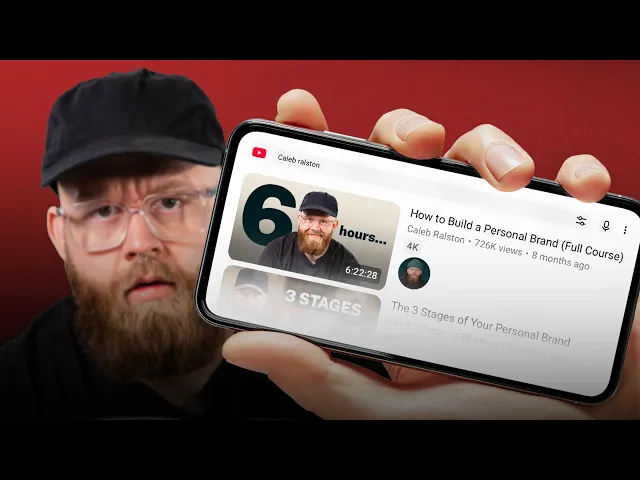
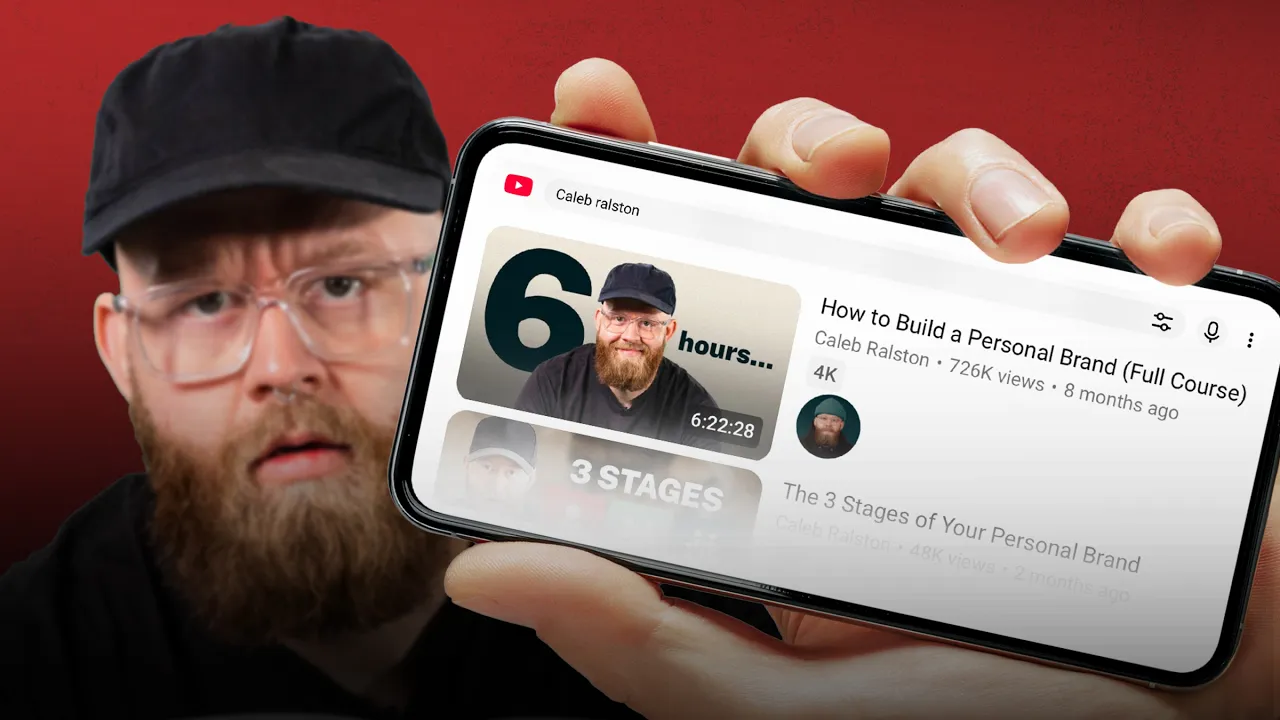
If you're one of those people who believes that giving away free things leads to less customers, not more, I have a story to tell you. Earlier in 2025, I decided to put out a 6 1/2 hour free course on YouTube. This free course has generated to date 36,487 leads, which is insane.
So insane that it actually ended up becoming a problem for my business. I couldn't manage it all. Even crazier is that 8 months into this video being live, we are still getting over 100 leads every single day.
And so what I'd really like to do with you is share how we got started and how you can go about doing this for yourself. I spent the first 15 years of my career working inhouse behind the scenes for some of the biggest personal brands in business. Over the years, I've gotten tons of questions from people who wanted information from somebody who was actually in it.
Not a guru who's only grown their brand and maybe had success for one or two years, but they were seeking information from somebody who has been doing this for over a decade now. So, the first place we started is we looked at what was the industry norm. And in our industry where we're talking about personal branding specifically for business owners and entrepreneurs, it was a whole lot of 10 to 15 minute long master classes.
That was the majority of what people were putting out there. And what they were doing is teasing information, teasing value, but not really delivering anything that was actually that useful. What they would do is they would take you right up to the edge of the cliff and then they would leave on a cliffhanger.
And the way that you could close that loop that you had is by buying their paid course, the course that they housed behind a payw wall. Do I think there's anything wrong with charging for a course? No.
The way I learned photography growing up was I bought a bunch of courses and got a lot of value out of it. But the thing that I noticed is that a lot of these courses they were selling were a couple years old. Not only that, they just weren't that useful or relevant.
Well, we looked at what the norm was and we're like, cool. We're going to do the opposite. Instead of putting out these 10 to 15 minute master classes, we're going to put out something powerful.
I believe the course we put out for free on YouTube is fundamentally better than 99. 9% of paid courses around personal branding. So, it was our hypothesis that if we do the exact opposite of what everybody else in the industry was doing, in theory, we will stand out because of it.
Now the second thing that we noticed in looking at our space is that there was a lot of content around content strategy but there wasn't as much content out there around brand and what brand is and how it relates to building your personal brand. And so we saw a wide space that we could take advantage of. And so if we jump in and we do that, we fill that need.
We believed that there was a chance that we would stand out and we would start to get more traction because of that. The third thing that we noticed was the majority of videos in this personal branding world were very narrow. What I mean by that is they were taking one specific principle or tactic and just speaking to that only.
And if you were to put together everything to build a personal brand, you'd have to stitch all of these different videos all over YouTube. And they'd be from different creators, too. So, there wouldn't be one consistent perspective that would be applied to the strategies that are being shared on how you can grow your personal brand.
And that's fine. That makes sense. And and that's how the majority of niches on YouTube are.
But what I wanted to do, and our theory was, we would put together one piece that encapsulated everything. It's your one-stop shop on how to build a personal brand. And in doing this, it would cause people to keep coming back to our video.
And so in the same way that they might consume 13 different videos over the course of, you know, several months on YouTube, they might be able to actually condense the amount of time that it takes to learn these principles and tactics and they get into the action quicker. And the fourth thing that we noticed is that a lot of the individuals that were making content around personal branding had done an incredible job growing their own personal brand. And I want to give massive credit on that.
That is a hard thing to do. But then what they were doing is going out and giving advice on what you should do to build your personal brand. I think you should be very careful about who you take advice from.
If you take advice from somebody who has only had success one time in one very specific lane, maybe what you want to do is listen to them from the frame of this is what I did. But if it's somebody who has done this in multiple situations in multiple different time ranges, right? what was working in 2015 to 2018 hasn't been working in 2024 to 2026.
You want somebody who has had that experience in multiple different scenarios because then they're able to speak to it from a principle base, not a tactic base. And what we noticed is that the majority of people making content around personal branding were speaking to tactics, not principles. Why?
because they lacked the experience to be able to teach principles. The best version of this is someone who has had success with multiple personal brands for other people and success for themselves. And so that's why we're on this journey this year of making content and building my personal brand.
Going into this, we had really low expectations. And at the time, I thought they were actually kind of egregious. I thought they were really high when we decided to make this course.
I remember turning to Trevor, my content director. I remember telling him, I was like, "My goal, dude. " Like, I would be flabbergasted, completely stoked.
We're popping champagne if in the first year we get a,000 views, 5,000 views, or 10,000 views. I can't remember which one of those three it was. It was either 1,000, 5,000, or 10,000.
8 months into it being live, that's where we're at right now at the recording of this video, we are at over 700,000 views. I never could have imagined that. Like I'm not gonna get all choked up and stuff, but like deep down inside I get emotional thinking about that.
Like I've been the guy behind videos that get 700,000 views. And I remember saying things to myself and the team being like, you know, I would never be in front of the camera. I could never accomplish anything like this.
Like there's never going to be that many people that ever would want to hear from me. The other thing that we went into it thinking was like not even in the first year. I remember telling Trevor, "Maybe one day we can get to 10,000 subscribers on YouTube.
" According to YouTube's attribution, which for all you YouTube nerds, I know this isn't accurate, but I'm just sharing it. YouTube says that we have directly gotten 30,000 subscribers from this one video alone. At the date or at the time of recording this video, we're somewhere over 67,000 total subscribers on the YouTube channel.
The other thing is we were thinking maybe a couple business owners will watch it and go, "Damn, that's way too complicated for me to do on my own. This guy's clearly an expert. I'm going to work with him.
" To date, we've had over 750 different businesses apply to work with us one-on-one. The other thing that we were thinking through is like we wanted to not just put this out, but you know, we're trying to build a business, so we wanted to capture emails. We put together a wildly robust uh workbook to go along with this, especially considering the fact that this is all for free.
Like I'm pretty sure the workbook is like 40 pages or more. There's a bunch of different exercises. We put like official job descriptions.
I mean it it's robust. It's crazy. And our hope was that we would be able to get maybe a couple hundred people.
As of filming this video, we're at over 39 39,000 people on our email list. There are people who are spending hundreds of thousands of dollars every single year to build a list that's half this size. I'm not saying this to try and brag on you.
I'm not trying to show you how great I am or that I'm some warm booger on a golden platter like my sixth grade teacher, Mr Pierce, used to say. I'm sharing this because I think it's shocking that you are missing out on so much potential by housing your course behind a payw wall rather than putting it out in a world where it can be discovered by so many people. Now, we're going to talk about how you can do this on your own.
One quick qualifier that I want to give, and this is super important. If your business currently is operating in a manner where the majority of your revenue is driven by that course that you're selling behind your payw wall, well, then clearly this is not the right move. Now, there's versions of this where maybe you have a course that you're currently selling and maybe you either film a new one and you replace that one and the old one goes for free on YouTube or you put out a new one that's maybe a little bit shorter and it solves problems that precede the problem that your paid course solves.
But what I want to make sure that you do not do is if you are making the majority of your income off of a paid course, don't just turn and flip it to YouTube and be like, "Caleb said to put it out for free. " Like, that would end up being very bad. Now, if you're still here, you're probably at this point on the edge of being convinced, right?
You probably are like, "Yeah, this this seems like a good idea. " Like, those are some pretty crazy numbers that he said. Maybe I should do this for me.
But you're also probably feeling a little confused on what does this version look like, right? Like, I'm ready to do it, but what am I going to do? And the first question that I think we should be asking, which is a little bit of a an intense question, but I would ask you to answer it honestly, is do you got it like that?
See, I believe that you're going to fall into one of two different camps. You've got the student and you got the expert. The student is the person who is on the journey of learning.
They don't have years of experience. They don't have big W's that provide for credibility and reasons for you or for your audience to listen to you. And your job is going to be sharing the learnings along the way.
The other camp is the expert. This is somebody who does have the years of experience. They do have the W's in their back pocket on their resume to provide credibility to the words that are being said in the content that you're making.
And so what you need to do is determine, am I the student or am I the expert? And then what you're going to do is make the decisions through the following steps accordingly based on whether you are the student or the expert. Oh my god.
Well, I forgot to film the ad for the worksheet uh that we made to go along with this video. Don't know how I forgot to do that because I literally talk about making a workbook to accompany your Yeah. Anyways, doesn't matter.
There is a worksheet that's going to help you actually answer all the questions that we walk through in this video. All you have to do is click the link in the description. Make sure you download that, follow along, and uh I hope you enjoy the rest of the video.
Now, the second thing that you want to do is look at your industry. Again, I hit pretty hard earlier on being abnormal or going against the grain, doing things differently than what the majority is doing. The point that I want to hit on here is if you are in a niche in a space where the majority of people are making free courses and putting them out on YouTube, I would argue you should probably stop here.
This is probably not the right strategy for you because it's not going to stand out in the way that maybe it did for me in my space given what the norm was. If this goes against the norm, then proceed. If this is what everybody else is doing, I would consider a completely different alternative version of this entire strategy.
And then third, it's going to be what is this course about? The level of width on the subject matter that you're going to cover in your course, I believe, should match the level of width that you have in your skills and experience. Here's what I mean.
I didn't make the course on how to build a brand but it was all about personal brand. I don't have as much experience and expertise on growing a brand in general. My experience and expertise comes from growing personal brands.
We designed this entire course to be about how you can grow your personal brand. Another example of this is you might be really good at building businesses. Okay, but what kind of businesses is this?
Brickandmortar businesses, health and fitness related businesses, ecom businesses, right? Like what kind of business are you good at building? That, in my opinion, is actually the course that you should make.
Let's say that you're really good at building brick-andmortar businesses. Well, then your course should be on how to build a brickandmortar business, not how to build a business in general. I believe that you're going to provide far more value by working within that constraint.
I also think that by making sure that it's very clear what the constraint is, you set proper expectations for your audience. You want it to be very clear who this is for and who it's not for. I believe that you develop trust by setting expectations and meeting those expectations consistently.
If we set proper expectations, amazing. We build trust. If we set improper expectations and a musician, let's say, watches my course and does everything that I say in it and doesn't get the results they're looking for, well, they're going to not trust me as much.
And so, the key here is to really be thoughtful about what your domain is and maybe taking the original idea that you had as I was talking previously throughout this conversation and see what can I really own within that domain. Because every level that you chunk down in your expertise, you're going to be able to go deeper and provide more value than a lot of your counterparts that are just scratching the surface on what they provide their audience. Or let's take beauty for example.
You can make a course on how to be beautiful. But within beauty, there's so many different subject matters or topics or lanes. Fitness, there's wardrobe, there's hair, there's makeup, there's cosmetic surgery, there's all of these different things that you could speak to.
And if you happen to be an expert at all of those, then cool. Put those all into your course and make one on how to be beautiful or whatever. But using this example again, if you're only an expert in wardrobe, right?
Like you understand how to put together the best fit, right? You can take somebody like me that looks like an average Joe and make them look like, "Oh my god, was he just on what not to wear? " Well, then cool.
Make your course on how to build a wardrobe that insert outcome, right? like how to build a wardrobe that attracts your ideal mate or something like that. That's what you could speak to rather than beauty as a whole.
If you are an expert in all these things, if you can touch on all the domains, right? Like the way that I can touch on brand, content, and team, maybe consider putting all of those into one chunked up version where, as I said earlier, the cool thing about this is then it's a self-contained thing. It's a one-stop destination for all the information that you need.
But on the flip side, if you're not an expert, then you're going to reveal your lack of expertise if you do try to do this. Now, one one quick little caveat, that thing that you're maybe a little bit more in the shallow end of the pool on, I'm not saying don't make content around that. You just need to make sure that you frame it correctly.
And so what I would recommend you do is instead of trying to lump it or force it into this course that you're developing, make it as its own individual piece where you can set the framing of you and how you speak to this subject matter properly so that your audience doesn't get it twisted. Now, after all that mumbo jumbo, the big question that you need to be asking yourself is, what are the problems that my ideal customer faces? That's ultimately what you want to make your course about.
My ideal customer doesn't understand a lot of times what makes their brand stand out, what makes their personal brand different than others. They also don't understand what is their personal brand. A lot of the people that you're watching, you know, the video that you watched before mine, a lot of these creators, they wouldn't be able to say in one sentence what their personal brand stands for.
I'm talking people with millions and millions of followers. That's a problem that my ideal customer faces. And so I wanted to help them solve that problem in one of the sections of the course.
The next thing is once they do understand their brand and understand what their personal brand stands for, how do they amplify it? You know, they they hear a lot of the viral optimizationbased content strategies from people. And some people, a lot of our ideal customers have actually tried that out and not found success in that.
And so we had to help them solve that problem, which is what does it look like to develop a content strategy that actually drives real results for your business, not just vanity metrics. Not only that, but one that you can stick with for more than, you know, 6 months. And so we help them solve that problem.
The next problem is, okay, I'm starting to make content consistently. What do I do with my media team? Or for our real ideal customers, it's like, I already have a media team, but it's not running very well.
How do I run it? Well, then we help them solve that problem. The key that I want to remind you on is that you're helping them solve that problem generally, but you're not helping them solve their specific version of that problem.
So, they're seeing your expertise and ability to solve the problem, but they still need the nuance difference and the tiny little, you know, context pieces that apply to their specific scenario that you're not able to address in your content. And so that's where again something like this is able to solve a bunch of problems and help a lot of people for free. I think that's a great thing to add to the world, but you're here to also grow your business.
And the people that are going to be your ideal customers aren't going to have enough time to actually execute everything that you share on their own or they're going to have a team that can execute it, but maybe their team doesn't know how to apply those principles in their specific context. And that's where working with you comes into play. Now, the fourth thing that I would encourage you to think through is who is the audience and where are they at on their journey.
We've identified the the space and the niche that we're going to be in. We know what our expertise lies in and that's what we're going to talk about. What we need to figure out then is who are we making this for and where are they at?
My how to build a personal brand course is not for people going from, you know, let's say a five to a 10. And it's not for people going from a zero to a two, right? Like, if you've never done anything for your personal brand, you could learn a lot from the video, don't get me wrong, but it wasn't designed for that.
It was designed to get people who are at a two to a five. So, it's not my most basic entry level and it's not my most advanced, really in-depth I knew that going into it. And so by knowing that it will, and this is going to sound obvious, but it will cause you to know what you should and shouldn't include.
We removed a lot from the course because it was either too advanced or it was speaking to somebody who had never made content or started their personal brand at all. But again, the goal was we were trying to take people that had gotten some momentum and get them to the halfway mark. What you need to determine is who am I making this for and where in their journey?
Using the wardrobe example uh that I I gave a second ago, is this for somebody who has no idea how to develop a sense of fashion and style? They they have no style of their own. They're just wearing whatever.
Or are they somebody who already has a sense of what their fashion style and taste is? they have some creators that they like to follow and they have a cool wardrobe, but they're looking to make it more intentional, maybe more diverse, right? Like something in the apparel or fashion world is being able to have modular sets.
So having, you know, a top that goes with five different bottoms, but that takes some expertise in knowing. I'm not an expert at that level. And so if you were to look at my closet, it doesn't look that way.
So figuring out who am I making this for and what stage or where are they at in their journey on what I am teaching them. The other little asterisk or additional point that I'll add on to this knowing where or who it's for and where they're at on their journey also informs the level of context that you provide on certain terms. I give a lot of context in the course on different terms and terminology, but there's some items that I am making the assumption that the audience understands going into it.
If I were making it for 0 to2, there would be a lot more defining of terms and like little lower thirds to add context. So, what you want to do is you want to have the amount of context and explanations and the level of depth that you go into that should be determined again by who this is for and where they're at in their journey. It's so simple, but answering this provides so much direction on what you should do for the rest of your course.
Now, the fifth thing is it's time to outline this We need to put pen to paper and make this a reality. This is the king or queen obvious here, but I'm going to say it anyways. You need to put a lot of effort into outlining and writing this course.
The thing that I've noticed that a lot of people that I've had this conversation with misunderstand that I know you're not going to misunderstand, they they think that they can put this together in like 3 or 4 hours and just put it out there and that it's going to work. There's over 700,000 hours of content being uploaded to YouTube every single day. For you and I to just sit here and think that we can put a limited amount of effort into something that we're making and that it'll stand out is absurd.
I spent at least 80 hours in pre-production on the course easily. Like it's a 45 to 50page outline that I rewrote over and over and evolved over and over. There was some times where I was wondering, is this going to be worth it?
like I'm investing a lot in my second month in business. I was investing a lot of my time into developing this thing that was going to be completely for free. But I also knew that's what it took to stand out in a world where there's so much everywhere.
We released it April 4th of 2025. Depending on when you're watching this, this might sound funny, but the evolution of AI content has been rapid since April. There is way more out there.
There's way more content being produced and uploaded to these platforms now than there was eight months ago. And so it is my opinion because of that the level of effort that is required for us to stand out goes up. Don't cash this in.
Don't have this be one of those things where you outsource it to your team. You know, you have your team write your course on how to bully. This needs to be something that you put an incredible amount of effort into.
The little hack for those of you that have an insanely busy schedule is just change the amount of time or the the timeline that you're trying to accomplish this on. Instead of trying to, you know, watch this video and then turn to your team and be like, "All right, cool. Let's let's have something that we ship by the end of Q1 next year.
" Well, okay. May maybe you work on this over 6 months in order to be able to put the level of effort that is required for something like this to actually stand out. Now, that effort, what does that effort look like?
That effort looks like writing, outlining, scripting, researching. I could spend a couple hours talking through how you should structure your outline or your script for your course, but for the sake of your time and for mine, I'm not going to go about, you know, going into the weeds on this. I want to cover this at a high level.
And something that I want to share with you, and in future content, I'm going to hit this a lot more in depth, but you need to have a really strong intro. Something that you might be considering right now is maybe you have a course already, right, that you've already made and it's maybe existing on your website, maybe it's free on your website, or maybe it's behind a pay wall. And maybe you're considering just taking that course and putting it out on YouTube.
The problem with that strategy, you probably didn't write and film the course with YouTube in mind. You made it with a completely different psychology in mind. You had it in mind that people were already bought in.
They either paid, so they're literally bought in, or they came to your website and there's not competing videos on the right side. But the reality is on YouTube is that you are constantly competing with other things that could pull their attention. You're also getting text messages, Slack notifications, like people on their team are coming up.
Like there's so many things that are competing for their attention. And so the intro for your YouTube course needs to be wildly different than the intro for your website hosted course. We use a framework called the four C's.
This goes for your packaging and your intro is you want to have your call out, your credibility, your compass, and your core learning. Your call out. Who is this for?
Who should be watching this and consuming this? Your credibility. Why the should I listen to you?
Right? like why should I take what you're saying seriously and actually put it into application. Number three is the compass.
This is also known in the YouTube world as the road map. Where are we going? Where are we taking the audience on this journey?
How are we getting their desired outcome? And the fourth one is the core learning. This one I've never heard anybody talk about in how they think through a framework for their intro.
You're here because you're making educational content. And it is my belief that the greatest retention hack in the world is not, you know, some dopamine injected motion graphic every 13 seconds in your video. The greatest retention hack in educational content is your audience learning.
And so I believe you want to get into a core learning very quickly in your introduction. So that's how I like to think about the intros. Again, there's so much more to go into it, but at a high level, that's how I would encourage you to be thinking about the intro for your course.
So, then from the intro, then you're going to go into your sections. I'm going to give you one kind of version that you can do here, but there's many different ways that you could skin this cat or eat this elephant. That's such a weird uh statement.
What I want you to think about for your sections here at a high level is you want to first rehook the audience. Even for the first section, right? We just went through the four C's.
You got your core learning. Let's re-engage them. Let's rehook them.
For your second section or your third section, I'll speak to this as somebody who's had a course like this out for, you know, almost a year now. The majority of your audience isn't going to consume it in one session. They're going to consume it in bite-size sections.
And maybe they come back the next day, 2 days, 5 days, or a couple weeks later. And so in doing that, I like to think through the frame of basically if they're coming back to a new section, like if they stopped after brand and they're coming back to content, this is a whole new video for them. So I need to treat it like a whole new video.
I need to have a really strong intro. So in that rehook, I encourage you to use the four C's. The next things that you want to do though are so you have your rehook, then you should provide some context.
Provide them context on what we're covering in this section and how it relates to the course as a whole. Then the next thing that you want to do is speak to principles. I encourage you to teach off of not just tactics, the things that they can apply and work today, but principles which are timeless.
Then share a story about a time where you tried to apply that principle either successfully or unsuccessfully. Or maybe it's a client of yours that tried to apply the principle successfully or unsuccessfully. Then after that, I like to go into tactics.
This is where you share the specific actions that are working right now that your audience can apply from your content. And then I sometimes will even share a story or an example of how you can apply that tactic. What I've done throughout this video a couple of times is given several different examples of how you apply a principle or a tactic so that you can see yourself or hopefully can see yourself in the example.
And that's the power of sharing those. this is going to be a really good starting point for you. Again, there's so much more that we could go in depth on in how you structure this, but if you follow just that basic structure, you're going to make a wildly useful course for your audience.
And the the thing to remind yourself on, and I've been saying it throughout this, but in outlining, think about your audience first. What I would encourage you to do is even picture a specific person. I do this for all the content.
Like for this video, there's one specific person that I'm thinking about sitting down and having this conversation with. Have that specific person that you're making this course for. This will help you in determining what examples you should share, what principles and tactics you should be sharing.
This will inform how you outline the video. But more importantly, once you've done the outline, you can review it through the frame of is this useful for Sarah? Does this help them accomplish what I'm trying to help them accomplish?
And if the answer is no, well then you know what's next? Remove it. Again, like I said, there's no oneizefits-all.
There's many different ways to do this and a lot that are very effective. I'm just sharing with you a top level easy version to get you started. Now, steps six through eight here are super super obvious.
Step six is you got to film the damn thing. Okay? Then you got to edit that And lastly, you got to distribute or post that Put it out into the world.
So boom, there you go. Steps six through eight. Now, one thing that I'm going to add that we didn't really touch on too heavily, I also believe that if you're going to go through this insane level of effort to put together something so robust, you should try to make it really easy for your audience to follow along and actually take action on what you're sharing.
You also should probably reap the benefits of this hard work. And the benefits in this case are emails, really warm emails. I would encourage you to make a workbook that goes along with the course that you're putting out.
And getting very granular for a second, the description of your course, the top line should be informing them of the workbook and linking to the page on your website where you host the workbook that they can get for free as long as they enter their email. This is beautiful because now you have earned this person's slot on your email list and then you can do amazing things like send them awesome offers that take what you've put out for free and contextualize it to them individually. And so I would highly encourage you to do this.
One thing that I'll note is that might sound wildly audacious and insane for you to accomplish. It's like, oh my god, I got to write this whole outline for this course and I have to build an entire workbook all before I even film. Well, the way we went about it, again, I try to optimize for ease and sustainability, is so far to date for the courses that we've developed workbooks for, we've made the workbooks after we filmed the entire course.
I knew a couple of the exercises or playbooks uh or checklists that were going to be included, and so I would mention that on camera in the course. But what we did is we filmed it, we edited it, and then we reviewed it, and we watched for all the spots that I called out. So, those ones we obviously have to include.
But then we were also watching for any additional exercises or playbooks that would be valuable to include that I walked through, but maybe didn't mention that there was an associated exercise or playbook with. And so this is where you're able to add in a bunch of extra valuable that is wildly useful for your audience, but it doesn't require you to go through the insane effort of thinking all of this up front and coming up with all of this. Because once you do a couple of these, you'll be able to figure out what your workbook is up front.
But I'm betting right now, if I were to tell you, hey, I want you to outline your course and outline your entire workbook before you film. You may never do it because it'll be a reason that you can point to for why you're procrastinating. And so I would encourage you make it easy for you to get started.
Determine what goes in your workbook after the edit is done. And then you can go in and add the lower thirds that inform the audience that hey, there's an exercise that's in the workbook associated with what I'm walking you through right now. This workbook allows you to reap the benefits of all the effort that you put into this massive, monumental piece of content.
I'm not out here preaching that you should just be the most Mother Teresa character and just give this out for free without any sort of monetization vehicle on the back end, right? Like I'm trying to build my business, you're trying to build yours. I just believe that it can be done in a way that I view as a little bit more tasteful that also ends up earning you far more trust upfront than the paid course workflow or strategy does.
And just like the fire burned out, so has this video.