Hi, everybody. Welcome to www. engvid.
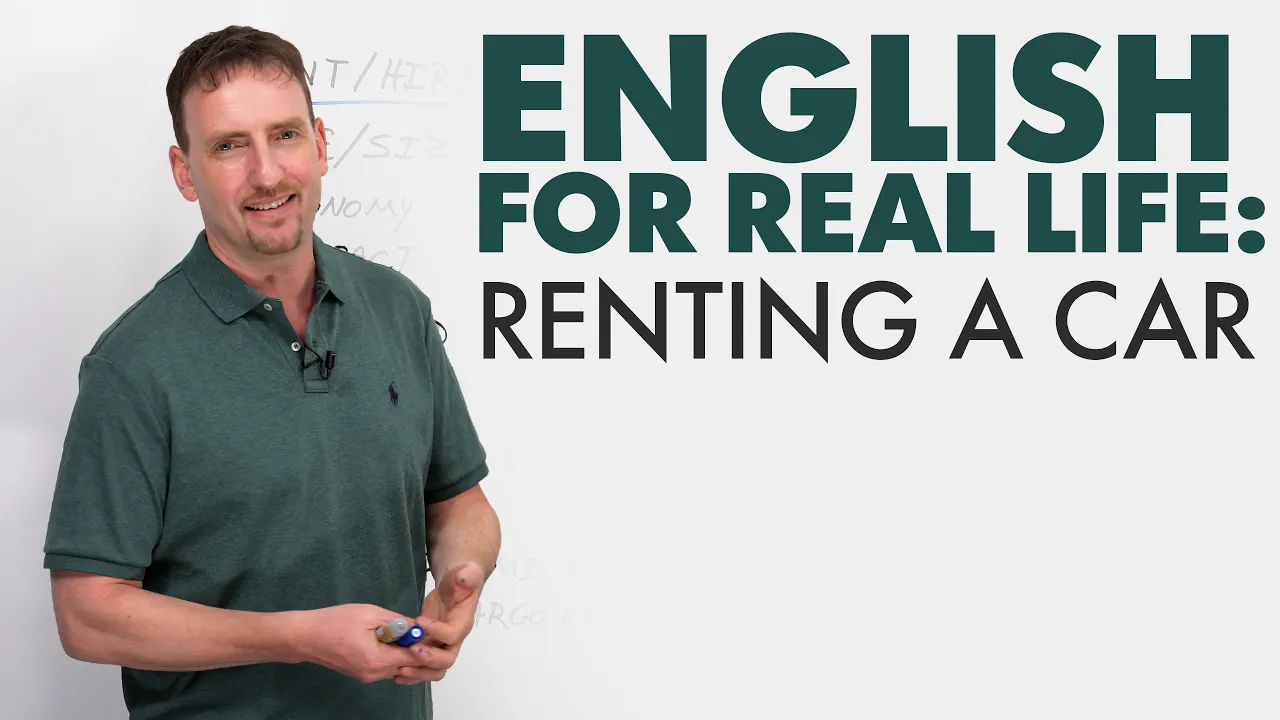
com. I'm Adam. In today's video, we're going to talk about renting a car, okay?
And all the things you need to keep in mind before you go to the car rental place. So, you'll notice here that I wrote "rent a car" or "hire a car". So, this is North American English; this is British English.
In English, you would hire a car; in Canada, US, you would rent a car, just so you know that. So, the first thing you're going to have to consider is the type of vehicle you want. So, actually, I should write this word here.
Anything that moves. . .
A little bit mixed. Anything that moves on wheels is essentially a vehicle, okay? For now.
So, you're going to have to consider the type or the size of the car that you want. So, generally, they move up in price as you get bigger. .
. A bigger car or a bigger engine. So, economy.
That's the cheapest car you're going to get. It's also the cheapest on gas, which is a good thing. If you're thinking about saving money, you might want an economy car.
Now, keep in mind that an economy car will be very small. Usually, it will be a hatchback. A hatchback, there's no trunk; the back door opens.
So, usually, you have, like, maybe two doors on the side and the back door opens up, and it's a very small car, and we call that a hatchback. Next, you have a compact car. Compact could be a sedan or a coupe.
A sedan has four doors; a coupe has two doors. So, a coupe is considered more like a sporty car, but they come in all. .
. The different sizes can be sedans or coupe. So, the compact car is also pretty small, has a small engine, usually four cylinders, and it's also very good on gas, but it's a little bit bigger than the economy.
Then you have the standard. The standard generally is comfortable for five people; two in the front, three in the back. It's also generally a four-cylinder, but it has a little bit more power.
It gets more gas into the engine, it can go a little bit faster, a little bit better gas mileage as well, and generally just a little bit more comfortable, but again, just getting bigger and bigger. Then, you have either a full-size car or a crossover, and these are generally considered basically family cars, where you have. .
. You can have three people in the back very comfortably. Here, in the standard, you can have three people in the back, a little bit tight.
In the full-size, they have a little bit more space in the back. It could. .
. It could be a six-cylinder, so the engine might be a little bit bigger by now. A crossover is between a full-size sedan and an SUV, so it's not a full SUV.
An SUV, sports utility vehicle, we sometimes call them trucks. They're bigger, taller, longer, bigger tires, and often they come four-by-four or all-wheel drive, meaning all four tires can move together, which is very good if you're going to a place that has a lot of snow on the roads, like in Canada, for example. So, an SUV.
So, a crossover is somewhere between a full-size car and an SUV. Okay. Then, you get into the luxury or premium car types.
These are, like, your BMWs, your Mercedes, your Audis, etc. , so it's a bigger car, a bigger engine, more luxurious, more space inside, maybe leather seats, maybe a sunroof, so more features in the car. And again, obviously, you're getting the name, the brand name to go with it if that's important to you.
Then, there are people who rent cars not to go on a trip. Maybe they need to move from one house to another, or one apartment to another, and they just need to move a few things, or they're going on a long vacation with all the family and they need more space for all their stuff. They can get a minivan, which is, like, very.
. . which is a very comfortable van, or they can get a cargo van, which is basically for commercial use.
Again, if you're going to move things around, or if you're going to buy a new couch and you just need to move it from the store to your house, you would get a cargo van, to carry cargo. If you're moving a full apartment or a full house to a new location, you may want a cube truck, which is bigger than a van and it's very square, that's why it's called a cube truck. So, these are all the different things you can.
. . you can rent, depending on the purpose of your trip.
It's not so common anymore, but you used to have the option, and in some places you might still have the option, of a manual or automatic transmission. So, manual means, like, first, second, third, fourth, fifth, reverse. You have to move the gears with a clutch and do it manually, or most cars these days are automatic.
Drve, go. Right? It's much easier to do that.
Some people like the manuals, and they. . .
these days, they're more common in very high-end sports cars; Ferrari, Porsche, Lamborghini, because people want to have that power, they want to control the power. In everyday cars, like family cars, not so common to see manual anymore, at least in North America. Okay?
So, one other type of car is a convertible, means no roof. You can take the roof off and just be under the sun, the wind in your hair, if you like that sort of thing. If you're trying to impress somebody, who knows?
So, you're going to choose the car or vehicle that you want, and then you may need to add some extras. If you're coming to Canada in the winter, it is very strongly recommended that the car you rent has winter tires. If you don't have winter tires, you may get stuck in the snow.
If a. . .
if a heavy snowfall comes and the roads are covered in snow, regular tires, like summer tires or even all-season tires, you're going to spin your wheels. So, get winter tires. You can get a GPS, Global Positioning Satellite, or navigation.
You might be. . .
you might see it listed either way, same. . .
same thing. If you have a young child, you may need a child seat. Now, it's very important that you do some research.
If you have a young child, the rules are different in different places. In Canada, I believe it's not about the age of the child, it's about the size of the child. So, if a child is a certain size, you must have a child seat.
If the police stop you and there's a child in the back seat, and there's no child seat and the child is small, you will get a very, very big penalty. If the child is in the front seat, you'll get an even bigger penalty. Children should not sit in the front seat unless they're in a child seat facing backwards.
But do the research. And then, you may have some options of technology. If you're renting a minivan for a long trip, let's say you want to go across the country on a road trip, you can rent a video screen and you can put videos for the kids in the back to watch.
You can get an upgraded stereo. You can get a satellite radio, which has no commercials, and you can choose the channels you want and the content you want. So, all kinds of tech things that you can add to the car, but you're going to have to pay more for that.
Okay? So, this is the essential. This is the first thing.
. . The first thing you're going to need to decide on before you go to the rental store.
Again, if you're not exactly sure what all of these things mean, the best exercise for you, actually, is just find some rental companies. Just look out. .
. Look, "Car rental in Canada", and you'll see a whole bunch of different companies, and they will show you pictures and samples of the cars that they offer for each category, and then you'll have a better understanding of what these words mean. Okay?
So, that's the first thing. Next, we're going to talk about some essentials of renting a car. Okay, so now, we've chosen the car we want to rent.
Now, there are some things that are very important to consider before you go rent a car. The first is insurance. Now, in some places, it's mandatory, like you must purchase insurance on the car.
In other places, it's optional. So, for example, when I rent a car, I don't buy the insurance because I use my credit card, and my credit card company provides insurance on car rental. If you don't have a credit card that offers insurance, it's very highly recommended that you buy some insurance.
Now, there are different types of insurance. Make sure you know what you're getting. Make sure that you're getting both collision insurance and liability insurance.
Collision insurance pays for any damage to your car that you rented if you get into an accident or if something falls on it, or a window breaks, or anything like that. Liability insurance pays for any damage that you do to others. So, if you get into an accident, for example, and the accident is your fault, not only will your - not only will you have to pay to fix your car, you might have to pay to fix the other person's car.
And if they get physically injured, you may have to pay for their medical bills. If you have insurance, they pay for all of that. So, make sure you understand what you're getting, what you have, what you don't have.
Now, most insurance policies will give you an option about the deductible or the copay. Same idea. This means that even if there's an accident and you have insurance, you may still need to pay a little bit of money.
The higher the deductible, the cheaper the insurance. The lower the deductible, the higher the insurance. Which means, if you want to only pay, let's say, $500, if there's an accident and the damage is like $10,000, you will have to pay $500.
That's your share. That's what comes off your insurance. If you want to pay zero deductible, like you don't want to pay anything, the insurance pays everything, that's possible, but the insurance policy will be more expensive.
Find out what you're getting. Now, make sure that you know what is in the rental agreement or the rental contract. Read it, basically.
Don't trust them to tell you what it is. Make sure you know exactly what the relationship is that you have with the rental company. Very important.
It's a legal document, so keep that in mind. You may have to sign a waiver, which means that if there's any problem with the car that they didn't know about, but it causes you problems, you cannot hold the rental company responsible. Right?
So, you waive. . .
It's like "waive", but it's not; obviously, different spelling. You waive their responsibility. You say, "Okay, I accept that you are not responsible for anything that we don't know about in this car.
" But then, before you take your car from the parking. . .
Wherever the car is, the parking lot or the garage or whatever, make sure that you do the visual inspection. Another way to say it is to do a walk-around. Walk all the way around the car and look for scratches, look for dents, look for cracked glass, like windshield or mirrors or anything like that.
Any damage that you see, they will write down, and you're not responsible for it. If you don't do this and there's a big scratch on the car, when you bring the car back, they will make you pay to fix that scratch because you didn't say it was there before. If it's not there, if you don't understand what was there before, every damage to the car is your fault.
So, make sure that they know of any problems before you take the car. Next, consider mileage. Now, most rental companies will give you unlimited mileage, means you can drive as much as you want.
Some companies will give you a cheaper rental rate. A cheaper rate, actually, is a rate, means how much you're paying per day or per hour. Some places rent per hour.
So, make sure you understand, if your rate is very cheap, make sure to find out what the mileage allowance is. An allowance means how much you're allowed to drive, basically. Unlimited, you can drive 10,000 miles, 10,000 kilometers if you want.
But some places will say you have 200 miles free, and then it's 50 cents per kilometer after that, or 20 cents per kilometer after that, which can get very, very expensive. Unlimited mileage is your best option, even if you're paying a higher rate initially. Then, make sure you know where you're picking up the car, where you're returning it or dropping it off.
Return, drop off, same idea. So, in some places with some companies, you can pick up the car at the airport and return it in the city, or if you want, pick it up at the airport, drive it, bring it back to the airport. So, find out what the pickup/return policy is.
It's very different for each company. Some rental companies will offer a shuttle service, meaning that they will come pick you up from your hotel, take you to where the car is, and then when you return the car, they will drive you back to your hotel. This is a nice service.
Make sure if you need it, ask them if they do that. Then, consider, in some countries or different cities or states, there are different rules, but generally, car rental companies want at least the driver in the car. Doesn't matter who's paying for the car.
Somebody who's going to be driving, and they will take your driver's license, must be 25 years or older. Now, some companies will not give a car to anyone under 25. Some companies will give a car to somebody under 25 years old, but they will charge a premium.
They will charge a higher rate because they consider you statistically more of a dangerous driver. So, hopefully you have somebody over 25 years old. Make sure you have a license for the area, and if you're coming from another country, make sure that you have an international driver's license.
If you don't have an international driver's license, they will not rent you the car. An international driver's license must have the details of your regular driver's license in the language of the place you're renting from. So, if you're coming to Canada from, let's say, France, well, not France because we have French here, too.
Let's say you're coming from Portugal, and in Portugal they speak Portuguese, the driver's license is all in Portuguese, you must be able to show the information of the Portuguese license in English, in Canada, otherwise they won't rent you a car. Okay? So, these are the things you need to consider.
Lastly, we're going to look at some questions you may be asked when you go to rent a car. Let's look at that. Okay, so now we're going to look at some basic questions that may be asked.
. . That you may be asked when you inquire about renting a car.
And again, remember, this is just an example. They may ask you other questions, they may ask you these questions in different ways. This is just to give you a basic idea.
So, first of all, you're going to inquire about availability, so you're going to find out if they even have cars. Do you have any cars available for rent? So, first of all, do you have any cars?
During peak season, peak tourist season, you will be shocked to find out that a lot of the rental cars, car companies, don't have any cars. They're all out on the roads. Make sure you call ahead of time.
So, you call to find out about availability, whether they're available. They may ask you, "How long will you be needing the car? " Notice here the "needing", just a little grammar point.
People say this all the time. Technically, not correct, but commonly used, so it's accepted. Or "How long will you need the car for?
" is also okay. Basically, how much time, and they may ask you, "When do you want to pick it up? " So, pick up, when do you need to pick it up, and how long will you need it for?
Do you need a shuttle service or do you need us to pick you up? A lot of companies will come get you. If not, not.
You have to find a way to get to them. Will you return the car to the same location? This is for sure they're going to ask you, because they need to know, they need to keep an inventory of their cars.
So, if you're going to get the car at the airport and leave it at the city, then the airport lot has one fewer cars, one less car, and the city lot has extra cars, so they have to balance this out. Do you require insurance coverage? Now, again, some places will ask you if you require it, some places will ask you what type of insurance coverage do you want, because there are going to be different levels, different prices.
Is the driver 25 years of age or older? So, they're very strict about the age thing. Make sure somebody is at that age or just be prepared to pay a little bit more.
So, again, these are just some basic questions that you may be asked. There may be other ones. They may ask these questions in different ways, but I just wanted to give you an idea of what to expect.
Now, aside from all of this, you really should go online and do some research if you're going to go someplace and rent a car. Not only about the car rental company and all their rules and what they have to offer, make sure that you also understand the culture or the etiquette of driving in the place you're going to, because different cities, different countries, different driving styles. Maybe on the other side of the road, maybe aggressive drivers, maybe defensive drivers, make sure you know all of that.
Make sure you know a little bit about cars, because at the end of the day, you don't know what you're getting from the car rental company. I'm sure they take care of their cars, but just in case, you don't want to get stuck somewhere. And if you're not too sure about cars or how to speak about them, I'll link a couple of videos that I made about driving and about cars, just to give you a little basic introduction to that.
Also, make sure that you a little bit learn the signage of the place you're going to, the different things you're going to see on the road, etc. It's very important for you to do that. Also, just make sure you're prepared for anything that's coming, because at the end of the day, it's very important that you enjoy your trip.
You don't want to have stress, you don't want to have problems. Do all the research you need to do. Okay?
Now, as far as this lesson is concerned, I hope it was informative, but the key here is English, of course. So, I hope you got some new vocabulary and I hope you got some new expressions. And if you want to make sure you understood what I was talking about, go to www.
engvid. com and take the quiz that's there. If you have any questions about any of this, I would love to help you with actual renting cars, but try to keep the questions to the English.
I'll be happy to help with either way. And that's it. I hope you liked this video.
Please give me a like if you did. Don't forget to subscribe to my channel and ring the little bell if you want to get notifications of future videos. And come back soon.
I hope. . .
Hopefully we'll be able to give you some more tips on enjoying your English life. Oh, and by the way, if you are going somewhere on a trip, bon voyage. Bye-bye.






![English Conversation [How to Rent a car & Travel English] Listening & Speaking Practice for Renting](https://img.youtube.com/vi/ySDYRf8xgzw/mqdefault.jpg)