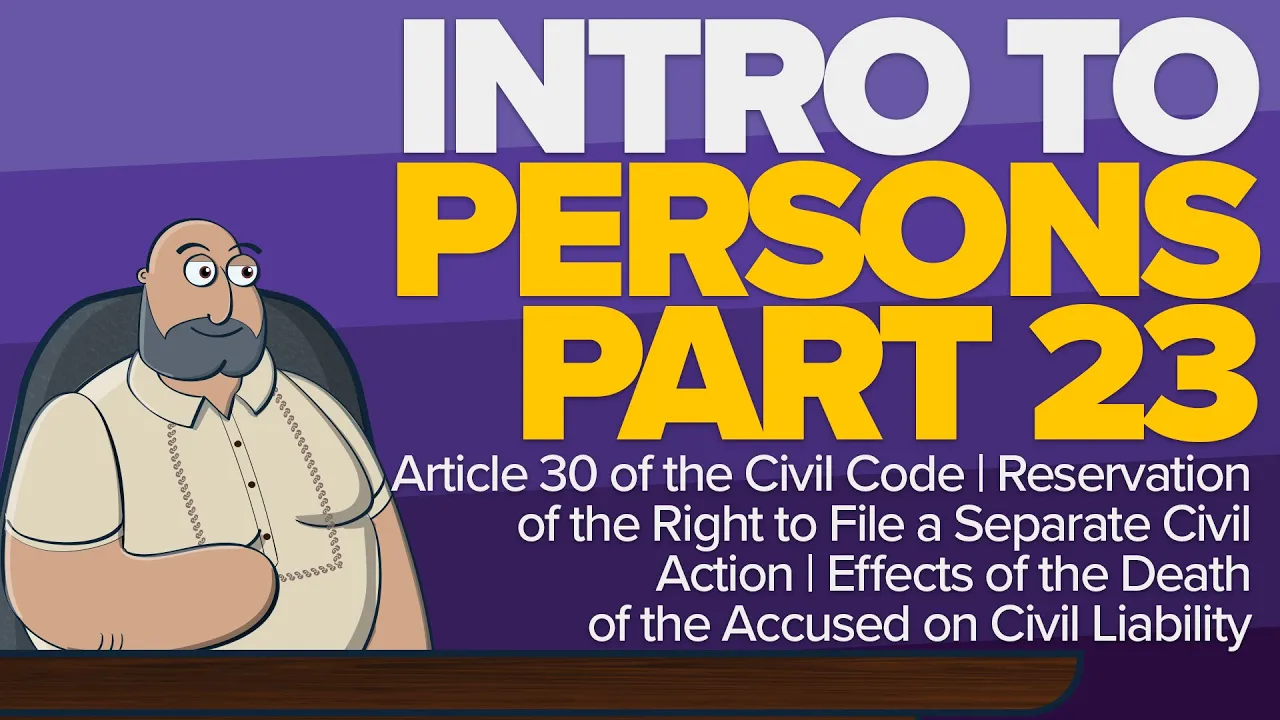
in our last lesson we talked about the many many new concepts covered in article 29 of the civil code we talked about the basics of criminal prosecution the degrees of proof or quanta of evidence and where each of them applies we also talked about the general rule that every person criminally liable is also civilly liable the exception to this rule is when the accused is acquitted on the ground of reasonable doubt then the offended party may still hold the accused liable in a civil case for damages but this time the quantum of proof required is
mere preponderance of evidence the exception to this exception is found under rule 111 of the rules of court the civil liability of the accused will be completely extinguished when there is a finding that the actor commission from which the civil liability might arise does not actually exist by the end of this lesson you should be able to number one enumerate the requisites for the application of article 30 of the civil code two explain the effects of the reservation of a separate civil action on the prosecution of the criminal case three identify the effects of the
death of the accused upon his or her criminal and civil liability all of this and more coming right up hi my name is lex and welcome to lex in motion in this channel i'll be helping you build your competence confidence and capability in law school start today by hitting the subscribe button below new episodes are posted every friday article 30 of the civil code provides that when a separate civil action is brought to demand civil liability arising from a criminal offence and no criminal proceedings are instituted during dependency of the civil case a preponderance of
evidence shall likewise be sufficient to prove the act complained of guyana bankit this is a very short and simple provision article 30 of the civil code a crime happened rather than bring the matter to the city or provincial prosecutor the offended party filed a separate civil action civil of proof case is mere preponderance of evidence that is level 2 in our enumeration of the degrees of proof article 30 of the civil code also teaches us that during dependency of the separate civil action no criminal charge was filed the practical effect is that the civil case
will proceed the offended party will have the chance to prove the civil liability of the defendant but in no case can the defendant be imprisoned justice paras makes a very very simple illustration of article 30 of the civil code cb a obviously has the option to file a criminal case of theft against b waiting a has another option and that is one provided under article 30 of the civil code it can file a civil action to recover his personal property his watch plus damages and whatever he has spent in legal fees option under article 30
and no criminal case is filed against b then the quantum of proof required is mere preponderance of evidence proof beyond reasonable doubt will not apply because this is a separate civil action and not a criminal case then you can stop here but i want to continue to share with you the rules on the reservation of a separate civil action and the effects of the death of the accused plus a few cases to drive home the point the rest of the discussion here you will encounter on your second and third year when you go through torts
and damages and criminal procedures article 100 of the revised penal code provides that every person criminally liable is also civilly liable the basis for this rule is the principle that every crime causes damage to two persons the first is the state the second person is the private offended party or in this case the rape victim the crime of rape leaves an indelible mark upon the victim or damages is somehow a way to make the person whole again with that being said let us now go to the first and probably most important rule you have to
remember this capability because it is the only reason why we have the rest of the rules on separate civil actions arising from crimes the last sentence of section 3 of rule 111 of the rules of court teaches us that in no case however may the offended party recover damages twice for the same act or omission charged in the criminal action or two times for the same act or omission charged the prohibition against double recovery or recovering twice the damages based on the same act of remission is based on the principle of unjust enrichment under article
22 of the civil code there is a separate lesson for this and in case you missed it i'll be leaving a link in the description down below will the prohibition on double recovery apply the answer capacity is no section 3 of rule 111 of the rules of court teaches us that the law prohibits double recovery for the same act or omission the act of stealing a watch worth 150 000 pesos is different from the act of stealing a cell phone charger next rule capacity section 1 of rule 111 of the rules of court which tells
us that when a criminal action is instituted the civil action for the recovery of civil liability arising from the offense charged shall be deemed instituted with the criminal action this rule tells us that by default every person charged with a crime is automatically charged with the civil aspect of the crime the basis of this rule is article 100 of the revised penal code to somehow make the victim whole again the law automatically combines the criminal and civil aspect of the crime to save time money and energy foreign the same provision section 1 of rule 111
also provides for us three exceptions to the general rule of the automatic institution of the civil aspect of the case these are one when the offended party waives the civil aspect of the case to when the offended party reserves the right to institute a separate civil action three when the civil action is instituted prior to the criminal action now let's discuss these exceptions una kapatid would be a waiver of the civil aspect for a waiver to be valid the person must actually have the right that he or she renounces and that he or she must
have the capacity to make the renunciation the renunciation must be made in clear and unequivocal terms and that this waiver must not be contrary to law public order public policy morals or good customs there is a separate discussion on waivers and in case hindi mo pana papa no kapatid there will be a link to that in the description down below the second exception kapatid is when the party reserves the right to institute a separate civil action when a party makes a reservation to institute a separate civil action the party in effect is asking for the
permission of the court to file another case a different case based on the civil aspect of the crime in practical terms kapatid marine coming in a reservation to file a separate civil action prosecutor i overworked underpaid at hindi 100 percent and focused how do you make a reservation kapatid a reservation for the right to file a separate civil action in effect is asking for permission from the court is a reservation has to be made by motion more on that when we discuss criminal procedure when do you make a reservation capacity section 1 of rule 111
of the rules of court tells us that the reservation has to be made one before the prosecution starts to present its evidence to under the circumstances affording the offended party a reasonable opportunity to make such reservation again nothing difficult here compared number one tells us that we can make the reservation at any time before the prosecution starts number two tells us that we can make the reservation at any time so long as the offended party has been given the chance usually the reservation is made during pre-trial pre-trial kapatid is the stage of the criminal prosecution
where the prosecution and the defense actually sit down and try to work out a few things for the speedy and orderly conduct of the trial bargaining accused to a lesser offense in relation to the crime charged the naren pinaga usa panama stipulation of facts the identity of the accused the end the victim and other preliminary matters pre-trial capacity is a good chance to make the reservation reservation by the offended party in the case of sarmiento vs court of appeals the supreme court ruled that the reservation of the right to file a separate civil action may
be expressed or implied it is expressed when the offended party makes a motion to reserve the right to file a separate civil action it is implied when number one when the court finds that the remedy of the offended party is civil not criminal two when the court fails to make a ruling on the civil aspect of the case in the same case the supreme court speaking through justice austria martinez teaches us that the appearance of the offended party in the criminal case through a private prosecutor may not per say be considered either as an implied
election to have his claim for damages determined in said proceedings or a waiver of his right to have it determined separately he must actually or actively intervene in the criminal proceedings as to leave no doubt with respect to his intention to press a claim for damages in the same action the primary effect of the reservation for a separate civil action is that the prescriptive period of the civil action reserved is told as you will recall from previous lessons the law puts an expiration date on the right to come to court some crimes prescribe in 20
years from the time they are committed others expire within four years from the crime is committed or from the discovery of the crime the prescriptive period or this expiration period depends on the gravity of the offensive impossible penalty bug that thing's reservation capability the practical effect is that the prescriptive period stops come back as a computer shop is nancy will ask until the final judgment in the criminal case there are three kinds of cases where the reservation of the separate civil action is not allowed they are one cases falling under batas bambansa belong 22 or
the bouncing checks low two cases falling under the jurisdiction of the san diego three tax cases as provided under republic act number nine two six two but as bombanza belong 22 or the bouncing checks low is going to be your primary illustration when you get to law school it's the perfect example because it happens a lot and it is very near to our personal experience a bounce check is a check that is dishonored by the bank account bp22 punishes the act of a person who writes and issues a check knowing that at the time of
issue once the balance on the account is not enough to cover the check and that this check was subsequently dishonored by the bank or that the cheque would have been dishonored had it not been stopped by the writer and issuer of the as we have discussed earlier the rule is automatic institution 1606 is the low penned by former president marcos in his capacity as the legislative branch of government it is the law that created the sandigan bayern it is a special court that sets on the same level as the court of appeals the zandigan bayern
has exclusive jurisdiction over violations of the anti-graft and corrupt practices act crimes committed by public officers and employees including those employed in government-owned or controlled corporations under title 7 of the revised penal code or the part of the rpc that defines crimes committed by public officers and such other crimes committed by public officers in relation to their office walang reservation capacity it is an offense primarily against the state against the people of the philippines there is no private offended party who can make the reservation in tax this is because when a person evades taxes or
does not file his or her taxes correctly the offended party here it's not you and me and tax evasion i crime hindi love and s in all these three cases those under bp 22 those under the sundigan bayan and tax cases the rule is automatic institution the civil liability arising from the crime charge is automatically deemed instituted when the criminal case is filed the accused himself who wants to file a civil case against the private offended party hindustan can the accused make a reservation to file a separate civil action the answer capacity is no the
accused cannot make a reservation to file a separate civil action by express provision of section 1 of rule 111 of the rules of court no counterclaim cross claim or third party complaint may be filed by the accused in the criminal case but any cause of action which could have been the subject thereof may be litigated in a separate civil action in one case the supreme court discussed the reason behind this rule the prosecution of the accused is not the proper forum to discuss his or her claims against the private offended party remember criminal prosecution the
case is between the accused and the people of the philippines the proper remedy the supreme court says is for the accused to file a separate civil action against the private offended party in this manner the private offended party united defendant two other concepts i would like to discuss with you kapatid are the suspension of the separate civil action and the consolidation of the criminal and civil actions however it will not be very practical to discuss these concepts without first understanding independent civil actions if you are looking forward to the next lesson on intro to persons
please let me know by typing following in the comments down below for now i would like to talk about the effect of the death of the accused on the civil action twenty-five percent it ona midterms a person at sadly simply please listen carefully there are four periods or stages in the prosecution of the criminal case when the accused might die they are number one anytime before arraignment two after arraignment and during dependency of the criminal action three during appeal for after judgment section 4 of rule 111 of the rules of court tells us that if
the accused dies at any time before arraignment or that part of the prosecution where the accused must stand before the judge and the clerk of court will read to him or her the specific facts and circumstances that amount to a crime and the accused is asked whether he or she is guilty or not guilty then the criminal case shall be dismissed when a person dies all of his or her criminal liability is extinguished the case is different upon the civil aspect of his or her crime remember or the private offended party can still file a
case against the estate of the deceased when the accused dies on the second stage of our timeline or after arraignment but during dependency of the criminal action article 89 of the revised penal code tells us that criminal liability is totally extinguished by the death of the accused hindus section 4 of rule 111 of the rules of court gives us the general rule when the accused dies on the second stage or after arraignment but during dependency of the criminal action then the civil liability of the accused is extinguished people of the philippines that's a private offended
party or for the amount of money designed by the law to make the victim somewhat whole again you see capacity there are different sources of obligations when someone borrows money from us the borrower is burdened with the obligation to pay the basis of that obligation to pay is a contract specifically a contract of loan when we make money from selling things online or for giving someone else our time energy and attention we are paid for our effort the basis of that obligation to pay is the contract of sale or the contract of service or contract
of employment from the proceeds of our sales of our salaries we earn income from our income we have to give back our share so that the government will keep our roads flat and clear of potholes so our government can buy vaccines for people who may not be able to afford it that money comes from the taxes we pay we pay taxes whether we like it or not the source of this obligation to pay taxes is the law major overwhelming capacity but don't worry we will discuss sources of obligations in our next lesson for now please
remember that there are various sources of obligations and one of them is a crime or delete when a person commits a crime he or she is in effect burdened with the need to make payment in the form of damages under section 4 of rule 111 of the rules of court the civil liability of the accused is extinguished when the accused dies after arraignment enduring dependency of the criminal action meaning the obligation to pay for damages because of the crime is also extinguished the exceptions are number one independent civil actions under articles 32 33 34 35
and 2176 may be continued against the estate or the legal representative of the accused after substitution two if the civil aspect of the case has been reserved and later on filed by the private offended party then the civil action will also proceed after the substitution of the parties the first class of exception falls under independent civil actions don't worry about this capacity because we will discuss these in our next lessons reservation and right to file a separate civil action the third stage of the criminal prosecution is the appeal okay is a remedy where the decision
of a lower court or a quasi-judicial body is taken up to the next higher court when a party makes an appeal he or she is in effect asking for the supervisor of the lower court to check the actions of the lower court and he raises all the available arguments that might change the mind of the higher court as applied in criminal actions the accused has the right to file an appeal for the same act for the same offense and probably using the same witnesses da hill's a prohibition against double job or di consignor binance then
the matter is now closed the accused cannot be tried again for the same offense end of conversation when the court orders the acquittal of the accused but orders him to pay damages then the accused can still go to the next higher court and appeal his case when the court orders the acquittal of the accused but does not order him to pay damages then the private offended party can also go to the next higher court and appeal the payment of damages or in other cases when the accused dies during the appeal then we follow the general
rule the criminal liability of the accused is extinguished based on article 89 of the revised penal code the civil liability of the accused on the other hand is also totally extinguished however midterms only the civil liability of the accused arising from the crime or delegate is extinguished if the private offended party can anchor his or her claim for damages upon another source of obligation such as a contract or quasi delegate or some other profession of the law then the civil action based on another source of obligation will prosper finally we have the last stage or
after judgment after judgment then we have the following scenarios number one the accused is convicted and he has to pay to the accused is convicted but he has no obligation to pay three the accused is acquitted but he has to pay for the accused is acquitted but he has no obligation to pay in all of these four scenarios to save the liability to summarize tonight's lesson number one article 30 of the civil code applies when a private offended party opts to file a civil action instead of a criminal case the quantum of proof required is
mere preponderance of evidence two a reservation to file a separate civil action may be made at any time before the prosecution presents its evidence or when the offended party has the reasonable opportunity to do so three the reservation of the right to file a separate civil action may be made expressly or impliedly the practical effect is that it stops the running of the prescriptive period number four the death of the accused at any stage of the prosecution will extinguish criminal liability the civil liability of the accused based on the crime or delegate may or may
not persist depending on the stage of the prosecution i think we can stop here capacity our next lesson will be on article 31 of the civil code and independent civil actions we're also going to take a look at sources of obligations all of these concepts competed you will encounter not in persons but in terms and damages obligations and contracts and criminal procedures now if you find this format of the lessons working for you please let me know in the comments down below finally there is a quiz that you can take to measure how much of
the lesson you actually absorbed please type your scores in the comments if you would like us to continue with the next lesson please type yes in the comments down below thank you so much for watching like and share this video for good law school carmine i will see you next friday
![[CIVIL LAW LECTURE]Article 31, Independent Civil Actions and Sources of Obligations | LEARN WITH LEX](https://img.youtube.com/vi/vknw9WMDjrc/maxresdefault.jpg)



![[CIVIL LAW LECTURE] Article 5 and the Verba Legis or Plain Meaning Rule | Intro to PERSONS](https://img.youtube.com/vi/qo0wwQaHVtw/maxresdefault.jpg)
![[CIVIL LAW LECTURE] Article 29, Quantum of Evidence, Civil Liability Ex Delicto | INTRO TO PERSONS](https://img.youtube.com/vi/nI66vAwRtig/maxresdefault.jpg)



![[CIVIL LAW LECTURES] Lex Loci Celebrationis and Summary of Conflict of Laws | INTRO TO PERSONS](https://img.youtube.com/vi/E7ivQ8sSH-I/maxresdefault.jpg)
![[CIVIL LAW LECTURES] Article 22 and the Principle of Unjust Enrichment | INTRO TO PERSONS](https://img.youtube.com/vi/xKCFb3q9aSE/maxresdefault.jpg)