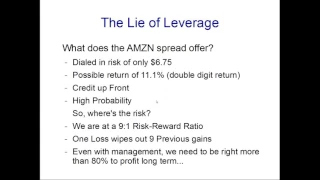
hi everyone Ryan Jones here and today I want to show you how to easily and safely make 3 to 5 % per week by exploiting a proven spread strategy applied to weekly options now this spread strategy carries small and limited risks it has a very high probability of success there are dozens of opportunities each week each spread has a profit potential that is one to seven times greater than the risk and it takes very little capital to implement so what I'm going to do is I'm going to give you an example we're going to get right into this by giving an example of a recent trade I made this particular trade was in STX and the absolute worst case limited risk on this trade no matter what happens is only $15 the absolute best case profit potential so if it goes absolutely perfect the absolute profit potential is a hundred and twenty four dollars and that means that the ratio of profit to risk on this particular spread the potential is eight to one and then of course the time frame is seven days since these are being taken on weekly options further this trade would make money whether STX moved up or down during the next seven days creating a very high probability of realizing at least some sort of profit and the only way the spread can lose is by moving a very significant amount in one direction by the expiration date so as long as it stays within a very reasonable seven-day range the probability if some sort of success is very high so how did this trade end well I exited the trade in six days for a profit of $32 or a 213 percent return on my risk in fact during this particular week I had eight trades with six winners and two losers and if you were to risk just two hundred dollars on each trade here's the outcome of each of these trades so I've listed here eight trades begin with exo-m if I risked $200 on exo-m I would have made 104 dollars now I say would have because I risked more than $200 on these trades so I'm saying if you only risked $200 on each of these trades then this is the amount that you would have made I risked more and I made more so exo-m 104 dollars or fifty two percent if you risked two hundred dollars on the trade worst case scenario STX if you only risk two hundred dollars you could have made four hundred and twenty-four dollars by taking the same exact trade that I did take and I risked a lot more than two hundred dollars on that particular trade here's a losing trade we risk two hundred dollars on the trade and the potential of actually realizing the maximum risk is very very small so in this particular one we lost 55% of what we were risking the Indian and earned $20 Amazon a hundred percent two hundred dollars BP lost again on 60 dollars or thirty percent of what was being risked FSL our is one hundred and fifty dollar profit and LVS is of two hundred and ten dollar profit or 105 percent return on whatever was being risked so the total net profit if you were to risk only two hundred dollars on each of these trades the total net profit from these eight trades was a thousand and thirty eight dollars and it would have only required an account size of sixteen hundred dollars to make and that that means risking two hundred dollars on each trade only required sixteen hundred dollars in your account to make these trades now these are not these are not hypothetical fills these are actual fills and these are actual trades actual results the week before again if you were to risk only two hundred dollars on each trade you NP for example seven hundred and fifty dollar profit 375 cent return that was the that was a very solid trade Amazon 24 percent Amazon again we did calls inputs 17 percent on that Netflix we did the same thing calls then puts 53 percent and 52 percent so forth and so forth you can see the only loot lost there was CSCO that was basically a break-even and the total net profit for that week if you were to only risk $200 on each trade was 1836 dollars and it would have only required an account size of $2000 to make all of these trades in risk $200 on each one again all of these are actual fills these are not hypothetical now each of these trades the risk was limited the probability of success was stacked in your favor and the profit potential exceeded the maximum risk by a factor of three to eight times in fact I don't take it trade if the profit potential isn't at least three times what my risk is on that particular trade and each trade took very little capital to implement and I'll get into more that here in a here in a bit now what are these trades based on they're based on time spreads or calendar spread strategy that was designed to exploit the faster rate of dying decay net occurs in weekly options but you can't just throw any of these time spreads on and expect these kinds are this kind of high probability low risk trade what I'm gonna do is I want to show you exactly what to look for that will stack the odds heavily in your favor now two years ago the CBO CBOE introduced weekly options for the first time on a select group of stocks so this strategy in this opportunity was not even available just two years ago and when they did it they only did it on a small group of stocks the volume wasn't very good you know over the last two years that is steadily increased to where now there's a hundred and fifty stocks that you can trade weekly options on in the volume is pretty much pretty good across the board so this is a tremendous opportunity and these options start trading every Thursday morning and expire the following Friday 7 trading days later so every Thursday morning you have new potential trades come on the board and they all and they expire in seven days now one major characteristic of options is that time value or extrinsic value of an option decays faster as the option comes closer to the expiration so here's a little chart if you will that kind of demonstrates or illustrates the rapid increase in the rate at which time decay occurs in an option the closer gets to option expiration you can see up here that the line the slope is not very extreme but the closer you get to the option expiration it almost goes vertical so here we are here's 30 days at this point here's seven days it's on the the line in which the time decay occurs is almost vertical at that point so essentially what we are doing is we're looking to exploit this advanced rate of time decay each and every week but while limiting dramatically limiting our risks to do so ok so let's take a closer look at the STX trade I mentioned earlier on October 25th we sold STX 28 call November 2 expiration or November 2nd expiration for 124 so we brought in 124 dollars into our account at the same time we bought an STX 28 call November 16th expiration for 137 dollars so we paid 130 $7 so our net debit on this trade was 13 cents or 13 dollars based on one spread option so this was entered on 1025 and at the time that we entered it with the STX was basically trading right at 28 dollars so this was at the money spread now as long as both legs of this spread are exited by the close of November second you cannot lose more than $13 per spread position so this is a very limited risk trade that's important to know that both legs of the calendar spread always trade the same strike and both are either calls or either puts so when you buy and sell you're buying and selling everything is the same except for the expiration date and that's the only difference between the two options that you're buying and selling so very important that you understand that a debit spread is when you buy the longer term option and you sell the nearer option so you need to also remember that now there are two important things you need to notice about this particular spread the first is how close the price of the options are you'll notice that the November second option is 90% of the November 16th option as far as the price is concerned so if your divide these into one another you would see you would come up with the exact number 124 is 90% of 137 okay so second the remaining time on the November second option is only 33% of the remaining time on the November 16th option okay so there's 7 days 7 trading days left on the November second option whereas there are our 21 trading days left on the November 16th option what you have there is you have a situation where the price is very close but the expiration dates are a lot further away these two things combined are very very powerful so on November 2nd xdx Clos st excuse me closed at 28 o 2 so this is the expiration date we entered on October 25th on the expiration date SDX closed at 28 - 28 Oh - and the spread closed at 67 or over five times what the spread was bought for we bought it for $13 it closed at $67 so exactly what has to happen for this spread to win and what has to happen for this particular trade to lose now based on the option values at the time the break-even range of this trade was approximately $26 and $30 meaning that as long as STX closed within this 14 percent range of the strike so within 7 percent higher or within 7 percent lower in just 7 days then the spread will at minimum break-even on the November 2nd expiration date okay so it had a $4 range that it could close in and you would at least break even the closer to the strike price that it closed the greater the profit potential for the most part of that particular spread but here's the deal so as a spread or as a stock is moving toward that break-even point as it moves towards the break-even point it actually causes the spread to widen prior to expiration this usually gives several opportunities to exit at a significant profit prior to expiration so for example on STX on October 31st STX took a dive and it moved down to $27 remember it needed to close between 26 and 30 dollars for this particular spread to basically break even or better or make some money so it took a dive moved down to $27 and on that move down the spread actually widened to 40 and I exited a partial position at a $27 profit per spread okay so the spread went from $13 to $40 and I exited partial position of this spread for $27 so this is basically a tremendous opportunity for me to take out a partial position which I did at the time and what this means is that in order to get to the loss level okay in order to get to the 26 level it has to move through 27 and has to move through 27 15 27 and 26 50 etc etc and as it moves towards the loss level it has to move through a level that will most likely give you profits so in order to get to a loss it's giving you a profit that's why this is so such a high probability strategy if you take the opportunity to exit when it gives you the profit potential before it reaches that level where it could potentially be a loss now there is a situation where it doesn't have to move through there obviously if the stock gaps then you may not have an opportunity to get out at a profit and that's where you can either break even or you take a small loss that's something that one of the trades that I showed you BIDU where we took a 50% loss what happened was the market gapped lower and gapped lower enough to where I could have exited for a break-even but I held on to see if it was gonna bounce at all and bring it back to a profit it did not and so I ended up just exiting at a 50% loss right before the trade expired so that is you know that's the instance where we could lose money on these or more likely we'll lose money on these if the if the stock gaps far away one morning and doesn't give us a chance as it's moving through that zone that gives us a profit profit level had STX clothes at $27 on November 2nd as opposed to moving it moved to 27 on October 31st so with still 3 days left on the option that's really what enhances the profit potential is that it does it early and had it closed at 27 on November 2nd the spread would have been at approximately 26 which means we would have taken we were still been able to taken a profit of $13 or a hundred percent on the trade but by exiting during the move prior to expiration our profit potential at the $27 level was actually greater so that's a little tidbit secret if you will that you need to know that when a trade is or when a stock is making a move that that's usually when the profit potential is presenting itself so you just have a limit order in place for one two three four times the maximum risk or you can divide it up there's a lot of ways to do it and there's no right or necessarily wrong way because you don't know exactly what's going to happen but my suggestion is is that you always take the opportunity to exit at least half the trade at a hundred percent profit that ends up bringing the rest of the trade to a break-even no matter what happens so as I stated for this trade to become a loss it has to move away from the strike and while it's moving toward the loss of what has to first move into a profit as long as it doesn't gap and as long as it doesn't wait too long to do it usually if it waits too long to do it it presents a profit potential anyway because it's still at the money right so just all sorts of ways to take advantage of this and by doing so it further increases the probability as long as you have chosen the right spreads in the first place to take so let's take a quick another quick look at another example on 10:25 we also made the following trade and we sold Amazon to 30 calls November 2nd expiration for 10 dollars and 10 cents and we simultaneously bought Amazon 230 calls November 16th expiration for $11. 45 so our net debit on this was a buck 35 so we're risking 135 dollars on this particular trade per spread the max profit potential per spread was over a thousand dollars so our reward ratio here was seven point four to one now the following day just one day later Amazon shot up to 240 it was trading at 2:30 at the time that we made the trade it shot up to 240 and the spread increased from 135 to 270 and we partially exited that particular spread for $135 profit or a hundred percent return in just one day and then on November second the spread closed this is like five days later after this the spread closed at 460 giving us about a 300 percent profit on that particular leg so another classic example of how how this works if Amazon had shot up to 240 and we exited and it continued to shoot up to the point where it produces a loss on the other half of the trade unless it produced the maximum loss on the other half of the trade we were guaranteed to make something by getting out of half the trade when it reaches a hundred percent return which happens a lot in these trades where the risk is the reward ratio is big like this seven point four to one reward ratio that's a big ratio now we can look at these examples all day long and in fact there are dozens of opportunities each week thanks to the inception of the weekly options the key is to only take the highest probability option spreads and then to take advantage of any opportunity to bring the trade to a break-even when presented the opportunity so you again you exit half position and at a hundred percent profit and that increases your your overall probability of success tremendously and Nikita's successfully trading the strategy is by his finding the right trades when they are available and this is why I had my own software program to quickly find and trade the spreads to meet the criteria that I'm looking for because there's almost nothing out there that allows you to do it and in a time efficient manner so I just finally I got tired of looking for anything out there and I just had my own program built or programmed software program programmed and I'm going to show you this here's a screenshot of the day that we entered that STX trade that I've talked about and the Amazon trade this is 1025 of 2012 as you can see here that was the date we're looking at calls here's a here's the price this is at 3:03 p. m.
we are actually entered the trade earlier that day it closed at 28 12 and you can see the net debit on this particular strike at 28 where we sold the 11 to expiration in bought the 11 this is actually it's an 11 16 they list it at the exchange is officially expiring on a Saturday but it's actually a Friday so on 11 17 and the sale price at 1:25 in the buy price at 141 for net debit of 16 so we actually got in at a net debit of 13 and it closed that day at a net debit of 16 here's the amazon trading just under 2:30 at the close and the net debit at 160 we actually got in at 135 earlier in the day so this is how we found these particular trades is through this software now take a closer look you can see this is the calls that lists all the calls for 11 to versus 11 17 and then it also lists all the other combinations as well if you want to look at the other combinations but that spread ratio is really where we find the opportunities I like to have spread ratios of 75 or better and you have two ratios you have the spread ratio which is the price against the price and then you have the evie ratio and the V ratio is is the extrinsic value ratio so some of these are in the money and the ones that are in orange are in the money the ones that are in green are out of the money and the ones that are in green that means that the price the sell price in the buy price and the sell evie and they buy evie are exactly the same in other words the entire price is extrinsic value if it's in the money that means that some of that price is intrinsic values so what I'm looking looking for is I'm looking for the extrinsic value ratio and here there's a buck thirteen of extrinsic value on the sell option and a book 29 of extrinsic value on the buy option so that's an 88% so it's very close so that's very good and I'm looking for the evie ratio of anything over 75% as a general rule now remember we want to get two we want to look at at the money or as close to at the money options as we possibly can because that clearly defines our risk meaning that we are most likely within that range are going to see a profit as long as the stock remains in that range if that ratio is is below 75 then the probability of or excuse me if we're looking at in the money options for example or even out of the money options we may not see the low of this spread or the debit so we're looking for we're looking to get into these with this little risk as possible and that is what increases our overall profit potential so here is a look at a more recent list of trades this was on 11 - at 909 a. m. and I believe 11 - was a Friday so Friday morning at 9:09 a.
m. the options came on the board Thursday morning so there's a whole host of option opportunities on Thursday morning and here's another host a whole host of opportunities on Friday morning and you just take a look at these queue come for example we have a debit of 17 which means that our biggest risk or maximum risk is 17 dollars while we have a sell price of a buck 31 so our max profit potential is the sell price which is a buck 31 or 131 dollars and you can take a look at these and they're all very very good and then you have the spread ratios that are all very good and I'm gonna take a look at these a little closer here on the next page but all of these arrows are the ones where the strike is very close to an at the money opportunity and those are the ones that I want to take advantage of now all of these they're not at the money but they can move at any time during the day to become at the money so that's something that you can plan as you're looking at some of these as well so anyway these particular trades I took all of these with the blue arrow and just take a look at the risk versus the reward so the cue column had a risk of 17 dollars in a profit potential of 131 dollars a risk reward ratio of 7. 7 to 1 JCP had a ratio of seven point eight five to one AET 6.
5 to one MCP 6. 6 to one and so forth and so forth remember the worst case scenario I want to take is at least a three to one ratio and you look at you the axe here and you have a three point four to one ratio now these are only the call spreads that existed at 909 a. m.
on eleven two of 2012 there are also ten legitimate put spread opportunities at that particular time as well so there are more than enough opportunities for you to take but here's the crazy thing the total cost to place one of each spread above was only a hundred and twenty eight dollars meaning you only needed one hundred twenty-eight dollars in your account to take one sprit to place one spread of each of these spreads that's it and you're only risking one hundred and twenty dollars if every spread looses the maximum amount which is just would have to be a bizarre situation for that to happen but if each spread was to lose the maximum amount you'd only lose one twenty eight dollars now how crazy is that remember at the beginning of this video where I stated that you could easily and safely make three to five percent per week with this strategy let me give you some perspective if you only make four dollars combined across all of the spreads given above or previously not individually all together combined a net profit of only four dollars you will net a three percent return on the amount being risked that's that is incredible so what I mean here is that if the only trade you make money on is cucum and you make four dollars on the cucum trade that's it just four dollars and you break even on all the rest you have netted a profit of three percent in one week on on the risk amount of 128 bucks okay so that is this thing absolutely doesn't do anything and you you still can easily and safely make 3% in there now you obviously don't want to max out your risk every week so if you have $1,000 account and you've only Grist one spread per opportunity meaning that you only risked 128 dollars if every spread went against you Mac to the maximum amount in your thousand dollar account you would still only lose one hundred and twenty eight dollars so basically about 12 percent you're risking absolute worst case scenario and if each of the spread opportunities only has a 50 percent return on average you achieve a six point four percent return not on the amount being risk but on your entire thousand dollar allocation to this particular week so can you safely and easily make three to five percent per week trading the strategy absolutely listen for those of you who have been looking for a strategy that offers low risk high probability consistent you can sleep at night type type of success that doesn't take a lot of capital and is easy to implement this is it and if this isn't it then I don't know what could be this isn't the holy grail you aren't going to knock a bunch of homeruns you're gonna have a few bigger trades every now and again and I showed you a couple but they're gonna be weeks where you don't make money but as long as you use the smart money management principles and follow my criteria for finding the right spreads I don't know of an opportunity that provides a higher probability of long-term success than what I've revealed to you today in this video if you're trading and you don't see this as one of the best trading opportunities that you've come across I don't know why you're trading this is a very very incredible opportunity that I think every trader should consider to some degree now the only question is how will you quickly find the best opportunities every week I had to have my own software program built so obviously we can do it and we are doing it so what we're going to do is we're going to make available this information twice daily through web updates so each day we post all the available call and put spreads to our website once in the morning around 9:00 a. m. and once in the afternoon around 2:00 p.
m. so it's during the day you can check the website you can see what opportunities are available and make whatever trades you want to make based on those opportunities that you see and we're gonna make to the Platinum pds platinum subscribers only we're gonna make this available through November 30th a six month subscription for one hundred ninety-seven bucks meaning you receive the updates twice a day once around 9:00 a. m.
once around 2 p. m.