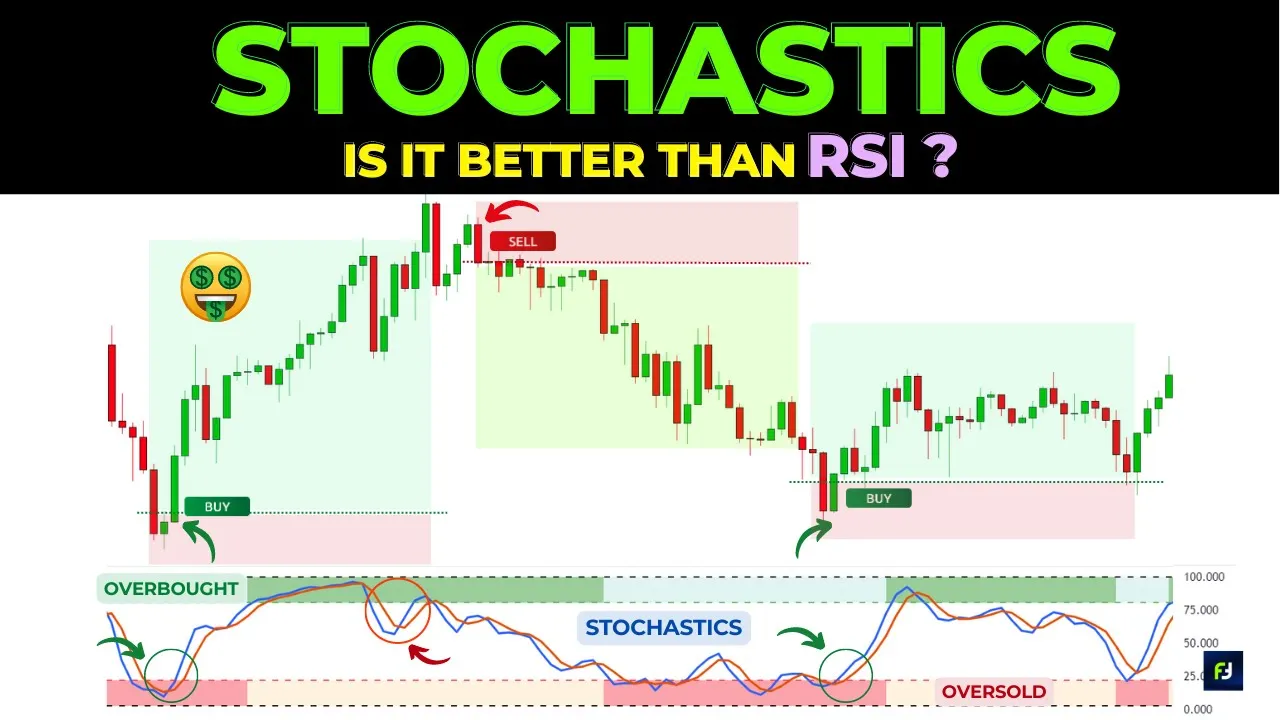
hello guys welcome back again in this video I'll be talking about the stochastic indicator which is among the list of most popular technical indicators in the market the stochastic indicator is a great momentum as well as a trend following indicator meaning that it can help traders in understanding Trend Dynamics and also improve their chart reading or analysis but all these properties are a waste if you don't really understand the indicator that you're using or even worse if you use these indicators in the wrong way you end up making bad trading decisions that could have been easily awarded so in this video I will help you understand the stochastic indicator in the right way and I will show you what it does and how you can use it in your trading and as always I will start from the very basics of stochastics followed by the calculation of stochastic the general settings of a stochastic indicator followed by the relationships between stochastic it goes later and relative strength index or RSI and we will also talk about the limitations of stochastic or even the mistakes that Traders make by using this indicator then we will talk about the stochastic RSI and its advantages and disadvantages over stochastic indicator and further we will learn a few uses of stochastic oscillator followed by different stochastic trading strategies and finally we will wind up the video by discussing a few ways in which we can combine stochastics with other tools or indicators so make sure you watch the video till the end and if you are benefiting from these video tutorials then please do like and share this video and if you are new to our Channel or haven't subscribed yet please make sure to subscribe and also enable the Bell notification so that you won't miss out on any upcoming video updates without wasting any time let's get started DrGeorge C Lane was the one who developed the stochastic oscillator in 1950s way before indicators like RSI which came into being only after 1978. unlike other traditional technical indicators that either follow the price or the volume the stochastic indicator follows the momentum of price of an asset or instrument this means the indicator measures the oscillations in the price of an asset which is the reason why it is referred to as the stochastic post leader but before we get into using the stochastic we should be clear about what momentum actually is in simple terms momentum is defined as the rate of acceleration of the price of a security or stock so in an interview with MrLane he mentioned that the stochastic goes later does not follow the price it does not follow the volume or anything like that but instead it follows the speed or the momentum of the price the way he provides an analog logy to understand the oscillator is quite convincing we ask us to visualize a rocket going up in the air but before it can turn down it must first slow down in a similar manner momentum always changes Direction before price or in simple Layman tells the stochastic is an indicator that measures momentum in the market but how does the stochastic oscillator actually work well as a matter of fact the stochastic goes later Compares a specific closing price of an asset with a wide range of high and low prices over a given period of time as a general rule of thumb the stochastic oscillator is calculated by taking a 14 period as the standard for calculation however as with any other indicator this period can be changed and adjusted according to your specific needs also keep in mind that since stochastic is an oscillator just like RSI the value of stochastic indicator for any specific time period always stays between a minimum value of 0 to a maximum value of 100 by the way I have already made a detailed video on RSI indicator so if you want to know more you can watch that video now the oscillator works on the following theory that is during an uptrend prices will remain equal to or above the previous closing price and during a downtrend prices will likely remain equal to or below the previous closing price this is the basic idea upon which the indicator functions but in order to understand how and why it works we will need to dig into the calculations of this indicator don't worry thinking that the calculations are going to be hard to understand I will try my level best to explain it as simply as possible now as mentioned just now the default setting for stochastic oscillator is 14 periods which can be days weeks months or any intraday time frame there are two variables that control these sensitivity of this indicator they are percentage key and percentage D now what do these variables imply a default 14 period percentage K would use the most recent close price along with the highest high over the last 14 periods under consideration and the lowest low over the last 14 periods under construction on the other hand percentage D is a three period simple moving average of percentage K variable this percentage D line is plotted alongside the percentage K line to act as a signal or trigger line this looks very similar to the macd indicator where there is a macd line and a signal line and the signal line is a nine period exponential moving average of the macd line so you can watch a detailed video on macd indicator from the I button so what the stochastic indicator does is that it takes the highest high and the lowest low over the last 14 candles and then it Compares it to the current closing price it is as simple as that we will see this with the help of two examples very so but before that the indicator uses two simple mathematical formulas to calculate the percentage key and percentage D values the K line formula is given by percentage K is equal to CP minus l14 multiplied by 100 the whole divided by h14 minus l14 this is not as hard as it seems here CP is the most recent closing price l14 is the lowest trading price of the asset in the previous 14 periods or candles h14 is the highest trading price of the asset in the previous 14 periods or candles percentage D is the three period simple moving average of the percentage K line the percentage K line is the slow moving indicator and percentage D is the fast moving indicator which is measured by a three period moving average of percentage K once again these two lines are same to the macd line in the sense that one is faster than the other as a general rule of thumb the stochastic oscillator suggests that when the market is moving upward the asset price will close near the highs and so will the stochastic values similarly the stochastic oscillator value will close near the low when the market is trending downward and as the asset price closes near the lows this means the indicator can have different sets of values under different market conditions let us understand this in Greater detail using some examples the first example is when we have a high stochastic number so when your stochastic oscillator is at a high value it means that the price closed near the top of the range over a certain period of time or a certain number of candles now take a look at this chart and consider the 14 most recent candles then Mark the lowest low the highest high and the most recent close price of these last 14 in candlesticks and as you can see the high is at 110. 61 rupees the lowest low is at 108.
76 rupees and the most recent close is at 110. 21 rupees now all we need to do is to equate these values onto the equations so we can calculate the range between the high and low price which comes out to be 1. 855 which is simply obtained by subtracting the high price and the low price values and we can also calculate the difference between the highest high and the recent close which comes out to be 0.
399 now all we need to do is to divide 0. 399 by 1. 855 to check how close the price is to the absolute high of the range now the calculation gives us 0.
215 or 21. 5 percentage when multiplied by 100 this means that the current close is 21. 5 percentage away from the top or another words it is 79.
5 percentage above from the bottom and indeed the stochastic in this example is at 79. 5 so therefore the stochastic indicator tells us how far the price has closed with respect to the highest high or the lowest low of a given price range and as you have seen the calculation is quite simple all you need to do is to just check the total distance of the range between the highest high and the lowest low and see how close the price is closing to the highest high or the lower slope moving on to example number two that is when we have a low stochastic number a low stochastic value indicates that the momentum to the downside is strong in this chart we can already see that the price has moved significantly lower over the last 14 candles and we can also see that the current close is relatively close to the absolute low only a small Candlestick Wick is sticking out lower just by understanding that app we can already assume that the stochastic indicator has to be very low since these stochastic measures how close the price is closing to the lowest low and how far away from The Price is the highest high and indeed the stochastic indicator shows a value of 13. 5 percentage this means that the price is just 13.
5 percentage away from the lowest low and is 86. 5 percentage away from the highest high I hope things make sense now similar to how we use RSI this indicator can also be used to identify overbought and oversold trading signals for any asset thereby it lets you spot price reverses in the market for instance if the value of stochastic indicator for a stock is more than 80 then the asset price is considered to be in the overbought region and if this value is less than 20 then the asset is said to be in the oversold territory but as with the case of RSI this indication of overbought and oversolder series should merely be taken as clues of future price movements and not as a conclusive evidence of the price reversal now before moving ahead let me mention the three types of stochastic indicators that you will be able to find now there are three versions of stochasticals later and these are fast slow or full oscillators now the fast stochastic oscillator is based on MrGeorge Lane's original formula for percentage K and percentage T that we have already discussed now this is the most common and most used stochastic indicator but the problem is that in this fast version of the oscillator the percentage K line can appear rather choppy and percentage te as mentioned is the three period symbol moving average of percentage K as a matter of fact MrGeorge Lane use percentage D to generate Pi or sell signals based on bullish or bearish divergences and MrLane even points out that a percentage Divergence is the only signal which will cause you to buy or sell Don't Be Afraid we will talk about divergences later on in this video now because percentage D in the first stochastic oscillator is used for signals the slow stochastic goals later was introduced to emphasize its importance so the slow stochastic goes later Smooths percentage K with a three period simple moving average which is exactly what percentage D is in the first stochastic oscillator so percentage key in slow stochastics is actually percentage D in past stochastic oscillator while percentage d e in slow stochastics is the three period simple moving average of the slow percentage K line this means that the slow stochastic indicator is more smooth or less choppier when compared to the fast stochastic oscillator now you can note down the difference in formulas if you want now a full stochastic oscillator is a fully customizable version of the slow stochastic later now this indicator in trading view is actually a full stochastic oscillator but since the variable was fixed to 1433 it is a slow stochastic oscillator but you can set the look back period the number of periods for slow percentage K and the number of periods for the percentage D moving average as you wish but it is not generally recommended to change these values as the default values works well most of the time now that we have understood in depth how the indicator is formed and based on what principle it was we now need to know what type of indicator it is is it a leading indicator or a lagging indicator now most of the time we compare stochastics with RSI but as we already know RSI is a leading indicator which provides signals prior to the actual price move but unfortunately stochastics is considered a lagging indicator so a lacking indicator like stochastics four low price action and give signals after the price has already moved as opposed to Leading indicators that are designed to anticipate future price moments and you may ask why stochastics is laggy now the reason being a stochastic indicator is based on historical data and is calculated using the closing prices of an asset over the recent 14 period now it compares the current closing price to the high and low range of the prices over this spotting period which helps identify whether the asset is overbought or oversold now because stochastic indicator is based on historical data it is slow to react to the market conditions and can be slower to identify the turning points in the market now this is why it is considered as a lagging indicator and this means that the signals generated by the indicator can be delayed and may not always be accurate but as always it is important to keep in mind that even lacking indicators can be useful for conforming signal us which are generated by Leading indicators and it is also useful for identifying Trends but as a matter of fact it should not be used as a standalone indicator we need confluences or we need more confirmations We compare RSA and stochastics more often because of the fact that both these looks and functions similarly even though the calculations are entirely different so let's see if there is any relationship between the stochastic oscillator and the relative strength index or RSI the first similarity is that both of these tools are price momentum oscillators that are widely used by Traders I have seen a lot of Traders for the sake of increasing the accuracy of a buy or sell signal they often use the stochastic oscillator and the RSI in tandem you can argue that the objective of both these technical indicators may be similar which is measuring momentum in the price move but as stated just now the underlying theories are different see the stochastic oscillator work on the theory that the price of an asset tends to close near its high during market uptrends and close marriage low during Market downtrends RSI on the other hand works by measuring the velocity at which the price of an asset moves so this helps us realize the fact that when we are faced with the market that moves in trends that is either uptrend or downtrend then RC can be a very useful indicator for identifying our boat and or Soul conditions however when the market moves sideways or in a choppy price action then the stochastic indicator is of more use for some of you it may not be clear so let me explain in detail consider a trending market so in a trending Market the asset price tends to move in One Direction making it more difficult to identify the overport and hours or conditions so in a strong uptrend for example the asset price May remain overboard for an extended period of time making it difficult to determine men to sell similar is the case when a strong downtrend essentially but when dealing with a side-based market the asset price tends to move within a range with a clear resistance level at the top and a support level at the bottom and when the assets price approaches the resistance level it is more likely to become overbought and when it approaches the support level it is more likely to become oversold so in this type of markets RSI May provide very less useful information as it may gain fall signals due to the lack of trend momentum but fortunately stochastics is considered to be better used in sideways Market because it is designed to identify these overbought and also conditions which are more likely to occur when the price asset is trading in a Range rather than trending up for now but a point worth noting is that stochastic still can be used in trending markets and you can use it in conjunction with other indicators and Analysis such as moving averages trend lines support resistance levels Etc now let's move on to the application side of this indicator let's just discuss the main uses of stochastics I will be explaining three main uses of this indicator there may be other uses but the ones that I will be talking about are the most popular ones these include identifying oversold and overbought levels bullish and bearish divergences and finally bullish and bearish setups so let's start off with the first use as we have discussed the stochastic indicator is designed to identify our boat and also conditions in the asset price now if you don't know what these are let me clear it up to you an overboard condition occurs when the closing price of an asset has been consistently High over a recent selected period which is usually 14 period for stochastic indicator and the price is approaching the upper end of the particular assets range this suggests that the asset may be overvalued or expensive and there's a good possibility that a price reversal or correction may be imminent likewise an oversold condition occurs when the closing price of an asset has been consistently low over a recent selected period and is approaching the lower end of the particular assets price range this suggests that the asset may be undervalued or cheap and there is a good chance that a price reversal or correction may be imminent now the overboard and oversold levels are determined by the settings of the stochastic indicator which can be easily adjusted as per your requirement typically the overbought level is set at 80 and the oversold level is at a 20. I personally prefer to use this default setting now the idea of overbought and oversold is very simple when the stochastic indicator is above 80 it is considered to be overbought meaning that the stock is overvalued or expensive and when the indicator is below 20 Level it is considered to be oversold meaning that the asset is undervalued or cheap now this overbought and oversold levels of stochastic indicator can be used as a part of our trading strategy to identify potential buying or selling opportunities now let me mention now a few ways in which you can put the overbought and also levels of stochastic to Good News number one is to use the overbought and oversold levels as potential signals now you can use the orbital notes or levels as signals to buy or sell an asset for example if the stochastic indicator is overboard it may be a potential signal to sell the asset and if the indicator is in the oversold territory then it may be a potential signal to buy the asset now don't start commenting right now just listen to me first second method is to use the overbought and or Source signals as an indication of a trend reversal now you can use these levels as an indication of trend reversal meaning that if the stochastic in indicator provides an overboard signal and if the asset price starts to decrease then it can be a signal that the uptrend is over and a downtrend may be starting similarly if this stochastic indicator is oversold and if the asset price starts to increase then it can be a signal that the downtrend is over and that an uptrend may be starting but it is better to use both these methods in conjunction with other indicators or Price action and one price action method that you can use in tandem is to look for a break in the trend structure that is an uptrend structure is considered to be broken when the price breaks and closes below the higher low while a downtrend structure break happens when the price breaks and closes above the lower high levels you can learn about Market structures and lot more in my free Price action trading goals now the third method is to use overboard and oversold as an indication of trend continuation Traders can use these levels as an indication of Trend continuation that is if the stochastic indicator is overbought and if the asset price continues to increase then it can be a signal that the uptrend is continuing similarly if the stochastic indicator is oversold and if the asset price continues to decrease then it can be a signal that the downtrend is continuing but I am not a big admirer of this particular method because I would rather trade Trend continuation with the help of RSI signals rather than stochastic signals now let's go to the Second Use case of this indicator that is bullish and bearish divergences you may already be aware of what divergences are but briefly speaking divergences form when a new high or a new low in price is not confirmed by the indicator or in other terms the price and the indicator gives opposite signals or contrary signals specifically a bullish Divergence forms when the price records a lower low on the down move but the stochastic alternator forms a higher low this shows a decreasing downside momentum or a weakening of the sellers which could in turn predict an upcoming bullish reversal or correction on the other hand a bearish Divergence forms when the price records a higher high on an uptrend but the stochastic goes later forms a lower height this indicates decreasing upside momentum or The Awakening of buyers that could predict a potential bearish reversal or correction now let's look at how we can spot divergences using this stochastic indicator first of all you have to add the stochastic oscillator to your chart and it will typically have two lines like I said that is percentage key and percentage D lines now you have to focus on the percentage K line if you are using either the fast or the slow stochastics now you have to look for the percentage K line to make a higher low while the underlying asset price makes a lower low this Divergence can indicate that despite the price moving lower the underlying momentum as indicate created by the stochastic OC data is getting stronger this is a bullish Divergent signal indicating that a potential Trend reversal to the upside is possible similarly you have to look for the percentage K line to make a lower high while the underlying assets price makes a higher high this Divergence can indicate that despite the price moving higher the underlying momentum as indicated by the stochastic oscillator is getting weaker this is a bearish Divergent signal which could indicate a possible Trend reversal towards the downside so in short if you see a bullish diversion signal you may want to consider buying an asset and if you see a bearish diversion signal then you may want to consider selling the asset but this signal as a standalone indication may not always work it gives better results if you incorporate Divergent signals with price action like a break-in structure or a long tailed rejection pin bar Etc now another me to look for a confirmation of an actual reversal is using the center line of the indicator for example a bearish Divergence reversal can be confirmed with the support level break on the price chart or a stochastic goes later break below the 50 level which is actually the center line now similarly a bullish Divergence reversal can be confirmed with a resistance level break on the price shock or a stochastic ghostly to break above 50 level now this 50 level is an important level to watch out for we know that stochastic oscillator is a range bound indicator that moves between 0 and 100 which makes 50 the center line you can think of it as the 50 yard line in football so particular team has a higher chance of scoring a goal when it crosses the 60 yard line on either side on the same note when the stochastic oscillator crosses above 50 it signals that prices are trading in the upper half of their high low range for a given look back period conversion a cross below 50 means that prices are trading in the bottom half of the green and go back period but being a price action based Trader I like my oats when there is a price action signal associated with an indicator signal you can call me a bit biased towards price action but I have tried to explain the different ways in which you can approach a Divergence so it is up to you to decide how to use it now let's talk about the third use which is bullish and bearish setups a stochastic Bull and Bear setup is very similar to the overbought and oversold method so a bullish setup occurs when the stochastic oscillator is in the oversold territory that is below 20 Level and then crosses above the 20 Level indicating that the market may be trending upward so in this case a signal is generated only after confirmation that the oscillator is above the 2011.
similarly a bearish setup occurs and the stochastic oscillator is in the overbought directory that is above 80 levels and then cross process below the 80 level indicating that the market may be trending downward here also a signal is generated only after the confirmation that the oscillator has crossed below the 80 level now this method is also used to identify potential buying or selling opportunities in the market so when you see a bearish or bullish signal you can use this information to make trading decisions so if you use a bullish signal you may want to consider buying the asset and if you see a better signal you may possibly want to consider selling the asset even though this looks very promising let me warn you there can be a lot of false signals that can be generated and thereby a lot of losses so make sure you use other indicators and price action to improve your odds of getting a profitable trade now let me talk about a few common mistakes that Traders make when using the stochastic indicator and discuss on how you can avoid this and if you can avoid these mistakes then you will save yourselves a lot of money in the long run the first mistake is going long just because the market is oversold and shorting just because the market is overbought I have talked about this in the previous section itself but the crust of this statement is very simple we know the stochastic oscillator is an indicator that measures momentum in the market so when it is at powerboat level that is above 80 it means that the market has strong bullish momentum and the last thing you want to do is to blindly grow short just because the stochastic oscillator is overbought and most of the time if you go short just because the market was overbought it would be a painful experience because a market can remain overbought or oversold for a longer period of time that you can expect you can just take the example of adani stocks which stayed overboard for many months and all those who shortened during that rally will be staying with a red account so always be cautious with this strategy and try to use it with some other confirmation signal Souls next let's move on to the second deadly mistake made by Traders which is ignoring the market Trend the stochastic indicator can generate a lot of false signals if the trader is not aware of the underlying Trend in the market you should always consider the current market Trend when using the stochastic indicator and avoid taking trades against the trend usually it is better to identify Trends on a larger time frame depending on your trading style and then move down to the lower time frames for taking positions I have already made a detailed video on this topic you can learn about time frame selections there now the third mistake is very common with RSA and stochastic both it is thinking that the market will reverse just because you have spotted our Divergence remember what you have learned uh bearish Divergence occurs and the market makes a higher high but the indicator of the stochastic indicator shows a lower high which means that the two signals diverge from from one another right now most trading textbooks courses Etc will tell you that when you support a Divergence It Means A reversal is about to occur but this is not the complete truth there are chances for reversal eye admit but sometimes it could just be a minor correction or retracement and on some other occasions Market won't even care if there was a Divergence So to avoid making such mistakes you can use the stochastic oscillator along with other technical tools like RSI and as a general rule of thumb when you can't confirm a reversal it is always better to continue trading in the direction of the trend and not against it the fourth mistake is something you might not have heard about or might not have taken into account it relates to not considering the volatility in the asset see the stochastic indicator can be affected by volatility of the market you should be aware of this and you should adjust the indicator accordingly so when the market is XP experiencing a very high volatility the stochastic indicator can generate more false signals this is because the indicator is based on historical data and during periods of high volatility the recent historical data may not be representative of the current market conditions therefore High volatility can cause the indicator to move faster than usual making it harder to interpret the signals so under such conditions it is better to decrease the sensitivity of the oscillator by increasing the period under consideration moving on the fifth mistake is not using confluences or not considering other indicators let me remind you the stochastic indicator should be used in conjunction with other indicators and Analysis such as suppose and resistance levels Channel lines and other momentum indicators moving averages Etc have you ever had the thought of having an indicator that gives the benefit of both RSI and stochastics fear not we have one such indicator called stochastic RSI which is already available in trading View and as the name suggests it is a technical indicator that combines the concepts of stochastic oscillator and relative strength index or RSI it looks and functions just like our normal stochastic indicator but I find it more related though not the same to the slow stochastic indicator that we have already discussed this indicator is designed to indicate whether an asset is overbought or oversold similar to The Standard stochastic oscillator however instead of using the assets price to calculate the indicator it uses RSI which is actually a momentum indicator that compares the magnitude of recent gains to recent losses in the assets price I won't go into the calculation part of this indicator maybe you can do your own search if you want to learn more now let's talk about some potential advantages of using this stochastic RSI as a technical indicator the first benefit is that we are combining the strength of two popular indicators that is by combining RSA and stochastic oscillator the stochastic RSI allows you to take advantage of the strength of both these indicators that is RSI can help you identify the momentum changes while the stochastic oscillator can help you identify overboard and oversold conditions the second Advantage is greater sensitivity of the indicator now because the stochastic RSI uses RSI assets base instead of price it is more sensitive to momentum changes than the standard stochastic oscillator now this increased sensitivity can help Traders identify Trend changes more quickly in addition to these this indicator can identify divergences better and as the name suggests RSI is a relative strength indicator which makes it a great tool to identify divergences so therefore stochastic RSI is a great tool to identify bullish and bearish divergences but as always the indicator is not without drawbacks there are several limitations of using stochastic RSI as a technical indicator which includes false signals and like all indicators the stochastic RSI can generate a lot of fall signals for example an overbought or oversold signal may not always lead to a price reversal I have tried to emphasize this many times you need to always look for additional confirmations now the second drawback is its lagging nature just because we have Incorporated RSI in our calculation it doesn't mean that this is a leading indicator since stochastic RSI is still based on historical data it can be slow to react to current market conditions this lag can be especially pronounced during strong market trends or high volatility conditions then there is always a matter of interpretation as the signals generated by stochastic RSI are based on relative strength calculation the results can always be subjected to deportation meaning that different Traders might interpret the same signal differential leading to different trade ideas and different trade management and the drawback which we can associate with almost all technical indicators is that can be affected by market manipulations that is like all technical indicators the stochastic RSI can be affected by market manipulations especially in low volume markets so always try to trade in only those instruments with ample liquidity now let's go to the most important part of the video which is trading strategies or signals associated with stochastics I will try to provide the most common signals and the ways in which Traders are using the stochastic indicator these include identifying breakout signals Trend following signals multi-time frame signals and range and reversal trading strategies let's start with the breakout reading first so here's the basic idea when you see that the stochastic is suddenly accelerating in One Direction and the two stochastic lines are widening then it can signal the start of a new trend but if you can also spot a breakout out of a sidewise range on your price chart then it is even better here's how you can use stochastics to find breakouts first things first you have to add the stochastic oscillator to a chart which will have two lines percentage K and person HD the next step is to identify areas of values around the current market price like key levels of supports or resistances previous highs or previous lows or even round number levels then you have to look for the percentage K line to be either in the overboarder tree that is above 80 or in the oversold directory that is below 20.