[Music] June 16th, 1815 was a day of two great battles. At Catra, Marshall Nay ran into Wellington's Dutch forces. The skirmish quickly erupted into a full-blown battle as both sides brought up reinforcements.
The Prussians were engaged near Sombre at Leni. Protracted back and forth fighting defined the day. That is until Napoleon broke through in the Prussian center, provoking a retreat.
The day ended with both coalition armies unable to join one another. But elated with success, Napoleon allowed the Prussians to slip away. Despite protests from Nisnau, the 74year-old Blucer made his decision to stay in Belgium, ordering a retreat to Vavver instead of east toward Prussia.
Despite horrific losses from the previous day, Prussian morale was steady. While the army of the lower Rine began its retreat that morning, Napoleon toured the battlefield, believing the victory was more decisive than it really was. Cavalry patrols were eventually sent out along the Namur road, where they found enemy stragglers and deserters fleeing to the east.
Because of this, Napoleon believed that Blucer was retreating via the Namur road and not the one to Vaver. Wellington soon learned of his situation, unsure if he could save off the French again alone. Fortunately, communication with his ally would be reestablished.
That rainy morning, Wellington decided that if Bler stayed, he would too. His 30,000 men and all the wounded were evacuated. Willington endeavored to bring his army to a place he had taken note of in the previous months.
The hamlet of MS located at the town of Waterloo. They slipped away under the noses of Nay's troops. The 17th, after all, was awarded as a day of rest for the French efforts.
For this, Napoleon was furious at Nay, declaring to him, "You have lost France. " The emperor, however, was just as complacent and had failed to provide Nay with further instructions. Had Na been ordered to renew the attack, he could have slowed or even stopped Wellington's escape.
Had the emperor pursued the defeated Prussians, the rest of the army of the North could have fallen on the Anglo Dutch left. Seemingly small decisions like these make history. Finally realizing the precariousness of his opponent's situation, the emperor marched 68,000 men toward Katabra.
33,000 men under Marshall Grushi were detached to locate and hold off the remaining Prussians. Upon arrival at the crossroads, French cavalry were immediately thrown against the rear units of the fleeing enemy. The armies got so close at Janap that French lancers attacked and overran the seventh British assaars.
In turn, they were countercharged by the British lifeguards, part of the elite British household brigade. The battle resulted in fairly light casualties, however, as it devolved into one against weather for both sides. A nasty thunderstorm quickly drenched all beneath it.
Wellington's army had outmaneuvered Napoleon and made it to Monang nearly unscathed. In a few minutes, the road and the plane were nothing more than a swamp, which became ever more impassible because the storm persisted for the rest of the day and the whole night, wrote a frustrated French lieutenant. Wellington himself couldn't recall the same severity of any monsoons he endured while in India.
French scouts nearly lost sight of the allies until they stumbled upon the sight of Mjang. Dawn 18th of June 1815. The rain lifted and the miserable night was over.
Today was the first time these two legendary commanders would face each other. Plans were relatively simple. Napoleon with 68,000 men and 246 guns must defeat Wellington's 67,000 men and 156 guns before any possible reinforcements arrive from Blucer.
Wellington must hold Mon until they arrive. The battlefield was small, roughly three square miles. The Duke placed the bulk of his infantry behind a ridge opposite the French lines, hoping to shelter them from the renowned French gunnery.
The bulk of the Allied cavalry under Lord Oxbridge was held further back on the left and center. Napoleon would plan around three main farm complexes, Ugamo, Lysant, and Papalot. Napoleon hoped to threaten but not immediately capture them.
In doing so, he would bring out Wellington's infantry, smash them with the superior artillery, and launch a devastating infantry attack to follow. Those French guns needed time for the ground to dry. The torrential rainfall left the ground a muddy mess well into the morning.
The guns were stuck and several crucial hours were lost while waiting. To keep the enemy on edge, the French made a grand demonstration against the coalition forces. Drms, five sembles, all sounded as each French regiment formed up for battle in plain view of the coalition.
John Dixon, corporal of the Royal Scots, described this show of marshall prowess. I could see the French army drawn up in heavy masses opposite me. They were only a mile from where I stood, but the distance seemed greater, for between us, the mist still filled the hollows.
It was a splendid show, one that I will never forget. Before the battle could properly commence, Grusi would receive instructions from Marshall Sult. These instructions were perhaps the most poorly written of the whole campaign.
Sultz contradicted what Napoleon likely wanted. He told Grusi not to position himself between Wellington and the Prussians, but instead to launch a singular drive to Vavver, keeping his enemy in his front and not to his right like he was told in the very same orders, and to keep away from the battlefield. The roads of the Lane Valley resting between the two coalition armies would remain wide open.
At Waterlue, attention first went to Hookamal. Napoleon reckons that if the farm here is threatened, though not yet captured, Wellington would draw troops out from the cover of the ridge and hold them there at the farm, allowing First Corps to attack the ridge line through the center. Comre commanding second corps ordered Napoleon's youngest brother Jerome to go first with his massive sixth division.
Reaching the woods through the undergrowth undulating terrain, the first light infantry received the fire of 600 Brunswick and Nasau skirmishers followed by the roar of a few batteries posted on the heights north of Hugamal. Despite their obstinate resistance, the skirmishers fell back upon the farm, some to the main line. Jerome, contradicting the orders of his superiors, proceeded to pour more meat into the grinder.
Colonel Macdonald of the Coldstream guards commanding the defense of the place was prepared. Men were firing from every building, every wall, and every hedro and garden. Fighting was most deadly in the 30 yards or so between the woods and the masonry walls.
General Budwa was killed leading his brigade there. The French, supplied without ladders or cannon, were moaned down in droves. Many of the wounded could be heard pleading to the Allies to cease their suffering.
Macdonald pressed took two subdivisions of the Cold Stream guards and third foot guards and told them to send the French back into the woods. The sordy began resolutely but was staggered by close-range fire. Luckily, around this time, Wellington was riding over to the right when the attack started and committed reinforcements.
He plucked four light companies and two more artillery batteries as well as some Hannavarians. He pointed at Hookamal and said, "There my lads in with you and let me see no more of you. " Swiftly, the infantry went on and reinforced the complex.
The additional batteries enabled the troops at Hugamo to resume their counterattack. The guard swept away any exhausted French from the kitchen garden and into the woods at bayonet point. However, the French were bringing up reinforcements, including the third line regiment.
Enemy numbers proved too much for the guardsmen and they slowly fell back to the gates and then into the northern courtyard. At this moment, a moment that would be well remembered in Napoleonic legend was born. Second Lieutenant Lucro, a sapper who could only be described as gigantic, gathered some 30 or so men from various commands and led this vanguard to the main gate.
They closely pursued the retreating guardsmen into the complex, hacking away and sewing chaos in the defenders. Confusion reigned among the allies and Lro almost succeeded in clearing the courtyard, but a quick-thinking Macdonald rushed to bar the gate behind them. With the French cut off, it was the defender's turn to show no mercy.
With the door barred and every gun turned on them, Lro and his men were cut to pieces. Only a lone drummer boy was spared. Despite horrendous losses, Jerome defied orders and kept feeding men in.
In an ironic twist, he would soon have 9,000 men struggling to tie down about 1,200. Meanwhile, over in the French center, cannon fire intensified. One of the greatest infantry attacks of the Napoleonic Wars was about to commence.
[Music] While the attack at Hugamon was underway, at 100 p. m. 54 guns in a grand battery began firing what would amount to 4,000 rounds.
their target, the 15,000 troops stretching out from Laison to Papalot. At first, it was ineffective against them as they were lying down behind the sheltering ridge, but the well-trained French gunners eventually found their mark and some of the red coat ranks. The noise was immense, a cacaphony of hellfire.
Violence Dutch Belgian brigade suffered the hardest. Through the roar of cannon came a familiar sound to the peninsula veterans among the ridge. The pa des 18,000 French infantry of Don's fresh corps began marching toward them.
The allied gunners pounded away but they could not stop the huge blocks of infantry. The first brigade, Kiel's first division, attacked Lai. After a tenacious resistance, they swept aside the riflemen of the king's German legion in the 95th Foot from the orchard and sand pit.
The riflemen placed themselves in the buildings while the 95th raced for the heights. Both the 54th and 55th line charged but were halted as accurate fire littered the ground with their bodies. From the heights, the Hanoarian Lunberg light infantry came to help, but were rapidly cut down by French cavalry guarding the flanks of First Corps.
Meanwhile, the rest of First Corps, raed by artillery fire, started to gain the ridge. The Allied skirmish lines sent to meet them reeled in panic and the canineers spiked their guns. The French cannon ceased fire.
Now the fight turned into a projected exchange of salvos as the other divisions gained the ridge. Schmidt's brigade rushed on to the wavering troops of violence which broke for the rear except for one brave battalion. To plug the gap, Pikton's fifth division was thrown into action for the second time in 3 days.
The long columns of red coats rushed into line and blazed away, stunning the enemy. Both sides were soon engulfed in close fighting. Pictton, conspicuous in his civilian attire and who had two close calls at Katra, was shot again.
This time he wasn't so fortunate and died on the field. The fifth division now under command of James Kemp was already depleted by fighting at Katabra and couldn't hold on for much longer. Their artillery was silenced and carassiers were preparing to strike their flanks.
To their relief, the trampling of hooves could be heard behind them. Sir Henry Padet, Lord Oxbridge had thrown in Somerset's household brigade and Ponenbbe's Union Brigade at the most critical time. The Red Coats hurried to let them pass and then watch the horsemen race down the ridge.
Dunelo's division on the west side, first struck by the Scots grays, was the first division to melt away. Thousands had no choice but to surrender. One private Louis Kendler described the route.
A real carnage followed. Everyone was separated from his comrades and fought for his own life. Sabers and bayonets slashed at the shaking flesh.
For we were too closely packed to use our firearms. Countercharged by the 800 Carassiers tried to save the infantry, but they too would be swept away in a chaotic melee. It was a hard fight, but a route nonetheless, as many of the Karassiers were pinned around Lis and slaughtered.
The British heavy cavalry were advancing far beyond the line of battle. Back on the ridge, Trumpeters sounded the recall, but the two brigades were elated with success. Darut's division attacking Pepalot was charged next.
Despite witnessing the complete route of their brother divisions, they managed to barely stave off the charge. Consequently, Ponenb's brigade turned south toward the Grand Battery and charged the guns. 15 of them and their crews were silenced but not disabled.
By now the British cavalry men had gone too far forward. In moments the Shashur Ashal and Lancers of Darut's division pounced. Colonel dear of the fourth Lancers encouraged the attack.
On children, we must destroy this rabble. And on they went. Being on fresh horses, the Lancers had little difficulty getting their retribution.
Sir William Ponmbbe himself was left for dead. Private Hasker of the Scots Graves was also one of the unfortunate Union men that day, and he leaves future generations a compelling memoir. Before I had well recovered my feet, one of the carassiers rode up and began slashing at my head with his sword.
I soon fell with my face to the ground. Presently, a man rode by and stabbed at me with a lance. He received two more wounds before being robbed.
Evading capture, he spent the rest of the day looking for medical treatment. As the cavalry charge in the center was made and then thwarted, another thing caught Napoleon's attention. A large body of troops in dark uniforms could be seen marching from the east.
Were they French blue coats or Prussian black coats? They were soon revealed to be Prussians of Bulo's fourth corps heading straight for Plansino. Grushi under the impression that they were marching north from Ver instead of west of it had actually attacked the Prussian rear guard at Vavver while Blucer's only fresh core and the rest of his troops slipped away to Waterloo.
Sult dispatched another courier to Grushi instructing him to lose not a minute more in heading west to Napoleon. Said courier would arrive too late. The sudden appearance of Prussian fourth corps put great pressure on the French.
Wellington had to be beaten quickly or they faced two armies with two/3s of their own. Over at Hugamon, its defenders remained defiant. At this time, five more companies of the third guards had reinforced the garrison, relieving four guards like companies there.
It would be an understatement to call the French frustrated by the defender stubbornness. In a desperate move, a battery of howitzers was moved up to the west of Hugamal. There they began shelling the large hay stack, setting it on fire.
The flames rapidly fell upon the main house and engulfed it. The barn, housing many wounded, soon caught fire as well, and most wouldn't make it out. A ferocious attack commenced as the second battalion, second line regiment, assaulted the estate.
Several fuseliers and a lieutenant broke through the door, pouring into the courtyard. A counterattack by Nasau grenaders threw them back. The rest of the attack faltered and a new lull took place.
Seizing the opportunity, many injured survivors, prisoners, and deserters began fleeing or moving to the rear. This was accompanied by a retiring movement on the ridge line of 100 paces. Ordered by Wellington to reduce the effectiveness of the French artillery.
Nay was informed of the movement as if it was a general retreat. Positioned on the southern ridge. He watched as they went.
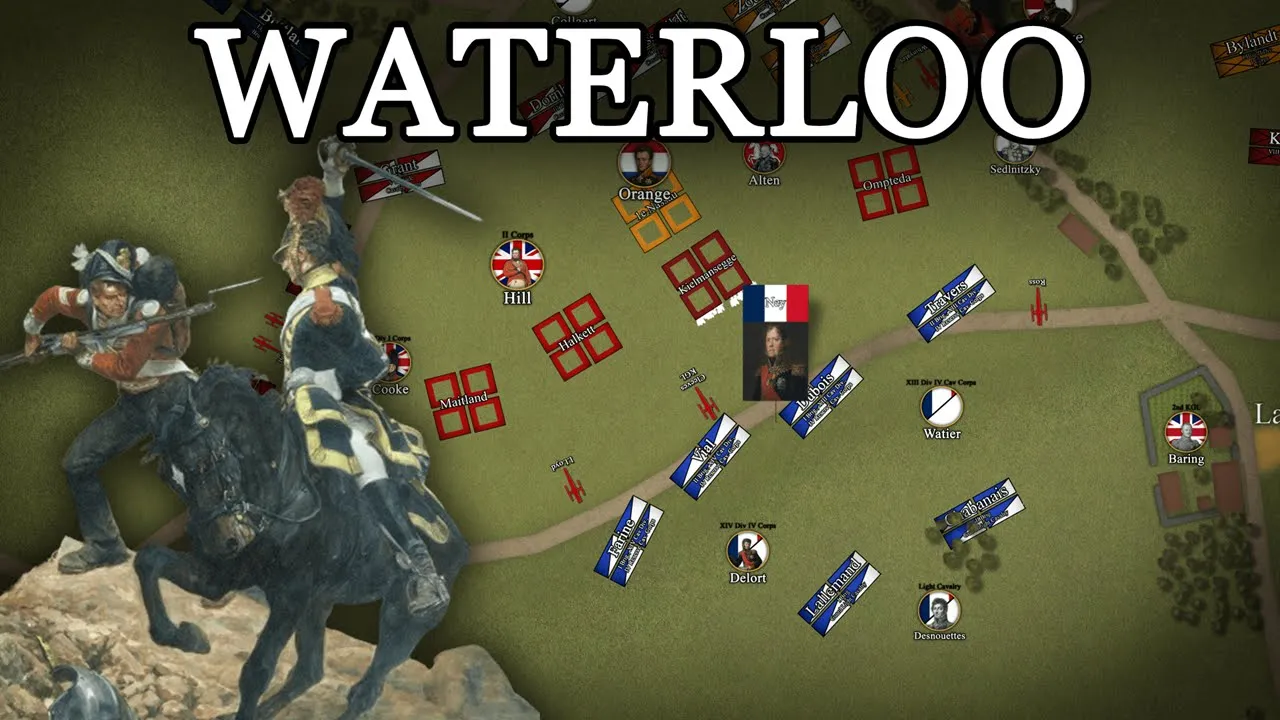
Nay began gathering any available cavalry to join him. General Delore protested when Nay plucked out one of his brigades, warning Nay not to expend heavy cavalry against infantry posted on superior ground. Forwards.
The salvation of France is at stake. Nay retorted. General Mio was a reluctant as well, but soon his whole cavalry corps was forming for the attack.
With Nay at the head, a tsunami of 5,000 cavalry charged across the valley. Allied artillery fired canister shot at Point Blank, but such shot had little effect. Those gunners turned and sought shelter in the mass of forming British squares behind them.
Wellington had seen Nay's preparations and ordered his battalions into square formation. The cloud of mounts and their riders flew into range and redcoat follys tore into it, reducing the mass ranks to mere mobs with every salvo. Time and time again, the cavalry were repelled as they attempted to break the squares.
Every wave was reduced to a disorganized rabble, doing little more than racing around the squares, looking for a weak point. Every swerve and turn led to another wall of fiery steel and lead. Nay had led his cavalry into a maze of death.
The engaged cavalry divisions were losing heart. Nay called on Kellerman's 11th cavalry division to intervene. They advanced up the road to Brussels through the trampled fields and soon crested the heights.
However, seeing that the gunline had been overrun and the infantry threatened, Oxbridge intervened with some of his own cavalry. He committed Dorberg's brigade of German legion light draons and Zutlan's brigade of Dutch carabaners for a countercharge. The first waves of French cavalry slowly fell back as the 11th cavalry division met with their opponents.
Oxbridge's countercharge was crowned with success as the tide was stemmed. The series of attacks were repeated numerous times with Nay even ordering the heavy cavalry of the Imperial Guard forward. In a short time, NA's wrecked cavalry began fleeing to the rear in utmost confusion.
But as they cleared out, French artillerymen no longer feared hitting their own men and hammered away at the densely packed Allied ranks. Horse artillery was brought up and then ripped into the enemy with solid shot at close range. The Anglo Allied infantry, while taking heavy losses themselves, stood firm for the moment.
In 2 hours, as many as 7 to 12 charges would be made. Not one would break a single square formation. This waste, though not over, will be deeply regretted.
In other sections of the battlefield, it was becoming a battle of three armies. [Music] Over the course of the day, Wellington muttered to himself one thing. Give me Bler or give me Knight.
His forces had held on against a great enemy, but were slowly being depleted. He had kept a calm demeanor, but in his mind, he had no idea if he could really hold out much longer. Then, at 4:30 p.
m. , as Derlon survivors reformed, a mass of blackcoated infantry, artillery, and cavalry emerged opposite plans. Blucer's forces had arrived.
Before 400 p. m. Husar's followed by two large Prussian brigades emerged from the blad deer.
Directly opposing them was a single regiment of infantry with two divisions of cavalry, the fifth and third. When told, Nay hurriedly dispatched Lobo Sixth Corps to meet the enemy. It would take them an hour to arrive.
The French fifth and third cavalry divisions probed against the reconnaissance party, compelling the Hisars to retire. And soon enough, the 19th and 20th Infantry Divisions began forming behind them. There they would make their stand against an enemy hellbent on revenge.
However, another crisis was developing in Wellington Center. Liz, garrisoned by 800 men under Major George Bearing, had been a frustrating obstacle during Derlong's attack. Soon, it was the object of another.
Additionally, the farm's defenses had been neglected, and Bearing's men were running low on ammunition. Four companies from the first light and fifth line battalions of the King's German Legion had been sent to reinforce the garrison as well as 200 more men from the first NASA Using Regiment. By 6 p.
m. , however, they were once again short on ammunition. More reinforcements were sent in the form of the rest of the fifth line battalion.
They had their commander killed, color taken, and the battalion cut to shreds by the ninth carassiers during NA's cavalry charges. However, the marshall was finally coming to terms that the cavalry was not enough to break the infantry squares. So he sent for the whole fifth division and a brigade from 9inth division, wishing to assemble for an attack toward Lysan and then the ridge.
In response, Wellington directed Frederick Adams Brigade to the rear of Hugamal, while George Duplat's King's German Legion brigade would confront the columns advancing in the valley below. Thio leapt from the ranks and targeted Ser's battery. In turn, German Legion skirmishers detached from their battalions and poured into the French, pressing them back toward the columns.
Simper's battery then began firing canister shot, decimating the front ranks and forcing a hasty retreat. As the bulk of the French cavalry finally withdrew from the infantry squares, Charlay's brigade finally made inroads at Lais. Before they knew it, the garrison had been flung into a fight for survival.
In no time, hundreds of the French swarmed inside the farm complex where intense hand-to-hand fighting broke out. Almost as soon as it had began, the object of Vering's men was to escape. Despite putting forth all their bravery, almost half of the garrison was wiped out.
Later in his years, Wellington himself claimed responsibility for the neglect of Lysant. With the farm captured, Napoleon was able to quickly move up horse artillery and pound away at the opposing Allied battalions. At 100 paces away, canister and solid shot soon ripped through the ranks.
Count Carl von Alton leading the third division was wounded by the fire as was Colin Hulkit of the fifth brigade. When Wellington rode into the storm to encourage his men, his aid to and quartermaster general both also received severe wounds. The toll was telling.
French Tayor began gaining the crests as the bombardment covered them. The prince of Orange tried to throw them off with one of his brigades, but in doing so was wounded himself. Nay had the enemy hanging on, but he needed the reserves to make a breakthrough.
But for now, it was an artillery duel that the French were slowly winning. "Hardp pounding, gentlemen," said Wellington. "Let's see who pounds the longest.
" They would not get the troops he needed yet, for the Prussian front was growing ever more [Music] [Music] pressing. At Planseninoa, the 16th Brigade advanced in three columns and reached the outskirts of the village. Not wanting his only route of retreat being cut off, Napoleon sent in Duim's 4700 strong core of the young guard to retake Plansenino.
Duim then plunged his guardsmen straight into the streets and alleys. His light infantry doctrine was well suited for recapturing the town. Despite their victory, the center and left column overwhelmingly attacked the southern end, driving the young guard from their positions.
Duhim felt mortally wounded in the process. With the southern half of town lost, Napoleon looked to his last reserve, the guard, and ordered Charles Antoine Moran to take plansino back. Moran dispatched the first battalion, second shashers of the guard.
This battalion was enough to drive the depleted Prussians out of the village. They also captured numerous artillery pieces which the Prussians had no time to spike. Their attack finally ensured Planseninoa to be in Napoleon's hands, at least for now.
Once more, Napoleon committed another unit to Planseninoa. This time, the second battalion of the second grenaders of the Imperial Guard. They went in with orders to use only their bayonets, no bullets.
With relentless fury, they drove the renewed attack out of the village into the fields east of it. Only the arrival of cavalry from Prussian second corps dissuaded the guardsmen. Further north, opposite papalot, Zetin's first corps arrived on the battlefield.
His core was engaged in the defense of Shahwa Gilli and had suffered heavily at Leni, bringing just 5,000 men to battle. Wellington sent Frier von Muffling to establish communication with them at Smoan as he desperately needed these troops to help defend his position. The column received conflicting requests from both high commands, delaying their entry into battle.
But soon enough it was decided that they would attack the French at Papalot. The Prussian vanguard deployed their Shutzen and artillery, then began the relief of the belleaguered Nassau troops under the command of Saxs of Imar in the northern half of the hamlet. Sometime 700 p.
m. , Napoleon heard the news. The situation was turning against him.
with the Prussian troops pouring onto the battlefield and he unable to retreat in the face of two armies thought it necessary to commit his last reserve. The immortals of the Imperial [Music] Guard as night crept over closer. As smoke billowed from the wreckage of battle, 5,000 men and eight battalions of the Imperial Guard formed into Square for protection against cavalry and prepared the move in them for the kill.
In support of them were remnants of Ray's second core. As they rallied to the guard, fighting resumed at Hugo once more. The French were applying pressure everywhere they could.
Zeton's core was reaching the eastern edge of Alington's line. But Napoleon, not wishing to waste the guard's morale, assured them it was Grushi. Before Laon, the familiar pa des sounded, the final phase of the battle of Waterloo had begun.
Wellington had been informed of the impending assault by a French deserter and frantically pulled in every unit he could find to repel it. for his standing battalions had suffered significantly from the bombardment. Allied artillery fired rapidly and desperately but couldn't match the guard artillery nor stop the guard infantry.
The first elements of the Shashur crept up the slope to the left and onto the crest where immediately they took fire from the British footguards. Adam's brigade quickly reinforced the British guards and together their fire became unbearable for even the Shashers. Astonishingly, they stopped their efforts, turned and ran.
However, that wasn't the end of it. As on the right flank of the Imperial Guard, the Grenaders found much more success. First, they attacked and mauled Kilmanseg's Hannavarian Brigade, which had nearly run out of ammunition.
The brigade was slowly pushed back in disorder. The neighboring fifth brigade under Halit buckled under immense pressure. Their right wing broke and then the whole of the brigade was thrown into a panic.
Cruz's large first Nesso Usingan regiment went forward to plug in the gap, but they too were met with the fury of the grenaders and fell back. Here though was the high water mark for the French at Waterlue. The grenaders were struck with an accurate musket and artillery fire.
Nay's horse was struck and Freant was wounded. This fire came from Shache's third Netherlands division which had marched from Mir brain in answer to Wellington. They surged forward with the utmost enthusiasm.
Before the grenaders could react, their front ranks became decimated. The Dutch joined by the British guards charged over the crest and went down the slope after them. When they were seen running, the rest of the army began to collapse like never before.
With fortunes reversed, Wellington raised his hat and sent what seemed like the whole line forward. Lord Oxbridge's cavalry followed and swept down the slope and cut down countless fleeing Frenchmen. This plague spread all the way down to Plansininoa and Label Aliance where the rest of the army melted away.
The few scant batteries fired their last shots before their crews raced for the rear. Though one of those cannonballs had struck, claiming a leg. Behind the grenaders and shashurers was the core of the old guard, which desperately clung on in the center.
Under General Pierre Cambron, they fell back in good order and never broke despite the torrential fire of the Anglo Dutch infantry. But no matter how bravely they fought, they knew their situation was without hope. The square slowly dissolved from losses as it retreated to Label Laiance, where Cambon finally surrendered.
The sun had fallen below the horizon and the whole war was effectively won. An exhausted Wellington let Blucer's bloodthirsty troops pursue. They chased Napoleon's scattered forces all night to the narrow bridge at Janap.
The bridge couldn't possibly handle thousands of panic-stricken men. Napoleon himself had to ditch his carriage to get across. Gusi, having won an empty victory at Vavver, was horrified by the news and began retreating toward the border while he could keep his army intact.
Napoleon finally reached Shalwa, where he hoped to rally his army. But the defeat was so complete that there was no hope in doing so. He had his last chance.
The carnage of the campaign was high before and it skyrocketed after the battles of Vaver and Waterloo. French losses were especially catastrophic at 27,000 men killed or wounded, 1 to 2,000 captured and 220 guns lost. In addition, 15,000 more men either went missing or deserted.
The Allies, ultimately victorious, also suffered for their triumph. 4,700 killed, 14,600 wounded, and another 4,700 missing for both Bler and Wellington's forces. Most of Wellington's losses, it should be noted, were killed or wounded by artillery.
Combined with the losses of both sides in the previous days, it totals to somewhere in the realm of 93,000 to 100,000 men killed, wounded, missing, or [Music] captured. The coalition armies race south into France. Despite some successful rear guard actions, nothing could stem the Allied tide.
From the east, the Austrians were pouring into the frontier. The Russians were not far behind. The Prussians reached Paris, hellbent on revenge.
It took intervention from Wellington to prevent the destruction of the Yana Bridge, which commemorated their crushing defeat in 1806. Napoleon had his last chance and abdicated. Paris surrendered on July 4th.
During an effort to flee to the United States, he was intercepted by a British blockade outside Aroucher. He would spend the next six years in exile until his death in 1821. Soon after, the redrawing of Europe began once more.
Louis V 18th once again sat upon the French throne. Wellington and Bler gained a reputation nigh unassalable for their victory over Napoleon. Many of Napoleon's generals, such as Sult, took up positions within the royal government.
Others, such as Nay, still regarded as a war hero despite his failures at Waterloo, held out before being captured and executed. Legend says he refused to be blindfolded and ordered the firing squad himself. Waterloo marked a turning point in world history like no other battle.
The previous century of on andoff warfare and rivalry between France and Britain permanently came to an end. In its wake, a new age would come to replace it.