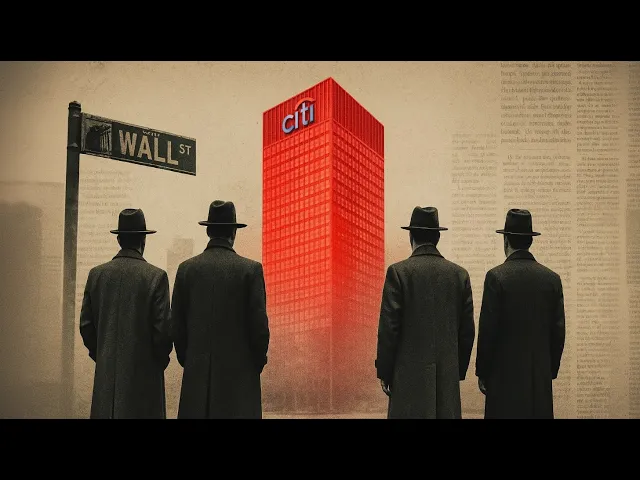
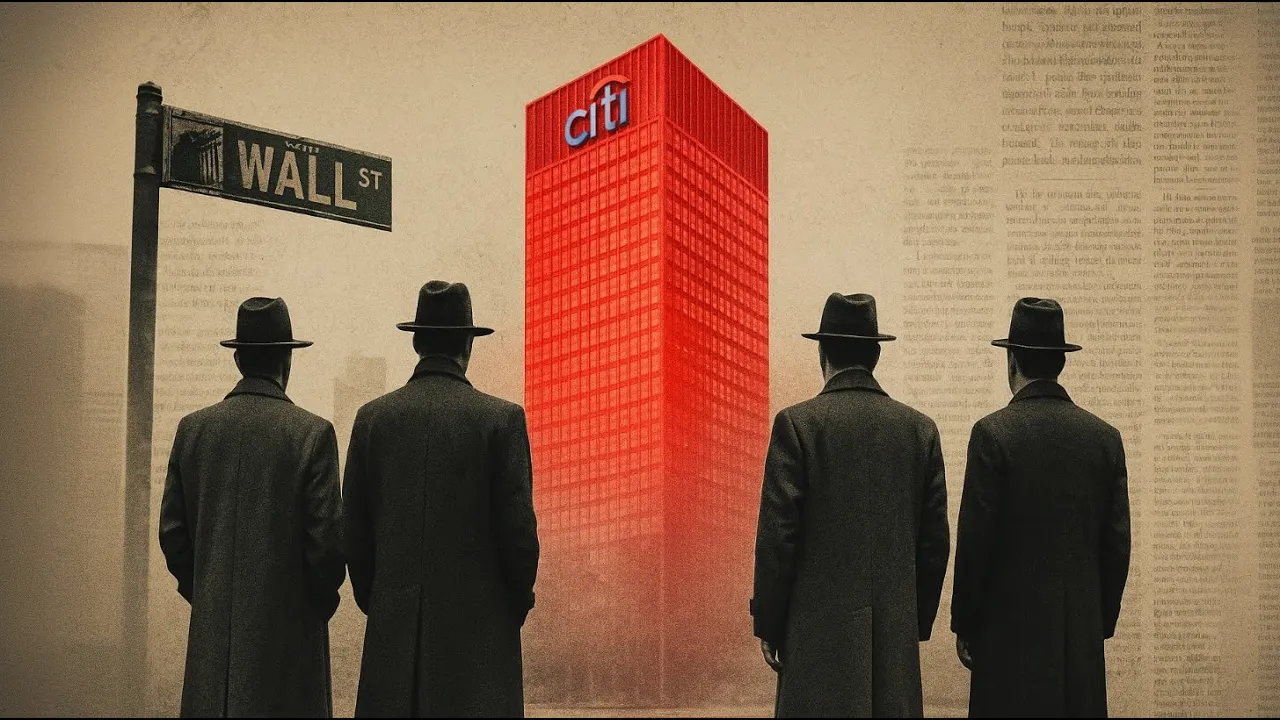
It was once the largest bank in America, born from the aftermath of war and financial ruin. But after over a hundred years of dominating the industry, its very existence is now being challenged. Since the late 90s the stock is down over 80%.
What Citi was doing it was illegal. Welcome to the banking business where you have a crisis around every corner. The year is 1837, marking the end of the panic of 1837, the worst economic crash in America's young history.
At the time America was a young country and the banking industry was very unregulated. And the directors of these banks would take depositors money for their own personal use. And as a result almost every five years there was a banking crisis.
Founded just 31 years before as a state chartered bank, the Citibank of New York was hit hard, just like many others. It faced a rush of withdrawals and a shortage of available loans. Depositors all over the country were frightened about the safety of their funds and rushed to withdraw them.
There were runs, there were failures of banks by the droves. The bank urgently needed new leadership, someone who could make Citibank trustworthy again. The board of directors recently appointed a manager named Moses Taylor, hoping he could rescue the bank from the brink of collapse.
For Taylor the challenge is immense, he has to find ways to transform a struggling bank into a successful one capable of surviving future crises. But Taylor is no stranger to facing adversity. At the age of 15, Taylor began working on the docks of New York Harbor.
But he quickly earned enough money to start trading his own account as commodities trader, including South American Sugar. By the age of 30, Moses Taylor had built a thriving business, a personal net worth of $200,000, the equivalent of $5 million today. His business was the Caribbean trade importing sugar from Cuba, but also fruits and other commodities from wherever they were grown.
As a self-made man, Taylor knows the importance of being financially conservative. It may be hard for modern Wall Streeters to imagine a banker who doesn't like leverage, but the merchant Moses Taylor avoided taking on debt whenever possible. Taylor's rise to prominence catches the attention of the richest man in America, John Jacob Astor.
And his saw Taylor as one of the most honest and trustworthy individuals he has ever encountered. At the time, Astor is the largest shareholder of Citibank, and he knows the bank needs to have a leader people can trust. So, he persuades the board to appoint the 31-year-old Moses Taylor as president.
As the boss, Taylor faces an insurmountable task of rebuilding the bank, and if he fails, he will lose everything, including his reputation. He immediately puts the majority of his own fortune in the bank stock, showing the employees and the public that he means business. And that's just the beginning.
Taylor believes a strong bank always needs what he calls "ready money. " Taylor summed up his approach to business in general and banking in particular with one phrase, "ready money. " He ensured that a lot more money was owed to Citibank than the bank owed to others, and he kept a lot of cash on hand in case of a panic.
His conservative approach to banking works. Over the next 20 years, Taylor turns Citibank from a little-known name into one of America's most powerful commercial banks. Taylor's mix of caution and ambition fortifies the bank, making it strong in the booming economy of the 19th century.
Taylor may have turned around Citibank, but he will have no escape from what is about to happen to him next. Moses Taylor passes away in 1882 while still on the job. His unexpected death is a huge blow to the bank as the board of directors are not ready to find a successor.
But they soon decide that his son-in-law, Percy Pyne, may be the best candidate for the job. Pyne became Taylor's right-hand man, and in 1855 also became his son-in-law by marrying Taylor's daughter, Albertina. But Pyne quickly proves to be incompetent as the president.
Pyne seems to have been a careful banker and good neighbor, but not much of a marketer and certainly not an empire builder. For Pyne, living up to Moses Taylor's legacy is overwhelming, and Citibank's business becomes stagnant under Pyne. And if the bank directors don't find a replacement soon, the success of Citibank will be undone.
After Percy Pyne's resignation, a new kind of leader steps in, ready to propel Citibank to a new direction. James Stillman is a wealthy robber baron in the cotton and railroad industries. A ruthless businessman, Stillman possesses a reputation for bending anyone to his will through intimidation and toughness.
Stillman was not exactly a people person and certainly not the type of nurturing mentor. He ruled absolutely by fear and was thoroughly ruthless in his life. was thoroughly ruthless, in his rebukes, when a job was poorly done!
Stillman was a unique figure in history known for his incredible energy and determination. He aimed to make Citibank America's number one bank, and he devoted all of his energy towards achieving this goal. But to achieve his audacious goal, Stillman understands that he must help the bank in landing wealthy clients, and he knows just the men to target.
Beginning in the 1880s, Stillman served alongside William Rockefeller, John's brother, and a Standard Oil co-founder on the boards of a railroad and a bank. The two directors became close friends, and two of Stillman's daughters eventually married sons of William Rockefeller. The business side of the friendship would help turn Citi into a financial giant.
Landing Standard Oil as a client proves monumental. It swiftly transforms the bank from a regional player into a powerful national bank. By 1894, after just four years of running Citibank, Stillman turns it into the largest bank in America.
With that ultimate goal accomplished, Stillman steps down as the bank's president, appointing Frank Vanderlip to oversee operations while he continues as chairman. Trained as a journalist, Vanderlip possesses extensive overseas experience. To foster growth, Vanderlip creates a plan for Citibank's international expansion.
But shortly after Vanderlip assumes control, America plunges into a financial crisis. The Panic of 1907. Confidence in the banking system wanes, triggering runs on banks and trust companies.
The New York Stock Exchange plummets nearly 50% from its previous year's peak, and the panic spreads, causing widespread bankruptcies. If you look at all these panics, they all have one thing in common. There tends to be a crucial element of human psychology that comes into play when things go wrong.
Everyone tries to head for the door. Everyone tries to sort of fold their cards. At the end of the day, Wall Street really is more about human psychology and how humans react to things.
Financier J. P. Morgan steps in, pledging substantial personal funds and persuading other New York bankers to bolster the banking system, including Citibank.
In the midst of the crisis, people flocked to Citibank as a safe haven. This was largely due to how Stillman transformed it into a financial fortress. It's a stark contrast to what would happen to Citibank in 2008 crisis.
But to Vanderlip, the Panic of 1907 underscores the need for a centralized bank in America. He envisions a banker-controlled central bank that can act as a last resort during banking crises. And as it turns out, other American elites are considering the same plan, including those in the government.
Post the Panic of 1907, Senator Nelson Aldrich is eager to find ways for the U. S. to avoid similar financial catastrophes.
And so he begins a trip to visit Europe to learn from their central banking systems. Central banks were common in Europe. The idea was to study how other countries dealt with financial panics and to consider, for example, the creation of a central bank to lend money to commercial banks in a crisis.
After he comes back, he is convinced that America should have a central bank. He invites a group of bankers to a secret meeting, including Vanderlip and Henry Davison from the Morgan Bank. None of these men would publicly admit their participation in the secret gathering for decades.
They were told not to use their last names when communicating with one another and to avoid dining together on the night of their departure. The creation of the Federal Reserve becomes one of the most significant events in the history of America and also the most secretive. If what we had done then had been known publicly, the effort would have been denounced as a piece of Wall Street chicanery, which it certainly was not.
None of us who participated felt that we were conspirators. On the contrary, we felt we were engaged in a patriotic work. We were trying to plan a mechanism that would correct the weaknesses of our banking system as revealed under the strains and pressures of the Panic of 1907.
With the establishment of the Federal Reserve, it becomes possible for the banking industry to thrive without worrying about systemic failures. The Federal Reserve will be able to lend to banks in crises. The road to hell is paved with good intentions.
Knowing that the Federal Reserve has its back, Frank Vanderlip is confident that Citibank should aggressively expand without hesitation. Citibank begins to borrow heavily from the Federal Reserve, securing up to $95 million for its expansion. Within two years, Citibank establishes branches in Brazil, Chile, Uruguay, and Cuba, all of which appear to be thriving.
But to Vanderlip, that is not enough. He aims to enter one of the world's largest markets, Russia. In 1917, Citibank opens a branch in Petrograd, known today as St.
Petersburg, Russia. Vanderlip believes it's one of the most important overseas branches for the bank. But what he doesn't realize is that Russia is undergoing profound changes, unprecedented in world history.
A victorious communist revolution looms, posing a real threat to Citibank's operations. In March 1917, widespread protests and strikes erupt in Petrograd due to the dire economic situation, war fatigue from World War I, and general dissatisfaction with the autocratic rule of Tsar Nicholas II. The Tsar's government collapses and he abdicates the throne, ending centuries of Romanov rule.
A provisional government, initially led by Prince Georgi Levov and then by Alexander Kerensky, is established but struggles to maintain control amid growing unrest and continued war. The Bolsheviks, a radical socialist group led by Vladimir Lenin, capitalize on the provisional government's weaknesses. They stage an armed insurrection in Petrograd, seizing key government buildings and infrastructure.
The provisional government is overthrown and the Bolsheviks declare a new government, leading to the establishment of the Russian Soviet Federative Socialist Republic. Lenin's regime is a government that's born in war, so it really is helpful to think about the period, I think, from 1914 to 1921 as one of continuous warfare. The Bolshevik Party at the beginning of 1917 is about 20,000 people.
By the end of the civil war, it's about 1. 3 million. The ascent of the Bolsheviks spells doom for the newly formed Citibank-Russian branch.
They quickly nationalize the bank and Lenin shows no intention of returning the assets and deposits to Citibank. When you invest in a society, you cannot always control how that money is used. In fact, you can never control where that money goes.
As a result, all of Citibank's Russian assets, worth tens of millions of dollars, are lost. But the Russian trouble is just a first domino to fall. Over 1,000 miles south, Citi's investment in Cuba is also turning into a disaster.
Cuba was in the midst of a major financial crisis. Sugar industry borrowers couldn't repay their loans and depositors understood what that would mean for the banks holding their savings. Citi had managed to take on $79 million of exposure to the sugar industry, a figure that rivaled the bank's entire capital, including a full $63 million of non-performing loans.
With its international business crumbling, Frank Vanderlip has no choice but to resign from the bank. The board turns to Stillman Jr. , hoping he will emulate his father's success.
But he, too, cannot turn around the bad investment in Cuba. The board immediately fires him and eagerly searches for a new candidate to resolve the Cuban crisis. But eventually, one man stands out by offering an unexpected solution to Citi's Cuban problem.
His name is Charles Mitchell. As the newly hired leader of America's biggest bank, Charles Mitchell knows his career depends on one thing, solving the Cuban sugar investment. His predecessor's failure in this arena looms large, a reminder of the stakes at hand.
For Mitchell, instead of turning Cuban sugar loans profitable, he figures out a way to hide it. So he set up another company and moved the bad loans to that new company. And then he gave the shares of this new company to the stockholders of Citi banks, effectively spinning this company off by removing the bad loans from the balance sheet.
Mitchell successfully solved the problem by shifting the debt burden to the shareholders. And now he can finally begin to look for a new growth avenue for his bank. A decade on from the Panic of 1907, America is now basking in an era of unprecedented prosperity, the Roaring Twenties.
The most extraordinary thing about the decade of the Twenties was a pandemic era of optimism, a feeling that the future of the country was unlimited. This period marks perhaps the most significant development in American history, the emergence of a thriving and prosperous middle class. The Industrial Revolution created the development of the middle class.
It created wealth that we never would have imagined possible before. As the new leader of Citi Bank, Mitchell is keenly looking for a new market to foster new growth for the bank. He sees the growing middle class as the opportunity he has been looking for.
Mitchell was an innovator in serving markets that other bankers had long ignored. Citi began to bring many of the financial products that Americans now take for granted to small savers and borrowers. By mid-1929, the bank had attracted more than 230,000 such customers with a full $62 million in deposits.
By giving out easy loans, Citi Bank fuels the Roaring Twenties. With the success of Citi Bank, Mitchell's status on Wall Street reaches a new height. He earns a position as a board member for the Federal Reserve of New York.
Mitchell understands that a booming stock market benefits his business. He continuously advocates for the Fed to maintain lower interest rates, enabling easy borrowing for his bank. But little does he know, after years of reckless spending and easy credit, America is heading for an economic disaster.
Bank stocks show heavy recessions. The Bank stocks show heavy recessions. The decline in bank stocks was led by First National.
This stock was down $500 on the bid price. Stock of the Bank of the Manhattan Company dropped $150 on the bid. There were losses ranging from $16 to $40 in issues such as Bank of America, Bank of United States, Chase, Chatham, Phoenix and more.
As the Great Depression takes hold, Citi's House of Cards begins to crumble. Since the Federal Reserve was set up, it looks like Citi Bank has abandoned the careful and cautious approach that Moses Taylor and James Stillman used to stand for. This is a classic case of moral hazard.
Knowing that the Fed will bill them out, they become more reckless with their money. As the crisis deepens and Citi's international businesses decline, with $44 million in the German branch becoming increasingly uncollectible. But out of all the international divisions, Citi Bank's Chinese division is the only one that is profitable, generating $9 million from silk trading.
This revenue becomes a critical lifeline, offering temporary liquidity to the struggling bank. But when it's revealed that Mitchell paid himself $1 million in 1929, the bank's reputation suffers a severe blow. Faced with no other option, Charles Mitchell resigns.
In the following years, Citi Bank struggles to recover. The bank once again turns to the government for help. The new president of the bank is James Perkins.
He is a personal friend of President Franklin D. Roosevelt. With this relationship, Perkins persuades the government to invest $50 million by selling preferred shares.
But Citi Bank's real breakthrough comes when the U. S. is plunged into the most brutal conflict in history.
World War II. As the U. S.
enters the war, FDR needs to rapidly expand the American military industry. As a bank with close ties to the government, Citi becomes a key financier of the war effort. During the three years beginning in June of 1945, Citi's commercial and industrial loans surged to $661 million.
By the end of the period, U. S. government securities added up to most of the bank's domestic earning assets, underlining how much the bank had become above all a vehicle to fund the federal budget.
It was four o'clock Pacific time in San Francisco when the announcement came, and people were quick to leave their offices for an impromptu spontaneous celebration. But it was in that city's Chinatown where Victory Day was the most joyous. When the war ended, Citi Bank enjoys the resurgence of the U.
S. economy and the booming middle class. But competitions are also quickly catching up.
In the United States, Citi Bank faces stiff competition from major banks like Chase Manhattan, Bank of America, and J. P. Morgan.
To maintain its edge, a new leader emerges, ready to take the bank to new heights. Walter Wriston The man who will alter the course of Citi Bank came from a prestigious background. Walter Wriston's father was the president of Brown University.
Even born with a silver spoon, his parents instill in the young Wriston a sense of hard work and grit. And the young Wriston does not disappoint, becoming the youngest Eagle Scout in the country at the age of 15. After serving in the U.
S. Army during World War II and achieving the rank of lieutenant colonel, Wriston could have pursued a career in politics. But he chooses banking, landing a job at Citi Bank using his family's connections.
At Citi Bank, Wriston quickly rises through the ranks, knowing that there is no reward without audacious risk-taking. To stand out, he knows he must take on projects that have the potential for massive profits. By the 1950s, one of these projects was Aristotle Onassis.
Aristotle Onassis was a Greek shipping tycoon. In the late 1950s, he comes up with plans to construct giant ocean tankers to carry oil. While other banks shy away from financing the projects due to the risk involved, Walter Wriston sees an opportunity for a killing.
Wriston became immersed in the business of providing credit to the transportation industry. Wriston arranged the financing to build the massive vessels along with long-term loans from the insurer MetLife. After arranging the financing needed for Onassis to build ocean tankers, the loan becomes highly profitable.
By the 1960s, the shipping department Wriston is in charge of becomes one of the most thriving departments at Citi Bank. By 1967, Wriston officially becomes the president of Citi Bank, then the second largest bank in America with billions of dollars in assets. The 1960s is a decade of drastic social and political change.
Fueled by the burgeoning middle class, the economy goes through robust growth, low unemployment, and rising consumer confidence. After World War II, the United States, remember, was the only country that was viable. We were the only pWristone country and we supplied the world.
We had all of these international agreements, trade agreements, United Nations, where we ceded sovereignty, we created military alliances, they were trade pacts. They were all very good. The World Bank, the Export-Import Bank, the International Monetary Fund.
It was all predicated on the principle that the United States was so wealthy. Walter Wriston builds a thriving international department at Citi Bank and, as the new president, aims to disrupt the banking industry entirely with a focus on innovation and risk-taking. He will eventually pay a price for this aggressiveness, but for now, he plans something big.
As consumer banking grows rapidly, Walter Wriston sees a need for consumers to get cash quickly and efficiently. I was in a tell-a-line one day, Bill, wanting to cash a check to get some money, and the line was long, it wasn't moving, and I was getting more irritated by the minute. And it dawned on me, there's got to be a better way of doing this.
Though the first ATM in the United States is rolled out by Chemical Bank in 1969, Wriston immediately sees its potential. He recognizes that offering customers 24-7s access to their accounts can draw more consumers and grow their deposits in an unprecedented way. And if Citibank becomes the first bank to scale the ATM business, it will have a real opportunity to regain its past dominance as the largest commercial bank in the U.
S. The invention and the launch of automatic teller machines becomes a massive success. They just look like more cash machines built into bank walls, but to Citibank they are a $50 million gamble that the consumer can be wooed and won with electronic services.
Over the next year, a pair of electronic tellers will be built into the vestibules of most of Citibank's 270 metropolitan area branches, creating the largest electronic funds transfer system in the nation. In just a few short years, Citibank sees a record number of customers opening their accounts. By the early 1970s, Citibank continues to prosper.
But what Wriston doesn't know is that the U. S. economy is about to face its biggest reckoning, and Citibank will endure a crisis that will put everything Wriston believes in to question.
Wriston managed to land a job in Citibank, largely due to his network of professionals. And more importantly, his connection with Aristotle Onassis laid the foundation for his rise at the Citibank. Having access to a network of pros is the key to success in finance.
Today's episode is brought to you by The Kapitalist, a YouTube channel dedicated to enhancing your practical skills and knowledge in finance. Founded by a private equity firm known for their acumen in real estate deals, they are the experienced pros who aim to use their extensive experience to empower you. On their channel, you'll discover the secrets of dealmaking and investing, honed over many years in the industry.
Whether you're an aspiring entrepreneur or just keen on sharpening your skills, The Kapitalist offers valuable insights. Click the link in the description to subscribe. Take the first step towards your financial empowerment with The Kapitalist today.
By the late 1960s, due to a significant decline in the demand for rail transport in the United States, the Pennsylvania Railroad and the New York Central Railroad are both struggling to stay afloat. As a result, they decide to merge, hoping to form a more cost-efficient railroad company called Penn Central. Citibank forms a syndicate with its fellow banks, and together they bankroll the merger, providing almost half a billion in debt, making the new company heavily leveraged.
But the merger quickly proves to be problematic. When we talk about mergers, a big problem is that most of them don't add value. Take the example of these two railroads coming together.
They're running into a lot of trouble, like having systems that didn't work, and a lot of redundancies, and dealing with a lot of debt. By 1970, Penn Central is on the verge of bankruptcy. If the company collapses, Citibank will lose tens of millions.
Hoping to salvage the loan, Walter Wriston reaches out to the Nixon administration, expecting a government bailout. Wriston even backed the preposterous argument that a railroad bankruptcy was a threat to national security. But for President Nixon, bailing out a private company would look bad for his presidency.
And such an action would signal to the public that the economy is in worse shape. He rejects Wriston's plea to bail out Penn Central. The bankruptcy trustees have done their best to give good railroad service.
But Penn Central has not been able to generate revenues sufficient to prevent continuing deterioration of its track and equipment, including its freight car fleet. The bankruptcy costs Citibank $28 million, an acceptable loss for the bank. As the economic conditions improve by early 1980s, Citibank continues to grow.
During Wriston's tenure, Citibank finally becomes the largest commercial bank in the United States once again. Walter Wriston was no doubt a great innovator in finance, especially during a period of significant economic expansion. But it's also worth noting that his approach to taking risks and focusing on growth have also played a part in making their banking operations less stable.
By 1984, Walter Wriston, after 17 years at Citibank's helm, officially retires. Under his leadership, Citibank not only overtakes Chase Bank to become America's largest bank, but also plays a pivotal role in bailing out New York City during the late 1970s. As Wriston retires, a young, ambitious banker rises to the top, planning on continuing Wriston's legacy.
His name is John Reed. The 1980s is a decade of the Reaganomics. The country sees historic economic growth as a result of deregulation, tax cuts, and increased defense spending.
As Citibank's new head, John Reed is set to uphold Walter Wriston's legacy. John Reed was the CEO of Citi. He had come up through the consumer side of the bank.
During this decade, Reed focuses on advancing technologies, including faster check processing and more efficient back office operations. By the decade's end, Citibank remains the largest bank in America. But as the 1990s approach, a different kind of crisis looms, beginning with an unlikely client of Citibank, Donald Trump.
In the 1980s, Donald Trump actively expands his real estate and casino ventures. His Trump Taj Mahal in Atlantic City, notably financed by high-yield junk bonds, is among these projects. Growing up in a wealthy family, Trump's ambition is insatiable.
He will stop at nothing until he becomes the undisputed king of an empire. But at the time, Trump doesn't know that after years of easy money and expansion, the U. S.
real estate market is heading into a recession. And not long after opening Trump Casino, his real estate business starts to crumble. The announcement that Trump was looking for a buyer for his shuttle was an early indication that Trump was running into a cash flow problem.
One report has that shuttle losing $85 million a year. You owe a tremendous amount of money. Are you going to sell that .
. . ?
Desperate, Trump turns to his father, Fred, for a bailout. I worked for Donald Trump in the late 80s and the 90s. Fred Trump showed up at the casino with $3 million and converted the cash into chips.
Now, normally you might say, "That happens every day. " But because he put the $3 million in, took the chips and left with the chips, it winds up in effect being a $3 million loan to the casino. But Fred's emergency loan is not enough.
It merely buys Donald some time. In July 1991, the Trump Taj Mahal files for Chapter 11 bankruptcy protection. And at the same time, Trump is also forced to restructure his entire business empire.
Citibank was part of the syndicate that holds Trump's failing debt. And now it faces the risk of substantial losses. To prevent the loans becoming worthless and hoping that Trump may eventually make good on the loans, within two years, the syndicate offers extra $65 million to Trump, and at the same time, reducing interest rates on the existing $2 billion loans.
As a result, Trump's business are salvaged. But for Citibank's, its troubles are just beginning. Hampered by a series of bad loans, including Trump's, the bank misses quarterly earnings.
To fortify the balance sheet, John Reed begins seeking more capital for his bank. And he knows just where to look. In February of 1991, Citicorp sold $590 million of preferred stock to Prince Al-Walid bin Talal bin Abdulaziz Al Saud, a member of the Saudi royal family.
With sufficient capital and aggressive cost cutting, Citibank finally rebounds by 1994. But for Reed, a bigger opportunity is just around the corner. Sandy Weill is a renowned dealmaker.
Through countless takeover battles, he has built Travelers Group, an insurance empire. And with his trusted lieutenant, Jamie Dimon, on his side, Weill envisions the biggest merger in the history of Wall Street. By merging with Travelers, Citicorp will not only become the largest bank, but also the largest financial service company in America.
The merger they're proposing is illegal. Most bankers wouldn't go there, but it took someone who had a different vision. And they decided, well, we'll do the merger first, and the world's going to change for us.
And they were right. The Federal Reserve yesterday approved the merger of Citicorp and Travelers Group, Inc. , a combination that would create the world's largest financial services company.
With assets of $751 billion and operations in banking, brokerage and insurance businesses. The merger may have created the biggest Wall Street firm, but the co-CEO structure spells trouble for John Reed. And a power struggle soon erupts between Sandy Weill and John Reed for Citigroup's ultimate control.
John S. Reed, co-chief executive of the financial services giant Citigroup, said yesterday that he planned to retire on April 18th after the company's annual meeting. Upon the departure of the 61-year-old Mr Reed, the chief executive's reins at the company will be held solely by Sanford Weill.
These different cultures never really mixed. And so pretty quickly, Sandy Weill, the ultimate operator who had won out in the merger and got rid of his rival John Reed. With the exile of John Reed, Sandy Weill is now the undisputed king of Wall Street.
By all means, Sandy Weill was not a bad manager of Citi. He was a ruthless cost cutter and always remained a prudent financial management. In the early 2000s, the U.
S. witnesses significant economic growth, driven by an expanding real estate market and a thriving banking industry. As Citigroup continues to prosper, Sandy Weill decides it's time to prepare for retirement.
Sandy Weill may have been a successful dealmaker, but he makes a controversial decision to appoint a lawyer to become his successor, Chuck Prince. Weill hopes Prince's legal expertise will guide Citi through complex regulations. In the end, hiring Chuck Prince will become a grave mistake for the bank.
For Chuck Prince, he believes that for the bank to thrive, he must do what it takes to keep the profit coming, including doubling down on mortgage debt and securities business, On Wall Street, a housing and credit bubble was leading to hundreds of billions of dollars of profits. You know, by 2006, about 40 percent of all profits of S&P 500 firms was coming from financial institutions. By 2007, Citi accumulates an astonishing $55 billion in mortgage debt.
Citi Group Inc. stunned Wall Street Tuesday by reporting that it had suffered a $10 billion quarterly loss, the worst ever in its storied history. As the crisis deepens, Citi Group dismisses Chuck Prince and appoints Vikram Pandit, a Morgan Stanley veteran.
But Vikram Pandit faces an uphill battle. He knows Citi Bank's potential collapse will be catastrophic, not just for himself, but for the rest of the world. Consider that 100 years ago, Citi Bank was the one who bailed out the industry.
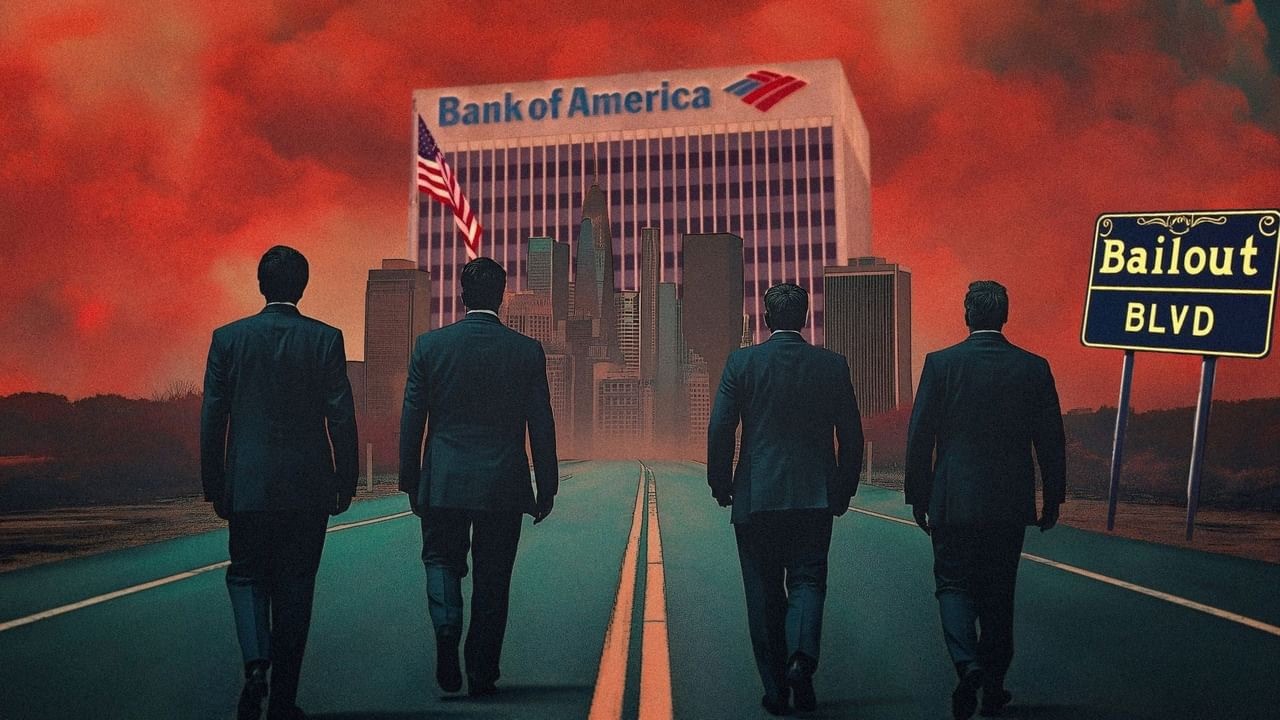
And now in 2008, it was not going to survive unless it was bailed out by the government. On October 3rd, 2008, Congress passes the Troubled Assets Relief Program. With this bill, Wall Street banks are set to receive massive bailout money.
And Citi Bank gets $45 billion. We clearly needed to stabilize Citi, and we were able to do it, working creatively with the Fed and the FDIC to combine our new powers and Citi survived. The bank is getting $20 billion in cash from the government's $700 billion rescue fund on top of the $25 billion it received just a month ago.
But even with $45 billion from the government, it is not sufficient for Citigroup to fully bounce back. By the end of 2009, Citigroup launches a public offering, selling $17 billion in common stock. Because Citibank lost so much during the crisis, Vikram Pandit was really focused on cost cutting and selling underperforming businesses in order to build a strong enough capital base.
With this capital, the bank embarks on an unprecedented recovery, earning a profit of $10. 6 billion by the end of 2010. Citibank may have bounced back, and its future finally looks bright again.
But the future of Vikram Pandit is not so optimistic. Under Vikram Pandit's unexpected exit, Michael Corbat becomes Citibank's chief executive. As Citigroup gradually loses its edge to competitors like JPMorgan Chase, CEO Corbat focuses solely on increasing profitability, and his push for profitability will have unforeseen consequences.
In exclusive and secretive online chat rooms, traders from major banks are cooking up schemes to make a killing in the currency market. In these online chat rooms, they call themselves the Cartel, or the Mafia. They share confidential information, coordinate trading strategies, and manipulate benchmark foreign exchange rates for personal gain.
Many of these traders trade on their clients' and banks' behalf. For example, a trader might inform others that their bank is about to make a huge purchase of euros. To take advantage of that, they could all benefit by buying euros before the price goes up.
A great majority of these traders are from Citigroup, JPMorgan, and Barclays. They manage to operate under the radar for years. But in 2015, the investigators finally begin uncovering the extent of their scheme.
As a result, the U. S. Department of Justice finds Citigroup over $900 million, and the bank pleads guilty to felony charges.
From 2015 to 2020, the banking industry experiences significant growth and consolidation. Under the leadership of Michael Corbat, Citigroup is attempting to achieve a breakthrough in technology The company hopes to regain its dominant position by expanding its digital banking services and integrating AI into its business. Despite ongoing efforts, challenges continue to arise.
As 2020 approaches, Citibank is poised to confront an even bigger storm. In late 2019, the world is hit by the COVID-19 pandemic, impacting businesses across the globe, including Citigroup. Like many banks, Citigroup has to set aside provisions for credit losses by allocating a substantial amount of money, anticipating future losses from its loans.
And during this critical juncture, Michael Corbat retires. And the reign of Citigroup is passed to Jane Fraser. Jane Fraser grew up in a family of successful business people.
Fraser is confident in her ability to transform Citibank for the better. In order to realize her vision, she must act decisively. Her strategy includes streamlining operations, which involves laying off employees and reorganizing leadership.
We got news from the company that it is what it is calling streamlining its organizational structure, simplifying its operating model, having leaders of Citibank's five interconnected businesses that will now report directly to CEO Jane Fraser and be members of the executive management team. But even that proves to be insufficient in fully addressing the challenges. After the world bounces back from the pandemic, Fraser observes a notable decline in branch visits, leading to a strategic closure of consumer banking branches, both in the United States and internationally.
What's actually happening is that the middle class is shrinking. As a result, banks are now shifting their focus towards high net worth individuals and institutional clients. By 2023, amidst soaring inflation and stringent monetary policies, Citigroup faces another pivotal juncture.
In recent years Citigroup has been going through a restructuring phase, trying to find a resemblance of a competitive edge that the bank used to enjoy in the past. But one thing is certain, as the third largest bank in America, Citibank is practically too big to fail. And with the backing of the Fed, this legendary bank will live on.