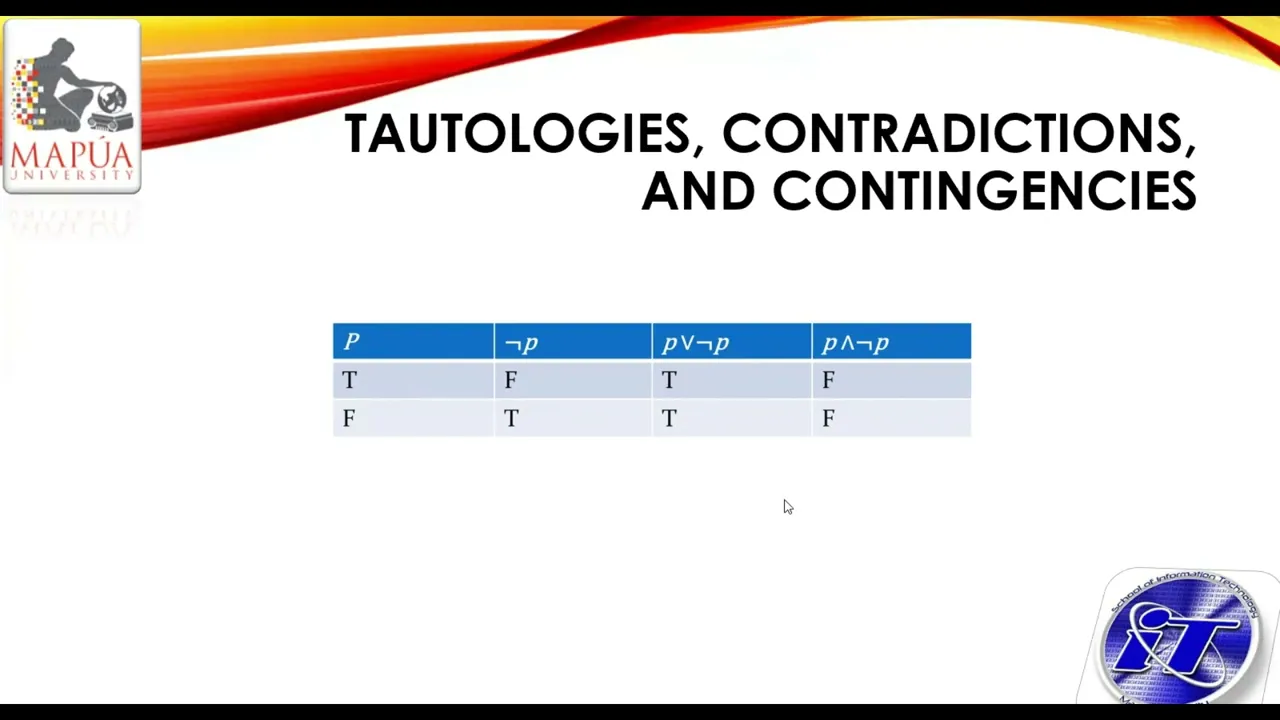
[Music] let's continue our discussion about module one but let's focus on proposition and equivalences so under this video lecture we're going to discuss what is a tautology contradiction contingency and logical equivalence so let's define first what is a tautology tautologies are statement that is always true for example p or not p whatever the value of p when we evaluate the whole statement it will be all it will it will always be true okay so that is tautology well for contradiction these statements are always false so for example p and not p and again whatever the
value of p when we evaluate the whole statement the result is always false okay so that's contradiction but in case if the statement is neither contradiction nor tautology we call it contingency so for example p so p could be either true or false so that's contingency so just a summary or comparison between tautology contingency and contradiction we have this truth table so p and not p could be either true or false so these are example contingency p or not p is always true so this is tautology p and not p is always false so this
is contradiction okay so that's tautology contradiction and contingency so now let's move on with logical equivalent if say logical equivalent we are talking about two compound prepositions wherein they have the same meaning okay so when we evaluate these two compound prepositions it will give us the same result if we're going to create a truth table it will give us same truth table okay so for example we have not b or q is equivalent to p implies q okay so by the way before we proceed in proving this this statement these are the symbols to determine
that we're talking about logical equivalence so double head double-headed arrow with thicker line or three lines okay so these are the symbols for the chocolate equivalency so let's go back to the example so using it through table okay we could say that not b or q have the same result we if compare with b implies q okay they have the same result true false true true based on the given pq values so therefore based on this p or q is really equivalent to p implies q okay so aside from a true table we could use
logical equivalence rules to determine if these two compound equations or statements are equivalent but the discussion will be on the next feature lecture so thank you and see you on the next feature lecture [Music] you













![I Replaced ALL my ADOBE APPS with these [free or cheaper] Alternatives!](https://img.youtube.com/vi/5EfqHg49kMk/maxresdefault.jpg)