this is a presentation of the natural stone Institute's natural stone University thank you for watching but now other questions I've asked people and the previous webinars to submit questions particularly about a particular slab or one with particular names but I can do a little bit of work ahead of time so I've got a bunch of questions here caveat is that didn't I just say don't do this visually so that's exactly what I'm doing and so I can I'm sort of giving you my thinking on these and what the tools that I use and maybe in
a lot of cases saying well I don't really know it's back to you guys so between the names and the visual this is not the best way to ID rocks then again I have a new in geology for a long time and I have some insights that hopefully could be helpful first couple questions aren't about specific slabs someone asked last week about the green bloom this is kind of out of my realm because I'm not a fabricator the things I can tell you about the green bloom in diagnosing it is that it shows up sometimes
after installation or the homeowner goes huh I didn't think this was green it has a really weird color of green it's kind of bright kind of fluorescent green almost and a lot of those natural greens and rocks are sort of a almost like a spinach color like that deeper green so that jumps out is like not being quite right and green bloom is a chemical reaction from products that are put on the rock the epoxy the activator and hardener in the epoxy reacting with the minerals in the rock so I don't want to get too
deep into this because it's not my expertise but that's what it is that's how you recognize it that the that color just is jarring against other colors in the rock but luckily it is solvable this one with a poultice and people that got all kinds of other methods but I'll leave that to the experts but that's the quick answer can we diagnose the methods be used to look at the men man-made styles courts and answers no not really quality of the manufacture courts has a bunch of other questions about how even is the are the
particles and other any bubbles of the epoxy and does the color go through and through and so these don't really apply hello if you got a piece of material that looks really really uniform and you're wondering is that even natural or is that a piece of limestone or what you can leave through the scratch test and I'll tell you if it's maybe marble or maybe manufactured quartz or something like that so you can get you a little ways but not really to the specific rocks by the way I love this stuff I love looking at
different rocks as best I can my usual method is to Google the name do a google image search and look at as many images as I can because no one image is going to give you all the information so this one is called stone wood or Palomino it's kind a wild looking here what it is you've probably seen this a dried-up little lake bed or dried-up mud puddle tends to crack in these sort of distinctive patterns called mud cracks if you had another little rainstorm washing across this picture it would you could imagine that it
would carry a fresh layer of mud into those cracks and fill them in that's what this rock is the original rock is sandstone you can see there's really a distinctive sandstone II layers and then you see in the cracks is this finer grain darker stuff that's the mud that fills in there's a two-step process you got your sandstone so I'm sort of you know tidal area lake bed something like that it dries up and cracks and then the next little washing of mud washes in those cracks avid geologists we love stuff like this it tells
us it harkens back to the conditions that were happening in this location at this moment of time that's what's fun about rocks they capture a moment in a place at a time so that's how you get your Palomino rock here's one that looks similar romo Imperial the same things with cracks and then this darker color like overlaid but the cracks don't have that mud cracky sort of almost hexagonal pattern these and more in right angles most rocks when you stress them out when it's a solid rock and you apply some stress to it it does
this it's cracks on right angles like that and then groundwater flows along these cracks and ground where's always carrying some sort of minerals in it and so in this case the brown stuff was brought in after the fact by groundwater not by surface water like the last example so it's the same kind of thing it's two stages you've got your white rock and then you've got your Brown minerals filling in in the cracks what is the white part yeah that's a good question there's like none of the photos I found where Dave enough information to
figure that out so there's where you'd want to do your Diagnostics but again like a two-step process you get the rock you crack the rock you bring in minerals along those cracks and you get a new color kind of cat a quartzite the question says we've been told it may or may not be quartzite this is a really really common question I got a couple slides on it so first of all there's Calcutta Calcutta quartzite marble Makabe all these firms all like strewn about so let's take them one at a time so calacatta quartzite and
the kaaba's quartzite are the same rock and they are quartzite so reason they look different I'm just going to go ahead my slide is that they're sliced in different orientations so the white Makka this is sliced so you can see the layers this is the original sort of sandstone layering this is a cross bedding again the original way the sandstone was deposited but if you were to cut this rock at 90 degrees then you're not really seeing the layers seeing like you're looking down the down the layers so far look at this year it's this
kind of view like using a piece of wood as an example so it's the same rock but you're just looking at different patterns because you're slicing it on a different plane same properties same everything then with the Calcutta Calcutta calacatta confusion there so Calcutta is also marble also sometimes called calacatta there's a million ways to spell that so there's a distinction and usually what I've seen is that the Calcutta with au is marble and calacatta with an A is quartzite but again don't go by that go by a Diagnostics takeaway message here is that Makabe
and how academic all this same rock sliced different directions they're really different pig colors on these pictures and that's just because they're pictures those same colors in real life so that's a good one there are a lot of rocks like this that have this sort of I would say is a childís crystalline look what is this Montebello doing what I told you not to do and going visually this crystal and look is consistent with a lot of the known court sites like Taj Mahal and sea pearl they have this uniform look and that look kind
of glassy and clear and courts really chemically is very similar to glass so that would be my guess but I know what I would do I'd get in there with a piece of glass or there's a nice big slab it's all the pocket inside so I'd get in there with a pocketknife I'd make sure no one's looking and I'd do a little sketch on there and see what it is and if that's quartzite then your knife won't scratch it that's how you know you're always crazy half-ass tree rocks fusion fusion exa fusion Wow it's got
to be a fusion extra Wow don't you think I mean the extra bling anyone there are similar they are also potentially quartzite van Gogh with another one that looks like this my best guess is you start out as a something like wild sea layer to quartz and stone and then if you expose that rock to some metamorphic processes you fold it up and you make taffy out of it and you get this really neat kind of rippled texture but the caveat you'll get used to be saying this you have to check it out for yourself
but that is my best guess on those this is kind of Americana cool I tried to group these in like families here avalanche otherwise known as a burlesque this is a pretty close up view because what you can see that looks like there's grains of sand in here which is tells me something but it's informed in an environment sandy so either a marine environment or maybe a river and the floodplain but in either case with sand you could have a white mineral that's either courts or calcite that's so the sand alone doesn't really help me
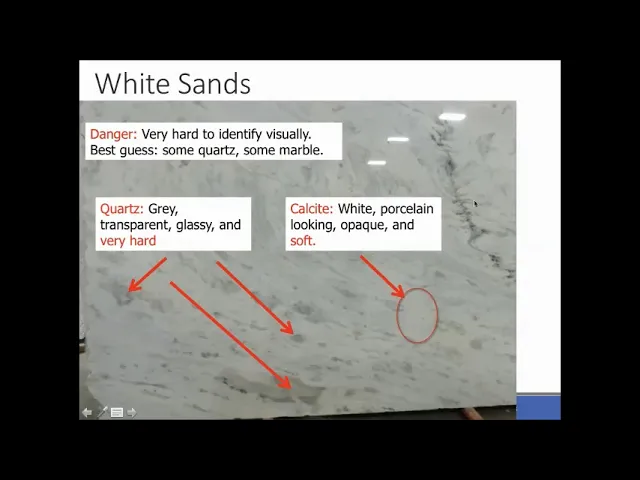
I'd say it's got equal chances of this white stuff being you know quartz or Cal saying can't televisual e they search around online and you find at least one person calls it marble well by that you know I go with sort of the lowest common denominator someone's calling it marble probably is but you know what I'm going to say next right you gotta test it yeah that's I know if yourself and that one would be also pretty easy to diagnose white sands there's still a lot that look like this these are so that I put
them in the danger zone this could one thing this could be that you got these different colors in here you've got these darker areas that if you were to look really close and you saw that they were more transparent more glassy and when you go to scratch on them they're really hard then those spots are quartz and that this these areas that are white almost porcelain looking they're opaque you can't see into the rock and they would be soft so this could be a sort of amalgam of quartz and calcite sort of like the way
super white is in that case I would sell and treat the overall rock as marble we can go with the least common denominator the most sensitive the most like covering your butt so I'll touch that because yeah it's got some coarse in it but that spot would certainly yet and scratch and things like that so go with the softest I've come there that you get Mont Blanc same thing if I were going to guess again I would look at that and say that probably a little blob of quartz floating in a bed of marble again
just two guesses don't say we toss to our dream same thing this one when I go around I saw actually every single possible label for this rock boy do I hate the term self quartzite pardon my biases but that's impossible there's no such thing as soft quartzite if it's soft it's not quartzite and if it's core say it's not soft but I'm not crying out I sort of cross that one out anyway quartzite or marble because we know how to tell the difference take a look at it with glass with acid see what happens Sequoyah
Brown this one I'm tempted to make a yes but I'm not going to you know hands on I could probably tell it reminds me a little bit of the fusion family of rock so it might be similar to that but boy it's hard to tell it's very cool but I don't want to want to go too far out and my guess is here the younger wood looks like wood right well I mean pretty sure this one's limestone the reason why I think that is that stars generally most of the pictures I found these generally flat
layers it's not swirled up into the marble texture limestone as a isn't shiny you could probably if you were really really good at polishing something make it so much tiny but it doesn't have the shine that any of the granite or quartz sites do and that's another very subtle indication and if this is it empty space now I could be a document or could be an open space if it's an open space then that really confirms that it's at least some sort of sedimentary rock because I hasn't been squeezed on hard enough to close up
that space once a rock goes through the metamorphic process it gets pressed and pressed and pressed in any open space in school clothes but limestone you know like travertine it forms on the surface of your these little layers sometimes they can be quite delicate so if there's open spaces in there that's a little bit of a confirmation that it's probably limestone this part under here is all it doesn't have the layers and there's all kinds of processes in these rocks form sometimes they end up at layers sometimes not sometimes the layers get laid down nice
and neat and a storm rips them up and messes them up so I'm going to ignore that and go with a diagnostic part here that's going to give me some useful information hmm Agatha how do you say that Mezzanotte this is family of rocks that black and white or black and gray and striked there's a bunch like that and the internet doesn't really help you too much because in person it's much easier to tell apart than it is visually but black and white striped rocks can be either nice which is the metamorphic rock that you
know in the industry we call it granite but it's bands of color of either black and gray or black and white or gray and white something like that or give me a marble that also can be the same way same colors same movement the good thing is that the properties are really different so any if it's nice it'll look differently and most importantly it will react with acid and it's quite hard so diagnostically there's really no problem there once you really get into it if you keep looking on the internet as I do I look
through those Google images I found this very helpful this is a vein that's definitely granted in there has a very traditional kind of specula granite look it's got the minerals that are consisting with granite so okay then I'm pretty happy then just call the whole rock nice or granite and not marble it's pretty unlikely that you get a granite little vein inside a marble rock not to say that it could never happen that's really unlikely so we'll go with calling the Flint River in its next one is Negresco or infinity also in that black and
white family limestone or marble again that Matt non-shiny luster tips the hat towards limestone also the veins are probably going to be pure calcite you could drop drop of acid on that it's going to is very enthusiastically type you want oh no soft quartzite I don't think it's quartzite because black quartz is pretty rare in general in science we like to take the most likely the most simple explanation for things that's a strong premise of the science isn't if you have to jump through a lot of Hoops to make something be true like then we
should say yeah there's simpler options yeah course can be black but hmm not usually my best guess here is a black mobile that's beautiful that's got a really neat texture yeah probably not quartzite especially not soft quartzite there's another one you can see the theme they're all looking kind of similar so what would you do here hopefully you're kind of going through your own pieces going on when I do with that luck either start out get piece of glass get your knife blade out and start looking at the individual layers this thing I could really
see it going either way this picture to me looks like limestone the way these pieces have broken up here but then when I searched outline some of them were definitely nice so here could be a rock that the same name different looks so hard too hard to give you a good answer on that one Pacific gray this one's like super smooth yes like no traces of any kind of geologic activity at all no layers no veins and nothing so I have no idea if I saw the rock I could probably tell you but from afar
it could be a very fine grain granite could be courtside fanzone I'm sure it isn't but even just from this look I couldn't even tell you if it's actual stone or not so not much clues on Pacific gray always attracts a certain type of people some people think well as a way too much this guy's this is legit this rock is has a merrill sodalite which is blue blue is there you know so when I see something blue I say well really really blue or that dyed blue it's much more common to have something dye
blue than naturally occurring blue so any blue rock I would really proceed with caution it's no big deal if it's dye it's probably not a problem but proceed with caution than blue rocks because they may be natural or maybe not so I'm gonna skip ahead here and just show you this most popular and marble and granite this URL is really any because it is the only place I've seen that links up the geologic means with trade names and it's the guy who made us know that there's a million different names for the trade names and
it's very helpful so when you're smoothing around I would count this as a credible source for trying to decipher what rocks are Karen we acquired a couple of questions here in developing a scrub for cleaning natural stone where would pumice rate on the Mohs hardness scale durability paradox Thomas is the same chemically as quartz so 7 on the hardness scale very very hard but it's around in these little wispy forms because it's mostly full of air it's full of bubbles so it's gonna crumble I would be really careful using pumice on a natural stone because
it's going to be harder than everything except quartz so gonna be very abrasive if you want that abrasiveness and yeah use it but be careful don't use it with a lot of pressure because it's gonna gouge most of the rocks that you're gonna be working with so yeah good to use but cautiously question she has a fusion quartzite with copper color veins and they look rusty will that welt spread inside the rock face they are resting that's what that's definitely it is I don't have a good answer for will it spread I think my best
answer is to do a little experiment I should probably get some samples and do the same thing because I've seen that question come up and I can't really tell you it depends on someone on the porosity of the rock is there room to move between those between each of those mineral grains and is there room for that iron to be further exposed to the atmosphere but it's possible that a feeler would slow that down but I'm really not sure so good another good diagnostic question of checking out taking a piece take a picture of it
read it every day take a picture of it a month later see what happens and then let the rest of us know that's a really good question his weight always collected Plested I need more information on that yeah I'll ask you for Pearl I we buy Eccleston we mean rippled you know the ripple effects how River I've seen it or people have claimed that it's slate when it's not been tested or rippled okay what's a cool question jaws it's ripping that it's not slate because the rippling is part of how it was originally laid down
that's that rippling is just from a water current and so that would be sail or silt stone once you take those rocks and then make some metamorphic about as you apply heat and pressure and start to change the rock a bit those ripples generally disappear and slate usually has just flat layers not rippled once so that's yes that's probably what's going on so if it's ripple that's not slate and if it's got a flat layers then it then it could be sleep dinner where the powder between slate and shell and still tone States just generally
harder it right it doesn't split apart it doesn't fracture apart into all these little tiny fragments and layers and things like that will a polished finish in path the result of the acid test excellent question Kim no past fear cetera has no effect so the acid doesn't care at all if you're careless as you're being included around these rocks it's useful to look at the surface and look at the edges broken edges and see if it acts any differently the only thing I can imagine making a difference on the polished surface if it has one
of those clear stone or those really sick coatings on top of it that certainly would but whether it's polished or not definitely won't whether it's sealed or not also won't so that's what's great about the hydrochloric acid it's kind of a no messing around thing it will give you the answer pretty definitively very good and question from Christian how would you classify Pennsylvania structural suede this is commonly sold in a home finish that's a beautiful rock that's just for this the name is fair on slate so slate of the rocket starts out as sale or
a mud stone or its own and gets exposed to a small amount of metamorphism so small amount of heat and pressure and compression makes the rocks stronger and it's a beautiful building stone because it's of its strong tendency to break across those break along those layers so it's really predictable and reliable and fantastic yes it's named exactly accurately so bonus points for that one do you know anything about the seed pearl variety of stone oh yeah super is another one of those core types that is like Taj Mahal and Madra perilla so far though it's
very crystalline quartzite so it looks kind of glassy yeah that's another one that generally is pretty reliable I haven't seen the name wildly variable on that one so yes see pearls quartzite this was a presentation of the natural stone Institute's natural stone University thank you for watching