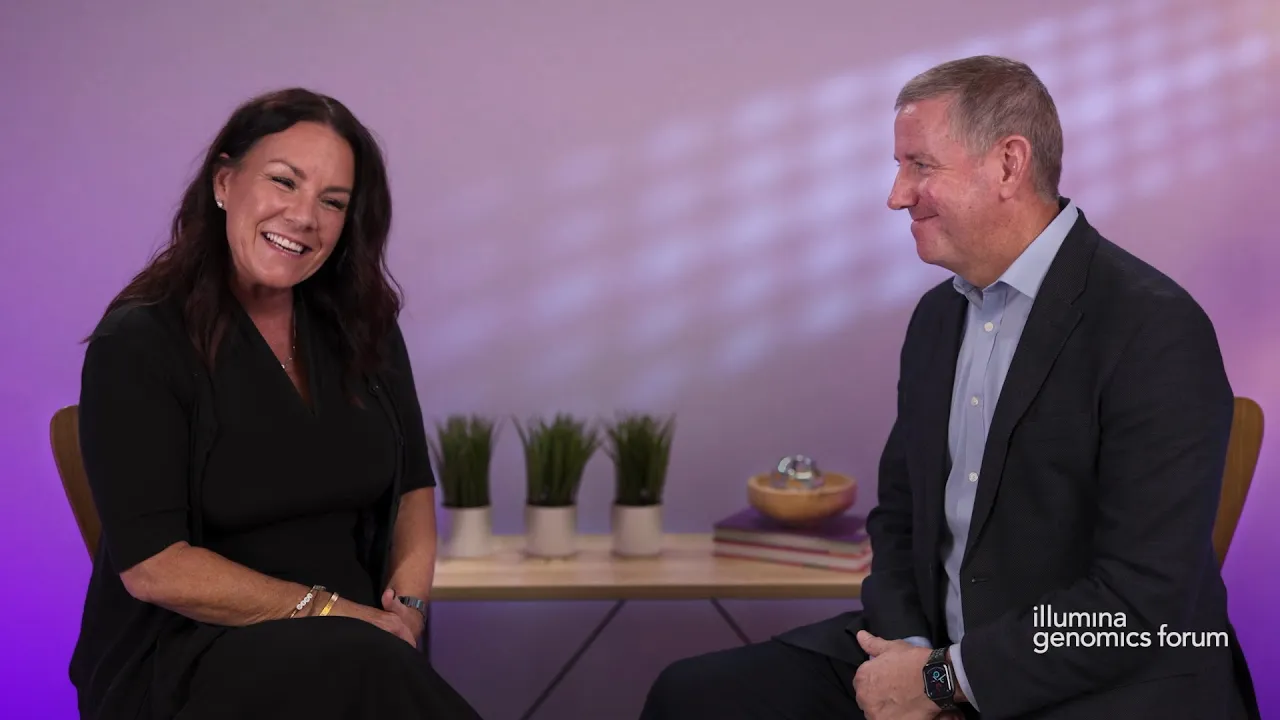
hi everybody my name is Kevin Keegan I'm the general manager of the oncology business at Illumina and here were the Illumina genomics Forum I'm delighted to introduce Danielle Hicks she's the chief patient officer at go to Foundation a lung cancer non-profit organization and we're super excited to have you here Danielle to talk to us about the voice of the patient advocacy organizations uh Danielle can you kind of introduce a little bit more uh broadly about not only what who you are and how you ended there but also what you do within the go-to foundation I
absolutely love my job we are a national and well not only National but a global non-profit organization focusing on the lung cancer Community but really my area of focus revolves around patient care patient support patient education patient programs so anything that has to do with patient touch is my area of responsibility fantastic thanks Daniel and when you see technology like what we talked about yesterday the genome MX roadmap the The genome era is here how does that how does that resonate with you and you uh Outreach your Outreach into your patient organizations yeah it's a
great question I think um first and foremost when we're talking about genomics and what that means to anybody I really feel that there's a need for a general awareness even before somebody's diagnosed with with lung cancer or any other disease that is appropriate for genomic profiling um so a lot of the work that we do every day and that you guys are doing I know is to really help to educate the patient not only the patient population but really the health care provider population the the Physicians that are out there treating these patients to make
sure that they understand what the right thing is to do at the right time in order to get the right drug to the patient at the right time when you think about you use the term education with respect to patients where does the real responsibility or accountability for building that education story for patients or is it a collective and partnership across all of these State key stakeholders I think it's a collective and I think it's a partnership I I have you know conversations with my pharmaceutical colleagues all the time and I I know they try
to do a really great job on educating patient populations on the importance of biomarker or genomic testing sadly when a patient's diagnosed a they don't understand what their disease is to start with right they're terrified they're scared they don't know where to turn or where to go when they are prescribed a therapy they don't know the name of the drug let alone who made the drug so as much as I appreciate pharma's attempt to educate this population is sort of a long shot to assume that a patient will find its way to an industry partner
for this type of education right and and we we talked a little bit I'll maybe a little bit connected but but different we talked a lot about Equity as well for patients and equitable distribution of access across all patient types you know we and we're talking about places like Billings Montana but also the rest of the world how can we do that I think in order to to truly create that that type of Health Equity you need to go where the patients are and you know roughly 20 of the patients are in those large academic
centers whether they're here in the U.S or outside of the U.S but 80 of the patients are in more of those rural community settings so I think one of the first things we need to do is is be able to come up with a plan to keep the treating Physicians educated and updated on what's happening right now so I really feel like it's unfair for a general oncologist particularly in the more rural setting to know everything there is to know about every Cancer that walks in the door whether it's solid tumor or blood it's just
I it's not fair and quite frankly impossible so how can we how can we use technology to help these treating positions you know plug something in and come up with a hate and here's the best here's the best plan for my patients it's a great point and even harder is keeping up with all the clinical trial information much of which is driven by you know genomic biomarkers um how can we also link that sort of data into clinical trials so that we can create access for community-based patients sort of a two-prong question one I think
one of the challenges when it comes to clinical trials is the majority of Clinical Trials happen in two or three handfuls of states right so access as a general rule for all the people in between those States is really really challenging um quite often treating positions in those in between states aren't aware of a clinical trial that's happening two hours down the road at go to we do have clinical trial Navigators so for and we always have these conversations with patients have this conversation with your treating position about clinical trials when and if it might
be a good time for you to consider and our Navigators can help kind of clinicaltrials.gov is not an easy it's not and not an easy website for patients or some some treating positions for that matter to navigate so we're able to help them with that we also have a community center of excellence Network and it's a designation based Network where whether it's screening in early detection research biomarkers survivorship there's about nine or ten different designations that folks can apply for and qualify for and within that this research piece is really really important because if we
can get these trials into these centers where the patients are it's a win-win for everyone right right um I think the next uh question for you is uh you know you focus on lung cancer uh for us in the genomics industry we we talk a lot we talk about lung cancer a lot because there's all kinds of biomarker uh content in the guidelines that are actionable for lung cancer patients um and and yet it's still it's a devastating uh condition for patients how do we how do we continue to stay on top of that but
make it digestible for both the oncologist and all the and for the patient I think um again one of the things that go to has developed is the shared learning platform within our Center of Excellence Network and I should say it's about 900 centers around the country which you know isn't all of them but it's a lot of them right and within that Network there is an exchange which is generated especially for this shared learning where you know something that's happening in Billing Billings Montana they can go into this exchange and say hey I have
this patient that X right and then somebody you know from you know I don't know somewhere in Texas can say oh here's what we're doing so I mean I think that those shared learning opportunities I think are are huge um creating those exchanges I mean academic Centers do them all the time right with their with their tumor boards um they're they're talking about patients and they're having these conversations about what the best next step is so things like that and and creating virtual tumor boards which I know exists but they don't exist enough and if
they do people don't know about them uh Danielle you just referenced that you have uh roughly 900 centers that work with uh go to what do those centers look like and how does the interface with goes here they vary um they vary from large community Cancer Centers to you know sort of these stand-alone screening centers so they really run run the gamut and how do they tap into you so um we've done I think a great job of going out there and boots on the ground coming to conferences like this meeting people who we know
are in our case interested in lung cancer start having those conversations start talking about this got it got it you know um you told me the story earlier and I'll I'll be uh um I won't disclose uh names or anything but you mentioned like this uh relationship a very intimate familial relationship with these with these folks uh that you know through your work um how do you manage that uh uh intensity yeah I would say um most not all everybody wants to connect on different levels right some people just want the information and then they're
good other other people need a little more hand-holding and one of the programs that I oversee is our lung cancer living room and it's a it's a program where we bring in key opinion leaders across the lung cancer Continuum beginning with really Diagnostics I mean we've we've had diagnostic companies come in pre-covet it was a live audience 60 80 people in the room and then we live streamed so we were really ready to Pivot once once covet hit to two virtual only but a lot of folks find out about that word of mouth believe it
or not from their health care providers there have been thousands of patients who's whose hand I've felt blessed to kind of hold and guide along the way and not just patients but their families and their caregivers and their loved ones I think it's an important part of the journey is being there it's such an incredible and when you talk about it you just you know you may be terrible but it's just so it's it's a special uh thing that you that you and your organization do for for patients um all right uh you may have
seen a a version of this earlier in this week so I'll I'll do this with you we're going to do a lightning round with you Dad oh boy okay I'm good all right um lung cancer in 10 years is in 10 years so right now um early detection is King I mean with all cancers we know it is um and within the next 10 I mean right now we have screening for lung cancer and four percent of the people that qualify are actually utilizing that screening um So within 10 years I would like to see
I mean I want to say a hundred percent but at least 80 percent of the people that qualify hopefully the criteria opens up and we get more people diagnosed early but really I would say early detection is going to be a game changer for lung cancer Precision medicine in lung cancer Precision medicine and lung cancer 10 years from now I would like to see every patient have upfront comprehensive biomarker testing and get the right drug at the right time love it what's next for go-to we have a sister organization if you will and it's called
the addario lung cancer Medical Institute and it's a research Consortium so some of it biomarker driven research which is really exciting we've got a ton of new patient or not patient really caregiver we're extending some of our Support Services out into the caregiver Community because we recognize the importance of that we're Gap fillers right we're not trying to reinvent the wheel or do things that other people are already doing really well um so we've we've done a lot of work this last year digging deep into Health Equity and the diversity and how we can really
better understand that and make our Mark in some of these you know smaller sort of communities so we're really excited about that that's great your favorite learning from from the igf every time I come to a conference like this and see the excitement and the energy and the passion and the compassion around doing better just yeah it gives me goosebumps I mean it really does it really does it's a it you know it's not any one organization not any one company is going to do this alone so to see everybody pull together um is really
I think what makes me most excited the most important question what do you want us to know from you or to take away from the igf I want you guys to know that you play a wildly important role in this process and bringing the patient voice to the process you can't do without the patient voice I mean you really can't nobody understands exactly what that Journey looks like except the patient so I I'm so grateful that you had me here today on behalf of the patient maybe next year we'll have a patient come with me
to actually share their story um and that would be fantastic well I have to say um your your words are powerful they're needed we can't thank you enough for sharing your voice and your and your what you do in the community uh Danielle Hicks Chief patient officer go to Foundation I can't thank you enough it's been an absolute pleasure talking to you thank you so much my pleasure thank you