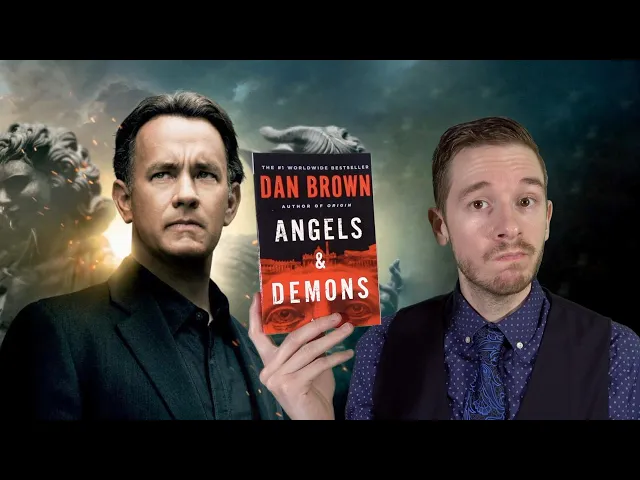
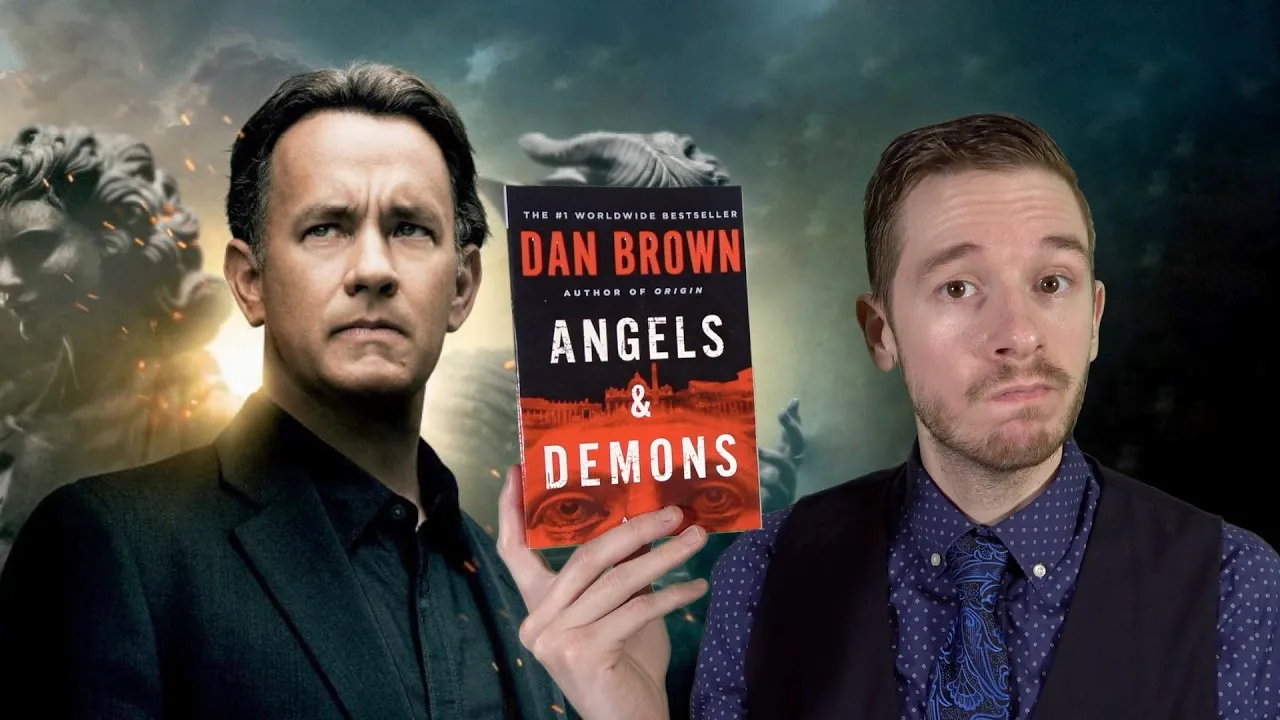
Hello my beautiful watchers and welcome back to lost in adaptation. The little corner of the internet that for some reason I’ve chosen to devote to comparing film adaptations of books to said books to see how loyalty they transferred the plot, themes, characters and tone from page to screen. Dan Brown is an American composer, singer, record label owner, former teacher and author.
He’s famous for writing action mystery novels that involve century-old historical events, usually with strong ties to religion and catholicism in particular. They tend to involve an equal amount of references to real-life figures and history and utterly made up conspiracies and urban myths because you know… It's fiction. There’s a bit of a strange timeline on this one so lemme just run through it real quick before we begin.
Brown wrote Angels and Demons in the year 2000. It was his third published novel and the first in his main series of books starring protagonist Robert Langdon. Nobody gave a shit.
It sold less than 10,000 copies in its initial run. However, that changed when he wrote a sequel 3 years later, a little book known as The Da Vinci Code. After getting a ton of free advertising from multiple controversies involving accusations of plagiarism and outrage from the Catholic church, sales of the book topped 80 million copies worldwide.
Only the release of the 5th Harry Potter novel kept it from the 2003 top spot. As one might expect, this overperforming younger brother’s glory dragged its predecessor’s sales up with it, belatedly putting Angels and Demons on the bestsellers list. When the film rights to Brown’s books were procured, for obvious reasons the decision was made to start with the crazy runaway successful novel instead of the first in the series.
The Da Vinci Code film came out in 2006 and was once again given a huge boost in popularity due to the Catholic Church blowing a gasket. Just in case you’re not familiar with it, a huge plot twist is the discovery that Jesus Christ fucked. After it made a mountain of cash for everyone involved, the milking of the rest of Dan Brown’s repertoire for all its worth became an inevitability so in 2009, Angels and Demons got its shot at the big screen.
Despite the book having been written first, they chose to make it a sequel to The Da Vinci Code rather than a prequel. This wasn’t awkward for the reasons you might expect as the books are fairly self-contained stories with little potential for overlap. There is exactly ONE reference to the events of Da Vinci Code in the entire film and it almost makes sense in context.
No, the issue is not continuity, it’s the fact that these stories are very, very similar. Very similar. I might even go as far as to say that The Davinci Code was basically an improved rewrite of Angels and Demons and you know, I kinda get it, if the first book didn’t that sell well and you think you know where you went wrong where's the harm in having another swing at it.
Bad luck for the film of course which now due to the switch around comes off like a poor knock off of its predecessor but them's the breaks I guess. I personally found this novel immensely predictable and not just because I’ve seen the Davinci Code and it’s the same freaking story. I could always tell when the heroes were on the right path and when they were about to get hit with some new plot twist JUST by thinking about which option would lead them to getting an easy win and which would put them in the position of being the plucky underdogs with maximum stakes and drama.
It's trippy reading this book in the year of our lord 2021 because the Illuminati features heavily in it and with the exception of Langdon, no one has any idea who they are and it’s all taken very seriously. It just kinda feels weird because the Illuminati are basically a meme now. This book is a prime example of what I’ve come to think of as mediocre middle-aged man power fantasy.
It’s a travesty that the Mary Sue trope gets brought up way more than any male equivalent because I have officially lost count of the number of times that I’ve read a book about a hero who is basically the author but in great shape, driving a cool car and picking up a hot, much younger girlfriend after being thrust into a situation where only his otherwise extremely boring academic knowledge can save the day. All in all Angels and Demons is a long book and I was really feeling that length towards the end. Tom Hanks reprised his role as Robert Langdon for the film and was joined by Ewan McGregor, Ayelet Zurer, Stellan Skarsgård, and Pierfrancesco Favino.
It was directed by Ron Howard, a Hollywood veteran who's worked with Tom Hanks multiple times before on some well-known films Akiva Goldsman was originally slated to write but the job changed hands during the 07-08 Writers Guild of America Strike and it fell to David Koepp to finish it. Considering Goldsman’s filmography is notoriously hit and miss this might have been for the best. The film is… Ok.
The cast is super solid and I don’t get the impression that any of them were phoning it in despite how obvious it must have been that the film was just an unnecessary cash in. I wasn’t shocked to find out they didn’t receive permission to film in any of the church-owned locations that featured in the story, partly because of the bad blood between them and Brown and partly because the CG they used to recreate them was less than convincing at times. That said, I liked what they did with the final climactic explosion in the skies of Rome, drawing on the kind of colour tones you often see in religious renaissance paintings to imply hellish power.
Most of the other issues with the film are tied into the book it was based on and how they went about slimming it down, so let's talk adaptation… Right after a quick word about our sponsor. Do you want to use the internet but don’t want your every move tracked and stored by unscrupulous organisations who want to make a profit from your personal information? On a seemingly unrelated note, have you ever wanted to watch a program on a streaming service but alas, it’s only available in another country because distribution rights are an ever-changing confusing maelstrom of red tape that we’re all trapped inside of?
Surfshark has the solution to both of these problems. Huzzah. By encrypting all your incoming and outgoing information as it passes through one of their many servers located around the world, Surfshark ensures your personal information’s safety and tricks most streaming platforms into thinking you're located in a country of your choosing, unlocking otherwise unavailable content.
A single Surfshark subscription allows you to install and run the program on an unlimited number of devices, it comes with a 30-day money-back guarantee and for a limited time you can get 83%, 83% off of a 2-year plan plus 3 extra months for free, bringing to cost to a mear $2. 21 per month. Go to Surfshark.
deals/DOMINICNOBLE and use the code DOMINICNOBLE to wave goodbye to those two specific problems. We begin with the unexpected death by stroke of the unusually progressive pope. Meanwhile, in CERN labs Geneva, a scientist named Vittoria Vetra and her priest-scientist lab partner discover a way to create antimatter using the Large Hadron Collider.
Alas, afterwards Vetra finds her multi-classed friend has been murdered so an infiltrator could use his eyeball to get past the retinal scanner in the lab and steal a huge quantity of it. This is somewhat concerning because Antimatter was a key component in the big bang and even a tiny amount of it would be enough to create an explosion equivalent to multiple atomic bombs and the electromagnetic vacuum container it’s held in has a finite battery life. Back in Italy, Vatican security discovers a canister has been placed somewhere within the city and a portable security camera has been stolen and pointed towards it, showing the ominous countdown of its battery supply.
Simultaneously, the four cardinals with the best shot at being the next pope are kidnapped right before the start of Conclave, the traditional voting ceremony to elect a new leader of the catholic church. It becomes clear that this is the work of the assumed long dead fraternity of scientists called the Illuminati, who were persecuted with torture and murder by the catholic church in the 16th century. Supposedly they’ve been biding their time for a few centuries and are now ready to get their revenge by ceremoniously murdering the 4 cardinals at key points around the city and blowing the Vatican sky high.
Because nobody knows anything about the Illuminati, Robert Langdon, a Yale college professor and religious iconography expert is approached for help. He deduces from a key phrase in a message from the kidnapper, that the Cardinals are going to be killed along the path of illumination, an ancient secret treasure hunt created across Rome by an Illuminati artist and the famous and much-harassed by the church scientist Galileo, as a way to recruit members into the Illuminati right under the nose of the Catholics. The general idea being if you’re smart enough to follow the clue to the end you’re smart enough to join the club.
He faces pushback from the Commander of the Swiss Guard, the elite military force chosen to protect the pope, known for their fanatical devotion and silly traditional uniforms. Fortunately, Langdon is able to go over his head to a priest known as The Camerlengo, the Pope’s personal advisor who, due to the weird nature of Vatican law, is technically filling the position until a new one is elected. This particular Camerlengo is very young, having been taken under the former pope’s wing before he made it big and is more receptive to the outside expertise, granting Langdon and Vetra special permission to enter the Vatican’s archives to find the last remaining copy of Galileo’s book which probably contains the first clue to the path of enlightenment.
Together they start unravelling the mystery and follow the clues across the city, but are usually just ooooone step behind the kidnapper who kills his victims after branding them with one of the four elements of earth, wind, fire and water. The final victim of the conspiracy is supposedly the Camerlengo himself who is branded behind a locked door, shortly before the swiss guard burst in and shoot his assailant. Ol’ Camerlengo then figures out the antimatter is stored on the tomb of St Peter and grabs it, leaping into a helicopter and flying it up high enough into the air to save the city and parachuting down just in the nick of time.
You are who you choose to be. Superman. Such a manly heroic act impresses the conclave of cardinals so much they decide he would make a great pope but just in time, Langdon discovers that the supposed Illuminati leader recorded video footage of what actually happened in that locked room.
It turns out The Illuminati really were long gone and this whole thing was actually orchestrated by the Camerlengo who was secretly super conservative and hated that the pope was into the idea of religion and science making peace, so he murdered him and orchestrated this entire event to restore the world’s faith in the church and be put in charge of it, before branding himself. Rumbled, the Camerlengo sets himself on fire and a less terroristy pope is elected the normal way. Other key elements of the story made their way into the film without much issue.
The dynamic duo half inching a page out of Gallieo’s book then mistakenly heading to the Parthenon first before realising their misinterpretation of the clue there. Langdon getting trapped in an atmospherically sealed vault during a power shut down and having to smash a bookshelf through a window to survive. The locations of each of the points of enlightenment and the eventual discovery that the Illuminati headquarters were in the Castel Sant'Angelo.
What is that? He must’ve died while carving it. Look if he was dying he wouldn’t bother to carve AAAGGGH.
You just say it. Well that’s what’s carved in the rock. Perhaps he was dictating- Oh shut up!
One of the first key differences between the book and film is the omission of the primary red herring character. His role is absorbed by the Senior Cardinal and the Swiss Guard Commander who act super suss all the way through the story only to turn out to just be assholes, not evil. The Cardinal, a fairly chill guy in the book spends most of the movie making things harder for everyone by being a stubborn old curmudgeon then going “whaaaaat?
You want me to be the new pope because all the better candidates are gone? Well if you insist”. To be fair the commander was an obstinate wanker already.
He originally died halfway through the book but they held off on his demise until the end to keep up the misdirection and killed off basically every other named police character instead. It was a big ol’ bloodbath. Sorry I know it probably sounds a little weird referring to everyone by their job roles but half of the characters have different names in the film so it’s just easier.
Another major change is Langdon successfully rescuing the last of the kidnapped Cardinals before he drowns in a fountain so he could go on to become the pope at the end instead of Cardinal suspicious. This let Langdon skip over the final set of clues as he could just tell him where the kidnapper had been holding him. Instead of sticking around and having an aquatic battle with the hero while his victim drowned, the kidnapper just chucked the Cardinal in the water and cheesed it, relying on the weights he tied him to make pulling him out in time impossible.
This gave Langdon a chance to smarmy him with an air hose and the help of a bunch of tourists. Oh hey Burnard, how was your holiday in Italy? Oh pretty good actually.
I had lunch in that little place you recommended in the Piazza Navona and ended up helping save the future Pope from drowning in a fountain. Dude nice! Did you try the ravioli?
I have… Mixed feelings about the film’s treatment of Vittoria Vetra. I should explain that I absolutely hated the way that Brown handled this character. He fell into the classic tonal dissonance you often get from male writers in which a female character is in principle strong, intelligent and independent but is still relentlessly sexualised throughout the story.
There’s an entire paragraph given over to describing her body in her first appearance, something that shockingly didn’t occur once with any male character, even Langdon. There’s a recurring theme in the story regarding her skin-tight shirt and short shorts being just too sexy for the Vatican and the kidnapper villan spends a great deal of his POV time thinking about exactly how he’s going to sexually assault her, taking time out of his busy Cardinal killing schedule to kidnap her to this end. I kid you not, the last line in this 616 page book is her telling Langdon she’s going to be great in bed as she literally throws herself at him.
The film does away with pretty much all of this. The respected scientist manages to wear pants while saving the day, the villain only takes her hostage for a hot second and expresses no desire to fuck her to death and they even completely removed the romance subplot between her and Langdon. All well and good, but unfortunately, they also stripped away all the things that made her halfway interesting in the story.
Originally she struggled with intense guilt over having created the antimatter in secret and starting the chain of events that lead to a fellow scientist's death and the endangerment of so many lives and the future of CERN. Said scientist was also her adopted father in the book so that was a huge thing for her. A lot of her POV chapters involved her intense inner struggle between the rage and desire for revenge against the man who had killed her daddy and her usual peaceful nature.
She’s just… Kind of there in the film. The closest thing she gets to a personality is when she rips a page out of an ancient book so yeah, I’m glad they toned down the casual sexism but I wish they’d tried a little harder to give her something else instead. The film's unusual choices for casting caused some deviation from the book.
Ewan McGregor’s Camerlengo is Irish instead of Italian, I can only speculate that this was due to McGregor’s self-professed inability to do certain accents convincingly. I mean yeah you don’t HAVE to be an italian to be a vatican priest but its still weird to think that he was adopted by the pope as a child and grew up in Italy while somehow retaining his original Brogue. In another accent related head-scratcher, Stellan Skarsgård appears to be using his normal Swedish inflexions while portraying the commander of the swiss guard, a position you 100% have to be swiss to hold.
The key is kind of in the name. While fulfilling basically the same role in the story, the guy who kidnapped and murdered the Cardinals was a very different person after he went through the adaptation process. In the book he was a middle eastern man who believed himself to be directly descended from the Hassassin.
A sect of Shia Islam in Persia who fought against the Knights Templar among other chaotic military forces and from whom we derive the modern word assassin. Put bluntly, he was a rape obsessed sadist who got his jollies from having power over his victims and enjoyed every murder he performed throughout the story, making him an easily manipulated puppet for the Camerlengo. I couldn’t find any interviews regarding this decision process but I’m prepared to go out on a limb and say that Ron Howard probably took one look at this extremely islamophobic stereotype and noped right out of the writer’s room.
As a result, the assassin of the film is portrayed by a white, Danish actor and appears to be an unscrupulous professional in it just for the money. He shows no remorse for the terrible things he was doing but doesn’t seem to derive any personal pleasure from it either. Just before he’s killed off in a double-cross, he spares Langdon and Vetra just because no one had paid him to kill them.
A far cry from the vicious struggle in the book that culminated in him falling out of a balcony to his sticky end. Brown gave the filmmakers something of an impossible task with the final Illuminati brand, describing it as a diamond shape made of the four elements but ingeniously designed to be a perfect ambigram. As he was a little vague how this visual contradiction was achieved, the filmmakers apparently decided to not even attempt it and switched out the last brand with the papel symbol.
Said brand was gifted to Langdon at the end of the book as a thank you for saving the day and a blatant bribe to not publish what a shit show the Vatican hierarchy is. This was replaced with the last copy of Gallieo’s book in the film which is definitely a better prezzy for a historian. Like… What the fuck was he supposed to do with the brand?
Start an Illuminati themed cow farm? Lastly I just want to call attention to the film’s way higher body count. Redshirt police officers manage to tag along to multiple encounters with the baddie and don’t have a fun time at all.
LEFT OUT The before mentioned main red herring of the book was a man named Maximillian Kohler, the director of CERN. Before being rushed to Italy, Langdon was flown to Geneva first at his behest when a priest-scientist was found with an Illuminati ambigram branded on his chest. Kohler was in extremely poor health and required the use of an electric wheelchair and constant medical attention, he was also, like basically every other side character in the book, a total asshole.
He spends most of the story unconscious, waking up just in time to figure out the entire conspiracy and fly to Rome and get framed as the Illuminati leader, only to posthumously foil the plot by having a secret camera concealed inside his wheelchair. Brown went in hard on making him seem like the logical choice for the villain. He even has Kohler flashback to when his religious parents ruined his life by refusing medical help for their very ill son, establishing a clear motive for the.
. . nothing he actually did.
They also evidently decided they didn’t need the final plot twist of the story that revealed that the murderous Camerlengo was the biological son of the recently deceased pope… Yeah. Apparently, when he was younger he had fallen in love with a young nun who had wanted to have a kid with him, but neither wanted to break their vow of celibacy so when science had eventually made artificial insemination a possibility and the result was two virgins having a baby that the pope pseudo-adopted after his mother died in a terrorist attack. Science doing him a solid like that left the baby daddy with a soft spot for it that most of the catholic church didn’t have approved of.
Angered that the church was losing influence and having super conservative views was still a factor in the Camerlengo’s motivation in the book, but the thing that had eventually tipped him over the edge into full pope murder was believing his boss had broken his vow and gotten busy, and it was the revelation that he hadn’t and that he had killed his own dad that drove him to Guy Fawkes himself. Unlike in the film in which the election seems to be a huge media event, the world was pretty disinterested in conclave until the bomb threat in the book. In fact, there was pretty much just one ginger bearded BBC reporter covering the entire thing.
The guy got a huge break when the Hassassin chose to leak the news of what was happening through him, though he screws it up towards the end by letting his past as a tabloid writer get the better of him and started spouting off insane conspiracy theories live on air. The only major action sequence omitted from the film was Langdon misunderstanding Obi-Wan's intentions and jumping into the back of the helicopter so he could help him throw the antimatter out into the sea or wherever they were going. After the Camerlengo awkwardly apologised and bounced with the only parachute, Langdon was forced to rig one out of a windshield cover, barely surviving landing in the river.
FINAL THOUGHTS You can see where the film-makers have deliberately changed the story to make it less obviously the same ding dang thing as the da vinci code. Removing things like the first murder being the love interest’s father and the plot twist involving men who shouldn’t have had kids having had kids. While the generalities of the story are recreated fairly well, taking an overview look I’d have to say the biggest difference in the film is the pacing.
Like with all film adaptations, they had to streamline things to fit a watchable runtime. In the case of the action mystery novel Angels and Demons, it appears that they chose to sacrifice a lot of the mystery in order to retain the action. So much of the frantic brainstorming and intense research is cut out it kind of feels like Langdon is breezing through this 300-year-old puzzle designed to test the greatest minds of the era like its a child’s easter egg hunt.
Adding to this, the law enforcement he’s surrounded by who don’t get killed off immediately give up on their jobs cartoonishly fast. Oh, the kidnapper he’s nowhere near the IMMEDIATE vicinity of this van! Well, our work here is done, no need to check any of the rooms RIGHT NEXT TO THIS ONE woop wooop woop woop.
It basically swung hard in the opposite direction to the book and went from dragging to rushed. Alas, Angels and Demons really is something of a nothing burger. Even the Catholic Church, an organisation famous for having zero chill when it comes to fiction could only muster the nearest, most half-hearted outrage towards it.
Certainly nothing compared to The Jesus Was A Sex Machine Code. Despite this, the film did well enough to justify one more sequel adaptation in 2016 which made so little impact most people aren’t aware it exists, and at the time of this video’s recording a TV series is currently being released on Peacock as part of that streaming platform's desperate quest for relevance. Thanks for joining me my beautiful watchers, don’t forget it’s more essential than ever to help your favourite YouTubers out by doing those good algorithm pleasing things, take care of yourselves out there and I’ll see you next time.