Violaine: Hello everyone and welcome to this new episode! I hope you are well and I also hope that your January was not too long. For me, this first month of the year always seems like an eternity.
But hey, here we are in February. Hi Nathan! Nathan: Hi Violaine, I share your opinion on January.
That's it, it's happened! V: Is it still okay? N: Yeah, everything is fine.
Nothing special. Listen, life goes on, takes its course, as they say. V: Well, that’s not bad.
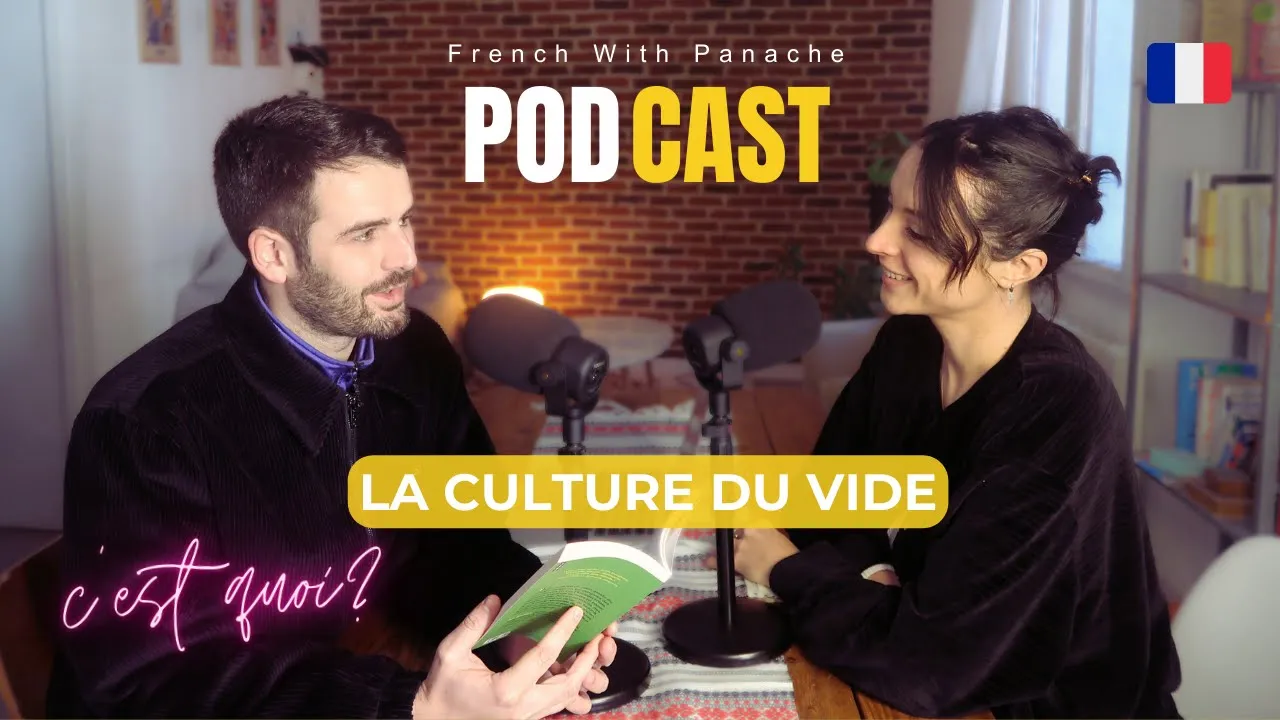
I propose to you and I propose to you, Nathan, obviously, that we attack directly with our subject of the day. A subject that was inspired by our own experiences. I am going to announce it directly, this subject is that of the culture of emptiness.
Um, to begin with, do you want to give a definition to this term that we hear more and more? N: Yeah, so it’s not necessarily easy to define. It's a somewhat abstract notion.
And besides, when you look for a lot of content on the Internet, you don't find much. I don't know if you agree with me. V: Yeah, I kind of agree.
I also believe because it is something that is quite recent. N: Yeah, it's totally recent. In any case, there has been awareness for some time.
It's somewhat linked to our way of consuming information. When I talk about information, I mean in the broad sense. There, we don't talk about the news or the current affairs.
We really talk about the information, what is shown to us a little, especially on social networks. So, we're going to talk a lot about quick, easy, light content, without really any depth. Everything we see, in fact, when we turn on our phone, for example, when we go to a social network and we are offered content that will be considered really very, very light.
V: Yeah, I agree with you. Me, I feel in the middle of a culture of emptiness, you see, when I scroll, when I scroll through social networks and I waste, I don't know, an hour or two hours and I realize that, well in the end, I learned nothing. And it even makes me feel bad.
That, for me, is truly the definition of emptiness culture. It's actually watching other people live, go about their lives. And there you have it.
N: Yeah, that’s it. And I even wanted to say that the culture of emptiness - the culture OF emptiness, sorry! - for me, it's when you put everything on an equal footing.
Everything and anything on an equal level, that is to say that if you witness a clash between two stars of. . .
Stars of I don't know what, of reality TV between two actors, between two singers and we are going to watch that and we are going to have as much interest in that as in something normally much more interesting, much more important and with much more repercussions in your life, like well I don't know, a presidential election, a war, a conflict or even a reform, a law. You see, that's really it. When in fact, there is no more hierarchy in the information and on your social network, we will offer you one piece of information after another and that's it, without.
. . Without how to put it?
Without hierarchy, what! V: But I would go even further, you see, I think that not everything is equal. This is because the lightest content is the one that becomes the most viral and therefore has more value or at least more audience than thoughtful, long content, which will analyze current events, a political conflict or whatever.
For me , the culture of emptiness is really when the content favors hyper superficial things, physical appearance, you see that kind of thing. N: That’s it. We have an expression for that.
We're going to say that anything with light content is king. It became king. And in fact, we have light news which will chase away other news which will be much more interesting, with substance, something which will have repercussions on you.
You know that this notion of a culture of emptiness has, in fact, existed for several years, even for several decades. There was a Frenchman, a French writer. And yes, I checked, he is indeed French.
Besides, he lives not very far from here, in the southwest of France. He's 80 years old, I think. His name is Gilles Lipovetsky.
And he, already in 1983, in fact, he published a book called The Age of the Void. So, it is not the culture of emptiness, but it is really the era, the ERE to say the period. V: Exactly.
N: The period of emptiness. And already at the time, in fact, he spoke, he deciphered this change to come in the following years. So today, in the years of the 21st century.
And he therefore deciphered this mutation in society, this change in society. And he therefore saw our period as a period where there is a form of cult of the individual. And even a cult of individualism perhaps, where the person really, you see, is put at the center of everyday life.
So, it's. . .
I think it's linked to this superficiality that you also spoke about. V: Yeah. And then with that, well I'm going to continue with another author and then, it will be over for the slightly technical terms.
There is a Frenchman called Guy Debord, who also spoke a few decades ago about the society of the spectacle. And for me, we are right in the middle of it. The spectacle society is in fact, well, when we, the consumers, witness a bit of the spectacle of the information that is broadcast to us.
And we are passive. And so, we are no longer active at all. We are no longer going to act at all in our daily lives to change things.
But we are rather passive. So. We look without thinking.
And there you have it. N: Obviously, because it's easy, because it's fun, because it's entertaining. And obviously, it requires no thought, very little thought.
And this is also the reason for this success. I want to talk perhaps about my personal case, to give a really very concrete example, because in fact, here, we are denouncing the culture of emptiness a little. We talk about it, but obviously, we ourselves, you like me, Violaine, are obviously concerned by it.
And I have an example with a famous social network. Do I name it? V: Of course.
N: TikTok, there you go. Which I was on a few weeks ago and which I left a few days ago. Because in fact, I let myself be fooled by this social network.
I got caught up in it too. I went there, in fact, as you said very regularly, as soon as I had a two-minute break. And in fact, a few days ago, I had a sort of realization, eh!
It clicked, it triggered something in me. And in fact, the tipping point, the turning point, is really a TV show. I don't know if it's a reality TV show.
. . No, in any case, a show that was on TV, that I watched, that you watched too, which is called Star Academy.
We will perhaps explain the principle of this show which is very popular in France, which was already popular in our childhood, in the early 2000s, but which has come back. And today, which is watched by millions of people. What is the principle of Star Academy?
V: Well, it's quite simply. . .
We're going to follow around ten, I think, apprentice singers and we're going to follow their adventure for three months. And at the end, there is a winner who wins the right to make an album. And there we are, we looked at that.
And you, you let yourself be caught up, and me too, by all the controversies that arose on TikTok. N: Yeah, in fact, it’s a show that still has quality because we really sing. It's an arts show with real artists, but every week there are students who were eliminated.
And in fact, I, well, I found myself. . .
It was the algorithm that was like that. Every time I opened this application, 'end as I opened TikTok, in fact, I really came across accounts of people who were discussing it, who were talking about it. And it really talked about trivial things, really secondary things.
And again, I 'm being kind when I say secondary. That is to say, I was going to be shown a video of an argument, for example, between two students. I was going to be shown a video of a person who was going to speak, who was going to criticize the outfit, perhaps the clothes of another person.
And it was really, well, videos like that, very short, 30 seconds or a minute. V: But which had millions of views. N: Exactly.
There were even people, TikTokers, who were specialized in this show and who still are, and who organized like lives, right after the show. And I already found myself, just after the show, going on TikTok and watching a live like that, to debate the show that had just happened and that I had seen. And the live didn't last a minute, two minutes, it lasted an hour.
So sometimes it really took the whole evening! So for me, that's it. Really, that’s what this culture of emptiness is all about.
It's when we put on an equal footing, well, what happens in this type of program and perhaps political news that happened the same evening, but which I would have voluntarily, how to put it, skipped, what, for this program. V: So it’s not equal! If we offered you content that was a little political or more intellectual, you swiped it.
N: Exactly. No, you're totally right! It even took over French news.
And concretely, I realized that I listened less to the radio in the morning for the news, for the real debates, uh because I was perhaps more on social networks where my mind was really on this show. V: Yeah, yeah, yeah. No, but it's sure.
Afterwards, I'm going to tell you something that doesn't change the world, but honestly, to take the test and listen to the radio in the morning, the current affairs radio, or watch the television news in the evening at 8 o'clock, well frankly, when you watch it, you say to yourself but it's depressing. 'I mean, the news coming out is horribly depressing. And so, I'm not saying that it's good, but it depresses us a little less to watch, obviously, clashes between people, to watch things that are a little lighter.
Because it's true that what is in competition with this culture of emptiness, well, it's a content, a reality, in fact, which is nonetheless anxiety-provoking and hard to follow. N: Yes, you are absolutely right and perhaps we will also talk about these consequences of the culture of emptiness just afterwards. I would like to come back to it right after, but I want us to just do a little test anyway, I want us to take our phone so that we can see live what the culture of emptiness is.
Because if I deleted TikTok, I'm still on another app, another social network. If you want, we'll take my phone. I don't know where yours is and I have little battery left on my phone.
So, we're going to take advantage of it. I open my application and I want to see what the algorithm offers us. I don't know what you think about it.
V: We're looking. So here we are on Instagram. We haven't named him, but we're on Instagram.
N: I'll open. It's true. So I'm going to click on what we call reals.
And it's really stupid, in fact, because we actually have content here from a person who teaches us how to date, how to have romantic encounters, how to have romantic encounters when you are religious. So, it's really weird. And there it is.
. . The person says dating when you're a Christian.
It's really lunar. I don't know what you think about it. V: It’s lunar.
Your content is completely lunar. Um, for me, when I do that, there's the experience that Nathan has, when I scroll through the Reels category of Insta, well, I'm going to see a lot, for example. .
. N: It's ridiculous. No, but this is crazy.
You're right. What do you see? Excuse me, but I find that fair.
. . I am, in fact, even more aware now of this culture of emptiness.
V: Even more so when you have to verbalize it, you realize how ridiculous it is. N: Exactly! V: No, but I don’t know.
I see content creators, since I follow a lot of women, who will show their clothes, who will show their lives. 'Fine really, it's uninteresting. When I tell you it’s uninteresting, it is!
And you wanted to address the consequences of this culture of emptiness. Well, there’s a main one! That's how bad it can make us feel, because I'm not telling anyone anything when I say that, once again, but the content creators, in these contents which are very short, they show what they want.
So, they will show an obviously hyper aesthetic life, outfits, things, possessions that they have, which are, there you go, expensive, I don't know! In any case, they will show a bit of a dream life, and I put big quotes. And so, that makes us, in fact, desire standards of living that are extremely high.
And so, we will say to ourselves: “oh but I’m not up to it! What I have is not good enough! ” And so, there's everything.
. . One of the big consequences of this culture of emptiness is on mental health and well-being in general.
N: No, no, I completely agree with that, obviously! There are harmful, dramatic consequences for us, for our mental health. You said it, I, you understood it.
. . There, what's on my social network, and it would be a lie to say that it's just light.
. . It's stupid, in fact.
We can say it like that. And I don't control, obviously, my algorithm, but even if it perhaps has a link with, supposedly, my tastes or my hobbies, my favorite activities. .
. But when you see what is offered to me, I'm not completely sure. I doubt it.
V: You doubt it! In any case, the algorithm got you wrong. N: Clearly, I doubt it!
Just, excuse me, I would like to say something else about the consequences of this culture of emptiness on us and even on the more global impact on society. For me, there's something a bit stupid. It's going to be very concrete.
I realize that when I scroll like this, I no longer take time, obviously, to do anything else. And it’s concrete. Lately, for example, I have deserted a bit, as they say.
. . So, I left aside , I put aside the interesting articles that I used to read, like, for example, the articles in Le Monde, obviously, a newspaper to which I subscribe.
I think I've already said it here. V: We say it in every episode! N: In all the episodes, that's it.
So it's also good to repeat yourself. The same goes for good films, classics, masterpieces, or even just good films that came out recently or during the last year and which I completely missed, you see! So that I didn't have time to see, that I really missed because, once again, of these networks and this culture of emptiness.
So I believe, you see, that if these videos are perhaps funny like that in the short term, they allow us, it must also be said, to just pass the time. We have the right, between two meetings, when we work, we also have the right to relax and laugh a little. But unfortunately, I believe that these videos in the medium term, well, they are parasitic on us.
They parasitize us and, obviously, it can be problematic because, by dint of watching, I think, these videos and this content which is very light, well, we. . .
When it comes to talking about more serious subjects, well we no longer have the mental, intellectual capacity to do so and we end up skimming over subjects. That means we're just going to be interested in the title and that's already happened to us. Sometimes we send each other interesting articles and then, in fact, we take more time to read them and to read them, we will just be interested in the title and the heading, as they say, that is to say in the introduction of the article.
And that's it. V: Yeah, I agree with you on that, but I'm going to go even a little further. It's that in fact, now, I have the impression.
. . So, I was talking earlier about comparison where we compare our lifestyles with the people we look at.
. . But I believe that in fact, we compare.
. . When we make this comparison and we say “Oh, but I don't have enough, I'm not enough, etc.
", well in fact, the comparison is made on extremely superficial elements since what we see of people's lives is superficial. And in fact, we will compare ourselves more on our value, on what we are inside and I find that one of the consequences of that is that it can create relationships, even in real life, if I can say so, it will create almost superficial relationships. We will no longer talk about somewhat deep subjects, as you have just mentioned, but rather also exchange in our daily life with our loved ones on rather superficial subjects and therefore this creates relationships which are superficial and that, I feel it or I was able, in any case, to feel it at certain moments.
N: That’s true. It comes back to what we were saying earlier, we are going to put on a pedestal perhaps, people or subjects which are clearly not, in fact, real subjects of discussion and they become subjects of conversation so that is a problem. Earlier, I wanted to come back to this, you referred to these news, to these newspapers, to this information, to this news which you consider a little depressing and too heavy.
But it is perhaps because, precisely, we are so used to seeing this very light content every day, from morning to evening, that everything else, in fact, seems boring to us, seems bland to us, seems to us, excuse me for the somewhat vulgar term, perhaps, but seems boring to us. And obviously, next to videos, like we just saw here, on Instagram, or of cats who are disguised or who are playing, etc. , or who are just cute, and people who make jokes.
. . Well, when you listen nearby, the same evening, to a debate show, a somewhat intellectual show, obviously, you see a gap which is just gigantic, which is enormous.
V: And we can't blame people and we can't blame ourselves for, in the evening, after work, after work, for wanting to completely disconnect the brain and therefore not inflict on ourselves this content which is nevertheless of very high quality. But even on that, I will add something, which is that on social networks, I find that there is even more room for politics. And when I speak of politics, I speak in the very, very broad sense.
I'm thinking, in fact, of all the content creators who, today, no longer dare to take a position on everyday political things because they say, well, that it's not their role, that social networks are not the place where we do that. And I find that this leads, obviously, to a. .
. Well depoliticization of who we are and our daily lives, whereas, I say it often, but our life, in fact, is political and everything we do, everything we consume is political. N: Yeah, even if I would add a little nuance, I find, in any case, as far as French social networks are concerned, perhaps media in the broad French sense which have accounts on social networks, which have pages, their own pages, I also think that there are, nevertheless, there remain, fortunately, content creators or media , journalists who are extremely popular on social networks and who are, at the same time, engaged, even politically or on social subjects eh, whatever it may be.
the edge, left, right, etc. I think there is a demand for that too. So, I would say that there is still a little hope, but it's true that even we, we can say professionally, because now, we obviously have a podcast that you are listening to and then, we have a YouTube channel eh, which I obviously invite you to join and subscribe.
But, when we see the algorithm that is proposed to us, when we see what works and what works less, what works or what doesn't work, well, we'll see that our algorithm, in fact, pushes us to create content like that that will be light, that will be entertaining content, put humor everywhere, you see, and as soon as it's a little more serious, we'll consider that it's a little annoying perhaps. And… V: And it can fall by the wayside of the algorithm, indeed. Quite.
We were talking about us, about how it made us feel to have delved a little into the culture of emptiness. I think that. .
. We've said it a little, but if we had to generalize, we can say that we have the impression that we think less and that we perhaps cultivate ourselves less. Do you agree with that or do you want to add some nuance?
N: Are we thinking less? I think, as we said earlier, obviously. .
. We dig less, we go less in-depth into the subjects because we no longer have time, in fact. We no longer find the time, we no longer take the time and we are faced with, there it is, with one on, but on, on, on information.
There are things happening everywhere, so it's exhausting and I can't, as I say, I can't know because. . .
There is still, fortunately, content, there are quality channels, there are videos that are long and also of reflective quality and which remain popular. So, I'm going to be mixed, but in any case, we are all affected by this culture of emptiness and we have to put something in place to change it and there has to be individual awareness, already. Because I think that from the moment we have individual awareness, which was a bit the case for me recently, I managed to put in place some strategies to do something else, like I told you, that is to say watch more films, eh.
Quite simply. I have never watched as many films in a month, in January 2025, as in a year, as in the year 2024 because, quite simply, I neglected, I put aside the networks a little. So, there are, there you go, there are little strategies.
I also started doing chess, playing chess, then on my phone, but, there you go, I find that it's a little more interesting . . .
Because there's human contact, I can talk to people about it, there's reflection, there's strategy. So, for me, in my opinion, we are outside of this culture of emptiness. V: Yeah, but it's hard, I think, to have this awareness.
I mean, not everyone has this awareness. Um… So, you were talking about the things that we put in place. Well, we also implemented a screen time limit on our phones.
And yeah, it has to come that far for us, to detoxify ourselves. Um… But, in fact, when I talked about the fact that we were less cultured, I was thinking of an example which is linked to the cultural recce of this episode. N: Okay.
V: So, I'm going to recommend a film to you, but just before, I want to say that for me, when I go to the cinema, when I went to the cinema to see this film, well, unfortunately, there were no young people in the theater, even though it's a film which is directed by a young woman of my age, uh with young actors, with a theme which is still very current. N: But, you went there very recently and I think the film had already been released for a long time, right? V: Yes, and what's more, it's in an arthouse cinema, as they say.
So, there you have it, a somewhat independent cinema in the city center. I know that in slightly larger cinemas where more international films are shown, young people do not completely desert the cinemas . But, here is the observation that I had very recently.
But, I know there is hope, as you say: the long format on YouTube is increasingly valued. So, there we have it, we have a little hope on that. And also, a very quick mention to the whole trend that there has been on TikTok which is therefore the booktok trend.
There you go, no need to translate. So it’s all the TikTok videos that recommend books. In general, its accounts are run by young women.
And it really garnered attendance, an increase in attendance at bookstores and libraries in France. N: Yeah. And I know, so there, he's a man, but I know, I discovered him very recently on Instagram.
I forgot what it's called, unfortunately. But, all that to say that he also recommends, he advises books, books. And he has over 300,000 subscribers.
V: Yeah, we'll put his nickname in the podcast notes. I think his name is Julius like Caesar. N: That’s it.
Well there you go, no need to put it on! Julius like Caesar, more than 300,000 subscribers. And at the same time it mixes entertainment and literature and culture.
So we can make the connection between the two. It remains very popular. Maybe you can tell us about this film that you teased.
V: Of course. N: Still, I want to know what he's talking about. You saw him last week, Sunday, I think.
I haven't been there, but I would love to see it. It made me want it. So maybe I'll go to the movies next week or this weekend.
I think he's coming this weekend! V: Okay, so this film is called Vingt Dieux, in reference to an expression that we find a lot in the East of France. And this film has a theme that I love.
Uh, it's the life of a young man and his friends. So, in the East of France, we are particularly in the Jura, in the Ain. There you go, if this ever speaks to you, these are extremely rural lands.
And in fact, this young man, uh, he will quickly lose his father, who was therefore a cheese producer and more particularly Comté cheese. There you go, I don't think we can be more French. And so, he will try to survive following the death of his father and he will in particular try to rebuild the county.
Um, so, we follow this life a bit in the French countryside. But here we are, we follow it in a very objective, very beautiful way. There is no miserabilism, as they say.
These young people are not going to say “my life is hard”, even though we know that the life of young rural people is quite difficult, with few opportunities, little money, etc. N: Especially in agriculture. V: Especially in agriculture.
But there is never this tone. And on the contrary, I find that it is a beautiful film of hope. You can see some very beautiful landscapes and above all, as a linguistic challenge, I don't think anyone has ever offered that to you.
Um, you will listen throughout the film to the accent of Eastern France, central north-eastern France. And wow, it's very complicated to understand. But if you find it with subtitles, honestly, go for it.
There you go, to see real life in France, it's fascinating. N: And as you said, it also allows you to hear an accent that's out of the ordinary, that we're not used to hearing, obviously. Everyone knows somewhat standard French.
We also know that there is a fairly strong accent, in quotes, in Marseille, in the southwest and the southeast. But here, in the Jura, is that it? It's roughly in that region.
Really in the East of France, well it’s quite original. You see, I've never been to this region, so it's an accent that I know little, very, very little. V: And it's nice to see in the cinema, in a film which has met with popular success, it must be said, it has had quite a few entries, Vingt Dieux.
It's nice to see this youth represented, far from the clichés and far from the image we can have of the French. N: And it’s true that this film was a real popular success, with a huge number of admissions to cinemas. V: While it is still a social comedy, so there we have hope about the culture of emptiness, that is also interesting when we talk about society.
N: Yeah. I am quite optimistic, in any case, quite proud of current French cinema. I have found, in recent weeks, that there have been some very, very good films and it is therefore difficult to see all of that in the cinema.
But fortunately, we also have the platforms that will be used to watch them perhaps more late. So for me, it's true that, as I said, to fight against the culture of emptiness, we can also watch films, we can stay, in fact, on the screens, but watch quality films . .
. It's true that, a little advice, I find that it's good to watch, perhaps not only films that come out today, but more classic films, films that we didn't take the time to watch, perhaps when we were younger. It's a bit my case, I'm a bit ashamed, sometimes, but it's true that we often talk about great films and then, we haven't necessarily seen them.
. . Films that we talk to you about throughout your childhood, throughout your life and I made a little list for myself, there, you see, in the last few days, so there you go, I hope to catch up.
I'm thinking in particular of American films that I want to see, you see, from the 90s. So, it's very specific, the theme, but here, I want to catch up on all this delay regarding films that talk about the Vietnam War. V: Wow, the doghouse!
N: So which came out, then, which came out, I think, in the 90s, maybe early 2000, but obviously, the Vietnam War was a little before, but all these films were, as they say, passed under my nose when I was younger, so, they passed and I watched them without, well, I watched them pass without seeing them, that's it! Without seeing them in the cinema or on TV. So, I advise people to try to do themselves good by watching great films and classic films, that is!
Cinematic masterpieces. V: And if you want to know how Nathan will watch his big films, well, you'll have the answer next week! N: Yeah, it's true that we'll talk about it next week, it's good to tease it.
So, you talked about a film, I would perhaps like to talk about a book. V: Come on. N: Because it's been a while since we talked about it and I, so, I just started reading it, uh but I think it may be interesting precisely for our listeners, the people who listen to us.
It's a book by Alain Mabanckou. The book is called Broken Glass. I have it in the library, I'll just grab it.
So there you go, I just got it back. Broken Glass, Alain Mabanckou. V: Can you tell us who this author is?
Quickly… N: He is a writer who has dual nationality: Franco-Congolese. And in fact, in this book, quickly as I said, I just started it there, I only read a few pages. But we are in Africa, in Congo exactly, in Brazzaville.
In fact, the main character is a customer in a bar who is going to uh. . .
Write about what happens in this bar uh. . .
All the everyday movements, the counter discussions as they say. . .
He is going to draw portraits of the people who pass by, that's it! You know people who are a bit of the outcasts of society, people on the margins of society and I really like the style because there aren't too many stylistic effects, it's very direct, uh it's written. .
. I have the impression without too much proofreading, you see. It's very oral so it's perfect I think because it's almost spoken French, even though it's a book.
And it’s actually quite funny! And Alain Mabanckou is still a super talented writer, who is a literature professor in Los Angeles, at UCLA. The very prestigious university of Los Angeles.
Professor of French-speaking literature. And I find that it feels good too, well, to read authors in French but who come from, perhaps, France. V: Yeah!
N: Because it’s true that he’s Franco-Congolese, but he talks a lot about Africa, it takes place in the Congo… So it’s good, there you go, to read a little something else! V: And we are going to try to do more and more French-speaking recos and not limit ourselves to Franco-French recos. So, Verre Cassé is a very nice recce that will allow you to learn more about French-speaking culture!
N: Yeah, and I even saw that the English daily The Guardian named this novel as one of the 10 best African books of the, let's say, modern era. Today ! So.
SO… V: Well, I think that in terms of cultural recce for this episode, you are served! Tell us if you are going to consume what we recommended and then, then, whether you liked it or not. I think it's time for us to leave you.
Nathan, do you have anything to add? N: No, nothing to say. I hope you liked it and above all, the next episode, it's true that it will also have a link with, I think, today's.
V: It will have a connection and you will find out in two weeks. In the meantime, I have a few questions to ask you: have you also been caught by this culture of emptiness? Do you consume light, short, viral content or, on the contrary, are you anti this type of content?
Tell us everything in the comments, we'll read it and respond to you, in any case we'll try! Thank you for listening to us until the end and we'll see you next time! N: Bye bye!