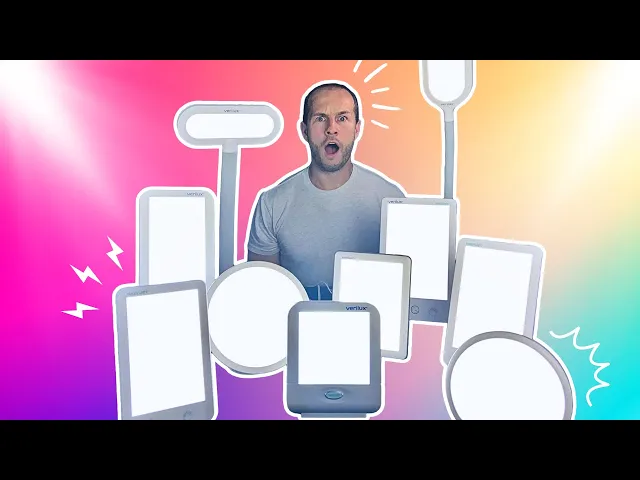
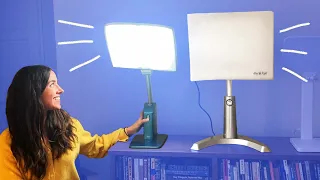
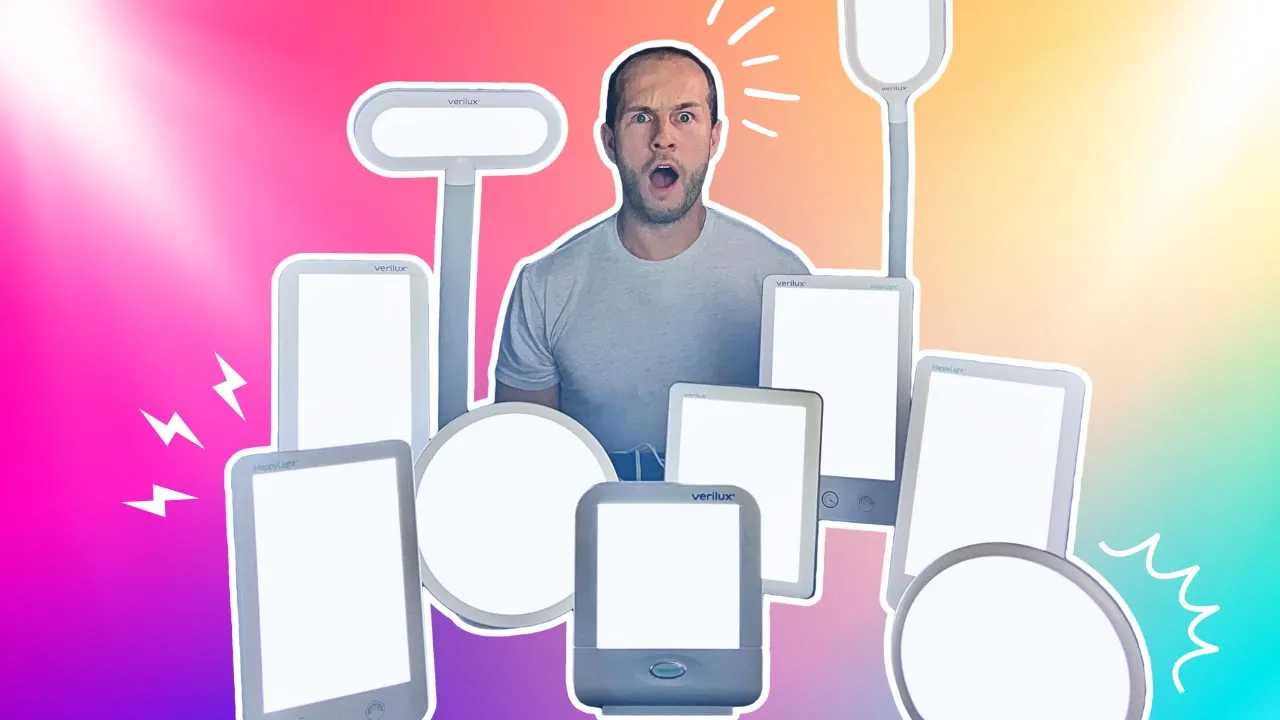
I'm on a mission to test every single light therapy lamp on the market and today I have all 10 of the Varilux happy lights so if you're curious to see all the data that we got on these stick around because we're going to go over all of it the Lux the Circadian light the glare so how much Lux per square inch flicker rate the Spectrum the color rendering index we're gonna go through all that stuff these are really popular light therapy lamps so I definitely wanted to add them to our database which you can find
below by the way we'll also go over how they compare to the Circadian Optics lamps which are kind of one of the other more popular light therapy lamps out there before we get into that though I I actually want to talk to you about how we test our lamps just just so you know we have a lab grade spectrometer that we place one foot away from every lamp and then we turn it onto its highest setting and we run that for an hour and we take a reading every minute and then we average that data
out over the hour and that is the data you'll find on the database so we can compare every lamp we test in the same way now Lux is essentially just how bright a light source is we typically see 10 000 Lux advertised on these devices which is just it's misinformation I I don't know how else to say it essentially any light can be 10 000 Lux if you just get it close enough it's a measurement of light on a square surface area so it isn't like the total output that we're talking about here we're talking
about something that changes with distance so saying that your light emits 10 000 Lux is arbitrary if we take a look at the Lux the happy lights put out we'll see that the duo floor is the only light that hits this 10 000 Lux at one foot all the other lamps are right around that 4 600 to 4000 range the Alba and the compact start to get a little bit worse compact is is just not worth buying at all it's an older fluorescent model just like the full size although the full size does put out
quite a bit more light I would just skip both of those what I want to go over next is a much more important metric so Lux is sort of the old gold standard of testing light therapy products there's a much better standard out now called circadian light it's measuring the wavelengths that activate the Circadian system so whereas Lux is just the brightness of a light it doesn't necessarily translate into activating the intrinsically photosensitive retinal ganglion cells in your eyes and a lot of the other parts of the eye that activate the Circadian system so as
you can see the duo floor is still much higher than all the rest but we do see a couple of the lights shift around here you can see that the duo desk all of a sudden is higher than the Halo so as before the Halo is putting out about 200 Lux more than the duo desk the duo desk is now putting out about 600 more circadian light units than the Halo there's almost a shift of like 800 units here and that's because the duo desk emits a Bluer cooler color temperature light than the Halo and
that essentially means it has more light in that circadian effective range so if you've seen our video reviews of the AO and the Lumina that you'll see that just because a light is very bright doesn't necessarily mean it's as effective as a dimmer light that's Bluer now I mentioned that the full size and the compact are using older fluorescent technology I want to show you a graph of color temperature for all these lights as you can see in this graph almost all of the color temperatures of the LED products stay very much the same almost
the whole way and that's how you know that these are pretty high quality LEDs but you can see that the full size and the compact fluorescent lights change quite a bit more they're also a lot Bluer Than all of the other lights but you can see in this graph that the duo desk is indeed Bluer Than the Halo and hence it's a little dimmer technically but it's actually more effective just to give you an idea of the difference between the fluorescent lights and the LEDs here is a spectrograph of the duo desk which is a
particularly High Sierra light which we'll get into and here is a spectrograph half of the Compact and you can see that the fluorescent light is just extremely spiky this is your classic fluorescent spectral graft it's obviously not very natural these typical LEDs that the Varilux uses also aren't natural they're not an even Spectrum like the sun puts out even though they'll advertise as full spectrum but they're still much better than fluorescence I mentioned the Circadian Optics lights I like the Happy lights more than those here's why the Circadian Optics lamps change color temperature pretty wildly
a few of them like the lampoo there it just keeps getting colder over that entire hour period they're not stable like the Happy lights are and that just shows me that they're using lower quality lights they're also a lower color rendering index than the happy lights the happy lights as a whole has better color rendering than the Circadian Optics lights so that's another reason if you're gonna pick between the two that the happy lights are the way to go so now I guess we can talk about color rendering this isn't the most important thing about
a light therapy lamp because you're not well you're probably not using it for color sensitive work or really basking and the reflections of the light but if you want a higher quality light as something that feels or looks a bit more like natural light you want a higher color rendering index so essentially how you determine color rendering index is we take 15 different colors and we're trying to see if this light reflects that color the way the sun does we take an average of all those 15 colors and we have a total score a hundred
means that it is very similar to sunlight almost indistinguishable to the human eye and a lower score like anything under 80 is bad so as you can see in our graph the duo desk is actually phenomenal I was really surprised because this is much higher than any other light therapy lamp I have seen thus far and the duo floor is doing pretty good too at 88.6 but all the rest start to go just from average to poor like 70 on the compact is just abysmal for a CRI even the worst LED light bulbs nowadays are
above 80. so I'm working on my own light therapy lamp it's going to be hopefully a lot better than all of these easy to make and fairly affordable that'll be coming out hopefully soon if you guys are interested in that you can subscribe and you'll be notified when that video comes out so as far as the flicker rate goes for these lights I did want to talk about that because some people are concerned about invisible flicker the onboard power equipment that converts the AC into a DC signal are often very low quality by the capacitors
and all that and what you're left with is a very high frequency flicker that is the case with almost all of these lights I'll show you just a quick video of basically every single light and they're all very high frequency very high percentage flicker rates some of them up to 100 so these are turning off and on and off not but at a very high rate so we're talking like 20 000 times a second according to the flicker standard this isn't an issue as long as the frequency is high enough it doesn't have any impact
on the visual system or the brain it won't cause you a headache probably not anyways if you actually look at the fluorescent models they Flicker at a much lower frequency but the percentage is lower it looks better on paper like when you look at the graph you're like oh that looks a lot better but because it's a lower frequency even though the percentage of that flicker is lower it's far more noticeable to the human eye and so I actually think that the flicker rate on the fluorescent lights is worse than these LEDs I prefer a
higher percentage higher frequency flicker than low unless it's low enough if it's a flat bar that's awesome so as far as these lights go on the flicker front I'm not that concerned with any of them so one more thing that we can talk about these lights and of the other metrics we have in our database is the glare rating so essentially what we do is we take the Lux at the highest brightness setting and we divide that into the square inches of the emitting area so essentially how much Lux do you have per square inch
because broadly speaking that's how we can determine how comfortable light source is now other things come into play like how much ambient light do you have but if we're just comparing the lights not the environment the lights are in this is how we would do that and so if we compare this metric across the board we see the Lux one of the largest of the lights is actually one of the most comfortable lights just because it has lower Lux per square inch it's going to be less obnoxious in your field of view than all of
the other lights at its brightest setting and the Lux is actually a fairly bright light so that's an impressive thing for it to achieve now the duo floor is much much higher glare it is very uncomfortable to look at it's one of those lights where if you look at it for a second and you look away you can't see anything for a few seconds you have that you know that shape of the light right in the center of your vision now obviously all of these lights can be adjusted down that's something that you can play
around with and find the brightness that you find comfortable so yeah I guess we could talk about the ones that I like the most now like I said I'm working on my own so I think that's going to be better than all these but if you're looking for a commercial device that you can just buy plug and play the Happy lights are some of the best lights that you can get and but there's 10 of them right so which one should you get I think the duo desk is probably my favorite it can go on
the desk you can move the arm around to alter its position it's a little bit large so that might be a detriment to some of you depending on your desk setup but it's just got great color rendering and because of the way the arm moves you can use it for task lighting so if you like to write or Draw or you do any color sensitive work so I think that makes it kind of an interesting choice and it's definitely one of the most high quality happy lights that rarelex makes so for that reason it's my
favorite and then you have the duo floor which again is one of the more high quality lines these are both the newer offerings by airlocks and it shows just because it seems like they're using higher quality LEDs on board but I like it just because it's so bright and it's a floor lamp so you can use it in the living room in the dining room in the morning or just on gloomy days like if you're playing board games with your kid or something and you just want to like illuminate that that space where you're at
that's why I like it it's kind of a versatile unique light therapy lamp there really aren't any other lamps out there like it but if you're looking for a more traditional desk lamp it's a little smaller I have two choices that I like I like the Lux and I like the Halo so they both excel in different ways the Halo is just slightly brighter than the Lux but the Lux is more visually comfortable as I talked about the Halo also is portable and you can change the angle of the Halo you can't do that with
the Lux the Lux is kind of stuck at one angle but the Halo you can you can rotate all around none of the other happy lights have that feature so I think that makes it a little bit more unique it's also portable like I said I don't know how useful that is if you're in the middle of like a really killer light therapy session and duty calls I guess you could take it in the bathroom with you because it's not very small you know it's kind of like a medium-sized life so it's not like you're
gonna just throw it in your pocket so I'm not sure how much the battery operated portability aspect of it is that useful you might immediately go like oh I know how I can use that but I couldn't think of any reason but anyways it's there it's it's a feature that not many other light therapy lamps have but I like the Halo just because it's kind of cool looking it has a rather large illumination area so it's not super uncomfortable and it rotates the other one I liked was the Lux and the reason I like the
Lux is because it's big it's not too big and it has a keyhole so some of the happy lights have key holes on the back which means you can mount them on the wall above your desk and so you can kind of clear up desk space and you might like that you might like that clean look and light coming from above is actually more effective than light coming from below as as you can imagine the sun is always above you we're meant to receive daytime light from above the eyes and so if you can mount
this happy light somewhere it's actually a little bit more effective than it would be below at the same distance that's something that you can do with the Lux that you can't do with the Halo and the reason I like the Lux over the other options is just because it's brighter you can always dim it to make it as dim as the other ones but if you want to make it brighter you're limited with all of the other options so yeah I think that about sums up my review of the Varilux happy lights they're they're pretty
good lights some of them are much better than others I am still hoping to make my own that I think is going to be really cool so again if that's something that interests you if you guys liked this video like it please helps our Channel out helps me out and subscribe if you're interested in seeing some of the projects I'm working on hopefully that'll be out before the winter months come along so if you're in the market for a light therapy lamp we don't need it yet and hopefully this will be done by then and
you can make your own full spectrum high quality light therapy lamp and it'll be versatile you'll be able to mount it on the desk use it on a floor lamp you won't be able to you know you won't easily be able to take it to the bathroom with you but you know we'll figure something out so just a reminder we have the light therapy lamp database on the website we've also tested a bunch of light bulbs we're going to keep testing stuff as long as I breathe I will test light products and hopefully in the
future we'll get into other stuff as well just sort of my jam right now so yeah that's all I got thanks guys