Decentralization isn't some line in a legal book decentralization is a technical Network property that is amazing that has unbelievably exciting consequences that's why the Internet Is So Exciting the internet is a decentralized system you can go and build a website and no one can tell you no and that incredible opportunity means all the brightest Minds entrepreneurs Cipher punks and crazy hackers and Creative people are willing to consider building their future and building the future of technology on a system like that because they can trust it and it's resilient and robust and predictable and powerful and
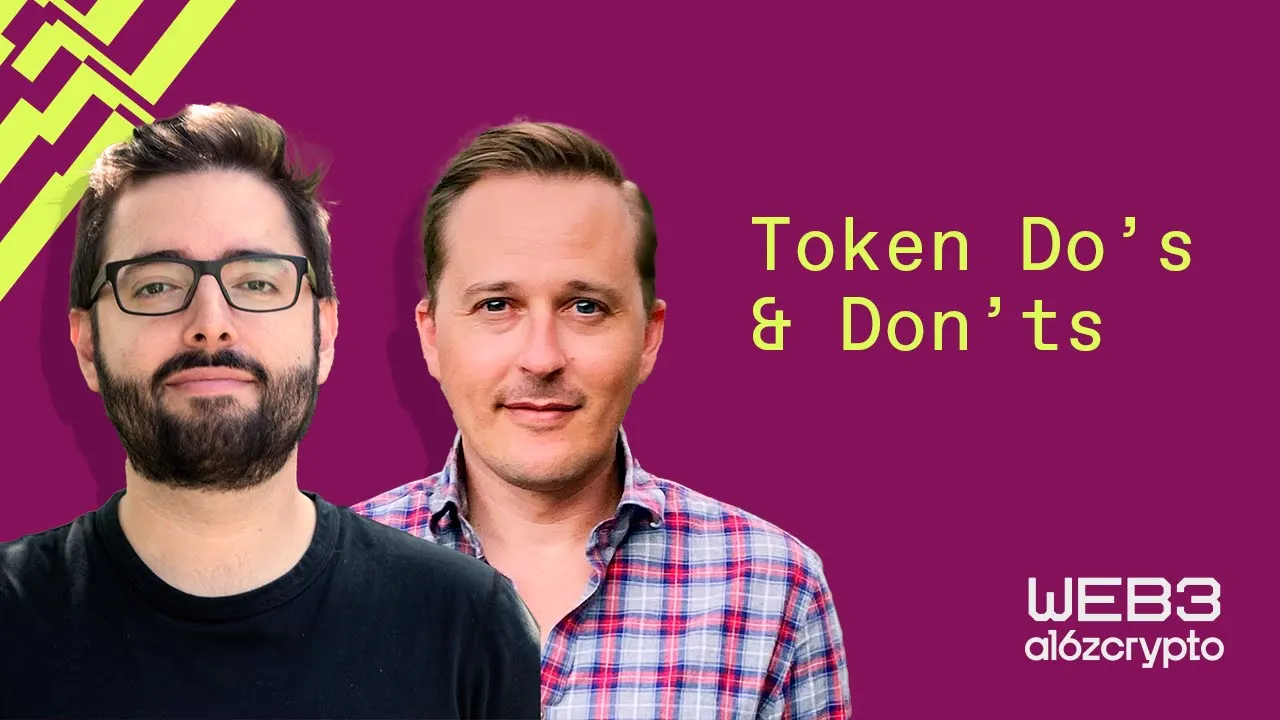
extensible and remixable and Rec combinable and all the beautiful things that we love about decentralization and permissionless composability so it's a beautiful coincidence and we're fortunate that the right legal strategy is also the thing That is totally consistent with the crypto ethos from its beginnings [Music] welcome to web 3 with a16z a show about building the next generation of the internet I'm Robert hackit and today's episode covers all things tokens that includes what tokens have to do with decentralized protocols understanding the different types of tokens and of course the dos and don'ts of Designing and
launching a Token our guests are a16z crypto Chief technology officer Eddie lazarin as well as a16z crypto general counsel and head of decentralization miles Jennings the two of whom have advised many scores of projects on protocol design and token craft they discuss what sets web 3 apart from earlier technology eras avoiding common pitfalls in the search for product Market fit had a reason about various designs and strategies as well as their risk and reward trade-offs and More as a reminder none of the following should be taken as investment business legal or tax advice please see
a 16.com disclosures for more important information including a link to a list of our investments all right Eddie since web 2 there are big Tech platforms applications that billions of people use the tech is good why do we need any changes there why do we need to add things like tokens on top of this when We have technology that works pretty darn well at internet scale let me flip the question on its head the answer to this question isn't why we need tokens the answer to this question is why we need decentralized protocols and decentralized
protocols in order for them to exist and be sustainable and to bring together all the stakeholders to continue running them properly we probably need tokens I think thinking of them as a currency like literally a Medium of payment that you use to buy you know conventional goods from other people that's a limiting way to look at them but the right way is to think of them as the means that users and stakeholders and network participants can have to represent their ownership and control in the end a token is just a balance in a program many
many kinds of programs can be written and the decentralized protocols that can compete with the web two protocols probably need Balances about who owns what part and who can do what part and that's where tokens come in let's talk about protocols because back in web we had HTTP and SMTP you know the web and email and these are decentralized protocols they require no tokens and yet people use them what's necessary about layering in a token when we have some of these existing technologies that can accomplish decentralization yes but uh the reality Is that every real
email endpoint all the big domains all the ways that people use email have been absorbed into big corporate networks you when use Gmail you're using Google's email and they can actually kick you off with that I can't imagine getting kicked out of my Gmail account that would be a disaster yeah that would be pretty bad I actually do know someone that that's happened to by accident but seriously it was yeah it was literally catastrophic what did that Person do I mean you just basically been exiled from the internet they got Sim swapped and that was
the end of that that was the end of that Google account they never got it back actually wow that's terrible yeah insane but nevertheless like although Google's not you know some Tyrant about the way Gmail works it still has more or less aifi and hasn't really changed and all the Company's trying to make better email I've really struggled to do that because Of the network effects around Gmail so I'd say those original web one peer-to-peer networks while really really interesting they had some fatal flaws they are unable to encode in them the economics that makes
them valuable and sustainable and they're unable to align all the people who use them and rely on them together in supporting that protocol they ended up having to go and make their own private networks and monetize in adjacent ways that are Unrelated to the direct use of that protocol and so the whole crypto thing is that now because we can assign ownership and control programmatically verifiable Computing gives us a whole way to make networks that can encode in them their fundamental rules now the that tokens come into play is tokens are that instrument they are
that tool that people can acquire have an economic stake in and use that stake whether it's through voting through consuming the Network now you can finally make that peer-to-peer style protocol but there are rules and principles and economics that make it a reliable platform to build on as opposed to building on like a a Gmail or something like that I mean I think that the other kind of like interesting Innovation that they've created in addition to incorporating the token into the economic model of the protocol is a lot of protocols have set aside a number
of tokens into a treasury That can then be used by the members of the protocol to fund future development the actual funding mechanism is already baked in and as a result of that they should be able to evolve over time and more effectively compete with web 2 networks right now all of the economics of the web 2 networks ACR to the people that own those networks so they're able to reinvest that Capital back into building out those networks and add features now we have slack telegram Signal whatever email didn't have that right with respect to
aifi Protocols of web one like email email hasn't changed and with web 3 and tokens we now have that model and have an ability to have these models evolve over time and that is a huge kind of value driver and gives them promise to be able to compete with web 2 and exceed them okay so why get economic and governance rights through tokens and not through some other form like through some pre-existing form Obviously we have Securities we have stocks you can buy those and profit from your interest in a corporation that way and also
have some say on what's going on with the company by being able to vote in shareholder votes are we Reinventing the Wheel by coming up with a token or is there something special and unique and different about the way tokens are that is superior yeah I think it is a lot different although you could of course use a token in a way that's Just like a company you could of course make a token that's just like Equity representation of company and does all the same things as a company does and as stocks do you could
do that but they're actually completely different you can't program the equity of a company to understand various things that happened in a computer and react according to different parameters and keep doing those things regardless of what anybody else says and a share of Amazon stock is Never going to guarantee compute on AWS yeah that just doesn't make any sense yeah with a token I'd argue that two key powers are that you can program it like I'm saying you can fully program it and you can have that continue to execute according to its program you cannot
guarantee a company will keep behaving according to anything even legal agreements can be skirted around or reinterpreted or renegotiated oh yeah I get emails all the time saying the terms Of service have been updated and uh just FYI they have been yeah yeah and are you saying you didn't waigh in on the terms of service updates are you saying you didn't you didn't I mean it's a ridiculous fiction the other key property is that like a country you can design the protocol to keep issuing the token for a specific purpose now of course if the
protocol just keeps printing the token for some absurd reason it's probably not going to be Very valuable but if the token is continuously issued like an inflationary reward for some valuable task then what you can do is you can ensure that that task is always being performed because you're continuously paying for it with that newly issued token and that's a really interesting guarantee like that's how ethereum Works validators perform the work of verifying and validating the blockchain they are the supply so to speak of a market of Verifiable compute and storage and network capacity and
then when people come to that market they can take for granted that it will continue being supplied as designed because the token will keep being issued to pay for it Bitcoin operates the same way all the so-called layer ones operate in this way now of course that's not the full picture of how one of these protocols work they're actually in their best form in their most complete form they are a Full economic loop from beginning to end ethereum like I just said tokens are issued to pay on the supply side for verifiable compute and on
the demand side people pay for that compute and some of that payment goes to burn the token or to retire tokens that ensures that the tokens that are issued on the other side remain valuable and they Aspire for a bit of an equilibrium and this equilibrium is what ensures that ethereum will keep Functioning exactly as described for the foreseeable future this is a beautiful setup that doesn't sound to me like Equity from a company that to me sounds like a fascinating type of economic Network that guarantees specific work is performed that's a weird new type
of thing that's how to think about what tokens are they're guaranteeing the operation of a protocol or a Marketplace and as a result investor expectations with respect to equity versus tokens Should be completely different a share of stock gives you ownership of a corporation that comes with certain statutory and contractual rights whereas a token does not come with either of those things right it is literally programmed into the code exactly what the rights are that you get so with Equity right you have a right to fiduciary duties the officers and directors of the corporations have
to maximize the value of that share no one In web 3 has to maximize the value of the token that you have the value of that token should be solely dependent on the underlying economic model of the blockchain or product that it relates to and even though they can't have economic models that result in cash flows and everything like that that ACR to these instruments Equity very much different differentiates itself from tokens voting rights are also very different in web 3 we talk a lot about governance Minimization and reducing overall governance burdens when it comes
to managing these protocols whereas in the equity World shareholders rights are Supreme and courts can even come and save them they've made a mistake as you know the court did in Elon musk's recent case this is Elon musk's case regarding Tesla in Delaware a court recently decided that when stockholders approved his compensation package a long time ago that they didn't actually have all the Facts necessary to do it and it resulted in Elon basically losing about $54 billion worth of compensation that he was owned for 10 Xing the company to extreme levs I remember when
they passed that compensation package and honestly people thought that he had set unreasonable targets for himself that he would never hit and that's why the board approved it I'm kind of shocked to learn that uh there's now this rewriting of history there of course the reason that The compensation ended up being so valuable is because the company became so extremely valuable based on his efforts none of this would apply in a token concept where a you wouldn't even be able to go back and rewrite the rules of something that was already approved but on top
of that the mechanism by which value accurs to these tokens isn't dependent on or shouldn't be dependent on the efforts of an individual like like Elon by the way speaking of stocks Like Tesla it's funny to me that people call out web 3 for having a sort of gambling problem when there are stocks in the traditional world that might have an inflated PE ratio just based on people liking the stock you know I just like the stock man so I'm going to buy it yeah all assets have multiple inputs into their ultimate price right there's
value investors and people who look at discounted cash flows at the one end maybe at the others there's people who Just got a good vibe and think that there's hype or you know whatever and different assets have proportionately more of the so-called fundamentals and others might have more purely speculative features markets have always had these properties as an example homes are pretty obviously important when concretely extraordinarily valuable on their basic fundamental features but that doesn't mean that people don't speculate on them it's impossible to get Rid of it there's no problem with speculation the thing
is with tokens maybe this is a good segue there's different types of tokens they can have different properties obviously none of the things we were just talking about would describe stable coins right stable coins that are like usdc or like usdt these are tokens that are worth $1 each and that's because they are backed and certified and they're collateralized with at least $1 each by some company Whose job is to do that and is regulated for that purpose those are not Network tokens those are not tokens that are issued to secure a decentralized protocol they
can be part of a protocol they could be used for payments they can be used as collateral they can be used as someone's savings you know as many or more applications as cash money but they're not the type of token that people typically talk about when they talk about issuing a new token so there Are all different sorts of tokens out there you sort of were alluding to one when you were talking about the underpinning of a virtual economy you mentioned stable coins there are all different flavors how do you break up the world of
tokens what's the taxonomy that you use I don't know that there's a B taxonomy yet and it's it's evolving but there are definitely some clear categories stable coins are one another is I call arcade tokens and these are Tokens that are typically transferable but for some reason or another have a somewhat dampened or stabilized price so maybe they're redeemable only in a few settings like at a restaurant or to play a game or something like that so they have a value you could resell them but there's some mechanism or another that keeps the price more
or less flat and there's continuous issuance and Redemption by the issue of those tokens whether it's a program or company or Something else a third category of tokens are meme coins memes have been around for a long time will always be with us I mean since the beginning of crypto if you look at coin market cap back in 2013 right go to the way back machine go look at the top 100 you will find some Classics some Main Stays that are still around Bitcoin Litecoin all these from back in the day but you will find
a ton of forks of Bitcoin and Litecoin and similar assets like that Where people took the codebase gave it a new name maybe gave it a funny name there's actually even one called mcoin or whatever tons of these and the token critically it's not that the token has some mimetic characteristics it's that the token is only mimetic characteristics when I say mic characteristics what I'm referring to is there's a strong narrative or sort of attention based activities around it doesn't really do anything it doesn't Really have a functionality it's just kind of a meme and
that's it and maybe the price goes up the price goes down they're highly volatile and they can be like an amusing way to kind of gamble for better for better for worse I think they'll be around forever they've been here since the beginning of crypto and there's no reason to believe that they'll go they're funny they're a part of like the crazy froth of the internet but ultimately the goal is not to have a Specific technical purpose you can speculate on them but they're not necessary to power decentralized protocols I think some of the the
interesting advocacy that I've seen on behalf of mcoins is trying to say well you know really what is the difference between this purely speculative vehicle versus a token that relates to a protocol that has no cash flows and doesn't really have decentralized governance and I think that that is a Fair criticism and I think that is largely driven by regulatory uncertainty the SEC has obviously been you know extremely aggressive targeting projects where projects having good faith built a protocol launched it and then launched a token and I think the regulatory system that we're currently have
enacts hurdles for real projects to create real value whereas there are much fewer hurdles to creating purely specul vehicles I think we've obviously seen a pretty successful Economic model with ethereum and other layer one blockchains where you do have cash flows accruing to them but there are any number of tokens that relate to Applications such as smart contract protocols that don't actually have any cash flows to them and one of the reasons why a lot of these don't have economic models is because there are a lot of regulatory complications to these things so you know
you takeen on a whole bunch of risk associated with what are The transactions that the thing is facil ating who is engaged in those transactions is it North Korea is it Iran who's going to pay taxes on these transactions a lot of regulatory uncertainty that comes with it is a significant challenge to introducing economic models and as a result of the regulatory situation you create hurdles for productive assets as compared to you know assets that might be purely for speculative value and that helps to blur The line basically between the two and as a result
of the regulatory situation there are more opportunities to speculate in assets that are purely speculative as opposed to ones that might have productive use cases regulators and policy makers they've not decided they've not reached a consensus on how to launch a token in a compliant way it's unclear what you can do to not get in trouble if you want to operate in web 3 so there is this uncertainty this Overhanging cloud above everybody's head first of all why would you launch a token in that atmosphere if you're worried about an enforcement action coming your way
and second of all what can you do to protect yourself look there's a lot of regulatory uncertainty there is no doubt about that but that doesn't mean that there isn't a pathway to mitigating the risks associated with tokens it is very possible to mitigate almost all of the Risk from a legal perspective but depending on what strategy you choose that might introduce other risks to your system I think even though the SEC has become much more aggressive in recent years and hasn't provided constructive guidance to the industry since 2019 that guidance still holds and is
still both principally sound and intellectually sound and so we work with a lot of Founders on is like okay how do you maap out what decentralization Actually looks like and that whole strategy and framework is built around trying to reduce the Reliance of people on the managerial efforts of the founding team that is a very counterintuitive process it's not one that startups in any other industry have to deal with but it is ultimately the thing that helps you achieve what we believe to be one of the core characteristics and features of web 3 and blockchain
technology which is Decentralization so we just published this token launch Playbook and one thing that was very enlightening for me was this balance between different types of risk and this sort of triangular dilemma that you face between operational legal and Commercial risk yeah talk about those differences and the tradeoffs there if I'm a Founder in web 3 which risk is best for me to take on unfortunately there's no you know one siiz fits-all approach and it's going to Depend on what your project is but let's talk through them so legal risk right is associated with
is your token going to subject you to Legal risk in the US so is it going to subject you to class action lawsuits or SEC investigations those can all cost millions of dollars and can really sandbag your project and the SEC has been very aggressive and plaintiff's lawyers are becoming more aggressive and so that kind of risk depends on managing it from the Howe Test under Securities laws commercial risk really looks at okay well what is your overall addressable Market what are the hurdles that you're putting in place to attract customers and to have your
product be commercially viable and then operational risk looks at what are the complexities that you're introducing by having a token operating in a decentralized manner is is very difficult it's completely different than what startups have to do in traditional Industries and there's a lot of of elements that go into it from coms to just organizational structure that are all quite complex but then on top of that having a publicly traded token is also something that really can change incentives inside your own organization and you have to kind of Juggle all that risk so then if
you look at the launch strategies that we've laid out you have decentralization you have excluding the United States and then you have Restricting transferability of your token on the decentralization side that's the best kind of long-term strategy that you can really adopt because it gives you the best commercial profile it gives you the largest addressable market and it also encourages the most people to build on top of your protocol but it's also the most operationally difficult to achieve so it increases the most risk for your project from an operational perspective And no matter what you
do decentralization is much more inefficient than centralization that is just the nature of the game yeah and I want to point out it's kind of interesting that decentralization has such strong legal benefits of course it's incredibly difficult and that's part of why it's been hard to build all this cool cryptotech but put aside the legal for a second isn't that one of the core values of our industry absolutely Like that's kind of what we're here for decentralization isn't some line in a legal book decentralization is a technical Network property that is amazing that has unbelievably
exciting consequences it makes the system robust it allows it to be totally Global by default it allows entrepreneurs and Cipher punks and crazy hackers and creative people to build on these systems and take their properties for granted even if end users don't Appreciate it natively like you know people aren't walking around the street saying I wish I used a decentralized system people know the value of it that's why the internet is so excited the internet is a decentralized system you can go and build a website and no one can tell you no you just get
a domain name and it'll work and that incredible opportunity means all the brightest minds are willing to consider building their future future and Building the future technology on a system like that because they can take it for granted and they can trust it and it's resilient and robust and predictable and powerful and extensible and remixable and Rec combinable and all the beautiful things that we love about decentralization of permissionless composability so it's a beautiful coincidence and we're fortunate that the right legal strategy is also the thing that is totally consistent with the Crypto ethos from
its beginnings and that is really I think the most frustrating and biggest Miss of policy makers and Regulators that are approaching this space is that the core value of the technology is decentralization for all of the benefits which include reducing risks right and the way that it is able to reduce those risks by disintermediation all of these things that then justifies a different regulatory approach because most Regulations are built around trying to regulate intermediaries and so it is in the interest of regulators it should be in the interest of regulators and policy makers to incentivize
decentralization and compound the benefits that this technology affords rather than trying to impede decentralization and put us in the same position that we are with current networks being controlled by monolithic companies to both of your points I mean A cynic might view this and say decentralization it's just a legal loophole but you've underscored all these additional benefits that you get from decentralization you know it just so happens that the legal benefits you get from it actually are they're almost ancillary to the real purpose which is Distributing control more fairly evenly among a community of people
yeah decentralization is not a legal concept it is a technical concept That we are now trying to make legible and comprehensible to Legal authorities and Regulators why focus on that prong of Howie there are multiple prongs that determine whether something could be deemed a security or not what's so special about this one about you know the managerial efforts of others you know you look you can come to the table and argue that you deserve different treatment for any number of reasons but At the end of the day fundamentally what decentralization does is it eliminates Reliance
on managerial efforts no managers control these systems which is what you want from the technological perspective and because these things are public visible on chain there is a lack of information asymmetry everyone has access to the same amount of information the decentralization and the transparency of these systems eliminates or can eliminate the risk of information Asymmetries those two risks are the core risks that Securities laws are meant to address so the goals of Securities laws and the goals of blockchains are inherently aligned what we need is more clarity around you know decentralization is very much
a spectrum and so the question should be where on that Spectrum do we sufficiently obviate the risks that we no longer need to apply Securities laws that should be the question it should not be that there is No question that there is no spectrum of decentralization that it's not possible to reduce these risks because it very much is and the benefits of eliminating those risks ends up with you know networks that aren't community-owned and controlled as opposed to networks that are controlled by corporations and that is a societal benefit if we establish a high threshold
for decentralization it'll not only make the risk profile of the consumers better but it'll also make The technology better it strikes me as the difference between adhering very strictly to the letter of the law versus the spirit of the law and what the law is actually intended to do that's right my total non- lawyer understanding is a lot of these regulations are here to protect people from getting rugged right and being rugged for those who aren't in crypto is where you take for granted where your feet are planted the economic viability of a project there's
some Platform that you want to use and then that gets pulled out from under you and what you thought was sound footing is now a trap and you end up falling flat on your face I like to picture uh Wy coyote from the Looney Tunes like going over the cliff and looking down and suddenly realizing that there's uh there's no Earth under him yeah that's exactly right and the laws are there because when you invest in somebody or you hand a bank your money whatever These very sensitive things there is somebody who could hurt you
You're vulnerable right they could change their mind and do a bad thing and the rules are there to protect you because of that vulnerability because of the intermediary satoshi's whole Theory right and like all the originating ideas that made crypto so exciting was that maybe we can make technology that can act as that intermediary but without being able to change its mind so it can Play that role in a functional sense but no one can pull the rug out from under you and if it's the case that the system is designed to have great security
and protects you using cryptography economics various technical features then maybe we should have other laws that properly capture what those properties are Ensure those properties are the case and if those properties are the case we can handle things a little bit Differently so we've talked a lot about decentralization but there were other strategies here so let's cover some of those decentralization is the best long-term strategy because it is again the goal of the technology and it is the one that presents the best legal profile and Commercial prospects the other two strategies you know if you
don't feel like you're on sound footing with respect to decentralization or if you need to be able to have a little bit More centralization in place there's two other strategies that you can use so one is Geo blocking us persons from participating in airdrops you know not listing on us exchanges this is excluding the US essentially it should be an embarrassment for the US that that is a strategy that entrepreneurs are having to deploy but it is an effective one that's a tough pill to swallow yes it's basically like cutting off your arm you know
it's like you're not going to Go after this Market that's going to be maybe the most important market for you that's right there have been a number of companies that have taken this approach have Geo blocked US citizens but you still see advertisements for them everywhere that seems like it's sort of talking out of one side of your mouth sure absolutely I mean these strategies can be used in a way that is effective and in a way that is ineffective it is very hard to restrict your Communications to be solely outside the United States in
a world where social media is so prevalent and everyone communicates through these channels how do you possibly prevent the information that you're putting out in the world from appearing on channels that us persons can see I mean I would say never buy an advertisement advertising your token anywhere well there you go that's a that's a good roll of thumb right there that's an easy one so the third Strategy is to restrict transferability so this can be done through transfer restricted tokens or you know more recently offchain points now I think offchain points should not just
be carelessly launched into the world you know and then marketed as financial instruments which we've seen a few projects do so you do need to be careful there but the fundamental idea is that if you lock the transferability of these things then you're able to prevent a Secondary Market from developing that no one's really able to invest into that asset and so you can kind of delay the application of Securities laws so this third option has lower legal risk it has low operational complexity though again as I said you don't want to be out there
marketing you need to be careful about money transmission all of these other things but again compared to decentralization it's fairly straightforward and then the commercial Profile commercial risk is somewhat lower than the restrict strategy because you can use these in the United States now you can mix and match all of these strategies right and we have seen projects that have done you know regulation s outside the United States transfer restricted inside the United States regulation s is an exemption for Securities that's right that's if you exclude the US and basically only issue your tokens outside
the US and all of This is setting up a pathway to achieve greater decentralization and again what I would argue is that if you actually do these correctly if you do the homework and you Implement them carefully you can mitigate the vast majority of Securities laws risk applicable to tokens in the US my question is if you're focusing on non-transferability doeses this in some ways hurt the utility of your token potentially I mean does that restrict the kinds of applications that you can Build if you're still trying to find product Market fit you want to
be able to control as much as you can having points means that you can move quick it's easier to be centralized and to perform these experiments and move quick and not worry about what all the stakeholders think because your project is smaller you're moving nimbly and people are less likely to be damaged because it's hard for things to have value if they're not transferable so you Can keep experimenting and eventually as you discover what's working and it becomes clear this is the thing then you can enable transferability so think of non-transferability think of points as
a way to maximize your nimbleness your ability to find product Market fit while minimizing the risks that token holders could face if it was fully transferable I think another element to that is that it does change their utility as an incentive mechanism and so for some Projects let's say decentralized physical infrastructure where people are expending cash to run let's say a note on a network for them non-transferable tokens may not be sufficient because they may need to bring capital in in order to continue the cost of running those nodes so in that case it might
not be a great idea for those types of projects on the other hand tokens can be a very significant noise when it comes to finding product Market fit for Applications where you know you're purely just using the token as an incentive to get users to do stuff and can hide what product Market fit actually is transfer restricted tokens Can Help dampen the effect of the incentive mechanism which can enable you to actually find True Market fit as oppos to one that's B based on the incentives that you're providing to users the incentive mechanism is basically
giving subsidies out to people To use your product correct it's really important that when you have an incentive you do the most you can to verify the quality of what is being incentivized right there's a famous social network from earlier in crypto days where they used to pay people for posts like they will give you token for a post you make a post you get some tokens people like your post you get more tokens uh Steam it right was that Dan L's project yes that's exactly right And what end up happening is kind of what
you'd expect if you pay for comments you know what you're going to get you're going to get comments you pay for likes you know what you're gonna get you're gonna get a lot of likes right you're gonna get all that stuff now good comments good likes that's not happening you're gonna get a swarm of bots that go wild and do everything they can to game the system it's good heart's law every measure which becomes a Target becomes a Bad measure and so you make an incentive you get that thing generally I think subsidizing demand is
very dangerous you do want to subsidize things in the growth of a network like subsidizing security is very good but I worry a lot about subsidizing demand and that's because if you subsidize demand you make it harder to identify whether you found product Market fit subsidizing demand can completely blow out the signal so in general I think what you really want to Subsidize are network effects to the extent that you can accumulate them and highquality Supply subsidizing demand is not something that's altogether bad it's a useful strategy and a lot of companies you know you
look at YouTube subsidizing video hosting or Uber making rides cheaper but this is a problem that we see in a lot of businesses that end up being non-viable is the customer acquisition costs are just too high and these companies are spending on Advertising to bring people into the network and they're just not making the money off of it where they're actually in a sustainable economic position afterward yeah totally there's so many nuanced economic tricks that help systems grow but it's just something you need to be very careful about obviously if you're just blasting tokens out
there if Uber made every ride free or paid you to ride that would just like blow the system up it's more about using powerful Tools carefully yeah and I think that that sometimes gets Ms right at the end of the day tokens are not magic beans the same fundamental unit economics that apply to real world businesses apply to tokens and people should be designing their systems accordingly but I've heard the big short guy call him magic beans yeah M what is his name Michael Barry or I forget what is I don't know I'm not a
finance guy Robert I've heard them called all sorts of things they are Certainly treated as magic beans by a lot of people but at the end of the day unit economics is a pretty fundamental principle that's hard to escape yep speaking of subsidies I want to expand the definition of security a little bit we're talking about security not Securities yeah that's exactly technical security and I would say Economic Security or what I'm talking about not uh not legal Securities okay yeah a good frame for a Lot of networks or decentralized protocols is as marketplaces I
think that's a nice simplification that you can apply to them that helps you start to reason economically about how they work you've got different participants coming together buyers and sellers users and providers yeah you have a buy side you have a sell side you have a supply side you have a demand side and those people those participants they have expectations of the market that they're Participating in so on a layer one blockchain people are typically buying compute they're buying storage they're buying network capacity indirectly they're trying to commit a transaction to the network and they
pay up front for that that's the thing that they're purchasing and what they expect is that the transaction will complete as submitted it will finalize it will be locked into the system and only exactly what they asked for will happen not some Unexpected other side effect on the supply side there are machines in this network that are performing the work of verifying the network and storing the things and transmitting the data and Performing all the tasks of the protocol and what they expect is if they do their job properly they will be paid if they
run the program if they abide by the protocol they will be paid in some Manner and of course there's variations there's always sort of risks in the way That these systems work like you maybe it goes down or there's some congestion or something depending on what type of system we're talking about but the point is that the marketplace works by Design to try to limit those risks and to make the process of buying or selling as direct and simple and predi ictable and guarantee as possible that's the purpose of the marketplace if you take this
General frame every Network token is trying to Do the same thing if you think about the protocol that you're trying to design you are probably trying to design something that could be seen as a marketplace where there are expectations of quality or security from the supply side and from the demand side and the role of your token is to do the work of ensuring that this is consistently provided by that protocol at all times with best effort and that the right stakeholders are constantly Incentivized to ensure that that remains the case that is the purpose
of the token at its most Raw it's most fundamental so the way some D5 protocols work for the supply side is I come and I put in my collateral and I can trust that my collateral remain secure and that no one can just steal it from me or destroy it or something and that within acceptable boundaries I will be able to withdraw it or collect interest rates yields based on the functioning of the Protocol on the demand side I expect to be able to deposit collateral and then to be able to borrow and to only
risk liquidation under known parameters no one will take my money the assets that I borrow are legit and things like that in other words the whole construction of the system the purpose is to ensure that both sides of the market are getting what they expect to get at very close to the optimal price all the time and to make it very easy to reason about and Very easy to build on that is its whole purpose so the point is that thinking of your protocol as a Marketplace will make it clear what types of things your
token should be paying for and subsidizing and also where your token can take fees to sustain its price to preserve its value and to preserve its ability to keep performing this task for the foreseeable future so I want to play a game with you guys I'm gonna call it bad token good token you don't have to name names but I'd like each of you to just present quickly what would be an example of a bad token versus a good one miles let's start with you looks like you've got one on your mind so look I
think one of the very prominent practice in the space is decentralization theater and this is where people want all of the benefits of having a token but they don't want to actually decentralize because of the operational complexity that involves you Know being decentralized is incredibly an efficient so the difficult thing from a legal perspective about decentralization is it's really hard to tell whether or not it is being faked or whether or not it is real bad actors will capitalize on that uncertainty pretending to be decentralized when they in fact are not it doesn't give you
any of the technological benefits but it does expose consumers to all of the risks that Securities laws are intended To address I would also say that for projects that are engaged in decentralization theater the value of that token is largely dependent on the ongoing managerial efforts of the founding team and so where that founding team does not succeed that token tends to go to zero and again that leads to a lot of consumer harm but it also leads to a lot of amongst developers that kind of walked into that trap because it's very hard to
undo a token after you've Already put it out in the world are there any tells like how do you tell a project is just you know engaged in decentralization theater yeah I mean I think that there are numerous examples right if you see a company that doesn't have locked UPS in place at launch right that last at least a year that is a Telltale sign that that launch of that token is intended to enrich the people that are behind the project as opposed to actually building a sustainable and Long-term decentralized project okay so that's an
example of a bad token and I want an example of a good token best example of a token in my mind is ethereum it's got an economic model the platform is incredibly decentralized it will exist in perpetuity regardless of the regulatory approach that's taken in the United States that is a great example of a protocol that is fully baked and one where there is no question that a level of decentralization has Been achieved that is somewhat un matched into space got it okay Eddie your turn bad token good token yeah another bad is when people
make a token that's just for governance it's just for voting that's all it's for right it's like why do we make a token but isn't that a valid thing is the premise of web 3 decentralization like what people uh have their say it's for decentralization not for farsal pointless voting in that regard right the number of people that YOLO out their token with like oh governance will figure out finding product Market fit that is another terrible example that's ridiculous that's exactly what I'm talking about products are not designed by large Committees of hundreds of people
across the internet like that's ridiculous that's so fake like absurd now does that mean tokens shouldn't have governance capabilities well like here's the more nuanced take voting sometimes is Necessary if a protocol is complicated it needs to be able to upgrade it's sophisticated and there are parameters that need human judgment to adjust those are totally legitimate reasons to have voting but not just toss on voting as an afterthought like this is good enough like it's not good enough and furthermore I'll just say it directly I don't think people want to vote on these systems like
people aren't going to buy your tokens so they can have a chance to Vote like voting isn't some fun thing that they want to do you know your token is not American Idol like your token is a complex piece of Internet infrastructure and so so voting is a last resort that's very powerful I'm glad we have it it's useful in different settings but don't use it as an excuse It's not American Idol and yet you're giving me the Simon cowl rant here yeah I think it will be surprising to people to hear that a governance
toen Is not necessarily the thing you want to Aspire to like okay maybe you do want to have governance in some elements but it's not the end all Beall and the fact that voting is in many ways not a boon but actually a bit of a bane it's like it's kind of hard and difficult and it's a bane that is very potent and can help resolve critical problems and design challenges but it can also cause a lot of problems right I mean I think like yeah and it also might not be necessary In order to
give users actual governance rights so for instance if you were to talk about decentralized social media obviously a very hot topic with respect to social media is censorship and who controls the censorship and right now a single person at whatever Twitter or X can control what content is seen and everyone has a big problem with that and they should but the answer to that is not to give a bunch of token holders with the right to censor people on Social media you can imagine the tribal Warfare that would result and the underhandedness with which people
would go about it like you don't want an HOA to be managing every aspect of the internet that would that would not be ideal it's also unnecessary if you have a decentralized social media protocol then you will have hundreds thousands millions of clients that act on top of that protocol and each one of those clients can engage in their own type of Content moderation and users then have choice between which client they choose they don't need to have token rights with respect to voting on censorship they can vote with their feet with their actual eyeballs
right there's a whole world of kind of decentralized control that is manifested by blockchain technology that doesn't necessarily rely on token based voting and I think what we've seen is that token-based voting should really be reserved to only those Areas where you fundamentally need it and that there is no other option one way I think of expressing this is that voting is a way to allow a group of people to make a choice that is what's happening but if it's possible to allow the users to make that choice that's also a potential design consideration you
could have a machine make that choice you can have a single individual make that choice you can have a randomly selected group of people make a choice You can have all the voters the token holders have a choice you can design some other type of body that makes a choice someone needs to make a choice somewhere and I think preserving the choice of the users of a system is very very compelling and should probably be the default whenever possible but there are just some designs some systems where allowing each individual user to have the choice
could create risk for others so so for example in like compound or Morpho uh morpo V1 if you allowed any user of the system to decide what is valid collateral to secure their onchain borrow it could be incredibly destructive because they could choose something bad and bring risk to the others but to the extent that those choices can be isolated from each other and everyone can cooperate in a single protocol without bringing risk onto others then you can allow individual users to make those choices for Themselves not unlike the way you choose what web browser
you use or what web pages you go to or what credit card whatever like you have choices and they all have risks and they can be reasonably isolated from each other so governance makes sense in this case where risks cannot be isolated or pushed to the edges but that's like a technical design consideration not a just random property you bolt onto a token to justify its issuance did you give me a Good token a good token to me is a token that ties together stakeholders where we've verified the supply we've verified the demand ethereum is
a great example of that I mean like Miles said it's the iconic example maker is a great example maker they're known for their algorithmically managed stable coin die yeah maker is an example of a pioneering really interesting legitimate protocol to me from the earliest days of ethereum it's still around it's huge and it's Incredibly complicated they bring human voting in to answer very specific questions about what certain fees should be what various risk parameters are tolerable that makes total sense that's just because they couldn't find a way to do it without the humans in the
loop and they tried believe me I know they tried really hard to minimize what those things are and that's where they ended up that's totally legit that is not what I'm talking about when I say voting is Not a real reason to make a token yeah I could imagine that they were trying very hard to automate as much as possible yeah I will say if you can make a protocol it's not upgradeable it just works it does the thing it doesn't need people to make choices about changes to make then that's a great way to
get very decentralized very fast because there's no wheel for you to even put your hands on it's not even a question of taking your hands off the wheel there's no Wheel and that's a thing that's easy to trust because no one can steer a raw it's interesting the best practice that you're identifying is to push decisions everywhere you can than into direct democracy but to leave that as a sort of Last Resort for the really sticky ones right I've got an example of a bad token that I disliked so I wanted to buy something and
it made me buy this other token as far as I could tell that was like Basically the only reason for that token to exist it's just like forcing people to use your token who like don't want your token they want something else and then it's just this fake volume you're getting I don't appreciate as a consumer when I'm forced into using something I don't want yeah I think wherever possible you want to allow users to just pay with what they have like if they have dollars if they have e or Soul or whatever makes sense
in that setting the Great web two apps try to minimize that to whatever degree possible it's just a better ux practice I think so am me we'll get there we'll get there in crypto but there are good examples of tokens that you can use for payments yeah I already mentioned arcade tokens as one well let me zoom out for a second say a little more clearly what we're talking about when we say using tokens for payments is not good is using network tokens for payments is not good Right the tokens that are meant to be
integral to a decentralized protocol there are all kinds of tokens that could be great for payment stable coins ought to be people already pay with assets denominated in dollars that's what happens when you buy something with cash there's no reason why you could do that on chain with a stable coin it's totally beautiful application there's arcade tokens that I already talked about where they're kind of price stampen it's like Airline miles or arcade coins like literally from an arcade I just bought some nights at a hotel with my uh credit card points so I get
that yeah it's completely reasonable way to pay totally intuitive makes sense I'm not sure I've seen the cases where it makes the most sense for Network tokens yet for peer-to-peer payments especially because the network token is volatile and evidence so far is that people don't really want to pay for Things with the volatile asset you know if you have to hold a volatile asset on your balance sheet in your pocket and the price is changing like how do you do you pay of course I'm happy to be wrong but that's just how the Market's formed
so far miles do you have any other examples of bad token good token I mean I think any token one of the things that we often see is recycling of concepts of icos so I would say any token that is basically sold publicly to the US Persons is a bad token because that token is highly likely to be deemed to security yeah this was one of the main themes of a previous bull cycle in crypto in 2017 everybody was doing an initial coin offering doing these public sales of coins but every cycle right concepts of
icos come back they just tweak them a little bit like there was protocol controlled liquidity where you basically sell the token through a DEX but then the Dow controls the value Afterwards still a token sale and so like every cycle there are new slight modifications on this where people get very creative to convince themselves that it's not a direct token sale but I think there is not one more greater fundamental risk to projects than selling tokens publicly in the United States it's just a known goal and people should avoid it at all costs we've been
talking about product Market fit as this kind of central Concept and this tension that we see Founders grappling with what's harder is it harder to have Market fit and to sort of back into a product from that or is it harder to you know imagine you had a great product maybe you're even like a company that has a product already and you're interested in getting into web 3 let me restate it like this is it harder to have a token and then layer on functionality or is it harder to have a protocol and layer on
token yeah exactly I think having a token and layering on protocol has a lot of legal risks I don't want to just beat people over the head with the legal hammer on top of that there's like a subtle Point here about how much token you own versus other people and then incentivizing them to give a about the protocol you're tacking on to it it's like very hard to talk about look decentralized value creation is one of the things that like everyone is looking for in this space Layer ones have found a way to kind of
do it a lot of people are building on top of ethereum Bas is having good traction optimism is having Trac a lot of people are developing on top of those platforms a lot of people are developing on top of forecast and all of this stuff and that magic that decentralized value creation of developers coming into ecosystems and building on top of them is a profound benefit of this technology but it's also really hard to capture and I don't think that we've ever seen it like you know manifest itself through launch a token first and then
somehow the value materializes out of thin air like fundamentally incentive alignment is a massive problem when you're talking about decentralized value generation it's very hard to basically just rely on a token distribution as being the mechanism that's going to drive that incentive alignment because just think about it if you could acquire a token And a bunch of other people were working to drive value to it you have a free rider problem why would I contribute value if I can just rest on your efforts right and so the free rider problem is really difficult to overcome
and the incentive alignment is very challenging and so as a result of all of that but it's very difficult to achieve decentralized value creation there has to be something that is driving that development and I'm not sure that we've Seen it much in a lot of places what is your single biggest piece of advice for web 3 Founders who are thinking about a token launch for me there is no more common mistake in the industry as far as I'm concerned than people that launch too early there's just a lot of stuff that needs to be
done you know token launches and tokens generally have had this kind of Mystique around them and a out of uncertainty because of the regulatory uncertainty That comes with them and you really do need to have a purpose for that token it needs to have a why before you actually go out and launch it because finding a why post launch is probably not possible that's great advice Eddie how about you what is your single biggest piece of advice that you would give to Founders who are thinking about a token launch what would you tell them remember
that you're making a protocol not a token token's just an instrument what really Matters is the under under Ling mechanisms that you're putting into effect that's right I think that's a perfect summary thanks for all your time thank you Robert thanks Robert [Music]