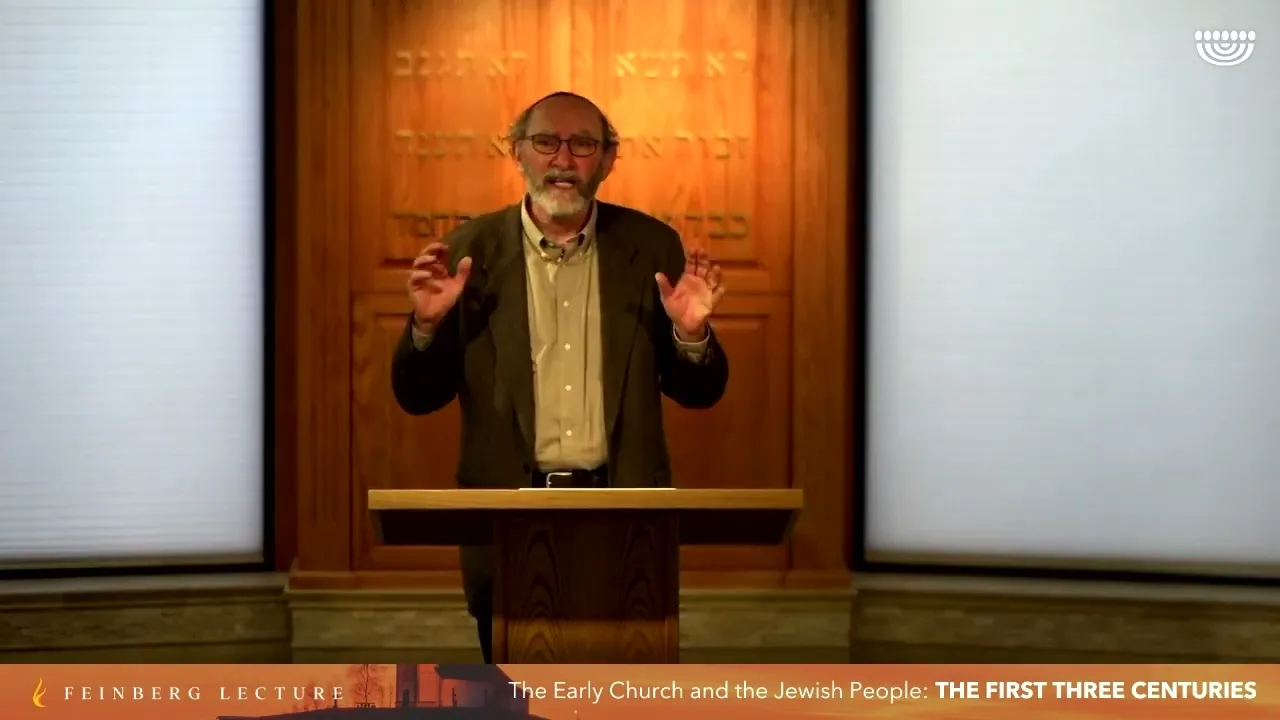
all right Shalom and welcome to the Charles L Feinberg Center for Messianic Jewish studies here in Brooklyn New York my name is Robert Walter I'm on staff with chosen people Ministries as the New York regional director and I'm a graduate of the Feinberg program and still involved with the seminary in a number of ways and we want to thank you all who are joining us in person of course and then everyone who's joining us online as well welcome to Brooklyn and we hope you're able to enjoy a bagel while you're here now um we are very blessed this morning and really throughout this entire day because we are picking up with another one of our Feinberg lecture series and the topic today will be the early church and the Jewish people the first three centuries and we have a very special guest presenter joining us today who will be bringing us through uh really these first three centuries of history and I'm sure it's going to bless you I'm sure it's going to be very intriguing and new information probably uh and uh and I'm sure edifying as well so let me introduce our uh our speaker for today DrDaniel nessem he is the son of Jewish parents who also believe in Yeshua in Jesus his mother is a survivor of the Holocaust having been hidden in Berlin throughout the Second World War his father was from a Jewish Family from Baghdad and Cairo a few years after his arrival in England in the 1950s Daniel's father became the first in his family to believe in Yeshua Daniel has thus had a privilege rarely accorded to Jewish Believers in Yeshua having a Heritage of faith in his own family thus at the age of seven Daniel already knew that Yeshua was his Messiah and Lord and made a decision to accept him as his savior after the family moved to Vancouver Canada where Daniel's father led a mission to the Jewish people Daniel eventually began a career in the engineering field before long however he studied for a bachelor's in theology from Northwest Bible I'm sorry Northwest Baptist Bible College and then went to Regent College for a master master of arts in Christian Studies it was shortly after this that Daniel joined chosen people Ministries working out of Seattle Washington after a few years Daniel and his wife went to England with their son where they established the United Kingdom branch of chosen people Ministries they also planted a Messianic Jewish congregation in the heart of England's Jewish community Drnessim holds a PhD in Theology and religion from the University of Exeter in England having focused his studies on the life of the earliest Believers and their beliefs he is the co-author of introducing your Jewish friend to Yeshua and has also written Derek Yeshua the way of Salvation as well as a Messianic Jewish prayer book Daniel is passionately committed to seeing other Jewish people come to accept the messiahship of Yeshua he believes that there is a great need to put shoe leather on the fact that Jewish people can believe in Yeshua and still be Jewish thus he maintains his own Jewish lifestyle as a personal commitment while encouraging other Jewish people to accept their Messiah and I'm sure you'll see throughout today that Daniel is a very skilled Communicator who has spoken extensively in Canada the United Kingdom the United States and Israel and he currently serves among the Jewish people of Washington Washington State and Vancouver BC and teaches in the Messianic Jewish movement so without further Ado Let's uh let's please greet and welcome DrDaniel nessem foreign it's a pleasure to be here this morning and I um I think you'll find this to be a very interesting time at least I hope so because the time that we're going to look at the first three centuries of the Christian era or the Common Era as we call it is crucial to the development of both Judaism and Christianity it's a period that both faiths look back on in some ways as a model for what they would like today and would like to see today our first three three centuries lasts roughly until the Nicene Council took place in today what is called Nikkei turkey it covers a lot of time 300 years and covers some vast shattering changes for both the Jewish people and Christianity this is a story of theological development driven by social necessity that transformed the early church from being from one form of being the Jewish people to another one could see our period begins when the church was the Jewish people in that its members were all Jewish through a period during which it began and increasingly rejected the Jewish people to an age where although few of its members were Jewish it considered itself to be the rightful Jewish people the people of Israel at the beginning of our period when the church was the Jewish people all of its members were Jews or proselytes in this hour we'll delve into what that meant so our title for this first lecture is the essenes the apostles and the dedicate that I carry with me the first volume of the apostolic fathers from Loeb which was my companion close companion for many years as I studied the didike in the UK and in Seattle will ask what is or was the religion of this earliest Church what were their presuppositions can we discern their theological map from their writings and those they drew on how did they perceive themselves and how did these earliest Believers perceive what we now call the Gentile mission in our second hour we will pursue a little bit further the texts and basically written remnants that tell us about this early period this this first three centuries as we do so we'll we'll cover various authors and they seem to have lost my paper just one sec computer went blank on me there we go we'll come we'll look at various authors and see the development of thought that they have within themselves but also the development that they are displaying that existed in the early church at that period we will particularly look at texts that reflect on the peoplehood of the Jews and their relationship to the early church in the third hour we will once again look a little bit at the essenes but this time we will look at them in relationship to the early church as a whole and to its social cultural context the aim of this inquiry is to help to redefine and Nuance the Quest for the supposedly undefiled Christian Judaism a mythical Christian Judaism that today even in the Messianic world is sometimes looked upon as a prototype we're going to look at not only this but also nascent Christianity which is one of the terms we used to talk about Christianity before it was an ism and frankly before Judaism was an ism we're going to make some pertinent observations regarding the so-called parting of the ways and we also want to observe how in some respects maybe most respects at that time the ways never parted further in an age that is seen the Jewish Reclamation of Jesus that is our age now we've seen the new perspective on Paul which is superseded in some areas by Nepal within Judaism endeavors and a beginning of a Jewish Reclamation of Christian literature we're going to see that and evaluate it so our period begins in a day that is dominated by the temple in Jerusalem it's dominated in those early days as we read in the book of Acts and as we see recorded later on by the teaching of the Apostles but this is also a day when paradoxically Israel has somewhat of a monarchy in place it continues in an era in which Scholars struggle to determine the boundary lines between Judaism and Christianity the problem is exacerbated by the fact that Jews at this time did not Define themselves as a religion the term Judaism while it does occur here and there was not common the Jewish people did not Define themselves as a religious group but more as a people who had a certain Covenant relationship with God as Daniel boyaran put it in his simple simply in his book The Jewish gospels actually there was no Judaism at all neither was there Christianity in fact the very idea of religion in the modern sense with all of its isms was foreign to that day this leads Matt Jackson McCabe a favorite author of mine to suggest that in a sense everything before the 4th century was judeo Christianity not Jewish not Christian but in the so-called Christian world judeo-christianity this isn't to say that everything before the 4th Century um was not Christian or was not Jewish but among Believers in Jesus to a large degree the two were somewhat merged then as now even answering the question who is a Jew has proven elusive while intermarriage was rare it seems in that day nevertheless today or nevertheless it was difficult sometimes to Define who was a Jew levels of observance varied tremendously so how do we distinguish between the early church and the Jewish people Edwin Brodhead in his book Jewish ways of following Jesus provides a possible way out of the impasse and one that can help us determine the polarities of this discussion it revolves around those who are presumably in between the church and the synagogue Broadhead suggests that in terms of Jewish Christianity or it's equally problematic but somewhat preferable Christian Judaism it is best to consider it a form of meta language used in a technical sense we can't really say what is Jewish Christianity or Christian Judaism because the borderlines between them were so blurred and varied there is an absence of any definable homogeneous group or consistent ideology in terms of Christianity however Jewish Christianity can actually be defined by exclusion as broad has suggests excluded from this definition of Jewish Christianity would be all conceptions of an Israel replaced by or superseded by Christianity all systems that abrogate or replace the law allegorizing or spiritualizing interpretations of the law and all christological paradigms that call into question the basic Integrity of monotheism these represent A disruption rather than a continuation of Israel's heritage what I'm suggesting is that if we Define Jewish Christianity of the day in line with broadbent's proposal we will also have a useful yardstick by which to define the Jewish people in contradistinction to the church put in positive terms then for our purposes the Jewish people are those characterized by a conscious identity of being the people of Israel a people who have a covenantal relationship with God manifest in the law Fidelity as well to the one God and God Alone this distinction will be manifest as we look at the literary milieu of the New Testament in the era when the early church was the Jewish people it's reasonable to suppose that the apostles and those around them did not know that they were writing what would later be called the New Testament it goes without saying in our context today that they did not expect that they were founding a new religion simply that they were proclaiming the Apex of God's plan for Israel and the world in Israel's Messiah Yeshua these presuppositions Place their writings within the Jewish world as a result it behooves us to survey their literary world for entreating the early church and the Jewish people our records for this first period are almost exclusively literary there are some archaeological remains but often they are disputable what were the writings that they were familiar with were they influenced by the content of these writings and the forms that they were written in we're asking what were the Jews reading in the apostles day we have numerous categories of material categories which we may be superimposing from our era onto theirs the first is closest to the Jerusalem Jewish world and comprises the Dead Sea Library it in addition overlaps with what we call the Apocrypha which also to some degree you could say overlaps with what we call the pseudopigrapha and of course there was the Hebrew Bible itself Jews of the day also read writings from Egypt and from Syria in addition there were writings by Philo of Alexandria which who was in Egypt and forms a class of its own and then thirdly another completely different realm of writing that some would have been familiar with but certainly not the majority would have been the writings of the Gentile World which not only included Greek literature but also Roman writers such as Cicero and varro these writings would have been known by many while literacy was low by modern standards this did not preclude some knowledge of their contents by the UN lettered the first place in our literature that we see any relationship between the early church and the Jewish people is in the New Testament itself The Book of Romans is famous itself for Paul's frequent pivots from addressing Jews and Gentiles in the Church of Rome however both Jewish and Gentile these were together the early church and just as the Jewish readers of the epistle were members of the church so they were also members of the Jewish people in order to have a constructive discussion then as we con consider the Jewish people and the church in the first three centuries we do need to continue drawing some sort of distinction between Jew and Gentile these are certainty distinctions that are affirmed in the New Testament and in Romans for example where Paul asserts his identity as an Israelite he speaks to the Gentiles as the other with phrases such as now I am speaking to you gentiles and refers to their ongoing relationship with God in chapter 11 asserting that they are beloved for the sake of their forefathers for the gifts and calling of God are irrevocable this then is the platform that we're laying for our exploration of the early church and the Jewish people the awareness of peoplehood among the Jewish people and an awareness of their enduring relationship with the god of Israel in the first century one cannot properly distinguish between the church and the Jewish people in large degree because in the very early years the church is the Jewish people and the challenge of the day at that time as we know well was how to integrate the Gentiles into that Ecclesia any reader of the Dead Sea Scrolls will see in short order that they demonstrate tremendous variety some would say that they cannot be the writings of one sect alone and that has a lot of Merit to it the writings of the Dead Sea Scrolls include the Damascus document another writing we call the sarak hayakad previously known as the manual of discipline or Community rule the book of jubilees many sectarian writings books a book on the temple called the temple scroll that exists in multiple copies a commentaries legal texts other texts that are categorized as Rewritten Torah and the books of Enoch and more Norman gold has argued extensively that the scrolls are obviously not the work of one group noting that just about every single scroll is written in a different hand and so he theorizes that possibly they were a temple library or a library from somewhere in Jerusalem Spirited Away from Jerusalem for safekeeping before the first Jewish revolt and such things need to be considered and we should remember of course that we're in the period very shortly after the academies of Hillel and shamai and certainly there were significant libraries we we assume in Jerusalem in part because of that with all that said it is still evident from Josephus and Pliny that there was such a thing as an essene sect and that many of their distinctives are indeed reflected in the Dead Sea Scrolls one of the most significant Scrolls is one Qs found in the first the first cave as the letter or number one signifies the sarikad which I mentioned a minute ago the sarek speaks of its Community with three different types of members there are those in Aaron who volunteer for holiness priests there are those in Israel who belong to truth that is the rest of the Israelites and interestingly the Levites are skipped over in this Division and thirdly there is there are those who are Gentile prosolutes proselytes who join them in community so this is reminiscent of the triple denomination of Torah readers in the synagogue those who are of the priests Levites and all of Israel but it is different and significantly so particularly because they include gentiles membership in this yahad as the community called itself the community is characterized or initiated no characterized by immersion it's not immersion to signify conversion because most of its members were Israelites but it is immersion to signify not only ritual Purity but also purity of heart the efficacy of this immersion is directly tied to teshuva repentance from evil and the word shuf is frequently used for those Wicked people who refrain from entering the yahad we are told ceremonies of atonement cannot restore their innocence neither cultic Waters their purities he or they cannot be Sanctified by baptism in oceans and rivers nor purified by mere ritual bathing they had also had an instructor who was to Enlighten and teach all the sons of Light about the character and fate of humankind so hopefully you're beginning to draw connections between the yahad and the early Believers in Jerusalem more to the point that we'll get to the sarek did not propose or presuppose that all of its members lived in its major communities the major community that we know of most clearly is that of qumran however there was also Jerusalem its members might dwell according to this document in diverse locations but where to eat pray and deliberate communally some of these groups might be quite small and so they are instructed that whenever 10 men belonging to the party of the Ahad are gathered a priest must also be present the men shall sit before the priest by Rank and in that manner their opinions will be sought on any matter there's also an aspirational aspect to the cerec like the New Testament it looks forward to the day when there are men who preserve faith emunah in the land with self-control and a broken spirit atoning for sin by working Justice and suffering affliction when such men come to be in Israel the surrogate struts that they are to go into the Wilderness to prepare the truth as it is written in the wilderness prepare the way of the Lord make straight in the desert a highway for our God this means expounding of the law decreed by God through Moses for obedience end quote is it any wonder that James Charlesworth theorized that John the Baptist had a close connection to the essenes and if we have time we'll talk a little bit more about this interesting paper later on the cerec has no introduction to speak of a lot of these texts don't they delve right in it is simply introduced however repeatedly and more or less throughout as a text belonging to the instructor so here's this scroll belonging to the instructor it is for him and he is going to deliver its instructions to the people and he's going to govern according to its instructions and also himself live according to its instructions it instructs how people should be initiated into the Covenant of the community and it also gives rules for membership a lot of rules toward the end of the third column the paths of light are contrasted with the paths of Darkness with the god of Israel being the one who created the spirits of light and darkness the following columns Describe the life of the initiate in the community both in terms of heart attitudes rules for Gatherings and food laws following this There are rules that are set forth regarding Community organization and discipline of errant members rules for the instructor and the significant Messianic bent appear then in the ninth column which we're getting close to the end which looks forward to the day when the prophet and the Messiahs of Aaron and Israel come to Israel or the yahad finally the 10th and 11th columns conclude with a prayer to be delivered by the instructor and these prayers have an increasingly soteriological bent thus he says as for me if I Stumble God's loving kindness forever shall save me by his loving kindness shall he provide my justification by his righteousness shall he cleanse me of human defilement and the sin of human kindness so while I think we could probably see some similarities in thought to some of the things that we see in the New Testament we can also see some shades of difference but I'd like to suggest and I have to say I'm biased because it was the subject of years of work that I am intrigued by the literary similarities between the sarek and the dedicate which was a first century instructional manual from the apostles or the Gentiles it has somewhat the same format it begins with the personal with how people are to be inducted into the community it continues into rules and and principles by which the community might be governed and it concludes with maybe not so much a a soteriological button eschatological epilogue it's introduction introduction as we represented by the incipit title and the incipit title is the title that is in the text itself the first lines of the text is quite likely original to the text there's really no good reason for thinking that it is not other than that it provides such a good introduction to the text it identifies the teaching as that of the Apostles while not claiming that it is authored by the apostles themselves this is somewhat after the fashion of the sarik which is written for the instructor but not by the instructor but obviously an instructor has composed the book just as the sarek broaches the subject of the Divergent paths Paths of light and darkness early on in in its column three so very early on the dedicate broaches the subject of two ways one of life and one of death both stretch texts stress that there is a huge Stark difference between these two ways while the data case says bluntly the difference is great between the two ways the sarak informs the instructor that God loves one Spirit the spirit of life but abhorse the other hating it's every impulse for all time and so the general course proceeds the sarek describing the rules by which one should live in the community quite strict rules and the dedicate providing instruction that is somewhat halachic in flavor in the dedicate a book of it's a book of 16 chapters versified or put into verse and chapter by a man called philotheus brienneos who discovered the manuscript in 1873 in Jerusalem and published it in 1883. he discovered it in the library of the monastery where he lived or worked in the Jerusalem Monastery of the Most Holy Sepulcher in Constantinople which we know today as Istanbul he divided it up so that the first six chapters comprise what we call the two ways section of the dedicate they are a detailed catalog of acceptable and unacceptable Behavior particularly geared towards Gentiles who might not know typically Jewish Torah aware we could say Torah aware um understanding of what is acceptable interestingly both documents end this section with comments regarding the food laws the cerec talks about pure food at the end and the dedicate concludes that the instruction but concerning food bear what you are able but particularly abstain from that which is offered to Idols for that is service to dead gods and you might detect a slight Pauline bent in that statement what follows is less clear but there is still a similarity between the two documents where following the discussion of food the cerec proceeds to discuss communal rules the dedicate proceeds to discuss immersion which is a communal Affair when someone is immersed at least the person who is immersing that person the MRC is too fast but preferably the whole Community everyone who knows them prayer is continued and blessing um and and here we have a rendition of the Lord's Prayer and then there are blessings before and after communal meals a form of birkat Amazon and while the word Eucharist is used Thanksgiving is used of this section and therefore many commentators take it to be a reference to the Eucharist that does not come later until chapter 14. this is actually the beer cut Amazon the Messianic version you could say the dedicate then proceeds through more Rules by which the community might be managed in terms of leadership and the reception of traveling teachers and Prophets it then proceeds finally as I mentioned in did the k-14 to discuss the Eucharist Lord's Supper the election of community leaders and then its final chapter it's eschatological chapter is very much after the pattern of Matthew 24.
the similarity is that although the order is somewhat different between the dedicate and the cerec nevertheless they cover the same types of materials in the general order that in in the same general order so we have to ask as many have before was there any relationship and if so what was it between the early church and the essenes did the sarak have an influence on the formation of the dedicate the dedicate is obviously a patchwork of various documents anyone reading it can see that quickly and certainly it's been the subject of much study and dissection but we consider it to have been redacted by a person that person that we might call the dedicist he is the final editor the final person who put the final touches on what was obviously a developing theme of instruction he is the in the early church he is the one who assembled these documents so then we can ask did this sarek play a role in how he selected and organized his material so now I now that we've talked a little bit about the cerec I would like to go on a little bit more and talk about the dedicate and the Gentiles it's short title which is uh people call it the inscriptio it's the the title that would have been written on the outside of a scroll so that in an ancient Library where you would have Scrolls that were without spindles rolled up tied with a string and and stuck in cubicles that are in the wall like pigeonholes you might you would be able to tell what was in the scroll by this writing the inscriptio on the outside that's what forms the title for the book today the teaching of The Twelve Apostles this dedicate is our best and nearly only source on the relationship between the Jewish people and the church in the very early years of the church outside the New Testament increasingly Scholars are dating it to sometime some have said as early as the 40s but that's highly unlikely but sometime between 60 and 100 CE previously years ago people used to date it as being in the third Century but the Dead Sea Scrolls have changed all of that at this point I hope I haven't lost it again okay at this point we're going to see that the writer is clearly writing from within the Jewish literary world and the first issue between the dedicist and the Gentiles was the issue of their relationship to God should they become part of the Ecclesia what are we going to do with these Gentile converts in communities that are springing up around the region of Syria and elsewhere interestingly we can see right away in the very title that we've mentioned in the title that is in the text we can see that there is an understanding of a Jewish Gentile distinction because this is a teaching that is to the Gentiles this is the teaching for the Nations this distinction carries through into the very first verse following where we read that first the first command is to love the God who made you and the second is to love your neighbor as yourself we might ask where does this interesting phrase Love The God Who made you come from and it is simply because the author understands that this is not the God who delivered Israel from Egypt and as is the original context of the saying but for all Humanity he is the god who made us all so while the language seems to Echo the Hebrew Bible it also makes a distinction for the Israelite the Shema is proceeded by reference to the Lord the god of your fathers and followed by reference to your fathers to Abraham to Isaac and to to Jacob and it goes without saying that for Gentile recipients of the dedicate the gods of their fathers were the gods of the Heathen and their fathers who are not Abraham Isaac and Jacob and so they have been specifically addressed in terms that apply to them and apply to all of us as human beings and so the dedicay takes everything that is here and applies it to human life and applies it to the life of the believer he unites us and says this is the teaching that relates to these matters bless those who curse you pray for your enemies and fast for those who persecute you he tells the dedicate Christians as we might call them do the Gentiles not do this as well and again now this is curious language because he's just said he's writing to the Gentiles and then he tells the Gentiles this is the way that you ought to live you ought to love those who love you um but or rap and he said but why is it so great to love those who love you do the Gentiles not do this as well but you should love those who hate you in other words he is now uniting them under the instruction of Yeshua the Messiah and so there is a sense in which the Gentiles are Gentiles but already we're beginning to see a little bit of a blurring of the boundaries because the Gentiles who have come to Faith are also in some ways different from other gentiles in the original context of the Master's saying this is Toby janicki a friend of ours um in the original context of the master saying he comments Yeshua used the term Gentiles in antithesis to his Jewish disciples in the same way when the word appears in the context of dedicate 1 and 3 it must be understood to refer to idolaters who have not yet accepted the god of Israel the in and the outs are different there are people who are in the community and there are those who are without this is of course in line with the way the word is used in the New Testament and that in itself is a bigger discussion but it does alert us to the fact that even in the earliest days there were some differentiation going on between Gentiles who are pagans and Gentiles who had come to God without applying the term proselyte to them following these initial commands the dedicay proceeds to lay out the obligations of the Gentile disciple these obligations are laid out in a strikingly torah-like fashion I write in my dissertation which has been published by Whip and stock that the dedicist gives the dedicate or his teaching here all the authority of the Torah he exalts the teacher in the same way as was done in second temple Judaism it was not only the essenes who demanded that people obey their instructor and look forward to the day of the teacher of righteousness these were the days following the zugot or pair of teachers the last of whom were Hillel and shamai whom we mentioned and they were the day it was the Day Dawning the era of the tanaim whose teachings based on those of the zoo goat would in turn become the basis for the mishnah while rabbinic Authority had not yet developed as it would to those who followed the teachings of secondary Temple Judaism and their teachers their teachers were indeed authoritative and the dedicate took that authority to itself and we see this level of authority very much in the Dead Sea Scrolls where so often um of the authority of the teacher is absolute and not to be questioned in addition to this the Decay asserts that the authority of the Lord himself because it says this is the teaching of the Lord through the Twelve Apostles it uses what we call the sectio evangelica or evangelica this is a section where verses are used that are that reflect very closely in some ways the sermon of the mount particularly in verses three to five and the dedicate again reflects the gospel of Matthew in chapter 16. again in that text asserting the authority of the Lord but perhaps that is all just a preface to the authority that the dedicate is exerting upon or taking upon itself for its readers as in dedicate chapter 2 3 4 and 5. we have three lists of commands for the Gentile each list is slightly different but covers the same ground and each of these three lists argues the on the basis of the commands of the second table of the law this is something that was initially noted by a scholar in South Africa Jonathan Drper and helped me to form my own arguments concerning the dedicate in each list all five of these commands are mentioned in each list the commands concerning murder adultery and theft are rep are reproduced also in the very same order as they occur in the Hebrew text but with other commands in between them and this varies depending on the list but what you get is the sense that what is being developed is a halacha for the Gentile basically taking the second table of the Torah and applying it to them in their context and so to me there is no doubt that the Decay intended to apply the Torah to its Gentile recipients you might be asking yourself what about the first table of the Torah then what was the didike doing with that certainly we've been told Love The God Who made you and we're reminded of the beginning of the decalogue The Ten Commandments where Israel is tall told I am the Lord your God who brought you out of the land of Egypt we have it behind us Adonai and we are told that he only should be worshiped but from then on the commands that are given in that first table are basically given short shrift it's interesting because this Omission seems to be quite intentional while it's clear that all of us all of humanity should Worship the Lord our God it seems that the dedicate was referring specifically to what was applicable to the Gentile convert and leaving the rest God was the one for example who said to the children of Israel you shall not take the Lord your God in vain there is some allusion to this command in the dead dedicate but specifically the fourth and fifth commands are not introduced to the dedicated believer for example the command to keep the Sabbath day is commanded in Exodus 20.
on the basis of God's creation on the seventh day so one might think that it is a command for all people however Deuteronomy chapter 5 clarifies and gives an entirely different or additional rationale that of The Exodus from Egypt this serves to clarify that the reason for the day of rest is based in Israel's Redemption and the reason for it being on the seventh day of the week is because that was God's day of rest despite philo's General advocacy of the Sabbath to all Humanity for many Jews of the first Century the Sabbath was something specific to Israel jubilees chapter 2 is representative of this in regard to the Sabbath reading the creator of all blessed it but he did not sanctify any people or nations to keep the Sabbath thereon with the sole exception of Israel he granted to them a loan that they might eat and drink and keep the Sabbath there on upon the Earth and this interpretation is corroborated or probably originates from Exodus chapter 31 where we read and the Lord said to Moses you are to speak to the people of Israel and say above all you shall keep my Sabbath sabbaths for this is a sign between me and you throughout your Generations that you may know that I the Lord sanctify you and those who are familiar with the Sabbath letter G know that this is reproduced this is a sign forever between God and Israel this commandment therefore is specifically associated with Israel and therefore is not reproduced in the dedicate for the Gentile believer then relevantly the fifth command to honor one's father and mother is particularly striking connected with the promise Exodus 20 reads honor your father and your mother that your days may be long in the land that your the Lord your God is giving you here whether long life is for the individual or Nation the point is that it is connected to life in the land given by God and so the dedicate while at nowhere gives a hint of disrespect for parents nevertheless omits this command so it does seem although it is not conclusive it seems that the dedicate is specifically applying the second table of the decalogue to all Humanity but understands the first table as largely specifically connected to the people of Israel this is important now when we return to the prohibition of idolatry the dedicate does include this command this command has Universal applicability it is specific it is clear it is comparable to the description of the path of the black one and the path of Eternal death in a related text the book of Barnabas 20.