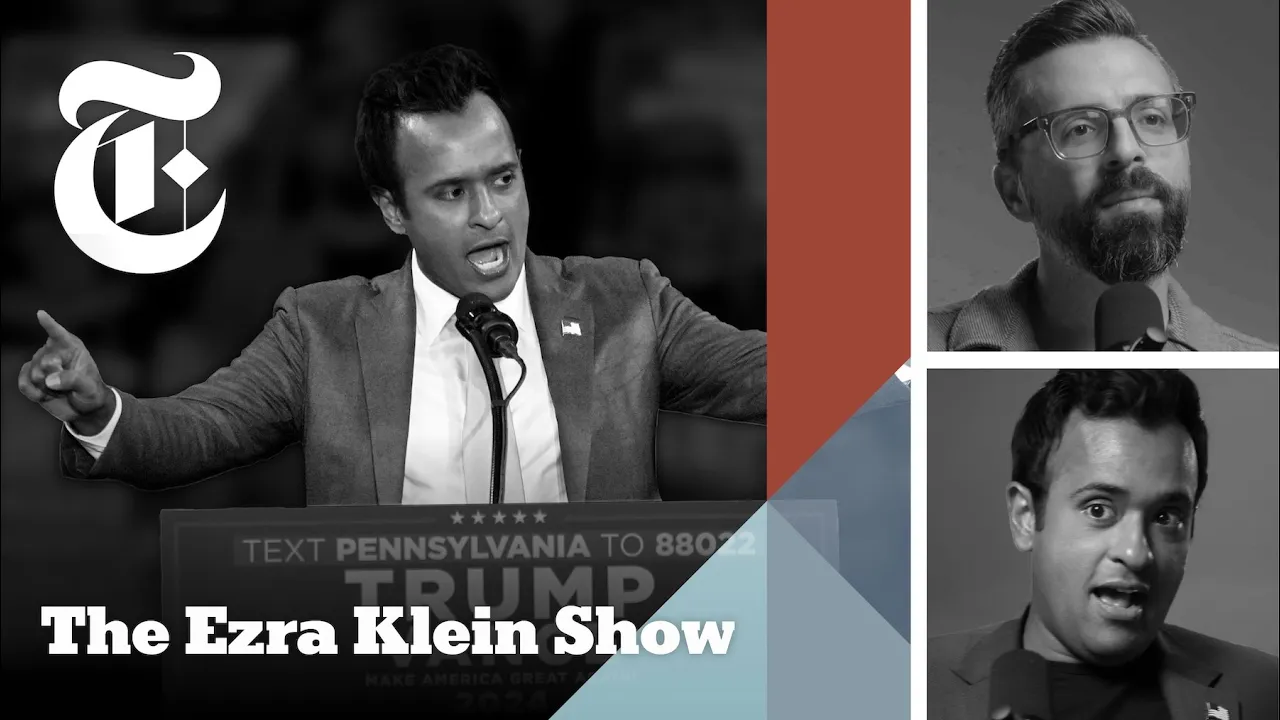
In 2020 very few people had heard the name Viv ramaswami th before he ran for president before he was one of the breakout stars of the Republican primary neither of them could even state for you three provinces in eastern Ukraine that they want to send our troops to actually fight for look at that I mean she has no idea what the hell the names of those provinces are he's pulling higher than Many of his competitors who have far more political experience rising to second place behind former president Trump in a new poll out of New
Hampshire today we become a party of losers at the end of the day that is where the party is headed it was this style of of rhetoric and then in the summer when Republicans are Riding High When Donald Trump seemed a pretty good bet to win the presidential campaign ramaswami went to the National conservatism conference Place where his colleague and sometimes friend of me JD Vance was also speaking and gave a pretty interesting speech thank you for the warm welcome it's going to be a different kind of speech tonight arguing there is a deep divide
in the America first movement it's not a Rah R speech my goal is to actually tonight just illuminate what I view as this growing healthy but existent Rift between what I call the national protectionist direction of the future And a national libertarian direction for the future Vance of course was then chosen to be Trump's vice president elevating the leader of the other side of what ramaswami takes as a divide to possibly the vice presidency but ramaswami thinks that a future Trump Administration and if Trump loses certainly a future Republican party is still quite shapable on
these issues he just published a book making some of these arguments and I thought it'd be an Interesting time to have a mom to talk about these divides as always my email as reclin show NY [Music] times.com beam welcome to the show it's good to be on man so in 2022 you told the New Yorker that you recoil when you're called a conservative in your book the term you like to use for your movement is the movement you're part of is America First what's the difference between being a conservative and being America First well the
reason is I think the term conservative and I would say everything I'm saying there's a parallel version of it for liberal and the left but that's less my concern on what you probably want to hear from me but what I think the term conservative itself is illd defined today and so I think that if there's one thing that unites the conservative movement today it is its opposition to radical left-wing excess but if you ask the question of what does It actually stand for that question I think is far more unanswered even the values or the
value systems that conservatives are seeking to conserve have in some ways actually been eroded and disappeared in the country which requires a kind of creation which has historically been a progressive project rather than a conservative project that gets a little eological and philosophical but in a more practical sense even the modern conservative Movement consists of I think a rather widely disperate group of movements within it you would have the neoliberal informed or what you might call neoconservative vision of conservatism Bush era Republican conservatism versus a more nationalist America First direction that speaks to certainly my
vision for the future of the country but if you double click on that that itself is comprised of at least two if not more different fact within it as well and so Anyway for me I think a lot of these labels can be confining and that's one of the reasons I've tried to you know maybe go out of my way more so than an average politician to write a larger number of books articles you know take a little bit more go to the distance a little bit to lay out what my views actually are rather
than to have them be analogized to somebody's pre-existing category of where they try to fit me in I'm unafraid of being a little eological We're we're here on a podcast I been thinking about George W bush recently um you know I have to think about him he's a big figure in my own cosmology and he was understood in his day as a nationalist right this was an era of flag pins you're wearing a flag pin right now like the post 911 period what I see in the America first world is a sense that what came
before was insufficiently nationalist if I was to say what unites all of you together It is a sense of renewed nationalism and the sense that that nationalism was betrayed not just by a that you uh say has excesses but a right that lost the plot in what way was George W bush not nationalist well the short version of the answer to that question would be interventionist foreign policy and the use of American taxpayer and even life life resources to advance goals that didn't directly advance or even indirectly Advance the American interest That's the short version
of the answer to that question but actually if we want to go longer form in in terms of History here let's go even further back to the evolution of modern conservatism and how we got to where we are I think if you go back to lynen Johnson's Great Society this is a kind of modern original sin in American politics of the creation of a nanny state to me I include the entitlement state which is the state that gives away stuff welfare Medicaid Etc there's the regulatory State the rise of three-letter agencies to administer this larger
form of government in the regulatory State and then there's the foreign Nanny state which is the foreign aid complex and the foreign interventionist complex what I think of as classical conservatism in the latter half of the 20th century was a reactionary response to that LBJ vision of the Great Society that got watered down through what we would say The rise of neoconservatism bush era conservatism that effectively accepted that this sort of larger form of government in some form was here to stay that we're not really going to undo the Great Society that we're not really
going to undo the existence of the regulatory state but we want to be thoughtful about curbing its overgrowth while at the same time saying that while we're at it and we got big government we might as well use it to spread democracy Using capitalism as a vector to do it and if we're not going to use capitalism to do it we'll use military force to do it and that's a different kind of big government that became accepted in the form of conservative Doctrine not just accepted but a central feature of it and then what I
see in the America First Response right now is a unified response that is against that neoconservative vision and I think what you see in broadly what's thought of in popular Circles as the America first movement today but what I call the protectionist wing of the America first movement is an economic objective an economic project you could call it economic populism or economic nationalism but in some ways the the protectionist strand of this says okay well if big government's going to be here to stay we don't just want to curb it we actually want to use
it to advance substantive goals of our own versus The Strand that I'm more uh Identified with I would I what I certainly term the national libertarian or National Liberty strand of America First says that actually the whole project we got to actually keep our eye on the ball was dismantling the existence of that Nanny state in all of its forms the entitlement State the regulatory State and the foreign Nanny State and you know we've gotten into the thick of a lot great I I I'm I'm glad to get into it were Medicare and Medicaid Mistakes
I believe they were with the benefit of retrospect particularly Medicaid particularly the welfare state without work attachments required attached to it Medicare and Social Security I put in a different category which we can get to later and I think is a a little bit orthogonal to the discussion certainly that I'm most interested in having that I think is on the money right now why they different C I think that Social Security I mean you Kind of had the real my real issue there is if we had ever actually taken advantage of the Surplus that we
had it's a bit more mechanical issue that if you just allowed for the Surplus to be invested at rates of normally normalized returns of the stock market or Diversified portfolio we'd have a far excess Surplus that would be sustaining itself so it was you pay in you pay out versus having a redistributionist quality to it versus what I think of as The welfare state my principal issue with it is that it actually I think the evidence would show in my opinion that it has harmed the very people that it was created to actually help but
you know my my core Focus actually even in my presidential campaign had been less taking aim at that though I do think that that's a project we have to come back to but was to take aim at at least the regulatory state that was a close cousin of that state and I think Basically what happened in the' 60s is we traded off our sovereignty for this stuff and I think the problem we're basically going to run into as a country is eventually that stuff is going to run out in the form of our national debt
crisis and we're left with neither sovereignty nor stuff and I think this should be the central focus and concern of the conservative movement which is not quite today that brings me back to this distinction between the national Protectionist and the national libertarian camps of the America first movement and the irony is is I've made the case for the more National libertarian strain let's just say in recent months in a more pronounced way in particular one of the criticisms I've gotten is that just a reversion to a kind of neoconservatism or neoliberalism and my sort of
retort back to that and this is at the bleeding edge of America First Debates right now is that actually the America First Wing the protectionist wings acceptance of the big state is actually the permanent codification of the neoconservative premise that rejected the classical conservatism that was hostile to the existence of the N state in the first place and so where we're getting right how many conservatism can dance on the head of this particular was I was you said you want to get into emology and lexicons And so so you know I feel like we're using
too many terms hold on to terms for a minute yeah I've sat in chairs exactly as far from Paul Ryan as I'm sitting from you put aside the foreign policy for a minute a lot of you're saying which is key yeah a lot of what you're saying just feels like Paul Ryan to me so so here's why it's radically different I would say is I am more committed in my rejection of blly neoliberalism even more committed What does blly neoliberalism BL NE liberalism is liberal internationalism of a variety that says We Were Somehow going to
export Big Macs and happy meals and spread democracy to China that the sole goal of immigration policy was to view the United States as an economic zone and that the goal of all immigration policy was to maximize the size of that economic pie without regard to national identity those are some of the big mistakes of blly Neoliberalism of yesterday I think what we've learned from that is here's a couple key errors I would say like deep category errors that were committed that we still suffer the the consequences of today one of those is that we
now depend on our chief adversary for our own National Security the number one supplier to the US military directly or indirectly is China 40% of the semiconductors that power the Department of Defense come from China our Military-industrial base is dependent on China so much so that rathon says that we have to make nice with China this makes no sense like even if you're classical hiek style libertarian read the road to serfdom he would even admit and even embrace the idea that Nation cannot depend on its adversary for its own National self-defense it just doesn't make
sense but that's I think the sin number one of the old blly neoliberalism and number two related to This issue of immigration that somehow I don't care what language you speak I don't care what your allegiance to the Civic ideals of the United States are if you know the first thing about it if you're going to add some unit of economic efficiency to the US economy our immigration policy is effectively just a subset of Economic Policy which I think has had the effect of eroding our national character and national identity and we just it just
wasn't in the scope Of concern of the Paul Ryan style worldview of the 1990s so in that sense I depart in no uncertain terms from the bive neoliberalism of yesterday however there's a fork in the road then about how one responds to that if you're really serious about declaring economic independence from China which I think is a chief and vital objective for the United States at least in areas critical to our national security then yes of course that means onshore into the us We're all in favor of that but it also means if you're really
serious about it expanding trade relationships with South Korea Japan India you could debate other countries Vietnam the Philippines Australia Etc but if your top goal is to protect American manufacturers from the effects of foreign price competition then you actually want less trade with those countries but if that's your objective then you're necessarily delaying the time period it takes to Declare independence from China so there's a choice so in this you sound a little bit more to me like where the Biden Administration is than where Donald Trump is I disagree with that well I'm sure you
will yeah uh but what you're describing is what they often talk about as friend Shoring before them what you're describing is what got talked about uh was actually called The transpacific partnership trade deal we are going to encircle China with a Series of trade deals and I'm sure you would have designed the trade deal in terms of climate and labor standards differently but with Trump right has a not just a set of china tariffs but a 10 or 20% depending on which speech he's giving tariff on all uh imported goods from anybody be they Friend
or Foe you sound to me like you're interested in this other idea that our uh trade with friends should go up in order to make trade with China go down that strikes me As actually more common cause right now with people on the Democratic side than people uh on the Republican ticket well the first thing I will say a lot of things to say in response to that first of all I could care less right now for the purpose of this discussion about what label we overlay on anything right because I think there's deep divides
in the Democratic party as I think there but I think it's useful to ground in actual policies people are proposing but But then the second point is Trump Biden's actually kept most of the Trump tariffs intact and then the next thing we could talk about right but he's not trying to create a universal tariff well that's that's an if he kept all the tariffs that he supposedly would have opposed from Donald Trump no he's not trying to create a 10 or 20% Universal tariff he's just not well I think I think we can get into
the essence we get the essence of what Donald Trump is also Trying to do which I think is a little different than what you he's proposing a 10 or 20% I think he's using the threat of tariffs to be able to accomplish other goals as a negot you don't think he will do the thing that he's saying he do I think that he's using Donald Trump is all about with respect to the international stage using our leverage to the maximum extent possible so we have to sort of assume secret knowledge of what Donald Trump is
going to do well I think that he's proven himself to be an apt negotiator for the United States and getting other countries to Pony up in context where they haven't in the past and so I think that we got a part of what you're doing by putting Donald Trump there is we're not putting a traditional stuffed suit politician but you're effectively putting somebody there who keeps other countries guessing in a way that we're able to extract leverage from them as a consequence but So we can't really debate what he's going to do then right so
he you're saying he is running for president on his core Economic Policy but we should not evaluate that policy because in office he'll do something else when he I think the way to evaluate Donald Trump is how he performed in his first term so the way Donald Trump performed in his first term is I'm going to do what's right for America I'm going to do it situationally What best advances America's interests whatever it is I think the TPP was you know poorly executed you anticipated correctly some of the things I would say with respect to
climate change related objectives Etc that are baked in but even more so just to get closer to the meat of it I think that it's not really free trade when the other side of that trading relationship isn't playing by the same terms as us when it comes to State subsidies for example so tariff is A tax but there's very ways of having indirect tariffs or indirect imbalances in the trading relationship when you have state related subsidies on one side versus another if another country or trading partner is applying a tariff to us either a direct
tariff or an indirect tariff in the imbalance of state sponsored support then I think is totally fair game for the US to say well we're going to do the same thing in return even though I believe the best State of Affairs for everybody involved is getting rid of that state sponsorship and the tariffs in the first place and I think if you look in fact like forget rhetoric and everything else but in fact a lot of what Donald Trump accomplished was either leveling the playing field or using the threat of going further than that to
accomplish other objectives that's what we got out of the first term I think that's fair game so I one thing that is difficult about talking about Donald Trump both in terms of polic C proposes but also the first term that he inhabited is that in both cases you have a problem of interpretation so in the first term it is not just Canon among liberal reporters but Canon among Trump staffers that Trump was highly blocked by the bureaucracy that he and Theory controlled and a huge amount of the thinking around the America first movement is how
to make a second Trump term more responsive to at least what People believe is Trump's uh interests and desires than the first term was I don't agree with with this sort of vision of Donald Trump as sitting up late at night every night carefully pouring through proposed trade deals with different countries bilaterally to decide what's in the American interest he got some things done and didn't change a whole lot of things but there are theories beneath these and what I think is interesting about your book About some of the speeches you've been giving is a
distinction in theory right Donald Trump as far as I can tell believes JD Vance certainly believes that we have very zero some transactional relationships with other countries and that we are getting robbed on deals but just in general we should be pushing to bring much much more on Shore a lot of trade theorists believe a lot of people think about trade believe you can Have much more positive some relationships I think that is functionally right now where you are and my sense is the Trump um the whole theory of those tariffs right which is why
I take them seriously at least as an idea of what Donald Trump believes about the world is that you would just bring back a lot more industrial base if you made all the imports from the rest of the world more expensive that is I think a a natural way to look at that it is The way JD Vance explains it is your view that Donald Trump does not believe that at core he's not merant in that way I think so so here's the thing about Donald Trump and the Coalition he leads right now versus a
part of that Coalition that has the ideology that you're describing I think Donald Trump at his core is a pragmatist and I do believe and and I I think it would be boring to have an hourong conversation about different interpretations of of Donald Trump's style but I'll give you my perspective on it is I do think that he is somebody who pragmatically is is not going to be an ideologue one way or the other on this question but it's just going to look at what makes America a better country and how you're able to exert
negotiating leverage in a situation by situation basis to get there what I think is more interesting though is there is the ideological strand that you described and I would go One step further in what that ideological strand thinks it's accomplishing The protectionist Strand it's not just bringing manufacturing back to the US I think there's even more to the project than that I think part of the project is also playing with American wages bringing the wage of the American worker up by saying that effectively you are engaging with slave labor style wages you could debate or
not but I'm I'm articulating The View That it's like slave labor wages in another country and stuff's made cheaply because of that you're effectively forcing the American worker to compete at that lower wage if you're engaging in a truly open bilateral free trade relationship and that's where this bleeds into immigration policy so trade policy immigration policy to the protectionist camp I think of as more of a subset actually of anything is labor policy a little bit of industrial policy But it actually is labor policy at its core The protectionist View on this is look if
an American company could pay an American worker $20 an hour to do a job and they could pay two foreign born workers legally or illegally in this case sometimes Republicans use the vment of our opposition to Illegal immigration to confound this much more uncomfortable discussion about legal immigration but what he would say is for $20 an hour if you could pay an American Born work but A foreign born worker even a legal immigrant would be doing the same job for $10 an hour the job of US immigration policy should be to keep those two foreign
born workers out so that the domestic born worker can actually be paid the higher wage that's a totally different view from not only classical economic theory but also my own view of the national libertarian worldview which is that actually the thing we should be caring about when it Relates to immigration policy is something else altogether which is the national character of the United States if your vision of immigration policy is one of protecting American workers from wage competition then you just want less immigration period if your goal is to actually preserve the national character and
identity of the United States it's a different immigration policy which in theory could be more same or less pragmatically in the near term almost Certainly means a lot less but you get there for very different reasons I always find the way the America first movement doesn't think about immigration to be interesting because on the one hand on the trade side what I see is a description of America as locked in incredible zeros some competitive relationships with other countries in the world competitive relationships for where you're going to put a factory for who's going to buy
who exports or Imports it's a very uh Doggy Dog economic view of things and in some ways it's true and here you have this incredible possible Advantage America has over everybody else which is everybody wants to come here and you could build an immigration system that is bringing in not just low-wage work but a lot of high wage Talent right in the uh stories of this you know Steve Jobs the son of a Syrian refugee or or Legion Elon Musk you know himself Elon Musk himself yeah the degree to which that does not seem to
be a huge part of competition strategies on the right or the American first thing is interesting me you bring up a point system in the book I'm not sure that it is well talk to me about how you think about it so I drew this distinction earlier but I dwell on it for a second because I think this is really important in understanding what's actually going on with our base versus what may appear to People peering on it from the outside versus in so I do think that most of the prominent voices that wear the
mantle of the America first right adopt the protectionist view I don't think that that is broadly representative of where a much more diverse Coalition even within America First dress you take someone like Elon Musk who's playing an instrumental role I think in in guiding uh you know hopefully success for Donald Trump in this election I'm where Elon is And elon's where I am on this question is that we want to be the championship team so so the three principles I give for immigration policy to make it really simple for people is no migration without consent
consent should only be granted to migrants who benefit America and those who enter without consent must be removed but number two is the most interesting consent should only be granted and and should be granted to migrants who benefit America now I view That benefit more holistically than just the economic benefit but who benit benefit America in increasing our the Civic character that I think we're missing in our country and further part of the a subset of that Civic character is self-determination self-reliance and the ability to work hard through ocratic system of American capitalism so I
think that that is alive and well actually in the bloodstream of America First policy but I think part of what's happened is Some of the most articulate thoughtful intelligent and prominent voices wearing the America First mantle on the right I think have adopted that more protection view that you don't really see fully embodied in Donald Trump Donald Trump has has facets of each of these elements in his policy Vision but I think that his view that if you were educated at a US University and you're going to be somebody who's actually going to be one
of the Geniuses like the next Elon musks Of this country we want them in the United States of America so on immigration I think you get this interesting question which gets to me at the heart of the the sort of cleavage you're describing I sort of look at America first as this strange effort to contest what it is that Donald Trump himself means and there's a version this JD Vance that I think you describing very well here which is the immigration policy here is about protecting American Workers from wage competition fair enough there's a version
that you are trying to Advocate and and and be a leader in which is we should be pursuing a certain vision of national identity and I want to talk about what that that means and there's a thing that I actually hear from the guy who has made this PO popular and who is leading this movement which is that immigrants are Vermin who are polluting the gene pool with bad genes that they are coming here From insane asylums they are coming here from prisons that the people themselves are the problem right sometimes it feels to me
like there's an effort to sanitize this or to ideologized Sheets to make it something that we could think about in policy but I think for Trump himself and the thing that gives us a lot of its power and the way he talks about it over and over and over again in a very consistent way it's not about wages and it's not really About identity it's a belief that the people who are coming here are bad they're not sending their best and that is the problem and so we should lock it up because the people come
here should not be coming here so let me draw a couple of distinctions right because I think that what I'm I I hate talking about stuff that's trite right and even amongst Republicans I try not to say things that have already been said but what you're bringing up is the Distinction that everybody knows about and I'm a hawk on this too which is illegal immigration so the premise here is if your First Act of entering this country breaks the law then by definition in some base sense of the word like definitionally you are a la
no I want to stop here actually because I'm not bringing up illegal immigration illegal immigration illegal immigration illegal immigration is part of what I'm saying but Donald Trump does not make The distinction you are describing if you may let me finish then I'm I don't to move the subject of what I'm talking I'm the subject of it but you're asking about who is he referring to and talking about criminals right broadly speaking denigrating terms I think are generally reserved for people who have crossed illegally we just been going through the Haitians and they have not
come here ille no no but well versus the same Donald Trump as a matter of a couple Months ago said that he wants to staple potentially H1B visa to everybody who graduates from a US University that's not a that's not a their criminals worldview so I think a lot of this and and I'm not you I'm here to share with you what my perspectives are but you're asking about Donald Trump my understanding of where he's at on this which I respect is broadly overlaps with the distinction between illegal immigration and legal immigration and Then there's
one step further in the Quasi legal immigration category an interesting thing about our current immigration system and I make this point in the book as well you can imagine an immigration system that rewards all kinds of different attributes it could reward intelligence it could reward National Allegiance it could reward willingness to work hard or economic contributions or how much money you have when you already come here so you're not Going to be dependent on the welfare state our immigration system rewards none of those qualities the number one human attribute that our current immigration system rewards
is actually your willingness to lie actually which is a sad and unfortunate fact if you're somebody coming from another country and you can't in good conscience say you're not seeking Asylum because I'm not going to be a threat of imminent bodily harm because of my race or my religion I just Can't say that to the US government because it's a lie you're not going to get in if you don't actually face that but you're willing to say it you actually do get in so I think against that backdrop we do have a broken immigration system
in both the illegal and even quasi legal variety where your willingness to lie on day one is the number one human attribute that sadly our current immigration system rewards so against that backdrop there's a lot Of frustration in the conservative movement broadly I share some of it Donald Trump clearly shares some of it to say that that needs to change but if you're if we're talking about Trump for a minute before moving on to broader you know policy views I think Donald Trump is also the person who has said things like he loves immigrant he's
married to an immigrant he Praises legal immigrants of different contexts and I I think that the top policy doesn't surprise anybody To know this just listen to Donald Trump at one of his rallies I think correctly one of the top policies is to seal the border and to stop the illegal immigration crisis into our country once we've achieved that I think we're going to be in a good position to have lasting immigration reform on the legal side and I believe there's two competing Visions here but I come down on the side of prioritizing Civic assimilation
and civic identity and economic Contributions as part of that as distinct from the economic protectionist vision of saying that somehow our job is to coddle Americans who already here from being prevented from having to compete in the labor market with the best and brightest whom we might otherwise allow into the country this is probably more where I take your earlier view on Donald Trump where I think that what he did in his first term is illustrative there were a lot of Immigration compromises Donald Trump could have struck that would have been border hardening at a
level he never got anywhere near because he couldn't pass legislation comprehensive immigration reform is now now I think an idea associated with the Democratic party right but it could be something that that members of the right propose right there could be a Vance Trump um policy that describes the Border hardening and deportation measures they would like to Take but also describes what a pro-america immigration system would be I think that's coming I think that's coming but I think we got to go in order and I think this is part of where we lack the ability
to have this conversation with intellectual Clarity without solving the mass illegal migration crisis order is weird here because the reason Democrats thought about conference immigration reform is recognizing they needed Republican votes They put a bunch of things they weren't actually that excited about in there to try to get them the reason I'd be interested to see Donald Trump and JD Vance put something like this out is that if you wanted to legislate on this you actually need Democratic votes so making it comprehensive not just saying my only uh uh aim is mass deportation is actually
how you get that two two points on this where I I have a different point of view I think it is actually for Uniting the American public around where we eventually land I actually think it's important to go in two steps and not do it in one step I think you got to deal with the illegal immigration crisis first after which I think you've built trust with the American populace that we can actually have an honest Earnest conversation about how we're solving for legal immigration as opposed to a system where we've really abandoned a lot
of the border security policies that have Bred deep mistrust in the American populace that anything we're going to do in some type of package hodge podge deal is actually just a reverse maneuver for accomplishing the same thing that we were accomplishing through Mass illegal migration so for the purpose of building lasting Unity around this I think we need to fix illegal migration first once that issue is done then I think we can have a rational conversation about what legal immigration policy looks like the Thing I want to get at though with immigration is and and
the point I'm making about Donald Trump is it actually really matters what is motivating somebody I think that is actually your core Point here yeah and I think a lot of people following Donald Trump are motivated more by what I would describe as policy objectives than than he is but the thing that has motivated a movement the thing that makes this whole thing powerful does have animal spirits in it One of things I I sort of appreciate about the distinction you're drawing between you and what you call the the national patronage side of this is
it I think what you're describing is closer to the way you would try to turn the animal spirits into policy than the economic side I think the economic side is trying to sanitize us whereas national identity I actually agree with you on that national identity is closer to the thing that I think theame Donald Trump feels that people behind him feel that is actually getting debated and that we don't really have such a good way of talking about because national identity isn't a thing you can measure on a chart right we don't run studies on
how good the national identity is and so it's actually not always the the simplest thing to put into immigration policy so talk to me about how you understand what kind of immigration helps and harms you just Made signals to me that I think you really I think uh I don't mean to sound pompous but you really get this I think in a deep way I think that's a little bit of retroactive re-engineering of what's going on but what's really in people's hearts is this deeper question of identity and then we can maybe get to this
later I think what's lurking underneath this entire debate is actually a deeper question ofid identity of what it means to be an American but We can come to that in a little bit so I think the question here as it relates to immigration policy is closer to Identity and American identity and I would like to translate that to policy through what I consider to be a Civic nationalist division in some sense the most Upstream view that I have is what it means to be an American is we have an attachment to these Civic ideals and
as it relates to immigration policy how we instantiate that is to say that if you have somebody From another country who has a greater understanding of US History than the average American citizen here has a greater commitment to the ideals embodied in that history than the average citizen here is more fluent in the US language or proficient in the US language than the average citizen here so therefore can communicate and and engage with those ideals and is willing to work harder and embody greater contributions to America than the Average citizen here then we should have
an immigration policy that selects for that class of immigrant which is different than the view of saying the blood and soil vision of identity say there are certain people who are vested into a tie to this Homeland that deserve to be protected and taken care of by their government and if there are other people who are going to offer a competitive force in the marketplace for labor it is the job Of America First leadership to keep them out now I actually believe what you believe which is that Donald Trump is actually much more motivated by
and I think a lot of the Bas behind Donald Trump and the Maga movement is a lot closer to the flame with where I'm at on this question it's much more about identity than it is about this economic populism two things have always struck me as complicated in this view one is that national identity is itself Malleable and what different people feel is the nature of attachment to America and the nature of the instantiation of American ideals differs from place to place I'm Californian we are a state with very high immigration very high immigration of
people who don't come speaking English I grew up in Orange County in a part of Orange County with very high Asian immigration a lot of the people I grew up with didn't speak English Amazing Americans work hard their children are amazing Americans they contributed a huge amount also to the economy of the country and part of being California at least in the way I am part of my national and state identity has to do with the way America assimilates and mixes in immigrants trying to get at that in a test one of the things I
I I sometimes find interesting about it an argument like yours is I get where you're coming From but there's this part of you that will in a minute tell me about the government's incapacity all the administrative agencies we need to shut down all the Regulators who might be well and want World place and then you're going be like but what we can do is people a test on paper I understand where you're coming from what kind of American they're going to be so let me let me just let me just start with let me just
Start with a basic premise because it's a fair it's a fair point for you to raise totally what I've said is at the very least for example just to people who may be have not followed my entire campaign but are listening to this conversation just understand where I'm coming from I'm looking at these principles not just the outside but also to the inside so one of the controversial positions I adopted during my Campaign which I stand by is I think Every native born High School senior should have to pass the same Civics test that we
already require of every legal immigrant who enters this country which I think every native born High School senior should be able to pass that arguably to even be fully viewed as a Capital C citizen in the United States in order to vote well I think that we could debate the way that you implement it but at least I think every High School senior let's just say the the Mildest version of this which I think should be least and controversial and most adoptable is to graduate even from high school you should be able to know the
same thing about our country that every legal immigrant is required to know before they become a full citizen so this is a Civic National nationalist view that goes far beyond just immigration policy as it relates to immigration policy you know it speaks to me when you talk about your identity as A Californian and the different attributes that compose identity right identity is such a a complicated concept there's a lot of layers of what one's own identity religious identity ethnic identity what foods you eat the cultural Traditions that make up who you are and I am
not of their view I don't I hope I haven't ever represented myself to be even inadvertently I'm not of the view that you need to abdicate those other forms of your identity to opt into the American identity I I it would be a bizarre thing for me to say because I am the kid of legal immigrants to this country and there are many elements to my own identity that go beyond just the Civic commitments to the US ideals but I think that that is a necessary condition of actually being able to opt into those ideals
so I draw a distinction between your knowledge of the ideals enshrined in the Declaration of Independence our constitutional system of Self-governance your ability and I think this is the most controversial one but your ability to speak English which I think is a precond condition for assimilating into a country of other people who share those same ideals versus whether you like to play baseball soccer or cricket and I bring that up because I think that is an issue for for certain cultural vision of what identity actually is like do you have to like hot dogs and
baseball rather than you know Enchiladas and and soccer disting between the two things here because this actually not even meant to be asked out question I I think the the question I am getting at is within your framework not even within my framework what do you believe these tests can really do a minute ago you said to me right I don't to fetishize that test is one attribute right English is a national language I think would be high on those I understand that a minute ago You said to me that our immigration system what it
prioritizes above all else is a willingness to lie right because you come and you'll claim Asylum and your view falsely that gives you you know you get brought into the country at least for for a period of time it's not my view Ezra don't just say in your view for I mean is what's happening today I saying that uh people can disagree on what is and in fact do you disagree you have a whole thing in your book about The rates at which different judges Grant Asylum claims so the question of what counts as a
credible Asylum claim right is not just contested but is itself ambiguous and in among other things the bill that uh Donald Trump helped kill we were going to change the sort of levels of Asylum claims you need to be able to make in order to to to claim that successfully so I think I'm actually saying same thing you are Asylum claims are are ambiguous although I don't always think that the same people you probably do are falsely claiming it uh I think you know different levels of fear are are understood differently by people the thing
I am saying is that how do you just avoid this being a teaching to the test right Coming to America is great you know being able to say on a on a form that the Declaration of Independence was about equality for for all men is easy so now we're talking About plumbing and implementation which I don't want to reject I isn't isn't this how you want to instantiate it well I I think a test is just one example I think Proficiency in English is high on the list and I don't want to dismiss the question
about implementation but what I do want to just draw the distinction of is there is a very different competing Vision that this is at all the thing that we're supposed to be concerned about versus saying if that person is Going to work harder and more hours for a lower wage that's a problem so that's the basic distinction I'm drawing now how you implement it I mean I I'm not trying to just be a philosopher in the clouds here those are important questions to get to but at least you got to know what you're solving for
before you actually even solve for it and there is a deep-seated divide even on the right about what we're actually solving for and I think right now especially if We're successful in winning this election as I'm rooting for and working hard to make happen I think it will actually be really important for us to just see with Clarity the why of why we're advancing each of these different visions of trade and immigration policy and especially attitudes towards regulatory reform so why why don't we talk about just at a philosophical level the difference you see between
the way that the national patronage um side as You call it and your side think about what should be done with the administrative State sure and I use the word national patronage and National protectionist sometimes interchangeably but I think there's two competing visions of how we view the administrative State and the regulatory State one is that we want to use the levers of power to advance affirmatively pro-american and pro-worker ends you could even call it more broadly Conservative ends there was a moment where you I remember was Bill Clinton kind of in the uh I
think it was in the late 90s that he said something like the era of big government is over which if a republican said it during that same period it would mean nothing but of course the fact that he was the Democratic president of the United States carried a lot of weight and though it hasn't been articulated in so many words yet I think there's a version Of the Republican statement right now from the protectionist or patronage camp that says the era of small government is over nobody said in so many words but effectively that's what's
on offer the separate vision is to say that we don't want to replace that left-wing regulatory apparatus and bureaucracy with a conservative or pro-american or pro-worker version of anything we actually want to get in there and actually dismantle it and shut it down In my view is that we are likely to repeat the mistakes of the past if we take the short-term approach of empowering the cfpb to cap credit card interest rates and Implement a statute that would do so and use a regulatory apparatus to enforce it or to empower the Department of Transportation to
include a broader set of regulations to make sure something we all want to see not happen trains aren't going off the tracks in East Palestine none of us want That to happen but is the right solution more regulation or less regulation actually to make that happen the department of education do we want to continue subsidizing four-year college degrees that hasn't worked out so well but is the right answer to then redirect that to subsidize to your college degrees or vocational programs or is the right answer actually to shut it down and send the money back
to the States and respectively then to the people Those are very different competing visions and my own view is that we cannot claim to reform this administrative state by just incrementally clipping it around the edges cutting off one headed of an eight- headed Hydra is an analogy sometimes use it grows right back we have to be willing to take on the project of actually just gutting The Thing versus the protectionist or patronage view says okay that's already Here to stay it's not going anywhere conservatives have been talking about this to give fairness to this view
for 60 years and it hasn't happened we might as well use that Machinery to at least achieve positive ends for American workers and manufacturers and pro-american goals and that's I think a well-intentioned but very different view than the one that I hold let me try to inhabit that other view for you sure uh which is I like the way the the Riff you Gave at the beginning which is that in a way the promis is the ER of small government is over I understand JD Vance and Kevin Roberts at Heritage who's got a fourth coming
book about some of this as really saying you could see this as having two axes right big small has been the traditional argument about government in American life for decades right that the distinction that is being made now is theirs ours right that the era of their government is ending and What's coming is the era of our government the Deep state will be turned to our use right the in the use of things like schedule F to sort of fill the administrative state with more political the sort of set of vetted and Personnel like databases
and plans which makes sense I mean you know people I talked to in the Trump Administration from the first term say and I think this is a completely credible argument to make That they were foiled Often by bureaucracy they felt they could not control but that the the promise being made is not just uh towards conservative ends but you know we use the administrative state to do some things we like to do but that it will actually be a tool of you know Republican in this case case power that'll be taken over and reoriented Miranda
santis who I think was sort of similar in this would often make the argument that what he was Going to do was use the power of the state to bring other institutions that had become too woke or too liberal to heal business universities Etc and that has been what has been exciting in it to people in that movement right one of the lessons of trump one was oh this has all been taken over by the left right we we don't control the government even when we control the government and the core promise I think of
a lot of the from Project 2025 to other sort of Maga Oriented policy projects has been no no no no no next time we will control the government so I think it is as yet indeterminate that's the case I would make to you and and again I come back to this principle that some of the most prominent and well most of the prominent well spoken voices out there at the top right of the intelligencia have come down on the side of using the levers of power to advance positive goals with what certainly what our movement
sees as Positive goals but I see an interesting Trend when I travel the country which is this would just be maybe interesting to you because it's just rooms I've been in that maybe you've been in two but I've been in a lot of them for for the last for the last you travel more than I and we can agree on that the last the last year and a half I've um there's there's a lot you can just get by the Sick sense of being in a room people that you don't get from any poll or
anything else there There are a lot of books in this room but but books leave something out yeah but books books leave something in too but I I would say that in this case if you're in a room in and I was room with you know a thousand people in Ohio last night and have been in similar rooms like that in places from Iowa to New Hampshire to you know to Nevada to other states across this country over the last couple of years there there's a funny thing right now which is you could walk Into
a room of a thousand of those people in a tent in Wisconsin for example another example of place have been and a leader from the protectionist strand of the America first right could say we need to bring more jobs back to America we need to protect American workers We're the Party of the working class we need to make more things here we need to make sure that people aren't the government's not taking advantage you break up the big companies and and Have delivered in the right and compelling way which isn't always exactly done but which
is the best version of that you're going to get a rousing Applause Standing Ovation yes we're in favor of that same room replay it I go in that room and say I don't want to replace the leftwing nanny state with the right-wing Nanny State I want to get in there and dismantle The Nanny State I don't want to get in there and reform these agencies I want to get in There and actually shut them down rousing Applause to the same thing those are two different competing visions of exactly how you're going to use the levers
of the state to advance or not Advance certain policy goals and what that says and why I think this is important to explicate these differences now is that I think our base right the Maga base the America First Base and what is now effectively the future Republican base and even beyond the Republican base of the country is I think actually very open to which way this movement is actually going to be led I will grant that some of the most uh well listened to voices that are most prominent from a media perspective and otherwise vice
presidential candidates May land on you know I me it would say the natcon current for the last several years I think has been in this direction but the reason yorum invited me to speak at natcon this year was to make the case That even in the natcon new Right movement that accommodates or there's a place for the movement in that new Right Movement for my strand which is different than the historical St strand of the new right so in some sense I'm proposing a new new right that I think is quite distinct from guess I
don't actually totally understand on this what is different about your strain so when Rick Perry famously gets up on the stage and is like I'm going to take out three Agencies and it's energy it's education and can't remember the can't remember the third one but that but that was a very common sort of thing to say right famously Reagan wanted to get rid of the Department of Education and one of the theories or certainly one of the the arguments has been what Trump has represented is an ideological break with that a sense that people didn't
want it and one reason they chose him over others in the party is it they just Didn't want that they didn't want the Paul Ryan thing the Ron Paul thing they're not Libertarians in that way so tell me what you think is wrong in that interpretation of your own so first of all Donald Trump actually interesting just bring up that example Donald Trump actually has called for the abolition of multiple agencies including the US Department of Ed but given he didn't do it I don't think anybody believes he will well I think that he try
I I I I um Again talk about the the evolution over the course of that first ter R Perry ended up running an agency he wanted to get rid of which is one of my favorite little pieces of put that to one side but I think that part of the problem in having the discussion and I said this earli when you brought up Paul Ryan is when you bring up any one person and try to pin the ideology to that you're always going to find a diverse ranges of actions and Perspectives that a person has
that don't map directly onto the ideology but in terms of the ideology is some of that there with Donald Trump absolutely we're talking about schedule left the first step was actually firing a lot of those employees the goal of whether or not you refill those positions is a separate debate that comes afterwards if you look at the efficiency commission that we're talking about right now I mean is the goal of that to rehire a bunch of those Bureaucrats that's not the character of certainly what Elon did at Twitter and I don't think it's going to
be the character of what the most important part of that project actually looks like which is shaving down and thinning down the bureaucracy now it's not just limited to these esoteric functions in the Department of Education or Commerce or whatever I think a lot of this gets pretty close to the center of the National Security State gets a lot Closer to even when you think about agencies that the Department of Justice interfaces with Regulatory Agencies those haven't really been areas where conservatives have taken real aim in the past and the irony is the protectionist Strand
or the patronage strand effectively is accepting the neoconservative concession to say that some of this government's here to stay all that the Paul Ryan wanted to do is how do we tame further growth of it Whereas now we've accepted that premise even further and said that we need to just use it in service of our own ends where part of what I want to bring back is actually the vision of completing the unfinished world what's your list of what you want to get rid of 75% at least of the headcount I think on day one
I mean if you if you woke up tomorrow and there were 50% fewer people working in the federal bureaucracy not a thing is going to change for the worse but a lot I believe will have changed for the better you're going to see a lower rate it it slows the rate of what I view as unconstitutional lawmaking which has been I think the cardinal sin of the last half century in American life is that most of the laws that are passed aren't actually passed by Congress they're passed and written by agencies that wrote them by
Fiat by employees who were neither elected nor could be elected out of their positions and According to classical interpretations couldn't even be removed by the people who were elected to those positions which I think is a violation of self-governance and it's also the wet blanket on our economy and so the way I would see this playing out is you look at the Supreme Court Holdings over the last three years cating in the overturning of Chevron Defence with the ler case this year the ler brigh case and you say a mass number of those Federal Regulations
quite possibly a majority of them quite likely a majority of those Federal Regulations as they exist on the books r on a foul of the major questions Doctrine in West Virginia vers CPA and for people who aren't aware with that case basically says if it relates to a major question that has a major economic impact on Americans or it relates to a major policy question and they give you the benchmarks of what counts as a major Question it had to be passed through Congress not by regulation or Fiat and that provides a basis a road
map for saying okay if you have this much of a constraint in the application of the regulatory State we necessarily have a surplus in the number of employee headcount that we need to support that that supports Mass non-specific but purposefully reductions in for this feels to me very generalized in a way that it's not going to hold out Specifically and I I'll give an example right okay I suspect that you are not a huge fan of the raft of environmental laws passed in the early 70s right NEPA and the environmental ni included by the way
were almost all passed under Nixon right he was ex um part of my work right now I do a lot of looking into how those laws are playing out and the amount of work that different companies have to engage in kind of working back and forth with agencies trying to see oh did my Environmental impact report you know work out and if you knocked out the headcount without changing the legislation what You' just done is unfathomably slow down allu but but you're not going Case by case you just want to do a 50% 75% head
count reductions on the regulatory case I think the way to do this is you have a constitutional lawyer embedded in every agency or some could overlap and double between multiple of them and you just Measure here's the standard in West Virginia versus EPA of what counts as a major question are all regulations right now going to fail that test no but are a lot of regulations going to fail that test if that regulation on coal miners failed that test and a lot of other folks who are even more advanced than I in the Constitutional sphere
of administrative law agree with me me you are talking about thousands upon thousands of federal regulations that Also fail that test one of the further obstacles those have to be litigated individually I I so so if K Harris is President that's correct what I'm offering is a vision of executive humility to say that the executive branch has being told by the Supreme Court that so many of the regulations that have been perpetuated by our executive branch actually go beyond this constitutional scope of what the executive could do so the Supreme Court Has already put the
executive branch of government on notice and I do think that part of what's happened this is my own theory of how we got to where we are is I'm going to be a little glib about this but only a little bit when you have a bunch of people who show up to work who should have never had that job in the first place whether it's a company or a government agency they start finding things to do actually I think that's a big part of how we got to a lot of this Overgrown regulatory State it's
it's it's a bit of a cycle where you have over hiring people then find things to do that they shouldn't have been doing in the first place and so I think you could look at a lot of these agencies in the history of of the agency creep and overgrowth of policy as part of actually just a the existence of a bureaucracy where in some cases even if you take the Department of Education part of the problem of what happened is the initial Problem that had existed to solve which in the case of the Department of
Education was making sure that southern states weren't siphoning money away from principally black school districts to principally white ones that could have been a task force at the time on the back of the Civil Right statutes you could debate the policy merits of doing it at all but if you believe that's an important policy objective you could set up a task force fored to do it but once That work is done these agencies don't fold up and go on and and redistribute their employees to the civilian or private sector Workforce they go on and find
new things to do so I think the road map we've been given by the current Supreme Court anyway gives us a path to correcting this and then you look at the headcount that's left it's far less than is required to do what it's been doing Which is far more than it was permitted to do in the first place if you imagine The sort of national patronage person sitting here and trying to imagine and there are a lot of policy plans out here trying to imagine this now of what the government should be doing all these
ends right you're talking about the goals you're actually trying to achieve you're trying to achieve as I understand it more economic growth and less unconstitutional lawmaking is that more economic growth and more self-governance more self-governance and that that Latter and what what's the other what's the other set of goals how would you describe that piece of it give do your best JD van so so yeah I could I could give you which I'm not going to do right now because you're not asking me the left the sort of the liberal perspective which is skeptical of
self-governance itself which is the idea that people can't be trusted to self-govern we'd screw it up and therefore we need intelligent educated trained Elites to Be able to at least make sure the right decisions are made for the people but you're not asking about that you're asking about maybe for the for the conservative end and I think it's a parallel argument which is that we have certain substantive goals that matter to us that we need to achieve by whatever means necessary to protect the Forgotten American worker to protect the Forgotten American manufacturer to be able
to as a government actually Serve the People a First world nation that doesn't look like a first world nation so their that view would say we got a lot of damage to correct first and a lot of that damage has been caused by regulatory capture and capitalist overreach capitalist overreach that's captured that regulatory State and it's the job of that apparatus to rectify that damage for the American worker and the American manufacturer who's been left by behind and hollowed out and ignored before we Ever get to the project of getting to some type of Liberty
based Fantasy Land of getting rid of the bureaucracy that'd be my beginnings of a best version of Steel Manning what I think that view looks like well let me try to add some bits of the Steelman here which is that there are goals that simply need to be carried out in protection of the people that the Republican party now represents and I hear this in terms of the you know it's Been one of the unusual kind of alliances where you people like JD Vance who will praise Lena Khan's FTC as doing a lot to break
up economic power and that creating more competition and and be good for American workers I think there's a lot of view of um and there are speeches of this at natcon about how could you use Regulators to try to build a more pro-life federal government right a federal government that is using more of its power to protect The Unborn and And to me this is is not a way station as I understand it on the path to perfect Liberty where we've gotten rid of these bureaucracies it is a view that the uh end goal here
is not Liberty as defined by the absence of government or Liberty even as defined by self-governance but it is you know more families right so we're not privatizing virtue as the language goes we're not privatizing virtue but but we're also seeing wages go up I mean I understand The ends of a lot of this movement now as fundament saying look if you look at a lot of these Midwestern communities you see family breakdown you see people without jobs you see low wages and more of all government policy from trade policy to the administrative State needs
to be in service of creating the conditions under which you will have stronger families stronger communities and as such the conditions under which more of what gets called virtue arises That's my that's my best of no I think I think those are good additions actually because I think that that does further and even uh more robustly represent the the case for the use of muscular state power and intervention to achieve positive substantive goals and I want to draw an important uh distinction in my own view here which is that I advocate my position not because
I think that the Liberty View is more important than serving American workers Or manufacturers I offer my view because I think that is actually the path to better Serve American workers and manufacturers in the long run I don't want to see America become some Backwater country on the other side of an ocean from a new Rising power we saw what that looked like in 1776 I don't want America to become the next Great Britain I think we are a nation in Decline and I think that the patronage view May Attenuate the trajectory of that Decline
and the experience of that decline for certain people who are alive today over the span of their lifetime but it does not fundamentally alter that trend of decline you know when I was coming up in uh journalism and economic policy journalism in particular the big critique that more liberal people or more Lefty people would make uh often be included of the dominant Trends in uh Democratic economics was That it didn't take power seriously that in your models there was no variable for power when you think about how a worker and a firm yeah are going
to come to a mutually agreeable contract with each other the firm's completely asymmetric power over the worker is not being sufficiently taken into account in your models of you know mutually beneficial negotiation and I sort of see a lot of this argument now being made on the Right that from the right towards the right right that we the right here have not taken power seriously into account and we need to start and that that's where you end up getting things like more affection for for Lena Khan or you've talked about the Consumer Financial Protection Bureau
which you would like to eliminate you're harshly critical of there's a lot that that uh organization does one of one of the things it does is administer the truth And lending act which forces credit card companies to disclose a lot more about what the fees and the late fees and the service fees Etc of what they do are and the view behind a bill like that is that the power is asymmetric and so the the arm of the government needs to reach in and force the credit card companies to tell people things that they would
not otherwise want to tell them and in fact did not tell them beforehand often hid from them in a million different ways And that until we do things like that people do not have actually the power in the marketplace to make good decisions should they not be doing that how do you think about this question of power I actually also have a concern about a type of power but it's a different type of power which is State capture see State capture to effectuate capitalist goals is not something that is internal to a national libertarian or
Liberty oriented perspective but it is a Perversion that is real and exists and that is more likely to happen in fact it happens all the time because of the existence of that bureaucracy in fact the more vast that bureaucracy is the more nodes you have for capture the market power concern is not high on my list compared to the government capture concern which is high on my list you could say that where this really so the credit card company uh disclosure acts that I've mentioned right how do you Think about them I think it increases
barriers to entry for smaller credit card companies to to have to say what your late fees and interest rates and so on by some sort of bureaucratized measure that involves an army of compliance Attorneys at a company that's what it's hard to start a new startup credit card company it just is actually yeah where this really comes into relief is in the area of tech right cuz what are our attitudes towards a lot of the Animus you've seen towards Big Tech comes from among other things but the rise of censorship or the perceived censorship industrial
complex the idea that big Tech or a small number of companies using their Market power can decide what information is or isn't available to you has led some to take okay they're too big and they exercise too much Market power therefore we need to actually break them up well what we learn is a lot of that censorship was at Least indirectly the product of receiving a favorable regulatory environment from the very government actors that cared about those companies making sure that certain forms of misinformation were suppressed and so I trace the root cause back to
the existence of the government and the related bureaucracy required to administer its Vision that's the wrongful exercise of power that I'm most concerned about and ironically the more You're trying to take care of Market power concerns the more of that other problem you end up creating in the process which was historically an argument the left but I think right now presents itself as this new argument within the new right as well so let's bring in a figure you've talked about as I think a leader on on your side of this a few times here which
is Elon Musk musk's current political Incarnation is fascinating and depressing to me not because we don't agree although we don't agree but because to me Elon Musk is the greatest walking example for Grand public private Partnerships that could possibly exist and now that he has uh succeeded in that he is trying to pull the ladder up behind him so Tesla exists because it's electric cars could take off because of subsidies upon subsidies upon subsidies upon subsidies to make buying electric Cars cheaper SpaceX of course is a on the one hand I think you could take
it very much as a critique of how bad product development and um engineering God at Nasa but it can only be what it is because you actually need the government to to do space and now musk is out there as a sort of more National libertarian figure saying we don't need the subsidies anymore get rid of them but in order to have truly two World beating companies in America right and I Take Tesla and SpaceX as extraordinary achievements and the people who want to dismiss what musk achieved I think it's functionally ridiculous yeah I agree
with that um but you couldn't have done it without the kinds of bureaucracies and government interventions that that not only are are you sort of dismissing but that he's now dismissing so I I um I respectfully disagree with that broad characterization because I think it gets Involved which part let's take SpaceX off the table right because space exploration is not going to happen for all kinds of reasons without I mean was done within the government your choices are do it within the government or do it through public private partnership outside government for space exploration as
a category let's just take that off the day okay so you're agreeing that we need the government there I agree that this is one of the roles of the long run I mean I think government has two purposes provide for long run security and protect private property rights and on the first prong of that space exploration is an important part of it and I think is in the National interest of the United States for the long run so that's just its own category on on Tesla I mean you're not talking about you're talking about kicking
the ladder out from underneath you for who like Ford and General Motors so like I don't have Some sort of kicking the ladder out from under you I guess concern to believe I do but rather and GM subsidies from the government I'm not sympathetic to that I do have this concern but but rather than debate the current state of the auto manufacturing world but what I am saying is that it is undeniable that we have Tesa because the government supported Tessa over and over and over again and also supported and kind of encouraged the electric
vehicle Development and Market in in the US so when you're saying when you're saying that that's my question right in China who's the other Grand competitor in this so strong that we are putting gigantic tariffs on their electric vehicles of course the state has been a huge incubator of the electric vehicle uh industry there too so in the two great examples we have of world leading electric vehicle companies the state has been a profound nurturing and protecting Force so I think we would have gotten to the same place in the development of let's just say
the category who has said it had to be electric but Innovative Next Generation vehicles that leave people living better lives and offering greater consumer choice I think we would have gotten there either way with or without that government intervention so to say that we wouldn't have a Tesla vehicle today but for the history of government subsidies I believe is a False claim you can't have a counterfactual because we never had the world or the country without those subsidies but we have counterfactuals by way of innovative Industries in a diverse range of sectors outside of electric
vehicles that prove that without the government intervention we achieved that same well this one's hard because we'd have to go sort of Industry by industry and see well where was the important research done where were there Actually subsidies but I guess this is also a disagreement rather than I mean we definitely disagree here but I feel like this is also actually an interesting disagreement between you and where the national protectionist and also for that matter the Biden uh World Is Gone which is there's been a huge Revival of a belief that you need high levels
of industrial policy to nurture American Industries particularly in a world where the reality is you have China you have the European Union you have Japan and South Korea and others semiconductors are another very good example of this let's talk about semiconductors actually I love talking semiconductors you know I mean it's an important enough subject so it deserves some air time at least right but you know it's important enough of course because it goes to the future you know security of our country it goes to F all forms of future Innovation power Powering Ai and the
AI Revolution so all kinds of reasons is an important subject but I bring it up because it was an interesting Joiner for you to bring up in the context of industrial policy it hasn't worked in China I mean actually what you see right it has worked in Taiwan and South Korea what you see is that but just talk about China which you brought up though which is you know a chief competitor in the grand geopolitical landscape is China now has Its Telltale corruption investigations which effectively follow nothing other than failed industrial policy for years coddling
these companies to be able to produce what they actually just consistently failed at in the US you look at at the rise of Nvidia and to be at least at certain points in this last year the largest company by market capitalization on planet Earth it wasn't because of the chips act it was because of massive booming demand for advances In the field of AI that demanded more semiconductor inputs that we were otherwise lacking in a supply demand imbalance that's actually what drives the Innovation not the state sponsored mercantilism of either China or the United States
is great it's a remarkable company my point is that the we had lost the capacity to make huge uh ranges of advanced semiconductors in this country uh over a long period of time and we lost it to Countries that had made semiconductor manufacturing Central to their industrial policy I don't think it was the Industrial policy in Taiwan that accounted for it I think there's actually deep cultural factors that accounted for it it was years of dedicated cultural approach to how you make these things which is a different kind of innovation where Taiwan culturally created a
Workforce that really excelled they're having trouble Even getting American workers even transplanting some of them to train enough not because of the lack of money it's not because we're not showering enough money on these semiconductor companies here that we're not able to get to the same place here as quickly I think it relates to some of those cultural attributes where our own Workforce has actually fallen behind in the long run I don't want to be this declining great power because these Short-term so-called protectionist policies are going to leave all of us holding the short end
of the stick see I think true American exceptionalism is aspiring towards true greatness in America that we want the championship ship team right here at home and that involves all of us stepping up and leveling up the same message that I've preached to the left right of victory over victimhood self-reliance and self-determination I think applies to All of us right now and we got to you know eat eat our own cooking is my own View for the long run because that's going to be better for the American worker and the manufacturer over time rather than
creating the artificial conditions of shielding ourselves from what eventually is going to be China or somebody else or China and somebody else inevitably otherwise eating our lunch and what that future looks like so that's where I'm coming from there was a Part of your book that I found uh moving or or sad and I guess this is well known I didn't know it that you'd had this interaction with an couter where I guess she says to you look you're great you're really impressive but I wouldn't vote for you because you're quote an Indian you are
so bright and articulate and I guess I can call you articulate since you're not an American black but I still would not have voted for you um because you're an Indian And I'm before we get into the the sort of bigger point you draw out of that what was just that moment like for you my M my first moment was just like laughter like this sort of person who's this undereducated about what exactly are the qualifications to be a US president was amusing I was wasn't saying it was about qualifications well I think she was
saying in a literal sense about qualification if you listen to what her justification is it's you Haven't been here for enough generations to be truly a natural-born citizen of a Kind who could be the US president and her view in Ed in this is that how American you are is a function of how many generations your bloodline is tied to the United States of America and I reject that view actually I think that a citizen is a citizen of this country period And I think if you have been born in this country you pledge allegiance
to this country those ideals whether it's One generation two generation or 10 there's not a spectrum of americanness another way of saying this is americanness is not a scaler quality to me it is a binary quality to me of whether or not you're an American citizen and she just fundamentally doesn't share that view part of what she was doing though is I think also just trying to be provocative to maybe get a little bit more attention than that interview otherwise would have gotten And I uh had to play a little bit nicer than I would
have if we were in a neutral Forum I i' invited her for God's sake on my own podcast to have her air some of the criticisms that she had of me during the presidential campaign so gave her a respectful chance to share her view but I think she's dead wrong I think there's three competing visions of American identity lurking underneath the surface of the America verse movement one is the one that I share which is the There's a shared set of Civic ideals that brought together a divided polyglot group of people 250 years ago enshrined
in the Declaration of Independence and operationalized in the US Constitution and that's what unites America and your commitment to those ideals is what defines whether or not you're an American I think there are two other competing Visions there's more of a blood and soil conception of American identity which is that you vest into how American you are based on how many generations your family and your lineage has been attached to the soil of this nation yeah how many people are in your Kentucky cemetery plot for example you know and the blood and you are inextricably
linked to this land on this view you will you'll have the view you know that people won't be willing to fight for abstractions or abstract ideals but they will fight for their Homeland I I disagree with that this is JD Vance's convention speech well I think it's a it's it's representative of a broader world view in some segments of the natcon world and in my natcon speech I rejected that view because I actually think the American Revolution was fought for a set of abstract ideals actually I think Thomas Jefferson the who signed the Declaration of
Independence was swearing into existence a nation founded on those Civic ideals and that's exactly what was the war that led to the Formation of this country and in some cases even the wars that we fought since including the Civil War that's different still from a third one which which came up even in an event I was at last night which is one grounded with religious identity where you know guy came up to the microphone and told me to my face you know you're part of a u what was the word he used Wicked religion and
you know that's that's unrelated to the founding of this country but those are Three different competing views of American identity many people misunderstood an culture to be in the third category of this which is's not when you try to I guess to yourself Steelman the spectrum of americanist view which is I think the blood and soil americanist view when when JD Vance was on the stage and he sort of I had heard this in his natcon speech and that he did it at the Republican National Convention and he gives this sort of Long story about
proposing to his wife and saying look I got a bunch of debt and I've got a cemetery plot and of course I'm biased because I love my wife and her family but it's true now when I propose to my wife we were in law school and I said honey I come with $120,000 worth of law school debt and a cemetery plot on a mountain side in Eastern Kentucky and Spins that into this broader point which I've also thought is a little bit weird because it ends up Fring him as more committed to the country than
than the person he's proposing to but what he's saying is that there is something about this being your land and your father's land and your father's father's land that makes you a partisan of it and makes you belong to it in a way my father is from Brazil right I am the son you know I'm the first generation of that side of my family to be American when I look inside Myself I don't feel less American than people who have a a longer relationship here but when you when you are around people who do feel
that way and right they're they your movement is r with them what do you think they are saying and it's interesting because you brought JD a couple of times he and I actually our friendship goes back we were law school classmates and you know I was with him as recently as yesterday his son shares his name with me as well as And we we have kids about the same age right so Usha and I are also friends from law school classmates all three of us and my wife as well got to know each other really
well years ago and one of the things I respect about him unlike so many in American politics including the Republican party is he does have a clear ideological Vision that is motivated by his love of this country and our friendship has been based even dating back 10 years long before we each Entered Politics on having healthy degrees of discussion and debate and honing one another's perspectives along the way and I think we're going to continue that relationship in in the years ahead of us and so like on a personal note like in sort of framing
since you brought it up it's I'm not in some sort of like at odds relationship I agree with 80% of views and he agrees with 80% I will say in the book it's very clear that he is framed as a leader You don't say his name directly but but JD V is very much a leader of this other side he's the most thoughtful American protectionist today no doubt about it I think that's a reasonable statement and and I respect the fact that and it's motivated by a love of this country on this question of of
americanness and identity this is the way National identities are normally built right so in some sense the default presumption has to belong to this other side that The blood and soil Vision like that has to be the default we think about national identity of Italy or the national identity of Japan right the feed stock the genetic stock the lineage the ancestry that's what makes just as a human being viscerally the way we're wired tied to a nation part of what gives that allegiance to the nation some meat some substance some heft is that genetic bloodline
type like that's just the way it's always been so that has to Be the default now I think what made America unique I would say exceptional and this goes to the question of American exceptionalism M and whether you believe it and it's possible is that America wasn't that actually broadly speaking basically the only major nation in human history that was instead founded as a credal nation a nation that was tied to a set of ideals enshrined in the Declaration of Independence and US Constitution not even religious ideals But Civic ideals that transcended ethnicity and even
religion so that's it that's what made America different I think the blood and soil vision of American identity makes American exceptionalism impossible because Japan's or Italy's claim on a strong national identity will always be stronger than ours because that's how they've been built far longer than we have by contrast I believe American exceptionalism is not only possible it Is real because we are exceptional as the only nation founded on a set of ideals that brought together an otherwise diverse divided group of people together and I believe those ideals still exist and I believe people will
fight and die for those ideals I think people did fight and die for those ideals and I think that that's why this country has survived and so that's a very different vision of what it means to be an American than one that scales As a function of how many generations you've been here and that by the way is the whale lurking underneath the entire policy conversation we've had why do you understand this as being contested in the America vers movement because if you went back a couple years right if you have George W bush and
John Kerrey debating this if you have Barack Obama and John Kan debating this they both sound like you without the talking about woke Capital right and what is new not New in American history I think it's because they failed actually I think this is a product of them failing so so I hope I hope I don't sound like them because my my aspiration is to fill a gap that they never did which is part of what's developed in our own country is a deep loss of what that national identity is in the first place and
so I think when you talk about everything I've I've worked on even the world capitalism stuff is actually Downstream of this Deeper whole of purpose and meaning in American life and I think we live in a moment you could debate what postmodernism is but I think we live in a moment in our national history and Broad more broadly the history of the west where people are starved for purpose and meaning and identity and I think that that was in other books that I've written in other work in Prior phase before I ran for US president
identified as the source of wokeness on The left but I think that that root cause is still the source of Clinging On to these other more innate native feral senses of identity that I think you now see emerging on the right as well and so I think the beauty of America is that our own Civic ideals and our pledging allegiance to those ideals can fill that vacuum actually that Civic vision of what it means to be a Capital C citizen of this country that's what I think we're missing I think John John McCain Or George
Bush went nowhere really near that in any substantive way that mattered maybe through some pre speech that they read off a teleprompter in some stilted way but to give people of this country the real sense of this is what it means to be a Capital C citizen of this country that's what I think has been missing in the leadership of the Republican Party since arguably Reagan and I think what it means to be an American actually is that you really Believe what Thomas Jefferson did as a deist by the way that all men are endowed
by their creator with certain inalienable rights life liberty property and the pursuit of happiness that's what made America great the first time and to me I think Reviving that conception of American identity is an essential part of how we make America great again I think that wrap-up is actually a nice place to end so always our final question what are three books you Recommend to the audience so I would say uh the constitution of Liberty by Friedrich Von Hayek and I'd actually because I'm in the mood today I'll recommend the bgav with Gita which is
a um which is you obviously religious text but has has great important and while we're feeling in the mood in the theme of the conversation today give another careful read of the road to surum and I think we would do well to remember a lot of those lessons because I think Hayek Is misunderstood or misremembered as so many scholars are and sometimes it's worth going back and just remembering what they actually had to say and on some of these questions relating to Pure you know Fantasy Land libertarianism versus actually very pragmatic insights that he had
in that book about making sure that National Security was a separate category from these questions rela to economic policy is worth even for a modern libertarian to remind Themselves of when we think about you know when we think about the future of our own country country V ramaswami thank you very much it's good to see you man thank you [Music] [Music]