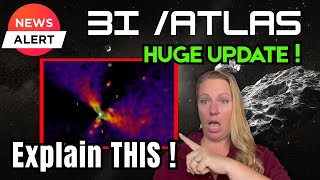
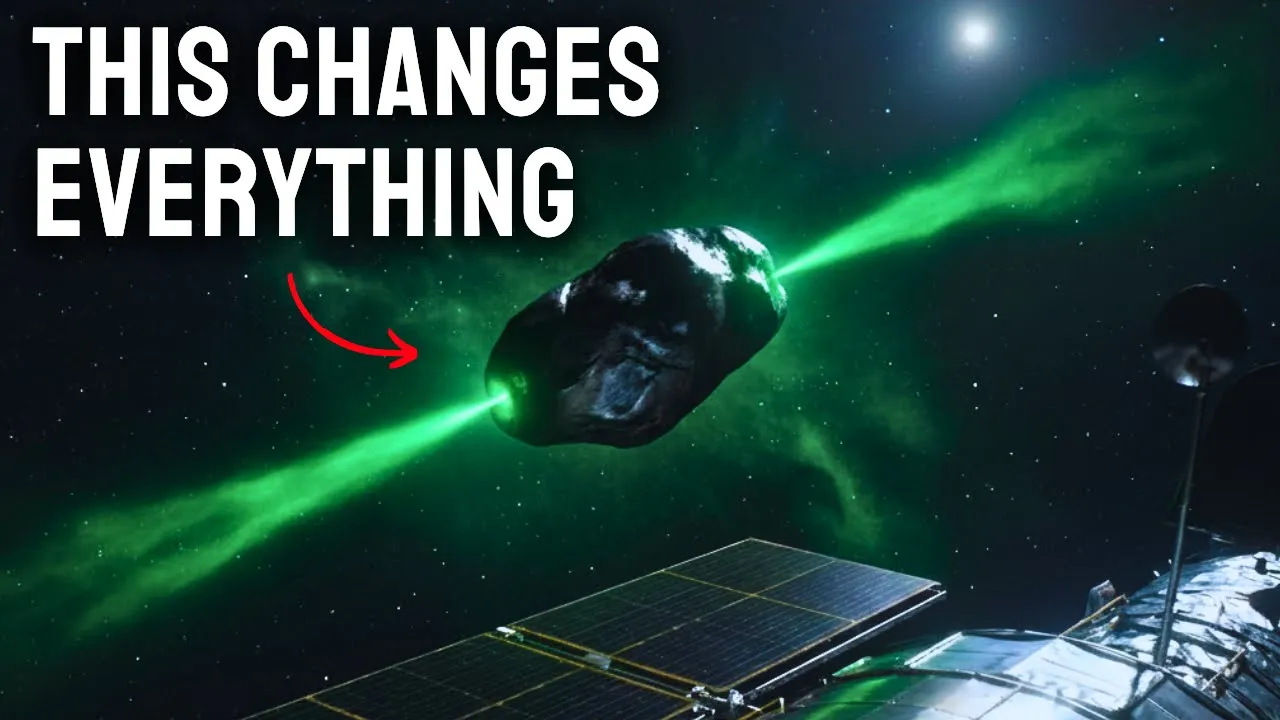
There is an object in our solar system right now that shouldn't exist according to the textbooks. This is Interstellar Visitor 3i Atlas. And here's the problem. Hubble just confirmed it was never actually a comet. Not in the way we thought. The jets are too symmetric. The chemistry is too wrong. The alignment with the sun defies probability in ways that make statisticians nervous. For months, NASA Called it an interstellar comet. But the data keeps refusing to cooperate with that story. So, if it's not a comet, what exactly have we been watching drift through our cosmic neighborhood?
Stay until the end because what the numbers are suggesting is going to make you question everything you thought you knew about objects traveling between the stars. And trust me, the implications are uncomfortable. If this interstellar mystery continues To grab your attention like it does mine, hit subscribe so you'll hear when the next observation drops. Comment below with where you're listening from, what time it is there, and whether you think the conservative explanation holds up, or if we're staring at something truly unprecedented. Part one, the announcement that shook the field. Picture this. You're scrolling through your
feed on a quiet Tuesday morning in July of 2025, and you see it. A headline So strange it makes you stop midsip of your coffee. Hubble confirms, "Mystery object may not be what we thought." You click. You read and suddenly the comfortable universe you thought you understood starts to crack at the edges. The object in question is threeey atlas and for months astronomers have been calling it an interstellar comet. Just another icy visitor from beyond our solar system. They said nothing to see here folks. Move along. But here's the thing about comets. They're predictable. They
follow rules. Ice heats up near the sun. Gas erupts. Dust follows. tail stream away from solar radiation like cosmic wind socks. It's physics 101, the kind of stuff we've understood since before your grandparents were born. Except Three Atlas doesn't play by those rules. When the Hubble Space Telescope turned its gaze toward this visitor in late July, scientists expected to see exactly what They'd seen a thousand times before. A fuzzy ball of ice and dust, maybe some jets pointing in predictable directions. A tail obediently streaming away from the sun. standard comet behavior, paint by numbers. But
what Hubble captured instead was something that made even seasoned astronomers pause and quietly mutter words you can't say on familyfriendly science channels. The images showed something strange. The dust distribution wasn't right. The Geometry of the jets, those plumes of gas and particles that shoot off the surface, they weren't following the script. And most bizarrely, there were features pointing toward the sun. Sunwood. Think about that for a second. Imagine standing in a hurricane and seeing the rain falling upward toward the storm. That's the level of wrong we're talking about here. Now, before you think this is
just Another clickbait alien story, let me be clear. The data is real. The observations are solid. Hubble doesn't lie, and neither does its younger, more sophisticated sibling, the James Web Space Telescope. These are the most advanced scientific instruments humanity has ever launched into space, and they're both telling us the same thing. Something about ThreeI Atlas doesn't add up. The scientific community is being cautiously diplomatic, as they should Be. NASA and the European Space Agency still officially classify this thing as a comet. They point to the hyperbolic orbit, the presence of a coma, the dust, all
comet-like features. And they're not wrong to be conservative. Science demands extraordinary evidence for extraordinary claims. And right now, we're in that uncomfortable zone where the evidence is extraordinary, but the claims are still being written. But here's where it gets interesting. And by Interesting, I mean the kind of interesting that keeps astronomers up at night staring at data spreadsheets at 3:00 in the morning. The jet structures aren't just unusual. They're showing a level of symmetry that natural processes rarely if ever produce. The chemical composition, as revealed by Web's infrared eyes, is unlike anything we've seen in
solar system comets. And the alignment, oh, the alignment. Some researchers are calculating odds That make winning the lottery look like a safe bet. Enter the controversial voices, the ones willing to say out loud what others are thinking quietly. Avi Lobe, the Harvard astrophysicist who became famous or infamous depending on who you ask for suggesting that Umaram Mua might have been artificial is now turning his attention to three-ey. He's not claiming little green men. Not exactly. But he is asking questions that make people uncomfortable. Questions Like, "What would we expect to see if an object weren't
entirely natural? And how would we know the difference?" The mainstream scientific establishment is pushing back as they should. Skepticism is the immune system of science, protecting it from infection by wild speculation and wishful thinking. They argue that unusual doesn't mean artificial, rare doesn't mean impossible, and just because we haven't seen something before doesn't mean it Can't be natural. These are all valid points, and they deserve serious consideration. But here's the thing that keeps nagging at me. The thing that makes this story so compelling. Every time we think we've seen everything the universe has to offer,
it throws us a curveball. Black holes were once theoretical impossibilities. Exoplanets were science fiction. The accelerating expansion of the universe made no sense until it did. The cosmos has a habit of being stranger than our best theories predict. So, what are we looking at here? Is 3i Atlas just a garden variety comet from another star system, one that happens to have some quirky features we haven't encountered before? Is it a new class of object entirely? Something that will force us to update our taxonomy of cosmic bodies? Or, and this is where things get really interesting,
is it something else Altogether? Something that challenges not just our models of comets, but our assumptions about what kinds of objects travel between the stars? The answer matters more than you might think. Because if this is just a comet, albe it a weird one, then it's a fascinating scientific puzzle that will teach us about conditions in other stellar systems. But if it's something more, if there's even a fraction of truth to the more speculative theories, then we're Not just updating textbooks. We're rewriting the entire conversation about our place in the universe. Over the next several
parts, we're going to dive deep into the data, the anomalies, the theories, and yes, even the wild speculation. We'll look at what Hubble and Web actually saw, what it means, and what it might mean. We'll hear from the believers and the skeptics, the mainstream and the fringe. And by the end, you'll have enough information to Decide for yourself what you think is happening here. But I'll warn you now, once you see what I'm about to show you, you might not look at the night sky the same way again. Part two, Hubble's latest imagery and morphologies.
The date was July 21st, 2025. And somewhere in low Earth orbit, the Hubble Space Telescope was doing what it does best, staring at things that don't make sense. Its target was Three Atlas. And the images it captured that day would become The foundation for everything that followed. Every argument, every theory, every late night debate in astronomy departments around the world would trace back to these observations. What Hubble saw was at first glance exactly what you'd expect from a comet. There was a nucleus, the solid core of the object, wrapped in a fuzzy cloud of dust
and gas called a coma. This cocoon of material is standard operating procedure for comets. When ice on the surface heats up From solar radiation, it doesn't melt. It sublimes, transforming directly from solid to gas, carrying dust particles along for the ride. The result is this diffuse envelope that makes comets look soft and blurry through telescopes like they're wrapped in cosmic cotton candy. But the devil, as they say, lives in the details. And the details here were devilish indeed. The shape of the dusk cocoon wasn't the usual spherical blob astronomers expect. Instead, Hubble Captured what researchers
described as a teardrop configuration with material distributed in a way that suggested something more complex than simple uniform outgassing. Imagine blowing up a balloon, but instead of it inflating evenly, it develops a distinct point, a directionality that seems to defy the symmetry you'd expect from random gas release. Then there were the jets. Oh, the jets. Every comet has them. They're fountains of gas and dust that erupt From active areas on the nucleus, typically spots where ice is exposed to sunlight. On a typical comet, these jets are chaotic, pointing in seemingly random directions determined by the
irregular shape of the nucleus and the random distribution of volatile ices. Their nature's graffiti, messy and unpredictable, but the jets on three eye atlas showed structure. Not the kind of structure you get from chaos, but the kind that makes you tilt Your head and wonder. Multiple jet features emerging from the nucleus in patterns that some observers described as suspiciously regular. Now, before you jump to conclusions, let me be clear. Natural processes can absolutely create patterns. Crystals form perfect hexagons. Snowflakes develop six-fold symmetry. Nature loves geometry when the conditions are right. The question is whether the
conditions were right here or whether we're seeing something that Falls outside the statistical norms of natural jet formation. And that's where things get murky because we're not just talking about one unusual feature. We're talking about multiple anomalies showing up simultaneously in the same object, which is where probability starts to get interesting. Researchers used Hubble's imaging to estimate the size of the nucleus, the solid heart of this object based on how much light it reflected and the Characteristics of the dust distribution. They calculated it to be somewhere between a few hundred meters and several km across.
That's a pretty wide range, admittedly, but it tells us we're not looking at a mountainized object or a grain of sand. We're talking about something substantial, big enough to have real mass, real gravity, real presence. What struck astronomers as particularly odd was the lack of a classic comet tale. You know the image, A bright head with a long flowing tail streaming away from the sun. The iconic look that's graced a million science textbooks and amateur astronomy photos. Three Atlas had dust. It had gas. It had activity. But the distribution wasn't cooperating with expectations. Some images
suggested material pointing in directions that didn't align with solar wind pressure or radiation pressure. The twin forces that normally sculpt comet tails into their Distinctive shapes. This is where the term antiale enters the conversation. And it's exactly what it sounds like, a tail pointing toward the sun instead of away from it. Now, anti-ales aren't impossible. They can happen under specific geometric conditions when dust particles lag behind the comet's orbit and create an optical illusion that looks like a sunwood tail. Astronomers have seen them before, but the ones on three eye atlas, if that's what they
Were, seemed more pronounced, more persistent than the fleeting phenomena typically observed. Hubble also captured evidence of what researchers called wobbling jets, structures that seem to shift and change over the observation period. This could indicate a nucleus rotating on an irregular axis, tumbling through space like a poorly thrown football. Irregular rotation is common in asteroids and comets, especially small ones, so this Alone wouldn't raise eyebrows. But combined with everything else, the jet wobble added another layer to an already complex picture. The dust distribution itself told a story. In normal comets, dust particles get pushed away from
the nucleus by gas pressure and then influenced by solar radiation, creating predictable patterns based on particle size and composition. Bigger particles fall closer to the nucleus. Smaller ones get pushed farther out, forming a Gradient that astronomers can model with reasonable accuracy. But the dust around 3i atlas wasn't following the textbook gradient. It was doing its own thing, distributed in ways that suggested either unusual particle properties or forces at play beyond the standard solar wind and radiation pressure model. Hubble's observations were comprehensive, but they had limits. The telescope operates primarily in visible and ultraviolet light, which
is Great for seeing dust and some gas species, but it can't penetrate the infrared where many important molecular signatures hide. That's where the James Webb Space Telescope would come in with its ability to see in wavelengths invisible to Hubble, revealing chemical secrets hidden in the infrared glow of the coma. But before we get to Web's findings, we need to sit with what Hubble showed us. An object that looks like a comet, acts sort of like a comet, But refuses to fully commit to the role. It's like watching an actor who knows all the lines, but
delivers them with just enough of an offbeat timing to make you wonder if they're improvising. The performance is close enough to be familiar, but different enough to be unsettling. And that unsettling feeling, that sense that something here doesn't quite fit, is exactly where the real investigation begins. Part three, the JWST spectral surprise, carbon dioxide Dominance. If Hubble gave us the portrait of three Atlas, the James Webb Space Telescope gave us the fingerprints, the chemical signature that might just crack this case wide open. And what a signature it is. When Web turned its infrared eyes toward
this mysterious visitor, it revealed something that made cosmic chemists do a double take. A coma dominated by carbon dioxide to a degree rarely, if ever, seen in cometry observations. Let me Explain why this matters. When we look at comets, we're essentially looking at time capsules from the early solar system. These dirty snowballs have been sitting in cold storage for billions of years, preserving the chemical conditions from when they formed. The standard recipe for a comet includes lots of water ice because water is abundant in space, plus a mix of other frozen gases like carbon monoxide,
methane, ammonia, and yes, carbon Dioxide. But the key word here is mix. Water typically dominates the show, making up the bulk of the volatile material. Three Atlas apparently didn't get the memo. Web spectroscopic observations showed a coma where carbon dioxide was the dominant species with a carbon dioxide to water ratio that ranked among the highest ever recorded. We're not talking about a slight preference here. We're talking about a chemical composition that flips the Script on what we consider normal for these objects. Now, before you assume this automatically means something sinister or artificial, let's pump the
brakes and consider what this could tell us about natural processes. The ratio of different ices in a comet depends heavily on where and when it formed. Objects that coales in the outer reaches of a stellar system, far from the warmth of their parent star, can retain more volatile compounds that would boil away Closer in. Carbon dioxide can freeze at slightly warmer temperatures than some other gases. So a body forming in a particular temperature regime might preferentially accumulate it. There's also the cosmic ray factor. Interstellar space is bathed in high energy radiation from exploding stars and
other violent cosmic events. These particles can slam into icy bodies, breaking chemical bonds, rearranging molecules, creating new compounds that wouldn't form under Normal conditions. Imagine leaving a block of ice in a particle accelerator for millions of years. You'd expect some chemical weirdness to emerge. An object traveling through interstellar space for who knows how long could accumulate chemical damage and modification that makes its composition stand out from solar system natives. But here's where it gets tricky. While cosmic ray processing is a real phenomenon wellstied and well understood, there are Limits to what it can explain. The
degree of carbon dioxide enrichment in 3i Atlas pushes against the boundaries of what current models predict. It's not impossible. Not by a long shot, but it's eyebrow raising enough that multiple research teams are furiously running simulations to see if they can reproduce the observations with natural processes alone. The spectroscopic technique web used is remarkably precise. Infrared light Reveals molecular vibrations, the ways different atoms jiggle and dance when they absorb energy. Each molecule has a unique vibrational fingerprint. Water molecules vibrate at specific frequencies, carbon dioxide at others, carbon monoxide at still others. By analyzing which frequencies
are absorbed or emitted by the coma, scientists can identify not just what's present, but in what proportions. It's like being able to determine the Exact recipe of a cake by analyzing the light bouncing off it. Impossible to do with your eyes, but straightforward with the right instruments. What Web saw in the infrared spectrum of 3i Atlas was a forest of carbon dioxide absorption lines, strong and clear with water signatures present but subdued. This wasn't a marginal detection or a tentative identification. This was a loud clear chemical statement. Carbon dioxide dominates this coma. The Question is
why? One interpretation suggests this object formed in an environment nothing like our solar systems comet factories. Maybe it came from a region where carbon dioxide ice was more readily available or where conditions favored its retention over water. Different stellar systems could have different chemical inventories based on their formation history, the composition of their parent molecular cloud, the Presence or absence of nearby supernovi dumping heavy elements into the mix. An interstellar comet could in theory have a completely different chemical makeup than anything native to our neighborhood. Another angle focuses on processing during the object's interstellar journey.
Radiation doesn't just randomly scramble molecules. It can drive specific chemical reactions. Cosmic rays slamming into water ice can split it into hydrogen and oxygen. And In certain conditions, these atoms might recombine with carbon to form carbon dioxide. Over millions of years, this could shift the balance of volatiles in the surface layers, enriching carbon dioxide at the expense of water. But some researchers are proposing something more radical. What if this isn't a traditional comet at all? What if it's a new category of object? Something that doesn't fit neatly into our asteroid or comet binary? We've already
had to expand our categories with objects like um MUA, which showed cometry activity, but lacked the classic coma. Maybe the universe is more diverse in its small body population than our solar system experience has led us to believe. The carbon dioxide dominance has implications beyond just chemical curiosity. It affects how we interpret the object's behavior. Carbon dioxide ice sublimes more readily than water ice At a given temperature, meaning the outgassing patterns could be different, more vigorous, potentially explaining some of the unusual jet activity. Different volatiles also mean different dust intrainment, which could influence the dust
distribution Hubble observed. Yet, despite all these possible natural explanations, the nagging question remains. Why is this particular object so different? Why, out of all the interstellar visitors we might detect, Did we get one with such an extreme chemical composition? Is it because objects like this are actually common and we just haven't had the tools to properly characterize them until now? Or is there something special about three eye atlas, something that makes it an outlier even among outliers? NASA and I issa scientists are being appropriately cautious in their language. They acknowledge the unusual chemistry. They're investigating
multiple Hypotheses, but they're not ready to declare this anything beyond a very interesting comet with a typical composition. And honestly, that's the right stance. Science proceeds by careful accumulation of evidence, not by jumping to sensational conclusions based on one weird data point. But the data point is weird. Compellingly, fascinatingly weird. And it's about to get weirder. Part four, mainstream counterpoint. NASA and ESR still call it A comet. Let's take a breath here and ground ourselves in what the official scientific establishment is actually saying about ThreeI Atlas. Because in the rush to explore anomalies and entertain
possibilities, it's crucial to remember that the people with the most expertise and the best data still classify this as a comet. Not a probe, not an artifact. Not a cosmic mystery beyond human comprehension. A comet. Unusual, yes. Interesting, absolutely, but fundamentally a natural object following natural laws. NASA's official statements on three Atlas describe it as an interstellar comet. emphasis on comet exhibiting activity consistent with volatile outgassing as it approaches the sun. They point to the hyperbolic orbit, the trajectory that brought it into our solar system from interstellar space and will eventually fling it back out
again. This orbital path is exactly what you'd Expect from an object that didn't originate in our solar system. One that's just passing through on a one-time visit, courtesy of gravitational interactions in its home system that gave it the velocity to escape. The European Space Agency echoes this assessment. Their scientists note the presence of a coma, the dust and gas envelope that is the defining characteristic of cometry activity. They observe jets which while unusual in Their configuration are still fundamentally explained by sublimation of volatile materials on the nuclear surface. The spectroscopic data showing carbon dioxide. Interesting
compositional variation they say but not incompatible with natural formation scenarios. This conservative approach isn't stubbornness or closed-mindedness. It's how science is supposed to work. You start with the simplest explanation that fits the data And you only move to more complex or exotic explanations when the simple ones definitively fail. This is Okam's razor in action. When you have competing hypotheses that both explain the observations, favor the one that requires fewer assumptions. A comet with unusual composition requires fewer assumptions than a technological artifact from an alien civilization. Let's address the anomalies one by one Through the mainstream
lens. The symmetric jets. Natural comets can absolutely produce multiple jets. And under certain conditions of rotation and surface topography, those jets can appear surprisingly regular. Imagine a potato-shaped nucleus rotating on a tilted axis with active ice patches distributed just so. At certain viewing angles and times, the jets could line up in ways that look geometric, even though they arise from purely randomized Distribution. Geometry emerging from chaos is ironically a very natural phenomenon. The anti-tail features pointing toward the sun also not unprecedented. When a comet's orbit brings it through the plane of the ecliptic, the dust
it's been shedding can create optical effects where older dust appears to be ahead of the comet or even pointing sunward. It's a perspective trick, a matter of where Earth is positioned relative to the Comet and its dust trail. Astronomers have documented anti going back decades. They're rare. They require specific geometry, but they happen naturally. The carbon dioxide dominance in the coma. This is where the mainstream argument gets more interesting because even the conservative scientists admit this is unusual. But unusual is not the same as impossible or unnatural. Our sample size of wellstudied interstellar objects is
exactly two umam mua and threei atlas. That's not exactly a robust statistical foundation for determining what's normal for interstellar visitors. Maybe high carbon dioxide ratios are common in objects from other stellar systems. Maybe we've just been spoiled by 4 billion years of looking exclusively at solar system comets and have mistaken our local chemistry for universal norms. The mainstream position also emphasizes what hasn't been detected. No radio signals, no optical flashes suggesting Artificial power sources, no spectroscopic signatures of industrial pollutants or refined materials, no trajectory corrections beyond what outgassing can explain. If this were a probe
or spacecraft, surely it would exhibit some unambiguous techno signature, something that couldn't possibly be explained by natural processes. The absence of such signatures is to the establishment strong evidence that we're looking at a Natural object. Scientists at NASA and EA also point out the dangers of premature speculation. Every time the astronomical community gets excited about a potential artificial object, be it pulsars in the 1960s thought to be alien beacons or mu more recently. The eventual explanation has been natural. The universe is under no obligation to be boring. But it also doesn't need to be populated
by alien artifacts to be interesting. Natural processes can and do produce outcomes that seem designed or purposeful when they're actually just following physical laws in complex ways. There's also the matter of observational bias. We notice things that are weird and we study them more intensely than normal objects. If threeey atlas were just another run-of-the-mill comet, it wouldn't be getting this level of scrutiny. The very fact that it's unusual means it Gets thousands of hours of telescope time, detailed spectroscopic analysis, and multiple research papers. A perfectly average comet would get a footnote in a catalog. So,
we're selecting for anomalies and then acting surprised when we find them. The scientific method demands that we test hypotheses against alternatives. The comet hypothesis is testable, falsifiable, and so far not falsified. It makes specific predictions about what We should see. Volatile outgassing, dust production, changes in activity related to solar distance, a composition broadly consistent with icy body formation. Three Atlas checks all these boxes, even if it checks them in unusual ways. But here's what bothers me and what bothers a growing number of researchers, even within the mainstream. At what point does a collection of unusual
features stop being quirky and start being genuinely anomalous? If one thing about this object were weird, fine. Outliers happen. If two things were odd, okay, that's interesting, but still within natural variation. But we're stacking up anomaly after anomaly. The jets, the composition, the dust distribution, the possible alignment features. At some point, the probability of all these unlikely things happening simultaneously in one object starts to strain credul. The mainstream response to this concern Is straightforward. We need more data. Much more data. Long-term observations to track behavior changes. Better spectroscopy to nail down exact compositions. Radar observations
if the object gets close enough. Infrared monitoring to detect thermal emissions until we have exhausted every possible natural explanation with comprehensive data. Jumping to exotic conclusions is premature at best and misleading at worst. And you know what? They're right. The burden of proof for extraordinary claims is extraordinarily high, and it should be. Science isn't about rushing to the most exciting conclusion. It's about arriving at the correct one through careful, systematic investigation. The fact that mainstream scientists are still calling this a comet doesn't mean they're being willfully blind. It means they're being appropriately skeptical, which is
exactly what we should want From the people entrusted with interpreting our observations of the cosmos. But skepticism cuts both ways. And it's fair to ask whether the same caution that prevents premature exotic conclusions might also slow recognition of genuinely unprecedented phenomena. That's the tightroppe walk of good science. Staying open enough to recognize the truly new while filtering out the noise of false alarms. The question is which side of that line does Threei Atlas fall on? And how will we know? Part five, where the standard model fails. So, we've heard the official line, the careful, measured,
scientifically responsible interpretation that says threeey atlas is just a comet with some quirks. And honestly, that might be exactly right. But science also demands that we examine where our models break down, where the predictions don't quite match the observations, because those gaps are Often where new understanding emerges. And there are gaps here, real, measurable gaps that deserve scrutiny. Let's start with the jets because they're the most visually dramatic anomaly. Standard comet physics tells us that jets form when solar radiation heats ice beneath dust layers on the nuclear surface. As the ice sublimes, pressure builds until
it breaks through, creating a fountain of gas and dust. The direction of these jets depends on Where the active patches are. And on a tumbling, irregular nucleus, you'd expect them to point in essentially random directions dictated by the body's shape and rotation. What researchers observed on threei Atlas doesn't quite match this random expectation. Multiple jets emerging at seemingly regular angular intervals, maintaining their structure over observation periods, showing a degree of organization that natural outgassing From an irregular body wouldn't typically produce. Now, I need to be careful here because seemingly regular is doing a lot of
work in that sentence. We're talking about interpretations of imaging data, not precise measurements with error bars, but multiple independent observers have noted the unusual geometry. Could rotation explain this? Maybe. If the nucleus is spinning on a specific axis, and if the active ice patches happen to Be distributed symmetrically, and if the viewing geometry from Earth happens to align just right, then yes, you could get jets that appear organized. But that's a lot of ifs. Each one is plausible individually, but stacking coincidences is where probability starts to push back. Then there's the axis alignment question, and
this is where things get statistically murky. Some analysts claim that the orientation of three Atlas's rotational axis shows Improbable alignment with its trajectory or with the sun. If true, this would be bizarre because there's no obvious mechanism for such alignment to occur naturally. Angular momentum doesn't care about your velocity vector or solar direction. A tumbling comet should tumble in whatever orientation its formation and subsequent collisions left it with. The counterargument is that we're cherrypicking alignment from noise with enough parameters to measure and Enough ways to define alignment. You can always find something that looks meaningful
if you torture the data enough. This is a real concern in any field dealing with complex observations. Human brains are pattern-seeking machines, and we'll find structure even in randomness if we look hard enough. But let's talk about the dust distribution because that's where the observations get really hard to reconcile with standard models. Comet Dust is supposed to follow predictable patterns based on particle size, composition, and the forces acting on it. Solar radiation pressure pushes small particles faster than big ones, creating a size sorted distribution. Gravity from the comet pulls everything toward the nucleus. Solar wind
adds another layer of influence. Put it all together and you get equations that describe how dust should spread out in space. Three atlases dust doesn't seem To be reading from that playbook. The distribution observed by Hubble showed features that don't match the standard models predictions. Some researchers suggest the dust is clumping or streaming in ways that require additional forces or unusual particle properties. Others argue the observations are being misinterpreted, that what looks like anomalous distribution is actually normal distribution viewed under unusual Geometric conditions. Here's where I need to acknowledge my own limitations. I'm not a
professional astronomer and I don't have access to the raw data or the sophisticated models these researchers are running. I'm synthesizing what's been published and what experts are debating, trying to give you a fair picture of where the uncertainty lies. And there is uncertainty, real substantive uncertainty about whether the observations can be fully explained By conventional comet physics or whether something additional is needed. The energy budget is another point of contention. When a comet outgasses, it loses energy. That energy comes from solar heating converting ice to gas. You can calculate how much energy is available based
on solar flux, surface area, and ice composition. You can then calculate how much gas and dust that energy can drive off the surface. The numbers should balance. Input equals Output. Thermodynamics doesn't take vacation days. Some analyses of 3II Atlas suggest the observed activity level is inconsistent with the energy budget you'd expect from solar heating alone, especially given its distance from the sun and the unusual composition. If true, this would imply either an additional energy source, which is problematic for a natural body, or errors in how we're estimating the activity level or energy input. Neither option
is comfortable. Of course, there are ways to patch these problems. Maybe the surface has unusual reflective properties that concentrate heat. Maybe there's residual internal heat from radioactive decay. Maybe subsurface ice reservoirs are releasing stored energy. Each patch makes the model more complex, adds more free parameters, and reduces the predictive power. At some point, you're not explaining the data so much as Accommodating it with increasingly barack adjustments. Polarization measurements add another wrinkle. Light scattered by dust becomes polarized, and the degree of polarization tells you about the dust particle size and composition. The polarization observations of ThreeI
Atlas apparently show variations that some interpret as anomalous. Again, the mainstream push back is that polarization is complicated, depends on viewing Geometry, and can be tricky to interpret definitively, but it's another data point that doesn't quite fit the standard picture. The brightness variations over time are also puzzling. Comets typically get brighter as they approach the sun and dimmer as they recede, following a predictable curve based on increased activity from solar heating. Three atlas showed brightness changes that some observers say don't match this expected curve. Could be rotation bringing different surface features into view. Could be
a regular outgassing. Could be normal commentary behavior that looks weird because of incomplete observations. Or could be something else. What frustrates me about this whole situation is the lack of definitive answers. We're drowning in may and could be and possibles. Every anomaly has a potential natural explanation, but none of the explanations are slam dunks. It's like a Court case where the prosecution has circumstantial evidence piled to the ceiling, but each piece individually could be explained away. The question is whether the cumulative weight of all these anomalies taken together pushes the probability of the standard model
below acceptable thresholds. Different researchers will answer that question differently based on their prior expectations, their tolerance for uncertainty, and their philosophical Stance on when to abandon established models. The conservatives say the standard model is flexible enough to accommodate these observations with minor adjustments. The radicals say we're seeing something genuinely new that requires new physics or new categories. And the truth, as is often the case, probably lies somewhere in the messy middle. But here's what we can say for certain. Three Atlas is pushing our models. It's testing the limits of what Standard comet physics can explain.
and whether it ultimately stays within those boundaries or breaks through them. It's forcing astronomers to think more carefully about what they actually know versus what they've assumed. And that regardless of the final verdict on this object is scientifically valuable. The question is, what happens when you keep pushing? When do bends become breaks? Part six, jet symmetry and rotation geometry, natural or engineered. All Right, let's get specific about the weirdest feature of 3i Atlas. The thing that makes even skeptical astronomers pause and stare at their screens a bit longer than usual, the jets. Not just that
they exist, but how they're arranged, how they behave, and what that might mean if you're willing to entertain uncomfortable possibilities. Imagine you're looking at a comet through a powerful telescope. You expect to see chaos. These are lumpy, irregular Chunks of ice and rock that have been battered by billions of years of cosmic collisions. Their surfaces are pockmarked, cratered, asymmetric. When sunlight hits and ice starts subliming, gas erupts from wherever ice happens to be exposed. Maybe there's a jet coming off what looks like the North Pole, another from a crater on the equator, a third from
some random spot on the southern hemisphere. There's no organization, no pattern. It's geology and thermodynamics having a messy conversation. But what if instead of that expected chaos, you saw three jets emerging from the nucleus at roughly equal intervals, 120°, 140°, 260°, spaced like they were planned, like someone sat down with a protractor and said, "Let's put the vents here, here, and here for optimal distribution." That would be weird, right? That would make you wonder whether what you're looking At is entirely natural. Now, before the engineers in the audience start sending me angry emails, let me
be clear about what we actually know versus what people are speculating. The reports of perfect jet symmetry and three atlas are not universally accepted. Different observation teams see different things depending on when they observed from what angle and with what instruments. Some see clear triple jet structures, others see more chaotic emission. The Data is messy, which is astronomy's default state. But let's play this out. Suppose for a moment that the symmetry is real, that we're genuinely seeing jets arranged in an organized pattern. How do we explain that naturally? Well, crystals do it all the time.
Water freezing into snowflakes produces six-fold symmetry from random molecular interactions following physical laws. Basalt columns form hexagonal patterns when lava cools. Nature loves symmetry When the conditions favor it. For a comet nucleus to produce symmetric jets naturally, you'd need symmetric distribution of volatile ices, which could happen if the body formed under conditions where ice deposition was uniform. You'd need the rotation axis aligned just so, which is just a matter of angular momentum. You'd need surface features that channeled out gasing in specific directions, which topography could provide. Stack enough compatible Conditions together, and sure, you could
get organized jets naturally. But here's the catch. Each of those conditions is somewhat unlikely on its own. Ice distribution on most comets is anything but uniform. Rotation axis point in random directions. Surface topography is chaotic. Getting all of these factors to line up just right in one object is possible, but improbable. And improbable isn't impossible, but it makes you wonder whether there's a better Explanation. The alternative, the elephant in the room that everyone's thinking about, but most scientists won't say out loud, is that the jet symmetry isn't accidental, that it's functional. That if you were
designing something to move through space using controlled gas emissions, you'd want symmetric thrust vectors to maintain stability and predictable trajectory. You'd place your vents at regular intervals to avoid Tumbling. You'd orient them to produce the desired acceleration without wasting fuel on random directions. I want to be absolutely clear here. I am not claiming ThreeI Atlas is a spacecraft. I'm not even suggesting it probably is. What I'm doing is laying out the logic chain that makes some researchers, including respected scientists with decades of experience, willing to at least consider the possibility as a hypothesis worth investigating
rather than dismissing out Of hand. The rotation geometry adds another layer to this puzzle. Objects in space rotate because of how they formed and whatever collisions they've experienced. That rotation should be stable and less disturbed by external forces. But some observations suggest three atlas might be rotating in ways that seem unusually stable or oriented relative to its trajectory. Again, this could be confirmation bias, seeing patterns in noise, or it could be A clue. Let's use an analogy. Imagine you find a rock on the beach. is roundish but irregular, clearly shaped by waves and time. Natural,
no question. Now, imagine you find a rock that's almost perfectly spherical, polished smooth with what looks like regularly spaced indentations around its equator. Still could be natural, weird erosion, strange mineral composition. Who knows? But your brain would start asking questions. You'd want to look closer. You'd want to rule out human manufacturer before concluding it's a geological fluke. That's where we are with ThreeI Atlas. The jet patterns could be geological flukes, cosmic coincidences, the result of specific but entirely natural formation conditions. And probably most likely they are. But the pattern is geometric enough, regular enough that
it triggers our pattern recognition systems, makes us want to look closer, makes us reluctant to just Shrug and move on. Some researchers have calculated the probability of randomized distribution producing the observed symmetry. These calculations are fraught with assumptions many of which can be challenged but they generally come up with small numbers not astronomically small not winning the lottery small but small enough to notice one in a 100 type odds maybe one in a thousand depending on the model which brings up the frequency argument. If the odds are one In a thousand and we've observed thousands
of comets, then seeing one with unusual symmetry is exactly what we'd expect. Rare events happen. That's what rare means. It doesn't mean impossible. It doesn't mean artificial. It just means most of the time you don't see it, but sometimes you do. The counterargument focuses on the cumulative probability. Sure, symmetric jets might be one in a thousand, but symmetric jets plus unusual composition Plus odd dust distribution plus brightness anomalies plus trajectory alignment. Multiply those probabilities together and suddenly you're in much rarer territory. You're going from we'd expect to see this eventually to this is genuinely surprising.
Of course, you can also argue that we're cherrypicking anomalies and multiplying probabilities inappropriately. Not every unusual feature is independent. Some might arise from the same underlying cause. And if You look at any object closely enough, you'll find things that seem improbable after the fact. This is the problem with posterior probability. Everything that happened was unlikely before it happened. Specificity creates the illusion of impossibility. So where does that leave us? with jets that are either natural and unusual or possibly indicating something worth investigating further with rotation that's either normal and we're over interpreting it or Aligned
in ways that deserve explanation with geometry that's either coincidental or meaningful and we don't yet have enough data to definitively say which I can tell you is that professional astronomers are taking this seriously. Multiple research groups are running detailed simulations trying to reproduce the observed jet patterns with natural processes. They're testing different nuclear shapes, different ice distributions, different rotation States. If they can find a model that naturally produces what we see, that would be powerful evidence for the conventional interpretation. If they can't, well, that's when things get really interesting. And interesting in astronomy often means
uncomfortable. Part seven, rare metal and molecular signatures. Now, we need to talk about the chemistry because if the physical behavior of threei atlas is raising eyebrows, the chemical composition is Making some researchers heads explode. We've already discussed the carbon dioxide dominance, which is weird but potentially explainable. But that's just the beginning of the chemical story. There are reports, preliminary and contested, of molecular signatures that have no business being in a normal comet. And chief among these is nickel tetracarbon. For those who slept through chemistry class, nickel tetracarbonel is exactly what it sounds like. One nickel
Atom bonded to four carbon monoxide molecules. It's a nasty piece of work. Highly toxic, volatile at relatively low temperatures. And here's the kicker. It almost never shows up in nature. On Earth, it's primarily known as an industrial compound used in nickel refining and as a catalyst in certain chemical processes. Finding it in space, especially in a comet, would be like discovering a plastic bottle on Mars. Possible, maybe, expected, absolutely Not. The detection reports come from spectroscopic analysis by amateur astronomers and a few professional teams who noticed unusual absorption lines in the object's spectrum that don't
match common cometry molecules. When they ran the lines through spectral databases, nickel tetracarbonil came up as a possible match. Now, and this is crucial, these detections are not confirmed by mainstream facilities. They're preliminary based on limited Data and subject to alternative interpretations. Spectral lines can overlap. Instruments can have artifacts and confirmation bias can make you see what you expect to find. But let's suppose, just for argument sake, that the detection is real. How the hell does nickel tetracarbonel end up in an interstellar comet? Well, you need nickel, which is common enough in meteorites and cosmic
dust. You need carbon monoxide, which is abundant in Molecular clouds. Bring them together under the right temperature and pressure conditions. Add a dash of catalytic surface chemistry, and theoretically, you could synthesize nickel tetracarbon in space. It's not impossible. Astrochemistry has produced stranger molecules in laboratory simulations of interstellar conditions. The problem is that nickel tetracarbonel is unstable. It breaks down under ultraviolet radiation which space has in abundance. It decomposes at relatively warm temperatures which an object approaching the sun would experience. For it to survive in detectable quantities would require either continuous production which implies active chemistry
happening on or in the nucleus or storage in protected reservoirs that only recently opened up. Both scenarios are plausible but add complexity to an already complicated picture. Other unusual molecular detections have been reported. Methanol, hydrogen cyanide, formaldahhide. Individually, none of these are shocking. All have been found in comets before, and all are products of ice chemistry in cold, dark environments. But the proportions are off. The ratios don't match what solar system comets show. It's like tasting a familiar dish, but the spices are all wrong. Recognizable ingredients in an unfamiliar recipe. Methanol, for Instance, is often
used as a tracer for certain formation conditions. High methanol relative to water suggests ice processing in very cold environments, possibly in interstellar clouds before the comet ever joined a stellar system. 3i Atlas shows elevated methanol, which fits the narrative of an object that spent eons drifting between stars, soaking up molecular cloud chemistry. Hydrogen cyanide is another interesting case. It's a key component in prebiotic Chemistry, one of the building blocks that might have seeded early Earth with the ingredients for life. Finding it in an interstellar visitor would support theories that life's precursors came from space, delivered
by impacts. It would also tell us that the chemical conditions for life might be common across the galaxy, not unique to our solar system. But here's where the fringe theories start creeping in. If you're looking for evidence of Artificial origin, unusual chemistry could be interpreted as contamination from industrial processes or fuel residues. Nickel tetracarbonal, after all, is used in certain types of chemical propulsion systems and refining operations. If you are a civilization trying to move a large object through space using sublimation based thrust, you might specific chemical compositions to optimize performance. You might include metals
for structural strength Or catalytic properties. I need to stop right here and emphasize this is speculation piled on speculation built on a foundation of unconfirmed observations. We have no credible evidence that three atlas is artificial. None. What we have are unusual chemical signatures that might point to exotic natural processes or might be artifacts of observation or might require us to expand our understanding of interstellar chemistry. The water detection is worth mentioning because it complicates the narrative. Early analyses suggested minimal water which fed the whole this is weird story. But subsequent observations with different instruments found
water signatures in the ultraviolet suggesting water is present just not dominant. This is actually reassuring for the natural interpretation because a complete absence of water would be truly bizarre for an icy body. Water is everywhere in Space. Finding an object with ice but no water would be like finding sand with no silicon. The chemistry debate highlights a fundamental challenge in studying these objects. We're trying to understand complex dynamic systems using snapshots and limited data. Imagine trying to figure out what's in someone's kitchen by smelling the air from their driveway. You might catch a whiff of
garlic, a hint of coffee, maybe something burning. But reconstructing the full inventory, knowing exactly what's cooking, that requires getting inside, which we can't do with an object millions of kilome away moving at interstellar velocities. Spectroscopy is incredibly powerful, but it has limits. You only see what's in the gas phase, what's subliming or being ejected from the surface. The bulk composition of the nucleus, the deep interior chemistry remains hidden. surface processes, solar radiation, and Interaction with the solar wind can all modify the coma chemistry, making it unrepresentative of the object's original composition. It's like trying to
understand a book by reading the dust jacket. You'll get clues, but you might miss the actual story. Different research teams are approaching this chemical mystery from different angles. Some are running laboratory experiments, trying to recreate interstellar chemistry conditions and see what Molecules emerge. Others are developing models of how cosmic ray processing affects ice chemistry over millions of years. Still others are searching for similar signatures in other interstellar objects, trying to determine if threeey atlas is unique or part of a population. What nobody wants to say out loud, but everybody's thinking is that unusual chemistry could
be the smoking gun. Not for alien technology necessarily, but for something genuinely new in our Understanding of cosmic chemistry. Maybe there are formation environments we haven't considered. Maybe interstellar processing creates chemical compositions we thought impossible. Maybe the galaxy is chemically more diverse than our parochial solar system experience suggests. Or maybe, just maybe, we're looking at something that didn't form naturally at all. But proving that would require extraordinary evidence. And so far, all we have are intriguing hints And uncomfortable questions. The chemistry of Threeey Atlas is strange, no doubt. Whether it's naturally strange or artificially strange
remains one of the great unanswered questions of this whole affair and the uncertainty frankly is the most scientifically honest position we can take right now. Part 8 fringe and academic speculation spectrum. Let me take you on a journey across the full landscape of interpretations for ThreeI Atlas from The scientifically mainstream to the wildly speculative because understanding this object requires acknowledging the entire spectrum of possibilities, even the uncomfortable ones. And I promise to be clear about where established science ends and imaginative conjecture begins because conflating the two is how we end up with headlines that mislead
rather than inform. At the most conservative end of the spectrum sits the hypothesis that three Atlas is exactly what NASA says it is. A natural interstellar comet with some unusual but ultimately explainable features. This interpretation requires the least number of new assumptions. Comets exist. Interstellar objects exist. Unusual chemistry exists. Put them together and you get threeey atlas. End of story. Back to cataloging exoplanets. Moving slightly toward the exotic, we encounter the idea that this is a Natural object, but one that represents a new category we haven't seen before. Maybe it's a hybrid body, part asteroid,
part comet, formed in conditions between the ice rich outer regions and rocky inner regions of another stellar system. Maybe it's a fragment of a larger body destroyed by collision, explaining the unusual composition through selective vaporization during impact. Maybe it's a captured rogue planet or moon that got booted from its original system and Spent billions of years being processed by cosmic rays. All natural, all within known physics, just requiring us to expand our taxonomy. Then there's the cosmic ray processing hypothesis, which takes center stage in several academic papers. This idea suggests that ThreeI Atlas spent an
extraordinarily long time in interstellar space, potentially tens or hundreds of millions of years, being bombarded by high energy particles from supernova remnants and active galactic Nuclei. This radiation could drive exotic chemistry, alter isotopic ratios, create unusual molecular species, and modify surface properties in ways that make the object look different from solar system natives that haven't experienced such prolonged exposure. It's natural. It's physics we understand. It just requires an extreme environment and extreme duration. Now, we start sliding toward the speculative fringe, but still within The realm of astrophysical plausibility. Some researchers propose that Threeey Atlas could
be a fragment of a pulsar planet, one of those bizarre worlds that orbit the remnants of exploded stars. These environments are bathed in intense radiation and magnetic fields, which could produce truly alien chemistry and physical properties. If such a fragment got ejected and wandered into our solar system, it might look like nothing we've ever encountered. Natural? Yes. Normal? Absolutely not. Another fascinating hypothesis suggests electromagnetic interactions with the solar wind could explain some of the unusual behavior. Charged dust particles, magnetic fields frozen into the nucleus, plasma sheets forming around the coma. All these could create forces
and effects beyond simple gravity and outgassing. We've seen hints of electromagnetic phenomena in comets before, but usually subtle. If threeey atlas has particularly strong Electromagnetic properties either from composition or from charged particle accumulation during its interstellar journey that could manifest as unusual jets, unexpected accelerations or aberrant dust distribution. Still natural, still physics, just electromagnetics rather than pure mechanics and thermodynamics. And now, dear viewer, we arrive at the territory where scientific caution gives way to provocative speculation. This is Where figures like Avi operate. And love him or hate him, you can't deny he asks interesting questions.
Lo and other adventurous thinkers have proposed that we should at least consider the possibility that Threeey Atlas exhibits features consistent with artificial origin or modification. Not definitely artificial, not probably artificial, but consistent enough that dismissing the idea without investigation would be intellectually lazy. What would Artificial look like? Well, if you were a technologically advanced civilization trying to move a large object through interstellar space, you'd face certain engineering challenges. You'd need propulsion, which could come from controlled outgassing, essentially using the object itself as fuel. You'd need stability, which requires symmetric thrust. You'd need navigation, which might
involve orientational control. You'd probably use readily available Materials, which means ice and rock, the abundant components of any stellar systems debris. The result might look a lot like a comet, but with subtle regularities that natural chaos doesn't typically produce. This hypothesis doesn't require little green men piloting the object. It doesn't require faster than light travel or physics defying technologies. It just requires engineering applied to cosmic scale problem solving. Moving asteroids or Comets is something we humans are already contemplating for planetary defense and resource extraction. A civilization a million years older than us might have turned
such operations into routine infrastructure maintenance. Of course, this raises the question, why? Why would anyone send a modified comet through interstellar space, probe, mission, waste disposal, accident, deliberate seeding of stellar systems with life's building blocks? The Motivations of a hypothetical alien civilization are by definition speculative. We can't even agree on why humans do half the things we do, let alone guess at alien intent. The most extreme interpretations veer into territory. That's more philosophy than science. Some suggest three Atlas could be a Bracewell probe, a self-replicating artificial object designed to explore the galaxy over millions of
years, using encountered materials to repair and Duplicate itself. Others propose it's a derelict, the abandoned remnant of failed technology drifting through space like the cosmic equivalent of ghost ships in Earth's oceans. These ideas are unfalsifiable with current data, which makes them poor science, but excellent science fiction. What's important to understand is that the spectrum from conservative to fringe isn't a spectrum from smart to dumb or rigorous to sloppy. It's a spectrum of epistemic Risk tolerance. Conservative interpretations minimize the risk of being wrong by sticking close to established knowledge. Speculative interpretations accept higher risk of error
in exchange for potentially revolutionary insights. Both approaches are valid. Both serve purposes in the scientific ecosystem. The mistake would be treating all positions on this spectrum as equally likely or equally evidenced. They're not. The natural Comet hypothesis has vastly more supporting evidence and requires fewer leaps of logic than the artificial probe hypothesis. But minority positions aren't automatically wrong just because they're minority positions. Science has a history of initially rejected ideas that later became orthodoxy. Plate tectonics, helioentrism, quantum mechanics all faced fierce resistance before acceptance. So where does 3i Atlas actually fall on this Spectrum? Honestly,
we don't know yet. The data is insufficient. The observations incomplete. The model's uncertain. What we can say is that this object has properties that push it toward the unusual end of the natural range, making it worth careful study, regardless of whether it's ultimately explained by known processes or requires new categories. The worst thing we could do is stop asking questions. The second worst thing Would be to confuse questions with answers or speculation with conclusion. Threeey atlas is a question mark flying through our solar system and how we investigate that question will say as much about
us as the eventual answer says about the object itself. Part n highprofile advocates and critics. Let's talk about the people behind this debate. Because science isn't just data and equations. It's humans arguing about interpretations, defending positions, Challenging assumptions, and occasionally throwing academic shade at each other in peer-reviewed journals. And few figures in astronomy inspire as much passionate response, both positive and negative, as Avi Loe. Lo is a professor at Harvard, former chair of the astronomy department, prolific researcher with hundreds of publications, and more recently the public face of the maybe it's aliens hypothesis for unusual
astronomical Objects. He was the primary advocate for considering that Uma Mua, the first confirmed interstellar object detected in our solar system, might be artificial rather than natural. That stance earned him widespread media attention, a book deal, a lot of criticism from colleagues, and a reputation as either a visionary willing to ask uncomfortable questions or a publicity-seeking contrarian undermining scientific rigor depending on who you Ask. Now, Loe has turned his attention to ThreeI Atlas, and he's doing what he does best, pointing out features that don't quite fit standard models and suggesting we shouldn't dismiss exotic explanations
without serious investigation. In statements and writings about this object, he's highlighted what he sees as eight specific observations that in his view are difficult to reconcile with natural comet behavior. These include The trajectory alignment, the unusual tail geometry, the symmetric jet patterns, the chemical composition anomalies, and several others. Lo's argument isn't this is definitely artificial. His argument is this is anomalous enough that we should seriously investigate the artificial hypothesis rather than assuming it must be natural. It's a subtle but important distinction. He's advocating for a particular approach to anomaly. Take it Seriously. Study it rigorously.
Don't let preconceived notions about what's possible prevent you from considering what the data might actually be showing. His critics, and there are many, argue that Loe is systematically underestimating the flexibility of natural processes and overinterpreting sparse data. They point out that every one of his eight observations has potential natural explanations, even if those explanations require somewhat Unusual, but not impossible conditions. They note that by cherrypicking the most anomalous features and ignoring the many ways three Atlas behaves like a normal comet, you can construct a misleading narrative. Some of the push back gets personal. There are
whispers in the astronomical community about attention seeking, about sacrificing scientific credibility for media coverage, about setting a bad example for younger researchers by legitimizing speculation That borders on pseudocience. Other scientists have publicly stated that giving oxygen to the artificial hypothesis without extraordinary evidence is irresponsible, potentially undermining public trust in science and encouraging conspiracy thinking. But Lo has defenders, too. Researchers who argue that science needs people willing to challenge consensus, who point out that history is full of dismissed ideas that later proved Correct. Who suggest that the harshness of the criticism says more about the field's
conservative bias than about Loe's arguments. They note that he's not claiming certainty, just advocating for serious investigation of a possibility that most researchers dismiss reflexively rather than analytically. The institutional response from NASA and ESA has been measured but firm. Both agencies maintain that their analysis of threei atlas is consistent with natural Origin, that no techno signatures have been detected, and that while the object has unusual features, unusual is not synonymous with artificial. They've issued statements clarifying that speculation about artificial origin is not supported by their data analysis and that the scientific consensus remains firmly in
the natural comic camp. Several prominent astronomers have published rebuttals to the artificial hypothesis, systematically addressing Each claimed anomaly and providing natural explanations. These papers are dense with mathematics filled with error analysis and probability calculations and they generally conclude that while threei atlas is interesting, it doesn't require invoking anything beyond known astrophysical processes to explain the debate plays out not just in journals but in media interviews, conference presentations, Twitter threads and blog posts. It's science as contact sport With competing interpretations battling for mind share in both the professional community and public imagination. And like most scientific
controversies, it's not purely about the evidence. It's also about philosophy, about what counts as good science, about the balance between skepticism and openness to new ideas. One thing both sides agree on, we need better data. more observations, longer baseline, higher resolution imaging, detailed spectroscopy across Multiple wavelengths. If 3II atlas were truly artificial, continued monitoring should reveal techno signatures that natural processes can't mimic. If it's natural, better data should clarify which natural processes explain the observations and put the exotic hypotheses to rest. The problem is that three atlas is now receding from the sun, getting dimmer,
harder to observe. The window for detailed study is closing. Some astronomers are scrambling To secure more telescope time before the object fades beyond detection. Others argue that resources would be better spent on objects with higher scientific priority. There's a real tension between the impulse to chase every anomaly and the practical reality of limited observational resources. What fascinates me about this debate isn't just the science, it's the sociology. The way careers and reputations get tied up in interpretations. The way institutional positions become entrenched, the way public communication affects scientific discourse. Lo's high media profile means his
ideas reach far beyond the professional astronomy community, which some see as valuable science communication, and others see as irresponsible sensationalism. There's also a generational dimension. Older, more established astronomers tend toward conservative interpretations, having seen dozens of anomalies over Their careers that all turned out to be mundane once better understood. Younger researchers, less invested in existing paradigms, might be more open to radical reinterpretation. But that's a generalization, and reality is messier than generational stereotypes. The critics aren't wrong to demand high standards of evidence before accepting extraordinary claims. That's how science prevents itself from chasing every wild
idea that sounds Exciting but lacks substance. The advocates aren't wrong to push against premature closure to insist that unusual observations deserve unusual scrutiny. Both impulses are necessary for healthy science. What worries me is when the debate becomes more about personalities than evidence. When disagreement hardens into dismissiveness, when asking certain questions becomes professionally risky. Science works best when it maintains a balance, rigorous in evaluating claims, But open to being surprised. That balance is hard to achieve, especially when media attention and public interest create pressures beyond the usual academic dynamics. So where does this leave us? with
a fascinating object, incomplete data, competing interpretations, and passionate advocates on multiple sides. With institutional positions that may or may not be influenced by conservative bias, with a public trying to understand What's actually known versus what's speculated, and with the reality that science is a human endeavor shaped by social dynamics as much as by pure logic. The truth about ThreeI Atlas will ultimately emerge from continued observation and analysis, not from who argues most forcefully or who has more media appearances. But until that truth emerges, the debate itself tells us something valuable about how science Grapples with
the genuinely unexpected. And maybe, just maybe, it reminds us that the universe doesn't care about our consensus positions or our comfort zones. It just is what it is, whether that fits our expectations or not. Part 10. Statistical and mathematical paradoxes. Numbers don't lie, but they can definitely mislead. And nowhere is this more apparent than in the statistical argument swirling around three eye atlas. We need to talk about Probability about what makes something statistically significant versus statistically suspicious because this is where the rubber meets the road in evaluating whether this object is genuinely anomalous or just
an expected outlier from natural variation. Let's start with the basics. When astronomers study populations of objects, comets, asteroids, stars, they build statistical models of what's normal. What's the typical range of compositions? How do Rotation rates distribute? What geometries appear most frequently? These models let us identify outliers, objects that fall outside the expected range. And outliers are interesting because they might represent new physics, measurement errors, or just the extreme tale of normal variation. Three eye atlas is an outlier. That much isn't disputed. The question is whether it's a surprising outlier or an expected one and that
depends entirely on how you Calculate the probabilities, what assumptions you build into your models, and how you account for selection bias and multiple comparisons. Take the jet symmetry for example. If you model jet formation as a random process where active areas emerge randomly on the surface and point in random directions, what are the odds of getting three jets spaced at roughly equal intervals? Well, you need to specify how precisely equal means within 5°, 10°, 20. The tighter your requirement, the lower the probability. Some calculations suggest odds of 1 in several hundred for near-perfect triple symmetry.
Others using looser criteria get odds closer to one in 50. Now, is one in 50 rare? In everyday life, yes. But in astronomy, where we've observed thousands of comets and can potentially detect millions more, one in 50 means we'd expect to see this occasionally. It's like being surprised that someone in your city won The lottery, even though statistically someone somewhere wins every week. Rare for any individual object, but not rare for the population. But here's where it gets complicated. The symmetric jets aren't the only unusual feature. There's also the composition anomaly. The carbon dioxide dominance
that places three eye atlas in the extreme tale of observed cometry chemistry. Let's say that's another one in 100 probability. And the unusual dust Distribution maybe one in 50. And the trajectory alignment potentially one in several hundred depending on how you define alignment. If these features are independent, you multiply the probabilities. 1 in 50 times 1 in 100 times 1 in 50* 1 in several hundred gives you odds in the millions. Suddenly, you're looking at a combination of features so unlikely that seeing it in one object strains credibility for the natural hypothesis. But that multiplication
assumes independence. And that's a massive assumption. Many of these features might be causally related, different manifestations of the same underlying condition. And for instance, unusual composition might drive unusual outgassing patterns, which creates unusual dust distribution, which affects how we perceive jet geometry. If that's the case, you can't multiply the probabilities because They're not independent events. You're essentially counting the same anomaly multiple times. This is the multiple comparisons problem and it's a notorious source of statistical deception. If you measure 100 different parameters on an object and find that one of them is unusual at the one
in 100 level, that's exactly what you'd expect from random chance. Finding something unusual when you're looking for anything unusual isn't impressive. What would be Impressive is predicting in advance which specific parameter would be unusual and then finding it. Critics of the exotic hypothesis argue that this is exactly what's happening with three eye atlas. Researchers are measuring every conceivable parameter, finding a few that happen to be unusual and then retroactively claiming that this combination is too unlikely to be natural. It's like shooting an arrow at a barn and then painting a bullseye Around wherever it landed.
You can always find the target if you draw it after the shot. The counterargument is that we're not just finding random unusual parameters. We're finding features that specifically cluster around a coherent alternative hypothesis, artificial origin, or at least highly unusual formation conditions. The anomalies aren't scattered randomly across all possible measurements. They're concentrated in Areas that would matter if this were an engineered object. That pattern within the anomalies is itself statistically meaningful. But even that argument has problems. Human brains are pattern matching machines. We see constellations in random star positions, faces and clouds, conspiracies and coincidences.
The fact that we can construct a narrative connecting the anomalies doesn't prove the narrative is correct. It might just prove we're good at storytelling. Let's talk about trajectory alignment because this is where the mathematical arguments get really heated. Some analyses claim that 3II Atlas's rotation axis is aligned with its velocity vector or with the sun's direction to a degree that's statistically improbable. If true, this would be bizarre because there's no known mechanism that would create such alignment in a natural object. Angular momentum and velocity are independent quantities. Why would they line up? The devil is
in how you measure alignment. Do you use the instantaneous axis or the average over time? Do you account for procession and wobble? What coordinate system do you use? Different choices give different answers. And critics claim that by trying enough definitions, you can always find one that shows apparent alignment just by chance. It's data dredging, finding Significance through selective analysis rather than genuine effect. Supporters of the alignment claim counter that the effect persists across multiple independent analyses using different methods. That wouldn't be expected if it were just statistical noise or selective reporting. Multiple teams seeing similar
patterns strengthens the case that something real is there, even if we're not sure what it means. The composition statistics are perhaps the most solid Because we have better data and clearer models. The carbon dioxide to water ratio in 3i Atlas is genuinely extreme compared to the population of observed solar system comets. You can calculate precise odds based on the distribution of known objects. And those odds are legitimately small. Not one in 50, but more like one in several thousand. However, and this is crucial, we're not comparing to a random solar system comet. We're comparing to
an Interstellar comet. And our sample size there is exactly two. Um and three Atlas. Making statistical claims about a population when you have two samples is, to put it mildly, problematic. Maybe all interstellar comets have weird chemistry. Maybe the two we've detected are both outliers from their home systems, which is why they got ejected in the first place. We simply don't know. There's also the question of what probability Threshold should trigger a paradigm shift. Science doesn't have a single answer here. The particle physics standard for claiming a discovery is 5 sigma, meaning odds of less
than 1 in 3.5 million of being wrong. Medical research uses lower thresholds. Astronomy is somewhere in between context dependent. For a routine measurement, two or three sigma might suffice. For claiming alien technology, you'd want much higher confidence. Some Researchers have tried to formalize this using basian analysis, which explicitly incorporates prior beliefs into probability calculations. If your prior belief is that artificial objects are extremely rare, then even moderately anomalous data won't shift you much toward the artificial hypothesis because the prior is so strong. If you start with a more agnostic prior, the same data might look
more compelling. The math is correct in Both cases. The difference is in the starting assumptions. What frustrates me about all these statistical arguments is how easily they can be wielded to support whatever conclusion you already favor. Conservative researchers emphasize multiple comparisons, selection bias, and the flexibility of natural processes. Advocates for exotic hypotheses emphasize cumulative improbability and clustering of Anomalies. Both can construct mathematically valid arguments because the underlying uncertainties are large enough to accommodate multiple interpretations. The honest answer is that our statistical tools are better at detecting clear signals than at evaluating messy multi-dimensional anomalies where
features might or might not be independent, where sample sizes are tiny, and where prior beliefs Dramatically affect conclusions. We're operating at the limits of what statistics can definitively tell us. and pretending otherwise is misleading. What we can say is this. Three atlas shows combinations of features that are unusual, potentially very unusual, but quantifying exactly how unusual requires assumptions that reasonable people can disagree about. The object is statistically interesting, worth detailed study, but whether it crosses The threshold from interesting to paradigm depends on factors beyond pure mathematics. And sometimes the most important number is the one
we don't have yet. The answer part 11 violent planetary formation seen live. Let's step back from three Atlas for a moment and talk about other ways the universe has recently reminded us that we don't know nearly as much as we think we do. Because while we've been obsessing over one weird object in our solar system, Telescopes have been capturing other cosmic events that are equally mindbending and they provide important context for why anomalies shouldn't surprise us as much as they do. In 2024 and 2025, the Hubble Space Telescope observed something astronomers had theorized about but
never directly witnessed. Massive asteroid collisions in other stellar systems caught in the act. We're not talking about gentle bumps between pebbles. We're talking About catastrophic impacts between kmized bodies, events energetic enough to vaporize mountains and spray debris across millions of kilome of space. The kind of violence that shaped our own solar system billions of years ago, now visible in real time around distant stars. These observations are revolutionary because they're giving us a direct window into planetary formation processes that we've only inferred from our own solar system structure and Meteorite compositions. The early solar system was
a chaotic shooting gallery with protolanets and planetes constantly smashing into each other, accreting mass, fragmenting, reacreting. It was geological violence on a cosmic scale and it's the crucible from which Earth and the other planets emerged. But that happened 4 billion years ago. We missed the show. All we have are the frozen remnants, the asteroids and comets that survived. The chemical signatures in Meteorites that hint at ancient impacts. It's like trying to reconstruct a war from the bullet casings left behind. You can infer what happened, but you're not watching it unfold. Now, with sufficiently powerful telescopes
pointed at young stellar systems, we're finally seeing planetary formation in action. And it's even more chaotic and violent than models predicted. The dust clouds that erupt from these impacts are enormous, detectable across light years. The debris discs they create can persist for thousands of years. The chemical signatures show vaporized rock flash heated to thousands of degrees rapidly cooling into exotic mineral phases that don't exist naturally on Earth. What does this have to do with three eye atlas? Everything and nothing. It's a reminder that our solar system, as familiar as it feels, is not necessarily representative
of cosmic norms. We formed in one particular molecular cloud With one particular chemical composition under one particular set of conditions. Other stellar systems form differently, experience different collisional histories, produce different populations of leftover debris. When an object from one of those systems visits ours, like three Atlas, there's no reason to expect it to look like the comets and asteroids we're familiar with, it might have a completely different chemistry because it formed in a different chemical Environment. It might have unusual structure because it's a collision fragment rather than a primordial body. It might exhibit behaviors we
haven't seen before because it experienced formation conditions we don't have locally. The planetary formation observations also highlight how much of cosmic evolution is driven by stochastic chaotic processes. Yes, there are patterns and regularities. Planets tend to form Discs. Large bodies tend to migrate inward or outward based on angular momentum transfer. But within those broad trends, there's enormous variation. Every stellar system is unique in its details shaped by the specific timing and magnitude of collisions, the distribution of materials, the gravitational perturbations from nearby stars. This matters for how we interpret anomalies. If cosmic processes were deterministic
And uniform, an object that differs significantly from our local population would be genuinely shocking. But processes aren't uniform. They're messy, path dependent, influenced by random fluctuations that get amplified through chaotic dynamics. Outliers are expected, weird as normal when you're sampling from a population shaped by chaos. Another recent discovery worth mentioning is the detection of unusual dust distributions around certain stars, Structures that don't fit standard models of protolanetary discs. Some show gaps and rings that might indicate forming planets. But the patterns are more complex than simple gravitational perturbation predicts. Others show a symmetries, clumps, spirals that
suggest gravitational instabilities or external perturbations we don't fully understand. These observations are forcing theorists to revisit assumptions about disc evolution and planet formation. Maybe Magnetic fields play a bigger role than we thought. Maybe turbulence is more important. Maybe there are processes we haven't even considered yet. The point is models that seemed robust when tested only against our solar systems architecture are showing cracks when confronted with the diversity of real systems. And if we're wrong about planetary formation, if the process is more variable and complex than we realized, then predictions about what Leftover debris should look
like become less reliable. The boundaries of normal become harder to define. An object that seems anomalous by solar system standards might be perfectly ordinary by galactic standards. We just haven't built our models broad enough yet to recognize it. The violence of early stellar systems also has implications for object compositions. High energy impacts don't just shuffle rock and ice around. They drive chemistry. They Create temperatures and pressures that forge new minerals, crack molecules into fragments that recombine in novel ways, mix materials that would normally remain separate. A fragment ejected from such an impact could have a
composition reflecting those extreme conditions, potentially explaining unusual chemistry without invoking exotic formation environments. There's something humbling about watching cosmic violence unfold in other stellar systems. It reminds us That our serene, stable solar system is a middle-aged remnant of a far more turbulent past. The calm we observe is temporary on cosmic time scales. Billions of years from now, when the sun expands into a red giant, our planetary system will experience another round of chaos as orbits destabilize and bodies collide or get ejected. So, when we encounter an interstellar visitor like ThreeI Atlas and find it doesn't
match our expectations, maybe the right Response isn't to assume it's artificial or even necessarily exotic. Maybe it's to recognize that our expectations are calibrated to one data point, one stellar system, one formation history. The galaxy is vast, diverse, and creative in ways we're only beginning to appreciate. That said, unusual doesn't mean we ignore it. Outliers are where new understanding often begins. They're the discrepant observations that force theoretical revisions, the Anomalies that reveal gaps in our knowledge. 3II Atlas is valuable precisely because it challenges our models whether it ultimately fits within expanded natural categories or represents
something genuinely unprecedented. The broader lesson from recent astronomical discoveries is that the universe is stranger and more variable than our theories often account for. Black holes are more common than we Thought. Exoplanets come in configurations we didn't predict. Stellar evolution has surprises at every turn. Why should small bodies, comets, and asteroids be any different? Why should we expect cosmic debris to follow our narrow local expectations? We shouldn't. And recognizing that doesn't diminish the interest in three atlas. It contextualizes it. This object is a messenger from a different corner of the galaxy carrying information about Conditions
and processes we don't experience locally. Whether that information updates our understanding of natural cosmic diversity or points towards something more radical remains to be determined. But either way, it's teaching us something. And that ultimately is what science is about. Being surprised, investigating the surprise, and letting reality update our models rather than forcing observations to fit preconceptions. The universe is under no obligation to conform to our theories. It just does what it does, indifferent to our comfort or confusion. And right now, what it's doing includes sending us an object that's making us question assumptions we didn't
even know we were making. Part 12 20 25's biggest scientific breakthroughs. Before we dive back into the deep end of speculation about 3i Atlas, let's take a moment to appreciate what an absolutely bonkers year 2025 has Been for scientific discovery across multiple fields. Because understanding one mystery requires context. And that context is a universe that keeps revealing itself to be far more complex, dynamic, and surprising than we imagined. Let's start with dark energy. That mysterious force responsible for the accelerating expansion of the universe. For decades, the standard cosmological model treated dark energy as a constant,
unchanging across space And time. But new measurements from multiple independent sources, including observations from the James Webb Space Telescope and groundbased surveys, are suggesting that dark energy might not be constant after all. It might be varying over cosmic time, which would fundamentally change our understanding of the universe's fate. If dark energy is truly variable, it opens up possibilities ranging from the mundane to the existential. Maybe it's not a property of space itself, but a dynamic field that evolves. Maybe the universe's expansion won't continue accelerating forever. It might slow down, speed up more dramatically, or even
reverse into a big crunch billions of years hence. The implications cascade through cosmology, affecting everything from galaxy formation models to the ultimate fate of matter itself. Then there's the black hole observations that have been Absolutely wild. The Event Horizon Telescope collaboration, the team that gave us the first direct image of a black hole's shadow, has been releasing new data showing unprecedented detail in the magnetic fields and plasma flows around these cosmic monsters. They've captured what appears to be material actually falling past the event horizon in real time, confirming predictions from general relativity with stunning visual
clarity. But it's not just super Massive black holes grabbing headlines. Observations of stellar mass black holes, the kind formed from collapsed stars, have revealed unexpected behaviors. Some are accreting matter in ways that don't match standard disc models. Others are producing jets with properties that challenge our understanding of magnetic field amplification and particle acceleration. It's like we've been studying black holes for 50 years and just realized we Were only seeing the simplest cases. The full diversity is far more complex. Astrobiology has had its own exciting year, though with the usual caveats about not getting ahead of
the data. New observations of Mars by the Perseverance rover have turned up organic molecules in sedimentary rocks that show structural complexity difficult to explain through purely abiotic processes. Not proof of life, not even close, but suggestive enough that the Scientific community is taking it seriously. The possibility that Mars once hosted microbial life is moving from maybe to worth significant investigation. Exoplanet science continues its relentless march toward finding Earth 2.0. The James Web Space Telescope has characterized atmospheres of several rocky planets in habitable zones around their stars. And while none show clear bio signatures yet, the
data quality is Improving to the point where detecting oxygen, methane, and other potential indicators of life is becoming technically feasible. We're not there yet, but we're close enough to start arguing about what would actually constitute convincing evidence. Gravitational wave astronomy has matured from infancy to adolescence. The LIGO, Virgo, and Kagra detectors are now routinely detecting mergers of black holes and neutron stars, sometimes Multiple events per week. But more exciting are the hints of signals that don't fit standard merger templates. Could be instrumental artifacts. Could be new types of sources. Could be gravitational waves from the
very early universe. Ripples in spaceime that have been traveling for over 13 billion years. The jury is still out, but the possibilities are tantalizing. Particle physics has been relatively quiet on the new particle front, much to physicists Frustration. The Large Hadron Collider hasn't found the super symmetric particles or extra dimensions that many theories predict. But absence of evidence is itself informative, forcing theorists to revise or abandon models that seemed promising. Sometimes science progresses by ruling things out, narrowing the space of possibilities until the truth has nowhere to hide. Neutrino physics, though, has delivered surprises. New
measurements of nutrino Oscillations, the way these ghostly particles change identity as they travel, have revealed discrepancies with the standard model that might point toward new physics. Maybe there are additional types of nutrinos. Maybe the masses are distributed differently than we thought. Maybe matter and antimatter behave differently in the nutrino sector, which could help explain why the universe has more matter than antimatter. Closer to home, climate science has been refining models of Earth's feedback systems with sobering precision. New satellite data and improved computational models are revealing how ice sheet dynamics, ocean circulation, and atmospheric chemistry interact
in ways more complex than previously understood. The broad picture of anthropogenic warming hasn't changed, but the regional details and time scales are becoming clearer and in many cases More urgent than earlier projection suggested. Material science has seen breakthroughs in room temperature superconductors. Though, as always, replication is key. Several groups have reported materials that show zero electrical resistance at relatively high temperatures and normal pressures, which would be revolutionary for energy transmission and countless other applications. But previous claims of room temperature Superconductivity have failed to replicate. So the community is being appropriately cautious while intensely interested. Artificial
intelligence continues to evolve at a pace that makes year-to-year comparisons almost comical. Models are now tackling protein folding, climate prediction, drug discovery, and theorem proving with capabilities that seemed impossible just a few years ago. The philosophical and practical implications Of increasingly capable AI systems are moving from academic discussion to urgent societal concern as these tools become powerful enough to fundamentally reshape industries and potentially pose risks if misaligned with human values. And woven through all these developments is the everpresent theme of instruments getting better, data getting richer, and reality surprising us. The Reuben Observatory is about
to come online, promising to revolutionize our Understanding of transient astronomical phenomena and small bodies in our solar system. Next generation telescopes are in development that will make even James Web look primitive. Computing power continues to grow, enabling simulations of unprecedented scale and complexity. What does all this have to do with three Atlas? It's context. It's a reminder that science isn't static, that our understanding is Constantly being updated, that models we thought robust are revealed to have gaps or exceptions. When we encounter an astronomical anomaly, we're not evaluating it against settled, complete knowledge. We're evaluating it
against provisional models that we know have limitations and will be revised as more data comes in. 2025 has been a year of surprises across multiple domains of science. Dark energy might not be constant. Black holes are More complex than we modeled. Mars might have hosted life. Nutrinos are hiding secrets. Each of these discoveries required scientists to update their understanding to expand or revise theories to admit that previous models were incomplete. So when we look at three atlas and find it doesn't quite fit our comet models, the appropriate response isn't to defend the models at all
costs. It's to investigate whether the models need updating. Maybe this Object will teach us something about interstellar chemistry we didn't know. Maybe it'll reveal formation processes we hadn't considered. Maybe it'll expand our taxonomy of small bodies to include new categories. Or maybe, just maybe, it'll force us to confront possibilities we've been too timid to seriously entertain. But we won't know unless we keep looking, keep measuring, keep testing hypotheses against evidence rather than dismissing anomalies because They're inconvenient. Science in 2025 is a reminder that the universe is under no obligation to be simple, predictable, or consistent
with our current theories. It is what it is, and our job is to figure that out, not to insist it conform to our preferences. And right now, among all the cosmic mysteries being investigated, ThreeI Atlas stands out as one that might just rewrite what we thought we knew about the objects traveling between the stars, the Question is whether we're ready for what the rewrite might say. Part 13, alien tech theories. Resurface eight hypothesis. All right, we've been dancing around this topic for the entire script, dropping hints, acknowledging possibilities, being appropriately cautious and scientific. But let's
be honest about why ThreeI Atlas has captured public imagination and why it's generating headlines that make Professional astronomers cringe. It's because of the question everyone's thinking, but most scientists won't directly address. Could this thing be artificial? Avibe has laid out eight specific observations about 3i Atlas that he argues are consistent with, though not proof of artificial origin or technological modification. Let's walk through them, not to endorse them, but to understand the argument and evaluate It fairly. Because even if the probability is low, even if it's vanishingly unlikely, the question deserves serious consideration rather than reflexive
dismissal. Hypothesis one, the trajectory alignment. Lo and others have noted that certain aspects of three Atlas's path through the solar system show what they interpret as non-random alignment with specific celestial reference points. If You were navigating through interstellar space, you might orient your trajectory relative to the galactic plane or nearby bright stars. A natural object would have no reason to do this. its path is determined purely by gravitational slingshot from its home system and random perturbations. The counterargument is that apparent alignment is subjective, dependent on how you define the reference frame, and that with enough
possible alignments to Check, you'll always find one that looks meaningful by chance. Hypothesis two, the unusual tail geometry. We've discussed the anti-tail features and the possibility of sunward pointing material. Lo argues that the specific configuration observed is difficult to explain through standard comet tail physics which are well understood and rarely produce persistent sunward features of the type reported. If you wanted to use controlled outgassing for Propulsion, you might direct exhaust in specific directions that could create tail geometries inconsistent with passive solar wind and radiation pressure sculpting. The counterargument is that anti-tales are rare but documented.
Optical effects can create illusions of sunwood material, and claiming this is different requires more rigorous analysis than has been presented. Hypothesis three, the symmetric jet Structure. We've beaten this one to death, but it's central to the argument. Triple jets at equal intervals, if real, suggest a level of organization that randomized distribution and surface topography wouldn't naturally produce. engineering thruster placement for stability would create exactly this kind of symmetry. The counterargument remains that symmetric features can arise naturally under specific conditions that the symmetry isn't as perfect as claimed And that confirmation bias is making people see
regularity and noise. Hypothesis 4, the carbon dioxide dominance and unusual chemistry. An object designed for controlled sublimation might be engineered with specific volatile compositions to optimize thrust efficiency or other performance characteristics. Carbon dioxide has different sublimation properties than water and might be preferred for certain engineering Applications. The counterargument is that interstellar objects can have different chemistry than solar system natives without invoking engineering. that cosmic ray processing explains exotic compositions and that our sample size of interstellar comets is too small to define normal. Hypothesis 5, the lack of significant dust tail. Some observations suggest three atlas
produces less dust than expected for its level of gas production. If you're using Ice sublimation for propulsion, you'd want to minimize dust because it represents wasted mass that doesn't contribute to thrust. You might design a system with relatively pure volatiles. minimizing rocky contaminants. The counterargument is that dust production varies widely among natural comets based on composition and structure, that observational conditions affect dust detection, and that absence of obvious dust doesn't imply absence of natural Processes. Hypothesis six, the rotational stability. Some analyses suggest the object's rotation is unusually stable or aligned compared to typical tumbling small
bodies. A designed object might have intentional spin for stability or communication purposes maintained through thruster adjustments or internal mass distribution. Natural objects tend to tumble chaotically unless they're Large enough for self-gravity to enforce stability. The counterargument is that rotation observations are difficult, subject to interpretation, and that many natural small bodies do maintain relatively stable rotation, especially if they've been shaped by past collisions into roughly symmetric forms. Hypothesis 7, the size and mass estimates. Based on various observations, ThreeI Atlas appears to be in a size range that's energetically plausible for interstellar transport with advanced propulsion technology.
Neither so small as to be insignificant nor so large as to be impractical. If you were building an interstellar probe and wanted to use a comet-like object as camouflage or as actual fuel, you might choose dimensions in this range. The counterargument is that natural comets span an enormous size range. that we're seeing three eye Atlas because it's in the detectable size range and that arguing a size is suspicious because it's plausible for technology is unfalsifiable reasoning. Hypothesis 8, the velocity and trajectory that brought it into our solar system. Some argue that the specific approach vector
and speed are suspiciously well suited for a close pass through the inner solar system, as if the trajectory were intentionally designed for a flyby mission. a random Ejection from another stellar system would be less likely to have such convenient orbital parameters. The counterargument is that we only detect interstellar objects that happen to pass close enough and bright enough to be seen, creating selection bias, and that claiming a trajectory is suspicious because it brought the object near us is circular reasoning when we only detect objects that come near us. Now, having laid out all eight Hypotheses,
let me be extremely clear. None of these individually or collectively constitute proof or even strong evidence of artificial origin. What they constitute is a set of observations that some researchers interpret as anomalous enough to warrant serious investigation of exotic possibilities while other researchers interpret as within the bounds of natural variation, possibly unusual but not inexplicable. The fundamental problem with the artificial hypothesis is the lack of positive evidence. We don't see radio transmissions. We don't see optical flashes. We don't detect refined metals or industrial pollutants. And we don't observe trajectory corrections beyond what outgassing can explain.
All we have is the absence of perfect fit with natural models. And absence of perfect fit isn't the same as evidence of artificiality. It's just an indication that our models might be incomplete. But, and this is important, absence of techno signatures doesn't definitively rule out artificial origin either. A sufficiently advanced and patient civilization might design objects that don't broadcast their nature. Maybe they use natural materials precisely to avoid detection. Maybe they've been traveling for millions of years and their tech is degraded or dormant. Maybe our detection methods are Looking for the wrong signatures. Arguing from
absence is tricky in both directions. The comparison to Umam Mua is inevitable. That object generated similar speculation when it showed non-gravitational acceleration that some interpreted as artificial propulsion. Subsequent analysis suggested that outgassing of hydrogen too diffuse to detect directly could explain the acceleration naturally. The exotic Hypothesis wasn't needed once the data was properly analyzed. Many astronomers see three atlas as um MUA 2.0, another case where initial anomalies will be resolved through better understanding of natural processes. But there's a key difference. With Uma MUA, we had very limited data because it was already leaving the solar
system when detected. With three Atlas, we caught it earlier, observed it more thoroughly, and still have anomalies that resist easy Explanation. That doesn't make the artificial hypothesis more likely necessarily, but it does mean the natural explanations have had more time to be developed and haven't yet achieved consensus. What bothers me about the entire alien tech discussion is how it polarizes the conversation. Advocates get dismissed as cranks. Skeptics get accused of closed-mindedness. The actual science, the careful evaluation of competing Hypotheses against evidence, gets lost in the noise of tribal signaling about whether you're a believer or
a debunker. The truth is, we should be skeptical of artificial origin because it requires extraordinary assumptions about alien civilizations, their technologies, and their motivations. But we should also be open to the possibility because ruling it out without investigation would be a failure of scientific curiosity. The balance Point is taking the hypothesis seriously enough to test it rigorously while demanding high standards of evidence before accepting it. And right now we don't have that evidence. We have anomalies, questions, and incomplete data. What we need is continued observation, better measurements, and the intellectual humility to admit when we
don't know rather than forcing premature conclusions in either direction. The alien tech theories will Persist as long as the anomalies do. They'll be dismissed by most scientists, entertained by a minority, and obsessed over by the public. And eventually, with enough data, we'll have an answer. Maybe that answer will be mundane. Maybe it'll be paradigm shifting. But the asking of the question, uncomfortable as it makes many people, is itself valuable? Because if we're not willing to seriously investigate the most interesting possibilities, even the Unlikely ones, are we really doing science, or are we just confirming what
we already believe? Part 14, unexplained chemical signatures in space. Let's broaden our perspective beyond threeey atlas and talk about how the chemical story of this object fits into a larger pattern of cosmic chemistry that keeps defying expectations. Because unusual molecules aren't limited to weird interstellar visitors, the universe is a giant chemistry lab Conducting experiments we're only beginning to understand. Astronomers have been detecting complex organic molecules in space for decades. And each new discovery pushes the boundaries of what we thought possible in the harsh radiation environment of interstellar clouds and circumstellar regions. We found amino acids
and meteorites, the building blocks of proteins. We've detected polyyclic aromatic hydrocarbons, complex carbon Rings that form in stellar outflows. We've identified sugars, alcohols, and even molecules with structures that suggest protobiological significance. The discovery of methanol and hydrogen cyanide in 3i Atlas places it in this broader context of cosmic chemistry. Methanol is a relatively simple alcohol common in molecular clouds where it forms on dust grain surfaces through reactions between carbon monoxide and hydrogen. Finding it in a comet isn't Surprising. What's surprising is the abundance relative to water. High methanol ratios suggest formation in very cold, dark
environments where water ice doesn't dominate as completely as it does in warmer regions. Hydrogen cyanide is even more interesting from an astrobiological perspective. It's a key precursor to adenine, one of the nuclear bases in DNA and RNA. Laboratory experiments have shown that hydrogen cyanide can polymerize into complex Organic molecules relevant to life's origin. Finding it in an interstellar object supports the hypothesis that life's chemical ingredients are common in the universe, delivered to planetary surfaces by comet and asteroid impacts. But beyond these expected, if exciting molecules, there are the weird ones. The reported nickel tetracarbonial detection,
if confirmed, would be genuinely bizarre. We've detected metalbearing molecules in space before. Aluminum oxide in stellar atmospheres, iron and magnesium compounds in planetary nebula, but they're typically simple oxides or sulfides. Complex organometallic compounds like nickel tetracarbonel are rare and require specific formation conditions that aren't obviously present in most astronomical environments. Laboratory astrochemistry has been trying to understand how such molecules could form. One pathway involves metal atoms Ejected from dust grains by cosmic rays or ultraviolet radiation reacting with carbon monoxide in the gas phase. Under the right temperature and pressure conditions, these atoms can bind multiple
carbon monoxide molecules creating carbon. It's chemically plausible, but requires a delicate balance of conditions that we're not sure exist in interstellar space for long enough to build significant concentrations. Another possibility is surface chemistry on dust grains. These microscopic particles provide catalytic surfaces where reactions that would be prohibitively slow in the gas phase can proceed efficiently. Molecules absorb onto the grain, migrate across the surface until they find reaction partners, form bonds, and then desorb back into the gas. Complex chemistry, including formation of organic molecules and potentially metal compounds, can Proceed through this mechanism. The cosmic ray
processing we keep mentioning is also relevant to chemistry beyond just three eye atlas. High energy particles don't just break chemical bonds. They provide energy for endothermic reactions that wouldn't proceed under normal cold interstellar conditions. They can drive synthesis of complex molecules, alter isotopic ratios in detectable ways, and create chemical environments unlike anything we can Easily study in terrestrial laboratories. Recent observations of molecular clouds, the vast regions of gas and dust where stars form, have revealed chemical complexity that challenges our models of interstellar chemistry. We're finding molecules with 10, 15, even 20 atoms. Structures that should
be destroyed by radiation faster than they're created. Yet, they persist, somehow protected or continuously regenerated. Understanding How requires rethinking assumptions about cloud structures, radiation field properties, and chemical reaction networks. Exoplanet atmospheres are another frontier of chemical discovery. James Web Space Telescope observations have detected molecules in hot Jupiter atmospheres that weren't predicted by equilibrium chemistry models. sulfur dioxide, silicut, even possible bios signature gases in concentrations that don't match what we'd expect from purely Photochemical or thermmochemical processes. Either the models are wrong, which is possible, or these atmospheres are more dynamically active and chemically complex than we
anticipated. The implications of cosmic chemistry extend to questions about life's origin and ubiquity. If complex organic molecules are common in interstellar space, and if comets and asteroids deliver them to planetary surfaces during heavy bombardment phases, then The chemical precursors for life might be available on most rocky planets in habitable zones. This doesn't mean life is common, just that the raw materials are, which shifts the question from where did the chemicals come from to what conditions allow those chemicals to organize into living systems. Threei Atlas in this broader chemical context is a single data point in
a vast population of objects we're just Beginning to characterize. Every comet, every asteroid, every interstellar visitor has a chemical story to tell about where it formed, what it's experienced, and what processes shaped its composition. We've studied solar system comets extensively, but they all share a common formation environment. Interstellar objects sample different stellar systems, different formation conditions, potentially wildly different chemical inventories. As we detect more Interstellar visitors in the coming years and decades, we'll build a statistical understanding of what's normal for objects from other stellar systems. Maybe three atlas will turn out to be typical, and
it's our solar system that's the outlier. Maybe it's genuinely unusual, even by galactic standards. We won't know until we have a larger sample. The chemistry angle also connects to the artificial hypothesis in ways that are uncomfortable for Mainstream scientists. If you were designing an object for interstellar travel using sublimation propulsion, you'd care about the chemistry. You'd want volatiles that sublime at useful temperatures that provide good thrust to mass ratios that don't clog your vents with dust. You might engineer specific chemical compositions that don't occur naturally, but are optimized for your mission requirements. And this doesn't
mean unusual chemistry implies Artificiality. It means that chemistry can't definitively rule it in or out. Natural processes can be extremely creative with molecular synthesis given enough time and diversity of conditions, but engineered chemistry would also look like molecules and might not have obvious signatures distinguishing it from exotic natural chemistry. What we need, and what's slowly coming, is comprehensive spectroscopic databases of interstellar and circumstellar Environments, laboratory measurements of reaction rates under space-like conditions, and better theoretical models of astrochemistry. As these improve, we'll be able to say with more confidence whether observed chemical signatures require exotic natural
explanations or whether they point towards something more radical. The universe is a chemist with 4.5 billion years of experience and a laboratory the size of galaxies. It's Created everything from the simplest hydrogen molecules to the staggeringly complex chemistry of living cells. Finding weird molecules in space shouldn't surprise us. What should surprise us is if we ever think we've cataloged all the possibilities. Threei Atlas's chemistry is weird. But weird chemistry is in a sense exactly what we should expect from a universe with unlimited time and unlimited experimental conditions to explore every Possible molecular configuration. Whether this
particular combination of weird requires updating our natural chemistry models or points towards something beyond natural chemistry remains an open question. And like most interesting questions in science, the answer is probably we need more data. Part 15. Closing. Look, the frontier of cosmic mystery. So, here we are at the end of this journey through one of the most Fascinating astronomical puzzles of our time. We've looked at the hard data from Hubble and James Web. We've examined the anomalies that don't quite fit standard comet models. We've heard from the conservative voices urging caution and the provocative ones
suggesting we expand our thinking. We've placed threeey atlas in the broader context of planetary formation, chemical discoveries, and the general pattern of cosmic surprises. And after all that, What can we actually conclude? The honest answer is not as much as we'd like, but more than we started with. Three atlas is definitely unusual. The carbon dioxide dominance is real, confirmed by multiple instruments using different techniques. The jet structures, while subject to interpretation, show features that at minimum deserve further study. The dust distribution, the brightness variations, the chemical signatures, all of these Contain information we're still working
to decode. What we can say definitively is that this object is pushing the boundaries of our understanding of comets or perhaps demonstrating that our category of comet is too narrow, too shaped by parochial solar system experience. Whether it's pushing us toward recognizing new natural categories, or toward considering more exotic possibilities depends heavily on your prior beliefs, your tolerance for Uncertainty, and your interpretation of statistical significance. The scientific process will eventually sort this out. More observations will accumulate, either explaining the anomalies through refined natural models or deepening the mystery to the point where alternative hypothesis must
be seriously entertained. The James Webb Space Telescope is continuing to monitor ThreeI Atlas as it recedes from the sun, gathering Long-term data on how its activity changes with solar distance. Groundbased telescopes are tracking its trajectory, looking for any deviations that can't be explained by outgassing. Future missions might give us even better tools. The Reuben Observatory, when it comes fully online, will dramatically increase our detection rate of interstellar objects, potentially finding dozens or hundreds over the next decade. Each one will provide another data point, helping us Understand whether three Atlas is an outlier or representative of
a broader population. If we find many similar objects, the exotic hypothesis become less appealing. If three Atlas remains unique even among a larger sample, that's when things get really interesting. There are also technological advances on the horizon that could directly interrogate objects like this. Proposals exist for fast flyby missions that could reach Interstellar visitors quickly enough to make close observations before they leave the solar system. Imagine a spacecraft passing within hundreds of kilometers of three Atlas, taking highresolution images, direct spectroscopy, maybe even particle sampling. That kind of data would resolve many current debates definitively. Artificial
intelligence and machine learning are being applied to Astronomical data analysis in ways that might reveal patterns humans miss. Algorithms trained on thousands of comets might identify subtle signatures in three atlas that distinguish it from natural objects or confirm it as an extreme but natural example. These tools are still developing, but they represent a new approach to analyzing the massive data sets modern telescopes generate. But beyond the specific case of this one object, there's a larger question about How we approach cosmic anomalies. Science requires skepticism, the refusal to accept claims without evidence. But it also requires
openness, the willingness to update models when observations don't fit. Balancing these impulses is hard, especially when the implications of being wrong in either direction are significant. If we're too skeptical, too committed to defending existing paradigms, we might miss genuine discoveries. History is full of Rejected ideas that later proved correct because the evidence was dismissed prematurely. But if we're too credulous, too quick to embrace exotic explanations, we waste resources chasing phantoms and undermine public trust in science by hyping claims that don't pan out. Three Atlas sits right at this uncomfortable boundary. conservative enough to be explainable,
exotic enough to be intriguing, the perfect test case for how modern astronomy handles Ambiguity and uncertainty. And honestly, I find our collective response encouraging. Yes, there's debate. Yes, there's disagreement, but there's also serious investigation, rigorous analysis, and willingness from most parties to let evidence lead rather than ideology. What excites me most about this whole affair isn't whether Threeey Atlas is natural or artificial, though I'm curious about that, too. What excites me is the reminder that we're Still in the early stages of understanding the cosmos. We've barely begun cataloging the diversity of objects in our own
solar system, let alone the broader galaxy. Every new instrument, every new discovery, reveals how much we don't know. The universe is under no obligation to be simple, predictable, or aligned with human intuitions. It just is vastly complex and infinitely surprising. Our job as scientists and as curious humans is to Observe carefully, think rigorously, and remain humble about the limits of current knowledge while confident in the power of systematic investigation to eventually arrive at truth. Threeey Atlas will continue its journey, receding into the darkness of interstellar space, eventually becoming too faint to observe. But the questions
it's raised will persist. The data it's provided will be analyzed for years. And whether it's remembered as an Interesting but natural comet or as the object that forced us to confront uncomfortable possibilities, it's already served a valuable purpose by making us think harder about what we think we know. So keep watching the skies. Keep questioning assumptions. Keep demanding evidence while staying open to surprise. Because somewhere out there between the stars, there are other objects traveling through the cosmic night. Some will be mundane. Some will be fascinating. And maybe, just maybe, some will be genuinely unprecedented.
The frontier of cosmic mystery isn't somewhere distant and unreachable. It's right here in objects like three Atlas that force us to confront the gaps in our understanding. It's in the space between what we've observed and what we can explain. In the tension between natural and artificial, known and unknown. And the beautiful thing about frontiers is that they keep Moving. Every question answered reveals new questions waiting. Every mystery solved uncovers deeper mysteries beneath. The cosmos is a puzzle with infinite pieces, and we've barely started working on the edges. Three Atlas is just one piece, but it's
a fascinating one. irregular in shape, hard to place, potentially connecting to parts of the puzzle we haven't even found yet. Whether it fits into the picture we're building or forces us to Reconsider the entire image remains to be seen. But I, for one, can't wait to find out. And I hope you're just as curious because the universe is vast, strange, and endlessly creative. And we're lucky enough to live in an age where we have the tools to investigate it, the freedom to question it, and the capacity to be amazed by it. So, here's to three
Atlas, whatever it is. Here's to the questions it's raised and the investigations it's inspired. Here's to The scientists working long hours to understand it. The skeptics keeping us honest and the speculators pushing boundaries. And here's to the next mystery already out there somewhere waiting to capture our attention and challenge our understanding. The cosmos isn't done surprising us. It's only just getting started. And that more than any single discovery is the most exciting truth of all. Keep looking up, keep asking questions, and never ever assume We've seen everything the universe has to offer because we haven't.
Not even close.