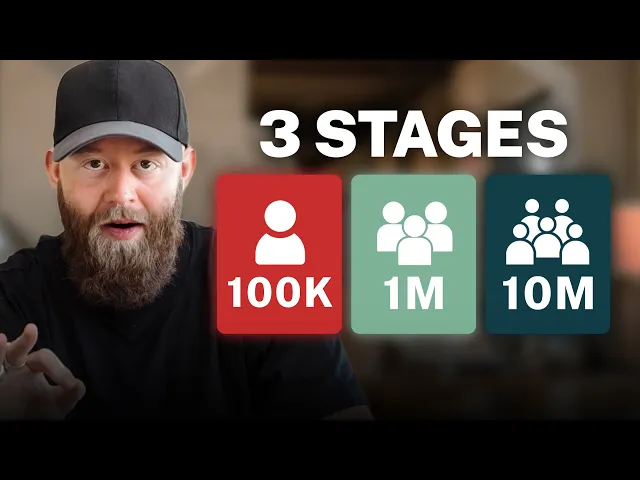
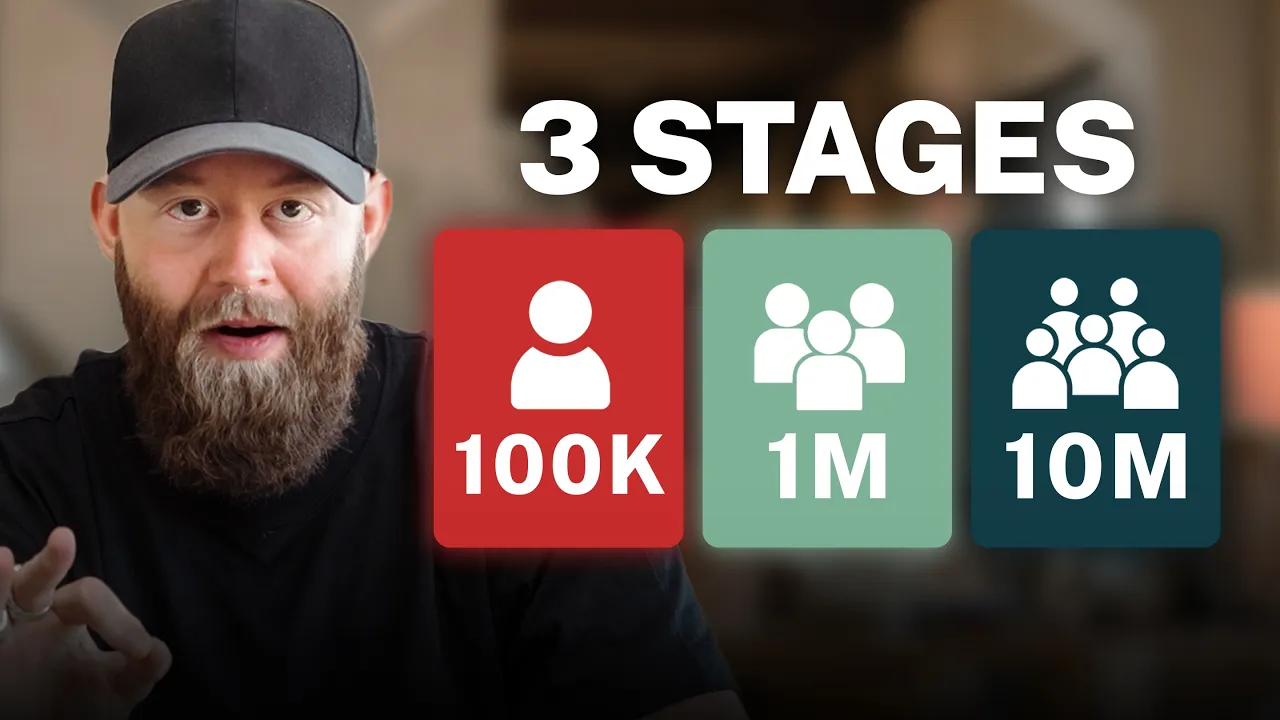
Whether you have 13 followers or 13 million followers, your personal brand is in one of these stages. I've been building personal brands online for almost 17 years now, and I've noticed that the majority of you stay stuck where you're at because you're using the strategy that you started with, or worse, you have no strategy at all. I'm going to show you how you can think about your personal brand strategy at Each one of these stages. Now, before we go into stage one, building the foundation, we need a blueprint or a playbook of sorts. Something that
we do uh for a lot of our clients in Rollson Reserve is we walk them through these very extensive exercises. I'm not going to go through each and every single one. I'm going to highlight four of them that I would like you to actually go through these exercises. Exercise number one is the brand journey framework. The most Important framework for your personal brand. Okay, it's four questions, very simple. And what it does is it gives us the end goal and then reverse engineers our way back to today. The first question that I ask starts with
the end in mind, which is what is the goal that we have? What is the outcome that we desire? Why are we building this personal brand? We're building it for something to happen. So what is that? The next question, the second one is in Order to get my desired outcome, what would I have to be known for? What would my reputation or my brand have to be associated with in order for that outcome to occur? The third question starts to get into some serious action here. In order to be known for the thing to get
the outcome I desire, what would I have to do? What are the actions that I have to take? We don't get known for things just purely by talking. We get known for things by our actions and the Results we get because of those actions. The fourth and final question is in order to do those things to then be known for the thing to get my outcome what do I need to learn? Let's say, for example, you need to build a business and then have a successful exit in order to appear on the stages that you
want to. Well, to build a business, there's a lot of different things you're going to have to learn, right? There's all the different departments, HR, recruiting, Uh, customer service, marketing, sales, all of these different areas and departments within the business. But it gets even crazier than that. All of those departments have a bunch of different functions. And then within each function, you have a bunch of different skills that you could learn. And so what this does is this takes you from your end goal to today. This is what you need to do right now in
order to accomplish your desired outcome. The Second one is brand associations. What I want you to do is after you've answered those four questions, I want you to think about four associations that you want to have come up in your audience's mind when they think of you. Now, a key distinction here is make two of them things that you want to be known as being for and then two of them as things that you want to be known as being against. So, quick example, I'll give you one of each. One thing that I want To
be known for is building a brand that lasts and is built around trust, not virality. Okay? Something I want to be known as being against is leading creatives with fear. I want to be known as somebody who creates an environment of psychological safety. So, what I want you to do is write out those four associations. Again, two that you're for, two that you're against. And number three is brand positioning. Brand positioning is a very complex thing that We walk our clients through. It's pretty in-depth. What I'm going to do is I'm going to instead give
you one core question that I want you to answer very thoughtfully. Don't just take what the first thing that comes to mind is like I want you to really push yourself on this. The question is what is your view your belief about the world or the industry that you are in that is fundamentally different than your peers than your counterparts than anybody else That is currently speaking in the space. It is my opinion that all of your titles your thumbnails your hooks even just like the ideas of the videos you're making those are important tactics
to put into place in order to have success in building your personal brand. But I would argue that your answer to this question is actually your northstar on what you want to hammer home over and over with your personal brand. The fourth one, real quick here, this will Be very simple. I want you to pick your preferred medium. I believe that there are four mediums or ways that you communicate in content. You've got video, audio, written, or photo/graphics. Pick one of the four, whatever feels most comfortable to you. And you know, I'm obviously doing video.
I think video is the highest leverage activity for sure. But if the idea of sitting here, you know, in this beautiful home, which Is pretty cool. Airbnb, by the way, not something that I own. If you feel like thinking about sitting here and talking into this like black hole that is a camera, okay, cool. Let's not start there. Maybe we start with a an audio podcast or maybe we start with written word. Now, with all this in mind, let's go into stage one, which is building the foundation. Now, real quick, I don't want you to
skip to your stage in this video. If you're in stage 1, 2, 3, or Even four, I promise there are things in the previous stages that you did not do. And just because you didn't do them in the beginning doesn't mean you can't stop and do them right now. I promise if you do that, you will get far greater results no matter what stage you are at. So, I would encourage you watch this video all the way through and if you want to go gangster mode, watch it all the way through and then go back
to whatever stage you're in and watch it in Light of the context of the whole video. All right, stage one. This is 0 to 100,000 followers. This is building the foundation. In this stage, you're trying to build trust with yourself before you try to earn it from your audience. Roughly 90% of creators online are in this stage. Okay? Of that 90%, 90% of those people are under 20,000 followers. And I share this with you to show you that if you're in this stage, you are in the majority. There's nothing wrong with That. That's where the
majority of people are. And that's where everybody that you aspire to be started. Now, something I've noticed is a lot of people, I mean, the reason why it's 90% is not because everybody started recently. It's because a lot of people get stuck here. And one of the big reasons why people get stuck here is they don't have any sort of sustainable or scalable process. Or even worse, and and this is one that I see with a lot of You and I get a lot of DMs about, they built their brand around a niche or a
subject matter that they don't want to talk about forever. Maybe they had a video that went viral or something like that and they tried to build their whole brand around that to match expectations of this new audience and six months in they're like what the [ __ ] am I doing? I don't want to be talking about this. And the third one that I've seen especially it's unbelievably prevalent in the Entrepreneur online creator space is trying to monetize just a little too early. I get it. We got mouths to feed, bills to pay. But the
reality is is you need to earn trust with your audience before they're going to be willing to transact with you. They have no idea who the [ __ ] you are or whether or not what you have to say actually works. And so what you're doing right now in building your personal brand and putting out content is just scaling trust. The Transactions can come later. Something the majority of you who are in this stage definitely resonate with is you're probably only posting when you feel like it. Your content cadence is like a roller coaster. Some
months you're excited, you're motivated, so you're making a ton of content and then you're not feeling it as much. You're feeling anxious about it. You feel overwhelmed. It's becoming too much of a burden. And so then the next month you put out half As much content. The consistency isn't there. And that's the key here is what we're trying to do. We're not trying to like get the attention of the whole world in this stage. What we're trying to do is we're building a consistent sustainable operation here. I talk about this a lot. It's a lot
like a really good personal training program, right? If you start off lifting and you try to do what Chris Bumstead or Ronnie Coleman are going to do, you're [ __ ] You're Not going to stick with it for a very long time. And so what we want to do is in stage one, make sure that you're building a cadence and a process that is actually sustainable. We're going to go really in-depth on what kind of cadence you want to be doing, what your output looks like, and everything like that. But the goal in this stage
is more that you're getting the data on what your audience wants, and you're establishing a process that you can actually keep up With. Now, a quick side note here is throughout this video, you're going to notice there's little lower thirds that are going to pop up either on this side or this side. I'm not exactly sure, but they're going to indicate to you that there is an exercise in a workbook that is available for download. You're probably watching this on YouTube, I assume. So, in the description, uh there is a link at the very top
of the description. Click that, enter your Email. We will send you this workbook. It is worth it. The whole reason you're watching this is to get an outcome. And the only way you're going to get an outcome is by taking action. And so, we made the workbook to make it easier for you to take action. Now, the primary focus of stage one, zero to 100K, building the foundation, is going to be building the habit of creating content at a pace you can actually keep. Like for me, I'm only doing one video a month Cuz that's
a pace that I can keep. The other thing that you are doing in this stage is you're basically proving to your audience that you're worth following. You're giving them evidence as to why you are worth I mean, think about it. I know right now as you're watching this video, text messages have popped up on your phone, Instagram notifications, LinkedIn notifications, Facebook not like everything, right? Attention is something that we are all Competing for. And so why are people going to spend their attention on you? This stage is you building that evidence as to why they
should spend that attention on you. And the other thing that you're going to want to do in this stage is you're going to want to be doing volume for learnings. you're going to be learning what your audience is [ __ ] with and wants more of. It's not as much about getting like crazy views and and going viral or getting a ton of Followers. That's not the goal here. We're trying to build the foundation so that we understand what our audience wants so that when we go into stage two, we have that data and then
we start dialing it up and optimizing. Now, the way that this is operationalized or the way that you can actually execute on this volume and testing and learning is a method that I call the accordion method. This is a very simple approach, but I [ __ ] love it. You can think of The accordion method very simply. When you expand the accordion, that's your volume phase. Okay, this stage, I would argue the majority of it is a open accordion. You're doing high volume in order to find out what your audience deems as quality. You don't
know what quality is. I don't know what quality is. And neither does Trevor behind the camera. And when I say you, I mean you creating the content. You, the audience, you're the ones who determine to me what Quality is. And the way that I find out that information faster is by higher volume, which is why we're in the expanded accordion phase. More volume equals more data on what you want more of from me. And the same is in reverse for you. If you're making content, the reason why you want to post more is to learn
what your audience wants from you more, not less. So expanding the accordion teaches you what works. When you go into stage two and you contract The accordion, that's when you make it work better. Now, what I just explained is uh a pretty obvious thing, right? People talk about test and learn. and testing and learning all the time. Here's the funniest part. I would argue the majority of you watching this are just doing the testing part and not the learning part. The way you learn from a test is you have to track it. You got to
track what happened. You need to track progress or lack of progress. If you're Not tracking and adjusting, all you're doing is just putting empty [ __ ] out into the void. you're not actually optimizing around what your audience is defining as quality. Now, a pitfall to avoid here is we're talking about testing and learning, but the majority of you, I think, are doing the testing part, but not the learning part. If you're posting often, but not actually tracking and then making adjustments based on the performance, it's not like You're building a foundation. Instead, you're just
throwing bricks into place and hoping that they land straight. Now, at this stage, the way you want to be thinking about your niche is you want to be thinking about clarity over width, depth over width. You want there to be a very clear thing that people can say about you without thinking. What I'm trying to do is I want people to be thinking about building a brand, personal brand strategy, like these are The things that I want people to associate with me. And so what I am doing in this stage, uh, I actually recently just
graduated at stage two, but when I was in stage one, and I'm still going to do this in stage two, I am trying to repetitively and consistently pair myself with the things that I want you guys to associate me with. So, in the beginning, I believe for your niche, you do want to be more narrow. There's a Lot of content that I've put out where I talk about how I'm not a big fan of like niching down in general and there's a lot of nuance to this. I think people misunderstand niching down and they think
I can only ever make content around this subject matter and anything even as like a you know like a little prop or whatever that isn't related to that I can't do. I do not believe that. I think if you do that you're going to [ __ ] hate making content and you Won't stick with it for a long time. What I'm saying is you want to talk about a narrow subject matter consistently build credibility as the go-to expert that people want to hear from within that subject matter. Now, you can pair that subject matter with
an interest that you have. For example, I made a video where I talk about the struggles that I was having in taking on this journey of making content and I filmed that over the course of a Motorcycle trip. And so I'm pairing uh the thing that I want you guys to know me for with an element of who I am as a human to help me stand out from the noise of all the other people talking about brand and content strategy online. The difficulty for some people in this is when you pick that, how do
you keep saying basically the same [ __ ] re relatively over and over and over again? Well, this is where stories and examples become very useful. You can share the Same principles through different scenarios over and over and over again. And a lot of people think like, oh man, is the audience going to get bored or what? The variability or the variety I should say that you get is in the different stories in different scenarios. The key here is that you do want to consistently say the same thing so that your audience does associate that
with you. Okay? You want to pair yourself consistently with that. An Example that I share a lot when it I'm defining brand and branding is Nike and Michael Jordan. And and something that I think is a huge key here is if Michael Jordan would have worn Nikes one or two games, it wouldn't have had the same effect. We wouldn't associate Nike with basketball greatness. It was the fact that he wore them every night for years upon years. Okay, you need to do the same thing with your core message. It's you being Michael Jordan and the
Nikes Every single night. And so the repetition is not a bad thing. It is a good thing. So Caleb, if I'm going to do this whole niching thing, how do I choose my lane? And this is actually a more common question and dilemma than maybe you would imagine. There are a lot of people that are like myself that are chronic overthinkers. There's a fine balance here. You want to be very thoughtful about it, but you also don't want to be delaying action for so long That you miss your opportunity. What I want you to do
is pick a domain that you are worldass at or you are committed to becoming world class at. Now, the the key here is there there's a massive distinction. It's like expert versus learner. You're either world class at it already or you're going to become that. Now, for me, my lane, you know, I'm going to sound a little uh I don't know, douchy here, I guess, but I am world class at building personal brands, Especially within the business space. That is the domain that I am making content around. Okay? And so everything that we've put out
on our YouTube channel so far ladders up and points back to that worldclass skill of building personal brands within the entrepreneur business space. Now what you're going to do is you're going to choose which one are you? Are you the already world class or are you committed to becoming world class? For me I Already am. I have many examples in my history of me executing this. But for some of you, you might be earlier in your journey. Uh whether you're a young person who's just starting out in their career or you're making a massive pivot,
both are awesome. The key here, and where a lot of people get [ __ ] up, is they're not the expert, but they posture and pretend to be. And this is no good for anybody. It's not good for you, and it's not good for your audience. And so, What I would encourage you to do is be honest. Crazy concept, right? Being honest with your audience, that's going to build trust. And your competitive advantage because you're not the expert is your your audience's guinea pig. You are the proxy for learning. You're going to make investments in
time, money, relational capital, all of these different things. And you're going to sometimes get it right and sometimes get it wrong. When you get it right, you're Going to share what you did to get it right and how your audience can potentially do the same thing. And I would argue more importantly, when you get it wrong, you're going to share what you did to get it wrong, how that came to be, and potentially how your audience could avoid making the same mistake. I would argue this is very valuable content. You don't have to be an
expert in order to make content, but you do have to be an expert in order to Actually call yourself an expert. And that's where I see a massive discrepancy, especially uh in finance TikTok. Now, something that we're going to hit on here is uh there's a little bit of a ratio of like depth versus width. You hear people talk a lot about making deep and wide content, right? And sometimes you hear people talk about trying to do the same thing in the same video. Uh I think that is a terrible strategy. You should definitely pick
one That you are aiming for. We're going to talk about kind of the uh ratio that you want. But one thing that you are going to want to do is make what I call nichwide content. What a lot of people think is I need to make wide content that is just for everybody. I'm, you know, talking about how to build personal brands online for entrepreneurs and now I'm going to talk about my opinions on toothpastes. That would be a wide video, But it has nothing to do with my niche, my topic, my my space, my
industry that I've chosen. Okay? It makes no sense. Now, if you look at my YouTube channel right now, the deepest video we've put out to date, not the longest, but the deepest or or smallest market video, I would say, is a 2-hour video on how to lead a media team. Not how to build, how to lead one that already exists. It will probably be one of our lowest viewed videos of all time. And then if you look At another video that we made, uh I think it's titled something to the effect of if you're struggling
with making content, watch this video. That one's a lot shorter, too. It's like 12 minutes. That is a far wider topic. It's addressing a lot of different people because a lot of people these days make content. I mean, hell, dads and moms make content online all the time. Uh, so this is a really wide thing, right? Like maybe they're not Trying to grow their business through it, but maybe they post a photo of their backyard or they take a photo or a video of the waterfall from the hike they went on and that's content, right?
And so this is relatable for a lot of people, but the key is that it's nichewide. It's still within your brand and content strategy. It's just appealing to more people than necessarily my ideal customer, which is entrepreneurs trying to grow their personal brand. Another Example is that my my space, my niche is brand strategy. But within that, I could be talking about brand positioning. I could be talking about media team, distribution, content strategy. There's a lot of subcategories that would fit within that. But what would not make sense is me uploading a video next month
talking about my views on crypto. That would make no sense. Okay? Even a video around like general productivity or time management Would probably not make sense. If I was going to make a video around time management, I would make sure that it's time management for a video editor or a videographer or time management for a busy executive who's also trying to build their personal brand. Right? You want to make sure that it is nichewide. It needs to be relevant. Next, what we want to do is define your unique point of view or your unique offering
to the world. I believe that within brand Positioning, there's three levers that you can pull on. You definitely need one of these to stand out at all. Ideally, two best case scenario is all three of them. And these are in order of effectiveness as I see them. The first one is going to be your contrarian belief. Okay, we talked about this at the top. It was the question that I asked you for your brand positioning exercise uh to begin this. What is it that you believe about the world, your Industry, your space that is fundamentally
different than your peers, than your counterparts in the space? I believe this is actually the biggest lever. It's like a two-hander that you can pull to stand out in any marketplace. I don't care how saturated the space is with creators talking. If you come onto the scene with a different view than what everybody else is saying, you will stand out and get traction faster. Two incredible examples I can Give you immediately off the top of my head, the man that I love and reference all the time, Gary Vee. Back in the day, this is going
to sound crazy for a lot of you watching this, we lived in a world where the majority of Fortune 500s and 100s were spending the majority of their ad spends on television, radio, newspaper, magazines, billboards, mailers, all these like very traditional forms of advertising. And Gary came onto the scene and was like, "Hey y'all, There's this like crazy thing called Facebook." He came onto the scene in a world where the whole advertising and marketing world all were prioritizing legacy media. Gary came in and was like social media is where you should be putting your money.
It was the thing I believe that really made a huge splash and why Gary exploded on the scene. Another great example that I love referencing is Cody Sanchez. In 2020, 2019, we had hit this like peak of Society believing that the best and really a lot of people would say things like the only way to get wealthy and to become rich is to be a a tech founder. You had to have the Uber of blank or the Airbnb of blank or the next Facebook or Instagram. That's not the only way. And Cody came onto the
scene and was like, "Hey, guess what? there's this like crazy other way to become a millionaire with laundry mats or as a plumber or owning vending machines. She came onto The scene and was like, there's another way. Boring businesses. And so, it's no surprise that both of them exploded in their spaces so quickly. So, what is it that you believe that is different? Like for me, I I would say, you know, we're not having the growth that either of those two characters have had by any means, and I'm not comparing myself to them, but we're
growing a lot faster than I would have expected to be very frank with you. And I think that the Main reason why is not like, you know, our titles, thumbnails. It's definitely not me and how I communicate or how I look. I think what it is is I have a fundamentally different view around how you optimize your personal brand online. The majority of people that are making content in this space have been pushing that you need to go viral, that you need to aim for more views, that you should be looking at the platform metrics
only. And those things are great. Views, Virality, and platform metrics are very important. But I believe that the northstar that you should be optimizing around is trust and conversions. And by coming onto the scene and sharing that, I think that is a huge reason why our content and our brand is scaling at the pace that it is right now. even with very little output from us. Now, real quick, don't develop a contrarian take to have one. It needs to actually be true to what you believe. Okay? So, I'm Not saying manufacture some controversial take so
that you stand out. It's that you need to be so deep in the weeds in your space and so much of a practitioner that you know what is being said from experts in your space is [ __ ] And that is your contrarian belief. That's what you want to lean into. For some of you, it's going to be a really wide thing. I would argue mine is a little bit wider, right? Like I believe that brand should be optimized Around trust, not virality. That's a pretty wide thing. Some of you, it might be like, I
don't think that you should use this format in calculating your profit at the end of the year. I was going to give a financial example, but I'm clearly not a finance expert. But you see the point. You can have it be as wide or as granular as you want. The next lever that you can pull here, number two, is the delivery lever. Something that I've been talking about And I want to put you all on to if you're not aware of it, is these comfort creators, the rise of comfort creators. And it's not a niche,
it's a delivery mechanism within different niches. So in the fitness space, in the uh health, the finance, the business, all of these different spaces right now, you're seeing a rise in comfort creators. And what it really is is it is a different delivery mechanism. I believe we've had a pretty common way of characters online Communicating to us through an educational stance. They're yelling at us about all the things that we're doing wrong and how we need to change. And that's very effective for a lot of people. That's what they need. But there's also a large
portion of society that uh does not respond well to that aggressive communication style and resonates more with a little bit more of a calm, relaxed tone. And so what I'm seeing is let's take the uh content Strategy space for example. There is somebody who I reference a lot. I really love her content, Sarah Snow on Instagram. I highly recommend you go follow her. She has her own views and everything, but a lot of what she's sharing is stuff that maybe you've heard or other creators are putting out there, but for her audience, it never would
have landed previously because of the way it was delivered with her content. I mean, one of the videos that I watched Recently, she's like tending to her garden and speaking very softly about an element of her content strategy. I I think this is another way for you to be able to stand out. Now, I'm giving you one version of this. But on the flip side, if you're about to embark on making content or you're already doing that and you're in a space where everybody is a little bit more calm and reserved and you have a
little bit of fire and spice within you naturally, not That you're making that up, it needs to be true to who you are. But if that's the case, well, I would argue lean into who the [ __ ] you are and you'll stand out. The key here is looking at what is the common way of delivery in my space and how do I do it differently that is authentic and true to who I am so that it is sustainable. Real quick, another example is if you're making content for accountants, what I will say is the
majority of the creators in this space Are very monotone and boring. And so if you're a very animated, charismatic kind of character and you've got some quirkiness to you, I think you would stand out really well in a space where everyone looks like a boring piece of paper. Speaking of paper, that brings us to the third lever, which is wrapping paper. Uh, that's what I like to call it. And this is how you're packaging your ideas, your views, and your delivery. You can think of your wrapping Paper as the format that you make the content
in. This is your title and thumbnail. This is everything that is surrounding the concept and delivery. Right? And so you have your contrarian belief. Then you have your delivery. And those two things exist within your wrapping paper. This is another way to stand out. I think a phenomenal example of standing out via your wrapping paper is Adrien Purr. OMG Adrien on Instagram. If you don't follow him, please for the Love of God, go follow him there, YouTube, everything. What he did is during the era of direct to camera sitting on a couch like I am
right now making videos talking about content strategy or or whatever strategy whatever space you're in. He was like, "Okay, I'm a cinematographer and I want to teach people. So, how would I go about combining the two instead of me just sitting here like, yeah, this looks cool, but his [ __ ] is a whole another Level." He makes all of these, you know, content tip videos into like short films. They're like cinematic experiences. When you go and watch him, you're gonna be like, "Oh, yeah. This is nothing new because you see a lot of people
doing it." And I don't know if he was the one that originated it, but god damn, he was the first one that I saw do it. And so, I believe he actually ended up creating this whole new wave education with cinema. It's making Educational content cinematic to watch. The big innovation was how he was communicating it. So you can pull any of these three levers. The best version is if you do all three. Now you don't have to do all three at the same time. It can be sequential. I would argue that the most important
thing to nail down is your contrarian belief. You should try to implement all three and do them in order of effectiveness. Start with contrarian belief. Then the next one You're going to want to do is your delivery. Then the third one is your wrapping paper. This will help you stand out. Now, two quick notes uh before we move on to another part that's very crucial, your mapping of associations. I want you to make sure that you aren't focusing on the wrong things. A lot of you see people online make content around gear, lighting, the cameras,
the microphones that you use, and all of these different things. And none of that [ __ ] matters. If you have a really strong and and effective and useful contrarian take, you could blow up with your [ __ ] phone. Think more and put more effort into the things that you're saying, not the gear you're using to capture what you're saying. Another way to make a massive splash onto the scene and stand out and position your brand effectively, is mega depth plays. They signal leadership. For example, my 6-h hour and 22minute course that we dropped
On YouTube for free, I believe put me in a completely different category in the market very quickly for a couple of reasons. One, uh, if you watch it, I think we give a lot of good [ __ ] and if you take action on it, you'll get results and that will increase your trust towards me. Secondly, I I think that there is a little bit of a perception play, which is how many other people could sit here and talk and articulate at a pretty high value per Minute for 6 and 1/2 hours on just personal
brand. I mean, that's pretty absurd. And so, I did it as a brand positioning move to be able to say, okay, the majority of my counterparts in this space sell something like this. I would argue it's not as valuable and they sell it for money. What would it look like if I were to take the thing that they sell and put it out for free in a better way? I think if you do something of that nature, you will have A very hard time not standing out. Now, to map out our associations and real quick,
all branding and brand are, they're very simple. It's it's not as complex as a lot of people online try to make it for you. I define branding as a pairing of things. I define good branding as a pairing of relevant things done consistently and then the byproduct of that is brand. That is when your audience associates inherently associates you and the thing that you Are intentionally pairing yourself with. Basically, if you agree with me with the definition of branding and brand, then really what we can say is you are who or what you pair yourself
with. So, what I want you to do is look back at the four desired associations that you list out. The two that you want to be known as being for and the two that you want to be known as being against. This is going to be very helpful in you determining what you do and arguably more Importantly do not pair yourself with. I've talked a lot about this. Not all press is good press. Not all views are good views. And so in defining what you want to be known as being for and being against, that
is your decision-making framework on whether or not you do collaborations with other creators, for example. So in this stage, you're trying to build awareness and have more people know who you are. And in doing that, a great strategy is to appear on podcasts, To go on shows where the host interviews you and asks you questions and then shares you with their audience. The interesting thing in that is when you go on, let's say, five to 10 shows, suddenly you have a collection of pairings that exist online. And what actually ends up happening is your audience
will interpret your brand through the pairings that you've made. And so if you go on podcasts that are not in alignment with your desired Associations, then what you are doing is pairing yourself with the wrong thing. And if you do that consistently enough, that is the inherent association your audience will create when thinking of you. And so the importance I I can't stress it enough. It's why I try to hammer it in almost every podcast I do, every video we put out, is really defining what do you want to be known for and then being
ruthless about what you say no to and yes to in order to get You closer to being known for that thing. Now, an exercise that I like to walk people through in Rston Reserve, I'll go over it really quick here, is the two column approach. And basically, what you're going to do is you're going to make two columns. On the left side, you're going to look at all of the things that people in your space are saying or doing that you either disagree with or find cringe or just icky are reasons why you wouldn't want
to make Content. You're going to list all those out. And then on the right side, you're just going to write out the exact opposite. What this is going to help you do is choose the things that you pair yourself with. It's less about the people in this one. This is more about the concepts, ideas, and actions that you want to not pair yourself with. And then on the right side, you're literally articulating the things that you do want to pair yourself with, the things that You want to say, the actions that you do want to
do. This approach, again, very simple, highly, highly effective. Now, I want to be uh empathetic here. When we're in the sub 100,000 follower level, it is very tempting when somebody with a large audience reaches out and asks you to come on their show. I understand the temptation. But what I want to tell you is that I'm currently going through this. There have been several I will say really big podcasts in in this space in The the you know business creator space that have asked me to come on their show and I am not going to
do it because it does not line up with the values that I have and the associations that I want y'all the audience to make when you think of me. So I am trying to not only preach but to practice. Okay. What I'm doing here is I'm protecting future Caleb and I'm encouraging you guys protect future you. It might seem like a great idea right now because you're Going to get a lot more eyeballs and maybe you've got a a launch of an offer coming soon and more eyeballs would mean more conversions. But here's the thing,
that is a shortterm decision and a shortterm game. And we want to play a long-term game here. Building your personal brand is a long game, not a short one. You want to make decisions that allow you to continue playing this game for much longer with higher amounts of trust with your audience. Protect Future you. And then one other note uh that I just want to hammer home that whole what you want to be known as being for and being against. These should be really [ __ ] clear. After a year of making content, that core
audience should be able to articulate those things on your behalf. Why? Because you are consistently hammering home this message. Again, you are Michael Jordan wearing the Nikes every [ __ ] game. Now, I've clearly defined my my niche, Right? My my space that I'm existing in. But within that, there are different topics that I'm going to want to address. Before you add any of those topics, I would encourage you to ask these three questions. If the answer is yes to all of them, then you know to move forward. If the answer is no, then maybe
you shouldn't add this topic into your content arsenal. Question number one, does this help me become known for my main thing or my one thing, the thing That I am world class at? Question number two is, does this line up with my contrarian belief, my delivery method, or my wrapping paper edge? And then number three, this is the most important one in my opinion. Will my audience actually find this valuable and useful or is this for vanity reach and metrics to make me feel good based on how many views it gets? If you can answer
yes to all of those, then cool. I think you should add that topic in and and start Making content around that as well. But if you can't, then I would say save that [ __ ] for your conversations with your homies. And that's about it. Hey, quick reminder. There's that workbook that I mentioned earlier. Hit the link down in the description. It's worth downloading. This is going to help you take this from just being something that you watch to something that you take action on. Now, on the subject of topics and adding topics, I would
encourage you to also uh Fairly frequently quarterly, monthly, whatever cadence you want, be ruthless with auditing the brand that you're building. So many people that I talk to get two or 3 years into this game and they've built a brand around a topic, subject, space that they have no interest in. They maybe were not being intentional with how they were putting out content and what they were talking about and they put out a clip that went viral and then they optimized and built Their brand around that subject matter rather than what they wanted to be
known for and wanted to talk about. You don't want to build a personal brand that holds you captive. You want to build a personal brand that provides freedom. A great way to know if you are doing all of this effectively, positioning your brand in your niche in the right way, is to look at your sales process. Now, most of you at this stage might not actually have a sales process or an offer. And So, the next best thing is you can have a free lead magnet available for download. What you want to look at is
how easy is it for you to get your audience off of YouTube as an example onto another platform like your website to download this. That would be a conversion. Even though you're not making money for it, that's still a conversion. And so what you're looking for is how easy is the point of conversion. Later on in this video, We're going to talk at different stages about the sales process. Like if a prospect hops on a sales call, like how many objections do they have versus are they just like shut the [ __ ] up and
take my credit card, right? But we're not quite at that point yet. And so the way that you can see if this is working is are people clicking on a lead magnet in your description and then downloading it. It's a proxy for you to know whether or not your audience felt like your Content was valuable enough to go further. And hint hint, when you go into a heavier monetization phase, that is going to be something that you want to have happen. You want to be making content that is going to increase the odds that your
audience wants to go deeper and convert with you. Much more on that in a little bit. Let's move on to what you are making. Now, the principles here under what you're making is you want to go deep over wide. Okay? And I think so far in this section I have given a pretty good argument for why. The other thing that you want to do is you want to document before you create. The legend himself, the Gman, Gary Vee, is the one who came up with this whole concept. Document don't create. And it's true. And what
that means, by the way, is not necessarily that you're vlogging all the time. You're just sharing your experiences, things that you have done, things that You have learned, uh client calls that you had this week, etc. Right? And so you want to go deep over wide, document over create. Every piece that you put out should be teaching a principle, showing proof or revealing a process. These are all things that will increase the trust with your audience. Okay, that is what we are optimizing around. So what you want to do in this stage is pick two
to three signature formats. Like I said at the top, we're trying to Build something that is sustainable that we're going to stick with. We're not going for the, you know, Mr. Beast or Gary Vee approach on day one. We'll be [ __ ] if we do that. There's there's not a shot. And so, a couple of different examples of formats that you could use is a deep explainer video. This is going to be something that is going to be going really deep on a topic. I would argue that our how to lead a media team
video is a deep Explainer video. You can do a case study tearown. Basically, what you want to do is you want to present the before, the goal, the steps that you had to take, the numbers, what didn't work, and then what did work, and how the audience can copy it. Case studies are incredibly effective because they end up showing proof that what you are saying actually works. Another one that you can do is a vlog. Uh, this is the ultimate version of document, don't create, right? So Vlogs work really well and I like them from
the standpoint of they demonstrate excellence and expertise in action rather than what I'm doing right now which is sitting here and talking to you about it. Vlogs show you in action and demonstrate the realities of what you're doing and increase the trust your audience has in what you say. Now we kind of know a couple of different formats that we could try here. Here's three questions that I think you should Ask yourself before you sit down to film. Question number one, does this answer a question that I am already asked very often? If the answer
is yes, green light, film that [ __ ] in your DMs. If you have even 5,000 people that follow you, uh you probably get some questions in your DMs if you're making educational content. And those questions are signal of content that you should make, especially the ones that you get very frequently. Question number two is, Does this solve a problem that my ideal customer experiences? Maybe you're solving a problem, but are you solving a problem for a customer that would be the worst possible customer that you could bring on? I'm in the process right now
of really narrowing in on who our customer is at Rollston, who we serve. And because of that, you're going to start noticing just a little bit of like more specificity around certain language and we're making content directed more Towards those individuals. So, for example, actually, this is an incredibly meta example that just popped in my head. Last night, while we were refining this video, Trevor and I were going back and forth, we beat it up, and he asked me, should we add in a section for solo creators? For all the solo creators there, I [
__ ] love you. like you're awesome and this is no hard feelings, but I don't believe that I can actually get the best results for solo creators, But where I'm going to have the competitive advantage in the marketplace is not the solo creator. I would argue a lot of the people that are giving trendy tactics and and you know, this is when you want to post, oh, Instagram released this new feature, those are the people that the solo creators need to follow, at least in the beginning. But it is my belief that if you are
wanting to do this for the long term and you're trying to grow your business through this, you Need to build a team. And so we're going to be making the majority of our content towards individuals who have a team or eventually aspire to have a media team. And so that's a very clear example of if we made a video for solo creators, amazing. We could solve a lot of problems for them, but that's not my ideal customer, at least at this stage in our business. But if it does solve the problem of your ideal customer,
green light, film that [ __ ] Number Three is, am I just filming this because it's trendy? If the answer is yes, I'm not necessarily saying skip it entirely, but probably skip it unless you're able to frame it uh in light of your core messaging or your niche, right? If you're able to repackage it or reconfigure it to make sense, okay, cool. But if it's a trending topic that's completely outside of your space and you're just doing it to get views, it's not going to be the right views. The new audience that you attract by
doing that is not going to be an audience that's going to have a high intent to buy. So, what the [ __ ] are we doing here? Ask yourself these three questions before you film. A point of reflection actually for you is to look at previous film sessions and upcoming film sessions and to ask yourself this question. Have I had to hype myself up or talk myself into this? If the answer is yes, Maybe you're not talking about the right thing. I can't stop talking about this [ __ ] I really can't. It is all-consuming
for me. It's been this way since I was 15. I was that [ __ ] [ __ ] in high school that read Crush It and then was telling all my friends and the adults at church and all these people that knew way better than me what they should be doing, which is being on social. Like, I just couldn't escape talking about building your brand online And how important it was. this morning when I woke up to film this video. Like, I didn't have to like rile myself up to talk about this. I'm [ __
] stoked. This is so exciting. We've been amped about this video for months now. And so, you want to be speaking to a topic that you look forward to talking about and you can't wait. If you're not excited about it, I would start to investigate why are you not excited? And that's a problem that you need to solve because If you're not excited about it, you're not going to be sticking with this long enough to make it even to stage two. The next section in stage one is sustainability. And you've probably been noticing throughout each
like subsection of this, I've been pushing sustainability. That's the most important thing in this stage right now. It's not about getting all the views, the followers. It's about building something that you can do for a very Long time. Part of that means you need to make sure that your content creation sessions, so if you're filming YouTube videos like this, your film sessions are something that you enjoy and ideally something that you look forward to. Now, if we rewind back to when I gave the definition of brand and branding, what I want to walk you through
is how you can brand your content sessions. And it's very simple. If we believe that branding is an intentional pairing of relevant Things done consistently and the byproduct is brand when the audience inherently associates the thing with the thing being intentionally paired with, we can brand our film sessions. If you show up to a cold, dark studio and there's a camera in the back and it's really dark and there's a completely emotionless human who is filming you. That is probably going to be a pretty shitty environment that you're not going to look forward to. On
the flip side, Let's say you love nature and you're in Italy on a on a vacation and you're staying at a beautiful little cabin in the Doommites and you want to film a YouTube video out there and so you do a cool setup out in nature. You're sitting on this rock. You got the mountains behind you and everything. You're probably going to enjoy that a bit more. And I would argue you're probably going to be more comfortable, which will come through in the content. But what you're Doing there is you are pairing content creation, something
maybe right now you don't like doing or feel a little anxious or weird about and something that you do love doing. And by pairing those together consistently, eventually you start to associate content days as something that you enjoy. This is what you need to do with your film sessions, with your writing sessions, however you whatever medium that you chose. When you are going to make content, you want to Pair those content days with things you enjoy. It can be an environment that you're in. It can be people. If you're struggling to make content, you're like,
I don't know how I'm going to pull this off. I feel so uncomfy. For some of you, this is a terrible idea. But for some of you, maybe having one or two people that you are close with, trust, and vibe with really well. Maybe having them be there is actually a reason that you do look forward to making it and you feel more Comfortable. Another thing that you can do, it's going to sound silly, but you can have beverages that you really enjoy. I really like sugar-free Red Bulls. I also really enjoy these wonderful little
snacks called chomps, beef sticks. This sounds simple, but I enjoy these things. They're all these little tiny little things that I'm doing that are making me associate film days with goodness, with excitement, with positive feeling. This is how you avoid Burning out in content creation. You need to brand the process, not just yourself. And just like with the content we're putting out, we're wanting to track the performance and make iterations based on that performance, right? Cuz we want to build a true foundation, not just throw bricks and hope they land straight. We want to do
the same thing with our content capture or our film sessions. What I want you to do is make a list of [ __ ] you don't Like. I call it the the [ __ ] I don't like list. After every film session, we are going to list out, it's like a postmortem. We're going to define the things that went well that we felt like, oh yeah, we should continue doing that. And then we're going to list out things that like sucked. Maybe I didn't do a good job of ordering breakfast early enough and so I
ate right before we went into filming and then my stomach felt funny and I was distracted by that or Whatever. Maybe because we're staying at this Airbnb and there's uh body soap in the shower that I'm not used to. Actually, what happened this morning is I showered with that and my arms right now are incredibly itchy because I think I'm allergic to whatever the the body wash was. And so, we're going to note that for future film sessions that I will always bring my Dr. Bronner's or Bronner's uh peppermint soap that I love so much.
And if you make this list, what You're doing, it's obvious, but I'm going to say it. you are refining the process and making it something that you're going to enjoy more. Just like we want to constantly be iterating and improving our content, we want to constantly be iterating and improving our content capture process. Your content system structure is going to look slightly different at each stage. In stage one, uh I am going to implore that you use the waterfall distribution Method. Now, this is an adaptation of the content pyramid that was originated by Gary Vaynerchuk.
He released a project back in I think it was 2017 or 2018 called 86 pages of insanity. It is truly insane. Uh it is very in-depth and still very relevant to today. I've made a few adaptations to the water or to that method and that's why I call it the waterfall distribution method. I also am a PNW boy so I like waterfalls and [ __ ] like that. The way that it works is you Want to make a pillar piece of content. Pillar piece of content. I mean that can be a YouTube video, that can
be a podcast, that can be a blog post like a long form one. That can be an email for a newsletter. It could be a book. It could be a talk that you give, whatever, right? You want something that is long form, preferably evergreen, so that way you can continue to repurpose it for years to come rather than it just being time uh relevant. Then from there, once You have established your pillar content, the way that you are going to be able to fairly easily distribute is you're going to do what I call mining. You're
going to go into that long form content and pick moments that are valuable nuggets in and of themselves. What that means is they don't need the context of everything surrounding it for it to make sense. We could take that moment and the audience would get value from that single moment. Now the Traditional method here is you mind that moment and then you clip it. You make it a short Instagram reel, a Tik Tok, whatever, right? And you post it. That is a great version, but less and less effective as we progress in this interest media
era, right? We're on the back half of 2025 as we're filming this and that is not always the most effective way. So what you want to do is you want to mind the moment. this is a a segment back and forth in a podcast or You know one section of a video maybe it's this section and this video that you're watching right now you mind that and the 2.0 version is is you figure out how do I take this moment and this information being conveyed and package or wrap it in the way that the platform
I am posting it on prefers the most. Now what you're wanting to do at this stage is you want to and we're going to talk about this in a second. You're going to have your top priority platform and your Secondary platform. So, all you have to think about when repurposing content at this stage is that one platform that you're repurposing to. It's not like you need to make this for like 30 platforms. That is the biggest mistake and the biggest lie that people believe, especially when starting off early, is that like you got to be
everywhere all at once. [ __ ] that. That's not sustainable in any way, shape, or form. Let's say, for example, you picked YouTube as your uh pillar, right? and you're going to redistribute to Instagram. That's your secondary. Well, what that probably is going to look like is sometimes, sure, you're going to clip that mind moment as a Instagram reel, but sometimes you're going to take that and turn it into a carousel. Sometimes you're going to take it and turn it into an infographic single post with a long form caption. It looks differently depending on the
platform that you Choose. So, the mind moment then needs to be repackaged contextual to the platform that you're on. A great analogy for this that I I like to share a lot uh came from Gary. I got it from Gary. You are you no matter where you go, right? I'm Caleb when I'm here on camera. I'm Caleb when I go riding my Harleyies with the boys. I'm Caleb when I go get lunch with my girlfriend and her mom. I'm Caleb when I go to dinner with my sister. But given that these are Different environments and
different contexts, I show up slightly differently. not inauthentically. I just bring out different sides of my personality and probably hopefully use slightly different vocabulary given the scenarios that I am in. I believe that social media operates the exact same way. That's why the 2.0 version of this is you mine the moment and then figure out what's the best version to wrap this moment for the platform I am posting it To. Now, uh, for your pillar cadence, this is such a widely debated, uh, thing. So, I'm going to give you some guidelines or or things to
follow. They're not rules. Ideally, you're posting your pillar content weekly or bi-weekly. But I also understand that a lot of us and a lot of you watching have a business and I'm in my first year of building a business and finding out very quickly that does not lead to my ability to make a weekly video right now. Uh I Do not have that bandwidth available. Eventually we'll get to that point, but we are not there right now. And so we are posting one pillar piece per month. What I will say is in line with the
previous section which is pick whatever is going to be most sustainable. You can always add more volume later. It's kind of like uh you know cutting hair, right? I remember back when I used to have it. I would always tell the barber trim less. We can always take more off later. But we can't instantly grow anything back. And I think it's very similar here. You can always increase your volume down the road. But what is more difficult to do is to repair the damage that occurs from burning yourself out trying to hit some arbitrary cadence
that some guru on TikTok told you to do. You might be watching this and you're like wildly more busy than I am and you're like a monthly video. I'm gonna put something out once a quarter. Cool. Do that. Do it for a year and then put out a video every month, right? Like you can always increase your volume. So I would start with something that feels realistic. And lastly, something that this is kind of like a preview to the next stage and the stage after. There's a lot of process that goes into making content. And
something that I've seen is a huge uh [ __ ] that a lot of these media teams have is they don't have ownership over process. They don't have Clearly defined roles on who owns what. Now, I'm talking to you in stage one. More than likely, you are a solo creator right now. Maybe you have somebody, but more than likely you are a solo creator. And so what I would say is list out your process and then make sure that it's very clear that you are owning it. It sounds silly, but essentially what I'm saying is
create a checklist to make sure that you do all the parts of the process to make sure that this is a Dialed system for you. The best part of this is if you operate this way when it's just you, it won't be difficult to be able to articulate what needs to be owned in the process when you do bring somebody on because more than likely they might not own everything. You might still own some parts of the process, but you'll have clearly defined what those elements are so you know what to delegate to that individual.
So again, it's kind of similar to the brand Associations thing like protect and make life easier for future you. And the north star here is to please prioritize consistent uploads rather than perfect videos. One, your subjective view of perfect is just that. It's subjective. The audience is who determines quality, not you. And so you uh spending a ton of time going back and forth on an idea or on an edit to try and make it perfect in your eyes. Well, that's kind of stupid. You have no idea what the audience is Going to think anyway,
so you might as well put it out. Prioritize the consistency over the perfection. And so, like I touched on, your platform utilization is very simple at this stage. You're going to do two platforms. You're going to pick your primary platform. This is where you're creating your pillar content. Okay? That's where you're deploying that. Then you're going to pick a secondary platform. That's where you're repackaging or rewrapping The content to deploy. The thing that I will say is, let's say, for example, you choose YouTube as your primary platform where you're going to put your pillar content.
And then YouTube Shorts is where you're going to redistribute. Well, YouTube Shorts makes vertical videos. So, it would also make sense that you could post those if you want on Instagram, Tik Tok, LinkedIn, Facebook reels, etc. It doesn't take that much extra effort. It is. It will take extra Time, but if you literally just copy and paste the caption and post it over there, you can probably get away with that with like just an additional 10 minutes per video that you're going to upload to all of these different platforms. Now, again, we're going to get
down the road into the future here, and you're not going to want to do that strategy because if you post the same clip at the same time to all the platforms, why would I want to follow You on multiple platforms uh when I'm getting the same [ __ ] So, eventually, we'll optimize this, but for now, this is how you're operating in stage one. If you're asking, well, how do I choose the platforms that I'm going to prioritize? How do I pick the primary platform? How do I pick the secondary platform? Well, there's two questions
that you want to ask. One, what is the medium that you chose? At the top of this whole video, I asked you to determine which of the four Ways of making content you were going to do. Video, audio, written, or photographic. Once you have determined that, it is going to be fairly clear where you should go, right? If you chose video, okay, cool. Well, what platform is going to take pillar content, aka long form video, the best? Well, probably YouTube. You could argue Facebook or LinkedIn kind of because LinkedIn can do like 15-inute videos or
whatever, but YouTube is probably going To be your best case scenario. The next question you want to ask yourself is, where is my ideal customer and my ideal audience spending the majority of their time? That is also a great indicator of that being a platform that would be useful for you to be on. Now, the 2.0 or the sub question there is, how do I figure that out? The answer is you do what I do when I visit a new city and want to find a metal bar. I find someone who is into metal and
I ask them. You Just start asking around. Okay? Like if you're into finance, uh, a lot of people that are into finance are really big on X and they love that [ __ ] Okay, cool. All it takes is doing just a little bit of research, a little bit of asking to find out where your audience exists. Don't be lazy, just ask. The next section in stage one here is your team composition. This is going to be a fast one. 95% of you, uh, you're going to be a solo creator. Now, you have the Optional
choice of hiring a like freelance Swiss Army knife. And what that is is it's somebody that can do everything. Not the best, but they can do it all. They can film, edit, make graphics, shoot photos, all that stuff. They can post the content. They understand it at a basic level. This is very useful if you have the means to be able to support it. Now the way you want to choose if you are going to do that who you hire is look at your process. What is the bottleneck in the process? For example, if you're
coming up with a ton of ideas and that's not an issue and you have no problem filming them, like you can set up the camera, the light or whatever, or you can go buy a window so that you don't have to use lights and you can do that, no issue. Okay, cool. You don't need a hire for that either. But if all of a sudden when videos get to the editing stage, they just sit on a hard drive for weeks at a time, I would Argue that's probably your bottleneck. And so when you hire this
Swiss Army knife freelancer, you want to make sure that their primary skill, they're able to do all of the things, but their primary skill is in editing. You want to hire around bottlenecks. That's the easiest way. And a preview of the next stage. That's what you're going to do when you start hiring full-time people is you don't hire just for ro sake. You hire to solve problems. And the problems Are the bottlenecks in your process. Now, if you are going to do this whole crazy hiring a Swiss Army knife freelancer thing, it's probably your first
time hiring a creative or if it's not your first time, I'm just going to make a bold statement. You probably aren't good at hiring creatives. Uh it's not the easiest role to hire. There's a lot of reasons for that and I won't go into them right now, but the way to avoid a mishhire is instead of Immediately going into contract, have them do a test. Have them do some sort of project. And the test should mirror what they would be doing in the role. So if you have a YouTube video, for example, maybe what you
do is you upload footage from a video that you've already filmed and you tell them, I want you to edit the opening 2 minutes. You're not going to have them edit a whole YouTube video cuz that might be a little much. But you want to see how do they operate. And what you're testing here is not only their skills on editing, but like their ability to communicate with you, to manage a timeline, all of these extracurricular or ancillary things that can either make or break this relationship. Please do a test project before you hire even
with a freelancer. Now, at the top of the stage, we talked about how you want to test and learn. The way you learn is you have to track. But what metrics should you track? I View data and metrics a lot like Charmin Ultra views toilet paper. Less is more. If you crowd your reporting with a shitload of metrics that don't change what you do, you're not adding signal. You're just diluting the signal with noise. And so you want to focus on a few key metrics. And actually at each stage you can add more metrics. And
the reason why is because you'll actually be able to take action on the reporting of those metrics. Right now, if you're a solo Creator and you're looking at your metrics, you're not going to be able to take action on every single little item, right? There's only a few things that you're going to be able to do to take action on as a solo creator. And so, the reason why the metrics that you report on and track expand is because your bandwidth expands because you're starting to bring on a team. But in this phase, it's very
simple. Number one, I believe you want to track your inputs. How many posts are you doing per month? That's it. Very simple. This is your habit tracker. Again, this stage is about developing the habit of doing this. And that's why you want to track inputs as your number one metric. Now, on outputs, what I would recommend you look into is your watch time and your views. Watch time being the most important thing here. The next thing that you want to track is quality of inbound. This is an indicator of trust. Now, at this stage, you
don't have some like wildly robust tracking system. I'm not saying that. Like, I'm not saying that you need to have some like crazy funnel tracker and, you know, you you tag your customer through the entire customer journey. No, that that's not what I'm saying at all. You're looking at like more anecdotal data. You're looking at text messages that you're receiving, emails, DMs, not only what they're saying, but who is saying it. That's a metric that we are tracking heavily. every video we put out, the number one thing that I'm looking for and that makes me
feel proud of a video or maybe not as proud is the quality of individuals that send me a DM, that send me a text, that send me an email, right? Whether it's somebody that I know already and have relationship with or we establish a new relationship because of the value that we delivered in that content. So, track the quality of Inbound messages. And then the last one that you can look at is your follower count. Everyone talks online about how followers and subscribers don't matter anymore and they are less relevant for sure because content is
served based on your interest, not your following, but they do still matter. One, it's social proof. Every account I've ever managed on Instagram, the moment it crosses a million followers, the daily follower count increases dramatically because There is something to be said about somebody having a million people following them. I am more likely to want to follow them. Follower count, in my opinion, is just a signal of demand. It still indicates that the audience is like, "Ah, I want to I want to get more from this person. I [ __ ] with this [ __
] I want more of it." And so, it's not something that you should be tracking like as a KPI. It's more of an indicator of the content being useful and valuable For your audience. Now, we talked about what to track. Here's how I like to track it. I like to track based on outliers using a multiplier. Establish your 90day average. Let's say it's uh Instagram. Let's say you're getting a,000 views per video because in stage one, that's probably where we're at. You know, somewhere between a,000 to maybe 10,000 views uh a video. That's your average.
Moving forward, once you've established that by doing the math, and I'm not a math expert, so I'll leave you to Google it. But once you do that, you're going to grade all future content performance against that. So, if we've established that your average is a,000 and we upload a video tomorrow that gets 6,500 views, I wouldn't report that as 6,500 views. I'd say it's a 6.5x multiplier. And what this does is it allows you to very quickly at the end of the week, the end of the month, look at your tracking sheet where you're keeping
Tabs on this information and this data and very easily see what I need to continue making and what I need to stop making. The amount of you that are posting content that you know is not [ __ ] working, but you still post it is absurd. This allows you to get slapped in the face every week or month with what you've been ignoring for potentially years now. And once you start to see those 2x, 1.8x, 3x, 5x, 6x, whatever, those are indicators of Content that you should double down on. What I look for in that
is I want to test what do I double down on? Because there's a lot of different reasons why it could have been an outlier. It could be what you are talking about. It could be the contrarian belief, it could be the delivery, or it could be the wrapping paper. Or it could be all three. And so what you want to do is you want to make a educated guess, a hypothesis of which one it's going to be And then double down on that to test and validate that hypothesis. This is how you start to figure
out what formats work best for you. This is how you start to figure out what key messages that you share work best and resonate with your audience the most. We developed this in Google Sheets. It's nothing crazy. I would encourage you build something very similar. A level deeper to this is when you do get to the point where you have a team or if you're a solo creator, but You're within a company that you have a team, not a media team, but you have other people. You averaging a,000 views and then going to your team
and saying, "I got 6,500 views on this video." Means jack [ __ ] to them. They don't know what the baseline is. So, they have no idea what that means. On the contrary, if you go to your team outside of a media team in your organization and you say, "We posted a video and it was a 6.5x outlier," everyone will know what that Means. That's [ __ ] huge. And so, it brings a common language for everybody involved that is not directly tied to the platform and seeing that you're getting a thousand views on every
reel that you post. And again, I would really encourage you screenshot comments and DMs. Like, one, I think it's good to track like sentiment in posts and stuff like that, but actually two, this might be a surprising take. Uh, there's times where you put out content and maybe you Feel discouraged. Maybe what you said was misinterpreted. Uh, maybe you didn't communicate very well. Maybe you put something out and it completely flopped. you can have a bank of highly encouraging comments that you can go to as a source of inspiration and motivation to make content. For
me, what I like to do is I like to try to look at these before I'm going to film a video. It sets my mind to know like, oh, okay, uh, I'm about to film for potentially Upwards of 14 hours today straight. That is a big amount of effort and very exhausting, but my motivation in doing it is because I know that there is a huge amount of you that are actually going to take action on this. and then you tell me about it and that's rewarding for me. And so I would encourage you keep
like a a folder of positive comments, also critical comments. I equally also specifically on podcasts I go on, I try to keep track of Things that people are saying that rub them the wrong way or make it harder for them to receive my message. Now, some of those things I would view as noise. Something that I'm noticing on a couple podcasts I've done recently is people calling out how much I say [ __ ] and how much I swear. I'm not going to change that. That's how I roll. it's authentic to me. I'm not going
to stop doing that. But if I start noticing that uh me sharing an analogy in a certain way is Just not landing, is not clear, I'm going to refine that analogy to make sure that the plane gets landed for the audience and they understand the concept. I view comments DMs as very good bumpers. Almost like if you're playing, like if you're bowling, right, and you suck at bowling, the bumpers help keep the ball in the lane. I kind of view it the same way. your comments and your DMs are like my bumpers in making content
here. I'm not always Going to implement every little thing that you guys say, but if I start noticing a trend, that's when I consider implementing it. And now on to monetization strategy, something that I'm sure y'all were waiting for cuz we want to get that bread. But here's the thing. If you're in stage one, and especially if you're in the beginning of stage one, I would argue you don't want to monetize your audience. You don't want to do any direct big asks. It's Almost like when you join a friend group. If you go into that
new community and immediately start asking for favors, everyone's going to kind of look at you kind of weird. You haven't earned that place in their life. You haven't earned that trust, right? And it's the same with your audience. If I all of a sudden two months into making content just start hardelling my audience, I think a lot of them would be like, "What the hell, man?" Like I you haven't earned That right now. Are they thinking that on like a conscious level? No. Like subconsciously, I think that's how this works. And so what I would
encourage you to do is do your darnest to go for six to 12 months without making any big asks of the audience. Now I know we got bills to pay, mouths to feed. So sometimes we got to do what we got to do. If you do need to make an ask, the ideal scenario is that it is onetoone private and ideally it is with a business that Already exists. It's not some new offering that you're coming up with for this audience. It's something that has already been established and is already rolling. In addition to that,
uh a very good version of this is to sell in private. And so what that can look like is if you're developing an email list, maybe you sell to them. If you are DMing back and forth with people, that's where you sell rather than uploading a video to YouTube or Instagram trying to Convert people on your offer when you haven't even fully earned their attention. Uh another thing real quick uh a tempting thing is if you start gaining traction in this phase, there will be smaller companies that will see that and they'll reach out to
do like influencer deals or you know brand partnerships or whatever and they'll want you to push their product. I really encourage you to not do this unless the product is in direct alignment with your Audience and adds value to their way of operating. Do not [ __ ] do this. What ends up happening for a lot of creators is they they need or more than likely feel like they need to monetize immediately and they end up shilling out shitty products that they don't believe in, they don't use, but they just want the check. The way
that brand actually works is if you push a product that I buy, you are the creator right now and I'm your audience. If I Buy a product that you're promoting and it sucks or even worse, it gets me back. It's not that it's like neutral. It's like it actually makes things worse. I am now going to associate you with that. You just paired yourself with a shitty product and diluted your brand a little bit. In the early days, if you can hold off, if you have some other way, a job, a business, whatever that you
can monetize off of, that is where you are going to be able to show up the best, Earn the most trust and increase the likelihood that people down the road do transact with you because I believe that trust is the currency that precedes the transaction. So, a couple quick reminders or guard rails or traps to avoid in this stage is remember that all views are not good views. Be very intentional with who you pair yourself with, no matter what the opportunity. I recently just turned down a podcast where the host has millions of Followers, millions
engaged followers. That was not easy, but it would not put my brand towards where I want to go. it would set me back. And so I would encourage you be [ __ ] intentional with who you pair yourself with. It is how your audience will interpret your brand. And second is that wide content without legitimacy or depth just feels generic. You're just playing the game that everybody else is playing. In this stage, you want to focus on truly deep, Valuable, useful content. It's why I think this is our sixth video that we're uploading and it'll
be our third video that is over an hour. Like we're trying to provide an insane amount of depth and usefulness to you guys as the audience to build the foundation of my personal brand. And so please avoid the trap and the allure of trying to get a bunch of views and make really wide content and all that. That is not going to lead to the business outcomes that you're Wanting. and the reason why you're actually building your personal brand. All right, that was stage one. That was hefty. If you are in stage two, my hope
is is that you watched this and you paused it multiple times and took action on the [ __ ] that we talked about that you have not done yet. For all of us, let's graduate ourselves up to stage two. All right, we're at stage two, which is 100K to a million followers in your Audience. And this is the build trust stage. Okay, it's all about converting the attention that you've been getting into trust and building repeatable systems that allow you to scale and maybe a little bit of uh sprinkling in some monetization uh if you're
feeling a little crazy. In the last stage, we started it by saying that 90% of you creators fell into that category, which doesn't leave much percentage left uh for two and three. In stage two, that 100K to a million, that is only 8% of creators. And so, I want to just start by saying congratulations. Uh you're in rarified air and you're doing some [ __ ] that the majority of creators online are not. You're getting traction in a way that they are not. And so I think it's very impressive that you've gotten here. Now, all
of those pleasantries out of the way, I think the reason why you will probably get stuck here if you're not careful is that people end up using the Same system that got them to 100,000 followers, let's say, in stage one, and they think that that same way of operating is what's going to take them to the next stage. A lot of you uh watching and listening are entrepreneurs and business owners. And you know that in business, the way that you got to your first 100K is not how you get to your million. And how you
get to a million is not how you get to 10 and so on. And it's the same with growing your Audience. You need to start scaling this out so that it's no longer dependent on just you, the creator. You start to begin to rely, and I know this is really freaky for a lot of you, on other people, which means you're going to have to hire. And at this stage, a lot of you creators are freaked out about hiring. Even those of you that have a business where you have employees, the idea of hiring a
media team feels weird or scary or even more interesting to me. You Don't think that you're going to get the return on it. That couldn't be further from the truth. And so, in this section, there's a lot we're going to cover, but a big one that we're going to go over is the team that you're going to need to start assembling. Now, another note that I want to give is now for stage two and stage three, these are wider ranges, right? We're going from 0 to 100K. Now, we're going from 100K to a million. Everything
that I'm sharing, all of the Principles and the tactics, they're not necessarily going to all happen right when you're at 101,000 followers. This is what you're doing on the path from 100K to a million. You know, we're going to talk about team. I'm not saying you hire three people all at once. As soon as you have 120,000 followers, you're gonna want to ease your way into it. And so I'm I'm giving you the what. I'm trying to show you how and the timing of when. That's that's what you're going to Have to figure out. So
like I said, this is a monumental stage. This is when you go from relying on yourself to also relying on other people. You can almost think of it like the stage one was like the crafted time. And this is when we're turning the craft into an assembly line. We want predictability and we want more volume. We also want to start expanding how much of the lane that we're in, we're taking up without diluting it. You want to maintain depth of content. This Is the point where a lot of people once you hit that six figure
follower mark, it gets very tempting to want to just like accelerate the follower growth really fast and try to get to a million and sprint there. But what I will tell you is if you try to sprint from 100K to a million, you'll get there. It might not be the million followers that you want or a million followers that have any interest in the offer that you have. And so we want to do this intentionally And not slow for slow sake, but just from a an intentional standpoint. We're not trying to blitz here. Now, on
the contrary, the thing that you're going to want to avoid here is as you start transitioning from you owning the majority or everything and you start bringing people in that you don't make the mistake of not properly delegating and assigning clarity to their role like what they own. I see many times in this scenario where, you know, the individual Creator was owning all the parts of the process, but what they didn't do is clearly document that and then relay that information to their new team. And so, a bunch of the plates that were spinning in
the air that the creator was holding up are now getting dropped. And so you want to make sure that as you bring on your team, you're bringing maximum clarity in their onboarding so they understand what they own, what is expected of them, and what good looks Like. So in this stage, your niche strategy is going to evolve quite a bit. In the last one, we were basically just sticking to our core niche and really going for the depth play. And that was the right move. And we're going to continue to do deep content. We're just
going to start to sprinkle in a little bit of extra sauce here. And so what I want you to do is I would encourage you within your niche, pick three to five topics that are niche adjacent for you. Here's an example. My core topic is personal brand strategy. But then within that, there's other topics that are relevant along with that. There's organic content strategy, there's paid media strategy, there's media team leadership strate I mean there's so many different things talent management, right? And so I would encourage you list three to five adjacent items, niche adjacent
items that you can start to experiment and test with. Now Here's the kicker. When you're doing these experiments, obviously, ideally, you want these to resonate with the audience and do well, but I actually see the intention here as a duality. Okay? Half of what you're trying to accomplish is finding the new [ __ ] that your audience is going to enjoy. Yes. But I would argue equally as important is figuring out formats that keep you energized and excited. For us, the first three videos that we filmed, not Released, but filmed, were all direct to camera
videos that were a minimum of an hour. The first one was an hour. The second longest one was 2 hours. And the third longest one was the 6 hour and 22-minute course on YouTube. You know, those are exhausting to produce. And so, I was talking with Trevor and we decided that we were going to test and try a completely different format. It ended up being like a 12-minute video. It takes place in many different environments and There's a lot of different shots and scenes that take place. It's all scripted, too. What we were doing there
is we were experimenting, yes, to find out if the audience would resonate and learn from it and find it engaging and enjoy it, but we were also trying to see is there another way of creating content that I really enjoy and would look forward to doing again. I just had a blast. Like, we had a really good time together filming this video. It was fun. And because of that, it got me excited about making content. And so, what you want to do is you want to find an easy, repeatable format. That's this. This is the
direct to camera video. Like this, we know we can predict blah blah blah. But then I would encourage you to find one that you really enjoy and lights you up. So, if you love golf, for example, maybe it looks like your next YouTube video being filmed out on the golf course. Now, a technical note here is if You try an experiment three times in a row and it performs less than a 1x, remember the 1x multiplier that we talked about in the last stage, how you're going to grade your contents performance against your average and
give it the multiplier uh rating. If this experiment you're doing three times in a row gets less than 1x, I would seriously consider trying something different. Now, if it's something that lights you up and you're [ __ ] stoked About and you don't care, all right, keep doing it. But ideally, the thing that gets you stoked that you really enjoy doing also happens to be valuable and engaging for your audience. So now we're going to go ahead and go over what you make. And in the last stage, it was 100% deep content. In this stage,
we're going to be having a little bit of an evolution occur. You're going to be doing 75% deep content that proves your expertise. Okay? Videos like this, for Example. Then 20% of the content that you make is going to be what I call nichewide content. This increases discoverability inside of your lane. I'm being very intentional with these words. Nichwide content because it increases discoverability within your lane. General discoverability is not useful to you or your business. In fact, it's noise, not signal. it's going to end up leading you to do actions that grow an Audience
that are never going to transact on your offer. And then that last 5% I believe you should be using that last 5% for personal content that humanizes you in an era of AI and I'm sure AI video generation in 2 months will be way crazier than it is right now. Things are evolving rapidly and information is becoming more and more of a commodity. And so the thing that you have as your competitive advantage to stand out is your humanity. That's what Not only separates you from AI, but also the other humans. There's no other human
on this earth that is exactly like you. And I think that something that a lot of the educational content creators fall victim to is they think that nobody gives a [ __ ] about this stuff. All they are here for is just value, value, value, information, information, information. But I would argue that the majority of you aren't that special in the information that you're sharing. It's not that different than some of the other people in your space. But what is special about you is the way that you communicate, your little mannerisms and how you talk,
the cadence in which you speak, the examples you give, and the passions you have that surround your core topic. That is what makes you interesting. That is what will cause you to stand out. And by the way, when I'm saying 7525, it doesn't mean that 5% of your uploads need to be a video of you, You know, on the boat with your family. I'm I'm not necessarily saying that 5% of what you're making should be revealing the human within you. So, back to the example of the video, you know, if you're struggling making content, watch
this video. I am on my Harley. That is something I am clearly obsessed with and love. And so I am sharing a side of myself. I also in that video reveal a couple of stories that I have not shared anywhere else before. I talk About how in high school I had a YouTube channel where I interviewed bodybuilders and powerlifters over Skype and I was 15 [ __ ] years old and so I was awkward as hell and I got introduced at a very young age to what it's like to deal with the trolls on the
internet. This was revealing more about me as the human. And go figure, a lot of people have dealt with similar things on creating content online and so they related to me more and we got a closer relationship Because of it. In a world where everyone is trying to jam information down each other's throats, be the one who stands out by not just sharing information, sharing information through a human filter. Now, some examples of depth plays. The amount of clients that we work with and meet with and just people in my network that think they're making
a deep video and aren't even scratching the surface is wild. And so I want to kind of break down a little bit more in Depth of like what the [ __ ] does he mean by a deep video. I'll tell you what it's not. It's not a 20-minute [ __ ] master class. Those aren't real. Like I'm not saying you can't portray or convey a lot of value in 20 minutes, but the amount of depth that you can accomplish in 20 minutes is less than an hour. And so what I want to give you is
a couple of formats that you can follow. And then at the end of these formats here, I'm going to walk you through what I believe has Been the biggest lever for us in our growth, all off the back of an insanely deep video. So the first one is definitive guides and frameworks. These are videos that you see a lot of people making. You've probably seen in their titles something something blueprint. That's kind of what this video is, right? This is a very very in-depth guide walking you through one point to an outcome. And typically it's
it's not like just a listical. It's like this Video. It's sections that you're going through and then within each section you're going very deep. The problem that a lot of people have is they'll they'll say, you know, I'm going to make a video on how to start a business. They'll do things like, make sure you collect cash up front or whatever, and then they move on to the next point when the collecting cash upfront could be potentially a 20 to 30 minute segment or section of a video that is a much larger in-depth Guide on
how to start a business for this example. Another one is case studies with real numbers. This is powerful for a lot of reasons, but the caveat I'm going to give you is make sure you don't make it like the the [ __ ] boring case study that lives on all these archaic consulting websites that are on the third tab that nobody ever watches. You want to take a case study and then modernize it for YouTube, for example. The beauty of this is You're doing two things actually. You're teaching and so you're basically scaling trust. You're
telling people what to do and if they end up doing it and getting the result, they're going to end up trusting you more. Amazing. But number two, if it's a case study of yours, you're showing proof of your expertise and ability to actually execute, not just pontificate. Powerful [ __ ] [ __ ] The next one, this might actually be surprising to You. I think that this format can go either way. I think it can be a depth play or a niche wide play, but I'm going to give you the example on the depth play.
A vlog. I think a lot of people don't think of it this way, but I view for you entrepreneurs out there a vlog not as a width play to try and get a bunch of views, but actually a depth play to show that you're actually in the [ __ ] trenches doing the goddamn thing, not just sitting in some chair Talking about it online. Vlogs are a powerful demonstration of excellence, and I view them as more of a deep play, especially for you entrepreneurs out there, than a width play. Now, there's there's plenty of ways
to make a vlog go wide, but I think that you build a level of depth with your audience and belief that they have in your ability to execute that you're not able to do when you're just talking about the thing. It's the whole show don't tell. This is The showing which I believe provides an incredible level of depth. Now, the final one here, and I I think there's probably more than what I'm listing. I just want to give you a couple examples, but this one uh I'm sharing from personal experience. I believe a lot of
you should put out a manifesto, a big pillar piece of content that is very extensive that goes extremely in-depth on your views around your core message. So for me, it was a 6 hour and 22minute Free course that we dropped on YouTube on how to build your personal brand. We put that together and the main goal was because I've had a lot of people ask me my opinions and views on it and I never had any resources to point them to and I wanted to put together one collective resource that I could point anybody to
that I felt like covered, you know, 99% of what they're going to need. In doing this, I gave the audience that we are growing ammo to create content and end Up amplifying my brand even more. Here's what I mean. We put out this course almost every week. I see three to six posts. Now, that's not a ton compared to like huge creators, but again, we're at 170,000 followers and we're working our way up. I see three to six posts every week on LinkedIn of people breaking down something they learned in the course and sharing it
with others. Now, this is beautiful for a lot of reasons. One, I want the message to get out there. So, Even if they didn't give me credit, I'm good with it. I want more people to hear this. That is my goal. I just want more people to change how they build their personal brand. But what's really cool is a huge portion of you guys, and I I do not expect this, but I'm very grateful for it, will tag me in it. And then a portion of your audience sees that content, they get value from it,
and then they go click on my page and see other content. And we bring yet Another person into the audience. There's something to be said about putting out a really powerful piece of content that is like your manifesto or and I I don't mean to sound sacriiggious for for those of you that that practice any sort of religion or anything, but almost like your Bible. If you put that out, you allow one yourself to teach off of that, but then you're giving ammo for other people to teach off of it. Not to mention, you know,
if you have something That long, if people are spending that much time with you and learning, meaning they're getting told what to do, they do it and get the outcome they want, they're going to trust you at a level that a 20inut master class just never will [ __ ] do. And by the way, it what I'm describing this like massive manifesto long form piece of content, it doesn't have to be a video. For the majority of humanity, uh, this has been a book and that works perfect. Like I Gave the analogy of the Bible
and people teaching off of that. And so, whatever medium you created, podcast, if you do audio only podcasts, you could do this. I I know his version is video too, but Mark Manson is uploading as of right now in August 2025, that dude is uploading 4hour long plus podcasts with guests. Joe Rogan has been doing this for years. The principle here is put your core thoughts and beliefs in incredible detail out in the world. Now, if you're Doing a book, you you got to charge for it. I understand you can't give a book away for
free. Maybe a digital download, but then, you know, how do people value it? There's debates all over for that. If you're doing video or a podcast, like a long form audio podcast, [ __ ] put that [ __ ] out for free. We posted that course on April 4th, 2025. And when we posted the course, we had zero people on our email list. Zero. And the only place that we have promoted signing up for the Email list is in the description and the first pinned comment of the course on YouTube. We link them. We link
everybody to a workbook that we created that's available for download. We went from zero to over 22,000 people on our list between April and August. In five months, we went from zero to 22,000 people on our email list because of this one thing. And on top of that, we've had over 500 people apply to work with us. So, putting out this Course for free in no way hurt our business. In fact, I would argue we are going to make at least 10 times through our business offerings what we would have made if we would have
sold the course as a digital product. [ __ ] put it out. And if you have a course that you're selling on your website and it's not a critical amount of your current revenue, [ __ ] put that [ __ ] out on YouTube. I package it well. Make sure it's valuable. Like if you really put Real effort into something like this, the results that you're going to get are going to blow your [ __ ] mind. Now, for the nichewide plays, um this is probably a newer term for you, but I I think it'll
make sense. Basically, within the niche, what is the widest version? So, as I explained earlier, the most niche video that we've made so far is how to lead a media team. The most nichewide video we've made so far is if you're struggling to make content, watch This. Do you see the difference there? We're speaking to a very small TAM, a total addressable market here. How many people do you know that lead a media team? Very few. I bet you the majority of you could probably count on less than one hand. How many people run a
media team? What you want to do is look at what is the widest topic that covers the most amount of people but still is relevant for my core audience. So struggling to make content that appeals To a whole lot more people as we discussed in stage one struggling with making content. Hell, there's moms and dads that are struggling making content that it's just photos of themselves or their family and kids posting on Instagram. they're nervous about getting made fun of or whatever, right? And so that is such a wide thing. But in addition to those
individuals who I am not trying to necessarily directly reach, I'm trying to reach you. And I Think the majority of you watching this at some point have struggled with making content. And so it was not only relevant for the nichewide audience, but more importantly, it was still relevant for you, my core audience. And so what are a couple examples of a nichewide play? One could be summarizing your career experiences and knowledge in x amount of minutes. Our first video that we released, I walk through kind of my career. And I would argue that is Actually
that kind of plays into two fields. That's the niche wide, but it's also a little bit on the personal element as well. But the reason why it was niche wide is I wasn't just giving a list of my resume. I was walking through my career and the lessons that I've learned along the way. I believe that it was very applicable for so many different audiences. Another example of something that you could do is a tier list video. These you've seen a lot in Like the video game world, in the tech world. It's definitely started to
emerge in like personal development, health, wellness, and in business. If you're making content about AI integrations within business, you could do a tier list video on the different AI tools and how great or not so great they work within your business and different departments. I think those videos are very effective and the cool part about it is they're very understandable for The audience. They're a format that people are pretty damn familiar with. Another example is sharing a oneoff story of a problem or pain point that you had in your lane in your space and how
you solved it. Not a bunch of really deep problems, but one big problem. I know I keep using this as an example, but the struggling with content video was that my problem was I was making content for other people and would never make it for myself. I share the reasons Why, how I overcame that, and how now I'm thinking about making content in this new phase of my life. Another one that you can do is reaction videos. This is also great from the standpoint of it requires not no prep, but less prep. You're having a
piece of content be the prompt that then you are making content off of. rather than you having to create the idea from nothing, you are basically given uh a walk to third base and you just have to round it home. Now, on the Personal plays side, this is that 5% that we talked about. So, 70% is the deep content, 20% is the nichewide content that we just spent a lot of time talking about, and now the 5% is the personal plays. Like I said, the personal plays could be their own videos, but then also that
5% can be sprinkled in to the deep content and the nichewide content. It depends on how you want to roll. You're probably not going to see me upload a video on YouTube. Maybe on Instagram as a short, but probably not a full long- form video breaking down my Harley-Davidson Road King 2021 special build, the $60,000 of upgrades I did to it. I'm not going to break that down on YouTube, right? That would be a very personal video. But what I do is I mention Harley all the time. I have sometimes a Harley in the background
of the set or I'm riding a bike or I'm wearing a t-shirt, whatever. These are little ways that you can Inject. But if you want to make a piece of content that is specifically encompassing this personal 5%, what that can look like is vlogs. Not only are they a depth play, they're also a personal play. you are able, in my opinion, to convey far more of who you are as a human being documented throughout your day than I can in this environment, for example. And what I will tell you is nine times out of 10,
this is not going to be your whitest Content. It's not going to get a ton of views. It will probably actually underperform by the views metric. But what it will massively overindex in is the depth of connection that you create with your audience. I've seen it time and time again. There's been several creators that we've worked with or that I've worked for in the past full-time in-house where I started with them and they were making direct to camera videos where they were talking about what they Do. And I'll tell you, no personality came out in
those videos. In fact, the comments were talking about how robotic they were. But I knew that wasn't who they were as a human. They were quite the opposite of robotic. Actually, they were very quirky, very silly, and very fun to be around. And so what we did is we started vlogging. not only showing this individual with what they did for work and their expertise, but we also showed silly moments when they were Interacting with their staff or their spouse or whatever. This will humanize and round you out. Another great example, actually, we were just talking
to a client of ours about this. This is a really good one. We were talking to a client about ours and they were saying that they had done a shorts shoot. They tried to apply what we were talking about of like pairing something that you enjoy with content creation. So, they were going out in the wild and they were On some BMX bikes and they were filming content. The talent just ended up enjoying what they were doing so much they didn't make as much content and they were being silly and goofing around and doing all
these like crazy tricks and stuff and the team was like, "Man, yeah, we walked away and and didn't really have anything." And I totally get that. But when we were talking about it, the creative director that I was talking to was like, "Wait a second, that that's Actually the gold. That's what humanizes the individual." Another great example is uh and this is maybe more on the short form side. I mean I think it works on YouTube actually, but the examples that I'm thinking of are on Tik Tok. These storytime videos where somebody has the archaic
I can't believe I'm saying that they're archaic wired Apple headphones and they have that mic or they have this mic that I'm wearing right here, but instead they're like Holding it. And typically this is a very low production video. It's grabbing the phone and usually setting it down on the desk and filming yourself. Or maybe it's going for a walk and holding it. This can be an update on where things are at in your business, the art that you're making, in your personal life. Maybe you have been really public about a move that you're making.
You know, you're living in a small town and you're about to move to New York City. You could do a storytime update on how the move is going. These are little things where you're able to bring people into your life and make them a part of it in a way where they suddenly feel like they are in your corner. They're not just learning from you and finding value and appreciate what you put out. They're actually in your corner rooting for you to succeed and grow further. Another personal play that isn't the video type is um
a photo Dump on Instagram or on Tik Tok uh or on LinkedIn. Now, short form you you can do that all you want. You could probably get away with doing one personal play. If you're uploading, let's say, 14 posts a week on Instagram. You could have one of those every week be a personal play only, and it's not integrating with anything else. That's all it is. On YouTube, however, if you're doing one video a week, then I would say make sure you integrate these personal plays Rather than having them be intermittent and be like one
video every 10 videos or whatever. And so for the team size at stage two, I believe that what is required is one to three members. One thing that you may be tempted to do is to sprint through this stage. I'm all about speed and I like quick growth. But what I will tell you is a good amount of our partners this year, our big one-on-one clients that we work with, a lot of what we're doing is actually Fixing problems that have popped up because of trying to build this team too quick and actually going in
reverse order. What a lot of people do, they don't think long-term and you're trying to solve a very narrow problem right now without thinking about the long-term ramifications of the way you're doing this. A lot of the teams that we work with, I am going in and fixing the fact that they built their media team in silos. Instead of bringing in a leader That knows how this operates and having them build out the system and take ownership over that, they go, "All right, well, we need to scale up our YouTube, so let let's hire some
YouTube editors and a a YouTube strategist and and maybe we'll outsource a thumbnail designer." And then they're like, "All right, let's uh let's do shorts. All right, we'll get some shorts editors over here, uh some overseas individuals, and maybe one person states side. Let's Hire a videographer, but they're a freelancer. We don't need them full-time." And there's all of these little operations that are occurring in silos and it's not cohesive. You literally have huge personal brands that a lot of you admire and watch that are creating content on YouTube and the people making the content
on YouTube never interact with the people that are making short form content. There's no cohesion there. If you're watching this, You're probably ambitious and you like to move fast. And what I would say is slow down for a second. The most important hire you can make in my opinion is bringing in a content director from the beginning. Now, for some of you, that's going to be somebody who is extremely experienced, has been doing this for 10 plus years, and they have all this crazy track record, tons of W's in their portfolio, and you have a
high likelihood of success ahead of You. Most of you are not at that position. one because you don't have the opportunity that would attract somebody of that nature or two you don't have the funds to be able to pay somebody of that nature. And so what you want to do is you want to get the best that you can get, of course, but it needs to be somebody who is able to think long-term. And if they're not experienced, then ideally you have a budget to be able to pay for consultants and agencies to Train this
individual to uplevel their skills very quickly so that they do know how to build out this team. Most of you are not going to be able to get somebody who has been building teams for years. you're going to go for a number two on a team that is making content for a personal brand or a brand in a way that you admire. So, I believe you want to hire a content director. This is going to take more money. This was my first hire. My first hire in starting my Business was not any role. It wasn't
sales. It wasn't product. Nothing like that. No developer. It was content. Trevor is somebody that is going to be building out my media team over the next several years. And rather than me being like, well, I'll just film the videos myself and I'll hire a freelance editor to manage it and stuff and making the mistake that I see so often and that we're trying to help repair with a lot of our clients. I figured if I'm going To do this longterm, I want to build it in a way that is going to be long-term minded.
And so, I would encourage you to do the same. I know we're all at different levels. Some of you are not at the point where you can do that. and you do need to hire that generalist videographer or the editor and you can't do a content director. That's okay. But then what I would say is as quickly as possible, you do want to hire that individual to come in. The earlier you Bring them in, the less of a shitow that they're going to have to come in and fix. for the content director. I actually think
that the best version of this is before you do bring on an editor, a writer or a videographer, whatever roles you're going to supplement around this individual, it is really good, tough, but really good for this individual to do all of the different functions. Now, because they're doing all the different Functions, you're not going to be able to do crazy volume by any means. But if they understand how the operation goes for a YouTube video, for Instagram shorts, for a written post on LinkedIn, for a carousel on Instagram and LinkedIn and YouTube community tab, for
uploading a, you know, selfie video FaceTime style on Tik Tok, if they understand what that process is like and what it's like with you specifically, not just a generalized process, but a reverse engineered Process that is tailored to you, they'll know one to look for in hiring. They'll know the little quirks that you have that they need to be weary of in bringing people onto the team. They're also going to understand how to get the best out of you. And again, they can not only hire for that, but train for that so they can show
these new members of the team how they can succeed best with you in a very short amount of time. It took this content director potentially 6 To 12 months to learn these things and they might be able to get your new hire up to speed in 6 to 8 days. There's a lot more. Aka Trevor does a lot and a lot of content directors do a lot. It is a very very extensive role. And so I could list out a million more things but it's actually a lot easier if you just download the job description
that we have for content director. That's part of this whole playbook that is available for download with this video. The link Is in the description. I think probably our pinned comment has it as well. When you hire this role, duplicate this job description, customize it for you and use it. Like that's why we're giving it to you. It's not just so that you can see what is expected of this individual. It's so that you can actually go out and then hire this person. Now, two optional roles that you can look at at this stage are
an editor and uh a writer or designer. These are going to potentially Be full-time or freelance and it's going to be up to you to determine the amount of work necessary for that role and that will influence whether you hire them freelance or full-time. For a lot of you, maybe writing is not a full-time function in your media plan right now, right? In the way that you're scaling your personal brand, you're not doing as much writing. Maybe you're only doing five posts a week on LinkedIn. I'm not going to advocate for you hiring a Full-time
writer to do that. That's where you probably want to hire a freelancer. On the contrary, if you're putting out 10 shorts a week and one YouTube video a week, you might be at the point where in addition to your content director, you need a video editor to be able to scale that volume. And so that's where potentially you would not only hire your content director, but you would also hire a full-time video editor. In this stage, That's what we will be doing. In stage two that we're in right now, uh we've already started implementing freelancers
here and there on occasional projects. What we will be doing is starting to bring them on in a higher capacity because we got a while before we're going to hit a million followers across all platforms. We're going to slowly build out the team and we'll bring on roles based on bottlenecks. And so right now, a bottleneck that Trevor and I have Identified is short form editing. We put a lot of effort into our long form content. Also, Trevor's not full-time on my content, he also works with our clients and stuff. And so, the capacity that
we have to be able to do the shorts at the volume that we want and the long form at the volume that we want and the written on LinkedIn that we want, that capacity is not there. And so, as the business grows and as we have the ability to justify bringing on new Hires, we will be bringing on these roles. I'm not going to go into details on what these roles do. I think it's pretty self-explanatory. Uh, in the playbook, there's going to be a brief description for each one of them and what they do.
We'll give you kind of a a download on on what you should expect from them and what good looks like. All right, so we're on to platform utilization. And the purpose of platform utilization within this stage is you Want to go deep on a few platforms that fit your medium and are where your audience is spending the majority of their time. and then we're going to repurpose the rest. Now, in stage one, we touched on the difference between your primary platform and your secondary platform. We're going to go a little bit more in depth and
give you far more context for stage two. So, your primary platforms, this is what you are going to be creating natively for. Remember that Example I gave in stage one about you being you and showing up to all these different scenarios and environments. And because of that, you are uh catering your vocabulary, how you act, and all these different things to the environment that you're in. And you want to do the same on social. So, you want to create natively for your primary platforms. Meaning, you want to make with the platform in mind, not just
some big piece of content that then you're Redistributing. You're making it contextual for the platform you're prioritizing. These are also the platforms that are going to get your best ideas first. So when you have that amazing new concept, you are immediately thinking about which of my primary platforms should I create this for first and you are thinking through what does the audience want on that platform in the current moment in culture. These are also the platforms that you're going To pay attention very closely on the analytics. You're going to be reviewing weekly and ideally you're
checking it daily, but you're doing a weekly review cadence. You are optimizing for these platforms. This is where your attention and focus goes. Now, the cadence that you're wanting or that I would recommend is you're doing one long form pillar piece a week on your anchor platform. So, again, let's say it's YouTube. And then you're making platform native Versions for your other primary platforms. So for example, we have YouTube as our primary platform for our pillar content. And as I mentioned in stage one, then we mine for moments from that pillar content. And then we
look at those mind moments and figure out what is the best version of this for LinkedIn or Instagram. Is it cutting a clip? Maybe it is. But maybe it's taking the transcript, rewarding it so that it is readable and putting it as a written Post on LinkedIn. Or maybe it's creating a carousel that you upload on Instagram. You want to take that moment and figure out what the best version of that is to deploy on these primary platforms. If you can't do weekly, cool. do bi-weekly. And if you can't do bi-weekly, do monthly. Again, that's
what I'm doing right now. Our goal for this year is to produce one YouTube video every single month. Eventually, we'll probably kick it into high gear and do bi-weekly as we Scale the team in order to be able to accomplish such things. Now, your secondary platforms, for us, for example, uh we have defined YouTube, Instagram, and LinkedIn as our primary platforms. And then our secondary platforms look like this. Tik Tok and threads. And that's really it. And we barely post on threads. And we just started posting on Tik Tok yesterday. Right now we are prioritizing
the primary platforms. We just are. We're Deploying very little attention to the secondary platforms. I think in about 3 to 6 months we'll be in a completely different space and we will be redistributing to those secondary platforms. I think we'll be using Tik Tok, probably Threads and X a little bit more than we currently are right now and probably Facebook as well. Again, like I said at the top of this stage, it's a long stage, so it's not like everything needs to be dialed and running this way Right from the beginning. This is what we're
wanting to work up towards. Now, these are the platforms that you're just repurposing with very minimal edits. So the the stuff we're making the example I gave earlier where we mine a moment from our YouTube video and then we're determining what's the best version of this for Instagram and LinkedIn. Well then we're going to take whatever we made for Instagram and LinkedIn and that will just get reposted on the secondary Platforms. The secondary platforms are not platforms that you are making the content for specifically. You're just taking [ __ ] that you've posted elsewhere and
redeploying it there. You'll get results. not the best results in the world, but you'll get really good results from this, especially in the early stages. This is also not the time for new experiments. You're not trying to experiment with the secondary platforms. I mean, I guess you could Argue maybe you want to experiment with the platform as a whole to see if it's worth taking on as a secondary platform, but that's the only experiment you're doing. You don't want to deploy any of your energy towards trying some new, you know, like for us, Tik Tok
is the one that we're adding in. We're not going to be spending any time trying to figure out what the new version of platform native content for Tik Tok is unless we start posting there and we start getting Signals that actually this is a platform worth graduating to a primary platform which brings me to my next point. If you start noticing that for three or four weeks straight, just constantly, your performance on one of these secondary platforms is beating your 90-day benchmark. I'm talking 90% of your uploads for 3 to four weeks straight are just
murdering. And in addition to that, and this is the key for especially for anybody who is trying to build their Personal brand to actually build their business, you need to make sure that you're not only getting a bunch of views and followers, aka success by platform standards. It's also driving high quality inbound leads for you, whatever that looks like. If you're a musician, leads are people that go from your Tik Tok or Instagram or YouTube and go to Spotify and add your music to their library and stream it. If you're a business owner, it's somebody
who Converts on your offer. And so, you want to make sure that not only are you getting platform success, but if you're going to start to deploy more resources towards this platform and graduate it from a secondary to a primary, you need to make sure that it's actually leading to the business outcomes that you desire. So, we went over the fact that you're going to pick three primary platforms and the fact that maybe you can graduate secondary platforms up to The primaries and also in reverse you can demote primaries down to the secondaries. Now, the
way I like to function with the primaries is using an analogy uh called the eye of Sauron. I'm a Lord of the Rings nerd and so I I like to inject that a little bit here and there where I can. In Lord of the Rings, the eye of Sauron is basically Sauron's fiery eye in this tower and he is constantly looking for the ring and the attention of the eye is always shifting To wherever he thinks the ring is. You want to do the same with your primary platforms. Instead of pretending like you are able
to have your eyes go in multiple directions, which you literally can't. I mean, I guess you kind of can. I can a little bit, but you can't actually put true focus on multiple platforms at the same time. Maybe you could argue as you scale up your team and you have like hardcore platform experts, but you the individual even, I Would argue, need to prioritize one platform at a time. And so this is the way that I like to function. I like to pick the most important or hypothesize what the most important platform is going to
be and then I want to apply ruthless focus to that. Let's say YouTube for example. This is what we did. We had our three primaries, right? YouTube, Instagram, LinkedIn. When we started making content, all of our effort went to YouTube. Sure, we made a Post every once in a while on Instagram or LinkedIn, usually to drive people to the YouTube video, but all of our focus, all of our pre-production, Trevor's editing, all of our production went towards filming long form YouTube videos. And our goal is to establish what's working, a proper system, and a repeatable
format that we can get on this assembly line that we're trying to build because we want predictability. For a lot of you, if you're doing a Weekly upload for YouTube, this can look like about eight weeks, right? Eight videos that you're putting your attention, your eye of Sauron on to really lock in. Now, for us, we only do one video a month. So for us, it was about five months or so, four and a half or so, because I'd say two to four weeks ago, we really started paying more attention to LinkedIn and Instagram. And
that's when our eye shifted because we felt like after about four or five Videos, we got to a place where we have a pretty good, not perfect, and we'll need to adjust it and improve it, but we have a good system that is gaining traction. You guys, the audience, have signaled like, hey, you're doing all right on YouTube. like we're watching the videos, we're subscribing, we're commenting and sharing how much we appreciate it. And so once we got to that point, cool, let's move to Instagram. And so what we're wanting to Do is focus on
that. And then once we get that dialed, then we will go over to LinkedIn. Then we'll go back to YouTube and we'll just keep rotating the eye. What I have found every single time without fail, anybody that I've worked with, client or when I've been in-house, and now that we're making content, this is true here. you, the talent, whatever you put your attention towards is going to be the platform that gets the most success during that window. No [ __ ] Doubts. That is where you're going to get the best traction. And so, you want
to make sure that you're doing a good job of not overemphasizing platforms that need a big lift because actually, you're going to get less return by deploying a bunch of energy trying to learn an entirely new platform versus doubling down on one. And so you want to use the eye of Sauron to your advantage. Wherever your attention goes, the money flows or some [ __ ] like that that Somebody online probably said and sounded piffy. So with the eye of Saron approach, you're putting attention on one platform at a time. What are you doing with
the other ones? Well, they go on what I call maintenance mode. I want to be clear, that doesn't mean that you're not posting, right? Like it's not like all of a sudden you're just abandoning those platforms. Not at all. What this really means is you're just not putting any efforts towards Innovation on those platforms. You're still posting. You're still making great content, but you're not trying to innovate. Right now, I would argue that our attention is on Instagram a little bit more than YouTube actually. And so what that means is right now we're not innovating
in a format. For example, on YouTube, this is not a new format for us. We've done videos like this. Still, I would argue hopefully this is a really valuable and really good video for you. Useful, but it's not innovative. Where we're trying to innovate right now is over on Instagram. And so, that's really what maintenance mode is. It's not that you ignore and abandon those platforms. You're still checking them daily. You're looking at the performance. You're monitoring comment sentiment. You're just not applying any sort of efforts towards innovating on them at the time because all
the innovation, effort, and bandwidth, and resources goes to where The eye is currently focused. Quick reminder, there is a workbook available. I've mentioned it a couple of times in this video already. Download it. Please download it. It's going to help you operationalize and take action on what we're talking about in here. Rather than just listening to me talk, it will help you actually do what is necessary. Now, in addition to your primaries and your secondaries, you have this kind of like undefinable platform which is podcast Appearances and collaboration. I'm going to not emphasize the collaborations
part and I'm more going to go on the podcast appearance, which technically is a collaboration, but I define collaborations as you and another person making a video on one of your channels. And a podcast appearance is when you're going on somebody else's channel and they are asking you questions, plain and simple. And so, we're going to go in on the podcast appearance one. I believe That as soon as you start having demand to be on podcasts, you should start doing as many as you can fit within your schedule without overwhelming yourself. Here's why. There are
people out there that are making content that believe that going on podcast is a waste of time and they'd rather double down on their own content. And I totally understand that point of view. It seems logical uh at first, but if you have any understanding of how the algorithms work And how these platforms work, you're making an assumption that you spending that time making content on your channel and deploying it on your channel, that platform is going to magically serve it to a completely new audience. Maybe it will if it gets traction, but the odds
are not super high and it's less predictable. On a podcast, however, you're immediately being presented to a new audience no matter what. You're being presented to that podcast host's Audience. And so, it allows you to reach new eyeballs and new people. Now, I would argue you want to be strategic with what or what shows you go on. Like, you want to go on shows that have listeners that are your ideal audience and ideal customer for sure. But when you do these, there's a couple of wonderful things that happen. What we've noticed is the podcast episodes
that pop, it acts like a YouTube upload for us. We literally see all of our numbers Spike on YouTube as a podcast is taking off. Like we recently uh went on the 505 podcast, for example, and that one is doing really well. And before that, we went on Jay Klouse that also is [ __ ] murdering for me relative. Again, this is all relative. And when that video started taking off, and the same with the 505, we noticed, oh my god, like we're getting subscribers like we do when we upload a video. We're getting views
on our back catalog like we do When we upload a video. Not every podcast we do uh accomplishes that because a lot of podcasts that I go on might not even hit, you know, a,000 views and that's fine, but the ones that really hit provide a lot of growth for our YouTube channel. So that's one thing. Another thing that I think people don't talk about as much, and maybe it's cuz some of us are embarrassed to talk about the fact that we're still becoming better at articulating our thoughts and Crystallizing what we believe. I'm noticing
for me, every new podcast I go on, I feel like subjectively I'm getting better at articulating my thoughts. I have a lot of [ __ ] up here in this dome that I want to get out into the world. And for years, I struggled with being able to communicate it in a way that was clear and actionable. And I find that the repetitions that I'm getting with the podcast allow me to communicate more clearly on future podcasts, allow me to Communicate more clearly and crystallize my thoughts for these videos. And then any sort of live
speaking that I'm doing, I'm finding it influences that as well. I did a little fireside chat at an event back in I think it was April and I was nervous as [ __ ] I was like shaking and I feel like it was like nah decent but I could have done a lot better. I recently did a talk back in July and it was worlds better like a million times better. That was my second time doing a Like a public live appearance or whatever and it was my first time giving a public solo talk. I
hadn't done any public speaking between the event in April and the event in July. The only thing that changed was I've done more videos like this and more podcasts. And so I think my confidence in my ability to articulate my thoughts and ideas increased. A third beautiful benefit if you are intentional with what shows you go on. It can help amplify and build Your brand and it can also help with your brand positioning. If you go on the wrong ones, however, it can do the exact opposite. It can tear down your brand. Because if we
believe that brand is essentially you pairing yourself with another thing consistently, if you show up on podcast hosted by sketchy, scammy people, then over time your audience is going to associate you with those individuals. Or you could be intentional and go on shows that have a really good Reputation. And by doing that, your audience starts to view you in that light. For example, I recently went on a podcast. The show is called Open Residency. Mark's uh, you know, a great host and does a great job. And for whatever reason, he wanted to interview me. All
the other guests are like these operators of like, you know, $500 million, billion dollar companies, like huge names that you've heard of, and then there's like this character. That Was an incredible pairing for me. I'm showing up on this podcast that interviews CEOs and operators, and then there's me talking about brand. That could not have been a better pairing for me. That puts me in a different category now moving forward and has a not a massive but a slight effect on how you, the audience, if you're aware of that show and me being on it,
it changes how you view me. And so I think that there needs to be a lot more thought around Podcast appearance strategy. And I think a lot more of you should aim to get on shows. a quick question that I know I'm gonna get, so I'm just gonna address it right now. How do I get on shows? There's a lot of different strategies out there. There's a lot of like the whole, you know, reach out to people, ask them, uh, do a pod for pod, pay to be on there or whatever. [ __ ] all
of that [ __ ] You can do it if you want, but I am not a fan of it. The strategy That I like to do is make your own content and say interesting [ __ ] that is actually useful and changes people's lives and how they operate. And then eventually people will want to hear more from you and you will get asked to be on small shows. Remove your ego and do the podcast that's going to get 13 views. When you start doing that, one of them might perform a little bit better than that
show's typical average. And what ends up happening here is a snowball Effect. A lot of podcast hosts are looking for guests that are going to help them grow their show. They want people to come on to the show that are going to bring audience, right? Cuz they're trying to grow in the same way we're talking about growing your personal brand. They're trying to grow their podcast brand. If all of a sudden a couple of episodes that you've done on smaller shows are their top performing episode, other podcasters at a higher Level will start to gain
interest. And that's typically how this works. I like to earn my place on these shows rather than try to claw and fight my way to get on them. I don't think that the best move is to ask people if you can go on their show. Build something interesting and then other people will become interested. So in stage two, the system structure looks a little bit different here. You're documenting these processes. So it's not that you're just Doing the thing. You're actually now documenting what it is that you are doing so that you can create repeatable
formats and be able to delegate the individual tasks and processes necessary to accomplish those formats to the team that you have hired or are in the process of hiring. And if you're going to bring people in, you need to be able to onboard them properly and give them a clear guide on how to continue doing the [ __ ] that you've been doing. The key Here is you're scaling what you know works rather than constantly reinventing the wheel every single week. That is not only tough to get good performance with, it's not sustainable. It's way
too big of a lift for you to constantly rejigger the wheel every single week. That is not the way you want to operate. Next, you want to create a weekly review. Now what what I like for this is typically I like to create a Google slide deck and I create slides for the different Platforms that we want to track. So for us this looks like YouTube, Instagram and LinkedIn. And and in that what we want to do is define the metrics that we want to track. Like we talked about in stage one we don't want
to be tracking everything. What we actually want to do is only track the things that are going to change what we do. If we see this metric shift either up or down, it's going to change how we act. That is the metric that you want to track, nothing Else. Everything else is just noise in a world where you're just trying to isolate the signal. And so what this looks like is putting together that deck and then doing a weekly review with the team. If it's you and your content director, cool. If it's you, content director,
and an editor, cool. you're all hopping on a call or jumping into the same room and reviewing the performance of your content from this past week. And last but not least, I Want you to shorten the feedback loop between creation, deployment, and learning. Something that I think is a very painful thing that I've seen with a lot of media teams, especially the individuals, the creators that work more so with traditional agencies, is they will batch a shitload of content all at once. And I love the efficiencies here. But the problem with batching two or three
months of content at a time is you have a two to three month minimum Feedback loop. Meaning you post this content and you're going to get learnings from it, but you're not able to implement those learnings for 2 to 3 months. That feels pretty [ __ ] stupid to me. It feels like a complete waste of money and time. I remember in a previous role in-house, I joined the team and the whole function, everything was purely agencies and vendors, right? Nobody was in-house. And one of the vendors that we were working with, they were running
one Of the platforms uh that we were posting content on. and they had come out to where the creator that I was working for lived and batched out a bunch of content for this platform. They filmed a bunch of videos and and within like 3 weeks they had all the videos edited. I reviewed them and I was like, I don't know about these. These don't feel very good to me, but I'm not going to put my subjective opinion on it. Let's go ahead and put it out into the market and see. Within like 2 weeks
of posting these clips, it was very obvious that nobody was resonating with it. The audience didn't could give a [ __ ] about this [ __ ] It was not performing well. And like four weeks later, I noticed that we're posting the same videos and they're still not working. And I asked this agency, "Why are we posting this? Are you not seeing that it's not working?" And I wasn't trying to be an [ __ ] but I was like, "This is so Obvious to me. How are we missing this?" And their answer blew my mind.
And a lot of you are going to relate to this because you're doing this exact same thing. They said, "Well, we made them, so we should post them. We made them so we should post them despite the fact we know they're not working. Like what? How? What on earth? I would argue yes, you are busy as [ __ ] I know. But batching within reason. I would recommend that you don't do any more Than a month at a time. And I don't even necessarily love that. But if you want to get aggressive, cool. Do up
to a month at a time. anything more than that and you're not going to be implementing any learnings into your content in a way that actually matters. These platforms are evolving all the time. the preferences of the viewer are changing at most monthto monthth but sometimes every couple of weeks. And so if that is happening, but your content capture and Batching cadence is on a 4 or 8 week system, well, you're not even catching and being able to take advantage of those new features while they're still a new feature and you can leverage them. The
best feedback loop, make it quicker. The last thing I'm going to say that you want to add or systematize is a framework called the 702010 framework. This is how you not only continue to scale what works but actually operationalize innovation. Okay. So the way that it works, it's very simple and I'm not going to go crazy in depth on it. 70% of the content you post should be [ __ ] that you know is going to work or you believe has a high likelihood of working based on previous data off of the content you've already
posted. So 70% of what you post is proven. You believe this is going to actually work for you. Now 20% of the content that you're posting is actually iterations of that 70%. This is where You're fine-tuning, you're tweaking the hook, you're adapting the packaging or you're changing the format of the content that you're making. That final 10%. This is what the majority of high performance teams and individuals end up missing out on. If you are a maximizer, an optimizer, somebody that just always wants to get the most out of everything, you are going to be
prone to wanting to make content that you know works and fearful of making [ __ ] that you have no Data to support whether or not it will work. The problem is is innovation typically doesn't have a whole lot of data backing it because it is innovative. It's new. There's not something that you can point to that has been the same. 10% of your content should be you making big swings on new ideas, new concepts. So 702010 70% of what you're posting is [ __ ] that you know is going to hit. 20% is iterating
on that 70% content. And that last 10% Is where you're going to drive innovation by experimenting. Now, one thing I real quick have to call out is you can't punish an experiment that doesn't work well. If you are going to do this 10%, you need to adopt the philosophy of we love a good flop. This is the way that I like to lead media teams to enable psychological safety around testing and experimentation. If you do not do this, your team and you honestly will actually sandbag your Experiments and tests and do [ __ ] that
you know is safe rather than truly pushing the envelope. You have to create the environment for failure to be okay within this 10% area. And now for the key metrics to be tracking at this stage. Now we identified what you want to be tracking in stage one. We want to add a few other things. So, another thing that I actually like to look at is the duration of time between idea to live, the time between shooting and Shipping, and the time between editing and shipping. I believe that if you track these things, you can slowly
start to compress the amount of time between an idea and shipping, edit, and shipping. And if you actually work on condensing the amount of time between those actions, it allows you to post more. And the last one that you want to measure is how often are you hitting your due dates? If you say you're going to upload a video on a certain date, are You actually doing that? If you say you're going to film a video on a certain date, are you actually doing that? I like tracking this because I want to make sure that
as the system scales, we're hitting our deadlines or ideally ahead of our deadlines. Even on our small twoperson media team operation here, Trevor and I, we are hitting our deadlines. We set a deadline for our YouTube videos and then we do everything to make sure that we hit them. The Reason why is because if we can't hit a deadline for one video a month, how on [ __ ] earth are we going to do the same exact thing for two videos a month? And so, in order to increase your volume, you need to make sure
that you're hitting your deadlines and your timing, your project management is dialed. Now for outputs, what you want to track if you're doing YouTube content especially, I would look at your retention for the opening 30 seconds. This is something that we are really trying to optimize around. Uh, for example, we noticed when we were doing the pre-production for this video, our media team video at 30 seconds in, we still have 89% of the viewers watching. That was our most effective intro that held people the longest. So, what did we do with the intro for this
video? We modeled it after that. We wouldn't have done that if we wouldn't have looked at the data to see the fact that that Video, despite it being our lowest performer in overall views, was our highest retention video for the opening 30 seconds. So, you want to look at 30 second retention. You want to look at average view duration. This is extremely important. These platforms make more money the longer your eyeballs are on them. And so, if your content keeps their eyeballs on the platform longer, they're making more money. your content is helping the platform
make more money. How do you think that content is going to perform? Probably better than average or definitely better than content that people immediately exit out of the application for rather than just skipping to another video. And so you really want to optimize around average view duration, especially for those of you in the educational space that have a business and your personal brand is here to grow your business. Well, the longer that somebody spends with you on good [ __ ] to be clear, the more they're going to trust you. It's kind of like friendships.
uh when you meet somebody on day one, you might not necessarily be like, "Yeah, go ahead and go into my house and chill there without me being there." However, a friend that you've known for 10 years, if you're out of town and they're in your city, you might have no problem with them staying at your place because you trust them because the amount of time that you've Had together. And reasons to trust. In long form content, the reasons to trust are as followed. You tell your audience what to do, they do it, they get their
desired outcome, they trust you more. Those are the opportunities to build trust. And so the longer they stick with you, the better. So AVD is really important. Clearly, I really hammered that one. The next one is, and especially on these more short form platforms especially, is shares. I care A lot about shares. And and one just obvious reason is if the content is good enough that you want to cosign it in your Instagram story, for example, or you want to text this Tik Tok clip to a friend or a colleague, what you're doing is you're
spending a little bit of your trust. When you send a piece of content at any level to someone, you're co-signing it. If they watch it and they didn't like it or didn't get value or they felt like it was a waste of time, It's not like they're going to all of a sudden hate you, but they view you slightly differently, right? Or they view your recommendations, I should say, slightly differently. On the contrary, if somebody sends something and the other person on the other end gets a lot of value out of it, then they're going
to view that person who sent it in higher regard and trust their recommendations more. But my point is is that when you recommend something, You're risking a little bit of your reputation with anybody that you're sharing that to. And so I view that as the ultimate co-sign that this was a really good piece of content, more than a like, more than a view, more than a comment. And so I just I view this as such an important metric specifically on these short form platforms. And then after all of those things, you really at a high
level, the thing that you should be optimizing and caring about the most Is the inbound lead quality. The previous metrics that I just described, they will indicate to you success on the platform. And you need that in order to gain enough visibility to make people aware of the [ __ ] that you do. But if all you do is optimize around the platform success and you never cross reference that with your inbound lead quality, you may find yourself on a really expensive journey for a couple of years of blowing up on a platform and Doing
the exact opposite to your business. This is a very frustrating, very painful thing to wake up one day and realize that you've been doing this. And so what I'm trying to do right now is shake you out of that. Track the metrics on the platforms for sure, but validate it by making sure that you're actually driving true qualified leads for your business that are converting. And earlier on in the stages, like we talked about in stage one, it might not Look like some crazy fancy CRM customer journey tagging program. Okay? It might look like you're
just asking prospects on a call or a point of sale, what caused you to feel confident in my services. It can be just as simple as that. Again, you want the information and you don't want the complexity of getting the information to keep you from getting the information. And lastly, you want to track not only the quality of inbound, but we're in stage two now, so We need to be working on tracking the conversion rate. Now, I would argue probably for a lot of us that part is going to come in towards the very end
of stage two, probably when you're at the 800k plus mark. But before you graduate to stage three, you need to have data to show you what your conversion rate is. You want to see what it looks like to go from content to booked call or application submitted and then closed. And if you can track that, you can start optimizing around that. You start to see what content drives better conversion rates and you start making more of that and less of the [ __ ] that does not have a good conversion rate. And then just like
in stage one, how we established the multiplier tracking system, the outlier grading, continue doing that here. But now you're operating on more platforms and so you're going to have to input more data on that. But you want to Continue doing that for now and beyond. And now, like I promised at the top of this stage, a little sprinkling of some monetization. The key here is you want to monetize trust, not just attention. Trust will convert far better than purely attention. I believe that trust is the currency that precedes the transaction. And so, if you are
monetizing around trust, you're going to have a better conversion rate. Now, your offers ideally should be a natural Continuation of the free content you're putting out. The best version of this is that the free content you put out solves a problem for your audience and then reveals another big problem that your offer then solves. The way that we're operating is we put out a ton of free content solving a lot of problems. And ultimately what it reveals is for a lot of you, you realize, okay, cool. I know the what and somewhat of the when,
but how this applies to my specific brand is Where I need help. And that's where we get a lot of our partners and clients is the fact that they consume the free content and go to implement it and then they need more personalized help on the how. You can do the exact same thing. To take it a little bit more granular, I'm going to remind you of what we've talked about throughout this video, but I'm going to I'm going to hammer it here real quick. Your purpose with educational content is to scale trust. If trust
is the currency that precedes the transaction, then in order to monetize, you need to build trust at some level. Well, how do you build trust with people all the way across the world? Potentially, when you are making educational content, you are giving people essentially a list of things to do. you're telling them what to do. And then if your audience goes and does it and they get the outcome they desire, their trust in you goes up. And if you Do that consistently enough times, when you make them aware of an offer you have, their trust
in the fact that your offer is going to deliver the value that you say it will goes up and the likelihood that they actually convert goes up. It's incredible. It's very simple. And so if you take it from this standpoint, everything you do in your content, the whole goal should be to make it as easy as possible for your audience to take action so that they can Get the outcome they want, trust you more, and then when you do make them aware of an offer in a non-weird way, in a very off the backfoot way,
then they want to buy. They know that they're going to get the value that they desire out of the offer that you are presenting to them. Now a couple of the guard rails and traps to avoid are one not all growth is progress. More does not necessarily mean better always. So be very careful about the platforms that You add in the volume that you add in. You want to protect reliability. Okay, we said at the top of this stage that we want to create an assembly line. You want to make sure that you don't overload
that assembly line and cause it to completely derail. If you're going to add a platform, for example, like we talked about, if you're going to graduate it from the secondaries to the primaries, you want to make sure that that's not going to [ __ ] up your entire System and cause your other platforms to suffer. So, be very careful with how you scale your system and your output. And secondly, if you try to go wide without any proof or without any depth to it, you're not really going to end up building trust. You'll build attention
and awareness, but not the power to be able to point your audience in one direction and have them actually take action. As much as it will be tempting, you've crossed that 100K mark. You got momentum, you're starting to see, you know, there's the the K on your Instagram, 100K or whatever. And the temptation, as we talked about, is to start going wider and wider to continue the momentum of getting those followers and those likes, those views. Fight that temptation with everything that you've got. You want to continue to double down on your deep content. Keep
that 7525 ratio. 75% is deep content within your Niche. 20% of your content is nichewide content. Again, it's wide for your lane. It's not wide for the world. It's wide for the lane that you are driving in. And then 5% is that personal content that we talked about. Do not fall into the trap of chasing the vanity metrics. Go for depth over width. And now we're going to move on to stage number three. All right, stage number three. 1 million followers to 10 million followers. Congratulations. Uh this is when you are Wanting to lead the
space. You want to own your space and you want to become omniresent. And so I'd like to start with some definitions because I just said lead and own your space. And I hear people say things like and I in the past have said things like you want to lead and and own your category or your industry. And I want to provide some definitions for these three different tiers, industry, category, and space so that we can have a little bit more Reality in what we are able to own if we're being honest here. So I define
industry as the umbrella. Okay, this is like the AI industry, the automotive industry, the health and wellness. Below industry, I believe is category. Okay, this is a major segment within that industry. And then we chunk down to space, which is a focused niche where someone can really be considered a leader. This is what you can own. I I'm not going to give specific examples Because I I think it might be offensive for some people, but think of your favorite influencer in whatever space they're in. More than likely, they don't own the industry. they probably don't
even own the category. That is a very difficult thing to do. And so I want to set proper expectations. If you're in the one to 10 million range, you're not owning a category and you're certainly not owning an industry. I believe that owning an industry is the combination of Results and reach. It's not one or the other. It's both of them together multiplied by each other. Now that we have that out of the way and we're no longer aiming for a completely unrealistic goal based on definitions that we do not have, we now know that
we are trying to own our space. If you are in this range, the 1 to 10 million, you are in the 1 to 2% category of creators, you are in very rare air. Congratulations. That's [ __ ] awesome. What I want to walk through is what you need to do and the changes that you need to make because what got you from stage one to stage two and what got you from stage two to stage three will not get you beyond from stage three to stage four. You have to change how you're operating. So really
it's it's pretty simple, right? You want to lead the space which means you need to build infrastructure. You need to remove yourself from the day-to-day activities Aka stop being the bottleneck. Now, the primary focus in this stage is debottlenecking. You make sure that you're involved in the pre-production process still. You're putting your thumbrint on everything. You're showing up to capture the content and you're making the big decisions. I want to emphasize that first part. Just because we're taking you out of the day-to-day as much as possible and really trying to debottleneck this, that doesn't mean
That you completely outsource the pre-production process. You can do that. And what I will tell you will happen is you will show up to film day and look at the outline or script that you're about to film and probably be like, "What the [ __ ] is this?" Because you didn't write it. And as much as you can have a team that really understands your messaging, your beliefs, your views, they can't, in my opinion, get it to a 100. They can get you to an 85, a 90, or if they're Really, really good, a 95.
But it is my opinion that your thumbrint needs to be on this content. Otherwise, why the [ __ ] is it you in front of the camera? Why isn't it just your team? Now, outside of rounding home on the pre-production and showing up to film the content and making the big decisions, pretty much everything else at this point in the content production system should be done by your team, not you. You need to be out of the day-to-day because more than Likely you have a business that you are scaling. And if you have been following
the strategies in stage one and stage two, if you are at this large of an audience at this point, you probably have a lot of [ __ ] demand and a lot of inbound because you've been building a brand based on trust, not optimizing just around views and vanity metrics. So stage one was kind of a handcrafted individual reps scenario. Stage two, we talked about creating an assembly line. I want you to think of stage three as a studio. Now, I don't mean a studio like a location that you film at. I mean like a
studio production company, okay? Like Warner Brothers Studios, DreamWorks Studios, or whatever other studios you want to imagine. This is a fullblown operation. Pre-production, production, post-production, distribution, and you have clear owners and accountability that go along with each part of the process. Now, a pitfall that you want to Make sure that you avoid in this stage is diluting your message. And that's kind of a common thing in each stage because as you continue to level up and get traction, I'll say it again, I've said it in every stage, you are going to have to fight the
temptation of trying to go ultra ultra wide and diluting the depth of brand that you've built. I have seen this time and time again at this stage. I can't tell you how many times I've seen creators because at this level You start hanging out with other big creators and a lot of times some of them are in the education space, some of them are in the entertainment space and the entertainment space is going to be a wildly different intent and purpose for the content. But if you hang out with a lot of these individuals, it's
very easy to become influenced by their numbers and their reach and start aiming for something that is no longer aligned with your desired outcome and northstar goal. All right. In this stage, the team is scaling and one thing that we know is it becomes very easy for any sort of messaging to dilute as you add more team, right? More individuals. The further the creation gets away from the sun, so to speak, the easier it is for your team to not intentionally, but make concessions for your brand. And so, what I want you to think about
within your niche or space strategy is I want you to stay very explicit about your thesis. An Important thing that I would argue you should do is write three to five non-negotiables that your content has to reinforce. This is like something that you should probably laminate and place in front of the desk of all of your editors and all of the people that are drafting your content because as we're scaling in stages one and two, you were holding the line for this. That was your job. But now you have a content director below You and
then other creators and doers below that content director. Either she or he is managing multiple people that are layers beneath you. And you want to make sure that you continue to hold the brand integrity that you have built. In stage two, we talked about collaborations a little bit, but mainly podcast appearances. In this stage, it is absolutely critical. This needs to be an operationalized strategy, not just a, oh, we'll take one here and there when They come through. This is something that you want to be doing at scale. And the best case scenario is you
want to be doing this sideways. people that are peer level or even better people that are above you, that are further than you. If branding is intentionally pairing yourself with relevant things consistently, if you start showing up with people that are further than you consistently, guess how your audience is going to perceive you? Amazing, right? And so, it's a very easy way to be able to basically pour more gas onto the fire that is your brand positioning. Now going on to what we make here. I want to change the ratios just a little bit. We're
now at a point where we have extreme momentum and probably quite a bit of interest around not only our knowledge but us as an individual. Okay? And so what I'd like to shift in your percentages or ratios is instead of 75% of your content being ultra deep, I want To change this to 65%. You still want the majority of your content to be this ultra deep content. The case studies that we talked about, the, you know, breakdowns, the insanely deep course level videos that you're going to put out on YouTube, you still want the majority
of your content to be that, but we're going to just adjust the ratio a little bit. So, after 65% of your deep content, I want your nichewide content to make up 25% of what you're Putting out. Then the remaining 10% is your personalized content. The [ __ ] that shows you as the human. In stage two, we talked about ways of doing this. It can be individual pieces where the whole piece is goal is to show your personal humanity or you can make sure that you're injecting that personality and that human factor into your deep
content and your nichewide content. So now that we understand 65 deep, 25 nichewide, 10% personal human-based content. Now at This stage too, I find it incredibly effective to have a series that you create that people start to get excited about and associate with you because now you're a relevant thing that is known and this new show is not. and you're going to intentionally pair you and this new show to brand the new show. And the reason why I like this is then the show can build a brand of its own. And real quick, when I
say this, like you want to create a name. I'm not saying that you Borrow from television and do like a 30-se secondond intro. You you'll lose everybody in that. What I'm saying is is you want to build something that people know how to label it. A great example of this is Steven Bartlett's Behind the Diary, right? He has created a an additional show in addition to Diary of a CEO, right? And this is a series or a channel where he is documenting the behind the scenes. Honestly, his main thing is also a great example. Diary
of A CEO, his podcast is a show. Podcasters do this really well and they do this immediately early on. I think this is something that at this stage you do want to adopt. Now, the key here is you might not crack it the first time you do it. It might take some configuring or trying different combinations for the Rubik's Cube here. And so I would recommend every quarter testing out a different series until you find the one that starts to resonate and gain traction With your audience. Now, the best version of this is most likely
probably going to be a nichewide kind of video, not necessarily a recurring series that is in the deep lane. You could, you absolutely could. I think you're going to get more bang for your buck if you go the nichwide route. Now, here is a kicker for you. Make sure that in doing this, you make sure to still be providing the same level of usefulness and value that you are in your normal Content. Just because you've created a repeatable format doesn't mean that you can all of a sudden cash it in and not put the effort
into the pre-production and concepting phase for these videos. Having a repeatable series isn't permission to become lazy. What it is is it's enabling you to consistently put out content as you are getting more and more busy and the demand for your time increases exponentially. So what does sustainability look like in stage three? Well, in stages one and two, we talked about how important your environment is, right? We talked about in stage one, especially having like snacks, beverages, maybe the environment and location that you're filming in is something that you love, you enjoy, it gets you
energized, right? That is a huge priority in those stages and you want to continue that into stage three. Somewhere in this stage, again, we're going from 1 million to 10 million Followers here. So, there's going to be a good amount of time in here. At some point in this stage, you need to prioritize having your own space to film a studio that is yours. Whether you rent it or you own it, whatever, but you consistently can just show up whenever you want and film the content. One, because your schedule is more crazy probably now than
ever before. If you have a moment when you can make content and you have a concept ready to go, all Of a sudden a call was cancelled or whatever, you can now take advantage of that rather than what we're doing right now, which is we have to book a studio or an Airbnb location to film our videos. And so there's no ad hoc video sessions right now. That's just not how it's working. Not only is it really good for your time to be able to just hop into the studio, you also more than likely aren't
going to have to commute. It's either in your house or at your Office. The other added benefit is it does the same thing for the crew. Trevor had to set up all the lights, the camera, the monitor, you know, like move all this [ __ ] If we had a studio, uh there'd be very minimal amounts of that. Now, I do recommend if you're going to do the studio, I'm going to give you a very tactical piece of advice. uh do your best to build it as a modular setup so that you can have multiple
different scenes so that you're not necessarily Always showing up in the same space. I think there's advantages to that. There's, you know, recognizability and people are going to be very aware that it's your content when that space pops up in their feed, but I personally like a little bit more variety. That's a preference. It's a preference that I found is a little bit more effective sometimes for high volume content creators, but you do you. The next thing is is that your time, like we said, is Becoming less and less available and more and more valuable.
If you have your own studio, I think it'll allow for easier batching. You control the environment. And so, you know, being in a foreign environment that I'm not used to, doing a day where we are basically filming for about at the end of this, it'll end up being probably about 14 hours. That's a long day. I probably wouldn't recommend that you do that, but I imagine it'd be a lot easier to do a 10-hour film session or an eight hour film session in your own studio than one that you are renting. And so, the beauty
of this is you can start to batch more content. So, instead of filming weekly, maybe you go to a bi-weekly cadence or potentially even a monthly cadence if that's what you need to do. Having your own space allows for a lot more flexibility for this. And so I want to walk you through the studio model at a at a high level here. So we got Pre-production and this is where your platform leader, so let's say it's YouTube for example, your YouTube director, YouTube manager, whatever title you want to use, they run the briefs that you're
putting together for the video. They're going to develop the outline. Again, they're going to get it to 85 to maybe 95%. You still need to put your thumbrint on it. You need to review it and make any tweaks to it. What you'll see is there's certain Things that's like I would never say it that way or nah I don't even believe that and those are the things that you want to catch before the film session ideally so that you can make those adjustments and not have it slow you down or [ __ ] with your
momentum. Now they're also going to be doing the proof sourcing or research. If, for example, you're doing a video that contains a lot of different stats about other companies or other industries, instead of you Being the one doing this research, it should be your YouTube manager or YouTube director. They're also managing the upload calendar. And so, they're making sure that they're getting this filmed, edited, and then ready to go and approved by you if you do the approval process in order to ship on time. And so they're managing that whole process. Again, you're just coming
in to round the outline home to go from third base to home plate. Then we have production. And what you do is you show up to an environment like this. You sit down or stand up or do whatever the [ __ ] you're doing if you're doing your little floating meditation thing. And you film. Something that I would recommend you do is not just rip through the outline. What you want to do is what Trevor and I do. Trevor will actually prompt me or ask me follow-up questions. And we're at a point now where he
really knows a lot of what I believe and what I share. And So sometimes I go through a section and maybe there's something I didn't cover and he's like, "Oh, hey, what if we were to add this element in?" This is really great because what I will tell you and I never realized it when I was behind the camera and now that I'm in front um I'm painfully aware of it which is it is sometimes overwhelming trying to think of all the different frameworks and methods and different tactics and beliefs you have that are corresponding
To the topic that you're speaking to and you're not always going to remember to mention all of them and that's where your team can step up to the plate and help you with this. Now, also uh you need the videographer. We're going to talk about the team here in a second, but the videographer is the one that is going to be running the camera, not the YouTube director or manager. I believe that these should be separate roles. You want somebody who's monitoring the Functions of the cameras to make sure that the autofocus is still working,
that the audio is coming through clearly, and that for some reason nothing has changed in exposure or any other interesting settings. That is their job. that and you know giving you positive visual reinforcement but the job of the YouTube manager or director in this case is they are directing the content. So, think of it like a some of you are going to be familiar with this, A traditional movie setup, right? You have your director of photography or the videographer and then the director, a Christopher Nolan kind of character. That is the individual that's working on
the script and working with the talent. They're also working with the production crew to pull off interesting shots. So, for example, if you're going to do an intro to a video where instead of being seated right here, maybe you're walking and the camera operator or videographer Has a gimbal in their hand, maybe the director is going to walk the videographer through the choreographed steps that you're going to take for this intro, for example. The director is the one that's bringing everything together. And in this case, the director is your YouTube director or YouTube manager. And
now we go into post-production. This is where the editor is going to ingest the footage. They're going to review and tag and make selects or favorites. They're Going to go through a couple of different versions of their edit. You're going to review, give notes, or ideally, not you, your YouTube director or YouTube manager is going to go back and forth with them for a couple of versions. Once you have a final, depending on your comfort level, you may want to review it before it goes out. I would encourage you, sure, do that in the beginning,
but very quickly, you want to get to a place where you don't Have to review it. You want it to be turnurning out without your involvement because again, at this stage, your time is extremely valuable and it's being pulled in a lot of different directions. There's a lot of different demands on it. And so, spending an hour and a half reviewing a YouTube video might not be the best use of your time at this stage. Now, now in post-production, in addition to the edit being made, you need to make sure that you have a designer
that is Making your thumbnails. Ideally, you're making your thumbnails before you even film, or at least you're sketching out what the rough concept will be so that you go into production knowing that my title and thumbnail have a high likelihood of succeeding on YouTube. And so, ideally, they at least have a rough sketch of what it is. And then maybe in post-production, they're fine-tuning it based on the photos that you actually took on set to create the thumbnail that They had pre-planned. And then the next thing, super [ __ ] complicated, publish. And then performance.
This is where the content director, the person that's overseeing the entire media team, they conduct a weekly meeting where the YouTube director or manager is presenting the data of the performance of the content that was just released. They're not only presenting the data, they're also telling you what we need to do to either Double down on an idea that worked or correct an idea that did not work in the next video we make. They're not just presenting data. They're presenting data and how we're going to move forward based on that data. And then with all
of this, like we said in stage two, I still want you doing the 702010 framework. Again, 70% of the content you're putting out should be content that you know is going to hit. 20% is iterating on that 70% and then the 10% is where the Innovation occurs. This is where you are testing and experimenting. Again, if you skipped ahead to stage three, go back to stage two and watch it. I go pretty in-depth on how to utilize this framework in your content. It is incredibly useful. Hey, it's me again. Just another friendly reminder from your
neighborhood friendly Spider-Man. There is a workbook available for download. This is how you actually take action rather than just watching this [ __ ] and Wasting your time. So, please download the workbook, take action. Okay, so for platform utilization here, we broke down in stage, well, we broke down in stage one and stage two the primary versus secondary. It's about to get a whole lot crazier. Now, again, a reminder, it's not that the moment that you hit a million followers, you need to do this. We're going from a million to 10 million. That's a very
long stage, right? And so, this is something that You need to implement over time. I'm not saying you go from three to six immediately, but I am saying we need to now have six primary platforms. I know it sounds [ __ ] nuts. To make sure it's very clear, by six primary platforms, I mean six platforms we are making content for natively. as in you have somebody on your team, and we're going to get to that in a second, that their primary role, really only role, is creating content for Instagram, for Facebook, for Tik Tok,
for YouTube, for LinkedIn, for Snapchat, for Pinterest, for whatever the platform of today is. And here's where it gets a little bit different than in the previous stages. For your secondary platform, what I want you to do is actually go with three high volume platforms. This could be a duplicate. So, let's say you have Instagram as one of your six primary platforms. I want you to create an additional Instagram account. Think of This like a fan account. Let's say you're posting twice a day on Instagram. This is an account where you're posting eight times a
day and you're not worried about any fluctuation or penalizing of that volume because you are just doing the volume game. In fact, you're not worried about the metrics on this channel all that much. Really what this is is it's a catchall and potentially depending on how you want to use it, you could once you build it up to a sizable Amount and so you can get really actually good data, you could turn this high volume account into a testing platform where you can upload posts to see how they're going to do with that audience before
you upload it on your main account. I remember back in 2018 we implemented this on Gary Vee's Instagram account. He has the Gary Vee account, but then also the Gary Veaynerchuk account. And I remember he came up with this idea of I want to have a platform Or an additional account that has a smaller following than my main, but it's the same kind of audience. And when we post content there, if it is a 1.5x or 2x or above, then it will go to the main page. And it is an incredibly effective way of operating
even to this day. Because to get really tactical and granular for a second, those of you who are in this stage have been in the game probably for a second. And you probably remember back in the day, not that long Ago, like 2021, 2022, when you would post a clip on TikTok, it would do well and that was an indicator that like you knew it was going to do well on Instagram or YouTube Shorts or Facebook reels. Well, that is no longer the case. But I believe that a really good way to test it is
utilizing the same platform via a fan account. And so that's the strategy of the primary and secondary platforms in stage three. Now your eye of Sauron approach is still something That you're going to be doing. But here's the difference. We now have a pretty developed team as in we have individuals to own each platform. And so you no longer need to approach the Sauron method in the same way. Now it's just your eye and your content director's eye and that's it. And they're shifting. So, you're never going into maintenance mode on any of these platforms.
You're just giving it your attention, your thumbprint, your impact. And the best version of this is you divide and conquer. You have your content director focus on one while you're focusing on another. Uh there's going to be seasons where you both want to focus on the same. You're going to have to figure out that eb and flow, that way of operating between you and your content director yourself. But this is when things start getting crazy because you're shifting your attention and [ __ ] is still being innovated and Growing. It's phenomenal. This is also the
time when you want to start thinking about developing a second pillar platform, okay? Like an anchor platform like we talked about. So in the example of making pillar content on YouTube, this might be the time where you strongly consider adding in a podcast. Now maybe you did that earlier. Maybe that was one of your three platforms that you were prioritizing. Okay? And if that's the case, then maybe what you do Is you add in a YouTube channel where you start making videos. Or if you're in a very interesting case and two of your three primary
platforms in stage two were YouTube and podcast. Okay, cool. Then maybe you add in Substack and you start writing long- form articles or something to that nature or whatever the substack of today is depending on when you're watching this. Okay, so now for the team composition and team makeup. And at this point, we are adding bodies. We're scaling and we're getting a lot of leverage based on this scaling. Your team in this phase is going to be in the probably 3 to 10 people range. What that's going to look like is your content director that's
overseeing everything. They're hiring. They're overseeing the operations, the creative, everything. This is the person that ultimately is held accountable for the performance of the media team. Then the next is you're going to have a Videographer like we talked about that they run the production on shoot days. They're going to be the ones setting up the lights, the camera, you know, the setting that you're filming in, all of that. This is where it gets a little bit interesting and a little bit different than how a lot of traditional media teams are set up. The way a
lot of traditional media teams are set up is you have a social media manager and then you have creators for these platforms. And the creators make the content, they give the content to the social media manager. The social media manager posts it on all the different platforms and then on to more creating. And what this does not allow for is a strong feedback loop. The way I like to build a media team is I want everybody who is creating to have the fastest feedback loop or the shortest feedback loop as humanly possible. And so the
platform owners are Also the platform creators. So here's an example. If I have somebody who's managing Instagram for me, I want them to be capable of editing reels. I want them to be able to make graphics so they can do carousels or do single image posts. I want them to understand the nuances of Instagram live. I want them to understand strategy for Instagram stories, etc. That's what they are doing. Here's the reason why I like this. One of the biggest seasons of Growth that I had in my career was when I went from being an
editor that handed off footage to somebody on the team to being an editor that channel managed Tik Tok for Gary. I remember Gary walking out of his office and immediately just yelling to the team, I want to take Tik Tok seriously. This was right after the whole musically to Tik Tok transition occurred and he was like, this is going to be a really big deal. I want to take it very seriously. I volunteered to lead That initiative. And so it was myself, Avatar, and Katie on the team, and we ran Tik Tok. And I was
the channel manager. This was a time in my career, it was [ __ ] crazy. I was editing six to eight clips a day, so on average seven, and then posting 10. It was nuts. It was absolutely insane. But the cool thing is is I got extreme learnings and calibrated what good on Tik Tok for Gary looked like at that time because I would upload a clip and Immediately and I would spend the time on the platform. I wasn't like a post and ghost kind of uh editor, but I would post and then I would
sit there for the first 20 to 30 minutes and watch how are people engaging with this? How is it doing? And anybody who's uh channel managed or ran any sort of platform in the past knows once you do that for a certain amount of time within like 3 minutes of uploading a clip, you know if it's going to be a banger or not. Especially back then. Now there there is this kind of like weird thing where sometimes clips don't do super well on Instagram or Tik Tok or YouTube shorts and then like day three, four
or five all of a sudden they just like pop. But back then you could tell within the first five minutes if this was going to be a hitter or a flop. And so that's why I like the people that are platform managing to be the creators. This also makes it so much easier, back to what we Talked about a while ago, which is showing up contextual to the platform, making content and creative native to the platform you're distributing it to. If you have somebody whose full-time job is just that platform, they're going to understand it
at a level that a general creator never will. Now, if we've identified that we're going to have six primary platforms, then I do think that the best version of this is having six platform owners and creators. If we're Strapped for budget and six is [ __ ] absurd, then what you're going to do is you're going to pick three. You're going to hire three of them and you're going to give them each two platforms. Here's a little nuance. If you do have to do this, then what you have to do is when you give those
platforms out, you have to prioritize it for them. You have to tell them what their primary and secondary platform is. They're deploying 70% of their energy to their primary and 30% towards their secondary. And again, remembering that this is something that is happening over time. It's not like the moment you have a million and one subscribers or followers, you're all of a sudden boom at six. This is something that you're progressively adding to your org. Now the next one is an optional role. I highly encourage it. Some people believe that it is not as necessary.
I believe it is extremely necessary. A project manager. If you've ever worked On a team of creatives, you very quickly realize there's a few of them on the team that might be really organized, but for the most part, creatives are not that great at organization. I could give you a million reasons why. I don't necessarily think it's inherent. I think it's how they're trained. Regardless, I don't care about the why. I just know that that is what is common in the space. And a project manager's job, their output is the team putting content Out on
time, being able to develop a predictive model of how long a piece will take. I remember on one of my teams, I hired a project manager and she started to track, she developed a process to be able to track how long a YouTube video would take for an editor. Now, was it scientific and perfect? No. But basically what we were able to do is over the course of three months we were able to see how long on average did this type of YouTube video take to edit Versus this type right because we had a couple
of different formats we were doing and suddenly once you have that information when you finish filming a video and it goes to edit you can predict when it will be done. For some of you listening it's like well yeah that sounds like an obvious thing and I would say you've never been on a media team. the majority of media teams, it's like down to the wire. If you're shipping a YouTube video every Wednesday, for example, a lot of media teams are finishing that video the morning of. And if that's how you like to roll, do
you, boo. But that's not me. I am not a fan of that. That stresses me out. And so, a project manager's output is the team functioning on time, being able to predict the amount of time that a project is going to take, and not burning your team out because they're keeping track of bandwidth. Another thing that I've noticed that is so Prevalent is media teams who are hired to make organic content and then different leaders from different departments, they they go into the Slack DMs, they go around the content director, they go around the project
manager and they request extra projects. Typically, uh the creative team doesn't necessarily they've never been trained to push back with an executive or with a department leader. And so what do they end up doing? They say yes. what suffers The organic content. A project manager is the person that can come in and keep track of all of this and actually push back. Best case scenario is they actually create a process where just like agencies have applications for clients to work with them, that's how they operate. A really good project manager is going to create a
ticket that has all the critical data needed in order to be able to turn around a creative project with as few back and Forth as possible. Okay. So, a project manager, though optional, is highly encouraged. Another one is uh a designer. For some of you, it's not going to be optional, and it's going to be something that you absolutely critically need because you're doing a lot of graphic- based content, and maybe you're doing high volume content on YouTube, and you just want an in-house thumbnail designer. For a lot of you, your graphic designs are going
to be Like one or two carousels a week on Instagram and LinkedIn, and then a couple of thumbnail iterations per video that you do. And I would argue that's probably not a full-time job yet. And so this is a case where maybe you decide to either work with an agency that can do this or you hire a freelancer that is capable of doing this for you. All right, key metrics to track in stage three. And you're going to notice it's pretty similar in stage two. So your Inputs keep tracking the same [ __ ] that
you were tracking in stage two. Your outputs, same [ __ ] as stage two. Now, one key differentiation here is for both the inputs and the outputs. Yes, you're tracking the same [ __ ] but on double the platforms, you went from having three primaries to six primaries. Okay? And so, though the data that you're tracking is going to stay the same, the amount that you're having to track is increasing. Now the difference of what You're tracking in outputs from stages one and two is I believe in stage one I I said something to the
effect of you don't need to be you know tracking your customer journey super in-depth. Well by the end of this stage you should know where your customer is in their journey very specifically and you really want to know that information because it's going to cause you to start making more content that gets people through the customer journey all the way to the end. And then for your outlier grading, you want to do the exact same thing that you were doing in phase 1 and phase 2. Use the same sheet, but again, now you're going to
have three more primary platforms that you're tracking this information on. So again, the information that you are keeping track of is pretty much the exact same. The difference is the amount of it that you are tracking at this stage. And now on to monetization. In stage two, we Sprinkled a little bit of this in here. And now we're at the point where you are full-blown monetizing the trust at scale. Your content is what is creating the demand. And your infrastructure that you've built out should be converting without you being involved in the conversion process in
any way. All you did is make the content and then your team took care of the rest. Now, stage three, in my opinion, is the perfect time to start implementing a paid media Strategy. Up to this point, all we've talked about is organic. And I'm not going to go granular on your paid media strategy. That's an area that maybe we can visit in future content. But for right now, this is where you want to make sure that you're implementing this. This is almost like your give in public. That's your free organic content. And then you're
selling in private is the paid ads that you are running. Retargeting the audience that you have Garnered through your free organic content. And what's really important here, like the paid media strategy is the right thing to do, but what you want to make sure is that you're following uh the framework that Gary gave years and years ago, which is jab, jab, jab, right hook. Your jabs are the organic content that you're producing and putting out there. And your right hooks are the paid ads that you're running, asking people to convert on your offer. If you
look at Facebook, Facebook has roughly a 4:1 ratio. Four organic posts from friends or things that you follow and one paid ad that will show up. Television runs roughly the same ratio, give or take a little bit. It's like 3 point something to one. These are extremely mature platforms. You and I are not nearly as mature as television or Facebook. And so I believe we need to jab far more if we're going to start asking. And so when you start implementing your paid ads, Increase the volume of your free organic content to compensate for the
fact that you are now making bigger asks of your audience. And the other thing is this is when especially at the end, I would say this is at the very tail end of stage three, you want to start considering building the brand of other individuals in your organization. This might be the fact that like maybe in that last phase or that last little stretch of stage three, you're building out the plan of How you're going to start edifying people on your leadership team, for example. Because in the next stage, we're going to talk very briefly
about a key way to start to scale yourself out of being the dancing bear in front of the camera and having other dancing bears act on your behalf. Now, a couple of guard rails for stage three for you and like traps to do your best to avoid is that in this massive scale, you want to be very careful that you don't blur Or confuse your message. This is something I've hammered on on each stage. And the reason why is because at each stage, we're going through a pretty significant growth period, right? We're scaling out operations
and systems. We're scaling out team. We're hiring more people. And as these things begin to grow, it is easier for that core message to get muddled and a little confusing and not as crystal clear. So make sure that you reinforce not only With your audience, but with your team what that message is and more importantly what that message isn't. And the other one is is you've hired this team. Let them do their jobs. Don't be bottlenecking them. Okay? This is the stage where you're starting to work your way out of the approval process. You're not
revealing every piece of content that goes out because you don't need to because you've established the trust with your content director to be able to Do that on your behalf. Don't be the [ __ ] that bottlenecks the team for no [ __ ] reason. Now, something you're probably noticing is that stage three went a little bit faster than stages one and two. And the reason why is because if you did the work in stages one and two, stage one, building the foundation, stage two, building the trust, stage three is really primarily about scaling and
optimizing that. Okay? You're hiring more people on your media team than You've done in any of the other stages by far. You're doubling or tripling your team size at this point. You're also at a point where you're starting to monetize, like real monetization, like this is something that is occurring 24/7 in the background that you're not even involved in. This phase is more about the finetuning of the systems and operations as you're onboarding new people, scaling out the individuals on your team, and ultimately scaling out The amount of content that you're doing. going from three
primary platforms to six, you're doubling the amount of effort that you're putting into your content distribution. If you jumped to stage three and skipped stages one and two, I promise you there is a lot that we outline in those stages that you have not done. I know you haven't. And so, please go back, watch stage one, watch stage two, and then go through stage three again in light of the context of Stages one and two. And now we're going to quickly touch on stage four, which is 10 million plus. This is when I think you
need to start thinking about becoming the media company. If you're watching this and you are at this stage, uh, side note, you're a [ __ ] savage. There are so few creators at this point, it's absolutely absurd. So, uh, first off, if you are somebody who is over 10 million, I would love to talk to you. So, please email Me, reach out. Uh, let's have a conversation. I think there's a lot of cool [ __ ] that we could do. Now, there is so much that I could talk about here, and it's probably for another
video. In fact, we will probably end up making this next year. I didn't want to go too in-depth on this because of the way that we packaged this video. This section would be very irrelevant for 99.9% of you watching this. And so what I'm going to do is I am just going to touch At a high level on what I think you need to be thinking about at this stage. You need to start thinking the bar stool method. Okay? Instead of just you as the personality, like I said, at the end of stage three, you
want to start thinking about edifying other leaders in your company and building their personal brands so that it's not completely dependent on you. And there's that whole lovely key man risk thing. And so what does that look like? Well, you can have The bar stool example, but another great example of this, whether you agree with his views on finances or not, I could give a [ __ ] less. The way he built his company was genius. Dave Ramsey did an incredible job of building his personal brand and building a very large company around it and
then building out different personalities within the Ramsay network. And it's at a point now where when Dave steps away, Ramsay the network is not going to die. They have Other creators that people come to and want to consume outside of Dave. There are literally people that are consuming some of the creators within the Ramsey network that never watch any of Dave's content. And this is what you want to be thinking about at this point. This allows you to not be that dancing bear like I talked about in front of the camera all the time. And
if you want to take a step back from the volume of content you were doing, this is the way That you can do that. On the flip side, if your business is dependent on what you're putting out and you want to take a step back, that means your business is going to take a step back. And so, you're at a point now where I believe you need to build a system where people are not just here for you, they're here for your team. If you watched all of this, but you haven't watched my free 6
hour and 22-minute course on how to build your personal brand on here on YouTube, well, I don't know what you're doing. I recommend you go watch that and then maybe consider re-watching this video in light of everything that you learn from that course. A lot of what we talk about here is influenced by the core principles shared in the How to Build Your Personal Brand course on YouTube. Again, it's 6 hours and 22 minutes. It's super in-depth. Hope you enjoy. Thank you for your time and attention.