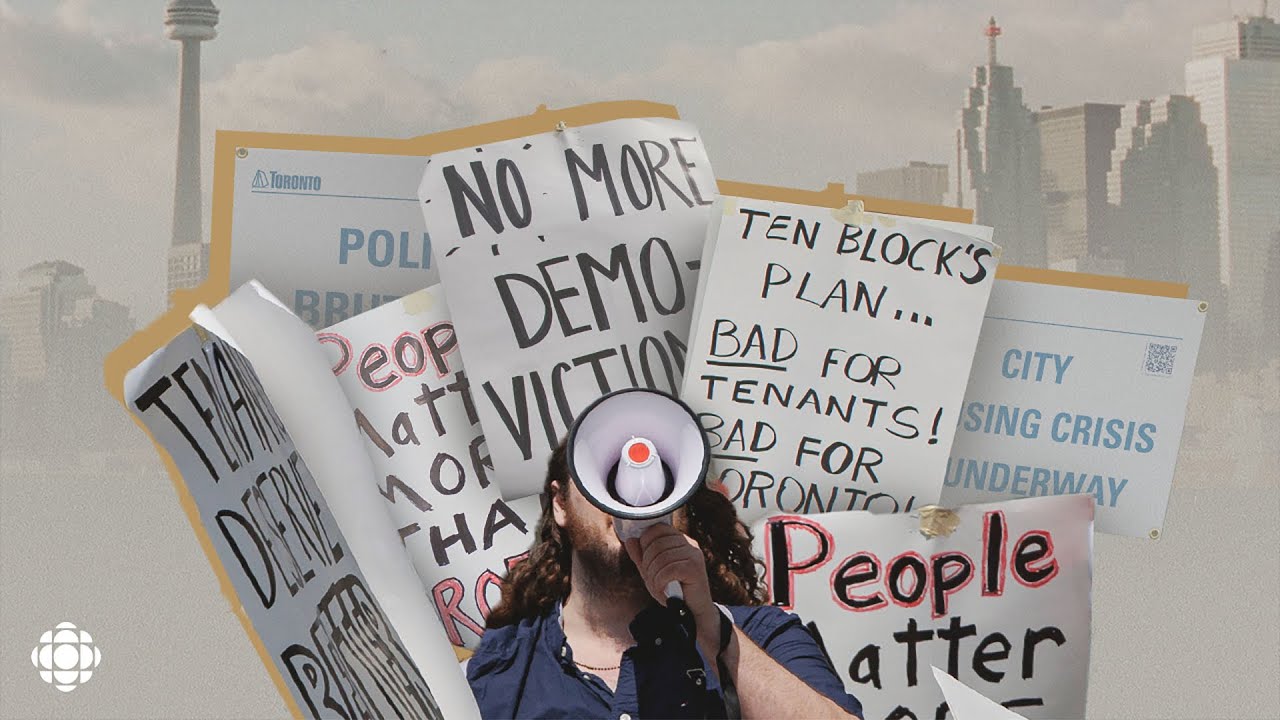
>> Steve: The cost of housing in Ontario far out stripped income gains over the past decade leading to what's widely seen as a crisis. The Ontario housing affordability task force's recent report offers 55 recommendations urging sweeping and immediate action. But big thinking can lead to big push back.
With us now on whether any of those suggestions have a chance of becoming policy, we welcome from the nation's capital in the Glebe, economist Mike Moffatt, senior director at the smart prosperity think tank and an assistant professor at Western University's Ivey business school. In Port Hope, Ontario, Alison Smith, assistant professor of political science at the University of Toronto and in Corktown, Eric Lombardi, founder of the volunteer housing advisory group more neighbours Toronto. It's good to have you three on the program tonight.
You just heard the former governor of the Bank of Canada and our conversation on his new book and I thought we'd start with each of you pluck one thing that you found noteworthy. Mike, start us off. >> Mike: I don't know if it's going to be helpful to tell generations -- future generations that they're going to have to get investors buying their homes and only going to be owning a small piece of it.
I think, you know, the point about progress is that things are supposed to get better. And I question whether or not that is a politically sustainable solution to say, okay, you can only own a chunk of your home and some far away investor is going to own the rest. >> Steve: He is not a politician, remember that, right?
>> Mike: That is true. But I think we may have policy revolt if that is seen to be the solution to the problem. >> Steve: Alison, how about for you?
>> Alison: I do have to say I was interested in his analysis of Jed Bartlett as a politician and whether we have a Jed Bartlett to lead us through this next pandemic recovery and everything. I think I agree with Mike in terms of the option that is are on the table for millennials and GEN-Z that partnering with investors or private sector investors and moving toward homeownership is sort of what that generation can look forward to. Canadians in Canadian housing policy history there have been periods where interest rates have gone up significantly.
In the 1970s that was the case and rather than looking to part another and share equity with private sector investors or developers, the government invested and provided interest rate subsidies to not just households low income but also medium households and subsidized housing. There are other solutions on the table but what I think what's interesting about the conversation we're having is it is really about restraining government development and I'm not sure that enough progress is going to be made by looking to limit government involvement everywhere we can. There are other options available.
>> Steve: Eric, what would you pluck out of the interview? >> >> struck me is the same as struck Mike. The idea that future generations have shared ownership to look Ford to.
I think especially in the "Globe & Mail" piece that he put out this weekend as well, where he expressed that he did not know and the economists did not know what the optimal prove of housing should be. It doesn't really matter what the economics say what the optimal price of housing should be because we can choose to make an objective as a society that housing costs should be lower and use the various tools at our disposal from market oriented tools on the supply side to direct government investment in creating affordable housing to demand side policies that demand speculation. In principle, we can say as a society we want housing prices to be lower.
We want them to be attainable middle class and working class families. The question is not what is optimal price. The question is what is optimal strategy from a policy perspective to allow us to achieve that outcome of lower housing costs broadly.
And I think the task force report is, in general, the very first step, a necessary step. But on its own insufficient to achieving that goal. >> Steve: Well, Eric, that's a beautiful segue to take us where we need to go now.
We do want to focus on this Ontario affordability task force report. 33 pages. Chack full of recommendations as we suggested in the interval to address the housing supply in the Province of Ontario.
I'll ask Sheldon to bring up this graphic to go through some of them. For example, adding 1. 5 million home it goes the supply over the next ten years.
That's the mission. Create, quote/unquote: As of right zoning instead of exclusionary zoning. We'll get into that in a moment.
Depoliticize the process of getting density built, re-more or reduce parking requirements and present appeals that are clearly laid at housing policies. We've seen a lot of those. Mike, overall recommendations what do you think?
>> Mike: I think overall they're fantastic of the task force had a very limited mandate but they weren't looking at affordable housing or for the most part purpose-bill rental or speculation. But what they've got here is a fantastic start of getting more housing, more what I would call family friendly climate friendly housing in our cities. Overall I think they've done a fantastic job with the limited mandate they have.
>> Steve: Understood. Alison, you being the political scientist I will ask you this question: Do you think these are political viable recommendations? >> Alison: So the Canadian federation is interesting where sometimes we have a situation where one level of government will kind of go beyond what its mandate is or what its mandate normally is to sort of get another level of government do something that it can't achieve on its own.
For example, in Vancouver where there were no limits on campaign spending and municipal actors basically asked the province to implement limits because it wasn't possible for local actors to do so. And I hear federal officials say this sometimes, too, that provinces will publicly disagree with something that the federal government is doing but behind the scenes will say thank you for making us do that because it gives us a little bit of cover. And so in this instance that might be what the province is doing.
It's appealing to some of the people who I think are supporting for it. This is the party of the social housing boondoggle. We don't want to increase government investment.
But rather create more space for the private sector. In a sense it aligns with the province government approach to housing historically and approach to housing protection. While also being a very interesting proposal for people living in urban centres who want more density.
But aren't able to achieve it because the way the system is set up there's a lot of barriers. You know, they say it's too hard to build housing. It's too easy to oppose housing.
So here the province is taking a little bit of heat off the municipality. So in that sense, if the province decides to go ahead with it, this is just a report. We don't know that they will or not.
But if the province decides to go ahead with it I think it opens up a lot more opportunities at the local level and does take some heat off local councillors and the mayor who may actually agree that this is a good way to go with housing. >> Steve: Mike, I know you're not a political scientist but you hang out with politicians from time to time and watch what they do. Maybe in your judgment you could tell us is the most politically tricky.
>> Mike: I think the one that's most tricky or the bun that's going to get the biggest bun fight are those around development charges. I read that a lot of these recommendations give political cover to municipalities who, you know, may think that these policies are good idea but have trouble convincing people. Ford's taken those off their hands.
But anything where the province is basically costing the municipality a significant amount of money I think you'll get some bite there. The municipalities will ask the provinces to be made whole and we'll have to see whether or not the Ford government is willing to do that. >> Steve: Now, Eric, the title of your group is somewhat self-explanatory, more neighbours Toronto.
But maybe you could go just one level deeper and tell us what your mission is. >> our mission is to get the policy reforms necessary to end the housing crisis both now but to create future housing crises from occurring in the future. The reality is we don't know whether or not this crisis is a bubble or actually based on real fundamentals.
But when it comes to policy reform there are really three pillars to getting what we need. We need more private market supply. We need more direct government subsidization of affordable and purpose-built rentals.
And we also need some demand said to measures that overall prevent bad behaviour in the market from driving up the cost of housing. Within all that there are lots of reforms that help everything involved with that. And so what we're really trying to push for it the government reforms required to achieve those goals.
And one of the ways that we do that is by showing up to conversations on housing in Toronto which have been historically dominated by famously the not in my backyard local neighbours and community issues who really don't understand how opposing housing in their communities is actually creating this crisis. And so we organize people to show up and say, yes, future residents matter. These homes are helpful for people.
And people deserve to live in Toronto and in neighbourhoods. >> Steve: Now, Eric, when you say "we," who's we? Who's in your group?
>> it is very broad but in general it is young people under the age of 40. Many of whom either rent or own. Who are thinking about what do you want in life?
Like families, ownership, et cetera. And finding that Toronto and even the GTA have gone up and are totally inaccessible to them and a lot of them have to make sacrifices in terms of will I be able to have the number of kids that I want? Or will I be able to live somewhere where I have job viable options within a reasonable distance?
Right? Should I be looking at remote options. For me personally, a lot of my friends moved to the States to get jobs because it's just not attainable here any more.
And for us, we see this crisis as something that is fundamental to solving it. We're looking at a much worse future in the GTA than it should otherwise be. >> Steve: Mike, as you listen to the mission of Eric's group, I wonder if you think his policy prescriptions are too interventionist for a conservative government to embrace.
What do you think? >> Mike: I don't think they are at all. There are -- somewhere it's more government spending, obviously you are going to have a little bit more of a push back from the government.
But a lot of this is government doing less. You know, getting less in the way. You know, less red tape and that kind of thing.
And we're going to need solutions that cover the ideological spectrum: Sometimes it's going to be less government and sometimes it's going to be more government and we need to be very pragmatic about it and not, you know, not have ideological blinders. >> Steve: Okay. Having said that, Alison, maybe you could pick up the store Friday this standpoint.
We know because these donations are made public that property developers are among the most significant contributors both municipally and provincially to campaigns. And I wonder whether it's really possible to divorce a good public policy planning as it relates to housing policy from what those who pay the piper and maybe occasionally call the tune would like. >> Alison: I mean I think a really good example of that is Ontario's refusal to allow municipalities -- or to download inclusionary zoning powers to municipalities.
B. C. municipalities have had that power since the 1970s and have used inclusionary zoning to mandate the contribution of affordable housing in new private sector developments and that has been a power in B.
C. since the 1970s. There are very close relationships municipally and provincially between politicians and developers.
But I think in Ontario because that power was not devolved earlier, the reluctance to download that policy speaks to the fact that that takes from a developer's profit. It's really unfair to municipalities, that the province has held on to that power for so long after it's been the only province in the federation to download responsibility to municipalities in the 1990s through service requirements. But it would also have allowed municipalities to contribute more to.
But nowhere what's needed. But made contributions. I think the relationship between developers and politicians is close.
And the fact that this task force has made recommendations specifically regarding zoning that tells me that developer does actually have an interest in this type of taking -- getting out of the way of what they're able to do of where they're able to build and what they're able to build and you just need to look at the composition of the task force and the recommendations that they made to sort of conclude that this is a good opportunity to contribute to the missing middle. But it is also something that private sector developers are interested in. There may be some overlap in terms of who's benefiting here, though.
>> Steve: Eric, can I get you to weigh in on the relationship between governments, plugger, and the development industry? >> yeah, I mean just like any industry there are going to be relationships between the development community and the government. And, you know, frankly, some developers and the way that they've behaved over the last couple of decades have earned them their bad reputations.
But everyone reacts different to incentives in the market. In Toronto and the GTA the incentive that leads to is the fact that land is unavailable. And so the reliability of that scarcity is allowing bad actors to sit on land that to sit on land that could otherwise be developed.
But what these task force recommendations actually do is alleviate that land scarcity by opening up more neighbourhoods to smaller forms of development. And what you'll actually see happen is smaller developers and new entrepreneurs enter that space. Families take home renovations to turn a house into maybe two houses and the cost for doing these things is lower.
So from my perspective, the additional politician will be welcomed by some in the development community who really want to make money off of building more homes versus others who are speculating on land and want to make their profits on margin. So I don't think that the development community is as ideologically aligned. And I don't think the task force recommendations are as aligned with pure industry as some opponents are making it out to be.
>> Steve: Before we pursue those ideas, Mike can I get you to weigh in on this political donation relationship between what developers give and what they feel they're entitled to in terms of provincial policy? >> Mike: Well, I certainly think that's an issue. We have to look -- there are three broad groups here.
There are the landowners, there are the developers and the home builders. And all three groups are big donors but they're not necessarily aligned with each other, have the same interests. And even within the groups, you know, you could have some wanting to build more.
Others wanting to build less to keep prices high. But I think furthermore we have to remember that when we look at municipal politics, you know, there are a lot of donations there and a lot of those donations come from existing homeowners who don't want change in their neighbourhood. It is not just the forces of change who are donating to politicians but it's the forces of not in my backyard or big political donors.
I mean you have to consider them as well. >> Steve: I thought NIMBY was not the preferred term anymore I thought it was banana, what is banana again? Build absolutely nothing anywhere near anything.
Since you put the policy decisions on the table let's go there. Mike, if you would, what is as-of-right zoning? >> Mike: Well, basically, if you own an existing house there are things you can do and can't do as of right.
So, for instance, I can basically tear down my house tomorrow as long as I get the permits and build a Mcmansion or something like that. But if I wanted to build a duplex or triplex or garden suite, often times they would have to go through a community process and all my neighbours would get to veto that. So basically what this would allow is property owners and landowners a wider set of options to build without, again, having to go through this community process.
And the idea is that it would allow more for missing middle developments. Allow for more granny suites and allow more from every piece of land which is absolutely needed in our cities. >> Steve: Eric, I'm trying to imagine how well, it would go over with the neighbours if somebody bought a large piece of property in Rosedale and tore down a big old house and decided to put up four smaller houses or four units in a big place in its place.
You would be able to house more people. How do you think the neighbours would react? >> the vast majority would not care that much.
And I think one of the issues in the conversations that we have about housing is that we highlight the forces and voices of people who are life-long perpetual complainers who simply reject the idea of change in their neighbourhoods. I do think the vast majority of people would be fine with building more housing in their neighbourhoods. Right?
There is a minor inconvenience that comes with construction. But, you know, I would really say that we listen far too much to those who complain. And the vast majority of people in most community meetings, most developments are simply not showing up because they're relatively indifferent to it and I think that's a really important point that we need to make sure that our politics is really reflective of what neighbourhoods think.
And most are not as against these types of changes as the NIMBYs would imply. >> Steve: Alison do you agree with that? >> this is gentle density.
We're not talking about big condos or even 10-unit apartment buildings. That is a fairly manageable amount of density being added into existing neighbourhoods. I do know that there is already a lot of strain in a lot of neighbourhoods already.
When I lived in the west end of Toronto, there were. So albeit condo developments but condo developments going up and right next not advertisements about the condo development was a posting from the Toronto district school board saying you are not guaranteed a spot in one of the schools in this neighbourhood if you move here because the schools are overflowing. And that's where the point about potentially waving those differences which municipalities will use to invest in social infrastructure could create some problems in certain neighbourhoods if there isn't the social infrastructure to be able to welcome more people into the community.
But I think generally adding, you know, four units with where there was one, or adding two units where there was one or three where there is two that's not a huge inconvenience to the neighbourhood life around there. It's more in terms of those big condo developments that are going up. Where I think you might see more opposition.
>> Steve: Well, Mike, let me get you to weigh in on that in this respect. The conventional wisdom is that people who need places to live are all too happy to have neighbourhoods change their characteristics in order to accommodate that. And the flip side is the people who already live in those neighbourhoods don't want them to change at all even though there may be a housing crisis out there.
Is that conventional wisdom wrong nowadays? >> Mike: I wouldn't say it's wholly wrong. As Eric points out it could be overblown that most people are indifferent.
But certainly you can see, the people who believe themselves to be inconvenienced by this will show up. But the people who are inconvenienced by not being able to live in that neighbourhood don't show up because those houses aren't built and they don't really know that they're getting blocked out. And I think that's -- to go back to the task force report I think that's, you know, the sort of brilliance of dealing with this at the provincial level where it takes that sort of local neighbourhood politics out of it.
It sets a baseline minimum standard for all municipalities. So you're not doing the block by block neighbourhood by neighbourhood. But instead setting these minimum standards and then it becomes more of a general -- you know, Jenae approach rather than, you know, doing this house by house which, again, can engender opposition.
>> Steve: All right. In which case, Alison, the provincial election as we know is less -- fewer than 100 days away. Do you see any parties on the spectrum that are embracing these recommendations and, thereby, intending to run on them when the election campaign is eventually called in May?
>> Alison: I mean that's a tough question. There's a lot going on. The parties are talking about and are not talking about.
So I'm not totally sure where they're currently standing on this. I think the Green Party has tended to have a pretty interventionist ace approach to housing and one that really dozen courage densities. Oftentimes I think what the Green Party does in its housing policy is sort of adopt aspects of other parties' policies to hold you to account kind of thing for what it is you said you were going to do or what we know some of the solutions are.
I think -- we're not going to zone our way out of this housing crisis. There is a lot that can be contributed by making changes to zoning. But there's also a huge role for the province.
And there's an opportunity here for whether it's partnering with private sector developers to add subsidies for guaranteed affordable housing, increasing rent supplements for people. There are a whole lot of different tools that are available that will not just get at this missing middle. I'm concerned in the first few years might be missing upper middle class and won't really affect people at the lower end of the income spectrum.
I think there's room for this to be one aspect of a party's policy. But maybe from those parties from the left we might see some more moves to partner, to really take advantage of the national housing strategy and the money that's on the table to partner with municipalities as opposed to saying municipalities you've been making bad decisions and we're going to come in and fix it and move out. That's not going to lead to a solution across the housing crisis that is needed not just in Toronto but in places increasingly all across the province as well.
>> Steve: Let me pick up on that. To the best of your knowledge are there other jurisdictions across Ontario or across the country which -- and let's take the example we've been talking about -- which allow somebody to buy a big house and tear it down and put up a triplex or a four-unit house in its place? >> Mike: Not in enough places but to comment on this, when we look at the politics of housing and how it relates in other places, right?
There are markets that are ahead of Toronto and even Canada on a decision-making process. You look at New Zealand that, you know, the politics of housing has reached a point such that they're able to secure these reforms. You look at California, Oregon, Massachusetts.
So many of these jurisdictions are facing long -- housing crises are now saying, yeah, do you know what? We recognize that the policies in place and restrictions and the difficulty of the process is a huge barrier to getting housing of all types created. And so my message to our critical -- to our political leaders is don't hang on to NIMBY-ism, it has become dirty.
If you want to win the election, boldness on this issue will be rewarded both from a volunteer Speaker perspective but I also think a volunteer perspective because these types of reforms winning elections in places like Ontario. When it coming toes the political parties I do think we will see some ambitious proposals. Especially I think the Ontario Liberal party will have some.
And I think, you know, even the PCs and NDP are both weighing right now just household bold they need to go. And is this issue going to be a winner for them? In many cases I think yes.
>> Steve: We'll keep our heads up for that. In our remaining moments let's put one more issue on the table and that is the issue of mobility. Mike Moffatt, think you have done some work looking at what's been happening in terms of people either coming into or leaving the capital City of the Province of Ontario.
What have you found? >> Mike: Yeah, well, before -- the year before the pandemic we saw 60,000 people leave Toronto and Peel on net for other parts of the province. And the most common age for them to leave is zero.
That is they're kids under 12 months. We've seen this exodus happening before the pandemic. Basically young families getting priced out.
Maybe they're living in a 600-square-foot condo. They have a baby or babies on the way and the couple is this ain't going to work. They're going to drive and qualify until they find a house and often it's in a small community like Thorold or Tilsonburg or Luken.
And this has only picked up during the pandemic. Now we're seeing mostly in Toronto but a little bit in Peel as well missing -- you know, a decline in the number of children under the age of 5. Because, again, they're kind of spreading out all across southwestern Ontario.
>> Steve: Should that, Alison, be of concern? >> Alison: I'm -- you know, yeah, it should be. If people are -- if families are leaving there's a lot that families can contribute and a lot that families can gain from living in an urban centre.
The one thing I moved from Toronto to Port Hope. My children were older than zero. They were 2 and 4 when we did and there are a number of reasons why we left.
But I think, like child care is also a crushing cost in Toronto. And when you have a baby and you are looking at the wait list for child care and you are looking at the cost of child care, which, for an infant can be up toed 2,000, $2,500 at minimum, currently for child care, plus you add exorbitant costs for rent, families who are renting homes are constantly living in fear that they might be evicted in the owner moves back in or sells. So I think -- I wonder if Ontario will sign a child care agreement -- we're the only province/territory that hasn't -- that would take a big burden off of families in the City of Toronto to be able to plan to have families, to afford housing, maybe if this missing middle comes or if the housing market cools.
But then also look at being able to manage the costs that are associated with child care as well. Knowing that it's affordable. Knowing that they don't need to delay a second child until their oldest is in school.
So they don't have to pay, you know, two costs of child care. Those kinds of things. So I wonder if it might be temporary or is there may be more of a longer term trend in terms of people wanting more house, more people being able to work from home, those types of changes as well.
>> Steve: Let me do a quick follow up with you. Do I infer correctly that you don't have to thrive from Port Hope to Toronto five days a week anymore? >> Alison: Not five days a week, no.
It would be one or two days. I also teach in Mississauga. I grew up in the interior of B.
C. where there's no rail transit and Greyhound has been cut so it's very difficult to transit around that province. So Southern Ontario is a different situation.
There is a VIA Rail stop here. "There is a House Here" are go trains. So the plan -- I have a little one who is currently ineligible for vaccinations so I'll being careful in what I am doing at this point in time but there is train transit to get downtown or to Mississauga.
And I'm fortunate I can do my job on the train. If it was five days a week that would be too much to manage. But it is a privileged position to be able to work from home most days of the week.
And then to take transit in when I'm teaching in person. >> Steve: Right. Eric, let me give the last 30 seconds to you on this.
how much concern do you have about the fact that there is an outflow of people -- 60,000 net according to Mike Moffatt these days? >> families are the future of the city. Young people especially are more likely to start businesses.
We had a member do an analysis of Toronto district school board availability. And one of the shocking things is, you know, there's actually a lot of schools in neighbourhoods that are shrinking because of these rules that have so much capacity that they're actually at risk of closure. And that really should not be the case in a city that is supposed to be growing.
And so the fact that we see families leaving is not an indictment of life in Toronto. It's an indictment of affordability in Toronto. It should be the goal of a policy outcome to staunch that.
>> Steve: Gotcha. Eric Lombardi, Alison Smith, Mike Moffatt. It's very good of you to join us here on TVO tonight.
Many thanks. >> All: Thanks.