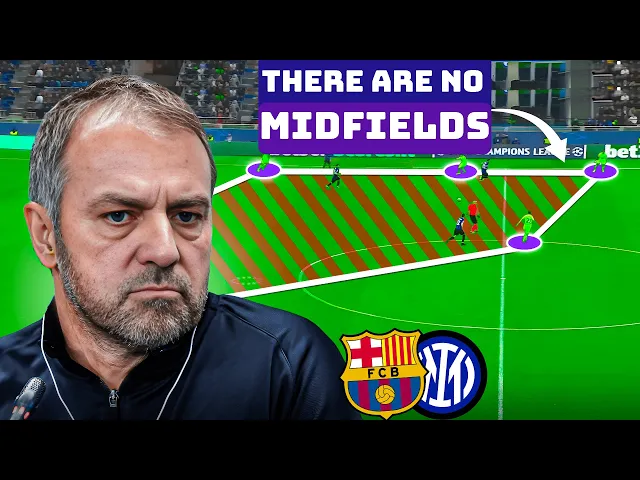
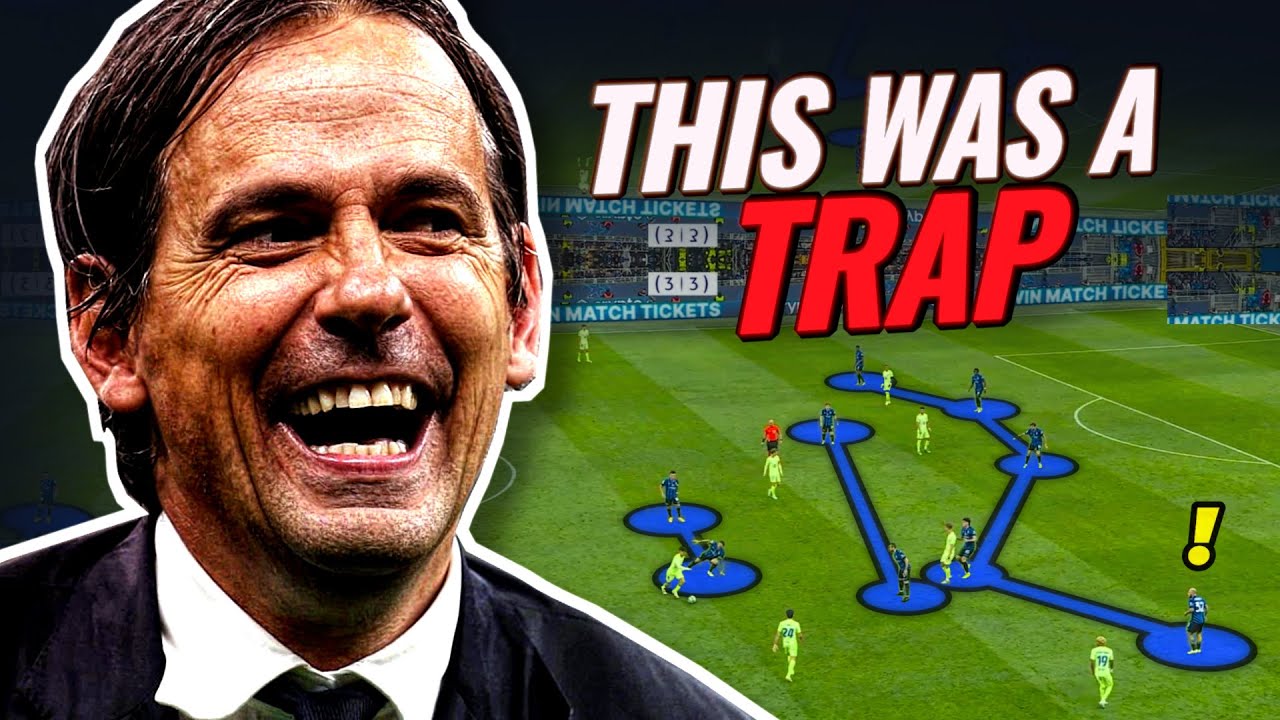
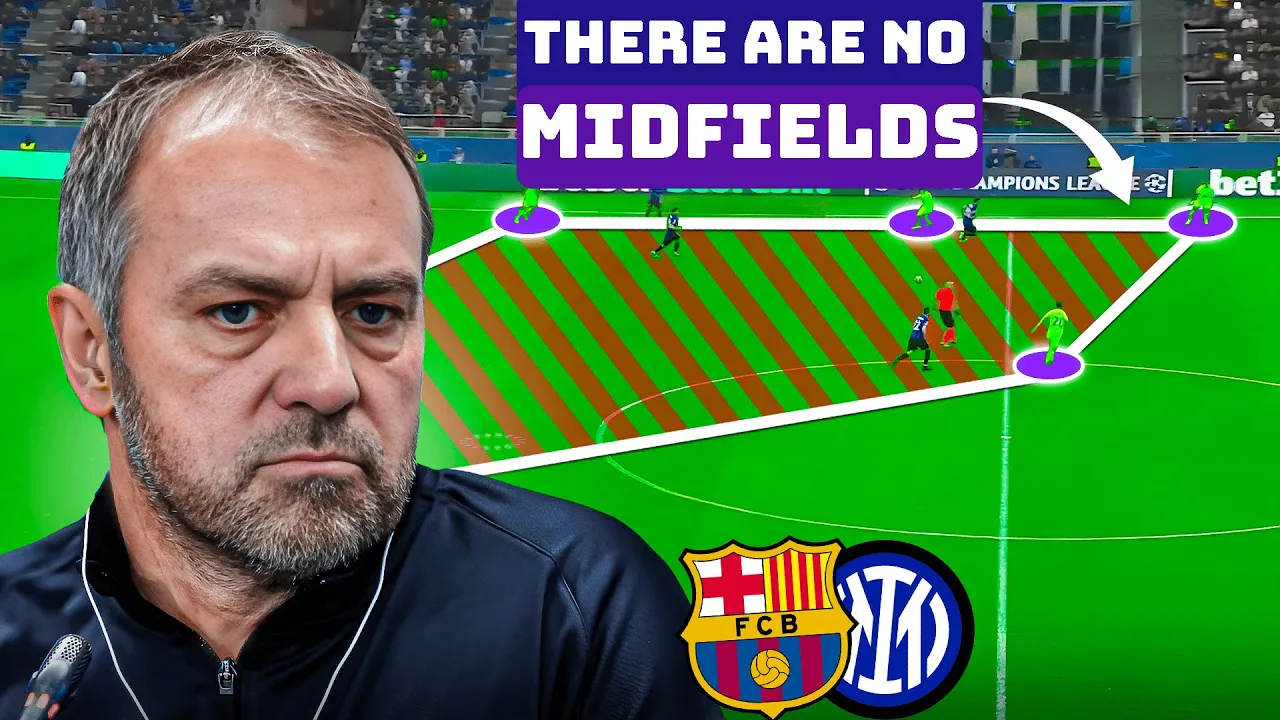
We often think a game is decided by what happens in possession. Or maybe if we take it a step further, we believe it's what happens in the defensive phases that determines the game. But Inter Milan versus Barcelona was decided by the fleeting seconds between these two phases of play.
The beautiful game is alive and well, and the tactics in this match were fascinating across both legs. But let's not waste any time and first look at Barcelona in possession as they ended with 71% of the ball. Early in the match, Inter were a force, pressing with the ferocity even from the Barcelona goal kicks with the front two readying the immediate pressure on the two center backs with Dumpries and Demarco backing this up as they were confident that the physical back three could handle anything that came over the top.
And this was the case with Chzny in the opening exchanges being forced long more often than not resulting in turnovers. And this theme carried on in open play with Inter Milan often taking up a similar pressing shape. Although Barela was the glue in the press due to his engine.
Whenever Terram or Martinez were caught out of position temporarily or pressing the goalkeeper, Barela never hesitated, always keeping Dong in his cover shadow while pressing the remaining center back to ensure that Barcelona's backline never had the room to breathe. In the early stages, it was a combination of Inter's mentality and their setup that made the press successful because the midfield was always backing up the press. The deadliest pressure comes not from individuals hunting, but from units coordinating.
And the opening goal shows shades of this with Demarco and Dumpreyy's aggressive positioning in attack and in the press in general, allowing Demarco to be involved in the counter press and helping in win the ball back. And the opposing wing back Dumpries is still high and he is able to put it on a plate for Martinez. But the interp pressing shape was also showing that there were gaps that the Blana could exploit.
The positioning of the Barcelona wingers was always a consideration for Inter as whenever the wing backs did press, it meant that they were exposing these spaces behind them and this could lead to a Barca winger receiving freely or more likely a wide center back being dragged into an isolated position. Not a good situation. Sensing this at times we did see hesitation from the pressing wing backs resulting in situations like this where the inter forwards are doing their job in the press but Dumpries is late to press Martine due to worrying about Rafinia moving wide behind him.
This gives Martine the space to get his head up and play a line breaking pass eventually finding Rafinia in the position vacated by Dumpries. As a result, especially once in were ahead, Dumpries was more conservative in the press, happier to allow Martin to have this space to advance because he was not an attacking threat. So in did not mind the left back getting the ball and advancing.
Or at least that was the thinking because we'll get to how Martin changed in the second half. But the problem for Barca in the opening exchanges was clear. The man-to-man press against their backline meant that they could not get into controlled possession phases, and the pain of Valde was clear at times.
His presence means that in scenarios like this, it's easy for usually Kundai to tuck in as the third man with a left back providing genuine threat high up the pitch. This would now mean that Barcelona have a three versus two advantage here using just their defenders. But in the first half, Martin was not that big an attacking threat.
Well, at the same time, he was not expected to invert into the back line. So instead, it had to be Frankie Dong who was almost a full-time central center back in the buildup just to allow Barcelona to hold on to the ball using this three versus two. But this in turn often forced Pedri or Almo into a deeper position.
Having Dong here for prolonged periods was not ideal as one of Flick's marquee strategies is having his midfielders high up to allow them to create central overloads. And we saw this in Fitz and Spert and how threatening Barcelona could be when all three of their midfielders were higher up. We saw this when in were pressing a little less and Barcelona got into settled position and rather than actually using a 42-31 or always having 238s, Pedri and Almo operated deeper in almost a traditional 4-3-3 with the key being always looking to remain on Barela and Mkhitaryan's blind sides for a key reason.
Particularly down the Barcelona ride, we saw Yamalo looking to receive deeper than usual and Demarco trying to remain touchight as always would be drawn up the pitch and because of positioning behind Mkhitaryan but Stony had to push extremely high up as Mkhitaryan could not pick up Almo and this left massive gaps on this right hand side which could be the perfect opportunity for Almo or even Rarely Pedri when he drifted across to make the run into. At the same time, it created not just isolations for Yamal, but isolations with plenty of room behind his man, which had him licking his lips. But here's the thing.
Trailing, Barcelona began to pour more and more men forwards. And here's the beauty of in. As much as possible when defending, they kept the front two high.
Meaning, when in won the ball, they always had at least two outlet options who were expert at playing off of each other. And Tam in particular was masterful in holding up the ball and bringing his mates into the game. But Inter were not just hitting and hoping to the front two.
The likes of Barela and the two wing backs were looking to provide plenty of support whenever possible. A defining factor in this match was that these teams had two things in common. Whenever they lost the ball, they look to counter press.
When they won the ball, they looked to be extremely vertical in the counterattack rather than begin a possession phase. This made their transitional phases extremely important because when Barcelona lost the ball in scenarios like this for example, Inter instantly committed men for those vertical passes. So now if in escaped the initial counterpress they had acres of space to exploit.
But if Barca was successful in the counter press, they could take advantage of the spaces in just vacated behind their wing backs. And we did see that at [Music] times and in did exactly the same in transition looking to use the space behind the boss of fullbacks. Whoever controlled the transitional phases would control the match.
And it showed that the modern game's currency isn't just possession, it's decisiveness after possession changes. But the reality is both sides struggled to control the transitional phases. Meaning there was a lot of pingpong going on in the midfield at times.
So what changed in the second half? Well, this man right here, remember that space that Dumpries afforded Martin in the first half so that he could help BC cover Rafinia? Well, Martin decided he would now make the most of it and ended the game with the second most touches.
The young Spaniard began to attack it more aggressively, but rather than stick to the by line and run into traffic, he produced outstanding crosses from this zone, aided by Barcelona, committing plenty of men into the box as they chased the goals they desperately needed. And down the right hand side, the individual quality of Yamal continued to shine as he completed a ridiculous 14 dribbles. And in general, Barca created chances that on another day might have nestled in the back of the net.
But despite only having 29% of the ball, this was no Katanacho style performance from Inter. And in possession, they were quite interesting. Inter biased their back five to the right hand side from the goal kick with the right back moving up to right wing and the right center back moving to right back.
This forced Barca into their own lopsided shape with Martin staying deep to handle Dumpries and Rafiniah wide whilst down the right Yamal came narrow on Bastoni and Garcia was hyperaggressive on Demarco. But in always had the option to play long to their center forwards. And importantly, they only used a single midfield pivot in the buildup phase from the goal kick, which in turn allowed Barela and Mkhitaryan to take up these positions, ready to support the wide man or to receive the second ball from the center forwards.
But the real threat came when Inter played short from the goal kick. Boss's left was well protected, but having Garcia so high up left them vulnerable down this flank due to the space in behind. Demarco and Mkhitaryan consistently combined to take advantage of that space.
Whether it was Demarco looking to find the Armenian, but more often they used one twos to get the Italian into dangerous positions in that space. Having initially dragged Garcia higher up the field and in fact taking advantage of this flank almost led to the opening goal in a different way. The principle is the same.
Bastoni dragging him off central and Demarco drawing Garcia. This time though, Bastoni makes the run into the midfield and receives the return ball. And again, Mkhitaryan is there to take advantage of the space and almost puts in a game-changing cross.
And it was clear from the off that in would be looking to take advantage of the Barca high line. And they got close on a lot more occasions than they did in the first leg. Firstly with Terram timing his runs better, but also using multi-wave runs with midfield and wing back runners, meaning that Barcelona not only had to catch the first runner offside, but also the second wave runner, a much tougher proposition.
For the entire season, Barcelona has thrived in chaos and always come out on top. But sometimes the champion of Europe isn't crowned for surviving chaos. They're crowned for controlling chaos when it matters.
But who do you think will be winning the Champions League this year? And a quick reminder, if you've always wanted to master tactical analysis, the early bird period for tactical mastery is almost closed. Tactical mastery is my program designed to teach you everything I know about analysis from the ground up.
So that goes from basic concepts to advanced concepts all the way to how to write engaging tactical concepts and a software walkthrough of how I put it all together. It's designed to teach you in the same simple style you know from the channel. And to top it all off, if the early bird pricing isn't enough, you can get an extra 10% off using the code extra 10.
Check it out through the link in the description or the pinned comment below.