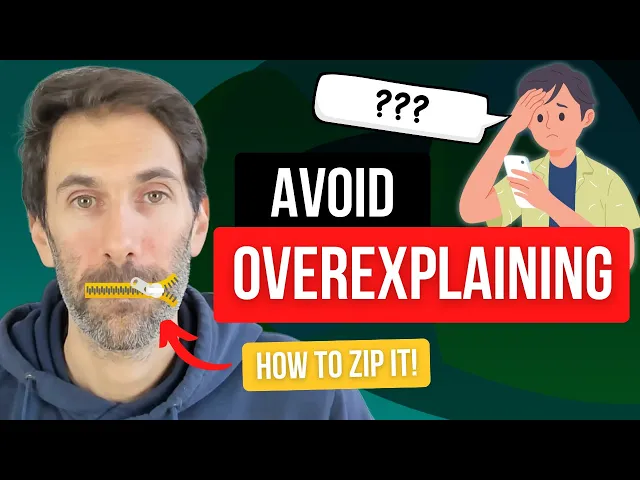
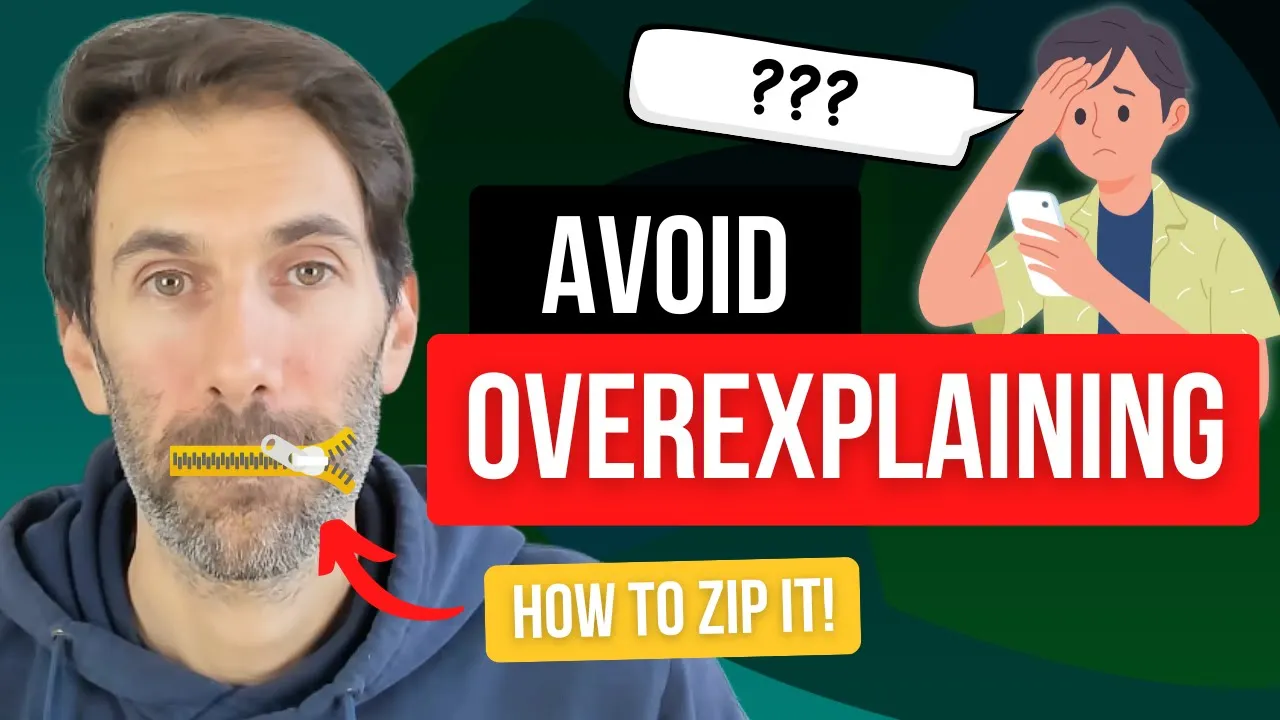
Are you an over-explainer? Do you sometimes send really long emails or texts in an attempt to clarify a situation? This is an extremely common trait in the autistic community.
I know I've done this a lot myself as well. It kind of makes sense at first. I want to avoid misunderstanding by clarifying more, but unfortunately in real life, this habit comes with some pretty serious negative side effects that are probably damaging your relationships.
And it also turns out that over-explaining is linked to a really common executive function challenge, which we'll discuss later. Hi everyone, Paul Micallef here from Autism From The Inside. I make weekly videos showing the human side of autism.
So make sure you hit subscribe to get the latest content. So I definitely identify as an over-explainer. I have sent my fair share of extremely long emails and texts and things like that in my time.
And while it may be reasonably easy to identify the extreme cases of where this kind of thing is inappropriate or ineffective. Recently, I've been becoming more aware of how this type of thinking that leads to that behavior is actually present in a lot of interactions in everyday life. It's that little compulsion to just add one tiny little extra explainer sentence, like I was late because, or I'm calling you because, or I'm not coming to your birthday party because, that kind of thing.
And the temptation is to imagine that by giving the other person more information, I am helping them to understand my actions and my decisions, and it's going to clarify the situation and avoid misunderstanding. And this is particularly problematic because the worst type of lie is a half truth. That's almost true.
It sometimes helps with understanding to clarify things and provide some explanation. But ironically, providing too much information and over-explaining actually causes significant misunderstandings a lot of the time. And one way that helps me to think about this recently is that the more words I say, the more chance there is of a misunderstanding, because you only need one or two words to be a bit off or cause a little bit of confusion and suddenly I've accidentally introduced a new source of misunderstanding that wasn't there before.
This is a little bit similar to some really common sales advice. After you've given your pitch, zip it. Do not keep talking at someone.
Let them process the information you've already said, because it's entirely possible that you've sold them already and the more and more and more you talk, the more information you're adding and they're actually gonna find a new problem with the situation that wasn't there before. So let's look at a couple of examples. In my experience, I'm often tempted to over-explain when I feel like there's already been a miscommunication.
You've misunderstood something about me and I want to correct that misunderstanding by explaining the misunderstanding and what to do about it. I remember once I sent my psychologist a really long email trying to explain something that I couldn't quite get out in the session. I didn't feel like we were making much progress.
I wanted the sessions to be a little bit more client-led. I felt like the questions she was asking me were kind of interrupting my flow a little bit. Anyway, so I sent this huge email being really, really clear on all of the things that I now understood that I couldn't verbalize in the moment because I hadn't processed it properly.
And in hindsight, I'm pretty sure that sending that email irreparably damaged that relationship. Why? Because I shared too much.
I brought up too many different things that were not understood. And from then on, it was not possible to close all the little gaps so that we could actually come back on the same page. Also in hindsight, I probably could have summed up that entire email in four words.
I don't feel heard. That's it. That's the message.
That's the core of the message that I was trying to convey in that extremely long explanatory email. But, and here's where the unintuitive paradox comes in, if those four simple words, I don't feel heard, are not understood and are not clear, then it doesn't matter how many words I use to try and explain it, it's not actually gonna help. Most of the time, misunderstandings are around differing perspectives on very simple things.
Sometimes explaining can help, especially if there is a very key piece of information that the other person doesn't know about the situation. For example, I might say, I'm sorry, I didn't get back to you for a week. I've been sick with the flu and couldn't get out of bed.
And this is adding some information to help the other person understand the situation. Whereas my long email was mostly analytical. It was explaining things like what I was thinking.
It was explaining things like the reasons and motivations behind my behavior or how I interpreted the situation and the other person's behavior. And I've realized now that a lot of the time, unless there's some significant new information in that, sharing more about my background and my context and what I was thinking and how I interpreted the situation and then listing all of the different options that we could possibly do going forward, that's a huge amount of information. And because it is so much information, what it ends up doing is putting the other person into summary mode.
So when faced with a two page email, instead of reading it in detail, like it was intended, they skim it, they instead say, oh, well, I need to read this whole thing. How about I skim it for the important information? And of course there is no important information.
The detail is the important information. And I'm assuming that the other person reading this long email is going to read every word literally and pay attention to exactly what I've said and exactly how I've said it. But in reality, the more information I give someone, the less likely they are to actually notice every word that I'm saying.
And this happens all the time. It's really easy to misread a text. You flip one word around and suddenly it has a slightly different meaning.
So the solution to this, the practical way forward for someone like me who has the tendency to try and be really, really, really specific with language is to instead focus on what is the important message and try and express that as simply as possible. I actually learned this in a really powerful way when traveling overseas and trying to communicate in languages other than English. In English, I know exactly every tiny little connotation of every word that I'm using in a perfect way.
In a foreign language, that's absolutely not the case. I'm picking a word that's probably close enough and I'm just crossing my fingers and using some hand gestures and hoping that my meaning is getting through. So weirdly enough, that actually taught me the value and the power of speaking really simply and not trying to layer so many complex things into the one sentence.
There's also a difference between overexplaining and oversharing. Oversharing, and I did a whole video on this, is where you're sharing information that should probably be private. Whereas overexplaining is when I'm not really sharing that much extra information.
I'm sharing all of my analysis of all the information that we already have. And to be honest, that's one way that I feel seen and heard. When I can share that inner experience with someone else, I really feel connected to that person.
So in a positive way, when there is no misunderstanding, I enjoy explaining my inner workings to another person and for them to hear it and for them to say, wow, that's interesting. I would not have known any of that if you didn't share it with me. So in the context of a relationship, that can be really, really good.
The problem comes when I attempt to have that really, really nice connection in a different context, in a different relationship, where the person is not actually able or capable, or maybe even where it's not even appropriate for them to know me at that level. And this is one of the most frustrating things that I had to just accept about the world, which is that the fact is most people will not be able to connect with me on that level. Most people, most relationships, most situations, it's not going to be appropriate for me to share everything that I would like to share in that situation.
I would like to share background and context and how I got here and the thought process behind it and all of the other interesting things that my brain is full of, but outside a couple of really special relationships, that's probably going to push us into the territory of misunderstanding rather than leading to more connection. When I first discovered my own autism, one of the things that it explained was why I felt forever misunderstood. And this goes back to reinforce the same cycle, because if I feel misunderstood, I am more likely to try and explain to get out of that feeling of misunderstanding.
So the opposite of that, I found to be an incredibly freeing concept, which is to just state your truth once. And this way, I don't feel like I'm arguing, I don't feel like I'm fighting, I don't feel like I'm trying to get someone who doesn't understand to understand, which is almost impossible. I'm also not trying to force someone to hear me who's not interested in hearing me.
It might be really sad that they don't want to hear what I have to say, but that's the really sad, frustrating reality that I need to accept a lot of the time. So instead, the strategy is state your truth once. That way, I've said very simply, very clearly what I needed to say, something as simple as I don't feel heard, no super long email necessary.
And then if that simple message is not heard, well, I've done everything that I could do. Another way I like to think about this is that the truth resonates. So it's like hitting a bell, you hit the bell once and then you let it ring, shut up and let it ring.
Don't keep hitting it, that's noise. If you just keep hitting a bell all the time, it's creating a lot of noise, which spontaneously encourages the listener to block it out and turn it into background noise. Whereas if you hit it once and let it ring, it's like a sound that people can actually hear if they want to.
Anyway, that is a helpful way I've found to think about this. Very interestingly though, this whole concept of over-explaining is actually directly linked to an executive function challenge. Prioritizing is a core executive function skill.
If I cannot identify the important part of what I want to communicate, then I will communicate everything equally importantly, and leave it up to my listener to read the two page email and then start to think, well, what is he trying to say? What is the important part of this email? So if I can instead take that job on myself and figure out for myself, what do I actually want to say, then it makes it a lot easier to communicate that clearly.
And this is becoming more and more and more clear to me through my coaching work as well. One of the main jobs of a life coach is to help the person get really, really clear on what they want. And what I've noticed is a lot of people come to me and they say, this is what I want.
Can I share all of the background with you? And I imagine that that's probably the way they're used to dealing with problems. We have a problem, how about I share all of this information with you?
And then once we've digested all of this really detailed information, then we'll move on to actually tackling the issue. And instead I suggest something very similar to what I talked about in the executive function video just recently about a top-down approach. Let's start with the most important thing.
Instead of starting with the itty bitty details of everything that happened in the situation that we're talking about, how about we start with the really high level of what do you want from this situation? What are you trying to do in this situation? That kind of thing.
And then we can identify what's most important. And you know what? Most of the time, we don't even have to get down into that nitty gritty level, which saves a huge amount of time because we haven't had to process all of these background things because it turns out they weren't as important as the core message.
Anyway, I don't know how much sense this is making. I should probably finish up soon, but I'll leave you with one last little tip. Overall, I've been talking about flipping from a bottom-up approach of sharing all of the nitty gritty information first to a top-down approach of figuring out for yourself what is the most important thing here.
And when you do that, when you start with that, then suddenly text messages become a lot easier. I used to really, really struggle with text because it's SMS, short message service, or at least it was in my day when it was invented. You're expected to say one or two words, not write an entire paragraph.
But for someone like me who's used to writing an entire paragraph, how do you do that? The answer that I found is to say in one sentence what it is that I wanna communicate. Something like, I would like to see you again, or I'm not coming out tonight, or would you like to go hiking on the weekend, or would you like to go in for a joint present for Mother's Day?
Whatever the core reason for the message is, I put that in the very first thing in one sentence. And the other thing that helps me to not over-explain, because what I would previously do is I would say that and then I put all of the reasons that I'm sending this message, because I was thinking this, and then I thought maybe you this, and then, anyway. It gets really confusing.
So instead, I imagine what if it's like a conversation? What if I say hello, and then I wait for you to say hello back, and then I say my first important sentence, and then I wait for you to respond to that, and then we can have more and more detail later. So with emails, with text, with other things like that, if I have the mindset that this is a conversation, I don't need to share 100% of what I'm thinking in the first blip of the conversation, because I can just share a little bit of it, and then I can wait for the other person to respond.
And that has helped me immensely, especially in communicating via text. Because what happens very often is the response that I get invalidates all of the preparation that I already made. So instead of having all of these plans and oh, let's go to Hawaii, and we're gonna take three weeks off, and we get it like, oh, I'm busy that weekend.
Okay, well, I guess we're not doing that then. And so it's about getting the other person included in the process. I am way off topic now, but that's okay.
Getting the other person included in the process, and part of that is not oversharing, over-explaining, over-delivering in one step and waiting silently for a response, which is why I really like life coaching, because I get to spend a lot of time silently waiting for a response. I can say one or two small things, and then we just let it sink in so that we can find what's most important. And I don't think we do that enough.
I'm way off topic. I should really wrap up. Anyway, I'm actually gonna wrap up now as I keep telling myself that I really should.
So thanks for watching. I hope you found this interesting. If you're an over-explainer or if you are not an over-explainer and you're like, wow, that's interesting, I'd love to hear your opinion in the comments.
So thanks for watching and I will see you again next week. Bye. Bye.