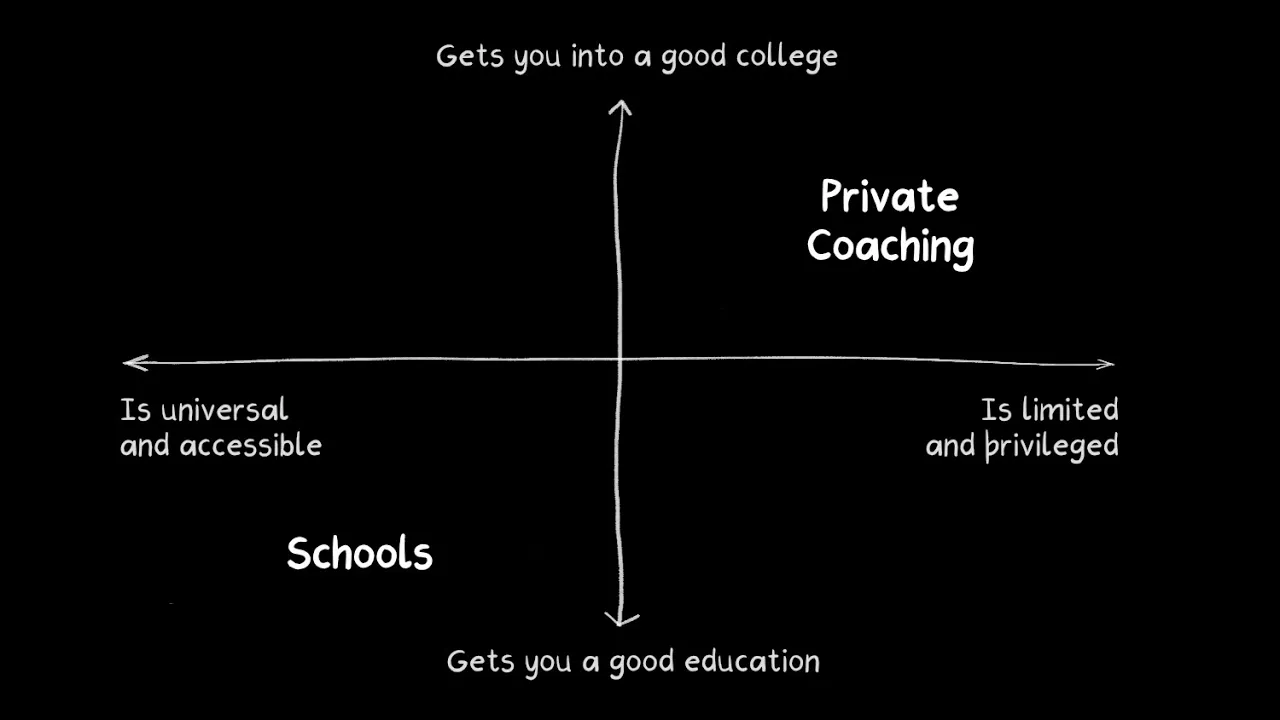
[Music] welcome again to 2x two a weekly premium business podcast from the Ken located at the intersection of curiosity and synthesis we like to call it your own personal investigative brain I'm your host Rohan dharmakumar and I'm joined as always by my co-host Trine gopal Krishnan I'm going to set up the context for the conversation and and it's I'm going to start with a very provocative headline which is private coaching is eating away at schooling India is currently in a slow but undeniably downward spiral with its school to college education system which is the best
method to not just harness our demographic dividend but also to help poorer families make the socioeconomic leap the schools to exams to college chain is broken perhaps because now it's the schools to coaching to colleges chain schooling is a complex and vast space there are over 59 boards in India including three National level ones there are differing syllabi uh there's of course the ncrt and state level ones various ones right it's a subject which is handled both by state and Central governments it has of course private and government schools then there's private coaching which is
of course dominated by the private sector it's estimated to be a roughly $25 billion industry by next year and increasingly private coaching is becoming the determinant of good education and in college not schooling and finally exams which are getting increasingly centralized and as a consequence of that accentuating our biases towards Central boards towards private coaching towards bigger cities towards boys instead of girls and towards families with higher incomes as a result 12 years of schooling which should is actually one of the largest Pens that an Indian family does over its lifetime is becoming disconnected from
college education and jobs of course this can't be sustainable which is probably why China in 2021 banned private coaching under the double reduction act double reduction because a it was designed to reduce stress and alleviate pressure on students and children and B it was designed to reduce the cost of private education and coaching and incentivize birth rates among citizens and families did it work I don't know it seemed to have pushed coaching underground and made group tutions disappear only to be replaced by secret and even more expensive one is to one coaching what should India
do that's the context for our conversation our first guest is Sumit meta co-founder and co-ceo of lead School lead school offers School edtech solutions that transforms education for 3.5 million plus students at 8,000 plus schools across the country with both parents as teachers Sumit CEO and Co co-founder of lead has education in his blood Sumit has made it his life mission to solve one of the biggest challenges in India's education system which is the gap in quality of schooling available in its small towns as compared to its larger cities and metros by focusing on the
tougher goal of transforming school systems he has chosen to stay off the Beaten Track followed by a majority of consumer K12 attech companies that Focus primarily on after school Solutions welcome Sumit it's really good to have you here thanks PR great our second guest is mahesar Perry who's the founder and chairman of careers 360 careers 360 is a data enabled and technology-driven education products and services company it integrates millions of students and institutional data points with its user generated preferences across 400 million students each year to help students explore and Achieve career plans based on
their interest and abilities careers 360 covers 36,000 plus colleges and offers 250 plus courses Mahesh has been an investment banker with SBI Capital markets and was with the Outlook group for 17 years including heading it for more than 10 years welcome to 2 by two Mahesh thank you so much bra and I'd like to introduce nitin P co-founder and director of the takash shella Institution nithin is the co-founder of Dr Shila which is an independent Think Tank and School of Public Policy based in Bangalore toila institution is an independent Center for research and education in
public policy it's a nonpartisan nonprofit organization that Advocates the values of Freedom openness tolerance pluralism and responsible citizenship it seeks to transform India through better public policies Bridging the governance Gap by developing better public servants Civil Society leaders professionals and informed citizens welcome Nathan to 2 by two hey guys happy to be here thank you all of you also I'd want to tell our listeners that two of our guests Mahesh and Sumit are joining us remotely so you might notice a slight difference in their audio quality all right with that out of the way let's
get into the discussion exams are getting increasingly centralized and I'd like to bring in Mahesh from kers 360 and ask you Mahesh how do you see exams in this chain so uh uh thanks for uh uh inviting me in the thing is uh if you look at the student uh U through the 12 years of education we prepare the curriculum we create the pedagogy we create a testing pattern we create the assessment pattern we assess them we pass them at the end of it we turn around and say listen it's not good enough right the
other part of it is that at every class if a student doesn't pass a certain level he's also detained in many of the states there is also detention system so he obviously passed and that's when he goes to the next level and the following level and the following level right so it is so unfair on the system to put pressure on the child to say listen You' done everything that we wanted you to do but it's still not good enough so you not need to clear something else for which whatever we taught you over the
last 12 years is not going to judge you right and that is very unfair if you now look at for example Kota kind of a thing or even the neat examination that happened recently you actually had students who got very very high score in Den examinations who failed the class 12th exams it's anecdotal one or two names have come out but many names would be there which have not come out remember that right and the other part of it is in one of the cases in in U harana where um U about six students got
720 on 720 when they were asked to take a r test they got less than 600 in fact right so which means dramatically lower than what they would get right and the school scores I'm told is very very bad there definitely seems to be a lack of sync between what is being taught in the schools to what is good enough for you to move to the next level so so in Delhi for example um like one is to have an entrance exam for engineering medical and all because there are limited seats and all in Delhi
the school education is demonetized you want to study further you need to write CU every Delhi student has to write CU to get into any undergrad program anywhere in the in in Delhi right it is so criminal because what is being taught in the school then and 85% of the students in Delhi are in government schools they can't afford coaching nor go through coaching right and when you now see the demographics of of the uh Delhi University School students you'll realize that you have disenfranchised a certain set of people because you impose something on them
which in the schooling system has not been taught and someone else who's better going through a coaching system is possibly coming through the whole thing and that for me is is is a serious issue because on one hand we want the government of Delhi push students to the government schools by know making the schools better than what they were and those kind of things they invested a lot of money on the schooling system but the schooling system scod no longer matters for you to even do any program any undergrad prog anywhere in the in Delhi
and that for me is very very wrong mahes if I can ask you exams and comparative exams have always existed in India right I mean uh all of us in this conversation are in our 40s so we've we've had those comparative exams even when we were coming out of school right what's the larger Trend that's playing on with exams that's not true but that's not true I think uh in our generation we had comparative exam but if you go back one generation to my father's generation just immediately after Independence board exams were actually the criteria
to get into higher education I think if you go back to the route what happened was that the quality of the board exams basically went down or it just was testing for Road and some of the engineering colleges and medical colleges said we want to set a higher bar and they introduced the the entrance exam you know and then I think everybody basically started to catch on so it is combination of the lack of innovation in the board exams because if you look at a cbsc or a state board it basically tests for memory and
then uh people who are doing a engineering college or a Medical College want more critical thinking skills so they introduce higher order thinking skill questions and then the Gap continued to widen and therefore the school Was preparing for board and then you had to have an additional thing coming to prepare for so there's it's been a it's been a gradual creep I would say over the last 50 OD years uh but if you just go back I mean there was a era where board exam was good enough to get into board exam scores were good
enough to get into colleges after this we discussed how competitive exams themselves don't really enable the student to do anything other than to clear an exam and to try to get into that desired College Mah I I know you've just a couple of days back put out this video which essentially analyzes the neat um exam and you did it in Fair detail we will will post it in the show notes a link to the video but I would like to ask you you're the one I I would argue that among the the three guests on
this show who studied exams and their evolution and you know their effects most closely what is your view on exams is it is it a necessary evil is it the only way we can solve things is it time to do away with it is there a better way to do it what's your view I mean I'm going to ask you to like you know tell us about exams specifically see I think uh I'll link uh exams to what ntin was talking about which is the outcome right ultimately we want our children to study learn and
then grow right now what coaching institutions do is they tell you choice this leave it for choice this question is not going to come or you don't need to learn this because it's never come in the past right so what they do is they channelize you to crack an examination and not to learn the subjects the concepts and the topics right and that is the reason why people who are topping the entrance exams also are failing in their own class examinations class board examinations right if you know if entrance exams will you know lot of
people say that listen coaching institutions teach you concept learn that's correct you know I think the coaching institions survive because our schooling education school education system is inefficient has it been slightly more efficient there is no way that a coaching institution can survive because if you learn a concept you learn a concept and you can crack that anywhere that you go including an entrance examination right but the problem with the examination is that it only channelizes the student to learn in a particular way only with a certain amount of uh thing like in in Hindi
now in in the Hindi Heartland you have something called kha I think Sumit would know about that what kha does is it says listen you just learn this 18% topics or up you will crack the examination right and every coaching Institution you know specializes in that is that is that the fault of or those who are preparing or essentially assisting you to crack the exams because doesn't this exist in some form all around the world there are people who help you prepare uh if you're going for an MBA they will help you write the best
application so if any place in the world where competitive exams exist to gate entry into uh you know set of coveted colleges wouldn't there be those who would help you crack it um in some way you're absolutely right that's a demand Supply that naan was talking about the way you dealt with is see a lot of people criticize Caple for many things that he does but I do think that you know he gave an equal weightage to the schooling system as much as to the entrance examination system which means that you learn over the 12
years in the school and that has got some value to it at this point in time you actually made it zero and that's a big challenge see because what happens is in school ner it is not on one single day that you assist you for unit test for there's a weit there's a term examination there's a weightage for that then for assignments there's a weightage and then you have the final Examination for which there is a weightage so it's a sum total of everything that you've done over two years or 12 years there is a
score that that is that comes out of it right now what we did was that we said the 12 years of work or two years of work or the one year of work on the class 12 for example has been completely de you know you said it's of no value for you now I will assess you on this completely different parameter that for me is a problem if you to put that back saying okay I give some kind of vitage to the schooling system also then the child has to go to the school he has
to learn in the school he has to be sitting in the school he cannot just walk away from the whole thing while he's preparing for something else and that might still be a good case but just to say that everything that you learned is of zero value and now I'm going to assess you only on it how you perform on a on a given day for me that's a big problem I'll I'll talk about exams and of course you have spoken about Nathan has said that it's an inevitability I know what you're talking about in
terms of private coaching I like to look at things through incentives and consequences so and again some of these are anecdotal examples but then we've already brought in anecdotal examples from Nathan who spoke about going to Majestic and getting Aid off so let me also join in uh so one anecdotal example is for example if you look at say uh an organ sorry engineering College like say bits bani now bits bani is a very interesting uh institution as an example because in the past the way how you would get admission into bits ban was exactly
through your board examinations I remember when I was doing my engineering or just around that point in time what they would do is they would look at all the board examination that are held all over in the country state boards and national boards and they would have a normalization system internally so they would create this thing where that says oh you've got 76% and you've come from say West Bengal state board as opposed to you got say 95% and you've come from Andra state board well through our formula we believe the ranking is this similarly
like for instance I went to another engineering College like nit TR nit TR does this thing where they used to have state quotas uh where they said that look from every state you send people based on your entrance exams you do your own counseling and when they come in here the number of students from every state is a constant so that was their system so the minute both of these moved into a entrance exam based system and you talk to people who are from bits vilani you will see the Unseen consequences of it like for
example they moved to a bitsat system and almost immediately from that year on the gender ratio changes completely it changes and skews towards men completely when you move away from the state based system into an i e system the state quota completely goes away and you stop seeing people from like RC and other RS and nits at that time had this thing where you had every state you had some set of students in it so in a sense over your four years it's almost like you have seen the whole of India but now suddenly that
changes the number of states and the kind of people who come in changes completely and I feel these are some of the Unseen seen consequences but I also think there was an incentive at play where I believe that a lot of Institutions particularly on the engineering government side believed that you know what let's just not get into this thing let us Escape scrutiny of trying to figure out because we don't want people coming to us and asking how could you do this what is this formula that you're using explain it to us we will file
a RIT petition in Supreme Court let us not deal with any of this hassle this is an entrance exam boss you do your marks you get your numbers and we are done I feel like that was also a part of it and finally in the last part of the conversation we got into a solution mode how should private coaching change should we even do away away with it in fact nian had a somewhat revolutionary idea which I'll let you listen to for yourselves I'll switch to a different country China um and and I want to
talk about private coaching in 2021 um You referred to this earlier when Xi Jinping uh what he did China banned private coaching and education and and they called it I think the double um effect if I'm not mistaken they usually have some very clever names for all these things and the reason why they banned and by the way when they banned it in uh 2021 it was roughly 120 billion dollars a year yeah I just want to come in and say it was called the double reduction act right and the reason they called it the
double reduction Act was because from their perspective they were reducing two things number one they were reducing stress and alleviating pressure on children and number two they were reducing cost of private education to incentivize birth rate but that's a separate thing altogether right so what and and a lot of the commentary on why China did something so drastic like instantly companies went bankrupt like I'm talking about $120 billion a year like large companies multiple companies the size of Bice like you know shut shop and like you know went bankrupt why did they do it because
they felt that what was happening in China was in some sense is similar to what's playing out right now that education 12year education itself is very expensive it's one of the most expensive things for a family plus they also have to put in kids increasingly in a competitive way for private coaching in order to get into ex like crack exams and get into colleges and I think what they saw was that the writing on the wall is this is not going to end well for firstly people are having fewer kids because it's so expensive second
at some point in a large country things are going to snap like the point that you made about why aren't enough people protesting it's true till at one point it suddenly isn't and then a lot of people suddenly rise up and say what's going on we have we can't survive this isn't sustainable any longer so China banned private coaching in 2021 because one of the fears was social unrest right so I mean I'll I'll ask you folks this and I think I'll maybe I'll start with you Mahesh because you've you've got very strong views on
this as well and in your last video you ended by by making a provocative point you said by look either the government of policy maker should consider ending private coaching because it offers a completely unlevel playing field to everyone or you have to make it affordable and accessible to everyone so that it is not a determinant so my question to you is I'll start with you Mahesh is that is there a chance that we're going to see some version of what China did with private coaching which is essentially a clam down of on it because
otherwise things might get much much worse so uh one small correction uh what I said there was that either you know we should have equal access to coaching for all students or the schools must undertake to ensure that the students are prepared for to crack an entrance exam also right uh because ultimately the school's objective is to yeah uh the school's objective is to make the students success succeed in in the career right now the thing is I don't think that we as a nation should be clamping down on um on a student wanting to
learn more or learn better right uh because that just goes against the grain of what we're trying to create now how do we eleviate that how do we still you know ensure that there is equity and and and fairness by ensuring that the other set of people also have an equal weightage so for me you you want to spend a million dollars to learn better and be better than someone else please feel free to do that it's your money right but how do we ensure that the other part of it also is got equal weightage
you need to ensure that there is a weightage for the school education at this point in time people are only Beering towards one which is coaching you bring in some kind of a value attached to a school education and what happens in schools also you will actually see some kind of a uh thing and the advantage in this whole thing uh rohin is that if you take stateboard Central boards or whatever now all of them private and public are lumped together when there is a common examination that happens so you might study in the best
school possible where the fees is the highest but you still be competing with a school student in a government School who's studying hard because they want to make a career for themselves right so and there is a lot of equity in that because if you see the Toppers in schools you won't find many private schools as much as you you'll find government school students coming up right and that is through share hard work despite the issues that we have with government education system it's only through sheer hard work that it happens so now if you
have to put some kind of a weightage to the schooling system which we completely removed from you know we basically removed the Clause out of the out of the system and handed it over then it's a problem for me otherwise I don't think we as a nation should be stopping anyone from learning more because they think that they will learn more in a at a like private you know if you remove coaching private there is no end to that because the parent will always keep investing in the child to study better and have you know
be better than the next one around so that we should not be getting into it Sumit what do you say about private coaching yeah I mean I agree with Mahesh you know I I mean parenting is Daran in that sense every parent is giving their child like an extra Advantage for them to do better than the the child so I think prohibition or all of that I don't think is the solution the root cause essentially is to eliminate the need for exams or the coaching or the comparative exams and I think that's the direction if
you take uh ultimately then people will start responding to the incentives you create so if the to my mind the solution is not prohibition of coaching my mind the solution is eliminate the need for coaching and that can happen if there are 10x the number of good college that we have in the country and not just engineering medical colleges but also good liberal arts colleges because like the like I think mahes and was saying 30% of people actually take the science engineering stream and then the remaining take Commerce and arts but they don't have apart
from say Asoka or a flame we don't have good liberal arts colleges today uh and the Earth while colleges that n was def to are yeah have at profit so that is the first solution second is give autonomy to the colleges to decide their admission criteria which could be a combination of board exam results and apps and in fact I wonder why colleges and universities don't have strong robust admission offices which can look at student applications and solve because these are solved problems in other countries why should we be still grappling with them then the
third thing is in addition to more colleges uh and uh not a single Dimension exam entrance but a more holistic exam we should also have in that holistic board result as like a significant proportion so therefore the focus shifts back to schools and then we focus on okay now how do we make our schools work better which is still an unsolved problem uh but then at least we are solving the right problem because if a child is spending six seven hours then you can not only teach him the conceptual skills but you can also build
character you can build social skills which makes a whole human being so yeah that looks like the direction we should be headed towards good Nathan I I want to ask you a policy question but before that I'll explain like you know again as a lay person so any of you if you want to correct my assumptions please feel free you include it I see this again like you know to go back to something that Prine said about incentives let's look at this as a market problem now we understand that a child and a family that
has a child is a lucrative annuity market so if you were to look at it from the point of view of a business it's a child who's she he or she is going to to enter a school and stay in school for 12 years so you can expect a certain level of fees from that child at 12 years right and of course like and forget about what happens after that like you know let's keep it at that now it is the fact like I don't think I think it's undeniable that government spending on education has
been coming down over time right it is I mean please correct me if I'm wrong but running schools is still technically a not considered to be a nonpr business right like you know schools it has to be yes that's right right it's techn I call it technically nonprofit because like most schools operate through the service provider model where it is possible to make profits though the school itself runs on a nonprofit model now if you were to view the reason why some of you earlier said that coaching used to operate for 11th and 12th then
it spread to 9th 10th 11th 12th now it's come down to class six is purely because of an Economic Opportunity the coaching sector the private coaching sector is unconstrained by private U sorry profit Mo like motives there are no rules on it they are allowed to make profits they will naturally optimize for profits there is private Capital there so they will expand into schools to take away more and more money from the pockets of parents and as possible so in this system where education budgets from governments is coming down and a child child and their
family is a source of um revenue for 12 years why would not coaching continue to eat away more and more money and what would change with respect from a policy point of view how would you solve this problem see here's the reading right what we've done here is an equivalent of what we used to talk about bank bailouts right you privatize profits and you socialize costs that's exactly what we've done here right we've privatized benefits and socialized costs so the benefits ACR to private uh test prep companies why because your schools are run at nonprofit
right and the government schools uh are underfunded and therefore the money which would have gone into education has gone into has diverted into the test pref industry and instead of from the pockets of the taxpayers from the pockets of the families amilies second now you and I are paying for iits as and all these uh top-notch government institutions right because as taxpayers we are paying this but who's capturing the the benefits of that the parents of the kids who or the the kids and the parents who've got managed to get the kids into iits right
and that's privatized now you could say there are external benefits of people in I Etc but largely is captured by parents who those are the people who could actually get their kids into coaching classes Etc who paid this private guy to make you know profit out of the test prep and sent him to a college like I or as where the fees are so low that you know they're just getting fantastic Returns on their Investments right so our education system therefore it's it's a it's definitely a unfair Lottery system right and it's a complex adaptive
system I think Sumit mentioned some things and mahes mentioned something how do you raise School levels how do you make other colleges raise their levels how do you make government spend money on uh colleges Etc in a complex system everything is interconnected right and you can't say that look this is the problem alone and fixing this is going to solve all but there is one leverage point and I'm going to set the cat among the pigeons okay this is this is a revolutionary idea go ahead okay it I've written about it it's a revolutionary idea
and it's a very simple leverage what you do is you have a screening system you have a basic screening test for all the kids who want to get into competitive exams this is just a basing screen test that you know basic science basic mathematics Etc it doesn't require you to do any test prep if you've done a basic 12th grade in a any state board you should be able to pass this test it's a pass or fail test once you pass this test you get a lottery you get a lottery number and your IIT your
nit and your as all these places are awarded to you purely on the basis of random Lottery okay you could even have reservations on this you know 30% of the seats goes to this category 40% goes to this so social justice is maintained but to everybody else it's just random now if you're IIT right currently you're basking under the fact that the kids who come in are already so smart and worked so hard that you could literally sit in IIT not teach anything four years later you'll get really good output right but now if it's
by Lottery your iits have to work harder right now you're getting a average you know at a large sample you're getting an average kind of a student now you have to take this average student and make this student extraordinary now earn your bloody Elite status right now you go into as you do the same thing earn your Elite status you have to bring your students to a higher level now what happens to the other kids who didn't get in now a lot of these people will be above average they'll have above average expectations they'll go
to local colleges once you so you're inverting it in some sense yeah and then your pressure is on local colleges to improve your standards no because now better students come to local colleges and your local universities so so what you're essentially suggesting through this Lottery system is that those who don't make it through the lottery system will include a lot of privileged folks who are now forced to go to local colleges and therefore they will exert their privilege to improve to improve the standard so you're kind of invting and what happens to a test prep
guy in this business he can continue I'm sure you can continue to do test prep and you know do these coaching whatever for but it's not really going to be a big deal because you're getting it out of Lottery and the fundamental part which is what I made in the point I made in the beginning is it was already a lottery it still is a lottery right between the first 20,000 first it's just a fair Lottery it's just a fa Lottery privileged now giving a chance to some guy who's sitting in a small town somewhere
in India now he gets to study at IIT man and what's why is that a bad idea now I'm I'm really puzzled okay I get it it's actually a very Innovative solution to be very honest but I'm I'm little puzzled why you're not advocating for a greater public investment into education at the central level or at the state level he knows what's possible and not it's about incentives it's about incentives you can argue we've all done this for the last 40 years right we've all said you raise your health expenditure raise your education expenditure build
better colle nothing seems to be happening right so now if you change the incentive structure right and say that the powerful people in each City the rich and the powerful in each City okay you can't send your kid abroad you can't send your kid to an IIT or a nit you have to by Force study in your state now you'll go and try and improve it no it's like it's almost like you're resetting the whole board you're throwing the table up you're throwing everything up and making because I think you need something like this to
shake up the system because you know what you're trying to do otherwise there a lot of platitudes man they're just saying oh you need to increase number of good colleges in Bangalore right everybody agrees then nobody does anything right because there's no pressure there's no fire Under The Minister's chair to change anything but once you have rich people and privileged people setting fire under your chair you'll move Sumit I think you want is going after you I I think uh uh see basically the solution essentially is I mean if you don't increase the supply of
good colleges whatever we say is not going to work because there are there are uh if I remember correctly some 10 million uh college students were get trying to get into college you know 1 million in IIT and 2 million in nit and the rest in other colleges but there aren't enough good colleges uh now nin solution in terms of randomize the admission I think it every decis has its own consequences this will have the consequences of people who deserve to be in a college and and do not get and then we will be having
another panel to say how do we solve for that fairness I mean essentially if we say that the solution is to increase the supply of good colleges because that's where the reason that's the cause of all these pain of entrance exam and the pressure of entrance exam and the need for coaching for entrance exam I still feel that you know unless we eliminate that problem uh it's not going to solve even if you have this basic fail test but the point that naan is also saying is that unless this problem is felt by India's privileged
it's never going to get solved so you have to in some senses inconvenience or disconvenience India's privilege through this Lottery system where they are forced to suddenly confront the fact that wait a minute why we not building better colleges why are we not building new colleges we demand it right so otherwise I mean so to just I mean I want to just have Sumit complete his point why would like I don't think anyone will disagree with the fact that we need more colleges and we need to improve our existing colleges the question is they're not
getting done right so what will cause it to change Sumit I mean I I think one is Revolution which is what Nan is saying second is you know like what we use the r word no he said I'm going to give a revolutionary idea I think the the way the Delhi Government tried to solve it by making it an election issue and then Punjab followed and then a few other states are following by making education a electoral topic I think that to my mind is a more democratic solution where uh people ask for uh whether
it is higher spend on education and and I'm thinking not hire is not the only solution because even our current spend is not getting utilized well but just having investment in good quality education and building the institutional capacity if people start demanding for it in a democracy that is the that is the path and a few states have already shown it so I'm not losing heart not possible it might be slower than uh how we want but that to my mind seems to be a more uh sustainable Democratic solution to this suit uh with each
passing year I My Hope about investment in good education system actually is falling apart thank you for listening to 2x2 what you just listen to is a short version with some of the most interesting parts that emerged as part of an hour and a half long discussion you can get access to entire conversation with a premium subscription to the Ken or get a subscription to 2x two on Apple podcast we are a new podcast and we also trying out a lot of new things and would love to hear from you about what's working what's not
working and what more can we do to make every epis episode better for you please write to us at 2x2 atthe ken.com and let us know what you think about it this episode was produced by Anushka mukarji and my colleague Hari Krishna is the lead writer and researcher for 2 by2 our resident sound engineer Rajiv Cen is the audio producer for this episode