so today we have a fe environmental example that makes use of the distributor phelps formula in the new fe handle so for this question if we read it slowly we're told we have a factory discharges its waste into a river flowing at a velocity five kilometer per day after mixing with the waste the river has the ultimate bod concentration of 15 milligram per liter the initial dissolved oxygen concentration is 8. 2 milligram per liter and the saturated oxygen concentration is 8. 9 milligram per liter the re-aeration rate is 2.
2 per day and the deoxygenation rate is 0. 1 per day the concentration in milligram per liter of the dissolved oxygen till 10 kilometer downstream is most nearly what so we want to find the concentration 10 kilometer downstream in the river right so real quick if we i draw a picture what we're actually given here so to draw just the basic image let's say you have a factory it discharges so we have our factory so let's say this is our factory and we have let's say it discharges through a pipe right and it discharges some waste and i'll use red for the waste so this is our waste here and this waste is discharged into a river so let's draw the river going this way right this is our river and let's assume it's flowing in this direction at some velocity right vector velocity v so we introduce this waste and we know when we introduce the waste we're influencing the oxygen the dissolved oxygen concentrations and that's the whole point of straighter phelps formula to model that dissolved oxygen curve or they call the do sac curve and we're going to essentially do up find the dissolved oxygen concentration 10 kilometer downstream so downstream is gonna be somewhere down here right so we start at zero here this is zero kilometer and we're gonna find the dissolved oxygen concentration somewhere down here let's say let's assume 10 is here right 10 kilometer we will find the do value right downstream after the waste has been mixed note here the waste is gonna go into the river right so that's what we're doing here and that's a basic picture so let's begin writing the variables that were actually given so we have the kd and kr value so in the fe handbook just know that kd is the deoxygenation rate and kr is the re aeration rate so let's write that as kd use black kd is going to be the deoxygenation rate is 0. 1 per day right 0.
1 per day and let's write kr the re aeration rate is going to be 2. 2 per day and note that formula in the handbook make sure to know what's on page 320 stream model stream modeling through the phelps equation and all the variables are defined so we know we have those so we have we took care of this we took care of this variable and we're told the ultimate bod concentration right after we mix note that this bod is as soon as we mixed here let's call this for example the mixing zone so this is where this occur occurs mixing zone as soon as we discharge the waste from the factory into the river in the mixing zone we will have a bod concentration and that should be given to you in the problem statement that's 15 milligram per liter and in the handbook that's denoted as the initial ultimate bod in mixing zone so that's la right the la variable so for the we will say it's 15 milligram per liter so we have that this is out right and the velocity so the flow velocity is five kilometer per day so let's just denote that as v it's a velocity it's five kilometer per day for that and that's taken care of so the only other two variables that we haven't described is this 8. 2 and the 8.
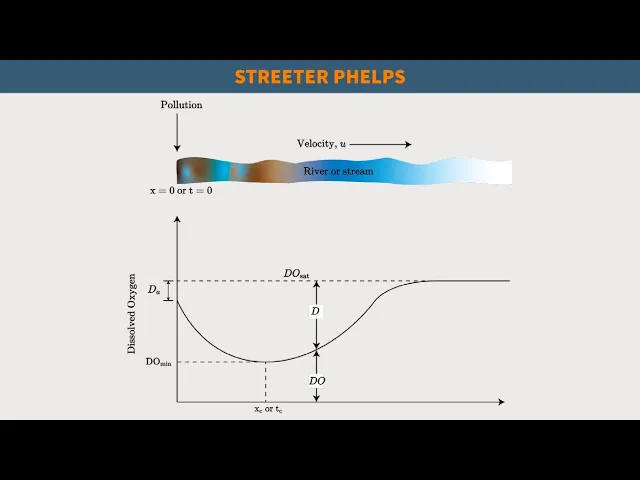
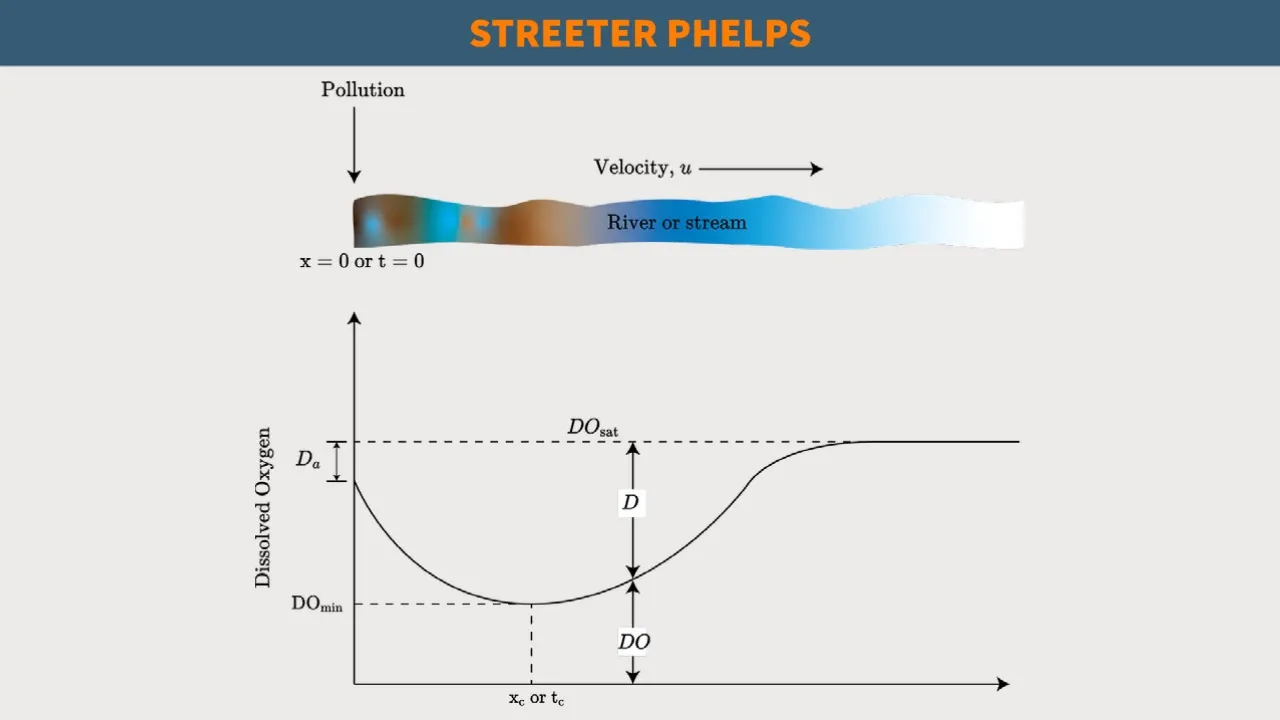
9 the initial dissolved oxygen oxygen concentration is just that it's the dissolved oxygen concentration initially so in here right at in this region so i'm gonna denote that specifically by calling it do initial no this is not the deficit right it's different than the deficit we will describe that in just a second in the figure but the initial there is 8. 2 milligram per liter and the saturated oxygen concentration dosat this deo says actually described in the handbook right saturate dissolved oxygen concentration is always d o set is 8. 9 that's given milligram per liter so the end goal again is to find the concentration of dissolved oxygen here 10 kilometer downstream so let's write that as what we want to find so do concentration and i'll just do a subscript of 10 kilometer that's what we want to find here so let's do the solution and dive into this and before we jump into equations let's quickly look at the sac curve so what i have here for us is we know we introduce the pollution right the waste and we introduce it as some x distance which is the starting distance right in the river x equals zero right we start at zero and that corresponds to a time t equals zero so that's where we introduce the pollution and this is also related to this graph right we know that we start at zero here for the distance or time right and over time we know the addition of this pollution as shown here by the brown the addition causes a decrease in dissolved oxygen this d a is going to be our initial dissolved oxygen deficit in the mixing zone at times you do not have a deficit but we know in the handbook it's described so make sure if you have a deficit you must consider it when you use the stridler phelps equation and that deficit is measured from the d.
o set to the bottom where we know we have that initial dissolved oxygen concentration that's actually given in the question and that's going to be this right d o initial so actually in this figure i did not label d o initial but we know d o initial would be this whole distance right we measure it from the bottom so this is going to be our d o initial that's our d o initial so we know d o set minus d o initial would give us d a and we'll come back to that as we solve the question but at the end we know that we start here we have a sac curve right we have a sac curve and this portion that's highlighted at the moment is where we have decomposition so the bod or the carbon is getting eaten up by bacteria or other aquatic life and they use oxygen they use a lot of oxygen to essentially eliminate the body so a lot of oxygen is being used that's why we have that sag right then we begin to have re-aeration so we begin to have photosynthesis and most importantly we begin to get oxygen from the atmosphere right so we have re-aeration in this case we have the addition of oxygen then we hit a saturated level we hate the dosat and just know the this phase again is that where we have rearration and oxygen being added and the way it's added is from the atmosphere and that depends on henry's law so it's from the atmosphere where we get that oxygen and one important thing is d o min is the minimum it occurs at the very bottom peak right d o min the minimum dissolved oxygen and that corresponds to a critical time or a critical distance that critical time has an equation in the handbook which is not applicable in this example but just note that it occurs at the bottom and at this d o min and x c t c we know the decomposition is going to equal to the re aeration or the oxy ox how much oxygen is added so decomposition equals to re-aeration at this point so that's all of that but the end goal here for this question if we use this figure is to find 10 kilometer so we know at somewhere downstream 10 kilometer i'll call it here let's say it's here x equals 10 kilometer we have a t where we will have a t of 10 kilometer so what's the time at 10 kilometer so we need to find that time then we can use that time and plug it into the straighter phelps equation right so we will say we're 10 kilometer downstream and the end goes to find that d o this value so we will find this d o by taking d o set minus the deficit right and that equation is in the handbook to find do at 10 kilometer we take the dosat the saturated minus d which is the deficit so anything here is the deficit right and that will give us our answer so that's what we will do i hope that made sense through this figure but let me know if you have questions down there so let's begin and we will first find the time again we need the time 10 kilometer downstream so that's step number one let me write that as one so we will find the time and we know simply the velocity is distance times time or we can say the time is going to be the distance divided by the velocity so the time at 10 kilometer downstream is going to be the distance x divided by the velocity so the distance we said it is 10 kilometer right we want to find 10 kilometer downstream so we do 10 kilometer velocity will be what the velocity is given to be 5 kilometer per day a kilometer per day and the kilometers cancel so we get the time when we are 10 kilometer downstream is going to be 10 divided by 5 is just 2 days so after 2 days we need to find the do dissolved oxygen concentration using the distributor phelps modeling equation so now step number two is the tricky step is we need to actually determine the deficit the initial dissolved oxygen deficit in the mixing zone so we'll call that step number two and this is finding initial dissolved oxygen deficit in mixing zone mixing zone so that is going to be arrived at by employing this equation where we're just going to say d a is d o set minus do initial initial so we know that's actually true right because we will say that d 0 is going to be this entire distance right that entire distance is doset the saturated dissolved oxygen we will take dosat minus do initial and that gives us this right the deficit the initial deficit in the mixing zone d8 and we know do initials actually given in the problem statement just know the initial dissolved oxygen concentration is 8. 2 if they say on your fe or in the problem the initial dissolved oxygen deficit you would just use that value but here it's specific it's the initial dissolved oxygen concentration right deficit is different than the concentration so we need to find the deficit so d a equals to d o sat which is going to be 8. 9 milligram per liter minus do initial which is 8.
2 milligram per liter and that equals to 0. 7 milligram per liter so we need that da when we use the final formula now we will find the deficit the oxygen deficit at 10 kilometer so we're gonna find this value right the d value now and that d value can be found by using that equation in the handbook right the steering phelps deficit equation so that's three we will find the dissolved oxygen deficit after 10 kilometer so doing that we know d is going to equal so the whole equation is this d equals k d times l a the b o d in the mixing zone then we take k r the reiteration minus k d the d oxygenation rate constant then we do the brackets so it says exp in the handbook that just stands for exponent the exponent e and we take negative kd the kd value times t times the time which we already solved and i'm going to use the time in red times the time then we close the minus e and we do negative kr so the reiteration constant times t and we know t again is the time close that close that then we close this whole bracket then plus d a and we do e to the negative k r times t right times the time okay close close and i believe that's it so we do d that's going to be the deficit we do k d 0. 1 l a is going to be 15 milligram per liter then we do kr is going to be 2.
2 no the units for these this is per day per day so everything at the end should work make sure everything is in days and everything is milligram per liter the concentrations and time right that's 0. 1 for kd then we do this e to the negative kd so we know kd again is going to be the same as this so it's just 0. 1 and we multiply by the time we said the time is two days right downstream at 10 so this is two here close the close then we do minus e to the negative kr is gonna be 2.
2 then times the time again which is 2 close close and close bracket then we need that d a right if you have a deficit you always include it and add it so in this case it's 0. 7 that deficit we found that 0. 7 that's going to be a milligram per liter times e to the negative kr is going to be 2.
2 times t which is 2. close the close so you can break this down do the brackets first then simplify this then break it down however you find reasonable and good for you but here i just plugged it all in in the calculator and i believe we should get about d the deficit equals to 0. 585 milligram per liter so now we have the deficit right we have this value and how do we get d o what will you do is they take d o set so we're gonna take this whole value which is our d o set minus this value which is the deficit and we get d o right so that's the dissolved oxygen concentration at that time or at after two days at what 10 kilometer so let's do that that's the last step step four and the equation for that is actually in the handbook so it says do is doc minus d but i'm going to rewrite this as do at 10 kilometer it's going to be the dou set minus d the deficit we just solved so this equals to do set is going to be 8.
9 milligram per liter minus d which is 0. 585 milligram per liter so then if you do the mass we get 8.