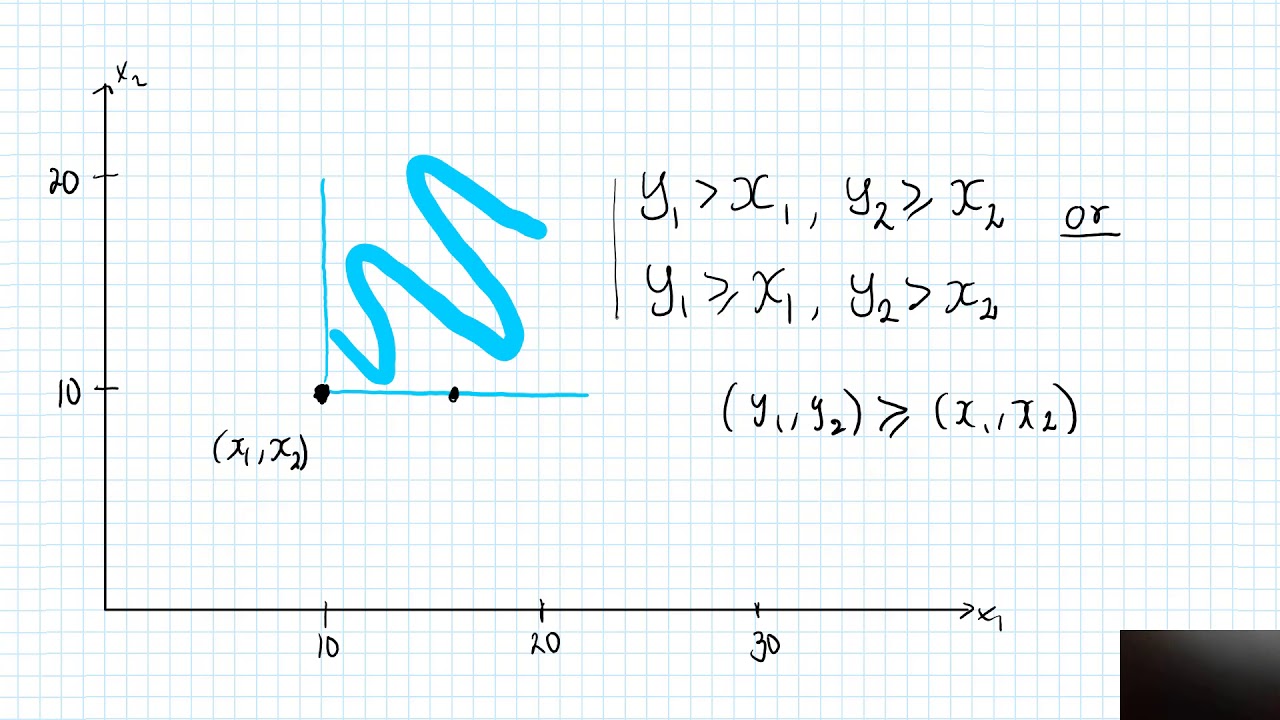
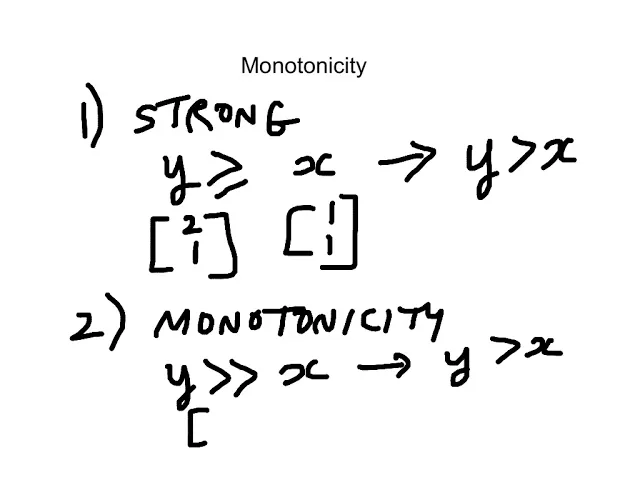
so we're looking at well-behaved preferences namely the kinds of assumptions that we have to make the properties that we have to impose on preferences in addition to rationality that are necessary in order to construct a utility function so as it turns out rationality is not sufficient on its own to be able to give a utility representation to rational preferences we need other desirable properties the first assumption is that a monotonicity which is the idea that more is better we say that the preference relation is strongly monotone if if we if we look at two bundles
y and x two commodity bundles and y is larger than X for some commodity at least one but no less for all the other commodities so for example two one one one right if you take the first commodity Y has more than X if you take the second commodity why does not have less than X it - it must have at least as much as X so if that's the case we say that the preference relation is strongly monotone if this entails that Y is strictly preferred to X so having for at least one commodity
just a little bit more in the bundle then another bundle and no less for all of the other commodities we have at least the same amount that entails strict preference so we disallow the possibility of indifference right I am not allowed to be indifferent to any commodity in my bundle if you give me just a little bit more and hold everything else constant I'm going to prefer that new bundle where I've slightly increased that one commodity monotonicity just regular monotonicity tea simply means that i'm disallowing i'm sorry i'm allowing the possibility of indifference so i
have to have more for all the commodities in my bundle in order to strictly prefer that bundle so if I compare wine X again I need Y to be strictly greater than X for all the commodities and Y in order for me to say that Y is strictly preferred to X so to go back to my prior example here this this first bundle 2 1 the first commodity does have more in Y the next but for the second commodity I have the same amount so it's not sufficient for me here to be able to say
that Y would be strictly preferred to X monotonicity I need all I need all the entries here to be greater than Y then then an X before example if I have two one and X has one zero then that's good right and that means that Y is strictly preferred to X one situation one situation I haven't really discussed here I'll write this at the top because I'm running out of space is the idea that he what can you say of two vectors if you have more for the first commodity but you have less for the
second commodity okay how would you be able to compare these vectors as it turns out you would not you can't really say much about these two vectors and you can't you could not you would not be able to say whether the first vector is preferred to the other or vice versa okay now in most cases a weaker assumption will actually be sufficient I don't need to impose full monotonicity of the underlying halation it is sufficient for me to have local non-satiation which is a weaker assumption meaning monotonicity entails local non-satiation but the reverse is not
necessarily true local non-satiation is the idea that thick and differents curves are ruled out they're disallowed so if I take a commodity bundle X let me draw the commodity space here's a bundle X let me consider another bundle Y which is going to be identical to bundle X in terms of how much of the second commodity we have this is commodity one commodity two but it will have slightly more of commodity one and slightly more a--there means I'm restricting myself to a very small change which I have to draw at a large scale in here
so you can see what I'm doing but this little epsilon here is just a very tiny increase in the amount of commodity one well local non-satiation simply entails that y must be strictly preferred to X if I'm restricting myself to a very very small change small increment in terms of how much commodity one there is in the bundle well I will still be able to do a little bit be able to do a little bit better and I will always prefer the bundle that contains a little bit more write in mathematical terms I can say
that for all commodity bundles in the space X and for all epsilon no matter how small so I can take this epsilon to be arbitrarily small I will always find the Y there exists a y another bundle which is in this commodity space which is such that the distance between x and y all right this is the concept of the Euclidean distance is smaller than epsilon and and Y is strictly preferred to X and we can see why this rules out thick indifference curves by the way right because if the indifference curve had the following
shape so let me just draw something like this okay all right and it's thick so everything in here is actually contained in my difference curve if that's my difference curve then I can see that I can find a point namely any point inside the indifferent surface here which does contain a little bit more than bundle X of Komachi 1 or commodity 2 for that matter and that would be that would not be strictly preferred right I would be indifferent between the two bundle even though this bundle here why does contain a little bit more of
commodity once so so so that's being ruled out ok and the reason is of course that I want to be able to to draw these in different surfaces and I want them to be to be lines I don't want them to be a surface like this I want them to be thin by the way it's very easy to see why monotonicity entails local non-satiation if the preference relation is monotone I know that if I have a little bit more of one commodity immediately that is preferred right by definition that's actually the definition of strong monotonicity
so strongly monotone or even just monotone preference relations will always automatically satisfy this this test for local non-satiation by definition because more is better even if the more is just a tiny tiny little bit amount

![(M2E3) [Microeconomics] Marginal Rate of Substitution (MRS) and Convexity of Preferences](https://img.youtube.com/vi/ZlufCX6je-I/maxresdefault.jpg)
![(M1E10) [Microeconomics] Continuity of Preferences: Lexicographic Preferences](https://img.youtube.com/vi/rX4Y14NtxGY/maxresdefault.jpg)