so i've slaved over perfecting my anki settings if you know me at all you know i do a lot of anki in fact i spend probably three to five hours every day doing anki at least that's a crazy amount of time and i know it's a crazy amount of time but if i am this crazy and if i'm spending this much time on anki i better be using it right i better have the right settings i found the settings that i think work best these settings avoid ease hell i think optimize your retention within a
one to two year period and they also prevent an excessive card buildup also i've tried to tinker with these settings over the past two years to adjust for understanding as opposed to memorization because i want to understand these anki cards these tons of flash cards that i'm doing i don't want to memorize them in this video i will show you each and every one of my anki settings and i also tell you why i made the settings the way i did if you guys don't know me my name is zach and i'm a second year
medical student in philadelphia this is a beast of a video this is a really long video and it goes pretty in depth in detail on kind of the settings of anki how the algorithm works so you can make your settings that are perfect for you but if you don't want to watch through it all if you just want to know the settings don't worry because i've been there many many times i'll leave a time stamp at the end of the video where i just have a kind of screenshots and i'll go through all my settings
really quickly so you don't need to listen to my whole explanation so there'll just be a timestamp somewhere and you can click that and you can see all of my settings which you can use if you're in medical school and i think have a pretty good start to your anki setting as a disclaimer i just wanted to say these are the settings that work for me and these are also the settings that work for me in medical school these settings might not work for you personally and also they might not work for the subject you
are learning like if you're learning a new language with anki there are no perfect settings for anki just like there's no perfect study strategy you should watch this video to get a good understanding of the settings so that you can adjust them and play around with them to best fit your needs if you watch this video you might need to watch it twice or watch it really slowly or pause a couple times but this is because i'm going to tell you each step of the anki algorithm and how each interval is decided for your cards
when you understand this you'll be able to really play with your settings and use anki the best it can be used but if you're ready to get into it buckle in grab your first aid book to know to keep you warm and cozy and get ready because we're going so let's start with preferences okay to go to preferences it's really pretty straightforward the only thing you need to do is you just need to go to the top toolbar here go to anki go to preferences and this window will pop up now the only setting worth
mentioning here is night mode this setting makes my deck have a gray background normally with white text and night mode also means certain things about my onky deck will look different than day mode if we go back to my main kind of browser here you'll see that kind of the background these sidebars are dark this text is white and when i actually go in to start doing cards the background is gray and the text is white i have another video on kind of customizing my anki background so if you want i'll put a link somewhere
in the general area around here and you can adjust it to kind of get any background image you want and change the text colors tons of good stuff but okay we're still in preferences we're still we did basic none of this is really that important scheduling now this is the most important section within the general preferences so the first part of scheduling is i have show next review time above answer buttons enabled and all that does is if you see kind of a card down here you'll see this kind of time of at 20 minutes
12.2 hours one day in four days and i think it's better to leave this enabled so you can monitor to see if anki is doing anything funky with your review times for example my step one exam is coming up in a couple of months two months to be exact so if i see a card and it says more than two months on the next timer like what i see on this part right here if it's two months or three months i know i won't see that card before i take my exam so i want to
make sure i know that card before i hit that number the next thing is remaining card count during review and i leave this unchecked the reason is if i check this off what happens is when i go to do my cards i see the amount of cards i have left at the bottom here i noticed kind of when i was first doing anki that i could leave that checked if i know the amount of cars i have left it begins kind of a race to see how many cars i can get through instead of how
many cards i can understand and i also just find myself just staring at the number just staring at how much cards the next thing which is very important anki 2.1 scheduler beta i have this enabled and i'll link to kind of a resource that shows you everything that's changed with this anki 2.1 scheduler beta but the main things that stood out to me is kind of from the past is that your reviews now show up in a random order under the deck so before what would happen is if kind of the reviews would show up
in order kind of the order you learn them which isn't really that good because you start to memorize the order of the cards that are presented to you instead of memorizing the information because think about it how are we going to be tested on the exam we're probably going to be tested in a random order right i know for step one i'm going to be tested in a random order so i want to review and i want to practice as close to how i'll be experiencing the test as possible so that's in a random order
also filtered decks work much better suspending or burying cars doesn't affect the learning steps and learning cards now have a hard button which is really just if you look at this card it's 15 minutes this is a card in the learning phase i'll go over that too and don't worry calm down if the card is 15 minutes here and a day here just averages these two and that's what your card number is so the next setting i have is you have to pick between mixed new cards and reviews show new cards after reviews and show
new cards before reviews i do show new cards after review and this is because i want to review all the information kind of from the past day that's settled in my brain overnight first and then i'll move on to the new cards and kind of learning new information i have a video on exactly the order in which i learned on a regular kind of study daily routine which i'll link again in this general area and the last important setting here is the time at which the next day starts at and i usually set this at
4 am because i'm never up past 10 pm studying and i'm never awake before 4 am so what's next we have the learn ahead limit and all this is basically is that you know if you go to your decks right here and you hit something like 15 minutes right well no matter what i do anki isn't gonna show me that card until it's 15 minutes in the future but if you go to your preferences and you go to this learn ahead limit and i set that to 15 minutes then even though my card is scheduled
for 15 minutes in the future so if i had this as 15 i could see it now because that's my learn ahead limit now i keep this at zero because again we don't want to mess with the anki algorithm at all we love the algorithm we want to keep as close to the algorithm as possible so let's not mess with it let's not change the time interval the only time i'll kind of do this is kind of what the on king does is maybe if it's late at night and i want to kind of just
finish my cards for the night i'll maybe set this to 15 or 20 minutes just so i can kind of hammer through maybe the last hundred cards before bed final setting here which i didn't actually notice until before seems kind of like a anki's attempt at a pomodoro timer uh it really isn't great so i'll just show you you can see right here i just did it so it'll show you how many cards you studied in the past whatever time it is so after a minute it'll this screen will pop up interrupting your studying and
it'll say you studied four cards in one minute and if you hit finish it'll leave you the deck and you'll exit the deck or you hit continue and it'll let you continue to keep studying now i don't use this at all i keep this at zero minutes because it's kind of distracting and annoying if you want to use a pomodoro timer there are much better things like the forest app for your phone and the one i used is the be focused focus timer from the apple store next we are on to network and backup so
network and backup again nothing really worth mentioning here i just sync everything i like it too because it'll sync it with these new versions it'll sync automatically while you're studying so if your computer crashes and you've been doing cards and you forgot to hit sync then it will sync automatically kind of during while you're learning the only thing i keep in un disabled is on next sync force change in one direction and i keep this disabled just because i don't want to force my sync in any direction i want the options to pop up and
i want to know which way i'm syncing and backups again doesn't really matter i would just keep it above 10. again it doesn't matter and all the backups backups are doing and they're just keeping backups of your past anki files so if you screw something up or you do some weird disabling you can always go back to a previous version of anki where you didn't screw it up [Music] okay now we're at the part you've all been waiting for we're at the most important part and this is your deck settings the deck settings are going
to be how often you see the cards how long they stay in the learning interval when they're graduated how your lapses act and a couple other things and this is really important and this is kind of the most important thing i'm going to talk about so the first thing i want to say is that as soon as you get one new card and that card is kind of added to your deck or unsuspended that card enters the learning phase when you hit the space bar enough times that learning phase then goes into the graduated phase
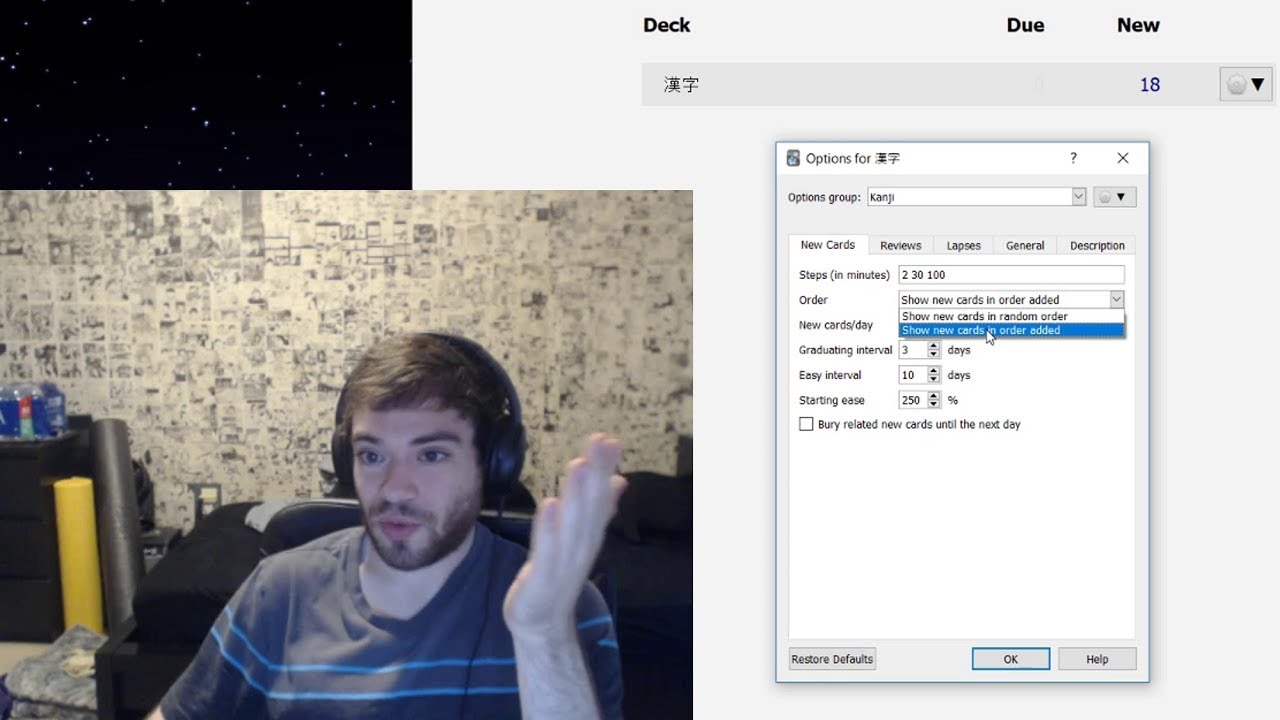
and there are different things that apply to cards in the learning phase and there are different things that apply to cards in the graduated phase so let's go to settings and i'll kind of talk you through it a little bit more so you understand the difference between learning and graduating because that is essential to kind of my settings so if we go to my settings here new cards this is your learning phase right and these are steps of 15 14 40 and 43 20. okay that's complex i don't know what i'm looking at here either
so let's break it down with some imagery what this learning phase really is you have a new card you see it for the first time and you hit again what happens well the card is sent 15 minutes into the future based off this learning step right here okay so the card sent 15 minutes into the future on the first day you're seeing it because that first learning step here is 15 minutes okay it's still day one it's 15 minutes later and you see that card again except this time you hit good because you knew that
card so what happens when you hit good well if you hit good we're at that 1440 time step so 14 40 minutes 1440 minutes is just one day so when you hit good it's shown to you in another day so one day after day one so you will see that card again at day two so again let's just go through this again slowly so the first time you see that card is day one if you don't know it and you hit again that card is sent 15 minutes into the future because our first learning step
is 15 minutes here if you do know that card and you hit good that card is sent a day into the future because that is our second learning step here now it's day two it's a day since you hit oak good on that learning card and you hit good again so what happens if you hit good again well we go on to our third learning step right which is 43 20 or three days so when you hit on day two when you hit good it's sent three days into the future which would make you see
it day five and now if you see it day five and you hit good you graduate your card so that means day one this is still a learning card day one you hit good it's still a learning card day two you hit good it's still a learning card day five when you hit good it's a graduated card so again the first 15 minutes you hit again it's still a learning card 1440 one day later you hit good it's still in here still in the new cards so it's still a learning card 4320 you hit good
now it's going to be a graduated card which is my graduating interval here which means that on day five this is the one to third time you've hit good so again that's one two third time you've hit good the card is graduated that means that card is graduated it's not a learning card anymore and you will see it six days from when you hit that good button which day five six days later is day 11. so okay let's go through it all one more time because i this is key to understanding the steps which i
didn't kind of get in the very beginning so when you first see a card for the very first time and you know it and you hit good it'll do go to that second kind of step right here which is one day for me then the next time you see it if you hit good if you have another number right here it'll go into three days into the future because that's the number i put if i put another number here like 10 000 then you would see that card again in three days but when you hit
good it wouldn't be graduated it would have you'd have to see it in 10 000 minutes later and hit good again for it to be graduated okay i hope that makes sense because this is kind of how every card works in the learning phase so again we're at day five we've graduated our card and our card is graduated that means we'll see it again at day 11 and it is graduated so how does the anki algorithm work on our graduated cards well normally when you hit a good card let's just be very simple if you
hit good it's 2.5 times the current interval so that means if the card was at one day you'd see it again at kind of two or three days and then you'd see it at seven days and so on and so forth because one times 2.5 is kind of three and then times 2.5 is kind of seven and so on and so forth but there are more buttons right there are more buttons there's the again button the hard button the good button and the easy button so now i'm going to tell you how these buttons apply
how the anki algorithm works the mainstay the crux of anki works on your graduated cards so imagine we have a graduated card so how does anki decide what the next interval will be once we see that graduated card [Music] if we have a card that has an interval of 100 days and we hit hard what happens well very simply it's just the current interval right which is our 100 days times 1.2 times our interval modifier so the interval modifier i'm going to get into later but all it is is a static number that you set
in the settings that is applied to every single card so my interval modifier i have is at 100 which means this is just one but if you had it at 50 for example this would be 0.5 so again you'll just see what i have in my settings so again our current interval was hundred one point two is a static number for when you hit hard and then my interval modifier is a hundred percent so one so what happens is i'll see that card in 120 days again i hit hard and it goes okay what's the
current interval 1.2 no matter what because you hit hard and then what's your interval modifier she'll see that card in 120 days or at day 220 when you first saw that card to 220 when you first saw it [Music] okay so now what happens if you hit good so if you hit good on a card with a hundred day interval like your current interval is 100 days remember we're a current interval which 100 days and we have this new thing called the ease factor the ease factor and we have our interval modifier which i talked
about right so the ease factor is a kind of complicated probably the most complicated thing i'm going to talk about and it's kind of this hidden value within every individual one of your anki cards and the way the reason the ease factor is in place because there are certain cards that are going to be harder for you and there are certain cards that are going to be easier for you so what angie did is said okay we're going to make it so every time you do a card and say it's easy for you we're going
to increase this ease factor and when you increase this ease factor you'll see that card farther in the future so there'll be bigger spacing between seeing that card which is good right because it's easy for you but if that card is hard for you and you keep hitting again or you keep hitting hard then we're going to reduce that ease factor so you see that card more frequently and which is good because the card is hard for you right yeah so that's what ease factor is and at a baseline it's set at 250 on every
card now you can adjust this but again i don't recommend changing that at all and i will go into that shortly okay so we know what current interval is it's 100 days we know what ease factor is it's 250 percent or 2.5 and we know what our interval modifier is which is 100 or 1. we hit good it goes 100 times 250 times 100 final number is 250 days and that will be your next interval which means that you will see it at day 350 from the first day you saw that card or 250 plus
100 days [Music] so specifically remember our ease factor starts at 250 on every card and when cards are harder for us anki will reduce that ease factor and when cards are easy for us anki will increase that ease factor so what does it specifically do what does the numbers do so when you hit again on a graduated card remember this is important i didn't mention this earlier but the ease factor modification only applies to graduated cards so cards that have gone through the learning phase so when you hit again on a graduated card that ease
factor gets reduced by 20 so that means it's going to go from two hundred fifty percent to two hundred thirty percent when you hit hard a card's ease factor is going to be reduced by fifteen percent which means it's going to go from two hundred fifty percent to two hundred thirty five percent when you hit good there's no change and when you hit easy there's an increase in ease factor of 15 which means that card's ease factor is going to go from 250 percent to 265 percent so as one more example to just bring this
ease factor home right regularly our card will have an ease factor of 250 percent so our next interval is 250 days but say we have that same card at 100 days but a long time in the past we hit again once well that means the ease factor on this card is 200 230 percent so what does that do so that means we have our same card at 100 days but we hit again once past in the past so our ease factor is 230 percent and the interval modifier still is at our setting stat of 100
which means we'll see that card at 230 days in the future [Music] so now we have that same card at 100 days what happens if we hit easy well if we hit easy it goes into a different equation which is the current interval we know ease factor we know now interval modifier we know and then there's this new number called easy bonus and all the easy bonuses is something you set for yourself right here in the review again i'm not i'm not going to talk about my specific settings yet we're just getting an understanding of
how the algorithm works so normally at a baseline it's set at 130 which means this is the equation for a good card right this is what our good card is except now we get this extra 1.3 times bonus on the card because we hit easy so it's 325 days also remember that on this card you're going to get a 15 bump in your ease factor so the next time you see it the ease factor is going to be 265 [Music] so let's start with laps you have your graduated card and you hit laps what happens
so again you shouldn't be i don't want you to copy down my settings here yet because i'm going to show you them all the end just look and pay attention so my lapse settings right are 20 minutes and one day so think of these kind of like your relearning phase these cards are going into re-learning that means when you hit again the first time these cards will be shown to you in 20 minutes and then if you hit good it'll be shown to you in a day so let's break that down with the current card
okay so we have a current card we see it right now as an interval of 100 days what happens so we're at day 100 what happens if we hit again on that card with my settings well if we hit again on that card remember because my settings have a 20 here we'll see that card in 20 minutes now it's still day 100 and it's 20 minutes later so if we see that card 20 minutes later that same day and we hit good it gets sent one day into the future why does it get sent one
day in the future because i have this second number here of 1440 which for 1440 minutes is one day okay now we see it that next day day 101 what happens if we hit good again well this card is re-graduated so what does regraduated mean well basically you pick a number which is your last modifier i've picked 10 percent that means whatever the current interval of that card was so it was 100 days will be multiplied by my lapse modifier which is 10 which makes which means the next time i see that card will be
in 10 days or a day 111 again we hit again on a card that's i had a 100 day interval it gets shot to 20 minutes you see it that same day because my interval here is 1440 you see it one day later then when you hit space again there's nothing left here right there's nothing left after it so it's re-graduated and it's sent to 10 of whatever the current interval is of the future so my current interval was 100 days my last modifier was 10 so it sent 10 days into the future from when
i hit good so day 111 [Music] i have one more bit of background information that i want to give you before we get into my individual settings and that is how we're going to avoid something called ease health so remember when we first see a new card according to my settings and we hit again on it we're going to see it again in 15 minutes if we hit good we'll see it a day later if we hit good again we'll see it in three days after that which is day five and if we good again
on day five our card is graduated now importantly the difference between a card that's in the learning phase and a card that's graduated is cards that are graduated are susceptible to ease factor modification so as you remember we talked about ease factor before but if you hit again or hard in any of day one or day two the ease factor isn't changed cards in the learning phase are safe from ease factor modification so because we're setting our own interval here where we're going to learn it in the learning phase the ease factor doesn't even come
into play right the anki algorithm isn't coming into play we're setting when we're going to see those cards in the learning phase as soon as you hit good on that day five as soon as you hit good on that graduating interval right here that means the card is graduated and you'll see it six days after that day five on day 11. graduated cards are susceptible to ease factor modification so why is it important to know about use factor modification and learning cards are safe from it and graduated cards aren't safe from it well i'll show
you why this ease hell was something that i discovered from this great post and youtube video conan i'll link it below what it means is if you've hit again on a graduated card six times that card drops down to the minimum ease interval of 130 and why is this kind of important to know well let's look at a comparison here so normally right we have an ease factor of 250 let's have a starting card start at a 10-day interval we hit good on a card with an ease factor of 250 percent that card will be
seen again 25 days later then we hit good again 63 days after that we'd go to 158 days after that now let's say we've had a card that we've hit again or hard a ton of times in so the ease factor is at 130 percent well we're gonna have that same starting day at 10 but the next time we see it because this ease factor is so low is 13 days later and then 17 days later and then 22 days later you can see there's a huge difference here between an ease factor of 250 and
an ease factor of 130 percent and what might actually might be happening here is we're seeing these cards too frequently if we had no learning steps if our learning steps was just 10 minutes and then the card is graduated which is kind of the basic setting the default setting that means that card is graduated right away and when it's graduated right away it's susceptible to ease factor modification right away well why is it important if it's susceptible to ease factor modification right away well i think when we're first learning cards things are just beginning to
make sense um but it's highly volatile right you might have had a bad day this certain subject might not make sense to you um you might have not gotten that much sleep last night right there's a ton of things going into this first kind of learning this first learning phase of this new card or maybe you and your first aid book are in a fight because you forgot to take out the trash last night well if on these graduated cards we keep hitting again we keep hitting again we keep hitting again we are tanking this
ease factor and we're tanking this yeast factor so we're going to enter this kind of new interval instead of this interval which most of our cards should go into and this is what is called ease hell because you're seeing these cards too frequently no matter how many times you hit good on these cards no matter how frequently you hit good on these cards these cards are going to show up too much that means the amount of cards you're going to see is going to build up over time especially after a year or two of doing
medical school anki these numbers are going to build up and become unmanageable so we want to avoid ease hell we want to avoid it because we will be seeing cards too frequently anki is an amazing software but it's exactly that it's a piece of software if we leave the settings as is we are more than likely to enter e-cell so we know it's important to avoid ease health we know we want to have a kind of longer learning interval so our cards don't get graduated too early so we don't start tanking our ease interval too
early so how did i decide on my specific steps to do this well i referenced the two kind of gods in this field right the on king and konana which again i will link below and what the on king's steps are are 25 minutes and then one day and then he graduates it at three days conan's steps 15 minutes one day six days and then he graduates it at 15 days another mentionable option which is reddit user anbu 5000 this is a good setting too is 15 minutes one day three days six days and then
it's graduated for 15 days now my settings the ones i've decided on are 15 minutes one day three days and then it's graduated to six days later why did i decide on this learning interval well in general i fall somewhere between anki's settings which i think are a little harsher and konan's settings which i think are a little bit more lenient and kind of longer term thinking so why am i between them well i'm more harsh than konana because i want to start messing with this ease factor reasonably quickly not super quickly not as quickly
as the on king but reasonably quickly because this is what's going to tell me okay these cards are harder or these cars are easy second of all we're trying to maximize our retention in kind of a one to two time period in medical school if i was trying to maximize for five plus years i might lean more towards conan's settings with longer learning steps also in medical school we're going to be learning things in a week that we might be quizzed on that week i don't know my medical school does quizzes every week but you
might also be quizzed in other ways during the week so i wanted to integrate another learning step that three days in that so that way i make sure that i'll kind of see that card in that week now the on king's justification is we want to aim for a retention rate that is 90 or above conan's opinion is that we should be between 80 and 90 percent we want to be between 80 and 90 as a couple internet resources say that kind of between 80 and 90 is this kind of goldilocks zone right the learning
isn't too hard it isn't too easy it's kind of just right and when it's just right you're more likely to kind of work harder and focus and remember this information however i couldn't really find any academic journals to kind of support this 80 to 90 number if anyone finds it please let me know but what happens is when we try to go above that 90 number we have to put in a lot more work 30 percent more work for 5 increase now leon king says we should be above 90 we should aim for really high
retention rate because we want to do really well on step right and to do really well on step we need to get a high percentage of these cards and and which will hopefully relate to a high percentage of questions right uh but i found that when you try to get above that really high rate that 90 success rate you're just seeing too many cards you just see too many cards and it becomes unmanageable however i do agree with him which is why i aim for really high like 88 89 or 90 success rate and you'll
notice if i hit shift stats which again i'll link the resources to get this application but my true retention rate is pretty good it's right around where i want it to be at around 89 so now thankfully things get a little bit easier so what is the next thing you see here that's easy interval so what is the easy interval well well that just means if we're in our normal learning steps right you hit good you'll see it in a day but say day two you see it again you're like this card was really easy
i don't need to see it again in three days i'm ready to graduate it so you'll see it at my easy interval which is eight days which means you're gonna see it at two plus eight which is ten so you're gonna see it at day ten in the future and the card is now graduated so you're skipping a step now this you could do this whenever right so if you see a learning card you see it on day one and you hit easy right away that means you're going to see it eight days in the
future or at day nine and that card is graduated starting ease we talked about starting ease we want to keep that at 250 because we don't want to mess with the algorithm this was decided on by a couple of really really smart people and there's papers about it and stuff like that which i will link below the next thing i do is i hit barry related cards until the next day and the reason i do this is because say you have something like two plus two equals four and you have one card that's two plus
blank equals four and you have another card that says two plus two equals blank well if i see two plus blank equals four and then i solve it as two so i know i've seen that card two plus two equals four and then five minutes later i see two plus two equals blank i'm gonna remember four from the last card i saw right and i'm not gonna remember it because i understand two plus two equals four and this is how we wanna maximize our understanding versus our memorization right so i keep this checked because what
this does is this separates the cards that are closely related so you're depending on understanding as opposed to memorization which is really important so we are done with new cards well done now on to the reviews section here for my reviews i have my maximum reviews at nine nine nine nine but again you're never going to get to 999 or you shouldn't get to that many reviews in a day we just want to make sure we're doing all our reviews every single day because again we don't want to mess with the anki algorithm if we
have a max set of kind of 100 reviews a day our cards will be sent farther and farther into the future and they will get skewed off of the anki algorithm which we don't want to mess with at all again so set this at a max do all your reviews every day this way you stick to the anki algorithm as close as possible so the next thing i do is i've easy bonus set to 140 it's default at 130 but i just found i hit easy rarely so when i hit it i want it to
mean a little bit more so i just bumped that number 10 so my car is sent a little bit farther into the future now interval modifier this is an important thing and this is the first thing i would kind of think about messing with so the first thing i would think about medicine with again is this interval modifier so this interval modifier right is applied to every single card we see so if our interval modifies 100 it's times one but if we change our interval modifier say we change it to 50 then we'll see that
card at 125 days as opposed to our 250 days before because it's 50 this will be the first thing i play around with this would be the first thing i start to change and i would change it by maybe five to ten percent you download the kind of application that i link below that shows you your stats and you go here and you see this number is kind of too low from what you want it to be that means you're you're seeing these cards not enough it means you need to see these cards more frequently
because they're harder for you to up your retention rate so what you would do what you might do is if you want to up your retention rate if you want to see these cards a little more frequently you would decrease the interval modifier so you might make it kind of 90 and that would apply to all of your cards and you would see those cards more frequently if you are seeing cards too frequently and maybe your percent correct your success rate you think is too high then what you can do is you can up this
number to maybe five or ten percent and this will separate the cards so you see them farther apart i spoke about this earlier but i'm just going to reiterate it again i like to aim for a success rate of around 88 to 90 percent my reasoning is i want to do well on steps so i want to score fairly high except i found that when you start to get above 90 you have to put in an insane amount of extra effort see an insane amount of extra cards to get to that higher retention rate the
next thing i want to talk about is the maximum interval uh my maximum interval is 365 days but if you're a first medical student i don't want to officially recommend that i want to recommend 240 days just because sometimes people freak out ever having this long interval but there is a really nice post by reddit user nicolas curi but he argues that we should never cap our max interval so we should have it like 10 years in the future and i think i agree with him to an extent so what i want to show you
is how the max interval comes into play and why it doesn't really matter if you set it shorter to an extent so the first line i want you to look at is this rng line here this kind of here you can look at the peak down here and this is set at a year interval and the second line is at a six month interval so you can see these cards are really close these lines are really close together and it doesn't really matter if you do six months or one year but if you set it
shorter at three months you start to see a spike so your interval at a minimum of six months again 240 days i think again that's eight months i think that's a good setting to have too hard interval you don't have to change this if you want but we talked about this earlier remember it's going to be your current interval times 1.2 which is this number here and then times your interval modifier and you want to have bury related reviews until the next day because we talked about this before right you don't want to be memorizing
2 plus 2 equals 4 you want to understand that 2 plus 2 equals 4. we're on the home stretch here so hang in i know i'm getting a little tired but we're gonna we're gonna get through this we're gonna get through it so lapses so lapses this is what happens if you have a graduated card and you don't know it so you hit again and what happens with these cards is when you hit again when you have a graduated card you hit again so say you have a card that's going to interval 100 days it's
at day 100 you hit again and because your interval here is the first one is 20 minutes you'll see it in 20 minutes day 100 20 minutes later you see it again you hit good this time it's one day or 1 40 minutes because that is my setting here it's day 101 you know it again so you hit good and now it's going to be 10 which is my new interval right here times the current interval which is 100 days so that's 10 days so that's it's going to be regraduated and you're going to see
it again at day 111. i have my lap setting at 10 because when i get a card wrong i usually really don't know it i almost need to entirely relearn that card uh this is the way i design my settings i don't have it at zero percent because that makes the card load too high i don't recommend this this is what i used to have a while ago when it made the card load too high i experimented with the 80 laps percentage but this was way too high i would relearn a card with those steps
of 20 minutes and one day and if i had an interval of 100 days i would see that card 80 days later it was definitely not quick enough relearning or not solid enough relearning to be shoved 80 days into the future what i noticed is i'd see this card 80 days later and i hit the inevitable again slightly slowly slinking down into ease hell as we talked about before so i suggest you set your lapse interval from 10 to 30 so with this lapse interval of 10 however a lot of your cards are going to
be like 10 days 13 days so if you have a card day at 10 days and you have a lapse interval of 10 that means you're going to go through the steps right you're going to hit again so it's 20 minutes later you know you hit goods you see it the next day like like day 11 but then when you hit good again it goes to 10 of 10 days which is one day right which is 11 days so you don't want to study it 20 minutes a day and a day because that's silly you
want to go back into the normal interval which is 20 minutes a day three days and so on so what i do is i have my minimum interval set to three days which is the minimum like graduated interval you will see that card re-graduated interval you'll see that card so i'll show it to you here so again day 10 you see the card you don't know it you hit again you'll see it 20 minutes later day 10 you know it now 20 minutes later so you hit goods you'll see it in a day day 11
you see it you know it you hit good now here's where the funny things happens this card is regraduated but because 10 times 10 is one and that's less than three days which i've set here is my minimum interval the card immediately gets converted to a three-day new interval and you'll see that card three days after day 11 which is day 14. i think this makes sense because it's helpful the next thing is leech threshold this is just eight that means if i hit if i hit again on a card eight times that it'll be
it'll be tagged as a leech and we want to tag it right we don't want to suspend it because we want to know as many cards as possible i only suspend cards that i think are silly or unnecessary if i don't know a card but i think it's probably important i'm not going to suspend it i want to know it so it's tagged and i can go into my browse section and view that card later so now we're on to general we're so close we're so close so the first thing here is you ignore answers
longer than 180 seconds long and as you leave for 180 seconds that means whatever answer you hit here it doesn't matter anki doesn't track it it doesn't care about it because you're away for more than three minutes i don't want to show an answer timer because it's distracting i automatically play audio but i don't really have any audio on my card so there's no audio to automatically play and i always include the question side when replaying audio but again these aren't really relevant for me because i don't have audio [Music] one other thing i want
to talk about is if you get really in depth and you look kind of deep into this you'll notice that when you hit cards that like again good or easy they're not going exactly where the algorithm tells them to go and the reason this is happening is because in a recent version update of anki they integrated something called the fuzz factor and all the fuzz factor is is that means on your graduated cards it's going to apply a new interval from between 80 percent to 120 on these new cards now this sounds like it's really
really bad but it doesn't really matter that much because this is going to be varied again between 80 and 120 it's not always that it might be 95 and 105. so if your next interval is 100 days based off the button you press that card might be sent to 80 days in the future or 120 days in the future and the reason i think anki did this is because they kind of wanted to integrate their own load balancer don't use the load balancer add-on by the way i don't think it's good it messes with the
algorithm too much but this kind of fuzz factor doesn't mess with the algorithm as much it just sends it into different parts of the future and the reason they do this is because say you do like 300 new cards on one day and you do no new cards the next day no new cards the next day no new cards the next day well then you're gonna have like a spike of new cards on a certain day right and they don't want that to happen so they kind of spread it out a little bit but if
you're using anki the way i do in medical school you're just gonna you're doing new cards every day so it doesn't really matter so it doesn't really apply to us that much but again i wouldn't worry about it it doesn't make that much of a difference but i just wanted to mention it because if you get into it and you start tracking your cards which i don't recommend i don't know why you would track your cards you'll notice that the cards are sent into different spots in the future that differ from what you think the
algorithm should be putting them in now here's the part that everyone's been waiting for if you watch the entire video before this you don't have to watch this now because i'm just going to go through every one of my settings quickly so you can look over them and if you want to just copy my settings you can do that but again i recommend kind of going through this video understanding why i have my settings the way they are and then adjusting your cards and your interval modifiers and your learning steps to best fit your learning
and your learning style [Music] so for my settings basics i have show play buttons on cards with audio these three unchecked night mode enabled when adding default to current deck for scheduling i have shown you next review time above answer buttons enabled show remaining card count during review disabled show learning cards with larger steps for disabled anki 2.1 scheduler enabled and i've shown new cards after reviews my next day starts at 4 am my learn ahead limit i have it 0 minutes my time box limit is 0 minutes because i don't want this annoying time
box to pop up network i have these three checked and this unchecked backups i set around 20. i just have it more than 10. now for my deck settings and this is the deck i apply to every single one of my decks i have my steps at 15 minutes one day three days 1 40 minutes is one day 4 320 minutes is three days i show my new cards in a random order i only do a maximum of a hundred cards a day i have my graduating interval at six days i have my easy interval
at eight days i have my starting ease at two hundred fifty percent and i have my brewery related new cards until the next day enabled for reviews i do a maximum i have it maxed out here at 9999 my easy bonus is 140 my interval modifier is 100 my maximum interval is 240 days my hard interval is 120 my maximum interval is 365 days actually but i recommend if you're in medical school just setting it at 240 days it doesn't really matter if you go up but people will freak out if it gets too high
uh hard interval i have 120 percent and i have very related reviews until the next day enabled for lapses i have steps of 20 minutes in one day with a new interval of 10 percent minimum interval of three days leachated to eight and one leech action is tag only for general i have 180 seconds here are the things here description you don't need to worry about so some final quick tips that i just want to say for kind of using anki with these settings that i have to the best effect you must be honest with
yourself that's really the most important thing of all ivanke you must be honest with yourself well i guess the most important thing is to do all your reviews every day then after that the most important thing is to be honest with yourself if it's on the tip of your tongue and you hit it you're like oh i totally knew that no you didn't know it so you hit again if a card is really really showing up too much i'll hit ease i rarely hit easy so if i do it it's for a good reason and
the last thing i do is i continually like edit like add images to my cards like add text to my cards connect to other cards um practice the fame and technique all these kind of things that i'm going to talk about in another video later but this kind of helps these cards stick more and helps me maximize my understanding as opposed to my memorization but that's it oh we did it oh i've been sitting here for about three hours just talking about this stuff this is great so this was a long video if you got
through all of it well done really well done and i think it's going to help you and i think it's important too because sorry i'm just stretching it and i think it's important too because this is what you're going to be doing if you're in medical school kind of like every day for the next one to two years if you're starting this when you first start you should understand what each setting means and how to adjust the settings to best fit your needs but that's it we did it thank you so much for watching i
hope this was helpful i hope you didn't get confused and i will see you in the next one you