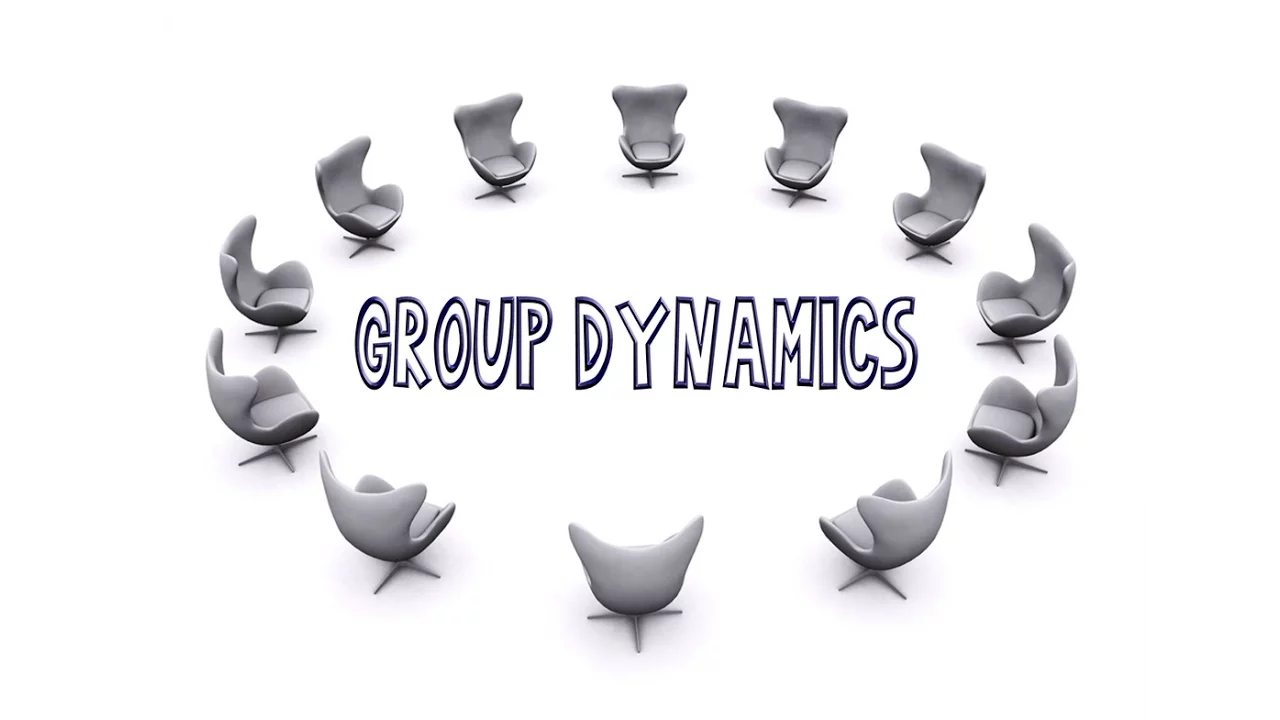
[Applause] Understanding group dynamics: you're the leader of your organization. Really, you're the leader of a small group. All groups have dynamics.
Group dynamics are the interactions between group members and how your group interacts with other groups. Today, we'll explore this interaction known as group dynamics. What are group dynamics?
Group dynamics are the behaviors of individuals in one group and the behaviors of one group of people with another group of people. Group dynamics can happen on a sports team, a singing group, or an academic club. Group dynamics are a part of all student clubs and organizations.
Why is it important to understand group dynamics? Knowing how your group works on the inside, as well as how it interacts with other groups, is key to leading it. Knowing your group's dynamics helps in understanding how your group makes decisions, how your group responds to change, how members of your group interact with each other, and how your group interacts with other groups.
How can this help me in the future? Based on Fortune 500 companies' research, the number one reason why people are fired from their jobs is their inability to get along with others. Based on a Yale University study, the number one reason why people are fired from their first job is the inability to get along with others.
Lastly, based on a Resident Assistants study, the number one reason why first-year college students have a bad experience living in a residence hall is their inability to get along with others. What will I learn from this? Today, you will learn to recognize the current group dynamic stage of your club or organization, learn how to establish trust and confidence for the group, and learn how to build awareness of yourself as a member of a team.
Where is my group? Tuckman's 1965 theory of group development describes four different stages. Those stages are forming, storming, norming, and performing.
Going through each of these stages is necessary for your group to grow, face challenges, overcome problems, find solutions, plan projects, and deliver results. Now, we'll look at each one of these stages individually. Forming: When the team forms, it meets for the first time to learn about each other, the group, and commonalities that individual members share.
This is a great time to run some small group icebreakers so that everyone can get to know one another. Becoming comfortable with each other is incredibly important during this stage; without this level of comfort, your group will go nowhere fast. After becoming comfortable with each other, the group then agrees on goals, challenges, and tasks they will accomplish together.
This is best outlined in the creation of a successful Club Constitution. During the forming stage, the individuals in your group will behave independently, be ignorant about the goals of the group, beyond their best behavior so they don't offend anyone, and be very focused on themselves. As your group's leader, you should model appropriate behavior at this stage.
Being the leader everyone wants to follow is a good rule of thumb. If you expect certain behaviors from everyone else, like being quiet when someone else is talking, then model that behavior yourself. The forming stage lasts during the first minutes, hours, and days that the group first comes together.
This stage may last for a while, based on how often your group meets and the interactions that individual group members have with each other. Storming: When a team storms, individuals in the group begin to form opinions of one another. Many of these opinions are based on the character and integrity of other individuals.
Oftentimes, the more active members of the group will voice these opinions loudly when one or more people are not contributing to a group effort. Also, team members will share their opinions about others publicly when trying to dominate the conversation. They may also talk about individuals to other team members in an effort to form small groups and alliances.
At this stage, some individuals may question the actions or decisions of the leader. This represents the growth of some individuals and their desire to define their role in the group. As the leader, it will be your role to resolve disagreements and personality clashes before the entire group can evolve from this stage.
Because of this, the group may never leave the storming stage and may be stuck here until it resolves its issues. Also, a group can devolve back to this stage when new challenges or disputes arise. Some high-performing groups might skip this stage altogether, but most will go through it in one form or another.
Group leaders can overcome the challenges of this stage by emphasizing tolerance for each individual member. Without tolerance and patience for all members, the group will fail. This stage can be destructive and harmful for the team; group motivation will suffer if disagreements get out of control.
Because of this, some groups may never leave this stage. However, the ones that do become stronger, more diversified, and are able to work more effectively as a team. The goals for the storming stage include individuals learning to resolve their differences, individuals being able to communicate with each other more comfortably, and individuals being free from judgment based on their opinions.
It is normal for the group to experience tension, struggle, and arguments at this stage. This stage is upsetting, but it is often necessary for the group to grow. The storming stage lasts for as long as the group has internal issues to resolve; it is based on the level of comfort, communication, and acceptability of its members.
This stage may last for a while, based on how often your group meets and the interactions that individual group members have with each other. Norming: The norming stage begins once the group has resolved its disputes with one another. Once personality clashes are appropriately resolved.
. . It often results in greater trust and cooperation with one another.
Once this happens, the group is aware of competition from other groups. This results in the team realizing that common goals, ideas, interests, beliefs, and philosophies are what bind them together. In the norming stage, individuals take responsibility and have the ambition to work toward completing the team's goals.
In this stage, team members begin examining the personal goals and objectives of their teammates. Individuals then begin looking for ways to accomplish their personal goals, group goals, and teammates' goals at the same time. At this stage, individuals accept their teammates; this is because they are making an effort to move on and accomplish projects together as a group.
As the leader, it is important to maintain harmony and balance for the group. At this stage, however, there is always a danger that members may be so focused on preventing conflict that they are reluctant to share controversial ideas. As the group leader, it is important to always question practices in order to determine if the group is headed in the right direction.
The norming stage lasts for as long as the group has established goals and objectives for each other and actively works towards achieving those goals. Groups may stay here for an undetermined amount of time. This stage may last for a while based on how often your group meets and the interactions that individual group members have with each other.
Performing is the highest stage of group dynamics and development. At this level, the group has successfully established roles for themselves and each other and begins to accomplish synergy. Synergy is what the group can accomplish together that no individual could accomplish on their own.
At this stage, individuals are motivated and knowledgeable; teammates are confident in their own skills and can work autonomously on their own to achieve goals and handle decisions without having to involve leadership at every step. Arguments and conflicts at this stage are expected and should be allowed. The group should define how these conflicts should be addressed and resolved in a way that is acceptable for the team.
The organization's leadership should know that even the most high-performing teams can devolve to earlier stages in certain circumstances. Teams that have been together for a long time go through these cycles many times as they react to different changes. These changes include new leadership, which causes them to go back to the storming stage.
New people entering the group can also cause the team to devolve back to the norming stage. The performing stage lasts as long as the group is working independently toward achieving group goals. The main difference between this stage and the norming stage is that higher-performing groups have individuals that can work with autonomy.
The leadership trusts individuals to make decisions that are in the best interest of the group without having to supervise all of their actions. Groups may stay here for an undetermined amount of time. This stage may last for a while based on how often your group meets and the interactions that individual group members have with each other.
Conclusion: Group dynamics are the behaviors of individuals in one group and the behaviors of one group of people with another group of people. Knowing how your group works on the inside, as well as how it interacts with other groups, is key to leading it. The number one reason why people are fired from their first job is the inability to get along with others.
Tuckman's four stages of group development are forming, storming, norming, and performing. - Forming: The group learns about each other, the group commonalities, and sets group objectives. - Storming: The group experiences conflict with one another, resolves issues, and overcomes issues by tolerating one another.
- Norming: The group works together to achieve common goals but may hold back criticism to avoid conflict. - Performing: The group achieves synergy, and individuals work toward the common good without supervision.