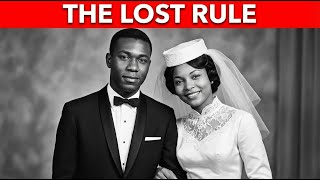
On the morning of September 29th, 1948, something happened that shocked the world. Serets Kama, an African royal heir, Oxford educated intellectual and future leader of Botswana, [music] married Ruth Williams, a white English woman. At the time, the marriage was considered an abomination.
At the most visible level, the controversy about their marriage was about race. At the time set Kama married Ruth, the world was still structured by rigid racial hierarchies. South Africa had just introduced apartheid laws including bans on interracial marriage.
A black African royal marrying a white British woman was unthinkable and seen as a direct challenge to white supremacy. To aparttheide leaders, the union was not just offensive. It was dangerous because it symbolized racial equality.
Setsi Karma was not an ordinary man. He was the heir to the Bamanguato chieftainy in Betuana, a British protectorate. His marriage raised fears among colonial officials that a white woman could become queen of an African people.
British authorities worried this would undermine colonial control and provoke unrest both among white settlers in southern Africa and within traditional African leadership structures. Within months, he was banished from his homeland, stripped of his right to rule. Cast out not for treason, but for refusing to abandon his wife.
Ruth, vilified and isolated, followed him into exile. Her life permanently altered by a vow spoken in a quiet room. The shock was global because the marriage shattered an illusion.
It exposed the moral bankruptcy of empire and revealed how fragile racial supremacy truly was. Saratikama did not raise an army or lead a rebellion that day, but with a single Idoo, he shook the foundations of colonial power. In this video, we shall shine the light on one of the most controversial interracial marriages in modern African [music] history and how their union changed the political landscape in southern Africa.
This is the story of love, betrayal, and compromise. This is the shocking love story of Serret Si Kama and Ruth Williams. Set Kama was born on July 1st, 1921 into one of the most powerful royal families in southern Africa at a time when colonial rule shaped every aspect of African political life.
He was born in Seroe in the British protectorate of Betuana land as the grandson of Kosikama III. A legendary leader who had successfully resisted incorporation into white ruled Rhdesia and South Africa. Serretzy's destiny was marked from birth, but it was sealed even earlier than expected when his father segma Kama II died in 1925.
At just 4 years old, Serretetsi became the rightful heir to the Bamanguato chieftainy. Because Serretetsi was too young to rule, [music] leadership passed to his uncle Chikedi Kama who became regent. Chikedi was a stern, disciplined traditionalist who [music] believed deeply in both Tswana custom and the strategic use of western education.
He took personal responsibility for shaping Saretszi into a future leader capable of defending his people's interests in a colonial world. Under Shikidi's supervision, Saretszi received an education that blended African values with European schooling. An unusual but deliberate preparation for leadership.
Serets [music] began his formal education in Betuana before being sent abroad. First to Fort Hair University in South Africa, one of the few institutions at the time that educated black Africans at a high academic [music] level. Fort Hair exposed him to a wider African intelligencia and to early nationalist thought.
Though Settzi remained cautious rather than radical as racial segregation intensified in South Africa. Cheddy decided it was safer and more strategic for Seretsi to continue his studies in Britain. In England, [music] Serretzy attended Bale College, Oxford, where he studied philosophy, politics, and economics.
Oxford refined his intellectual outlook and exposed him to democratic ideals, rule of law, and liberal [music] thought. Unlike many African elites who became deeply radicalized abroad, [music] Serretzi developed a pragmatic worldview, believing change could be achieved through institutions rather than violent confrontation. After Oxford, he moved to London to [music] study law at the inner temple, preparing himself for leadership in both traditional and modern political systems.
Life in postwar London was formative. Britain was rebuilding after World War II and while racism existed, the city offered Serretetsi a degree [music] of personal freedom unknown in colonial Africa. For the first time, he lived largely as an individual [music] rather than solely as a future chief.
He interacted with students, church groups, and professionals from across the Commonwealth. These social circles, particularly those connected to the London Missionary Society, would [music] later prove significant. By 1947, Seretsi Kama was a young man standing at a crossroads.
He was intellectually confident, legally trained, and conscious of his obligations to the Banguato. At the same time, he was experiencing life beyond rigid tradition and colonial expectation. It was within this space between duty and personal freedom that sett Ruth Williams.
An encounter that would transform his life and alter the course of African and imperial history. Serakama met Ruth Williams at a moment when his life seemed clearly mapped out by tradition, empire, and [music] destiny. Yet fate quietly intervened in the most ordinary of settings.
[music] In 1947, Saretsukama was living in London, studying law at the inner temple [music] after completing studies at Oxford. He was not merely another African student abroad. He was the rightful heir to the chieftaincy of the Bamanguato people of Betuan land, a British protectorate.
His education in Britain was meant to prepare him for leadership under colonial oversight, blending traditional authority with [music] Western legal training. London, still recovering from the Second World War, was a city of rationing, rebuilding, and subdued social life. Yet, it also offered spaces where people from different worlds could unexpectedly meet.
Ruth Williams was a young English woman working as a cler at Lloyds of London. She came from a modest working-class background in Cudden and lived a life shaped by routine rather than political ambition. She was not part of elite circles, nor did she have any connection to colonial administration or African affairs.
Their meeting was not orchestrated by diplomats or intellectual salons, but occurred at a social gathering arranged by mutual friends from the London Missionary Society circle. [music] At the time, interracial social interaction was rare and often frowned upon, but wartime Britain had temporarily softened some racial barriers. When Seretsi and Ruth first spoke, [music] there was no dramatic declaration or instant scandal, only conversation.
curiosity and an unexpected sense of understanding. Their relationship developed [music] gradually. Serretzy was intelligent, reflective, and deeply aware of his responsibilities, while Ruth was straightforward, warm, [music] and unpretentious.
They bonded over shared values rather than shared backgrounds. Serretzy found in Ruth a person who treated him not as a prince or political symbol, but as a man. Ruth in turn saw beyond his status and skin color, recognizing his kindness, seriousness, and quiet humor.
As their affection deepened, both were aware that their relationship crossed boundaries that society guarded fiercely. Interracial relationships were controversial even in Britain, [music] and for a man destined to rule an African people under British supervision, the stakes were infinitely higher. When Seretsi informed his family and advisers back home of his intention to marry Ruth, resistance was immediate and intense.
His uncle Chaedi Karma who was serving as a regent of the Bamangato was particularly opposed. Cheddy believed that such a marriage would undermine Seretsi's legitimacy as chief [music] and provoke both internal unrest and colonial interference. Among the Bamanguato, some elders were concerned not purely about race but about tradition, fearing that a foreign woman would not understand or respect their customs.
Meanwhile, British colonial officials viewed the situation through a political lens, worried about how white settlers [music] and more critically apartheid era South Africa would react. Despite mounting opposition, Settzi refused to abandon Ruth. He insisted that his right to choose a wife was fundamental and [music] that his people should judge him by his leadership, not his marriage.
In September 1948, after months of uncertainty and pressure, [music] Serretets and Ruth decided to proceed. There was no grand wedding. On September 29th, 1948, [music] they were married in a quiet civil ceremony in London.
The simplicity of the event [music] contrasted sharply with the storm it unleashed. There were no royal honors, no official blessings, and no representatives from the colonial administration. [music] Yet the act itself carried enormous symbolic weight.
News of the marriage spread rapidly and ignited outrage far beyond Britain. South Africa, which had just institutionalized apartheid, reacted with fury. Its leaders warned Britain that recognizing or tolerating the marriage would destabilize racial order in southern Africa.
Britain, heavily dependent on South Africa for economic and strategic reasons, panicked. What should have been a private matter was elevated into a matter of state. [music] The British government convened inquiries, debated Serrets's suitability to rule, and framed his marriage as a political problem [music] rather than a personal choice.
Ruth, who had married out of love rather than ambition, found herself vilified in the press. She was portrayed as reckless, manipulative, or naive, [music] while racist undertones permeated public commentary. Seretsi, meanwhile, was scrutinized not as a husband, but as a potential threat to colonial [music] stability.
In 1950, after a controversial investigation that many saw as biased, [music] the British government banished Zoretszi from Betuana land, effectively exiling him for marrying the woman he loved. Ruth followed him into exile, enduring isolation, financial hardship, and constant hostility. Yet, the marriage endured.
What began as a meeting between two ordinary people in postwar London became a defining episode in African and imperial history. Seretsi and Ruth's union exposed the hypocrisy of colonial rule, challenged racial ideology and reshaped Serets's destiny. Stripped of traditional authority, he eventually turned to democratic politics, leading Botswana to independence and becoming its first prime minister and [music] president.
Their marriage, once condemned as scandalous, came to be recognized as a quiet act of courage, proof that a deeply personal decision could confront and ultimately outlast the power of empire. The marriage between Seretsi Kama and Ruth Williams was controversial and scandalous because it struck at the heart of the racial, political, and colonial order [music] of the midentth century. What appeared to be a private union between two individuals became a global crisis because it challenged systems [music] that depended on racial separation, imperial control, and political expediency.
The most immediate source of controversy was race. In 1948, interracial marriage was deeply stigmatized across much of the world. In southern Africa, racial hierarchy was not only social but institutional.
South Africa had just formally introduced apartheide, including laws that criminalized marriages between black and [music] white people. Serrets, a black African royal, marrying a white British woman, directly contradicted the ideological foundation of apartheid. To white minority governments, the marriage was not merely offensive.
It was a dangerous symbol that undermined the belief in racial superiority. The scandal was intensified by Seretsi Karma's status. He was not an ordinary man but the rightful heir to the Bamanguato chieftainy in Betuan, a British protectorate.
His marriage raised fears among colonial officials that a white woman would become queen of an African people, something they believed would disrupt traditional authority and provoke unrest. British administrators worried that African subjects might reject a white chief's wife, while white settlers feared the symbolic collapse of racial boundaries. A decisive factor was British geopolitical anxiety.
Britain depended heavily on South Africa for trade, minerals, and regional security. South African leaders applied intense diplomatic pressure, warning that recognition of the marriage would damage relations and destabilize [music] southern Africa. Rather than defense arets's personal freedom, Britain prioritized its strategic interests.
This led to a series of investigations [music] and political maneuvers designed to remove sets from power without openly admitting racial bias. The marriage also exposed colonial hypocrisy. Britain publicly promoted Christian morality, democracy, and individual rights.
Yet it punished Seretsi for exercising those very principles. Parliamentary debates [music] and newspaper coverage turned a man's choice of wife into a matter of state. Ruth Williams was vilified in the press, often portrayed through racist and sexist stereotypes, while Serretzy was depicted as irresponsible for choosing love over political convenience.
Finally, the scandal lay in what the marriage represented, a challenge to the idea that empire could control African lives at the most personal level. By refusing to abandon Ruth, Serretsama defied both colonial authority and racial ideology, the resulting exile, banishment, [music] and political fallout transformed their marriage into a symbol of resistance. In essence, the union was scandalous, not because it violated moral values, but because it threatened systems built on inequality, fear, [music] and control, making love itself a political act.
The marriage of Seretsi Kama and Ruth Williams had far-reaching consequences that extended beyond their personal lives, affecting colonial policy, racial politics, and the future of Botswana. At its core, the Union challenged entrenched racial norms and exposed the moral contradictions of British colonial rule. By marrying a white English woman, Serretzi directly confronted the racial hierarchies of southern Africa, particularly apartheid South Africa, which viewed the marriage as a threat to its ideological and political stability.
Britain under pressure from Pritoria initially exiled Serretzy, highlighting how colonial governance often prioritized political convenience over justice and individual rights. The [snorts] personal consequences for the couple were profound. Seretsi was stripped of his chieftainy and banned from returning to Buana land while Ruth followed him into exile facing social ostracism and isolation.
Despite these hardships their marriage endured, demonstrating resilience, loyalty, and courage. This perseverance became a public symbol of resistance against racial prejudice and colonial interference, inspiring international attention and sympathy. Politically, the marriage shaped Serretets's trajectory and ultimately Botswana's destiny.
His exile pushed him from traditional leadership toward modern democratic politics, where he championed equality, non-racialism, and the rule of law. Upon his return, he renounced the chieftainy to lead Botswana as its first prime minister, guiding the nation toward independence [music] and stability. Beyond Botswana, the marriage left a global legacy.
It became a quiet but powerful testament to the transformative potential of personal choices in confronting injustice. Their union highlighted the arbitrary nature of racial barriers and exposed the hypocrisies of colonial power influencing broader conversations about race, governance, and human rights in the midentth century. In this sense, their love story was not merely personal.
It was revolutionary. The legacy of Seretskama and Ruth Williams Kama is one of courage, resilience, and transformative influence both in Botswana and on the global stage. Their story is remembered not only as a personal tale of love against all odds, but as a defining moment in the fight against racial prejudice and the assertion of African self-determination during the era of colonial rule.
[music] At the most immediate level, their legacy lies in challenging entrenched racial barriers. In the late 1940s, interracial marriage was deeply stigmatized, particularly in southern Africa, where apatite was consolidating. By marrying Ruth, Serretzi confronted these social and political boundaries headon.
Their union became a symbol that personal choices could defy institutionalized racism. The global attention their marriage drew exposed the moral contradictions of colonial governance, forcing Britain and the wider world to reckon with the human consequences of racially discriminatory policies. In this sense, their love was not merely personal.
It was revolutionary. Politically, Serrets Karmama's legacy was profoundly shaped by his experience with Ruth. Exiled from his homeland [music] because of their marriage, he returned with a renewed commitment to democratic principles, non-racialism, and rule of law.
He renounced traditional chiefty to embrace modern political leadership, eventually becoming the first president of independent Botswana. Under his guidance, Botswana developed into one of Africa's most stable, prosperous, and democratic nations. Ruth played a critical role in supporting him, often working behind the scenes to help maintain social cohesion and assist in diplomatic and civic initiatives.
Their partnership demonstrated that leadership could be shared [music] and that effective governance could be rooted in principles of equality and mutual respect. Beyond Botswana, their story has enduring symbolic power. [music] It stands as an inspiration for couples who challenge social norms, for leaders who confront injustice, and for society striving to reconcile tradition with modern values.
Their marriage, once considered scandalous, is now celebrated as a courageous act that reshaped political and social landscapes. Finally, [music] their family continued this legacy. Their children, particularly Ian Karma, carried forward the values of public service, national development, and principled leadership through both personal and political impact.
Seretsi and Ruth Karma's legacy is a testament to the transformative power of love, integrity, [music] and resilience, proving that individual choices can echo [music] across generations and alter the course of history.