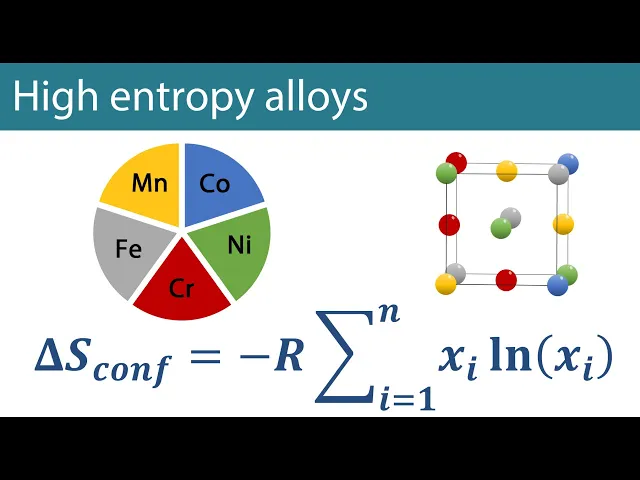
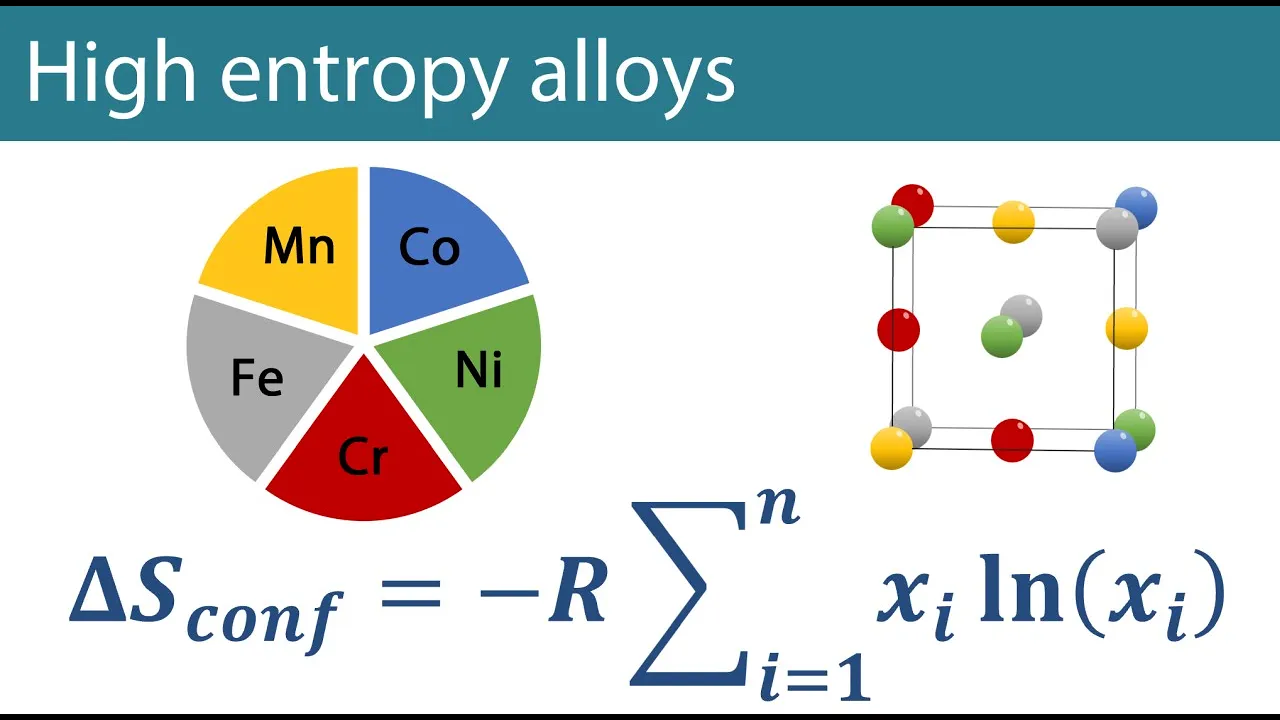
hey everyone it's Taylor Sparks and I am back with another video today we're going to talk about high entropy Alloys a topic that has been requested by a ton of people and I understand why because High entropy Alloys are an exciting and relatively new class of materials that's emerged and they've got some pretty remarkable properties for example uh I'm going to show you here this Ashby plot which shows classes of materials as a function of different materials properties take a look at the y-axis for a minute this y-axis shows fracture toughness while your x-axis shows yield strength now as we know it's tough to get a material that has both high strength while maintaining ductility and toughness but some materials do a fairly okay job of that and if you look at the different classes from non-technical Ceramics like cements you've got your polymers our glasses are down here technical Ceramics are over here they tend to be quite hard but and strong right but at the expense of fracture toughness meanwhile our metal alloys can achieve really high toughnesses while being fairly strong wrong metallic glasses are over here and then check out up here here we have our high entropy and our medium entropy Alloys really achieving Best in Class fracture toughnesses something like 200 plus megapascal root meters that is absolutely phenomenal or as these authors put it from this review Ashby plot of strength versus fracture toughness showing chromium Cobalt nickel based medium entry and high entropy Alloys are among the most damage tolerant materials on record so we're seeing remarkable performance in terms of mechanical properties how on Earth are these things so much better than other metal alloys how do they differ from them to enter that we need to go back to where they were discovered it's actually a cool story there was actually two research groups totally separate from one another one at Oxford and Birmingham and the other one in Taiwan that we're working on this almost at the exact same time the Canter paper from the UK was actually published online December 31st in 2003 whereas the other one from Taiwan was only submitted December 1st of that same year so technically Cantor beat them a little bit but these were really independently discovered at basically the same time whereas the first paper by Cantor looked at you know an alloy made up of Manganese Cobalt nickel chromium and iron in equal portions right so it was an equity Atomic mixture of these five elements which if that seems unusual to you we're going to talk about that in a minute but they had five different elements present in a lattice and they found that a single phase emerged a single FCC phase emerged super uh surprising result there and the other group by yea you know they found something very similar it was a slightly different mixture they worked with copper Cobalt nickel Chrome and iron and they added additions of aluminum so it was equitomic but then as they increased the amount of aluminum the aluminum was not Equity Atomic and they found something even more interesting they found first off it's not just FCC but as you increase the aluminum content so on this x-ray Specter you see as it's going up they're increasing the amount of Lumina check it out the Spectra corresponding with the FCC phase disappear and you see the rise of BCC phases until it's completely BCC so there's a transition with just a little bit of alumina relatively speaking you're able to transition from FCC to BCC and even more exciting and what really caused this field to sort of take fire was take a look at this the yay paper did more than just look at the phases present they did a quick hardness measurement and if you look at the hardness measurements again over here is no aluminum and as they increase the amount of aluminum we've already seen that it goes from FCC to a mixture of FCC and BCC all the way to BCC and look what happens to your hardness right it skyrockets which is not too surprising for a lot of reasons which we could talk about BCC we know has fewer slip systems the interstitial sites are not the same size in both but it's the value that's exciting here look at the values there she leaving right the as cast are like seven to eight hundred right in terms of the hardness values wildly higher than many many other metals so these things have awesome mechanical properties which really it felt like a gold rush because nobody expected to find single phase materials in those compositions how come normally uh when you look for single phase materials you don't look in the middle of the phase diagram think of like your binary like eutectic right you have solid Solutions on the edges and then middle you either have a two-phase region or maybe there's an intermediate compound a line compound something in the middle but it's simply an inner metallic in the center you don't typically find a solid solution of a single phase in the center you can but it's uncommon right so instead when people look at Alloys and they want them to be single phase they normally look at the edges of a phase diagram so in this ternary diagram for example you might have a compound that is primarily atoms a so in this cartoon over here you see the big green atoms are all atoms a and then if you did add a little bit of B and C you wouldn't want to add very much they would be right the solutes inside the solvent of a maybe C is a small one it could fit on interstitials where B is about the same size and so it's a substitutional right but these are going to be small amounts because if you add too much we know that it's going to mess with your solubility you might reach your solubility limit after which you will no longer have a solid solution so this has been the guiding principle now the yay paper they pointed out that you know where we have these you know really non-dilute mixtures of elements that they're roughly in equal proportions with one another maybe what's going on and maybe the reason that we're not forming inner metallics is that we have an entropic stabilization right in fact you can calculate the configurational entropy right it's just going to be equal to the negative gas constant times the summation of each of your different components you're going to take what is the composition right what's the fraction of that component times the natural log of that fraction of its you know presence in a so when you do that you find that you know actually you can achieve significant uh configurational entropies especially as you increase the number of components in your system so if you have an alloy that say has five different alloys five different Metals in it and you start to add that together you can get to really large configurational entropies and so most Alloys are in this low entropy regime right when you take like iron that's been doped with a little bit of carbon to make a stainless steel to make a steel or when you add a little chromium aluminum you're still in the low to maybe medium entropy alloy but when you have really large amounts of many different phases present that's when you can get up into this High entropy alloy regime and that's where the name is sort of stuck they put an arbitrary cut off the set if it's over one and a half R then you're now in a high entropy alloy as opposed to a medium entropy which is between one and a half R and just R and then low are being less than R so that's where this term came from so what's it actually doing for us well remember we've said before that single phases are typically not found in the centers of phase diagrams but at the corners in fact if you have let's say three different components shown in this drawing here from the paper by George and nature review materials if you have three different components present and you were to combine them then there's a bunch of different scenarios on what could happen one scenario is that they mix and form a solid solution right where the solid solution is lower in terms of free energy than any of the three individual phases and so they just mix this is typically pretty uncommon it's very common for us to have when we have equal amounts mixing like that that we have inner metallic phases forming so that's the other option that happens okay instead of being perfectly mixed we're going to form an intermetallic so in this case the green and the orange atoms are going to form some sort of inner metallic which is more energetically stable as we see from the free energy diagram and so there will then be a mixture of the solution and the inner metallic right so that's one possibility you've got the solid solution you've got inner metallic what else could happen so you could end up with multiple solid Solutions where you have three regions which are primarily one type of atoms but with small amounts of impurities of the other phase in them right so these are multiple solid Solutions that's another possibility or finally it could have spinodal decomposition where you start out with a random mixture and then the regions actually segregate into regions of different composition based off of your free energy curve in this case you have so in this case they're ending up with a mixture of different uh maybe the same phases but different composition okay so what dictates whether or not these four different sort of possibilities takes place has all to do with free energy now when we mix things together we form a solution you might remember from thermodynamics that you have this Delta G of mixing so Delta G remember that's our change in the Gibbs free energy so when things are separate that's at one energy level when you put them together they're at a new energy level and the difference between them separate and them now in a solution that's Delta g mix right that's the change in your Gibbs free energy when you mix them together and it's going to be made up of two components right there's your change in enthalpy upon mixing and then there's your change in entropy on mixing which gets multiplied by temperature so essentially what the yay paper was pointing out they said hey maybe what's happening is that because the configurational component of our mixing entropy is so big maybe this term is really large and then they said okay imagine a scenario where this thing orders perfectly right so you're if you did form an inner metallic it was perfectly ordered that means that this term is going to be very low and if the enthalpy of formation of that inner metallic is not too big then what you really have competing with another is this really big term giving you a big Delta G of mixing meaning it wants to form a solid solution competing with a smaller term coming from this formation energy and under that scenario maybe now you have the formation of a solid solution over inner metallics so they thought of it as a stabilizing Force the entropy is actually helping you stabilize the solution over preferentially over the inner metallic now this really actually kind of violates the long-standing Hume rathery solubility rules in your intro to MSC course you probably learned about these I know I teach in mine um we talked about you know when you start to put a dopant or an impurity atom into a metal and form an alloy it typically has a solubility limit it's uncommon for materials to have a complete solid solubility all the way across although some do right it's much more common that there's a limit and you can ostensibly say that the amount you're going to be going to be putting in is going to be reduced if a number of different criteria are met for example and this is where the rules come in right they said okay if the atomic radius between the solute and solvent are bigger than 15 difference then it's unlikely you're going to have a large amount of solid solution right that's one thing what if the crystal structure of your two different atoms are very different then it's unlikely that they're going to dissolve in one another so if one is BCC and it's pure phase and one of its pure phase is FCC it's unlikely that they will have you know good solid solubility one with another um talked about it's better if they have the same valence if they don't then it's less likely although if one has a higher valence than the other and it's more likely to be a solute than a solid than vice versa or vice versa and the last thing is that they should have similar electronegativity which makes sense because if you have a big difference in electronegativity meaning one thing one of your elements really wants electrons and the other one doesn't want them very much then they're more likely to Just Surrender that electron the other one takes it and in doing so they've formed an inner metallic compound right so if they're closer to the same electronegativity then it's not like one of the atoms really wants the electrons much more than the others and so it's less likely to form an inner metallic those are your general rules and we see that a lot of these things just get completely thrown by the wayside in these high entry Alloys take the Canter alloy remember it was made up of Manganese copper nickel chromium and iron these things have like very different Crystal structures right um and yet you're able to get a single phase of FCC well at least in the early days they thought they were single phase turns out as they started to dig into these they found out that many of the early works on has actually were segregating and the differences were subtle and sometimes hard to see and so there'd be maybe two FCC lattices the slightly different lattice parameters but it still was very surprising in terms of that it looked pretty much like a single phase and the mechanical property spoke for themselves right so let's jump ahead and talk about some of their core effects when people talk about heas and why they're so interesting it's because a couple different reasons first has to do with thermodynamics which we've been talking about I'll say a little more about that the second has to do with lattice distortion when you bring together all these different atoms then is sluggish diffusion where you get very different diffusion rates and then finally the cocktail effects or unexpected synergies so let's kind of walk through these first off thermodynamics so we start out with our pure elements we said pure elements if it's a Pure Element it has been mixed therefore it's changing free energy of mixing is zero it's enthalpy of mixing will be zero entropy of mixing will be zero okay now that's one scenario that's our Baseline when things are separate now if you bring them together they have the option of either forming a random solid solution or forming compounds so okay if they form a compound typically if it's an inner metallic that forms it's going to have a large negative change in Gibbs free energy and that arises primarily from the large negative enthalpy right the formation of those compounds typically these things are very ordered they're so their entropy will be smaller not zero but smaller right whereas the random solution right they form a solid solution now because of the configurational entropy this can be quite large right whereas the enthalpy is not typically as high it's a little bit more negative and so overall you can also get a large negative uh enthalpy of mixing and so ultimately depends on which one is going to be larger as to whether or not you're going to form a solid solution or an inner metallic you can actually see that if you combine different elements so if you start out with just two different elements then the configurational entropy is going to be and these are assuming Equity Atomic mixtures so in the if the case of two then that's 50 you know percent moles of one and 50 mole percent of the other if you combine them then the configurational entropy would be 0. 69 r as you increase that to three different components in equal amounts that rises to 1. 1 times the gas constant at four it's 1.
39 1. 61 1.