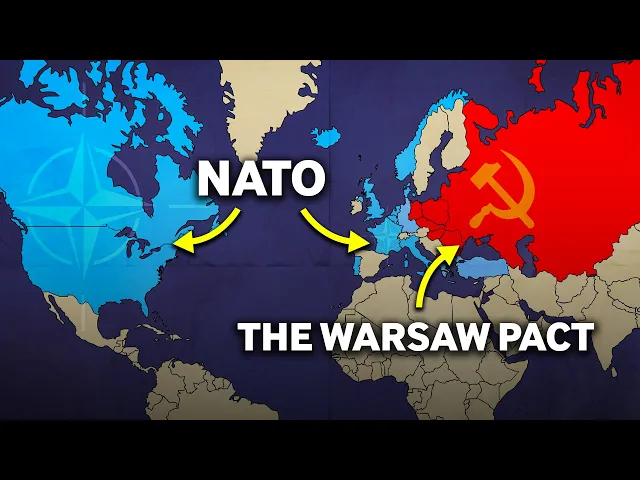
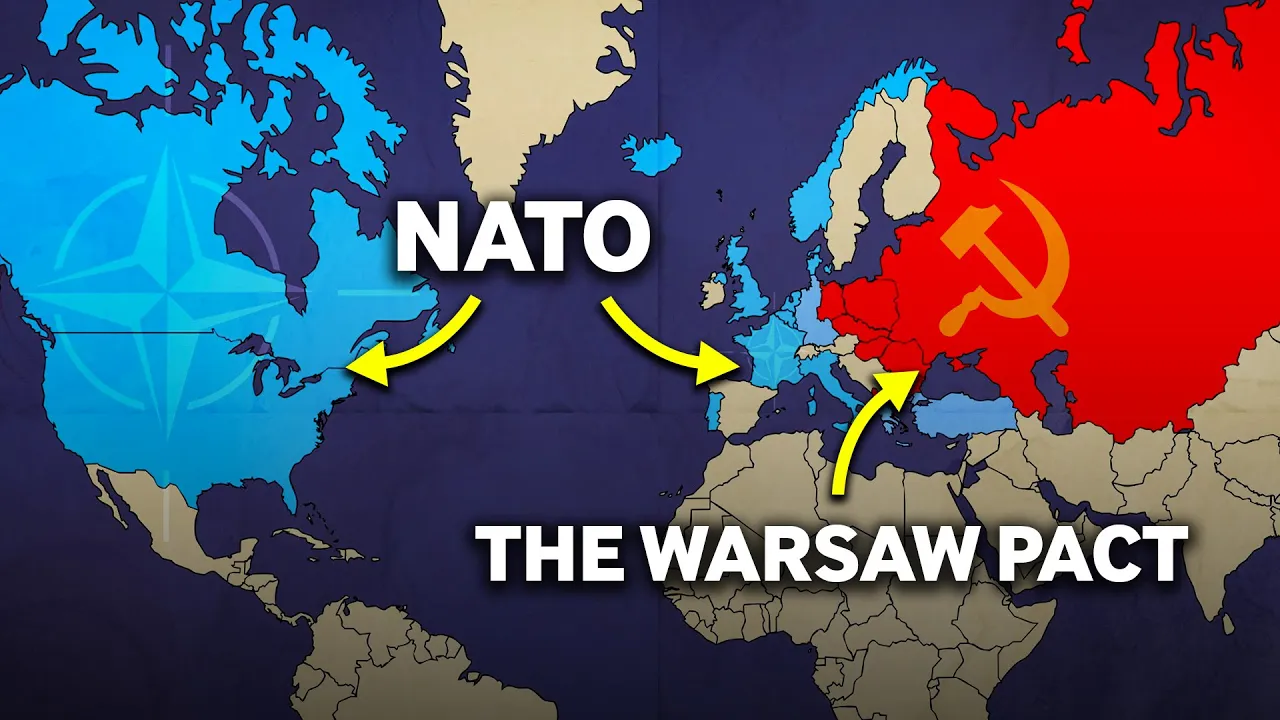
This is the Iron Curtain. For decades, it represented a geographical divide between two conflicting ideologies. Communism versus capitalism, East versus West, the Soviet Union versus NATO.
The North Atlantic Treaty Organization is arguably the most significant international alliance of its kind. With 32 member states as of 2025, it represents an immensely influential collection of nations where an attack on one country is considered an attack on them all. But when it was first formed in 1949, things were far from certain.
The story of the birth of NATO is invariably linked to the start of the Cold War. But why did Europe become so deeply divided? How did Berlin become the epicenter of cold war tensions?
And why was the formation of NATO such a threat to the Soviets? In the aftermath of the Second World War, Europe was shattered physically, economically, and socially. Tens of millions were dead.
Cities lay in ruins, and hunger and homelessness were widespread. Countries like Germany faced staggering devastation with places like Hamburg seeing half a million people without shelter. The continent was desperate to rebuild but also to redefine itself amid rising tensions between east and west.
During the Second World War, the Western Allies had worked together with the USSR to defeat the Axis powers. But now these former allies were strictly divided along the ideological spectrum and tensions in Europe had been slowly increasing since the end of the war. In the east, communism was the dominant political ideology.
The idea of a classless society where owning land and producing goods is the sole responsibility of the community as a whole or rather the government. This was in stark contrast to the capitalist west who strongly believed in personal freedoms and private industry. These two opposing ideologies by definition were a direct threat to one another.
Stalin had openly committed to spreading communism throughout the world and had been installing communist governments and exerting Soviet control over vast swades of Eastern Europe. Winston Churchill's iron curtain speech captured this growing mistrust between East and West. As the Soviet influence continued to spread, the Eastern block was beginning to take shape, and there were fears that Greece and Turkey may be the next countries to submit to communist control.
>> This expansionism, coupled with the Soviet's continued military buildup and investment in armaments, alarmed Western powers who were demobilizing after the war. The USSR's refusal to scale back its presence and its pursuit of nuclear weapons deepened tensions, laying the groundwork for the Cold War and the eventual formation of NATO. The exact beginning of the Cold War is ambiguous, but many attribute this moment to President Truman's announcement of the Truman Doctrine in March of 1947, where he outlined a strict policy to contain communism.
This was followed the next year by the Marshall Plan to help rebuild Europe. But it wasn't just economic aid. It was a strategic move to stabilize Western Europe and prevent the spread of communism.
>> Stalin saw the Truman Doctrine and Marshall Plan as tools for spreading capitalist influence and undermining communism in Europe. In response, he formed Common Form, an organization made up of communist parties from nine European countries who were devoted to coordinating communist activities and Soviet directives across Europe. Stalin's rejection of the plan for Eastern Europe deepened the divide, crystallizing two ideological blocks, Britain was weakened and retreating from its imperial role.
While the US now saw its own security tied to Europe's fate, Berlin quickly became the symbolic epicenter of cold war tensions. Germany was formally divided into four occupation zones at the Potam conference of 1945 with Berlin itself split among the same powers but located deep within the Soviet zone of occupation making it a geopolitical flash point. Soviet foreign minister Molotov famously said what happens to Berlin happens to Germany.
What happens to Germany happens to Europe. Germany's post-war fate reflected broader ideological clashes. Western zones gradually merged, first into the Bzone in 1947, then the trizone in 1948.
But beyond the east west divide, there were lingering fears about Germany's potential resurgence, prompting alliances like the Dunkerk Treaty between France and the UK in 1947. In February 1948, the Communist Party of Czechoslovakia, backed by Moscow, coordinated a coup and seized full control over the Czech government. This marked a dramatic expansion of Soviet influence in Europe and deeply alarmed western powers, shattering any hopes of a potential democratic buffer state between east and west.
Then in June 1948, the Soviet Union imposed a blockade on West Berlin in response to the Western Allies introducing the Deutschmark into their zones, including West Berlin. This move, part of broader efforts to stabilize and rebuild Germany, alarmed Stalin, who saw it as a threat to Soviet influence and a step towards a strong capitalist Germany. The blockade aimed to cut off all land and water access to Berlin, forcing the Western powers to abandon the city or make it dependent on Soviet supplies, effectively bringing it under communist control.
The Western response was swift and determined. Refusing to back down, the US, UK, and France launched the Berlin Airlift, supplying over 2 million West Berliners with food, fuel, and essentials via air corridors. You're looking at the Handley Page Hastings.
When it was introduced, it was the largest transport aircraft ever designed for the Royal Air Force. The Hastings entered service in 1948, eventually replacing the Avro York as the RAF's standard long range transport. It was rushed into action during the Berlin blockade to deliver supplies and vital coal shipments to sustain the city through the harsh winter.
This very aircraft participated in the Berlin Airlift for almost a year, flying missions to Berlin's Teagle and Gateau airfields with number 47 squadron. It was also operated by air crew from 53 and 297 squadrons. As these aircraft flew day and night to keep the people of West Berlin alive and the city functioning, secret negotiations were already underway.
In the wake of the Second World War, new international structures were emerging, most notably the United Nations in October 1945, replacing the League of Nations. The UN was intended to foster international cooperation and prevent future conflicts, but it became hamstrung by cold war tension, particularly the Soviet Union's frequent use of its security council veto power, which continued throughout subsequent decades. On numerous occasions, the USSR blocked the admission of several countries on the grounds that they were too closely aligned with the West.
This pattern of obstruction continued with the Soviets using their veto to stall all resolutions that challenged their strategic interests, particularly in Eastern Europe. These vetos represented a deepening ideological divide and contributed to growing Western frustration with the UN's inability to act decisively when needed. The Treaty of Brussels signed in March 1948 by Britain, France, and the Benelux countries established a mutual defense and economic pact.
Some of its military structures were shaped by figures like Field Marshall Montgomery and sought military support from the United States. These negotiations directly triggered talks about forming a transatlantic alliance. However, those conversations were politically sensitive, especially in the leadup to the 1948 US presidential election and faced resistance in Congress.
The idea of NATO was a controversial one. The negotiations that followed were anything but smooth. From 1948 into early 1949, secret talks between the US, UK, and Canada laid the groundwork for what would become the North Atlantic Treaty.
These backroom deals, as Peter Apps describes them, were driven by strategic calculations and political sensitivities. Some Americans were wary of entangling alliances, fearing NATO might undermine the United Nations or drag the US into future wars. Congress was particularly cautious about Article 5, which dealt with collective defense.
Other contentious issues included whether the NATO alliance should be purely military or also political and economic, how long the treaty should last, and how to handle colonial territories. The US election of 1948 added further delays, but ultimately Truman's unexpected victory helped push the treaty forward. Finally, NATO was formed on the 4th of April, 1949 with the signing of the North Atlantic Treaty in Washington, DC.
The 12 founding members were Belgium, Canada, Denmark, France, Iceland, Italy, Luxembourg, the Netherlands, Norway, Portugal, the United Kingdom, and the United States. The ceremony marked a turning point in post-war diplomacy with President Truman delivering a speech that framed the treaty not just as a military pact, but as a moral choice. This is an illustrated printed booklet from within IWM's library collection entitled NATO Means Peace and it was created by the NATO information division.
Judging by the references within it, we can place its publication to around 19556. It is essentially selling the NATO mission. Its purpose was to explain probably to Western audiences why NATO was formed, how it works, and what it's done in its first years.
It details the historical context behind the creation of NATO, including the Berlin blockade, when the free world stood firm. But throughout, it really hammers home the narrative that NATO is peaceful and defensive. Meanwhile, the Soviet Union is the aggressor and the oppressor.
The way that NATO presented itself was as a peace-seeking, defensive alliance, rebalancing the scales of power in a divided world. We see these themes repeated again and again in this booklet and that narrative approach is absolutely mirrored in the early NATO produced information films as well which also reside in IWM's collection. NATO was carefully crafting a message.
NATO is necessary. NATO means peace. We can see article 5 described here in the NATO booklet.
to agree that an armed attack against one or more of them in Europe or North America shall be considered an attack against them all. Article five, the collective defense clause would become the defining feature of the alliance and arguably the largest deterrent against aggression from the Soviet Union. As members of NATO, every country was now in theory protected under the USA's nuclear umbrella.
>> From the beginning, NATO positioned itself as a force for peace, not merely a bullwark against war. While it's often thought that NATO was created solely in response to the Soviet threat, this is only partly the case. The alliance stated three core aims upon formation.
To deter Soviet expansionism, to prevent the resurgence of nationalist militarism in Europe, and to promote European political integration. This aspect is often overlooked, especially in narratives that consider NATO as purely a product of the Cold War. From the Soviet perspective, NATO's creation was viewed with deep suspicion.
see not as defensive or aspirational, but as provocative and dangerous. >> To Moscow, NATO wasn't just a military arrangement. It was an ideological challenge to the Soviet world view, one that had threatened the legitimacy and the spread of communism across Eastern Europe.
This perception fed into a broader narrative of Western aggression, reinforcing Cold War paranoia and deepening the divide between East and West. The Berlin blockade came to an end on the 12th of May 1949, just over a month after the formal creation of NATO. But while the timing might suggest a direct link, the reality is more complicated.
The Soviet decision to lift the blockade was less about NATO's formation and more an acknowledgement of the failure of their own strategy. The Western Allies had successfully sustained West Berlin through the Berlin Airlift, an enormous logistical effort that continued for several more months, even after land routes were reopened. Over the course of the airlift, 32 Hastings aircraft delivered over 55,000 tons of supplies with coal desperately needed amid the energy crisis brought about by the blockade.
The final flight of the airlift was performed by a Hastings on the 6th of October 1949. Though NATO didn't directly end the blockade, the crisis played a significant role in shaping Western strategic thinking. The blockade had exposed vulnerabilities and underscored the need for a formal collective defense mechanism, one that could deter future Soviet aggression.
In that sense, the blockade was part of the backdrop that helped galvanize support for NATO's creation. It demonstrated the importance of unity and coordination among Western powers and the airlift's success became a powerful symbol. Then on the 23rd of May 1949, West Germany was officially formed as the Federal Republic of Germany, including West Berlin as an enclave and bringing an end to Tonia.
This further provoked the USSR and their response was to form the German Democratic Republic from East Germany that October. Although the signing of the North Atlantic Treaty in 1949 formally united the Western Allies, it did not initially provide a framework for coordinated military action. This changed dramatically in response to escalating concerns about Soviet intentions, particularly following the Soviet successful test of an atomic bomb in 1949 and the outbreak of the Korean War in 1950.
These events underscored the need for a unified military strategy within the alliance and combined manpower and military resources. NATO established a consolidated command structure anchored in the creation of Supreme Headquarters Allied Powers Europe or SHAPE located in France. American General Dwight Eisenhower was appointed as the first Allied Supreme Commander Europe.
This foundational structure laid the groundwork for NATO's evolution into a fully integrated defense alliance. In the years that followed, NATO expanded beyond its original 12 founding members and admitted Greece and Turkey in 1952. This enormous flag dates from around the late 1950s.
It shows the iconic NATO logo in white on a dark blue background. This specific flag is what's called a sealed pattern, which was a master pattern, a standard for other flag manufacturers to then copy. As you can see here, it has two wax seals, and these mean the pattern has been officially sealed.
While the tags identify the flag as an official standard of NATO, this flag is a window into NATO's early years, an insight into how NATO visually communicated the purpose of the Atlantic Alliance. It gives us a sense of the increasing use of a recognizable visual identity, a simple but striking way of asserting NATO as a united peacekeeping organization on the world stage. The compass design has remained largely unchanged to this day and has become synonymous as the symbol of the organization.
This is testament to the work that was being done in the early years of NATO to establish a recognizable visual identity that would cement the ethos of the organization in the eyes of the public and on the world stage. Lord is the first secretary general of NATO announced this would be the official flag and emblem design of the Atlantic alliance and still it endures today. He described its symbolism as a four-pointed star representing the compass that keeps us on the right road, the path of peace and a circle representing the unity that binds together the 14 countries of NATO.
The dark blue color of the flag represents the Atlantic Ocean, that all important geographic dimension around which this huge international alliance was formed. In 1955, an enormously significant turning point was reached when West Germany joined NATO. A move that significantly heightened cold war tensions and directly inflamed the Soviet Union.
Their response was to create the Warsaw Pact as a counterbalance to NATO. The Soviets worried about a resurgent potentially militarized Germany in future and worried about increased Western influence and power. But ultimately the Warsaw Pact was also a tool to further control Eastern European countries.
This was one of the most defining moments of the Cold War. The creation of NATO in 1949 and the Warsaw Pact in 1955 didn't just formalize military alliances. They cemented the ideological divide between East and West, drawing that iron curtain down the middle of Europe.
These two blocks represented opposing visions of the global order. With each signed bound by mutual defense commitments and deeply entrenched suspicion, this division would shape foreign policy, military strategy, and domestic politics for decades to follow. The Cold War was no longer in its infancy, and the scene was set for the decades of tensions, proxy wars, arms races, espionage, and diplomatic standoffs that all unfolded within the framework of this new divided world.