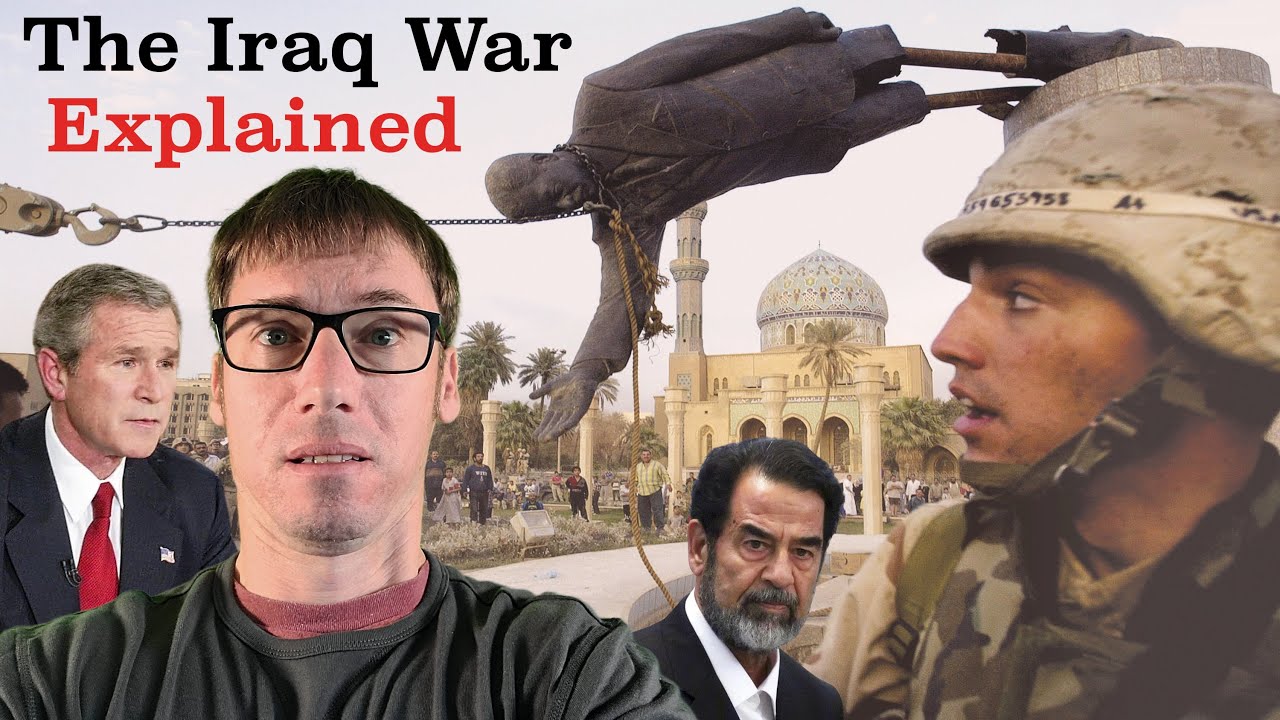
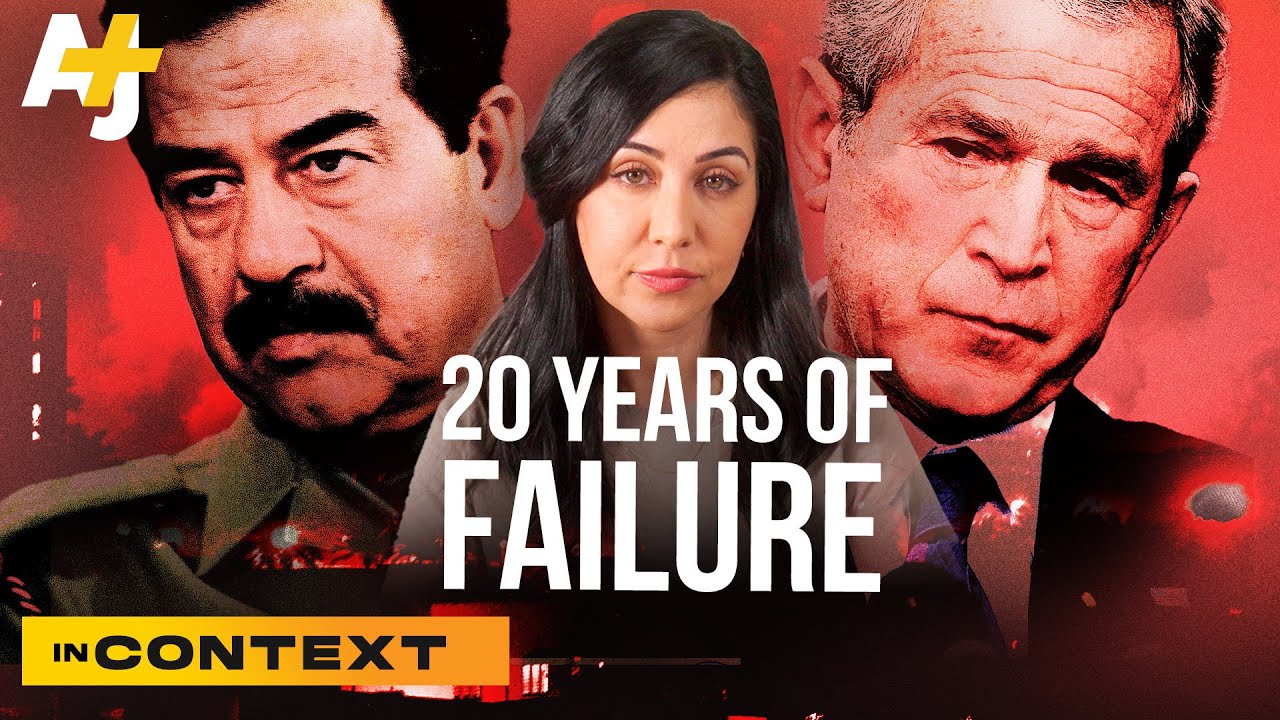
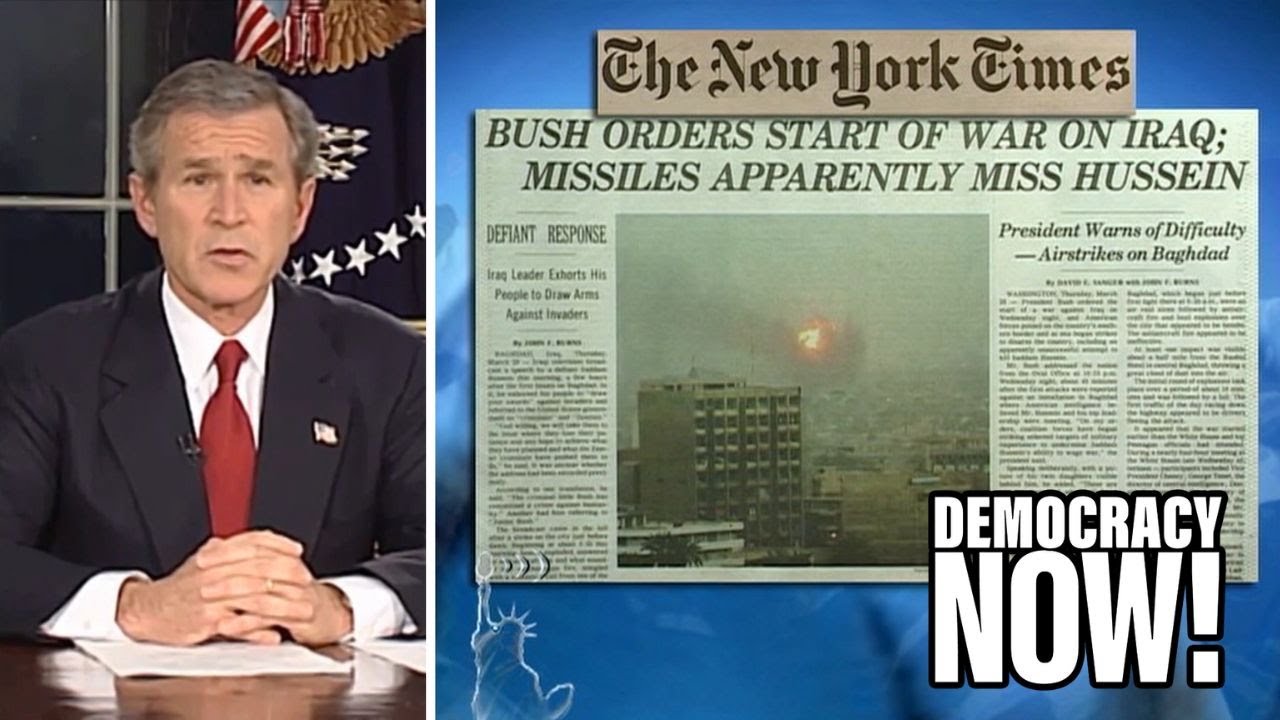
On March 19, 2003, the United States began its invasion of Iraq. The war lasted officially more than eight years. My fellow citizens, at this hour, American and coalition forces are in the early stages of military operations to disarm Iraq, to free its people, and to defend the world from grave danger.
And you can know that our forces will be coming home as soon as their work is done. It's been 20 years since the invasion. It was a war of many consequences: consequences for Iraqis, for the entire region, for an entire religious community that would become marred by sectarian fault lines.
It was a war of consequences for how we govern borders, how we define and practice national security, how we justify wars or regime change. It was, again, a war of many consequences, but none for those responsible for any of it. Twenty years ago, the United States couldn't have just invaded Iraq.
It needed to build a case, a justification. It had to sell the war — and it did: in our headlines, on our broadcast news networks. - Military recruiting stations are seeing people walking in and saying, “Sign me up.
” We don't have a choice. He is going to conduct more terrorist operations whether we strike or not. Know that this war is necessary.
It is just. And no one — none of its cheerleaders who held political office, who wrote news stories regurgitating government propaganda — apologized. No one was held accountable.
And so what do the moral and journalistic failures of U. S. news media in manufacturing the case for the Iraq invasion tell us about power and the press in this country?
What do they tell us about what's changed, and what hasn't, in two decades of reporting on national security and foreign policy? Welcome to season two of “Backspace,” where we tell you how the story is told in the headlines, and then we think about how we can tell it a little differently. After 9/11, the United States was engulfed in an ideological fog: Talk of "revenge" and "our enemies" was everywhere.
Americans are asking, "Why do they hate us? " I've always been a bleeding-heart liberal, but right now I certainly feel a lot of anger. And, you know, I mean, there's a side of me that wants to see our government just go and— whoever's an enemy, just hit 'em now and ask questions later.
The invasion of Afghanistan — that happened just months after the attacks — was quick and didn't require a lot of convincing of the public: Ninety-three percent of Americans supported taking military action against whoever was responsible. Eighty-six percent supported going to war. It didn't matter that Afghanistan wasn't responsible for 9/11 — the ruling Taliban's sheltering of Osama bin Laden, the head of Al Qaeda, was more than enough.
And, at the time, very few thought it would become a protracted war, occupation and quagmire. But invading Iraq needed a little more convincing. Not only Americans, but an extremely skeptical international community — skeptical allies — had to be convinced.
And it worked, at least domestically. When the United States invaded on March 19, 2003, 72% of Americans supported the war. A staggering number for a war that, by all accounts at the time, shouldn't have received that level of popular support.
It was going to be expensive, long. There was going to be a lot of life lost, both among the Americans and the Iraqis. But Americans, overwhelmingly, wanted the war.
So how did that happen? It couldn't just be because of post-9/11 hypernationalism, could it? Well, for a war against Iraq to be popular, it had to be sold as a just and necessary war — Iraq and Saddam Hussein had to be seen as a "clear and present danger.
" Despite the long-standing hostile relationship between the two countries, the Bush administration knew that this would require some maneuvering. So much so that in November 2001, then-Secretary of Defense Donald Rumsfeld was already meeting with military brass to figure out justifications for "regime change" in Iraq, considering linking Iraq to 9/11, or creating disputes over weapons of mass destruction inspections. There are also unknown unknowns.
The Bush administration, before the dust of the towers had even settled, began building a framework to justify what would lead to two decades of war, surveillance, torture and destabilization of entire regions — the so-called global war on terror. We must find terror where it exists, and pull it out by the roots, and bring it to justice. The greater danger is that Saddam Hussein, left to his own devices, will perfect his means of delivery of weapons of mass destruction.
The United States has entered a struggle of years, a new kind of war against a new kind of enemy. Iraq had to be brought into that fold, into that fight for civilizational survival against terror. And it was, in a January 2002 speech when President George W.
Bush introduced Iraq, Iran and North Korea as part of the so-called axis of evil. States like these and their terrorist allies constitute an axis of evil, arming to threaten the peace of the world. By seeking weapons of mass destruction, these regimes pose a grave and growing danger.
And while that wasn't the first instance of when the Bush administration had started constructing a narrative connecting Iraq to 9/11, to WMDs and to Al Qaeda, it was the moment that explicitly put the target on Iraq for regime change. It's from then on that we see a sustained campaign to mention Iraq, 9/11, terrorism and WMDs in order to rally public opinion, despite there being zero evidence connecting Iraq and 9/11, or Iraq and Al Qaeda, or zero conclusive evidence that Iraq still had or was developing WMDs. Simply stated, there is no doubt that Saddam Hussein now has weapons of mass destruction.
But the lack of evidence didn't stop the Bush administration from making those links. . .
We know they have weapons of mass destruction. We know they have active programs. There isn't any debate about it.
. . .
and an uncritical news media from helping them manufacture the story. - No one is certain what Saddam has, though they do know what he is capable of doing. - He's on a collision course with the United States over weapons of mass destruction.
We go to the UN, make one last diplomatic effort on inspections, and Saddam says no. It's clearly he who has refused the diplomatic route. For the first time in four years, UN weapons inspectors will be back in Iraq to scour a country the size of California for evidence of weapons of mass destruction.
I mean, look, it got to the point, they knew that we knew that they knew that we knew. The U. S.
news media and political class very easily accepted the idea that if Iraq's government did in fact have WMDs, then of course there was just no other choice but to invade. Because a full-blown war isn't catastrophic the way chemical weapons can be. And so wall-to-wall coverage, a grab for ratings, as well as a default tendency within the news media to uphold the power of government and military, ensured that an impenetrable wall was created against any criticism of the warmongering from U.
S. officials. A 2008 study by the Center for Public Integrity, a nonpartisan group, found that in the two years following 9/11, President Bush and seven other top U.
S. officials made a total of 935 false statements about the threat posed by Iraq. In addition to being given a consistent platform on cable news, Bush administration officials — as well as anonymous government sources, Iraqi defectors and Republicans — were also unquestioned sources on the war that they had long salivated for.
You have laid out a very firm case and I give you a lot of credit. Time and time again, the overwhelming majority of voices featured were current or former government officials, the majority of whom were pro-war — a trend that would also continue into post-invasion coverage. In a single two-week period before the invasion, only one U.
S. official out of 267 American guests featured on broadcast news — such as NBC, PBS, ABC and CBS — was somewhat critical of the prospect of war with Iraq, according to Fairness and Accuracy in Reporting. There was no room for dissent — and when it was featured, it either provoked considerable backlash or was usually from non-Americans who didn't exactly carry much authority among the average American viewer.
MSNBC, which had been given a directive to go to the right after 9/11, even fired veteran media personality Phil Donahue for being too critical of the Iraq war, as a leaked memo revealed. Good reminder, by the way, to throw in here that while this was all happening in the United States, massive protests were overtaking major cities around the world — so there was a lot of dissent. But protesters, whether they were the Dixie Chicks or the entire nation of France, were met with mockery, counterprotests, and accusations of betrayal and treason.
Now, the case for war wasn't only being made on cable news, of course. Print newspapers and magazines pulled their weight too — at worst advocating straight out for an invasion or, at best, never even questioning whether possession of WMDs really necessitated a war. The New York Times, in particular, became a hub of misinformation.
The entire institution itself came to signify the journalistic failures that led to, in 2003, the vast majority of Americans believing that Saddam Hussein was involved in 9/11 and that he provided support to bin Laden. Of course, neither of those things were true. The Times consistently published reporting on weapons of mass destruction and the threat posed by Saddam Hussein that was based on faulty sourcing.
Like, mainly a single source — a source that happened to be the Iraqi National Congress, an opposition group that wanted Saddam Hussein gone. And it also just so happened to be founded by a guy with a history of having close friendships in American neoconservative circles: Ahmed Chalabi. He would go on to become the head of the Iraqi Governing Council, the deputy prime minister and the minister of oil.
While all the blame post-invasion fell on national security reporter Judith Miller, who co-wrote several of those faulty reports alongside reporter Michael Gordon, it took an entire editorial institution and process to accept, edit, approve, edit again and fact-check every one of those stories. And those stories, filled with false information, were then in turn used by Bush administration officials in their public campaign. There is already a mountain of evidence that suggests that Saddam Hussein is pursuing weapons for the purpose of using them.
Even a decidedly liberal magazine, The New Yorker, devoted its pages to making a case for the invasion. Its coverage provided a moral negotiation for the American liberal who may have held some doubts around a Republican campaign for war. Its editor in chief, David Remnick, literally wrote “Making a Case.
” Its Middle East correspondent, Jeffrey Goldberg, wrote “The Great Terror,” using a single, later-proven-to-be-lying, source claiming a link between Saddam Hussein and Al Qaeda. New Yorker staff writer George Packer would lament, in The New York Times Magazine, “the liberal quandary” over the invasion, ending the piece by referencing an anecdote in which an Iraqi dissident shut down the anti-war arguments with a few words. That Iraqi dissident happened to be a friend of, of course, Ahmed Chalabi.
And there were countless others. Peter Beinart, editor in chief of the progressive New Republic magazine, supported the invasion, as did senior editor Jonathan Chait, who made the liberal case for war. Michael Kelly, editor in chief of The Atlantic, also supported the invasion.
He would later become the first American journalist killed in the Iraq war. Thomas Friedman of The New York Times not only supported the war, but even — for years — argued that it just had to happen. Well, suck on this.
OK? That, Charlie, was what this war was about. We coulda hit Saudi Arabia.
Coulda hit Pakistan. We hit Iraq because we could. Fareed Zakaria, heralded as a sharp political commentator and public intellectual, penned such classics as “Why They Hate Us” and “Why the War Was Right.
” He argued that Iraq wasn't just a threat, but an opportunity to instill democracy among the Arabs. And so there was a journalistic consensus in this country around the invasion, facts be damned. So what happened to all these architects and cheerleaders — every single one of whom was proven wrong very, very quickly after the devastating invasion of Iraq?
And what does the coverage before the invasion of Iraq tell us about the depth of persuasion when political power and the power of the press lock hands? Now, we know that not a single member of the Bush administration — from President George W. Bush himself to the legal architect of torture John Yoo — saw a day of accountability.
President Bush gives candy to Michelle Obama and paints his days away. John Yoo teaches at Berkeley Law. Condoleezza Rice is at Stanford.
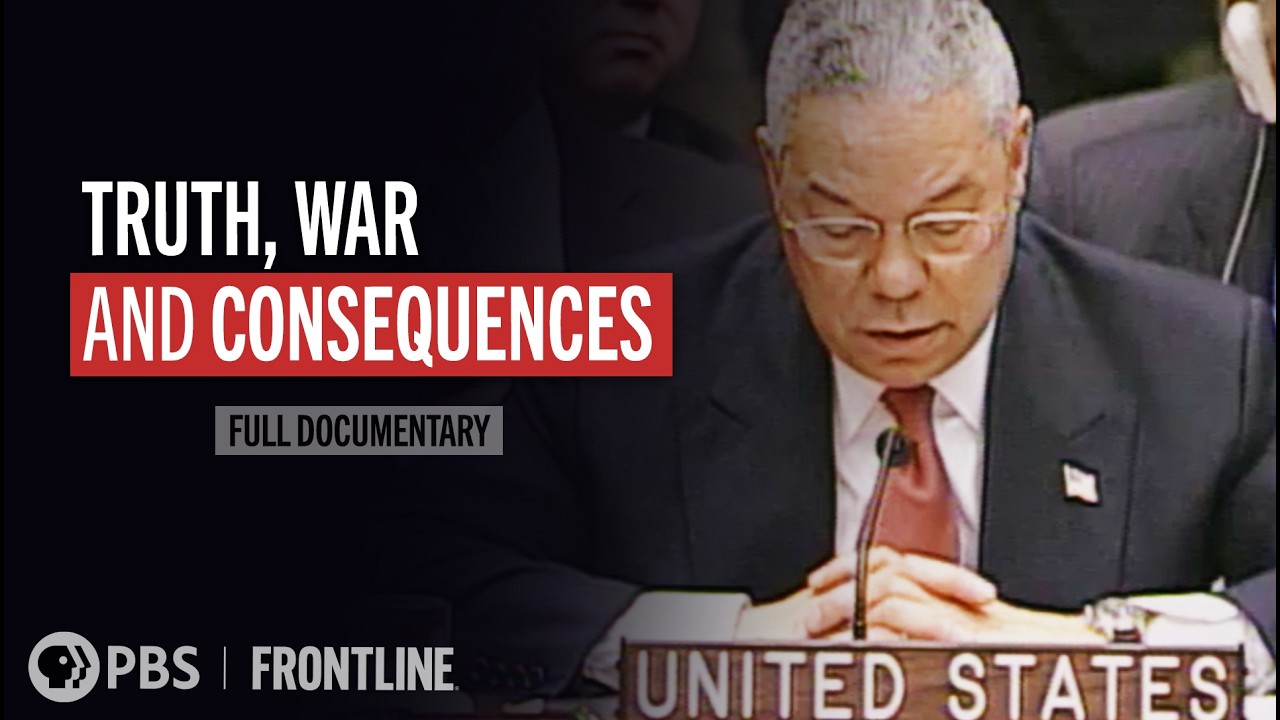
David Frum, the speechwriter who wrote the "axis of evil" speech, is a columnist for The Atlantic. Dick Cheney was applauded for his 2022 rebuke of Trump after supporting his presidency in 2016. And Colin Powell and Donald Rumsfeld are dead.
Except for Judith Miller, almost every other media cheerleader went on to have an illustrious career. David Remnick is still the editor in chief of The New Yorker. Jeffrey Goldberg went on to become the editor in chief of The Atlantic, where George Packer is also a staff writer.
Jonathan Chait is now a columnist for New York magazine. Thomas Friedman still has a career, of course, at The Times. Broadcast news networks have barely acknowledged the role they played.
The war was a lucrative time for most news channels, and government officials and other pro-war pundits continued to flood national news channels well after it was clear that the premise justifying the invasion had crumbled. The New York Times in 2004 published what some referred to as a mea culpa, but it barely even scratched the surface of its role in pushing war propaganda that resulted in a minimum of of 100,000 Iraqi deaths. Yes, there were scattered apologies from individual journalists like Beinart and Zakaria, but there was no real accountability, no consequences.
And in that — that lack of consequences, that lack of accountability — we find the unsettling truth about the relationship between power and the U. S. news media.
That truth? That not much changes despite glaring failures. Patterns of misinformation and disinformation about U.
S. foreign policy decisions and aggression have continued. The architects who held office or sat behind news desks have thrived in their careers and moved on to manufacturing other countries as threats, using the same blueprint as the Iraq War, with some sharper edges.
There is always deference to not just U. S. government talking points — especially on foreign policy and national security — but to U.
S. interests. And while that's inevitable, it's going to happen — it's a media landscape that's made up of Americans, of course — the veneer of objectivity needs to fall.
The coverage leading up to the invasion of Iraq shouldn't be forgotten. It is the foundation of understanding how an entire population and entire news media came to support something so brutal, destructive and illegal. There are a lot of consequences in not acknowledging and holding to account what went so fundamentally wrong by design 20 years ago.
But the most devastating injustice done is to the people of Iraq, the victims of that war — dead and alive — who lost everything for a war our leaders and our news media lied about. Thanks so much for joining season two of “Backspace. ” The Iraq War was a formative period for, like, a lot of journalists, and it's the reason why I became a journalist.
It's the reason why even “Backspace” exists: to put a critical lens on how our news media is telling the big stories. So what do you guys think? Who was probably the most responsible for spreading misinformation in the lead-up to and during the Iraq War?
Let us know in the comments. And don't forget to like, share and subscribe. And we'll see you soon.