Hey real quick before we get into the actual podcast I turned off the ads for the mid roll so you should see no ads throughout the podcast also there are chapters for each section so you can skip to whatever section that you're most interested in and you can also listen to this podcast on your favorite podcast platform so you don't have to sit here and watch the video necessarily and finally if you like this kind of Podcast I have a podcast that releases monthly for the physionic Insiders it goes far more into the details and
how to actually apply app a lot of this information to your life so if you like this kind of work and you want to support my work as well as get huge benefit through the actual monthly research then uh consider joining the physionic Insiders it's in the uh description box of wherever you're listening to this okay with that ad out Of the way let's get into the podcast hi hello welcome to the physionic podcast it's been what three four months since the last one and today we're going to get into yet another gargant to an
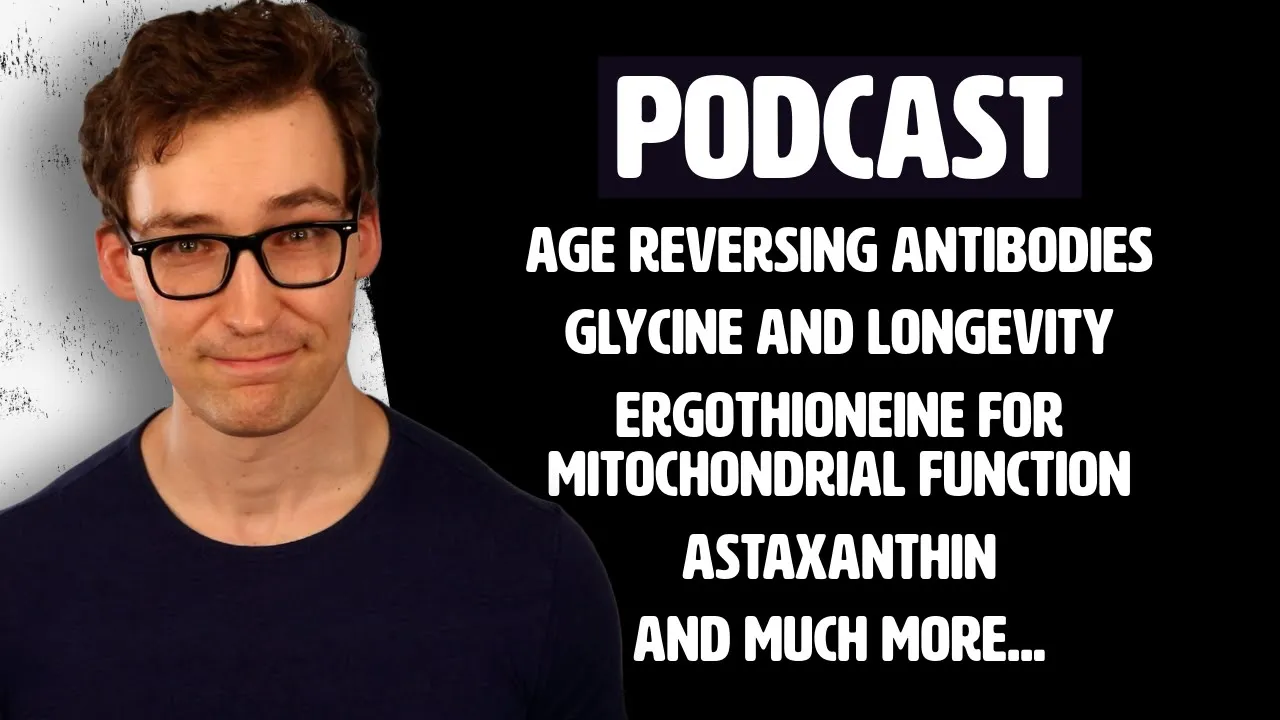
podcast episode where we're going to be covering let's see let me rattle off the list of things we'll be covering here aaz anthon and skin Dr Ronda Patrick on her opinion on mixing banana with blueberries along with your comments on that ergine and Mitochondria Glycine and Longevity I might also touch on Glycine and sleep because I didn't actually have that on my list but I forgot that I did do an investigation on that as well uh cocoa benefit for cardiovascular disease glucose spikes causing cardiovascular disease multivitamins for cognition red light therapy on skin aging and
mitochondria let's see zanthin and Lutein for Eye Health Omega-3s for cardiovascular disease creatine on your bones and muscle specifically for people who are of an older age uh let's say over the age of 60 age reversing antibody therapy which is a really cool uh science that I'll be getting into two age related issues that come about roughly right around the age of 60 so I'm going to use that as The Benchmark uh two things that are specific to people in their 60s and Beyond that you should be aware of and finally C15 the fatty 15
supplement company and then I'll be going into a little bit of housekeeping as well assuming that you're going to hang out with me for that time I guess first things first if you're watching the podcast you'll notice the uh the old couch is gone uh yeah I did did end up selling that I've moved uh since well this was I was going to add this in my housekeeping section Maybe I'll talk about a little bit more during that section but I finished my PhD I finally have my doctorate and I've moved so yeah I got
rid of that old couch and now sitting on this new couch and in a new location which has been quite an adjustment because uh especially for the videos getting the audio and the lighting correct has been an absolute nightmare in this new place so making incremental improvements over time I also don't have A a stand to to hold this microphone so I'm going to be holding the microphone for the next several hours and speaking of the length of this podcast well I mean let's see the last episode was five hours long uh I don't I
don't think that this episode is going to be that long I don't know if I have the energy to to to do five hours uh this time around but it will be quite long regardless so probably If you take last episode and combine it with this episode uh you'll get a full night's rest you'll get about eight hours of sleep so that's uh that's what we'll we'll aim for in total okay without further Ado let's go ahead and uh jump into this because I I don't want people to feel like I'm rambling about every every
little thing when we should be getting into the science uh I guess one thing before I jump into this I have videos on almost all these topics and I'll be fleshing out some of the additional nuances in this podcast I usually get comments from people saying hey uh you should break this podcast up into little bits the answer is no I refuse don't even comment it it's not going to happen uh but I do have videos on each one of these topics so if you'd like to you know have a visual representation much shorter videos
and whatnot then jump on over to those but if you'd like to relax and just uh sit On the couch with me and just discuss science then this is what this uh podcast is all about all right so let's flesh out this AA anthon and skin so I've been I've been uh what the last year or so I'd say yeah probably the last year maybe a little over a year I've been really focused on a lot of anti- aging skin uh supplements molecules things of that nature and certainly for selfish reasons uh I like to
I I definitely like to take or just Do things that are going to maximize my looks anti-aging wise uh not saying I'm an attractive human being or anything I'm literally just saying that I'd like to Stave off aging as much as possible and certainly what's within is certainly uh incredibly important you could easily argue it's more important um but I'm also taking care of that as well but also on the exterior that's something that people have to constantly consider considering That everybody else is seeing the the external version of themselves so yeah so I've been
I I looked over cagen hyaluronic acid those are the big two that I covered in the past and now I was focusing a little bit my attention on ases anthon just because I was curious if that might have an effect and if I remember correctly I went over a metaanalysis that uh looked at AES anthan consumption or supplementation and the effect that it had on three Different outcomes of skin Health skin youthfulness whatever you want to call it three different skin metrics it was elasticity uh moisture and the wrinkling so those were the three and
the mechanism by which asaz anthon does these things or or is supposedly supposed to help with uh anti-aging of skin is that it is a potent antioxidant and I I often feel like a lot of these molecules are being talked about as just this this just like they're an Antioxidant therefore they're beneficial and it's seems to me like it's almost getting overly repetitive when I think that there's a lot more that these molecules could be doing and that is while that is the primary mechanism of asanin to be an antioxidant meaning that as your cells
create these damaging molecules called free radicals I'm sure we'll talk about that in the future of this podcast but these free radicals are Produced by our body as a matter of fact I know of one mechanism that we will be discussing called nadph oxidase uh so anyway these free R free radicals get produced uh like reactive oxygen species and they can be if overabundant uh damaging to your cells because they interact with a number of different uh proteins and fats and sugars that are found within your cells and they essentially damage the Integrity of uh
the the structure of the entire cell so Antioxidants are around to quell think of like a reactive oxygen species as being a rebellion and the antioxidants are there to quell that rebellion and to to create a go back down to a more uh normal State a more steady state the reason why I say steady state is because and I've said this many times before that reactive oxygen species do serve a purpose in ourselves it's not that we want to eliminate them entirely we just want them to be at minimal levels until They're necessary to be
used and as signaling molecules and then uh they can be increased for a little bit but then they have to be dampened back down to a baseline level that's a really rudimentary understanding of of the that concept so but with with aging we have this this continuous buildup of reactive oxygen species as in our oxidative stress the the level of creation of these damaging molecules versus the Amount of antioxidants that we have available becomes unbalanced so that the reactive oxygen species rise and the antioxidants decrease and what I mean by antioxidants in our cells is
that our cells also have the capability of generating antioxidant proteins okay so that's a little bit of a background on antioxidants and reactive oxygen species but aanin is a molecule That's Unique in that its structure it's a very kind of linear structure with these rings on on Either end and those Rings actually have a potent ability to quench these free radicals or these uh damaging molecules and that's the primary mechanism but through that because it has that ability it also decreases the amount of cyto that are release cyto kindes are these can be I should
quote state that can be these pro-inflammatory proteins that are secreted out of the cells which then recruit immune cells to that region Now that's typically a quote unquote bad thing if you're not in if you're not sick for example because if that continuously happens over time then we're talking about chronic inflammation and the reason why immune cells being recruited to an area is a negative without infection present is that if the cyto kindes end up activating the immune cells then these immune cells shift from I forgot which one it is M1 or M2 uh they
go from a quiescent kind of restful State quote unquote to a more activated State and there's there it's more like a gradiation scale it's not really like a flip I think we initially thought that it was a flip just go from quient to rage mode uh no I think it was it's it's a little more of a gradiation scale but the point being that these cyto kindes get secreted from from the cells let's say from your keratinocytes or or from any number of Different uh dermal cells that you have so skin cells and those can
then recruit these immune cells to that region if these immune cells are then activated they themselves will also start start to produce a lot more of these reactive oxygen species and will start to secrete more of these pro-inflammatory molecules which ultimately there's so many different mechanisms by which this negatively can affect your Cells and I'm talking about it from the perspective of just your skin but it also also applies to uh the rest of your body anyway if you can quench these reactive oxygen species you will also have an effect at the amount of cyto
kindes that are produced because there's a strong relationship between reactive oxygen species generation or free radical damage and the increase in gene expression of these cyto kindes and I have to specify that I'm talking about pro-inflammatory cyto kindes because there are cyto kindes that are also known as anti-inflammatory IL interlukin 10 is one example of that while pro-inflammatory or what tend to be pro-inflammatory keep in mind when I'm saying like pro-inflammatory I'm saying like let's say 90% of the time it's that way there's always exceptions but the pro-inflammatory ones would be like tumor necrosis Factor
alpha or incin 1 beta those kinds of cines and Those are the ones that we're talking about in this situation when they're overabundant and recruit uh the the immune cells okay so aanin uh quenches reactive oxygen species reduces cyto release and if I remember correctly let me check my notes Here it also increases the internal antioxidant systems within your cells so the cells themselves that's quite a word that's Quite a jumble of words the cells themselves um the cells themselves have these antioxidant systems that I mentioned and they can produce these proteins that have the
ability to quench these different reactive oxygen species if necessary and some of them are pretty potent so uh like super oxide dismutase uh glutathione is a really popular one in the social media sphere people say that one Repeatedly uh or catalase is another one which is found in well it's found in the cytool of the cell but it's primarily attributed to an organel known as the peroxisome anyway these anti antioxidants are around for at least one of their purposes is one of their primary purposes is to quench these potentially damaging uh molecules and to make
sure that they don't become overabundant so as the banthin seems to encourage the gene reading or gene Expression of these proteins that are responsible for the innate inner workings of the cell to be able to uh quench these uh these molecules uh one more thing as well is that it reduces the peroxidation of fats so lipids that are used in the production of sebum so you know that uh the there's a secretion that comes out of the I shouldn't say pores but the this gland that's found in your skin called the sebaceous gland and it's
actually a A perfectly natural process a normal part of your body's physiology uh it's probably I think a dermatologist would have to to correct me if I'm wrong on this but I'm 70% sure that it's the reason why we get oily skin so some people have an overly active sebaceous gland and this sebaceous gland creates this oil and end ends up secreting and it's also found in the the follicles now that sebaceous or that that sebum that gets produced is pro Produced at least partly with different fats and if those fats are oxidized then the
sebum is less functional essentially which means that then you could like clog your you can have more acne and things like that you can clog your your follicles so and this is just like one mechanism I'm sure there are many others that somebody who's like a Skin Pathology or skin scientist could probably uh talk about this in in Far More depth at any rate aanin prevents the peroxidation or which is basically the oxidation or the damaging of in this case damaging uh damaging of these fats which ultimately leads to lower quality sebum which then can
affect the dryness of your skin and can also affect the the quality of of your skin as a whole so those are the mechanisms but does AO anthan actually improve that's that's something I'm going to try to do Throughout this whole thing uh is try to discuss the mechanisms I think there's maybe one topic where don't have a mechanism section planned out but I'm going to cover the mechanisms which is what hopefully makes physionic unique from from other uh well hopefully everyone else um but I'm going to cover the mechanisms then I'm going to go
into the actual results themselves so go from mechanisms to the clinical evidence and then uh I'm going to go into a few Comments from people that uh have tried some of this stuff and some of the comments were really insightful which is stuff that you know uh I'm only one person I only have certain amount of experience so it's great to have other people's experiences that I can colay together and and report on in these podcasts okay so what were the clinical results ultimately asanin was shown to improve skin moisture as well as Skin elasticity
but Did not have an effect on skin wrinkling now I don't think we have enough data to be 100% certain that there's no effect on like wrinkle depth or wrinkle amount from aaz zanthin consumption so I think I would hold off on the overall interpretation of that yet I think I would say currently we don't have any evidence that it it seems to help with uh reducing wrinkles but that could change if we get uh more data in the future because I think the P Value is relatively low and it wasn't like they added a
ton of studies it's not like they had a ton of studies looking at uh wrinkle volume or wrinkle amount with Asa anthon so we'll see what the future brings but uh that's so I guess what I would finish with is just to say that ases anthon has some some evidence that it provides some help to to the skin it's just not as powerful I would say as some other Ingredients some other molecules like collagen peptides is something that uh I think has gotten more and more research behind it uh indicating that it does seem to
help especially with like wrinkles um but it also may help with like elasticity as well so I think collagen peptides hits a lot more of these mechanisms or a lot more of these outcomes I should say because the mechanisms are different for between collagen peptides and AOS Anthan and so I if if you had to pick between the two I would pick collagen peptides anyway the comments so these aren't like usually people's names uh this is what I'm able to pull off of YouTube and it gives you just their their handle so you're going to
hear some interesting names here stacked crooked had this to say on ASA anthon this is totally anec anecdotic I don't think that's a word anecdotal and worthless as Evidence I appreciate I appreciate uh the talking about it uh as as if well I'm just going to throw this out there uh but I do appreciate the fact that people do understand that if you have an experience it is an N of one and I know that scientists say that and people sometimes just kind of repeat it but I don't know if they really internalize exactly what
that means uh an N of one can be confounded by like a trillion different things which is not the case With studies which is why we focus on studies anyway I I won't go into it right now back to Stacked crooked but I recently stopped needing reading glasses after taking ases anthon for about 3 months I started ases anthon in the hopes that it would protect my skin and stop further deterioration of my eyesight then I real recently realized that I unconsciously stopped using reading glasses about 3 weeks ago So it seems to have not
only prevented further deterioration but actually reversed some of the damage I didn't expect that at all I hope it lasts yeah I hope so too and although that didn't have anything to do with skin and and it didn't seem like there were that many people that were that commented that were actually using it for skin so I couldn't include any of those uh comments but this is a bit of foreshadowing to in the in the future of This podcast where we're going to go into some of the sister compounds of asantha and the effect that
it has on the eyes all right moving on to Dr Rhonda Patrick and her opinions on mixing bananas with blueberries so the controversy here was that Dr Patrick was saying that you should not mix bananas with blueberries if you do let's say if you consume them in combination or if you use them in like a smoothie for Example and the reason for that is because blueberries are full of polyphenols which we know through multiple mechanisms clinical evidence and more that polyphenols tend to be a net positive for our health through a number of different uh
means and we're actually going to go into a particular type in a in a little while as well but the point being that you want to have polyphenols blueberries have them and unfortunately when you Mix blueberries with bananas suddenly you lose all the polyphenols that are found in blueberries so the reason why is according to the study that she cites is that the bananas have this enzyme in them called polyphenol oxidase this polyphenol oxidase oxidizes or changes the chemical structure of the polyphenols essentially rendering them uh well I guess you could say useless less less
functional and so the idea is that you Should stop eating bananas with blueberries now a lot of people get really upset with that uh which is such a hyp specific scenario but let's say a person was doing that and to be fair there were a few people that commented and said wow actually I do do that I I do combine the two uh so it's just something to to be aware of if you care about polyphenols if you don't care about polyphenols then just forget about it don't worry about it there's no Problems with combining
the two but if you do care about polyphenols it might be worthwhile to just separate the two this is not to say that bananas are bad for you they're not uh it's not to say that blueberries are somehow useless because they've been combined they're not but if you want the best bang for your buck from you know a nutritional standpoint then simply separating the two is is your best bet it's really not it's not any deeper than that Really let's see yeah that's that's basically it I mean that that was this one study just tried
to find out about that and there are other foods like other people commented that there were other foods that also have uh high levels of this polyphenol oxidase it's actually not really the case bananas are among the highest and maybe there's like one other one or two other Foods I think one of them is like beet something I forgot Exactly what it was it doesn't matter the point being that there honestly are not that many foods that actually have high levels of the this polyphenol oxidase at least from the list of like 30 or 20
that the study uh mentioned bananas were way way up there so I think it's really just a hyp specific scenario that I think most people don't need to worry about and like I said if you don't care about polyphenols just Chuck this Information okay so the comments for this I did get a few good ones uh Inner Light Dimension said if eating bananas Is Wrong I Don't Want to Be Right I understand I understand uh please continue eating bananas if you feel that strongly about it Miami man 196 had this to say every edible item
has a study that says it's bad for you and another study that says it's good for you bam well you know what Miami man that is not that Untrue it does seem that that's the case and I think you could could probably make an easy argument any which way so it's true if you were to pick a food and then just look for studies against it and look for studies for it you could probably find collate a group of studies on both both sides the problem is that science really isn't like that uh science is
a lot more fine-tuned in terms of how we talk about our conclusion Illusions And this is something that I really stress for people to to try to learn how to do and understand to be a lot more nuanced I've said this before in the podcast I've said this in many other videos before that Nuance is King when it comes to understanding how to interpret science you're going to have some studies that have these like over overall they they just look at so many different Metrics and you can get a pretty good idea of what a
particular food might do but even huge studies unless they look at so many different populations of people or samples of the populations of people it's going to be extremely limited uh and even I in my interpretations even I bend the rules a little bit in in just kind of generally saying things when in true scientific fashion I should be a lot more Specific the reason why I don't get overly specific is because most people just tune out the specificity so I realize I'm being a little bit uh wishy-washy in my explanation here so to give
you an example let's say let's just use the same example we've been using bananas let's say you look up a study in banana for the consumption of bananas in and is it healthy which is completely the wrong kind of question to ask but This is typically how people write or ask questions so let's just roll with it so you find one study that says bananas are amazing they're they're really fantastic for uh let's say cardiovascular Health they're just great at lowering your apob levels I don't know I'm just throwing something out there this is not
fact by by by the way I'm just throwing out an example and on the other hand you find another study that says well okay but they increase Blood sugar and they increase insulin resistance as a whole okay so now you found two studies that contradict one another but the truth is they don't actually contradict one another the thing is that now all I've done is is layer on one more layer of specificity which is one study looked at bananas on cardiovascular disease and the other study looked at diabetes risk or insulin resistance so while those
two are Closely tied together because obviously diabetes contributes to cardiovascular disease and people that have diabetes tend to have a higher risk of cardiovascular disease we really have to put think of it like uh like the a bowling ball you're you're asking a question and the bowling ball is is this like probing at the answer and the pins are this completely coming off the top of my head the pins are the Answers and you're hitting all the pins but what people do is is that they jump from like Lane to Lane to Lane almost and
they don't stay within the confines of the lane it's like you have to have the the bumper ball the the the bowling ball bumper plates have to be up or railings have to be up to make sure that you're always stuck to that exact definition of what the conclusion is so in our example here bananas on Cardiovascular disease and I teach this in my course this is one of the the main things that I talk about is being hyp specific about the questions that you're asking so looking at bananas on cardiovascular disease that is some
level of specificity but then where I don't go as in depth when I should to be fair is that you also have to keep in mind okay well what population are you sampling okay okay bananas are beneficial against cardiovascular Disease in in people that are in their 30s that are also very active and use the glucose taken up from the bananas and they're very active in a very particular way they do a lot of endurance exercise it's like suddenly you get into these nuances like each study is telling you a very specific specific story and
unfortunately the way that it gets reported in social media and where I am somewhat culpable although I do try To like offer some level of nuance is that people will just look at the study and say well then it applies to everyone or bananas are good on this day and then good and then bad on another day when they're looking at two different outcomes or they're looking at different populations or they're looking at different times or they're looking at different Geographic areas like it's Just so many different little stories that each study tells you and
then you want you need to group those together metaanalysis to determine where there's consistency in the effects to be able to tell oh okay yes this truly does help in this group of people in this particular metric hopefully that made some sense I feel like the the the bowling ball analogy kind of went went off the rails uh but the idea being that in General you want to be as specific as possible and you and your interpretations need to be as specific as possible the conclusions need to be as specific as possible so that you
don't end up in this situation like Miami man mentioned where you start to feel like there's always a study that says one thing and then a study that says another thing and then another variable on this is some people are just absolute trash at reading Studies and they don't even read the study they just read the title and hopefully they read at least the abstract they pick out a sentence with without understanding how the scientist is actually talking about it and then they just report on it and just throw up the the study on the
screen and say well this study says that and often times if you read this study it's it's not what the study is saying at all so that's also a major major reason why uh we have A lot of problems with people not understanding uh how something can be good one day and and bad the the next day um it's very context based and it's very Nuance based and it's it's something that you just have to to build over time and asking further questions I think is is also important especially on social media when people are
like well this bananas cause diabetes let's just let's just put that out there uh then You should be asking questions like well well we the metrics uh were they just consuming bananas what was the population study did they already have diabetes like like there's so many things that you have to ask from that point on uh to really get uh the full context about a story a study a story and people just don't do that uh it takes a lot of work to to do that kind of stuff and people just want the answer now
oh bananas are bad got it I'll stop consuming bananas then the next day oh bananas are good what okay I'll I'll start taking bananas and they just keep flipp flip-flopping back and forth back and forth back and forth and that that's that's on the presenter the social media presenter to be more nuanced to to be a professional to be better about how they report things uh anyway I'll leave it at that I could talk about that for a very long time so those were the comments the next Topic is ergo thionine and mitochon Anda there's
this one paper that hadn't been published yet actually when I released the content on it but maybe it has now maybe it hasn't I imagine it's quite imminent in terms of its H publication it was it was a a pretty well done paper especially for it's being submitted to pretty large papers I'm pretty sure like nature or cell or something like that science anyway it's about this molecule called The ergine and how it could be a a boon to mitochondria so we're constantly focused it seems like a lot of people are very focused on improving
mitochondrial health and that's fine uh that's that's perfectly understandable you know I've studied mitochondria for over a decade uh when I was doing research work and this compound ergine was identified through what's known as metabolomics so essentially it's this Massive screen of molecules and the researchers identify which molecules are most closely attributed to a particular let's say metabolic pathway and if those metabolic pathways Converge on like mitochondria for example then you will then say okay well these molecules are the ones that we should be focused on because they're in such high concentration or they just
show up so Often in this metabolic pathway and ergine in this situation was the molecule of Interest so that's what they uh that's what they ended up looking into and they ended up isolating mitochondria which was a really cool process they end up using tags on mitochondria to then be able to pull the mitochondria out of the cell so they break the cell open and then they pull the mitochondria out so that they can isolate the mitochondria and do Experiments specifically just on those isolated mitochondria which is actually an experiment that I've I've done in
the past okay so they've identified this ergine being identified in metabolomics as being highly expressed in mitochondria especially in uh in muscle and but also applies to other tissues as well also what they discovered is that the mechanism by which ergine provides potential benefit I Guess I'll discuss the benefit real quick what they also measured when they when they isolated mitochondria and they measured the activity of these mitochondria if they had higher ergine or lower ergine these mitochondria had greater ability to utilize oxygen which means that there's a better ability for them to produce potentially
energy or just to be more active mitochondria so the activity of mitochondria was increased With ergine present okay okay so why well the reason why is and they figured this out too is that there's this enzyme called mpst and this npst enzyme is responsible for adding sulfide molecules so a particular to proteins that are inside the mitochondria to modulate their activity and this is called persulfidation and through this persulfidation then you can improve the Activity or enhance the activity of mitochondria allowing for better function okay so that's a pretty General understanding of how ergine plays
a role in mitochondria and it plays this role through this npst enzyme which has a a long name that I refuse to say mainly because I also don't remember it and remembering the names of all the enzymes is just it's futile there's thousands of them okay then the researchers didn't just discover okay ergy is tied to Mitochondria it's through this npst enzyme they also wanted to know while are things that that we can do that might be able to change the concentration of ergine in our systems in our in our body and what they discovered
is and this is all in animal research to be fair but the reason why they have to do this kind of stuff in animal research is because well uh it's difficult to do I mean you can do some a little bit more invasive research with Muscle in humans but it's still uh it's still far more restrictive than what you can do with animals so anyway they exercised the animals and then they looked at blood ergine levels and they did confirm that this also happens in humans that blood erganian levels increase uh with exercise and on
top of that that you get greater localization of mpst this enzyme to mitochondria so you get increases in Ergine and you get increases in the actual localization of the ergine and the MPS St uh to mitochondria in addition they also showed that you can supplement with ergine and see the same benefits that you would with exercise now obviously exercise has tremendous benefits Beyond just what erging does you know regardless of what erging does exercise has independent effects that are going to affect all kinds of different organ Systems so they're not exactly one to one but
if a person for what ever reason didn't want to exercise which is kind of a fundamental aspect of Health but uh let's just say they didn't want to exercise or be physically active then ergine supplementation may be an option now this is in preclinical models so we still need to figure out exactly like the amount and all that good stuff but here's where the comments came in and Were really helpful because I got a a few comments or one comment that offered some useful takeaways if a person wanted to consume foods that were hon ergine
okay so the first comment which which is uh which I thought was hilarious so I'm adding it here Jonas had this to say what a coincidence remember how I didn't want to say that the M the mpst enzyme name well the reason for that is because it's Just ridiculous it's called three M mapto pyruvate sulfur transfer okay so Jonah said what a coincidence we considered naming our son to three mapto pyruvate sulfur transfer but we went with Dexter instead that's a good one yeah um I a little easier but hey you can always abbreviate mpsd
mpsd get over here anyway the the useful comment Jonas all though your comment was useful cuz it brings joy and laughter to the world the Unseen truth which is a little ironic considering I'm I'm putting it up on a podcast I guess you can't see it still but you can hear it uh porcini mushrooms and yellow oyster mushrooms generally contain the highest amounts of ergine and also a good amount of glutathione they mention so I I don't know about the others uh but I did look into porcini mushroom and that does seem to be the
case that uh tend to have very high levels relatively Speaking Rel very high levels of ergine so if uh if you're a mushroom head you enjoy eating mushrooms or just want to add that to a more plant-based style of eating then there you go there's an option uh without needing to supplement which is uh which is really nice all right next topic on the agenda is glycine and LA longevity all right so the mechanism by which glycine May extend longevity I guess I'll quick discuss the result this Was this was an ITP study so an
interventions testing program study which means that this was in mice but it's a little bit more rigorous than other research and I guess I'll mention real quick that we do mouse studies for longevity research because we simply can't really do we can't do rigorous at least rigorous longevity studies in humans because well darn it we just live too long and we care about Freedom uh we're not just going to take You know One supplement for the rest of our lives or whatever it might be so the idea here was that the researchers gave G SE
to animals from three different Labs that were genetically different from one another so heterogeneous mice which is different from other Mouse research in that other Mouse research is just given to one group of mice and they tend to be uh a lot more genetically similar to one Another so that creates some further problems for trying to translate that research to humans I get I mean yeah of course mice themselves are not human so that's another aspect but even more layers between you know translating Mouse to to human so the ITP offers a little bit more
rigorousness in that you're looking at mice that are genetically diverse which like humans are but then on top of that uh they're applying it from three Independent Labs so the three independent Labs have these huge groups of mice which really increases the power of the analysis of the number of data points that they're going to be able to get and then they'll be able to detect an effect if there is one and then on top of that because it's three independent Labs then you get to see some level of reproducibility or some level yeah some
level of reproducibility between Labs Which is sometimes an issue in in science you know one lab will report something and then it's like we're getting to the point where we kind of have to wait for at least one other lab to reproduce the results uh while adding their own flavor to to the research some additions to the research to be certain that the effect is is actually real and there isn't some something else going on anyway so in these ITP studies they discovered that glycine supplementation These mice did extend uh their lifespan and the mechanism
that was brought up which to be fair I think is a little shaky I I don't think that the mechanism is well understood but the mechanism was that methine which is a different amino acid so glycine is an amino acid methine a different amino acid activates the master protein synthesis regulator mtor so so mtor is another one of these enzymes just like mpst but mtor is Responsible for uh cell growth in general and there's this idea that if mtor is is continuously activated that you're getting uh more growth than you might need and on top
of that that there's this uh relationship this association between increased mtor activity and reduced length of existence uh you you shorten your lifespan essentially if you have elevated mtor activity for well for long periods of time and we're talking about Years decades of time so Lucine is is the most potent or one of the most potent activators of mtor and there's another one it starts with an A I'm not sure if it's a sparate or not but there's another amino acid that also has this effect on mtor in activating it and there's also methionine which
is the one that I'm talking about now methine also activates mtor so you've got certain amino acids that are more potent and activating mtor Than others and where glycine comes in is that glycine can help in the demethylation if if I remember correctly of methine which then allows methionine to be released from the cell so it goes from a high methionine pool within the cell glycine will interact with methine I'm assuming this is an enzymatic reaction some sort of enzyme that I'm not familiar with uh plays a role in this And demethylates methionine and methylates
Glycine and glycine does not have this activation effect on mtor so therefore you are lowering the pool of methionine which then reduces the effect the the reduces the activity of mtor which then would then uh relate to increased lifespan now this is something I need to look into a lot more to look if mtor specifically is I'm sure there's like some genetic knockout animals or can There be m is such a potent enzyme it's kind of hard to just knock it out because it tends to lead I would guess it probably leads to what's known
as embryonic lethality where before the the animal is born it it dies because it simply can't grow um but I could be wrong about that something I need to look into maybe that's something that would be really interesting uh for people actually let me know in the comments or if you're listening to the To the podcast um yeah just hop on over to the to the video version and and just leave a comment would you be interested in me investigating mtor's relationship to longevity is it really something that we have to constantly knock down or
does it you know is it maybe it misunderstood the reason why there's a little bit of doubt in my mind is because well one it's overly simplistic which the human body is just so complex it seems a little I mean there's the O Aam's razor aspect of it like you know the the simplest Sol simplest explanation is often the the correct one hopefully that's somewhat correct but on the other hand just the human body is so complex and it's not like we usually just take one thing and then it just fixes all of our problems
so it seems a little dubious in my mind to then point at one enzyme even if it is a super important enzyme and say aha that protein right there is the reason why we We age at the rate that we do and in addition to that mtor activity stimula mtor activity is also really important for mitigating sarcopenia and for muscle growth and for other positive Health outcomes so it's a little difficult to just pin everything on mtor but then again that also may be why we have this what I I so far still believe that
there's this discrepancy between longevity and health span that Those aren't necessarily always in line with with one another they are up to a point and then they kind of diverge from one another but I've I've covered that in uh in other content anyway if you'd be interested just uh just let me know but the idea of the takeaway here is that uh glycine seems to improve lifespan there was another mechanism that was brought up that glycine can also bind to Chloride channels in immune cells and maybe this applies to other Cells as well but the
research has been focused on immune cells and these immune cells then allow more chloride I did say chloride earlier right I didn't say okay anyway chloride allow more chloride into the cell now why is that important the reason why that's important is because chloride is a is a negative ion so it reduces the membrane potential of the cell uh let's see should I go in okay let's go into it I'll go into a little Bit I think it's a little bit of hand waving by the researchers again like I said the glycine mechanisms just aren't
exactly clear but to back up one step your cells are not they're in they're in this state where they are more negative inside like the the polarity there's polarity between the outside of the cell and the inside of the cell The inside of the cell is more negative than the outside of the cell this is especially true for neurons especially true for cardiomyocytes heart cells but it's also true for other cells as well mitochondria if we want to take one step further is even more negative than the inside of the cell and that's what creates
the membrane potential for mitochondria but we're not talking about That we're talking about keeping positive ions outside of the cell at least relatively speaking and keeping negative ions inside the cell or just keeping a a larger proportion of positive ions outside of the cell than inside the cell because you do have to have some positive ions inside the cell now that said glycine binds to this transporter that allow or opens chloride into the cell as I mentioned chloride is a negative so it reduces the idea is That it would reduce the membrane or it would
increase the membrane potential the membrane potential is the actual difference between the outside and the inside of the cell but it would reduce the like the the the negativity would Inc I guess I should say it increases the negativity of the inside of the cell relative to the outside because you're taking in more of these negative ions into the Cell from there the idea being that you are less likely to activate the cell because to activate the cell through a membrane potential change is that you need to increase the negativity within the cell to be
more positive it doesn't have to actually become positive it just has to hit a threshold that threshold then allows the What's called the depolarization or the overall complete loss of negativity within the cell and There's these widespread changes that occur throughout the cell and this is especially true for neurons and heart cells heart muscle cells but exactly how that applies to immune cells I'm not entirely sure they also didn't they just didn't go into it they just didn't discuss it any further than that so I don't know exactly how that's all supposed to feed together
it is true that if you increase the membrane potential it is more difficult For the cell to become activated but that still doesn't exactly tell me how that would necessarily lead to Greater longevity I mean in this context we're talking about immune cells so maybe if you were to have fewer activated or or Pro inflammatory State immune cells like what we were talking about at the very beginning of the podcast then maybe that could have an effect at lowering chronic inflammation Which of course would have an effect on longevity but you know it's like I'm
I'm as you can tell I'm already kind of making these like assumptions for the researchers which just doesn't seem it's not uh it's not very grounded in I mean it's it's educated guessing cuz cuz I know these things happen but it doesn't exactly resonate as this is definitely the mechanism so but what we can take away is that this study did show that glycine extended Lifespan even if the mechanisms by which it did that are extremely unclear okay the comments let me just a quick mention one a Dave fit are you saturated is this person's
name I started taking about nine grams of glycine a day divided into three servings of three grams at night I take three grams with Knack that's an acetal cysteine before bed I've noticed a significant Improvement in my skin face is smoother firmer Etc I started taking I started taking it based on Age Loss of glycine and for joint Improvement Etc but the not ible skin Improvement was a nice bonus I knew it was good for the skin just didn't expect to see those results so quickly yeah so nothing about that study actually talked about skin
but as we talked about before there's a certain level of vanity that comes with and I mean even beyond that I mean skin health is not just vanity but it is a major aspect is Vanity just wanting to To look better which uh which feeds into this whole l longevity Journey so anyway it was interesting to hear uh the the benefits that that Davis has experienced again it's just it's it's not like you're going to get this comparison of like Dave talking about his taking of glycine and another person named I don't know Peter and
they started out the same age and Dave's been taking glycine for 40 years or 50 years or 80 years yeah let's just say he's 89 Years old and and Peter or whatever I said his name was died 3 years ago and then that the reason why he died earlier is because of gly he didn't take glycine like we just don't have that it there's no way a person can comment and say my longevity is better because of glycine because it it's it's impossible to know that without actual science scientific studies and those scientific studies are
have their kind of arms bound behind their their back because of the fact That humans live for such a long time and we just can't experiment on humans those drastic drafted ethics getting in the way of of our scientific studies to figure out if glycine is is beneficial for longevity so that's why we use animal studies uh actually before we move on from gine let me also quick I don't want to go into this nearly as much I didn't have this planned in the notes but I did want to Quick touch on the fact that
I Looked at four studies on Glycine and sleep and what I discovered was that there was some modest evidence the studies were pretty well done but the the actual outcomes that they assessed were pretty unsatisfactory for for my liking but the studies that have looked at glycine consumption for for sleep have noted uh at least across the four that I found a consistent effect of Improving sleep with glycine consumption and there have been a bunch of people that have actually commented I don't have any of the comments to share because I I didn't plan on
this but uh a lot of people have commented saying oh yeah I've been taking glycine for sleep and it's it's like knocked me out uh other people have said that it's helped them a little bit I read a comment I think yesterday or maybe even today I don't know days blur Together and that person said that they felt cooler at night when taking after taking glycine which uh I found especially interesting and then there have been a few comments of people saying that it did absolutely absolutely nothing for them which is just the way the
way it is um science is talking about averages you're can have some people that have absolutely no effect and some people that have drastic effects but the Average effect in general was across the four studies I would say pretty mild a very mild effect of glycine at improving sleep so that's like sleep latency uh sleep duration things like that so pretty important metrics but don't expect it to just like clear clear up your insomnia oh although I will say uh and I'm well aware this is all anecdote uh Rey from my insiders Community which if
you haven't joined please do uh the in the Insiders Community mentioned Publicly that uh he had been struggling with sleep for quite some time and had tried a few other things and had no success but then tried glycine after the the video release that I you know where I talked about the studies and again I I can't stress this enough the average result was pretty mild and took it for his insomnia and apparently it really helped to the point where he he felt compelled to to like write and uh and comment about it all excitedly
so I was I was really thrilled to to see that and uh so anyway thanks for sharing Ray and it might be something to consider the if I remember correctly the amount that was used in the studies was three grams and they did take it one hour before sleep so results will vary of course because that's just the nature of what I just explained earlier but uh you know if you're the average person and you have a little bit of trouble going to Sleep it might be worth a worth a shot especially considering I mean
in addition glycine seems to have uh other health benefits so something something to consider okay let's get into Coco and its benefits for cardiovascular disease so this was based off of a relative well pretty large randomized control trial offering coco or Placebo to two groups of people and Then followed them I think over two years maybe three years Maybe four years some number of years between two and six we'll just say that I think I'm pretty safe in saying that and then measure the amounts of cardiovascular events so events being like myocardial inunction heart attack
or stroke or uh any sort of condition that would be notable that would land you up in the hospital for example or they also measured cardiovascular deaths and over that time they showed that the benefit of just just cocoa consumption Keep in mind that the diets were supposed to be the same between the groups and when you have sample sizes of hundreds and hundreds of people that whatever differences there are like let's say if four people are strictly vegan or six people are strictly ketogenic diet that gets washed out in the randomization process I mean
one it gets washed out in the number of participants but beyond that it also uh gets the the random chance of Randomization that's the whole point of randomization also uh reduces that issue considerably so nutrition is to be assumed roughly the same between the groups that's a little bit less certain when you have smaller groups of individuals smaller studies so let say like 20 people and 20 people but in this case we're talking about at least a 100 if not way more I'm pretty sure it was a lot more actually and what they found is
that Coco did seem to have a protective Effect at reducing cardiovascular deaths it did not have an effect at cardiovascular events but I think that they did an adjustment for people who strictly consumed the cocoa every day as they were as they were intended to so I think that's they were specifically seeing if if they included the entire group that was put on Coco told to consume it every day you have some people that are going to consume it every day they're Very disciplined and then you're going to have people that are not as disciplined
and only take it like five days a week or maybe take it three days a week or just don't take it as much as they're supposed to and once they establish compliance which is how many times a week you take it and and continuously then they're able to eliminate people that only had maybe 50% compliance or 65% compliance because then you those individuals are a lot More like the placebo because they're not taking the treatment as they're supposed to so once they adjusted for those individuals and just only looked at the people that did consume
Coco continuously throughout the those years I believe that they did find an effect for cardiovascular events as well as cardiovascular mortality but cardiovascular mortality was improved regardless of how often you took it but There has to be some threshold so usually it's like at least 80% okay so that was the benefit the idea here is that these flavanols that are found inside of uh cocoa is are especially beneficial so these flavanol and you can go into the the actual videos that show you the where I created these like Graphics to show you like what enzymes
they interact with and what not but the flavanol that come from Coco reduce the expression or The release of uh protein called endothelin one so endothelin one is released by the endothelial cells these are uh cells that line the blood vessels your blood vessels so think of like a tube and the very first lining of that tube is the endothelial cells these endothelial cells secrete these different molecules nitric oxide being one which is another one I'm about to talk about and endo one being another One but they have antithetic effects so endothelin one tends to
lead to Vaso constriction so the the smooth muscle cells that are a few layers under the endothelial cells those are the ones that are actually responsible for constricting the the blood vessel and if you have blood vessel constriction then that means you have an increase in blood pressure in that area so if you have higher endothelin one typically You have increases in the constriction of the blood vessel because the smooth muscle cells get attached or endthe one attaches to smooth muscle smooth muscle cells uh specifically and then you have the constriction of the the smooth
muscle cells get activated to then uh constrict so flavanols from cocoa reduce the amount of endoth and one that's released which would then reduce the amount of constriction that's occurring at the the arteries The second thing that it does as well is it stimulates nitric oxide and there are a bunch of mechanisms by which it does that uh there's some other there some like specific flavanols that are in cocoa that have some unique effects at increasing nitric oxide so they might uh they inhibit arginase for example which is a enzyme that degrades nitric oxide nitric
oxide is kind of the opposite of endoth one in that if you are increasing your nitric oxide release From the endothelial cells those can also bind to the smooth muscle cells and have them relax so they become activated in the opposite way is and they they relax and therefore the the Lumin or the opening of the blood vessel opens up so arginase I believe I mentioned uh is the enzyme that degrades it so if these flavanols can inhibit this arginase then that means you have more on the back end of nitric oxide it also tends
to increase I believe it's an Increase in a molecule inside of the cells called cyclic GMP uh the cyclic GMP is a signaling molecule a very important signaling molecule and cyclic GMP will uh allow more nitric oxide to be produced as well I'm hoping I'm remembering the right direction of that if that's an increase in cylic GMP anyway so those are a few of the of the mechanisms by which and uh then the overall effect that Coco had on cardiovascular Mortality but one more warning or one more thing I should say is a warning is
if you did end up deciding that you wanted to consume Coco uh for your overall health because I'm I would imagine that Coco probably has benefits Beyond just your heart health you would want to make sure that you get it tested and it's not like you yourself have to get it tested there are Uh different websites and companies and whatnot that will do kind of independent testing and there are certain uh regulatory bodies now that they're independent regulatory bodies that will test a lot of these uh different comp these different molecules these different uh supplements
that are out there and cocoa is one that I probably would not start consuming cocoa and this has to be at like at least 70% cocoa uh if You're going to eat it in like chocolate bars or whatever it might be um but if you use it as a powder it should be yeah 70% cocoa or higher I mean 100% is certainly better should also be undouched which I'm about to get into as well and when you have it tested you want to look for metal poisoning so like arsenic uh cadmium I believe was another
one of the poisons and Lead is another one of the poisons so you want to make sure That it has the lowest levels of of those because especially I believe cadmium is the one that really builds up in your system so you want to make sure that you're not over consuming uh on cocoa for the health benefits and then you end up shooting yourself in the foot or maybe even in the face because uh you're you're consuming these uh these heavy metals anyway something to to consider so definitely get it checked if you if you
Decide to to try the cocoa bandwagon some comments on this skeptical caveman for those who drink coffee just mix a tablespoon of raw cocoa powder into your coffee uh yeah I mean that's that's the way that's a lot of people take like collagen for example you can do it that way with collagen uh cocoa powder I do wonder if the heat from the coffee I suppose maybe It's not going to be that extremely hot uh if that might change things I don't know but I'm skeptical skeptical caveman another comment nagana said the undouched chocolate that
you reference is non-alkalized chocolate alkalized chocolate is less bitter and is used in milk chocolate yeah we're definitely not talking about milk chocolate if you are looking to buy The Beneficial Chocolate vendors such as Amazon do not use the term undouched so you should look for non- alized cocoa powder studies I've seen regarding the risk of heavy metal namely lead in Cocoa have shown that this is not naturally occurring rather cocoa beans dried next to roads accumulate lead from vehicle exhaust H see these kinds of things are things that I don't know uh But it
is true that when I've looked uh Amazon did not have a great selection of these kinds of undouched or non alkalized chocolates so in terms of like where the lead comes from that I have absolutely no idea um I tend to just worry about is it there how do I vet for it is it going to affect my health and that's it I don't everything beyond that is completely out of my scope so I just uh I just let it go but that that seems reasonable but if it's True I don't know all right let's
move on to the next topic which is glucose spikes causing cardiovascular disease the reason why I picked this to cover was because there was this uh Jesse the glucose goddess was blowing up on social media people were asking about this craze about glucose spikes should we be worried about them and this is a prime example of what I'm talking about when uh when I'm talking about being more specific about Questions and outcomes and stuff is because saying hey is this a problem that is such a general thing like you could you could focus many years
on just just one of these areas glucose spikes are they a problem are you talking about cancer are you talking about particular types of cancer are you talking about heart disease are you talking about dementia it's all these different things and all like to do a proper investigation this Stuff you have to do a lot of work and open up many many studies so anyway I chose cardiovascular disease and that's that probably an area that has the most research and even that really needs a lot more research and I'll explain why uh and I'll offer
a little bit of context to the glucose Spike craze but really we do need more research on this so the the mechanism that's been Proposed in some of the research that I looked over is that glucose if glucose spikes upwards that you have the production of these ages or essentially these uh these end byproducts of glucose being attached so these advanced advanced glycating end products wow that was having a trouble trouble coming to me these ages are these gluc molecues it's just like you Would you know consume them and they get non-enzymatically bound or attached
chemically bound to any number of different things inside of your your body if that's proteins if that's fats whatever it is it can bind to them if it's in high enough concentration that's the idea of this glucose Spike and then these ages are related to to any number of different disease States diabetes cardiovascular disease and so on so how do they actually have an effect I mean Once you produce them I feel like a lot of people just or it seems to me that people say well we have to get rid of these uh glycating
end products it's fine but what's the mechanism like why now we have them it's like uh if we have a large amount of kyom microns which are these uh the the things that are we package a bunch of fats into when we consume a large amount of fat that fat gets repackaged in our intestines And gets sent out in these kyom microns so just because you have a large amount of kyom microns what would be the mechanism for they damaging of your your body and in this circumstance we're talking about my ages it's it's just
seemed to me on social media that people just kind of say well we just got to get rid of Ages and maybe maybe somebody will say oh they increase oxidative stress which is some stuff that we' talked about Earlier but that's kind of unsatisfactory for me so I did look into some of the mechanisms and one of the mechanisms is through this rage pathway which I think is just one of the cool names for a pathway the rage pathway is activated so the rage receptor is bound on the exterior of the receptor so the receptor
is embedded into the cell membrane you have a cell membrane you have a receptor that's inside of it but It goes through so it's a transmembrane receptor meaning that there's a section of the receptor that's in the actual fatty layer of the the cell membrane and then it has an an inside portion that's primarily proteins and then it's got an external section so the the intracellular section of the receptor and the extracellular section of the receptor and the AG will bind to the extracellular section of the receptor and when it binds to this rage Receptor
it changes the confirmation or the shape of the internal section of the receptor this intracellular uh section which then leads to the activation of an enzyme that I very briefly teased at the very beginning of this podcast called nadph this NAD nadph enzyme oxidase enzyme ends up generating oxidative molecules so it generates an overabundant level of these uh Potentially damaging molecules so that's one of the ways that ages are proposed to have a negative effect on the cell and on your and of course this multiplies out millions and millions of times to apply to your
entire system another way that it does that is if it binds to the rage pathway and the same thing happens but it activates What's called the irk pathway the erk pathway and what that is is a grouping of Proteins and they go through this Cascade so one protein gets activated then another protein gets activated then another protein gets activated so on so forth until eventually you get to this kind of terminal protein that goes into the nucleus of your cells binds to different genes and then leads to the expression of those genes now those genes
in this instance are pro-inflammatory gene expression so you're increasing again going back to Like the cyto kindes for example you're increasing the cyto kindes or you might increase the amount of IAM activity IAM is a protein that your immune cells can bind to and then stay in that region and they can also invade past the cells if they if they're able to stop and anchor to these IAM proteins and then they go below your endothelium and then you get this uh this kind of propulsion of of inflammation occurring within your arteries So this pathway the
rage receptor gets activated and then Downstream it activates a protein called Ras which activates a protein called Mech which activates a protein called irk and that irk protein is the one that ends up uh influencing the the gene expression so those are a few the the pathways some some of the mechanisms but there are certainly others that that are out there as well I don't want you to think that you know I I cover everything in in These Pathways but it gives you some idea of okay there's there's complexity here and there's many ways that
these uh molecules can affect our our cells okay so that's the idea now the that's the mechanism and I don't think anybody would argue that ages are good for you I think that they're they're pretty well established to be a negative Health consequence but do glucose spikes themselves that Let's say they do generate ages do they actually generate them in such an outsized way that ultimately leads to increases in cardiovascular disease and there have been some experimental human studies that indicate that there's an increase in oxidation so the with the reactive oxygen species we've talked
about as well as reduce flow mediated dilation so the amount of blood flow that can flow through uh a a artery so remember when I talked About with nitric oxide and endothelin one the enlarging of the artery allows more blood flow obviously through the Lumen the area that actually allows the blood flow through and if you constrict it then you have less and with flow mediate dilation you want to have the most amount of dilation or the most amount of opening of that artery which then allows you to feel like okay you've got a lot
of flexibility there that's a great sign For overall cardiovascular health now it's not the best metric to just just use that kind of evidence because there are other areas like if you consume I believe there are certain fats that people can consume that lead to reduce flow mediate dilation there are also effects of exercise so acute exercise can decrease flow media dilation which both of those would then seem like it's a bad thing and the reality is that you have To look at long-term data not just look at flow media dilation because flow media dilation
in an acute sense can sometimes look worse and then a day later a week later months later flade dilation on an average sense improves so those are the kinds of things that you really have to consider so if we step away from those really short-term experiments that are done over maybe a day but they are in humans which is nice uh then we start looking at some Pharmaceutical methods for reducing glucose spikes and one of those is a repaglinide so there's this comparison study of repaglinide versus Glyburide and both of those they their aim is
to reduce blood sugar but they do it through two different mechanisms I don't remember the exact mechanism of rep reide repaglinide versus gide but the the general gist was that Repaglinide was the one that was supposed to stomp out or reduce the actual glucose spikes themselves and gide was the one that lowers your overall blood sugar over time but does not necessarily stomp out the the glucose Spike and they do show some data that the glucose spike is smaller in the repaglinide condition and in that study when using repaglinide glucose spikes are lower and they
also looked at inam media thickness So looking at the thickness of the wall of your blood vessels and they show that there's a reduction in the in the progression of this intima media thickness so the thicker it is the worse your health because that means that there's atherosclerosis occurring of some sort so the fact that it's reduced is a huge benefit in favor of repaglinide which would then mean okay well then we're also uh addressing this this uh glucose this uh glucose Spike and yet what was interesting is that the fasting glucose was lower in
the gide condition because there's also because what we're trying to do at this point is try to separate out if you have just elevated blood glucose levels that is a cardiovascular disease risk so how do we separate out the specific risk of the glucose Spike versus the overall increased blood sugar that you have on a consistent basis if you'd never had a spike but you had high Blood sugar or if you have glucose spikes but you don't have high blood sugar or if you have both how do you distinguish between those and that's really diff
to do because they're they're really intimately tied with one another and if you were to switch to like nutrition to try to achieve that now you're introducing so many other variables that could be having an effect on the glucose spikes and then of course You're not going to be measuring like intima thickness if you're getting to that level of granularity it becomes a lot more difficult to do studies so anyway this study showed that with the GoRide condition which did not reduce glucose spikes that one had lower fasting glucose and yet still had worse intima
media thickness compared to the repaglinide condition which did dampen down the glucose spikes which would Indicate then that it might not be because of the fasting glucose levels but because of the glucose spikes because the repan condition had higher fasting glucose and they were still able to see improvements in their intimate media thickness that said however the wrench in here is that inflammation was also lower in the Replicon condition so the C reactive protein measurements were improved in the Replicon condition so Now you're seeing okay now is it the glucose spikes or is it the
fact that they were able to reduce the inflammation or these could also be very well tied together and maybe but now it's the Chicken and the Egg which one comes first is it the reduced inflammation that came first or is it the uh glucose Spike so there just so many variables that are moving all at once and of course this study also didn't have a Placebo condition didn't have a uh a control condition so that makes the interpretation even harder on the other hand there was another study looking at a carbos which which is uh
essentially delays the uptake of glucose or carbohydrates into the bloodstream and that one did reduce uh heart attacks compared to Placebo but the problem with that again is that so they did have a placebo group that's great but on the other hand the problem Is that you're still affecting many other things uh usually you're not just affecting the glucose spikes you're affecting multiple other factors so which one of those factors is actually the one that's uh causing this uh this Improvement so overall and then there are some other studies that I went over as well
but none of them give clear definitive evidence that glucose spikes absolutely are this horrendous thing so overall we need more studies this is one That is just really up in the air really wishy-washy the but something else I wanted to add here is that healthy individuals I did find a study that showed that healthy individuals have glucose spikes above 140 milligrams per deciliter for less than 1% of 24 hours so now let's say so now for glucose spikes to be that detrimental to your health you this thing would have to be incredibly potent in that
1% to have an Effect for the other 99% of your day I was about to say 23% of your day getting 23 hours and uh and 99% confused for the other 99% of your day which if that isn't experiencing really high glucose spikes which by the way 140 milligrams per deciliter is not like supremely High by any means uh but it is higher than your fasting levels so you'd have to incur so much damage from that one% moment for it to for you to Psychologically have to worry about this to to a huge degree and
I just don't think that healthy individuals that don't have diabetes or not pre-diabetic really have to deal with worrying about this stuff to to any great degree at the current moment I'll just put it this way at the current moment the the evidence is so shaky I would focus on so many other factors like physical activity just getting uh your nutrition in in check making sure Body weight is normal like those kinds of things AC crewing muscle those things are far more important than sitting there making sure that your glucose Spike doesn't just barely reach
into you know 145 milligram per deciliter one time in your day or two times in your day it's just like that is so much work to worry about something that takes up such little amounts of your overall day which also means that it likely makes minimal Impact that's my guess that it probably makes minimal impact for healthy individuals it might be a different story for people that already have uh chronically elevated blood sugar levels but let's say you did want to reduce it the glucose spikes you should be focused on uh the actual spikes of
the magnitude of the effect and the duration of the effect so if you have a huge glucose Spike but it sharply goes back down to the kind of normal levels then that Might be better that probably is better than having a sudden rise and then having that last for 60 Minutes 90 minutes or whatever it might be oh one more thing that I forgot to mention that I don't have in my notes keep in mind that when we're measuring glucose spikes we're actually not measuring immediately after consuming the meal we're not measuring it at the
highest point that it hits a lot of the measurements at least by if I Remember correctly by the oral glucose tolerance test is at least 2 hours but I think most measurements are at least like 90 minutes or something like that so a lot of the benchmarks that are used I'll put it this way the benchmarks that are used in studies are set at I believe 90 minutes after consumption of food and what people are getting really freaked out about is 30 minutes or 45 minutes it's like of course that's going to be higher And
yet the studies are focused on 90 0 minutes so you can't make that equivalent because they're two completely different times and for glucose spikes that that's a major major factor to get the timing correctly for when you're measuring so that's just another thing to consider so some comments uh Billy boy 66 said I stopped eating sugar processed foods seed oils and all I can say is that it's lifechanging okay down 50 lbs in 11 Months and exercising like a mofo okay well congrat I mean seriously that is that is highly congratulatory 50 PBS uh in
any amount of time 11 months is great but any amount of time is really fantastic I'm 58 years old I couldn't find the motivation to exercise until I stopped eating American junk unfortunately I have ascvd which is a cardiovascular disease has a CA four of 600 discovered a few months ago so pretty elevated and so now I'm simply trying to stop the progression of pla I eat foods with one ingredient that's it mostly meat and veg wish me luck Nick well Billy boy I wish you luck of course as always uh but also you know
really commendable losing 50 PBS that that'll make a big difference on your health huge difference which I don't need to tell you you already said it lifechanging that's that's how I would describe it too and being able to stop the Progression of the plaque yeah I think uh I think that's very feasible the one takeaway I would say is that usually when people comment in and they comment in and say oh I did this change and it led to this outcome usually that's not in a systematic way so like this doesn't necessarily tell me anything
about the glucose spikes uh so stopping eating sugar right that would contribute significantly to glucose spikes processed foods maybe as well Seed oils probably not even though people feel very strongly about seed oils I mean they are fat so seeing a glucose Spike from a fat is a would be a little weird um or at least the significant one so and the fact that you're changing so many different things plus exercising it probably isn't the glucose spikes that are actually causing these all these benefits but ultimately we don't really care because what you're doing is
You're prioritizing what's the most important which is doing the fundamentals cutting out processed foods uh making sure that you're exercising eating less uh which is just going to be a function from eating less processed foods sticking to foods with one ingredient I mean mean maybe you don't have to get that that aggressive with it but if it works for you and if you can stick with it that's great uh you know five Ingredients three ingredients there there's all kinds of different uh benchmarks that people like to to create either way whatever works the lowest number
of uh of ingredients is probably going to be uh great simply because you're sticking to to a food that is not going through a ton of processing that's not going to be having a ton of things added to it you know like the processed foods that have the ingredients that are like 50 different Ingredients uh for all kinds of different reasons which is something I need to to create a lot more content on uh looking at uh Pro processed foods and the effect that it has on our health some of it is pretty obvious but
I'd be really interested in some of the mechanisms as well that go beyond I eat too much I mean that's pretty obvious okay Dennis forb excellent summary thank you it's also worth noting and they were talking about One of my videos not my podcast which clearly is not summarized it's also worth noting that one of the reasons that there is an absence of compelling data is for simple functional reasons the appearance of continuous glucose monitors is a very recent invention and any sort of large scale long-term study cannot possibly come out for probably years years
so in a few years we may learn that controlling glucose spikes is the key to health or we Won't yeah that's uh that's a fantastic Point that's true glucose monitors at least the way that we've been using them recently with so many people trying them uh is not has not been around for a very long time and when we are assessing things like ascvd cardiovascular disease which takes years and if not decades to really be prominent especially when you're trying to measure events actual cardiovascular events uh it's it's difficult To to assess that or it's
basically impossible to assess that if you just don't have the right time Horizon with this new technology so in this case glucose monitor so it's a great point in the future we might be able to start teasing out there are going to be correlations to be clear we're not going to get I don't think we're going to get randomized control trials on this kind of stuff this is going to have to get teased out just through correlation uh And ultimately then after if we did say that glucose spikes were dangerous then I would then Wonder
well how much of an effect is it going to have so uh some things to consider all right the next topic to go over multivitamins for cognition I just add a quick I don't have any comment ments for this I don't really have a mechanism that I needed to cover for this one but I did want to Quick mention that I covered a study I think it's called The Cosmos Studies Cosmos mind as well as Co Cosmos Clinic studies and they looked at multivitamin use and those over the age of 60 and over two years
in healthy non-demented individuals which I I actually like the fact that they focused on non-demented individuals so people that are mentally pretty healthy mainly because I'd like to then see if they can pick up an effect of multivitamin use and what they found is that yes they were able to detect an effect however I Will point out and this was actually something I did not emphasize in the video which is a shortcoming of the video I did end up adding an amendment uh or a reminder just a note to people and because some other people
had mentioned this which I thought was an excellent point that we may be seeing a very small effect so the the study showed a very very small effect uh in benefit of taking multivitamins for uh your Cognitive health over those two years what I fail to mention is that it's possible that over a longer time Horizon that you would see that effect increase even more and on top of that a should point out that when you're talking about healthy individuals it's difficult to then say okay you're going to see a huge effect of anything really
literally anything how are you going to see a huge effect when people are already do not have any Sort of mental pathology or brain pathology it's a completely different story if a person has deficiencies and then you supplement those deficiencies and then they get remarkably better over let's say a year or two that makes a that's a different story and you actually don't need as long of a Time Horizon to detect an effect so even though the effect is very mild in this circumstance it doesn't necessarily mean That it's useless and on top of that
multivitamins have other usefulness about them I know that some people uh have I I think some people have sent me some stuff on multivitamins increasing risk of mortality I think I briefly peruse those studies that's not exactly what the studies were saying maybe I'll cover that in in some some future work once I've actually uh looked into it in in Far More depth but again we have to be focused in on the Outcome of Interest so multivitamins on cognition and in this case the the it is a n benefit but it's not going to be
a huge effect but since you're maybe already taking multivitamins for other things just to just to make sure that your your health is okay you know it's really not an added cost if you're already taking it and it's just a little bit of an added reason to to take multivitamins and We'll see if that pans out in some of the other research I mean maybe multivitamins are are useless in other metrics I believe I I looked at one video by Johnny Harris looking at multivitamin use on the effects that it had on other outcomes of
health and I didn't see anything overly striking there that it basically had a relatively neutral effect unless you hyperd doed on uh vitamin A I want to say but that then we're not talking about multivitamins Now we're talking about specific vitamin U regimens which is not what we're talking about here anyway point is very small benefit on cognition but the benefit was there and that's for people over the age of 60 okay on to the next one let's go on to red light therapy on skin aging and mitochondria oh man uh I gotta be honest
I did not care about this topic really at all uh I did this simply because I got so many requests to do it and I try To listen to what people want um sometimes I do things because I'm interested in them and other times I do them because people I just there seems to be a ground swell of people that are just really interested in the topic so red light therapy is one of them [Music] and it's it's a confusing one it's really a confusing one so I looked at two different metrics I looked at
skin aging and I looked at Mitochondria got a bunch of complaints from people saying well why don't you focus on inflammation why don't you focus on cancer why don't you focus on Eye Health why don't you focus like all these different things but again I just can't stress enough that it really you C you can't have a shot like a buckshot approach to this stuff you can't just say well there's this one study in Eye Health and then I'm going to go over To this other study that looks at cancer it just doesn't work the
best way to get a a robust P mindset on evidence is to aggregate a bunch of studies on one topic cover that then aggregate another grouping of studies on another topic cover that and so on and so forth and I mean this kind of stuff this these investigations just take me weeks to do and although there was there seemed to be a lot of people that were really Interested in Redlight therapy the videos actually didn't do that well um even one that was covering mitochondria which was an area that people really uh find very interesting
so considering it's a topic I don't really care that much about considering it doesn't do that well and each video full disclosure cost me hundreds of dollars to to make uh and I just don't really see the appeal of then looking at inflammation Cancer All these different things especially when the science is not that great and that's kind of what I'm getting into here with the skin aging again the reason why I picked skin aging was because uh I was mildly interested in it and on the other hand I was also uh trying to focus
a little bit more on the Aging aspect which seems to be of great interest to people so yeah the studies on skin aging were Were pretty shoddy I mean almost none of them had I think none of them actually had Placebo groups which I realize is difficult to do but there might be ways that you can figure out a placebo condition not to mention you can also use questioner and figure out how effective the placebo was which is something else that I think that we often fail to address in in research that you can just
ask and see hey which condition were you On do you think that you were on and the participant can then answer and if you have like 80% of people that get the right answer of like yes I was on Placebo then okay maybe the placebo wasn't very effective people know that they were on Placebo or uh you know if they yeah I mean you get the idea so anyway it's it is definitely more difficult to do more Placebo trials but it doesn't even necessarily have to be Placebo it can also be like another Type of
treatment and then have like a regular control group and then maybe between those two you'd be able to tease out differences against the the actual red light Therapy Group so anyway the this I think there was like maybe one or two studies that used like an actual control group and that control group just didn't experience anything so they were just measured and nothing was applied to them and then they were measured again at the End of the study which is just like it's just a comparator that's all it is it's not it's not really a
true control group if you want to put it that way so the and then there were some studies in cells there were some studies in animals for that's the mitochondria side uh but for the skin side Mosa's studies were also industry funded one study was industry funded one of the researchers was the CEO of a red light therapy mask and on top of that They they did a bunch of experiments and did the wrong statistics on all of their experiments so I had half a mind to just kind of Chuck that entire study not again
because of the the potential conflicts of interest but because of the statistics were wrongly applied to on all their experiments which then kind of gives me this sense of like okay maybe if you mess up the statistics on one that makes some sense but if you mess it Up on all of them uh it just kind of gives this sense of like maybe carelessness I don't know I don't know anyway the point being that overall the skin studies I just if you want to believe that red light therapy works all of them showed that red
light therapy was beneficial to your skin so great but if if you're if you only follow scientific rigor and you want to always stick to control groups and Placebo groups and all that stuff you Would be wholly unconvinced by the data on red light therapy for skin now the next one is to go on on mitochondria and here what's intriguing is that you can do a little bit more with some more experimental research like in vitro so like work or animal work and with animals I mean as far as I'm aware I'm not a veterinarian
uh but or I don't really understand animal psyche that well but if you were to apply like a red Light therapy to animals and then apply like a different type of color therapy of of light therapy that you know doesn't penetrate the the cells then the animals definitely won't know and you could probably do this with with humans as well because there's different uh wavelengths of light as I understand it and red light therapy I believe it's 600 to 700 I also looked at near infrared uh near red light therapy as Well and all of
those studies seem to indicate there was a benefit to mitochondria but that benefit is conditional on the length and intensity of the light and if if you're expecting me to get into specifics on exactly what length and exactly what intensity that stuff is really up in the air because the studies use a wide range of intensities wide range of different durations and different styles of how They did red light therapy so it I'd just be taking just a complete shot in the dark uh if I said oh this is the exact temperature but I can
say is that doing it at the highest intensity possible actually led to worse mitochondrial outcomes so and there's a a relatively wide band there where if you use like moderate intensity red light therapy however you Define moderate I can't Define that for you unfortunately Based on the current evidence but moderate red light therapy led to improvements in ATP Generation by mitochondria as well as other metrics of mitochondrial activity yet going more intense eliminated that benefit and if you were too low if you use too low of intensity that actually worsened mitochondrial health or mitochondrial function
so I mean like I said all over the place now in terms of the mechanisms it Seems to affect effect uh mitochondria by energizing complex 4 so you have these different complexes that are found inside mitochondria have two membranes on the inner membrane the second membrane there's these different proteins and these proteins are the ones that are responsible for ATP generation and they have to work together so all five proteins work together as in they exchange electrons to eventually lead Comp Lex 5 or the ATP synthes to generate ATP so without those five complex is
working efficiently then you're not generating as much ATP so the idea being that red light therapy would directly affect complex 4 because complex 4 binds to oxygen and oxygen is one of the critical components for this whole like electron system I'm being a little general here mainly Because I just don't want to get into the specifics of it because it just doesn't add that much to our understanding uh if you want more specifics you can check out the video but the there's something unique about complex 4 and that unique aspect is the fact that it
is it interacts with oxygen does something to oxygen which then allows this whole system to work that's what you need to get across from this and red light Therapy increases the ability for this complex 4 to function additionally it seems to also affect complex 5 and I should say on complex 4 it also if I understood this correctly which I think I did but the the exact mechanism like the the sub molecular mechanism which is something that I think I would probably need to consult with uh like a physicist and maybe a Structural biologist uh
to be able to figure exactly how this this happens but red light therapy can also encourage the dissociation of molecules that would otherwise block Oxygen's interaction with complex 4 so that was another me that was a more direct mechanism of what I was just talking about it also increases the speed at which ATP synthes complex 5 is able to generate ATP so and then there's something called Retrograde signaling that if you increase the efficiency of mitochondria and they end up generating more ATP that that ends up kind of bleeding into the cytool so outside of
the mitochondria and then the changes in the amounts the concentrations of these molecules inside the cytool now allows all these different enzymes and these different genes and all all these different systems within the cell to to change how they React and or how they behave and that's so instead of them affecting mitochondria mitochondria are affecting all these different systems that's why it's called retrograde signaling so there's and then there's a bunch of other proposed mechanisms that are just like they just take so much effort to understand and they also require I think degrees that I
do not possess I did consult with my dad who has his a PhD in physics on uh on Some of this and we talked about it for a little while the mechanisms I just went over seem to be pretty solid although uh the the science behind them is just it's the type of science that is starting to get to the fringes of my level of expertise so it's probably an area that I can't assess as well as somebody who has a degree in chemistry maybe or physics maybe bioh physics and structural biology anywhere in that
Realm which is a little bit to the left of where I am uh would be able to to give a little bit more detail on that okay so some comments I guess the big takeaway here just to close this out red light therapy seems to improve mondro function and I'm a little bit more convinced of that than I am of the skin the anti-aging skin data I'm still a little shaky on it but it's it's better than I initially expected I'll just put It that way okay comments zappy o which by the way zappy always
has some fantastic comments very funny I I've laughed multiple times zapo says should I go to to the red light district to obtain these benefits no zappy you do not need to go to the red light district for anybody that doesn't understand that joke uh I'm not going to help you sorry Neils Neils 50008 I like this video thank you Uh not talking about the podcast obviously I swear my I swear by my red light therapy panel it really improved my hair growth by a lot it really is night and day from when I started
using it a few months ago all my other treatments only affected the hair Edge but red light also affects regions much F farther away from my hairline it really is something else okay cool well thanks for sharing and another anecdotal piece is From CES cesos I am not saying that again I have never felt more repeatable robust consistent and efficacious effect for my well-being that I have from consistent red light therapy since I started using it one year ago and at first it felt almost negative like detox but soon turned into one of the most
enjoyable lifestyle Staples I've Incorporated thus far the dose makes the Poison or the medicine red light has been no different for me well again it's great uh it's encouraging to to hear these things obviously these aren't like mitochondrial assessments or skin assessments or anything like that but hey I mean I guess if you're doing something and it's you're getting you feel like you're getting that much benefit from it I've said this before but who cares About the mechanism of like oh is it actually working I mean it's working for you so great that's that's really
wonderful okay well I teased it much much earlier actually in our very first topic looking at Asa anthon and we're going to talk about the sister molecules zanthin and lutein for Eye Health so the mechanisms are largely the same so they are potent antioxidants because they have a similar structure to aanan little bit chemically Different but for the most part largely the same which allows them to quench these uh damaging molecules the reactive oxygen species that we talked about but on top of that they actually get embedded into the cell membrane so we've been talking
about the cell membrane a good amount it's what separates the exterior of the cell from the inter internal components of the cell and zanthin and Lutein can actually embed themselves or be found inside the membrane of the cell itself and what that allows is first of all protection from any sort of external factors that might increase like reactive oxygen species but what it also does is it attracts antioxidant binding proteins from the cytool so from other areas of the cytool so that's the kind of the open area within the cell these proteins will be attracted
to zazan and lutein And find themselves at the cell membrane which then localizes these antioxidant proteins to that region right on the surface of the cell which not on the actual outside of the cell but just below the the uh inside of the cell and that can also act as a layer of protection for the deeper the other uh sections of of the cell so I thought that was uh that was pretty cool and probably there are other uh mechanisms as well what's interesting too is that Lutein is found all over the retina so it's
it's found all over that back part of of the eye on the other hand zanthin accumulates directly in the macula which is a particular uh specific section of the eye so zanthin is highly concentrated in that area which is what also makes zanthin a an especially unique molecule to the eye if I remember correctly those two molecules especially zanthin end up almost not not completely But a large part of it gets just taken up in the eye so they end up finding themselves and attracted to in a manner of speaking to uh the eyes so
that's that's what mechanistically makes them such interesting molecules that are unique from other molecules that might have similar effects antioxidant effects like aanin I don't actually know yet if aaz anthon goes to the eye but even if it does does it have The same level of specificity that zanthin and some other derivatives like meso zanthin and lootin do and if you were to pair aaz anthon with those would you actually see better results my impression is probably not it seems to me this is just educated guesswork to be clear it seems to me that maybe
Asos Anthem would be better for the for the totality of the body and for these two other molecules lootin is Also heavily implicated in the brain but or in other parts of the brain I should say uh but zanthin would be then more particular to the Eye Health so do they actually help in Eye Health well I went over a number of studies six or seven studies something like that and the evidence is quite good actually in in the pairing of zanthin and lutein to improve uh vision and reduce the risk of macular degeneration now
something that I made sure of one of the the tests That's commonly used for ey health is to use an M pod test which is uh immacula pigment optical density test something in that realm and so that was used in a lot of studies but the problem that I have with that test is that you're just measuring the overall density or the overall health of let's say the macula but that doesn't actually give you functional measurements it doesn't say oh now I can actually see better like Some of the comments that we uh that we
talked about earlier like with asto anthon and the only way to do that is to actually do functional eye tests over time so I believe I did find one or two studies that did look at functional eye tests and did indicate that there were some mild improvements in I function from the continued consumption of both zanth and lutein I also don't think I found any studies that separated the two They were always consumed in combination and that might be because of their localization ltin is found across the entire retina while zanthin is not that it's
not found anywhere else but it's largely largely heavily focused on that one region so that was uh so zaz anthan ltin for ey Health uh looks looks like a a good good thumbs up on that one Joseph woo says I've been taking them and recently I've been seeing my Neighbors through the wall so had to [Laughter] stop I you know one thing that I really love about physic Beyond being able to talk about physiology Beyond being able to do what I love uh being Beyond being able to read research and just educate myself to a
massive degree and to help other people with their health is I have been a lot more myself just with jok and whatnot which I know make people Cringe they they crack me up even when they make people cringe but it also attracts people like this uh Joseph woo I mean that was a good one that was a really good one I've been taking them and recently I've been seeing my neighbors through the wall so I had to stop uh okay Superman all right seos an act a more serious one uh I've taken linee zanthin aazan
and torine for 2 years and I've stopped needing glasses from a low prescription yeah so I mean we do know like I said there were a few studies that showed improvements in eye function so could you see some reversal of of like low prescriptions yeah possibly uh I don't think that you know I'm going to stop needing my glasses but still it's uh it's you know I mean that alone is pretty impressive just to take some supplements and you don't have To get them from supplements I believe the main source if I remember correctly of
of these molecules was kale and then there are a few others that have much lower levels but some at least appreciable levels of uh of these molecules uh uh is lutein found in eggs I think so that's also another source but I don't know the exact amounts of each one I do know kale was really high up it was probably number one on the list so you don't have to supplement With them but uh if you wanted to uh you you easily easily could anyway impressive impressive results now on to the next topic Omega-3s on
cardiovascular disease I have quite a lot to say on this uh because I did a ton of research on this okay the Omega-3s omega-3 fats are polyunsaturated fats that have been uh linked to a number of different Health outcomes positive Health outcomes but I was especially interested in the effect It had on cardiovascular disease and I think in the past I've discussed their effect on the brain so DHA and EPA so Doo hexanoic acid and eicosapentanoic acid those are the two main Omega-3s that people talk about have different effects in changing your cell structure so
they have a number of mechanisms by which they've been proposed to help in cardiovascular disease and we'll go into the actual Clinical results which is a little bit less certain than one might initially imagine and then it becomes a little bit more certain once you understand some of the nuances I'll explain what that all means in just a bit so let's return back to your cell membrane in your cell membrane you have many different molecules that are embedded you have these phospholipids you have uh different Proteins you have glucose like different sugar molecules like uh
saccharides that are stitched together you have all these different Pro all these different molecules that are found in your cell membrane another one is called cholesterol these like cholesterol domains and these cholesterol domains when they get embedded into the cell membrane they tend to stiffen the cell membrane that's not necessarily a bad thing I don't want you to think Stiffening is always bad it's just you you usually want to have some level of balance between you know some level flexibility and some level of stiffness so stiffness for for example if you have too much stiffness
let's say like red blood cells when they have to squeeze through capillaries capillaries are really teeny tiny and red blood cells if you've ever seen an image of them like actually trying to squeeze they have to collapse In on themselves only way they can do that is if the membrane is fluid enough and flexible enough to be able to do that otherwise the red blood cell bursts so DHA and EPA influence the number of these cholesterol domains that are found inside the cell membranes so not just talking about red blood cells overall and in this
case we're talk sure red blood cells but we're also talking About endothelial cells smooth muscle cells cardiomyocytes like different heart related cells and DHA if I remember correctly was the one that allows more cholesterol domains and EPA may be the one that disallows cholesterol domains there's a little bit there's an opposite effect there but both of them ultimately lead to Improvements in heart health at least according to these mechanisms the EPA I believe was the one that most of the reviews focused on and they also mentioned that it doesn't just affect the cell membrane by
being integrated into the cell membrane but also affects how cells interact with one another in that cells can produce what Are known as ioso which are produced from other fats inside the cell membrane so these fats are embedded into the cell membrane I told you that there were many different molecules found in the cell membrane which then can be interacted with by phospholipase enzymes to produce arachidonic acid this arachidonic acid is then acted on by oxygen oxygenase family enzymes to turn them into ioso or e e eoso however You want to pronounce it I'm going
to pronounce it ioso because good gracious I'm not going to be able to say that over and over again so ioso are then released and can recruit immune cells so a little bit like the cyto kindes are a lot like the cyto that we talked about but in addition to that they not only recruit immune cells potentially to be pro-inflammatory but can also bind receptors on cells like endothelia cells smooth muscle cells Etc So in this case we're talking about smooth or endothelial cells and smooth muscle cells which are found in the uh in the
the blood vessel wall and in this case they can bind to a receptor called the thromboxane receptor which then activates a pathway called The Rock pathway and it's spelled exactly like a rock is r o k which then increases the number of focal adhesion proteins remember when I mentioned IAM at one point so these focal adhesion Proteins are proteins that get produced by the cell then get uh exocytosed or get essentially uh not necessarily released but get moved from the inside of the cell to the cell membrane and embedded into the cell membrane so that
they stick out they're like almost think of them like hooks so they they stick out of the cell and then these immune cells can then bind to it and uh just like what we talked about with with IAM uh focal adhesion proteins on the Cell and can change the endothelial cell morphology as well so meaning that the endothelial cell and the adhesion proteins they're also like these different tight Junction proteins that are proteins that uh are bound between cells as in these tight junction junction proteins might bind endothelial cells next to each other together to
to tighten their connection with one another so that you have less things that are traversing from the Lumin the Open space where the blood flow is to the deeper recesses of the of the blood vessel so like the intima the media that I was talking about earlier when we were talking about intima media thickness and what this activation of this rock pathway does is that it can change the morphology of the endothelial cell so that it it squeezes in on itself which allows greater gaps between the endothelial cells and allows more for Example APO containing
lipoproteins to then go into the subendothelium and then potentially accumulate as well as be oxidized on the other hand so so Omega-3s the way that they act in this is that they can block this process either directly blocking this process process or they can be embedded into the cell membrane which actually crowds out some of these other fats that would allow this whole process of ioso to be Uh to be produced another thing that Omega-3s do is that they encourage the production of specialized pro-resolving mediators which are molecules a little bit uh opposite of ioso
that can also be released from the cell and when they bind to different receptors on other cells they can reduce cell migration they can reduce oxidative stress and reduce cyto production so we've already gone over oxidative stress And cyto production but why smooth muscle migration would be or why cell migration would be wanted to be reduced is because in the later stages of atherosclerosis is are like the middle stages of atherosclerosis which is the plaque buildup and the overall uh heart disease burden smooth muscle cells will move from the deeper recesses of the subendothelium and
actually migrate literally move to other areas that are Right under the endothelium and start to create this cap or try to form this cap uh over the plaque formation and that is one of the signs of a progression of atherosclerosis so the idea being that you can stop this migration and hopefully keep atherosclerosis at earlier stages I think that there's a little bit of hand waving there I don't know if that necessarily translates to better outcomes or anything like that but this Is one of the the proposed mechanisms at least okay okay so what about
the clinical results so for this there have been a lot of metaanalyses a lot of studies done on this over 80 studies looking at omega-3 consumption and the effect that it has on cardiovascular disease most of the meta analyses that I looked at show that there is a benefit for cardiovascular disease as measured by myocardial infarction that's heart attack as well as mace that's major Adverse coronary or cardiovascular events as well as there was a cardiovascular death so it seems to improve in all those metrics across multiple metaanalyses however here's why I have to push
back a little bit and tell you why there's a little bit of uncertainty and then bring you back to certainty is that the Cochran review which is one of the gold standards when it comes to uh meta Analyses they actually released a meta analysis as well including 86 studies something like that which I did not include in my in my analysis my study analysis my full study analysis which is a shame and I I should have done that and I completely missed the ball on that one however I did Rectify it in that I did
read it I analyzed it and I have it included in my upcoming video uh which is going to be looking reassessing the Effect on cardiovascular disease so you're getting a sneak peek on what I'm going to be talking about in that video or one of the things I'm going to be talking about in that video in my more like the shortened version of my analysis so I did read this Cochran analysis and they actually indicate that there's no benefit of Omega-3s on cardiovascular disease at first glance however if you actually read the analysis and analyze
it because they Do I don't know something in the neighborhood of like 50 different sub analyses so it's like it's a ton a ton a ton of work that they've put into this and it's a fantastic review but I will say I disagree with how they wrote it in in certain respects because if you actually look at some of the comparisons that they do you'll find that actually omega3 supplementation did improve cardiovascular outcomes for for certain metrics that they looked at so But then when you look at the paragraphs of them writing they say it
has no effect like sometimes they would just say it has no effect but then you look at the anal Anis itself the actual data and I was very I was like I was very confused by that because it clearly showed an effect and I'm I'm double-checking the references triple checking the references and I'm like 99.9% sure that it truly does show an effect but the way they're report the Way it's written it just seems so negative when in reality I probably just would have written it differently I would have said like there's a small effect
or something like that as opposed to just saying there's no effect when clearly they show a statistically significant effect they show that there is an effect it just happens to be small so then saying there's no effect is just very confusing to me um anyway so it's just like beyond the discussion Here but I ended up looking at those and across multiple subanalyses let's say if you were to just look at straight up cardiovascular uh mortality or cardiovascular events in certain subanalyses there was no effect so if you're looking at like studies that were under
a 100 people or if you looking at uh I don't know studies replacing monounsaturated fats with Omega-3s or whatever I'm just like picking random things then there was no Effect in certain subanalyses but then in other subanalyses especially where they incorporated as many studies as they possibly could there tended to be a benefit of Omega-3s and that's also true when comparing against other types of fat so overall it seemed to me plus the inclusion of some of these other metaanalyses it seemed like the evidence was Leaning pretty heavily but maybe not like outright but pretty
heavily in favor of Omega-3s being a benefit for cardiovascular disease now a few more things to say on this one is that there's a little bit of back and forth on if Omega-3s may also cause heart arrhythmias so like a uh an improper uh beat especially atrial uh fibrillation which is an improper beat in a particular section of the heart which has been known in the past to be Dangerous uh mainly because it increases stroke risk and I will say that none of the analysis analyses indicated a benefit towards stroke risk uh from omega-3 so
that is kind of notable I don't know if there's something there I will I mean I can safely say that none of them showed an increase in stroke risk and this is in randomized control trials so these are long-term randomized control trials typically uh lasting like maybe Two years which is kind of the upper end of where you're going to get with uh with rcts so it's it's a little bit of a mixed bag when it comes to atrial fibrillation there seems to be a lot of debate on from some researchers they say yes it
definitely happens and The Meta analyses that I looked at did indicate that there was an increased risk I don't remember if the Cochran review said that there Was an increased risk I don't think that they did but I'll have to double check that but the other metaanalyses did indicate that there was an increased risk of uh of this uh arhythmia with omega-3 consumption now the idea behind these arrhythmias is that it's specifically the change in of the cell membrane to be more fluid is changing how different ion channels remember when we talked about chloride well
there are other ion Channels that are also bigger ones much more influential ones for sodium and potassium and those if they get disregulated then that can lead to the cell not activating when it's supposed to so that's a really General explanation but that's that's uh if you want like actual visuals and stuff I have a video on on the topic and the cell membrane when it's becomes to fluid it seems to not allow these channels to function quite correctly so they they Don't close when they're supposed to and they're open when they're not supposed to
which ultimately leads to uh some cells not Contracting when they're supposed to or cells cont rating when they're not supposed to so that ultimately leads to an arhythmia so that's the general idea but again like I said there is some debate on if that's actually the case if that's actually truly happening so that's something that we'll have to look into In the future but currently the evidence kind of leans in the direction of yes there does seem to be an effect but ultimately other than the fact that it's kind of uncomfortable and maybe a little
scary to have your heart doing something a little weird uh the overall outcomes are still benefits so you're still getting protection from cardiovascular disease you're getting protection from cardiovascular death so and you're not seeing an increase at Least by the data that we have currently there's does not seem to be an increase in stroke risk so you know is it just kind of this benign kind of added side effect that's kind of uncomfortable but doesn't come with the added risk that would normally be attributed to atrial fibrillation and just arhythmia in general I don't know
we don't we don't I don't I mean I'm sure some scientists that actually studies Omega-3s and heart rhythms could Expand on this to a greater degree but I I don't have uh the answers to that right now okay the comments on this would so gorilla mode asks would the benefits apply to krill oil is there less risk with krill oil talking about atrial fibrillation and oxidation contamination than fish oil okay so the oxidation contamination aspect so contamination is a completely different Story that's like separate molecules or bacteria or Whatever Gets inside the product that's something
I can't answer that's just going to come from the manufacturing and and good process but the oxidation I did look at some studies on oxidation of fish oil and if it happens uh people have way overblown just massively overblown based on the current evidence which isn't much but like the evidence does not point to oxidation official of being detrimental To your health I don't know where people have been getting this they've I it just seems to me like people think okay oxidation is bad so therefore it must be bad that polyunsaturated fats like omega-3 get
consumed and then they harm our our body but there's no evidence of that there are some human trials looking at that and they have shown either neutral effects or still Improved uh Health metrics from eating highly oxidized fish oil or Omega-3s so whoever I see these comments from time to time and it's just there's no basis in in science on that other than just mechanistic but that's still clinical data trumps mechanisms when it comes to actual outcomes uh and in terms of the other question would the benefits apply to krill oil yeah I think so
I think the The well I I think the composition of the oil is really what matters it doesn't really matter the source uh if it's krill oil if it's algae oil uh as long as it's DHA and EPA that you're getting uh that's what's most important and if you're part of physionic insiders I went to more detail on like the different types of fats and and the amounts and like you know what might be the right threshold and all that stuff it's just there's there's a lot of Nuance that one needs to get into and
I think some of it as I mentioned with like atrial fibrillation and stuff that we just haven't quite figured out although like I said there have been a lot of studies on Omega-3s and you oh one more thing that people ask about fish oil do you need to supplement with fish oil no you don't you can absolutely eat fish that's another option uh maybe if you're eating fish you can maybe cut down on the Supplementation with fish oil you probably don't need to be supplementing with fish with fish oil or krill oil or algae oil
whatever and eating fish at the same time you could probably just do one or the other Rob Smith uh how does the consumption of fatty acid c115 affect this process so I'm actually going to be covering C15 uh in just a little bit so stay tuned for that but to answer the Question uh it does not affect the process at least based this is educated opinion on my end and yeah I would just say it just doesn't it doesn't have an effect mainly because the evidence around C15 is well let's wait till later all right
creatine on bone and muscle in older individuals well the reality was I looked at a metaanalysis on bone and I looked at a meta analysis in muscle and On bone the the researchers indicated that there was no effect of creatine on bone now before I keep going I'd like to point out because people were then saying well you're we won't see any benefit of creatine without resistance training and the both groups were resistance training the control group or the CBO group and the creatine group were resistance training and there was no effect seen however there
were some big Critiques that I had of the analysis not necessarily the analysis itself but like should it have even been done mainly because half of the studies there were only like six studies five six seven studies something like that involved in the analysis and only six of the Six studies 50% of them only lasted maybe 3 months which for bone is entirely too short of a timetable to assess any sort of meaningful differences unless the effect is Massive uh in in very quick form which it is not with creatine uh it is maybe in
muscle but not in in bone so I my conclusion is not that creatine is ineffective for bone in older individuals but that we simply don't have enough data quality data to really assess if creatine is a benefit to Bone so for the time being I would say inconclusive we just have to wait for more research in terms of muscle obviously We've got plenty of research saying that creatine is beneficial for muscle in younger individuals but I wanted to know if it also happened in older individuals and the answer was a resounding yes so creatine was
still beneficial in increasing the lean mass which obviously could be different tissues but uh likely it's dominant in in muscle the second thing that it helped With was muscle strength as well so it improved uh muscle strength across all the metrics that were seeing and then I went into some more specifics uh for for the Insiders with like the the frequency of dosing the effect that it has a lower body strength versus upper body strength and things like that but the overall point was that creatine does seem to benefit uh muscle muscle strength muscle size
likely and it's inconclusive on on bone so still a Fantastic supplement to to continue to consider using if you uh if you want okay comments V ger 2 people hate hearing it but the best thing for the for the last onethird of your life is to have cared for it in the first 2third of your life you'll have more in the tank heading into your later years well I certainly don't hate hearing it it's absolutely true uh the sooner you can get onto physical Exercise nutrition all that stuff uh the better your your health will
be but the next best time is today so any uh any sort of positive change towards that can can have tremendous effects for later in life when you're in your 70s ' 80s '90s and and Beyond Mike levenson 70 years old here I lift three times a week one day cardio I take approximately 5 to six grams a day of creatine it's not a miracle supplement but it does make a difference in Building muscle for me yeah which is consistent with what a lot of other people have reported and obviously what many many many Studies
have reported as well so thanks for sharing Mike okay we're in the home stretch last three or so topics left I'd like to cover a study on age reversing antibody therapy so I thought this was this came on my radar I don't actually know how but uh I thought it was fascinating so I decided to do something uh for myself And just uh read it and go into a deep dive on it so the way this study worked was that they were trying to use immunotherapy essentially so they're trying to replenish the immune system of
old mice and they're already going to be I think moving on to humans for the next stages for this and they there's uh some really promising research and promising uh ideas related to this so immunotherapy Is essentially just using your immune system system to take care of different problems and as we get older what happens is that we get an imbalance of immune cells so we get more myoid immune cells than we do lymphoid immune cells the difference between those two is that myoid immune cells are kind of like a first line of defense think
of like macrofagos neutrophils things like that so these cells scavenge around they're just kind Of like patrolman they're just kind of walking around uh looking for burglars and once they encounter like a bacterium or whatever then they end up eliminating it just kill it but on the other hand if something becomes too overwhelming or they just can't handle it uh there's an exchange of responsibilities essentially not that Milo just like give up and just sit back but they essentially recruit this other system system this other System is the lymphoid system it's far more specialized so
the myoid system and these kind of intermediate systems between the two will present antigens or parts of the pathogen that they're trying to get rid of that they're having trouble with and that will then activate the lymphoid system to then generate many different te- cells and many different B cells of many different uh immune cells that will ultimately be very targeted on exactly That pathogen so they're not as effective for General like Sentry but they are very targeted at attacking that one pathogen that they've now been trained to attack so your immune system is an
incredible thing however as we age we have more of these myoid cells and we have fewer of the lymphoid cells so obviously that means that if you have a dangerous infection think about it or if you have cancer or if you have any sort of Condition that has any relevance to your immune system then you don't have the requisite lymphoid cells there to deal with whatever problem is there and that could then lead to people dying much earlier than they normally would so what this research group grou did is they tried to find a way
to get the stem cells that are found in the bone marrow [Music] To be more balanced so we have these stem cells the way that all of our immune cells are produced is that these stem cells called hematopoetic stem cells will differentiate will turn into the different types of immune cells these immune cells or at least like these progenitor cells these kind of uh uh beginning stages of these immune cells will then be more myoid or they'll be more lymphoid and then they'll continue down that path to become Whatever uh myoid or lymphoid a mature
version of that but the researchers are trying to address specifically as stem cells not the later stages of myoid or lymphoid development but specifically the stem cells that may be more biased or this old phenotype quote unquote old phenotype that would be more biased towards creating myoid cells so the stem cells would divide and then they would turn into myoid cells as opposed to Turning into a balance of you know maybe some myoid maybe some lymphoid like they do in in healthy uh young individ individuals so the way they address this is that they had
to figure out a way how do we tell the difference between the the balanced stem cells that we want the ones that create both myoid and lymphoid and the myoid biased stem cells how do we tell the difference because they're they're Both stem cells they're both hematopoetic stem cells so how do we tell the difference well they were able to characterize that the myoid stem cells have high levels of a protein called cd150 and the balanced hematopoetic stem cells have low levels of this cd150 on the surface of the cell so now we have a
distinguishing feature to separate out the two groups on top of that they did some further uh work where they figured Out some other proteins as well that then a are able to Target those specific proteins and the way they're able to Target that is by producing these antibodies these antibodies then bind to the proteins that are more highly expressed in the myoid bias stem cells and essentially encourage them or or have the immune system come in and destroy those myoid immune cells it's either the the immune system or they can also undergo apoptosis which is
Programed cell death because the the researchers also blocked a protein cd48 or something like that cd63 I can't remember but they blocked A protein that would normally block apoptosis from occurring so they blocked the Blocker of apoptosis which then allowed apoptosis to occur more readily so now they're diminishing the stem cell pool of these myoid biased stem cells and then the question was well are we getting more of These lymphoid stem cells and the answer was yes they ended up with this antibody cocktail they were able to increase the number of these balanced stem cells
in addition they did a few more experiments where they did vaccinations of uh of the animals to see if if the animals would be able to react to the vaccine which is obviously really important when you're talking about older individuals older individuals when they're uh getting vaccinated it might not be as effective Well the reason is because or at least one of the major reasons is this so if they can fix this then vaccinations should be much more effective meaning that with the vaccine you would see because you're you're applying like maybe a particular section
of the pathogen that you're trying to vaccinate against now you're stimulating that lymphoid system to generate cells for that for that pathogen so and what they found is that yes they were able to Increase the number of these lymphoid cells they also had some experiments on spleen which spleen is important in immune function as well but ultimately the point being that you see increases in these cells the study wasn't perfect in certain respects I wish that they had had comparisons against well I I I suppose I don't need to get into it for the podcast
the point being that the study wasn't perfect but it was very very interesting and I Think also that this would apply not just to just in general increasing your the the number of lymphoid cells but that would actually translate if the effect size is great enough which is something that's definit itely needs to be figured out but if the effect size is great enough then it could affect cancer rates like you could be able to fight cancer much much more potently because remember cancer tends to show up much later in life and the reason one
of the Reasons is because of uh the lymphoid system not being able to handle new cases of cancer so just one of the mechanisms there certainly more so it'd be a huge anti-cancer uh treatment not necessarily as like an immediate like oh I have cancer so therefore I'm going to take it but as a preventative actually and what was really cool is that they only applied this once and it lasted months the the benefit lasted months so think about that what if this applied to Humans of course that's a what if but what if this
applied to humans and a person just takes one I don't know one pill or one it' probably be a shot if I had to guess one shot of this preventative cocktail and then it lasts six months or it lasts a year that your entire stem cell system kind of regenerates so that it becomes more in a youthful State now one question that people had had was well I don't Understand if we're eliminating stem cells these biased stem cells how is that going to improve the stem cell population stem cells renew themselves so and our stem
cell pool decreases mainly because we have we start to acre a bunch of damage those stem cells essentially just become defunct they become ccent or they just become uh less able to to replicate themselves whatever it might be so our stem cell pool decreases over time and What this would is it would preemptively eliminate the the ones that might be crowding out some of the the younger more functional uh stem cells and allow those stem cells to then refill the pool that's the theoretical idea I don't know if that's exactly how it would work but
that's my understanding of of how it would work okay so anyway I thought that was really cool and I thought I'd share some comments on this Azie Freeman said uh maybe they will do study to see How this affects people with autoimmune issues okay yeah so that's a great Point that's that's another one where maybe especially if as if a person has an autoimmune issue that occurs later in life that if you can Target the proteins that would be expressed in the stem cells that are creating these problematic immune cells because obviously the profile would
be different and you'd have to figure out what that profile is what the proteins are that Are specific to those stem cells then you might be able to eliminate those and then be able to cure a person with autoimmune or at least treat them so well that they feel like they're cured they just have to get a shot every six months or whatever anat diatlov that is revolutionary I agree uh I'm already hyped to get therapy like this and hope it will become available in the next few decades uh actually I'm I'm not that optimistic
usually on most things but I think on this I am optimistic immunotherapy has been around for a little while I remember when I was first getting into my PhD uh at the University of Florida I did some interviews there for different PHD programs and uh they they had a bunch of uh researchers working on immunotherapy and I'm sure it's being worked on many many different places and so that would not At all surprise me I think that uh I think that I'm more optimistic I don't think it's going to take decades uh maybe a decade
I don't know but I think we're going to see some some really great advancements in the next 5 to 10 years I don't think it's going to take decades for us to get to a point where we have uh at least clinical trials and hopefully some kind of preliminary some preliminary treatments I don't know how the safety assessment of that is going to go because you are messing with your stem cells which is a major major thing that you have to be very careful not to not to mess anything up but I'm I'm a little
more bullish on this than I am many other therapies and supplements and whatnot that have been proposed and put out there all right second to last topic is the two AG related issues I did mention that over the age of 60 these two issues pop Up so I'm going to keep this relatively short the two things are a drop in metabolism which people seem to think that your metabolism drops around age 30 that is very far from the truth your metabolism actually remains incredibly St a uh for the majority of your life it's not until
you're about 60 that you start to see a drop and even then it's not huge uh and then it becomes a little bit more noticeable around age 70 and Beyond but while the Overall effect is not solely muscle based one part of it is and it's a large part of it so it's not completely because of your loss of of muscle but it is a large part so the solution of course as you can guess is to uh weightlift and to make sure that your resistance training to a point that you can maintain your musculature
as best that you can the other factor is something that nobody I almost no one ever talks about but was talked about in My courses and in some of the labs that I that I did some uh some work in and that's a drop into power output so power is the speed at which you can move a particular weight in very simplistic terms so while strength and muscle are important and critical I would say for overall health especially after the age of 60 what we don't realize is that our power output is also something that
needs to be Considered so doing exercises or doing something that's maybe very light on weight that's not actually uh very heavy for you but is you move through it very quickly through that range of motion very quickly can improve your power output actually powerlifters do this uh all the time where they're they're not necessarily just working in the really heavy ranges sometimes they'll they'll uh back off and do work at much lighter Ranges but try to lift the weight as quickly as possible so those two things power which is something that decreases very quickly at
around middle age actually it occurs usually before 60 but around middle age it starts to occur and it's very important because when you're let's say walking and you trip and you fall especially older individuals can break something or You know completely mangle their body which leads to hospitalization which is one of the number one uh leaders or relationships to to death obviously it seems almost obvious that oh wow Nick you're saying hospitalization is uh has a relationship to death shocking oh I mean it's obvious yes but specifically that type of hospitalization I should say is
highly related to uh ultimately leading to mortality in in just a very short period Of time because everything just kind of goes downhill once you're immobile and you're unable to to do anything from that point on we're talking you know when you're in your 60s but especially in your 70s and 80s and Beyond so power will allow you to trip and catch yourself before you have this this disastrous consequence so power is not something that people talk about and it's not something that's that's obvious when you just look at someone but it is Something that's
insidiously decreasing over time and just weight training is not necessarily going to be enough you have to implement some power specific training as well from time to time so anyway just some some things to consider some comments here uh grayy said a caution from a 54y old that had returned a resistance training after a 7-year break doing explosive lifts when you're older can get you tend tendonopathy which is a Like hurting tendons we'll just put it that way very simple terms uh rotator cuff biceps patellar P formis I've messed up all the tendons in the
last eight months the risk is probably higher if you're not an experienced lifter since since in the beginning strength and force output develops faster than tendons so after one year of lifting you're just strong enough to hurt yourself yeah that's all a good point that was actually one of the push backs I got on that video that people were like well you know if you're older you probably you shouldn't be doing explosive uh movements and whatnot I think that people are failing to realize that you can do explosive movements uh at you're not supposed to
do Expos exposive movements at the same intensity that you would do your normal movements you're drastically dropping the intensity so that you can move through the the range of motion without Affecting these other other systems like the tendons your ligaments and all that stuff and also you're not doing it necessarily every single workout um you can do it every workout maybe just like one set every workout or you can do uh just have like one dedicated workout or you can just have one workout where you do it of course everything is going to have to
be changed based on indivi what the individual can handle um but also when you're talking about percentages When it comes to like weightlifting percentages and stuff you you're simply not doing this kind of explosive stuff I mean maybe if you're younger you can but you're simply not doing this explosive stuff at like 80% of your one repetition maximum or 90% of your one repetition maximum you're going drastic lower than that just to to go through those motions and especially I mean sure for older individuals you might even have to go even lower than that But
it's it's either that or you just you continue to lose your power with no way of fixing it which I mean granted I don't have personal experience with this so maybe I'm just completely naive but then again I also think to myself you know if you're doing like 30% of one repetition maximum that is very very light so I just I if your tendons are that weak I think then I would probably put It that I would probably put it this way if you have real trouble like where you're you're experiencing a lot of tendonopathy
and whatnot you should probably focus on strength training alone and not worry about any sort of explosive movements and just kind of build up those those uh tendon strengths and then after a certain time let's say six months once you feel more robust in like your ability to do to to Lift weights and whatnot then you can try to do some more of this explosive stuff still at a drastically cut percentage so then the relative amount is you're going to at this relative amount that's much lower I'm just throwing out a number 30% or whatever
it might be and your your tendons have been under much higher load so once you're doing your much lighter load even if it is explosive your tendons should be able to Handle it at least that's how I would approach it if I was having continuous problems with with my tendons uh because and of course you need to be changing things based off of your uh your personal circumstance but hey who knows maybe I'm just naive which is entirely possible but regardless one way or another that's the solution that you have to do you have to
do explosive movements it's there's there's No as far as I'm aware there's no way to go to do it differently to to increase power output because the power is specifically hinges on speed so if you're not implementing a speed component then you're not going to be improving your power output I mean I'm sure there's some parallel between like a strength as your strength increases your power might increase a little bit but it's just not going to be nearly as direct of an Effect but hey maybe it's something I can look into in in in more
depth especially uh on channels and brands that specifically focus on exercise and focus on uh muscle see these are the kinds of things that you know when you you go to a lot of like weightlifting channels and bodybuilding channels and stuff like which I've gone to so many of them in the past uh because I was really into it and still am but just a little bit Less there's always this complaint that they they talk about the same thing over and over and over again and I think that's generally true there are some channels that
that try try to mix it up a little bit but there's a wealth of of information out there that people could be getting into that they're just not and this is an a great example of like how this is a fantastic problem to try to fix for people well I'm 75 years old I can't do explosive movements so how Would I improve my power output that would be a great question for somebody in the exercise like specifically in the exercise space I mean I could look into it myself because I do have a master's in
exercise physiology and certainly I could look into the research but um it's it's something I think maybe someone with more Hands-On knowledge is maybe even somebody who's in their 60s or 70s that has a bunch of this background knowledge could could Address anyway let me move on Seattle Gurley said in my mid-40s I was seeing a decrease in muscle strength not extreme just getting harder to lift a big box of cat litter out of the ship out of the shopping cart back into the gym I went now I'm trying to get all my friends to
lift weights yeah so it's like it's sometimes the small stuff you just realize wait a second this used to be a lot easier for Me and now it's become a lot more difficult and I mean kudos to you seriously and also to gayy earlier just going back to the gym at 54 Seattle gley going back to the gym just from noticing that small thing it's like you have that shift of like I need to do something about this and a lot of people would just let it go like oh I'm just getting older I'm just
getting weaker but that mentality is so commendable to to say I'm going to fix this and there's a lot You can do which so yeah really awesome okay let's round this out the final topic fatty 15 the company or C15 which is a odd chain saturated fat so if you pull all the carbons together in a chain you're going to have 15 of them you have other odd chain fatty acids or fats fat molecules like c17 and this has become all the rage there's been a ton of hype I don't know if it's just me
I've seen a ton of marketing for this This uh supplement called fatty 15 they have a Ted X talk or Ted Talk whatever whatever the difference is between those and I've seen all over Instagram and YouTube and and shockingly shockingly it's crazy to me how many people have created videos on C15 and said it's a good product I'm talking about like Science Channel I'm talking about longevity channels I'm talking about channels that are that are supposed to Be evidence-based supposedly and they're talking about c-15 like it's the next Frontier of of health and I cannot
express to you how much I disagree I read eight studies to get to the bottom of it and I didn't know anything about C15 I read a bunch of studies went to the fatty 15 web website and fatty 15 website makes a ton of claims about by comparison to like Omega-3s they say that it's like it strengthens the cell Membrane uh it's just like it's that's marketing talk that what is that means strengthen the cell membrane uh it is better than Omega-3s because it repairs 2.5 times or 3.5 times more cell types it's like but
then you look at the research that they site for that and it's research that doesn't have proper statistical comparisons doesn't have proper statistics as a whole the evidence that they site actually doesn't show that it has it has Nothing to do with cellular repair uh it's using a cell-based system which they claim is supposed to be representative or close to representative of of um clinical outcomes it's not it absolutely is not it's just it's just nonsense I mean the the whole thing is just crazy hyped up and there's two clinical trials on it one of
them is partly funded or partly in relationship with the fatty 15 company and that study found some small Benefits on Liver Health so that's good I think the study is pretty well done to be honest uh the but the effects were on Liver Health and basically nothing else um there maybe there were some slight effects on like LDL cholesterol the magnitude of the effect is minuscule like you could sneeze and there would be an effect it's it's that small the other clinical trial has a few issues with it but it is not a Associated to
the c-15 selling Company and that trial showed uh no benefits of C15 so I just and then some of the other studies there're like there's one correlation study they do have some adjustments like uh some statistical adjustments that are kind of that strengthen the case for a correlation study but it's really difficult to do statistical adjustments on a single molecule fuel it's a different story When you're talking about like did physical activity which is like an all-encompassing it does many things or if you're doing a statistical adjustment for diabetes like that affects many different organ
systems but to look at a single molecule when there are thousands of molecules and then saying well we adjusted for weight caloric intake which are important adjustments it's good to Do but like even if you adjust for all those things you also have to adjust for thousands of molecules which you can't do but you can adjust for like physical activity because it's an actual overall outcome it's an overall thing that you can do as opposed to C15 is just a single teeny tiny molecule in a CA of other molecules so adjustments are kind of a
a they're they're they're I don't want to say useless but Like it seemed to me like close to useless anyway the point is that study found that there was a a good relationship as in a a negative relationship with diabetes so if serum or blood C15 levels were higher incidence of diabetes was lower so that's good but that's to me that's for other people that constantly claim correlation you know is not causation uh this is a prime example of when you could easily say that because Usually if there are like adjustments the proper adjustments that
are made in what's called a multivariate analysis then it's not that you can say that correlation is causation but you're actually you're you're clamping down and you're saying okay well we're we're controlling for all these other variables so it's likely this very likely this even if there's still a little bit of a shadow of a doubt but with this there's tons of doubt that's Still available but let's let's roll I mean what is undeniable is that there is a relationship between higher blood values of C15 and lower diabetes risk what is deniable is is that
a cause and effect relationship that's my question and I just don't really believe that at least based off of the evidence I've seen so far which is ma mainly based on Cell studies uh let's see what else yeah the omega-3 comparison it was horrible uh Just such a bad comparison it didn't tell you anything and then oh yeah one more thing they said Omega-3s were cytotoxic so they would kill off uh four I think or like a bunch of cell types I don't remember the exact number but it would kill off a bunch of cells
at a high concentration while c-15 did not kill off any cells at a high concentration but then I I looked at that study that they cite and they show no evidence zero evidence of that as in I went into the supplemental material as well to look at their data zero evidence of that it's like they didn't even do the experiments I I'm going to give them the benefit of Doubt and assume that they did do the experiments but they just don't provide any data for that they they say it the the researchers say it which
the researchers by the way are the same people that that wrote the article for c-15 because it's the company the one of the co-founders Is the researcher and the other co-founder is the one who wrote the article comparing omega3 versus c-15 so the researchers aka the the co-founder says that this in the research paper but then doesn't Prov any evidence for that so it's like that kind of stuff what else was there there's some Claim about ferroptosis ferroptosis I've talked about apoptosis briefly apoptosis programed cell death there's a Relatively new type of cell death called
ferroptosis there's another one called necrosis but we'll focus there's this new review on ferroptosis in c-15 I briefly skimmed it 100% honest I have not read the whole thing um I mean I skimmed the whole thing but I just haven't like done a deep dive into all the studies and whatnot that they link and the review mentions that the relationship between C the mechanism by which c-15 improves Health is by or one of the mechanisms at least is by reducing ferroptosis ferroptosis is a type of cell death that occurs at the mitochondria you have a
a what's known as an antiporter which allows a certain molecule or ion into the cell and then another uh ion it kicks out of the cell or I guess it's not an ion in this situation we're talking about a molecule it's glutamate that it kicks out of the cell and I believe cysteine uh that gets Imported into the cell and the cysteine then gets used to create glutathione which then gets used by glutathione I think peroxidase to don't quote me on that exact name uh to eliminate reactive oxygen species and eliminate these different components of
damaging molecules now apparently there's some sort of cell fragility syndrome which I am 100% unconvinced actually exists so far that may change in the future but from the Little bit of reading I've done on it I it just seems like another just buzzword that's just being thrown out there so cell fragility syndrome uh occurs when you have this lack of intake of cysteine into the cell and then you don't have the production of glutathione and therefore the cell and the mitochondria ends up uh essentially like dying off and then you have uh ferroptosis you have
the the the cell death pathway gets activated and Then the the cell ends up dying there's also an iron component where uh he or iron uh is involved in the process as well anyway C15 has is proposed to to lower the amounts of this like cell death this particular type of cell death now I did look at those few sentences where they tried to make the link between c-15 and ferroptosis and stopping ferroptosis and there is basically no evidence they they sh first off they Make the claim and they they say there's all this evidence
but then they they provide zero citations next to that sentence I'm like all right great so now so then you read further into the review and you get to like a paragraph or two where they talk about it and they have three references one of them is a paper in mice don't have a problem with that but it's in mice and they actually fed inulin a fiber to the mice and the mice's Microbiota created a C15 and then that led to some improvements in some Gene signatures or some changes in some Gene signatures which are
associated with Better Health outcomes that is a lot of Hoops to jump through to get to the idea that C15 is ultimately leading to Better Health outcomes AC like reduced diabetes reduce obesity all these different Health outcomes reduce cardiovascular disease that is a lot of Hoops especially on a mouse study to be fair This mouse study did also apply C15 to the mice directly and they did find these effects however none of that is related to ferroptosis none of it I even checked the pap I did like a a a search for ferroptosis and apoptosis
and those words weren't even mentioned in the study and yet it's being referenced as uh as the reference or one of the the few references for how c-15 is is affecting uh Ferroptosis okay great then the other study that they reference is their own study where they looked at mitochondria because they're trying to create the relationship between C15 and improved mitochondrial health and they use a single mitochondrial measure in a immortalized cancer cell line which to be fair that's perfectly fine but that's still that is literally the bottom of the barrel level advice or not
advice but evidence the bottom of the barrel I'm not I don't have a problem with it it's just you have to go up the rungs and continue to prove that that's the case in other cell types then you have to go onto tissues then you have to go onto animal models and then at animal models at that point you can probably start to make this claim but and then you should ideally try to go up to to other models which obviously are more difficult like like human models okay so they site their own paper Where
they have a single experiment where they applied c-15 to these cells and the cells mitochondria ended up generating less reactive oxygen species except the amount of difference is like 10% or 15% and the control is has multiple problems with it which I don't need to get into because it's it's I'm just going to go off on a tangent which I basically already Am and they also misspelled the word mitochondria on the data itself which I mean isn't a a huge deal and you could accuse me of nitpicking but then I'm thinking to myself like if
this is your only piece of data how have you not looked at it to to make sure that at least the spelling is correct it it just it just gives off this this sense of like we don't really care we just want to throw it out there uh they also report relative changes only uh which Isn't the biggest deal but it you know it it kind of feeds into this idea of like okay we're we're giving you the least amount of information so that we can make this claim and then we're just going to like
shuttle it away so they referenced this particular study uh and I I mean I won't deny it reduced reactive oxygen species but I'm thinking myself I imagine there are many other molecules that do this to a far greater degree than 10 to 15% Um they what else oh then they referenced a dolphin study that was that that was their three pieces of evidence for ferroptosis as far as I could see so none of those directly measure ferroptosis yet in the title if I remember correctly in the title it says ferroptosis so they're making all these
links but the links are these like Hoops that the the reader would have to go through to maybe get to the conclusion that it could have an effect and it's It's just such bad bad science it's so bad so let me get to my final Point hype outpacing the science I am I am frankly appalled by the number of people that are on social media you type in C15 at the time of this recording and look at the number of people that have talked about C15 they even Flash the study titles up on the screen
and whatnot and yet the science is so bad and no one mentions anything about this stuff Why are they just not reading the studies are they just like incapable of of realizing that these studies are just absolute crap I don't get it I really just don't get it anyway that's my strong opinion on C15 to be 100% clear I'm not saying C15 can't have evidence behind it and maybe it does have a benefit to to our health but the amount of hype and the amount of like oh yeah we have so much science behind this
Product the amount of hype that's been built up around this thing and when you look at eight nine studies on the topic and they're all just such bad studies for the most part it's really difficult to imagine how how did they get to this level of excitement about this product and the amount of marketing from people that like I even saw somebody Market a registered dietitian marketing on Instagram with with fatty 15 I'm thinking Have you no shame have you not looked at these studies this is horrible okay I I'll stop I promise I'll stop
I I just I get passionate about this stuff because it's just insane to me anyway my opinion currently it may change if maybe five more studies come out and they are like really well done and they show c-15 clearly has a tremendous benefit I will absolutely say c-15 now has the evidence behind it but currently the c-15 does not have the Evidence to support it and I would say save your money do not buy C15 okay last comments Danny uh dude thank you so much you're welcome as always uh the company is charging $100 wow
or more for their product I actually didn't know how much they're uh charging save me some money yeah uh you're you're very welcome definitely save those those $100 uh Somerset girl uh I fell for the C-15 hype bought a 90-day Supply and took them consistently I didn't notice any of the supposed benefits so haven't bought any more one factor has occurred to me I consumed quite a lot of full fat dairy in the form of kefir and cheese so it's possible that I was already replete in this nutrient so taking extra was not going to
have any benefit or effect yeah that's absolutely uh that's that's absolutely possible uh one benefit of the studies is that they Did separate out those that achieved a a higher level of c-15 in the blood and uh want and then they eliminated the participants that did not see an increase in c-15 and to their credit they did see the liver improved in only the people that reach the higher C15 values but to temper that just to remind you the effect was pretty small it's not a massive effect it's not like your liver is suddenly going
to regenerate or anything like that it's a small effect It is there but it's a small effect uh so it's possible definitely anyway those are my opinions on c-15 the final consideration here is the housekeeping I already uh spoiled this but I finished my PhD uh back at the end of June so I'm officially done with that uh I feel incredibly relieved and a little shell shocked and that leads me to what am I going to do now uh so I love physionic I Love what I'm doing I get incredibly passionate about it and I
can't seem to stop thinking about just reading research and and putting out videos and and just like having a go with this so that's that's been my plan that's what I'm doing I'm uh I'm just going to keep creating videos uh hopefully continue to build a business out of this and hopefully there'll be enough people that want to support my work over time that I Can continue to do this in perpetuity because uh I would really love to be able to just keep at this um I don't think I ever want this to be like
a massive Endeavor where I have a whole like teams of people uh helping me with all this stuff and and all these different yeah just it's just overwhelming I just like to keep it just me but um the the other thing that I'm considering Is potentially doing some teaching uh but I don't want that to take away from physionic if I can um just like financially I just have to figure things out in terms of like what's feasible and what's not feasible and time is also a massive resource that that I don't have a whole
lot of time I don't have a lot of uh oh you don't have a lot of time you know wow shocking um so there's a lot of considerations but I'm really excited about the future I'm Really excited about where physionic is going and I'm going to continue to put my best foot forward and lastly on my notes I I always want to make sure that I'm I'm thanking everyone for for getting to these points I mean I'm not even talking about just specifically in the podcast yeah the podcast ends up being super super long what
is this one over like around four hours long but just in general it's it's incred it's always incredibly humbling to have People that frankly harass me for my opinion on like C15 for example which by the way that those videos that I did on C15 just flopped I mean I got so many requests like the most request I've ever gotten people were getting angry at me that I hadn't released in my investigation on C15 and then it releases and the videos do really badly it's just comical to me how some people can feel so passionate
about like Learning about something and then uh and then the uh the the greater majority of individuals just don't care uh so anyway it was it was still fun for me to to look into C15 and it is humbling that people actually care about what I have to say on the topic um I may have gotten a PhD now in this kind of stuff but still it even beyond that it's uh it's an incredibly humbling experience to to be able to sit here and discuss science and try to put your best foot forward And try
to make a difference in the world So yeah thank you I I I really can't express that enough um and that's that's always going to be the case anyway this is where I'll end the quarterly podcast if you want to call it that or every three to four five month podcast and uh thanks again for for listening in if you got to this point in the podcast seriously it's like shocking when people do uh but I'm uh I'm ever grateful and Until until next time have a good one see you