<i> MARTY: Guys, I've asked us to come here</i> because this is kind of the crew that is planning the well drilling. And I would just like to make sure we're all on the same page. <i> NARRATOR: As a new day in the quest to solve</i> <i>a 229-year-old treasure mystery begins on Oak Island.
. . </i> Let's get these next holes decided.
<i> NARRATOR: . . .
brothers Rick and Marty Lagina,</i> <i> along with their partner, Craig Tester, are meeting</i> <i> with members of their team in the Research Center</i> <i> to discuss their current search operations</i> <i>in the legendary Money Pit area. </i> MARTY: I've been focused very much on these metals in the water. After our recent go-around with the scientists, they seem to say that that had the most potential to be where the metals are coming from, wasn't it?
Yeah. IAN: The yellow, that's Fred's sort of special area of interest, mainly because that's where we got persistent high copper, lead, zinc and tin. <i> NARRATOR: And while their most recent tests have suggested</i> <i> that the treasure lies buried</i> <i> inside of a 2,500-square-foot region known as the Pie,</i> <i> Dr Michel believes that it is most likely hidden</i> <i> within a mere 30 by 15-foot oval-shaped area.
</i> We need a name for this golden circle, golden oval, golden ellipse. All of those are too difficult. Let's call it the Golden Egg from here on out, okay?
-Yep. -And let's hope that that name is prophetic. -Okay.
<i> -MARTY: We have the Golden Egg,</i> where most likely the metals are coming from. <i> So, we have to drill a bunch of wells in there,</i> <i> sufficient to evaluate it. </i> So, our first well, by the sound of it, is gonna be EN-13.
So, 13 is covering -the Baby Blob and the Golden Egg. -MARTY: Yep. -Seems like a good idea.
-SCOTT: Yep. This is what we need to do. MARTY: Okay.
This is the year. Let's go back. We're looking for treasure.
<i>SCOTT: We're not gonna find it in here. </i> <i> MARTY: (laughs) That's a good point, Scott. </i> <i> We're not.
</i> <i> NARRATOR: The following morning. . .
</i> <i> NARRATOR: It is an intense moment</i> <i> in the Money Pit area for Rick Lagina</i> <i> and members of the Oak Island team. </i> We'll have a good look here now. <i> NARRATOR: While drilling borehole EN-13</i> <i> in the possible treasure zone,</i> <i> dubbed the Golden Egg.
. . </i> What do you got, Adam?
-Ninety-nine. -Ninety-nine feet. Thank you.
<i> . . .
evidence of a possible structure has been encountered</i> <i> at a depth of nearly 100 feet. </i> -How you doing? -Good.
You felt like you just caught something? Well, it was really soft at the top here. Felt like it, anyway.
And then, got super stiff. It is a little soft. Let's carve it up.
Most of the intersections at about this level get soft. But it gets relatively firm here. But no wood.
And this is. . .
this is relatively soft material. We're in fertile territory. This looks pretty good, Mike.
So, we could be close to something. We're through that zone of interest, but that is suggesting something-- something might be close. We could go back.
I'd just move over here. -TERRY: No problem. -RICK: Right, and the next hole, we're five feet away.
-Yeah. -So, if there's something there, we should be able to find it in that hole. ALEX: Any utility in grabbing a sample of the water for metal testing?
RICK: I'd like to see Dr Spooner take a sample. All right. Good luck, guys.
-We'll see you later, all right? -TERRY: You bet. <i> NARRATOR: Later that afternoon.
. . </i> <i> NARRATOR: .
. . Rick Lagina has arrived in the Money Pit area</i> <i> NARRATOR: .
. . Rick Lagina has arrived in the Money Pit area</i> <i>after being alerted to a potentially major development</i> <i> near the recently drilled borehole known as EN-13</i> <i> in the so-called Golden Egg.
</i> <i> A borehole where, one day ago, the team believes</i> <i> that they nearly drilled into a possible man-made structure</i> <i> approximately 100 feet underground. </i> IAN: Right there, that's the drill hole EN-13. And I just sampled FN-13, in the yellow cone there, -right under the yellow cone.
-RICK: Yep. And I was bailing it, and I thought there was thunder. Boom, boom, boom.
And, uh, it was coming out of the-the well. RICK: Really? You've never heard that underground before?
No! No, honest to God. It was really quite extraordinary.
It went on for about 30 seconds. RICK: What do you make of that? My thought is that when they were drilling EN-13 there, we know they were in soft ground, -that they're near something.
-Mm-hmm. And now it's moving around air within it. The implication being there's something open down there?
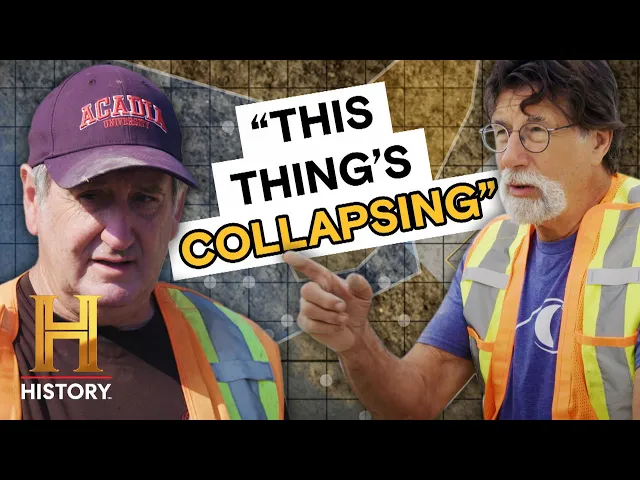
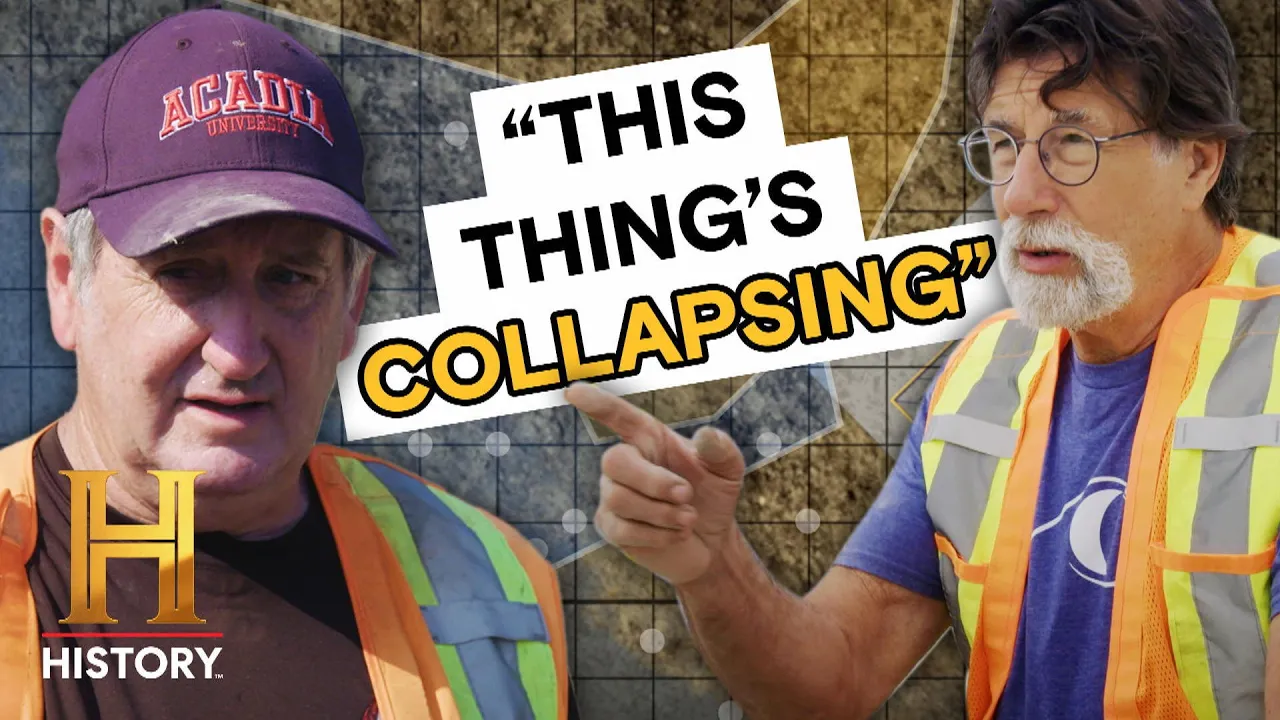
Yes. This thing's collapsing. So, to collapse, it means there has to be a void.
<i> Dr Spooner revealed</i> <i> he heard some sort of collapse underground. </i> <i> I never heard anyone talk of that before, so,</i> might there be a chance here to-to discover the treasure once and for all? Sure.
<i> There's all of these clues that strongly suggest</i> <i> this area holds significant interest. </i> So, I think something's going on here. -Something's going on here.
-All the chemistry has -kind of pointed to that. -Yeah. So, you know, here's.
. . here's one example.
If you hold it up to the sun, you can see the discoloration in it, the yellow color. -Mm-hmm. Mm-hmm.
-Yeah, that wasn't there beforehand. -You just took a sample? -Yeah.
-After that? -Yes. The darker water can indicate -we're closer to, uh, wood, a source of wood.
-Oh. So, I'm very interested 'cause we have not seen this -at this well before. -Hmm.
And if that's the case, then we've moved something around. There's some, almost a direct connection from something. Yes.
<i> IAN: I think the underground collapse</i> <i> probably means that we're in and around an open chamber. </i> <i> So, what we think is that this event moved water</i> <i> from a tunnel or a shaft,</i> <i> and all of this is critical</i> <i> to understanding where the metals are coming from. </i> So, it's a good place to have a very strange event occur.
Well, that next hole will be very interesting. IAN: Yes. Hopefully we'll just.
. . we'll drill there, we'll hit it, and we'll actually hit something that can help us explain the metals.
Okay. Well, thank you for the update. -Yup.
-We need to keep our wits about us. IAN: Yup. <i> NARRATOR: The next morning.
. . </i> <i> Following the discovery of another a Roman coin--</i> <i> which the team believes may be connected</i> <i> to descendants of Vikings--</i> <i> Doug and Emiliano have a new</i> <i> and potentially important development to discuss.
</i> We learned that by 875 AD, <i> the Norse had reached Iceland,</i> <i> and by 985 AD, they had reached Greenland. </i> <i> But what's more intriguing is,</i> <i>the only known Viking settlement</i> <i>on the North American continent,</i> <i> the L'Anse aux Meadows site in Newfoundland,</i> was, uh, active in 1021 AD. Seems like that's our next destination.
<i> NARRATOR: Located in modern-day Newfoundland, Canada,</i> <i> approximately 625 miles northeast of Oak Island,</i> <i> L'Anse aux Meadows is a Viking settlement</i> <i> that was established more than 1,000 years ago,</i> <i> and has been designated by the Canadian government</i> <i> as a National Historic Site. </i> <i> Today, it is the only officially-recognized</i> <i> Viking settlement in North America. </i> <i> RICK: The descendants of Vikings are very important</i> <i> to understanding how an old-world treasure</i> <i> might have come to Oak Island.
</i> I believe they were integral to the ability of someone or someones to come across the North Atlantic to the Maritimes and do this work on Oak Island. to the Maritimes and do this work on Oak Island. Are we going to bring the things that we suspect possibly Are we going to bring the things that we suspect possibly could be related to the Vikings' descendants?
We-we can certainly get permission to do that. -What about the arrowhead? -Absolutely.
MARTY: Right. So, when did they discover L'Anse aux Meadows? -In the 1960s.
-MARTY: Yeah. Okay. -In the 1960s.
-MARTY: Yeah. Okay. So, if that one was hidden until 1960, -why would it be the only one?
-EMILIANO: Yeah. -Yeah. -DOUG: Well, this is another mystery, and this is why I think maybe, since we have found other things on the island of possible Scandinavian origin, this could be indications of prolonged activity -by descendants of the Vikings or the Templars.
-Yeah. DOUG: Maybe they came down from L'Anse aux Meadows in Newfoundland to hide something, -and I think that's what brought 'em to Oak Island. -Yeah.
-and I think that's what brought 'em to Oak Island. -Yeah. <i> MARTY: If something happened in the 1200s here,</i> <i> it almost has to have a component</i> <i> of the Vikings' descendants.
</i> Based on everything we know right now, it almost has to. Um, there weren't a lot of other people who knew about this place then. <i> It's entirely possible</i> <i> that they could have brought the Knights Templar</i> <i> or anybody else to Oak Island</i> <i> for purposes of depositing something.
</i> So, I want to just chase that. I think we should mount an expedition. -I-I.
. . -I really do.
I want to go this time. I totally agree. There's.
. . There's always something to learn.
-Yes. -MARTY: Yeah. You know, we just found another Roman coin on Lot 5.
My suggestion would be, go to L'Anse aux Meadows and see what you can find. -Absolutely. -RICK: I can stay, hold down the fort here.
I mean, we'll get a full lowdown of what happens there, and new perspective, new insight is always a-a big thing. -Yeah, I'm in. -MARTY: I'm in!
We will give you a full report. -Right, guys? -EMILIANO: Yeah.
-Yeah. -Yes. Okay.
Let's go. -Yeah? I'm good.
<i> -MARTY: Let's make it happen. -DOUG: See you, gentlemen. </i> <i> RICK: Bon voyage.