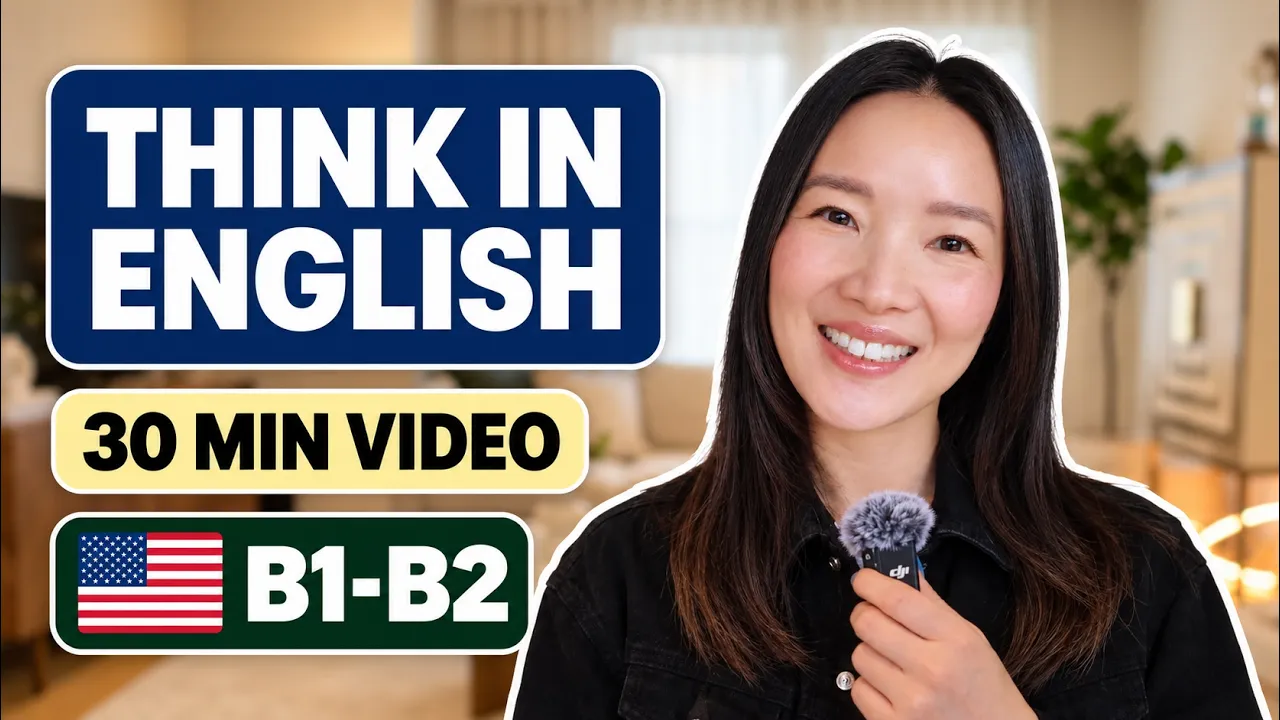
Hello everyone. Welcome to a new episode of Bose's Slow English. In today's episode, I will speak at a slightly faster pace than my normal slow English speed.
I've been reading everyone's comments and although there are many English learners on my channel or subscribers that are comfortable with the slow speed, I would like to challenge you so that you can get used to or familiarized with a slightly faster speed. That way, maybe a year from now, you will be able to comprehend the speed of a native English speaker. The topic of today's episode is how to think in English.
I personally know how difficult it is to think in a foreign language because I've tried to do it with French. I grew up in a Korean household, so I'm able to think in Korean with the basic vocabulary that I know. But with French, because I was not immersed in it from a young age, which means surrounded by it, and I only practiced or studied it for several years, it did not come naturally to me to think in French.
So there's a technique that I would like to share with you and I hope that it is helpful for you as well during your English learning journey. If you are new to my channel, I'd love to introduce myself. My name is B.
Hi, nice to meet you and welcome to my channel. My goal is to help you to feel comfortable when you are listening to English, speaking English, reading English, and maybe writing English. I teach real world practical situations and I like to talk to the camera like I am talking to you my friend.
Please click like to show your support. It keeps me motivated to film, edit, and post new videos every single day. And please click subscribe if you are new to my channel and that way we can be friends.
I recently launched a membership on YouTube. So, if you're interested in receiving my videos earlier than when the public receives it, please click the join button and you will have first access. And one more exciting news, I am very close to finishing an ebook.
I will have a free version available and I'll also have a paid version available. The topic of this book is phrasal verbs which I understand can be difficult to learn if you are not immersed in the English language. So, this book will help to get you ready if you were to ever speak to a native English speaker and I hope that you consider it.
Why is thinking in English important? It speeds up the conversation. It reduces the fear and hesitation.
It helps you to become fluent, not just correct. When I was working with a French tutor, my teacher or tutor encouraged me to speak French during the majority of the class. And although it felt uncomfortable, it primed me.
Or in other words, it helped me to become successful in my abilities to think in French. And when I started to really force myself to speak French, then I started to force myself to think in French. And eventually while I'm watching French vlogs, I realized, wow, my brain is starting to work in ways that it wasn't working before because I would read the subtitles and I didn't have to go through this twostep process in order to understand the word.
I highly recommend that if you do not have a friend who speaks English, just try to talk to yourself in the mirror or record your voice in your phone and listen to it and try to do that 5 to 10 minutes per day. The problem with translating a word from your native language to English is it really slows down the conversation. It also breaks the flow of the conversation.
It breaks it breaks the flow. This is the flow. So it's breaking the flow.
It takes a lot of energy out of your brain to translate words from your native language to English. So, it's just a habit that you have to form to stop translating words, but it will come with time and practice. So, the easiest way for you to not translate a word from your native language to English is to first speak it out loud as much as possible.
I used to play a game in the morning while I was getting ready to start my day off with a little bit of French. I would describe the things around me and all the actions in French and I would say it out loud. So, I will act out how I did that and that way maybe you can learn some new vocabulary.
And here we go. I'm going to clip my microphone to my jacket. Hopefully you can hear me.
I am holding this mug. Mug is another word for cup, but it is a cup that specifically holds warm or hot beverages. So, I'm describing what I'm doing.
I'm holding the mug. The mug feels really warm against my hand. I'm opening the teab bag.
I'm pulling out the tea bag. I'm unraveling the string. I'm dipping the teabag in the warm water.
And I am letting the tea steep in the warm water. As you can see, I just described everything in present tense, which is great. And maybe that's where you would like to start.
But if you'd like to get into a more challenging territory, then you can start to speak in past tense. So, I'll do this whole thing again in past tense. I held my mug in my hands.
The mug felt warm against my hands. I opened the teab bag. I removed or I pulled out the tea bag from the bag.
Are they both bags? I released the string from the tea bag. I steeped the tea in the warm water.
And I forget what else I said in present tense, but I'm going to say I took a sip of my tea. I love this tea. It's triple mint tea.
Let's describe some other things around me. I'll do it in different tenses so that you can learn. I'm holding this avocado.
The avocado is not ripe yet, but it is almost ripe. And I can tell because the color has changed from green to brown. Also, when I press press on the avocado, it's still firm to touch, but I bet in one day, it will feel soft enough where if a knife were to cut through this avocado, it is edible.
Edible means to be able to be eaten. So when I described this avocado, I said it in multiple tenses. Let's do lotion.
I'm holding this lotion and I'm pulling the cap off. I'm squeezing the bottle. I'm closing the cap and I'm putting the lotion back down.
I have a drop a drop of lotion in my hands, specifically in the palm of my hands. And I'm rubbing my hands together to allow the lotion to sink in, sink in to my skin. If I were to turn this into past tense, I could say yesterday or last week or this morning I used this lotion.
And when I used it, I opened the cap. I squeezed the bottle. I closed the cap.
I rubbed my hands together and I let the lotion sink into my hands. Are you starting to understand the purpose of this exercise? So try to do it after this video.
Let's say you are about to brush your teeth. You could say, "I'm closing my laptop. I am walking towards the bathroom.
I am opening the bathroom cabinet to pull my toothbrush out. I'm squeezing the toothpaste onto the toothbrush. I let the toothbrush run under water for 1 second.
I put the toothbrush and toothpaste in my mouth and I I circle the toothbrush around my teeth. And after a few minutes, I spit out the toothpaste. I rinse my mouth with water.
I gargle. I swish the water in my mouth. And I spit out the water.
You could also do that all in past tense, of course. Like I said, you could say yesterday I d and this morning I d by the way in your country how would you say d let me know in the comments when you are doing this exercise you can start by creating simple sentences. es such as I have a mouse.
This is a mouse. Or I'm holding a mouse. And then if you would like to get into more intermediate, then you can build on to that sentence.
You can build on by adding more phrases to the sentence. You could speak it a little bit faster. You could do past tense.
You could do future tense. So, I'll show you an example of what a more intermediate thought process may sound like. I have a black mouse that is connected to my laptop through Bluetooth.
I have batteries inside the mouse that is allowing it to operate. I switch the button to green which means on. And I have to plug in this USB into my laptop.
This whole device actually is called a dongle. And because my laptop doesn't have this specific type of USB, I had to buy this dongle adapter so that I can place the USB inside the dongle. And then this USB, specifically USBC, gets plugged into my laptop.
And now my wireless mug mug, my wireless mouse is ready to be used. So that is a very elaborate intermediate thought process, maybe even slightly advanced. And if you can do that, I'm very happy for you.
That means that you're little by little getting to a higher level or as Americans would say you're leveling up your skills, your English speaking skills. Don't beat yourself up, which means beat yourself up if you start with a simple sentence because you need to have a foundation and you build on to the foundation. Okay?
And one more thing to add to that piece of advice, don't over complicate things. In fact, when it comes to simplifying your sentences, speak like a baby because who cares? No one is watching you.
No one is judging you. Judging means shaming you for your actions. This is a good place to start.
So, start like you're talking like a baby and then work your way up. Here's a really important tool that you could use. Think of the English language as pictures and not words.
For example, if you hear the word pillow, envision a pillow. Envision means you are seeing it inside of your brain. Envision your pillow.
You could even create flashc cards and have the word on one side and the image on the other side. So, it's like a visual flashc card. I think that would be really helpful because a lot of people are visual learners.
How about you? Are you a visual learner? Do you learn best by seeing the object?
This next technique that I'd like to discuss is the shadowing technique. I read the comments every day. And at least once or twice a day, somebody comments, I do the shadowing technique by reading your subtitles and it really helps me.
That's awesome. That's such a great technique to do to use. I know I've mentioned in several videos that when I was learning French, I would read the subtitles.
Try not to put pressure on yourself. Pressure is like like what is this? Um, pressure is like you push yourself too much and then you get stressed.
So, if you're seeing or reading my subtitles and if I'm going too quickly, hit the pause button, stop the video, repeat what I said, and then go back and listen to how I said that sentence again. stop the video and you can go back and try to read it but better the second time. So shadowing technique is awesome.
That way you can imitate or mimic the tone, the um the speed and the intonation or inflection. Do you know what the word mimic means? I explained it in a previous video.
Think of mimes. You know mimes with the white paint on their face and um they look like characters and they do this. So they are mimicking each other.
So I said, "Try to mimic me. Try to shadow me. Try to imitate me.
That's all the same. " If you've watched several of my videos, you may start to pick up on, which means get accustomed to, which means get familiarized with certain phrasal verbs or idioms or sayings that I have. And I would recommend try to memorize those phrases.
It could be something like let's do it. Just remembering those chunk of words together can be really helpful. Or even I don't know.
I don't know. I don't know. and try to imitate how I say I don't know because if you were to say I don't know that does sound a little bit awkward.
I can slow down I don't know for you which would sound like I don't know. Sorry that's not slow. I don't know.
I don't know. I don't know. The D, the T are very soft.
The D and the T. So, I don't know. Or how about the question, what time is it?
What time is it? That's a really good one to know and it's very practical. Learning these chunks of words allows you to learn fast because you don't have to start from zero.
you have a foundation where you have a few words grouped together and that is a really special technique to have so you're not trying to piece one word here, one word here, one word here. You can just remember what time is it. If you watch American English TV shows, turn off your subtitles.
Try to watch the show and really listen just for 10 minutes at the tone of the actor or actress. And from there you can also try to imitate them. Actually today at work my coworker says I want to learn some Korean.
How do you say hi in Korean? And I said and I said you have to bow when you say that. And she said like she couldn't she couldn't do it but she tried and she tried three times and eventually it sounded like ano which is great and now she has a chunk of Korean characters together and she knows one phrase.
Also, thank you to all of my South Korean subscribers. Hi friends. Um, maybe I will meet you one day if I go to Korea.
That would be really cool if I hosted a meetup and then you can teach me how to speak Korean. My Korean is not so good. Not so good anymore.
So, please help me. Another tip that I have is change your phone's language, which sounds really stressful. I think about how many times I look at my phone throughout the day and if I change the language to French, I might freak out.
Freak out is ah. But if I really want to learn the language, then I might do it for maybe 15 minutes a day. Try it out and let me know.
Don't be afraid to make mistakes when you're practicing. Don't become a perfectionist. Do you know what a perfectionist is?
The root word is perfect. You don't want your goal to be perfect all the time because you will stress yourself out. So don't strive for perfectionism, which means that you don't want to have the goal of being perfect.
And my last tip for you is when you come home, maybe you should try journaling. You could say how your day went. Like for example, I would say, "Today was a boring day at work.
The sky was gray most of the day. " and the gray sky made me feel lazy. So you can describe how your day went, how tomorrow will go.
Writing is definitely helpful in your learning process. So what do you think about all of these tips, tools, and tricks? I think that if you were to try a few of these every day, eventually you will be able to think in English.
You won't have to translate a word from your native language to English. I hope you enjoyed this lesson and I hope you learned something new. Please share this with your friends or classmates or family members if they are also on an English learning journey.
And I will see you in the next video. Thank you. Bye.