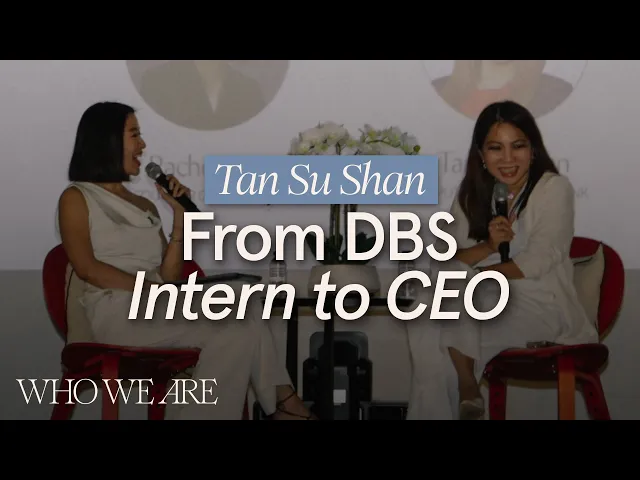
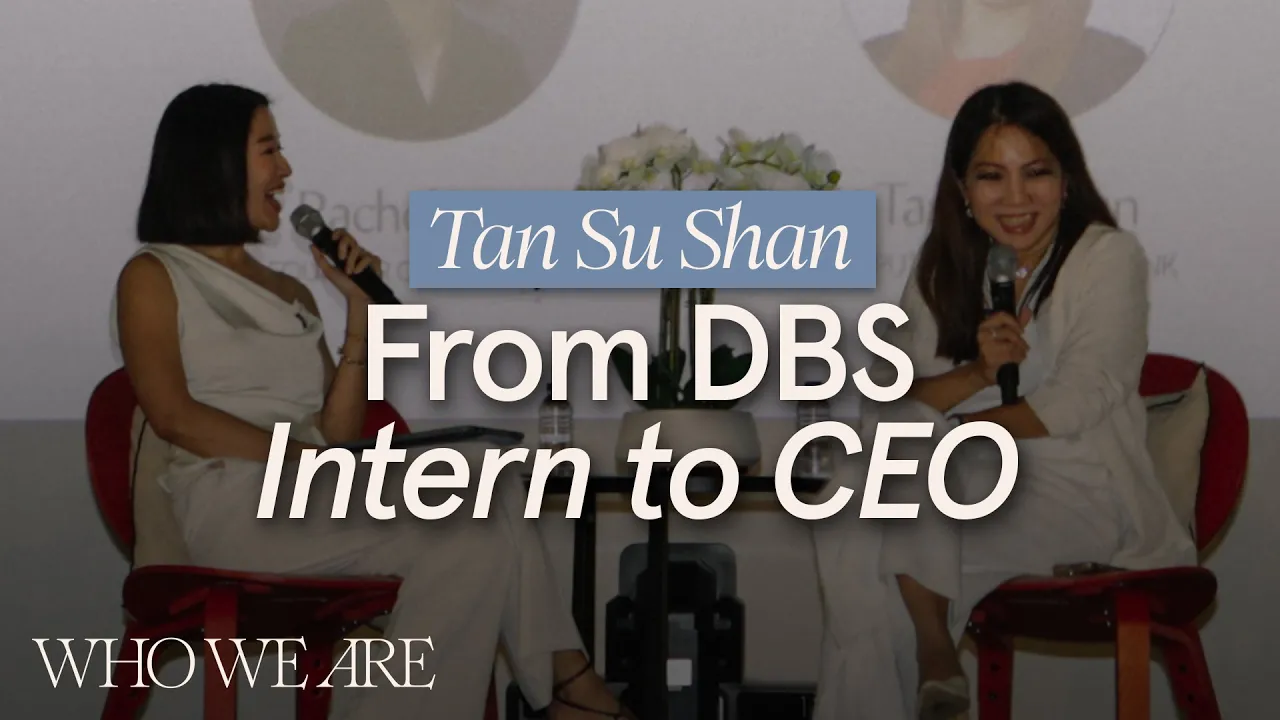
Welcome Susan and thank you for being here today. It is such an honor to have you with us. Thank you for having me.
Susan, congratulations. You truly are stepping into one of the most significant leadership roles in Asia. And beyond all that you have achieved, what stands out is really the journey that got you here.
The decisions, the sacrifices, the challenges that have shaped you to the leader you are today. And today we're going to dive deeper into that um to also you know hear from you how you have truly broken barriers and also the lessons you have learned from this incredible journey. So Sush before we start you know maybe could you bring us back to the very beginning.
You were a young intern at DBS all those years ago and I was. Yeah. And you know if you could go back in time, if you could sit down with young Susan back then, younger Susan back then, what would you say to her?
And would she have imagined this at all? Definitely not. A definitely not.
I was uh 18 or 19 years old. Uh $20 a month in turn. Um, and my job was to carry all the heavy IPO perspectuses to the raffles place MRT and give them out.
And I remember in those days was really hot. Um, and I had to stand outside the MRT right in the hot sun and sort of noon to 212 because that was when it was busy. But you start at the bottom.
We we all do. And and and it's okay. Yeah.
I think that's what I've learned is life is um is cyclical and it's up and down. Generally you want to have your life go more up than down. So your trajectory is generally on the up slope but there will be downs downward curves and the up slope and you take the downs with the ups.
Wow. And so she know also having the privilege of also watching you as an incredible not just you know great in your career but you have a great family too. And you know, a lot of times we celebrate and we often talk about the the highs of success, but we rarely talk about the price of success, what it takes to get to where you are today.
Is there something in your journey that perhaps was unexpectedly more challenging that got you to where you are today? So, um, there were many points in time where I took a a demotion. So, as I said, life isn't always a straight line and in one's career, it's never a straight line.
And sometimes you have to take those deliberate steps down or steps back. And I think that's what when when when you say deliberate, I did it knowing that my my career was taking a hit, but I would do it uh for the long term. So, I always call it one step back to take two steps forward.
Wow. Um so when I first um worked in London um I did pretty well and then um moved up the career went to to Tokyo, went to Hong Kong um and my my first job was in a dealing room and it was talking to customers about derivatives which is a complex financial product. Um, and we went from talking to customers to talking to their voice boxes, to their voicemails, to sending messages to then I started to wonder, do they even need me?
And when it dawned on me, I'm not sure how many of them actually now are listening to my voicemails. I realized maybe this job has had its day. maybe we are going to be replaced by a new way of working by machines by algo trading whatever.
So that was when I said, "Okay, time to give up my title, my clients, what I've built, start again. " Luckily, I was still quite young. I was 28, 29.
So I went from being an associate director or like a VP equivalent to being an associate again at the right old age of uh 29. I was the oldest associate in the room. Um but it was okay.
I think um you know in life you take those risks because you you you take that step back because you want to learn something new and you think okay what's your downside right you're still young you're still learning as long as you're learning there's no downside it must have taken so much courage and conviction sush because that looking back now of course you can connect the dots but there and then were you what were you feeling what was it like were you fearful were you unsure I was What kept you pushing ahead? You know, great family support. At the time, I hadn't had my kids yet, but my husband and my my my parents were incredibly supportive.
Um, and and and actually the boss that I worked for then said, "I know this is tough for you. You're taking you're giving up everything you've built to to do this job that you've never done before, but you know what? If you do well, I will give you this.
If you do better, I'll give you this. " So I had a I had a career path mapped out if I hit the the the targets that he wanted me to hit and and and and I think as long as when you take that step back you know that in the long term you're building something else why not and it happened to me when I first joined um DBS Bush Gupta my CEO I was hired me to report to him but after a month joining DBS I realized I had to downgrade myself again uh at the bright old age of 42 because for for for for the work I wanted to do to to to to succeed I had to create what we call the wealth continuum which is a wealth management business but I had to create it within the consumer bank not on my own setting it up conflicting with the consumer banking head so when I realized that I went up to to my CEO and I said I think you have to downgrade me to to to not report to you but to report to the consumer consumer banking head and he said how ridiculous. I've just hired you.
You have gone on a group MC. Why the hell do you want to do that when you can report to me? And I said to him because that's the only way it's going to succeed because if I report to the consumer banking head who then reports to me so I take one step back.
I can create we can create together something that's going to work for everyone. It's a win-win. He will support me.
I will support him. And you know it makes sense. He said it does.
It's unorthodox but okay. So I got downgraded. So in my first month in DBS I also got downgraded but this time around I downgraded myself.
So I think you know and I never felt the downgrade range. I never felt it because I was doing a lot more than if I had been upgraded but doing less. Right?
I really believe that titles don't matter. It's impact that matters. Right?
So if you're doing a lot in a lower grade, who cares? As long as you have impact and ultimately you will make more impact in that role than in a sort of a higher status but less impact. What do you choose?
And what happens also when in those moments of self-doubt and you find that maybe they sometimes they can get overwhelming as well. What goes through your mind or what do you tell yourself? So I try to figure out okay where is this self-doubt coming from?
Yeah. Is it coming from a lack of confidence or a lack of knowledge? So, if it's a lack of knowledge, what knowledge do I need?
Are there things I can learn? So, I listen to a lot of podcasts. I love listening to podcasts when I run because it it's so, you know, it just you learn so much.
You've got a great podcast, Ra. But also, um, like for example, when I first started my technology journey in in DBS, I really didn't know anything about tech. Yeah.
So I got all these young engineers to I said sorry to bother you. I used to do this Saturday afternoon. I'll meet them buy them a coffee and they'll teach me.
Okay. Okay. So this is what public cloud hybrid cloud this is what microservices this is how APIs work and I would learn from them.
And when I went into my new job in DBS, which which is to lead the corporate bank, I didn't know anything about metals and mining or renewable power or nuclear energy or you know how the EV battery works. It's all very technical. And I knew what my I think the thing is know what you don't know.
Yeah. Right. Then do you need to know everything?
You don't need to know everything, but you need to know enough to know what questions to ask. Right. So if you need to know enough to know what questions to ask, get the help to know that what that enough is.
Then you know what questions to ask. And sometimes going in fresh is not a bad thing. Yeah.
Going fresh is not a bad thing. It's like oh it's a fresh outlook. So she in your journey have you experienced you know also that women sometimes we tend to have conflicting expectations on us in a sense where we need to be strong but not too strong.
be confident but not be intimidating. So how has the journey been for you where you know how did you stay true to your leadership style while also commanding the room in your own way. So I learned at a very young age the importance of communication and by that I don't mean using big words and sounding smart but I mean sounding clear.
You can use simple words and be very clear and you've already won the leadership game. Why? Because people understand you, right?
Yeah. It's as simple as that. Yeah.
It's a clarity of communication. That's so important. Then it's a mix of agility and humility, right?
What do I mean by that? Being agile means being able to kind of change the way you carry yourself depending on what the situation requires. If it's a war room because it's a crisis, then it's a war room and you've got to be, you know, on the ball things, you know, come up with with all the data and and and make decisions and be quick and and have deadlines and and and time time frames.
If it's a Saturday afternoon women's leadership conference, it's less confrontational and more, you know, um, collegiate. If it's a negotiation then it depends is it a tough or a easy negotiation and sometimes when I go into a negotiation mode I often bring someone who's very different from me as I said because if you don't know the counterparty and it could be a difficult meeting the counterparty may not like me but they could like the person I bring in who's very different or they may not like the person I bring in then hopefully they like me but the point is to be agile and to to go in willing to to pivot if you need to pivot. Um and and and move on if you need to move on.
Um and humility, as I said, you know, the the the the changes upon us today are so profound and it it gets faster and faster, right? I mean, after Deep Seek, first you had CH GPT, then you have Deep Seek, the changes are so fast, then you soon you have quantum computing. Um, and it's really hard for humans now to keep up, right?
But if we're humble enough and we recognize that, you know, there's a lot of things we don't know, but our jobs as leaders is to make sure we know enough and we have good people around your team with diverse views to make a decision and land and you can do the execution together as a team and you can build trust within the team and you you get as much information as you can. I think chances are pretty good that you will succeed. But let me not forget in all businesses the number one thing is focus on the customer.
Yes. As you do, right? Focus on the customer.
Focus on what the customer needs are. Focus on delivery of the best customer experience. Yeah.
For yourself, Sush, what are some ways that you also instill that discipline of always going back and focusing on the customer? So at DBS we do this thing called managing through journeys which is you know most companies are organized vertically. We try to organize horizontally.
So that means there's product manager, there's the operations person, there's a tech person, there's a legal and compliance, there's marketing etc. We move everyone into a scrum and that's a performance cell. Like actually my I have a bunch of colleagues here.
I think they can probably form a cell right you guys who are here and and everyone brings their own subject matter expertise to the table and we are guided by data. You can tell me how good you are but if the data tells me you're not your your outcomes are not there your outcomes are not there. So you make sure you collect data that's live and you make sure you give a feedback loop.
So if you're launching a new product, you want to experiment with new product design, new product pricing, go ahead. But make sure you have the feedback loop that then tells you did the customer like it, the customer didn't like it, what's the customer score, what's your net promoter score, etc. So if you have this horizontal journey and you digitize everything from end to end, whether it's your work workflows, your work processes or in what we call the workbenches.
So all of us have a workbench that we work off and we've got all the necessary data we can look at. Then we're all on the same page. Then we all know what we all know and we're all united by the same customer outcomes.
We all want great customer experience. We all want great customer outcomes or we want faster turnaround time whatever it is. So when you incentivize everyone in that cell for the common outcome and the common good, magic happens.
Yeah. We also have um what we call a raccoon spelled wr o n. So ra raccoon, you know, raccoon.
Raccoon like the cute little animal but spelled differently because you know like if I'm the boss and I'm the what my my my younger colleagues say the the hippo, right? Which is I thought it was because I was gaining weight, but it's because you're the they call it the highest paid person in the room. Basically the boss, right?
Wow. So I try not to be the hippo. Uh but if there is a boss in the room, most likely, especially in an Asian context, everyone will be respectful towards the boss.
Agreed? If the boss says, "I like whites," no one's going to disagree with the boss. But we have a raccoon, so you can ask for a hello, can I have a raccoon moment?
Which means, uhoh, here it comes. this young person, male or female, is going to come in and say they don't like something, but we make it safe because you've asked for a raccoon moment. So, it's almost like asking for the permission to to say, "I'm going to wreck your idea cuz I don't think it's going to work even though you're the boss.
" And that's the best way to get different voices, no matter how junior, to surface in your meetings. And so, the boss then in that situation also has to take a step back. Yes.
and be very open to receiving that feedback objectively and sometimes it can be difficult especially if it's your idea but we've created these processes in our meetings to make it okay before we go into Q&A uh that will happen soon you've always had an eye on the future if you and you have always also you have you have you have surrounded yourself with you know different leaders business owners entrepreneurs and young people like you said if you had to take a bet on what is that one leadership skill that is going to be non-negotiable in the next decade? What would it be? It's attitude.
It's attitude. I I've um told my colleagues now because knowledge you can get. Yeah.
Right. Deep expertise um you can get. I I I I went to see a client on Monday night uh with my team.
There was seven of us and seven of them. And halfway through the dinner meeting, they dropped something which we were not ready for and it was new news and you know quick chat quick check under the table on GPT4 or DC or in our case DBS GPT right and the reasoning the the solutioning you don't take everything you take what you think is is right but the speed right So yeah, it's incredible how you know things are changing so fast. But if you have the right attitude, yeah, which means you're agile, you're flexible, you learn, you're open to learning, then you will do very well in this new millennium.
I ask my daughter all the time, you know, she's in the AI industry, you know, I ask her like, okay, so how do you hack this? How do you learn about that? And being able to learn from young people is a gift.
If you're all so young, I think all of you in the room, if the fact that you're here means you have a learning mindset and a growth mindset, that means you have a great attitude. So, you're already ahead of the game. So, cool.
You know, well done all of you, right? I'll give you all a clap. Yeah.
So, so you know, use that attitude. That's your superpower. And then the other superpower you will get from technologies tools and then you'll be unbeatable.
Wow. And thank you Sush for always being a great example of that yourself. And you also always you have been investing over the last decade in different businesses um countries and talents as well.
What is what would you say perhaps is the most important investment you have made in yourself? Um I don't know my my family is very important. And I I I think in life the most important thing is family.
Yeah. Um so you invest in family. You because that keeps you grounded.
Yeah. You invest in your friends because you know that also all the relationships. The relationships.
Yeah. Um so my best investments have been in my family, my friends. Um, and myself I would say sleep.
Oh, real talk. I I I bet you guys didn't expect that. But invest in sleep.
I have bad days when I don't sleep enough and I don't make good decisions when your mind is not fresh. So, invest in sleep, invest in in in in learning, you know, and um if you can do two things at the same time, listen to a podcast and do running, do it. Do what works for you.
Yeah. Great advice. And sleep.
I think that's the number one non-negotiable non-negotiable that we should start protecting. Okay, Sush. Wow, there's a lot of questions.
I'm just going to pick out maybe the just three. Um, okay. I think just now Sush, you talked a little bit about clarity in communication, right?
Maybe could you explain a little bit more around that and what's one tip or advice you have for all of us today to take away when it comes to clarity in communication? So if you're going to give a speech or you're going to present something, so this is a fireside chat, so it's different because I'm reacting to questions. Yeah.
But if you're not reacting to questions and you have to present on a topic for me, what works for me is setting the agenda and then going to the conclusion first. You summarize, you tell them your agenda and you tell them where you want to go in the next few me minutes and then your conclusion. Then you unpack your argument.
Then you say, you know, there's the positives and the negatives, but that's why we've landed. I find that quite useful, but that's me. It depends on your audience.
Um, I also believe in clarity of articulation. Yeah. I used to speak really quickly and and and no one would understand what I'm saying.
Um and my first boss made me listen to myself on a recorder. I was 21 years old or 22 and I was horrified. I couldn't believe how bad I sounded.
So don't be shy to listen to yourself. Just use your phone and hear yourself talk and decipher. Was that clear?
Did they understand me? And if you're clear, how have the battles won? Thank you, Sushi.
Moving on to the next question. And I'm just going to combine some of them because there's quite a bit of questions when it comes to sponsorship, mentorship. So, how do you find a sponsor who helps us in building our career path and also what's your journey like Susan?
Finding the right mentors and mentees and what has their impact in your life been? So if you work for a big organization, don't be shy to get a mentor. Preferably not your boss, but someone who who can see and look at your own career progression objectively.
Um and have regular meetings with that mentor by him or her coffee and you know every month or whatever. Give a progress report and let them um you know advise you objectively. That's one.
Sponsorship's different. sponsorship is where you have people who are your champions for your career progression or or or your scope of work and that's a little bit tougher and so if you work for an organization where it's not easy to find sponsors then I'll suggest that you have events that creates that chance for interaction. M so my boss used to tell me that whenever the big CEO comes to visit Asia and he was very junior at the time he will make sure he takes the car to go and pick him up or her up from the airport because that journey from Changi to the hotel 20 minutes 25 minutes hey that's a lot of oneonone time right so I used to do that by the way so whenever some when I work for city bank or mong standing when some big boss from New comes in, I always volunteer.
Okay, I'll go and be the the shopper, the chauffeer or the the certainly the bag carrier, right? Um, and that gives you that gives you air time. So, something so simple as that.
Amazing. Um, to at networking events, by the way, I also met Rachel at a women's networking event. I'm like every networking event many years ago.
But that's how I have met them. We were both on the same panel and I thought what a great young woman, founder, CEO, business leader and I felt I had to get to know her better because I wanted to learn from you right as a reverse mentor and so create those opportunities. So that's one of the reasons why I created uh the financial women's association in well 24 years ago because I felt that some women don't have that opportunity to meet allies, sponsors, whatever.
And so we could create that opportunity for them. So if you don't have it, create your own. Don't be shy.
Yeah, I think it's also like having thicker skin to just go for it. Susan, the second last question. What is an important mindset and habit you have to have to grow professionally and personally?
Um, I'm going to share a a little DBS trick about organizing organization and that's a scorecard. Create a scorecard so that everyone that either in your team or in your organization, your country, whatever is aligned. you know what your deliverables are whether it's for shareholder for customer for employee how you're going to do it who's going to do it what you're going to do for the full year if you can all agree that's the 2025 scorecard that's a very powerful tool to unite the team and have clarity set clarity from the get-go that's so important so I said communication I think the importance of a scorecard so that everyone's aligned on goals everyone knows where you want to go collective ly is important.
So those I think are for me are not negotiable. Then as I said creation of good teams. Yeah, I talked about diversity of teams.
I want to talk about trust in teams because if a team inherently has distrust amongst the the the the the teammates, it's not going to work. Yeah. Because if you don't assume good intent, everyone's always second guessing the other person.
Yeah. it's just not going to work. So if there is distrust and and and second guessing, deal with it.
So one of the habits or bad habits if you will is I like to deal with these uncomfortable issues upfront. Was it something that came naturally to you or you had it was a learned skill? It's very difficult because you have to deal with people.
That's the most difficult thing in the world, right? And worse still, if you're dealing with distrust or difficult humanto human dynamics or so, it's just bringing people into the room and saying, "Okay, we have this elephant in the room. It's a distrust between the two of you.
Let's just sort it out. Sort it out. " Right?
And more often than not, if the intent is good, the distrust comes from a lack of communication or a misunderstanding of intent. M and Sush as we close and wrap this conversation um we want to also leave the audience with one final thought. If every woman in this room walked away and did just one thing differently tomorrow, what do you hope for that thing to be?
Be agile. Be agile. So um be open to learning new skills.
Yeah. be not scared that the skills you have today may not be so relevant tomorrow and so therefore you have to learn new skills. So be agile.
Be agile in your attitude. Be agile in your career pathing. Um and learn.
I always like to say this, learn, unlearn, relearn. Yeah. I I'm in my 50s and I'm still learning.
So you're all in your 20s and 30s. You got a long road ahead. Don't be scared to keep learning.
Amazing. Ladies and gentlemen, please join me in giving a big round of applause to Susan. Thank you, Susan.