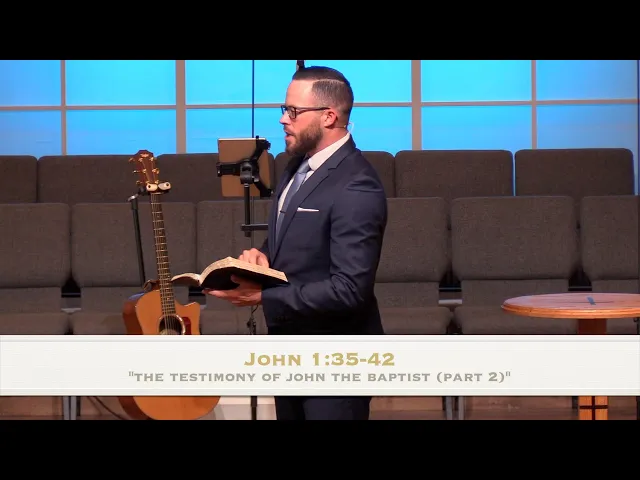
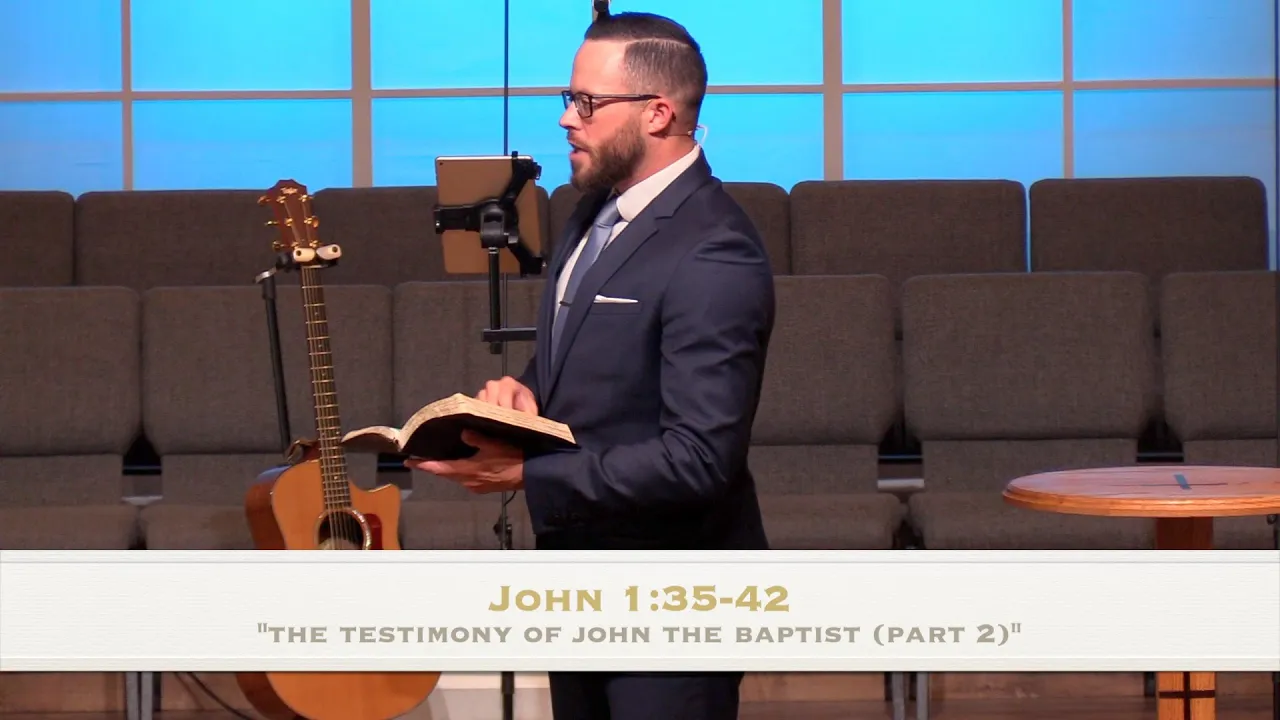
do now we come to the preaching of god's word this morning we're in john chapter 1 verse 35 through 42 john chapter 1 verse 35 through 42 i hope that this morning's sermon is very impactful for you very preparatory for you especially in light of this week especially in light of the fact that many of us will be encountering family many of us have family who are unbelieving uh and we will almost all of us have the opportunity to speak of christ to speak of the things of god this week in the presence of those who have yet to put their faith in jesus and so i pray that this morning's sermon that the text that god has ordained for us to examine that it will be massively impactful and preparatory for you as you get ready to spend time with family with friends i hope that this sermon this passage of scripture spurs you on very simply yet very profoundly to doing the work that god has called you to do this morning what i want to talk to you about is the right response to jesus the right response to jesus i think we see here in this passage three components three major components of the right response to jesus you can summarize all of it like this we do this every week if you want to take out a pen and take notes it would behoove you this morning and be very helpful as well let's summarize it by saying this the right response to jesus is submission belief and proclamation the right response to jesus number one is submission number two it's belief and number three it is proclamation those are three major essential mark that essential components of the right response to jesus it's not just that you believe in jesus it's not just that you submit to jesus and begin to follow him and follow him all of your days but following him looks like something and that something it looks like is proclamation it's not just being a perpetual student of the word and of christ it is being a sharer of christ this is an essential component to what it means to respond rightly to jesus you may look in your life this morning and you may say well i surely i believe that jesus is god's son i believe that he died for my sins i believe that he was raised up from the dead i believe he ascended to the right hand of the father and i give my life to love the lord i give my life to learn from the lord i give my life to serve the lord and maybe maybe you stop right there and think that that is sufficient sure that surely is sufficient to to be salvation but that is not the extent of all that christ has called us to you believe all those things about jesus understand also that he has commanded you as his disciple he has commanded you to be a sharer of jesus to be one who extends an invitation to be one who goes out and finds to be one who goes out and proclaims all of us all of us are called to be sharers of christ let's look at the text here and i think you'll see two parts at least that's what i see here in the text and i think it's a correct understanding verse 35 and 36 what you see is the preaching of john the preaching of john that is not john the gospel writer that is john the baptizer john the baptist so in verse 35 and 36 you see the preaching of john in verse 37 through verse 42 you see the response of the disciples the response of the disciples so here you have a sermon in verse 35 and 36 and here you have a response in verse 37 through 42. i want you to see it and i want you to see it very clearly how these two things interact how the disciples of john the baptist respond to the preaching of john the baptist and what that means for their their life and their response to jesus himself so let's look here at the preaching of john john's sermon verse 35 through 36 recalling the fact that in the previous passage john has seen jesus jesus has come to john's baptism there in the wilderness the lord had revealed to john the baptist through divine revelation that in the baptism ministry of john that the christ would be revealed the lord had revealed to him that when you baptize the christ you'll see the heavens open and you'll see the spirit of god descending and remaining upon a man and that man is the anointed of god that man is the king of israel that man is the son of god that man is the lamb of god and so in the previous text we we heard a bit of john the baptist preaching and what he did for us is he painted in words he painted two portraits for us of christ he spoke of christ as the lamb of god and he spoke of christ as the anointed of god here in this passage he's going to do much the same in verse 35 and 36 so here is the preaching of john look at verse 35 it says the next day so right after after jesus has been baptized john the baptist has declared him behold the lamb of god who takes away the sins of the world it says the next day again again john was standing with two of his disciples not two of jesus's disciples but two of his own disciples and he looked at jesus as he walked by and said behold the lamb of god i tell you what john's doing here john's preaching john is preaching there are really two features of john's preaching here he says behold the lamb of god the first feature of john's preaching is that he has a proclamation of the person and the work of jesus he calls jesus the lamb of god that's the first feature of his preaching jesus person and work the lamb of god he speaks here of jesus's work as being the sacrifice for the sins of the world john preaches christ crucified and yet christ has not been crucified john preaches christ as slain but jesus has not yet been slain john preaches christ as the lamb of god a sacrificial animal and yet christ has not offered his sacrifice yet john is a prophet john is a prophet of god and he is declaring prophetically the work of jesus when john called jesus the lamb of god he is pointing directly to his crucifixion and let me tell you our preaching today should not be different than john's preaching john looked forward to the sacrifice of christ we look backward at the sacrifice of christ listen to what the apostle paul says in first corinthians chapter 1 verse 23 and 24 the apostle writes but we preach christ crucified a stumbling block to jews and folly to gentiles but to those who are called both jews and greeks christ the power of god and the wisdom of god who is the christ that paul preached the lamb of god the christ who is crucified and this is what it means for christ to be the lamb of god i pointed it to you last week but i'm going to delve a little bit more into it the imagery of the lamb of god would not have been missed on anyone who was in john's presence in john's day the people there of israel the jews were very very intimately familiar with the role of a lamb in religious society every year they would take lambs to the temple and those lambs would be slain for their sins they would make offering for their guilt and the blood of those lambs would pour out as it were a river from the backside of the temple the lambs were slain the sins of the people were covered and they were able to go about their business for another year but they would come back again and this imagery of the lamb of god would not have been missed on any of them they would have all recalled back in genesis chapter 22 as i spoke to you last week of abraham walking isaac there up to the temple mount on mount moriah being called to offer isaac there on the mountain as an offering to god as an offering of faith to god isaac looks around he sees the the bundle of sticks he sees the altar but he doesn't see a sacrifice and he says father the wood the altar where's the sacrifice and you remember the words of abraham the prophet he said god will provide a lamb god will provide a lamb god will provide someone to substitute for you isaac god will provide a lamb and there abraham went through all the way up until the striking point of the sacrifice and the angel of the lord stops and says abraham i see now that you believe abraham looked up and behold there in the thicket was a ram caught by its horns god had provided a substitution for isaac there was no mercy shown to that ram we missed that point that abraham went and got the ram walked the ram over to the pile of sticks laid the ram down on that and he slew that ram and here is isaac free here's abraham having received his son as though back from the dead but there is that dead ram and the smoke of its sacrifice goes up to heaven no doubt pleasing to the lord later on we see this mystery more fully disclosed though not all the way there in exodus as the lord commands the children of israel to to make a sacrifice as a perpetual remembrance in israel to offer a lamb to cover their household because god had promised to bring judgment over all the land of egypt and god said but if you will do this israel if you'll take a spotless lamb a year old and you will slay that lamb you will take the blood of that sacrifice and smear it on the doorposts of your home take that lamb inside and by faith receive that sacrifice in yourselves consume that lamb to the end and when the angel of death when god's judgment would go over all the land of egypt god would see the blood of that atoning sacrifice and he would spare them the judgment that was coming in exodus chapter 12 verse 13 it says the blood shall be a sign for you on the houses where you are and when i see the blood i will pass over you and no plague will befall you to destroy you when i strike the land of egypt there we see again a lamb being substituted for another later on in the book of isaiah the prophet isaiah would foretell of one who would come and would behave as a lamb i want you to listen to what the prophet isaiah declared some 700 years before the incarnation of christ in isaiah chapter 53 verse 7 and 8. it says of jesus he was oppressed and he was afflicted yet he opened not his mouth like a lamb that is led to the slaughter and like a sheep that before its shearers is silent so he opened not his mouth by oppression and judgment he was taken away and as for his generation who considered that he was cut off out of the land of the living stricken for the transgression of my people stricken for who stricken for the transgression of the people how would this coming one behave like a lamb to the slaughter like a substitution like one who would stand in and be sacrificed on behalf and in place of those who were destined to die so isaiah prophesied of one who would come and who would behave like a lamb not an actual lamb but now the lamb of god and not just a man but the son of god god and man and one behaving like a lamb dying for sins as i told you last week i believe song number one in the heavenly hymnal it's not in the back of your pews but song number one in the eternal hymnal i think is recorded here in revelation chapter five i want you to listen to the song that is sung right now in heaven the song that one day your faith is in jesus let me tell you you'll sing this song too better go ahead and learn it better go ahead and learn it listen revelation chapter 5 verse 11 through 14.
this is how jesus is worshipped through all eternity then i looked and i heard around the throne and the living creatures and the elders the voice of many angels numbering myriads and thousands of thousands saying with a loud voice worthy is the lamb who was slain to receive power and wealth and wisdom and might and honor and glory and blessing and i heard every creature in heaven and on earth and under the earth and in the sea and all that is in them saying to him who sits on the throne and to the lamb be blessing and honor and glory and might forever and ever and the four living creatures said amen and the elders fell down and worshiped here's jesus worshiped and celebrated as the lamb who was slain before the foundation of the world and when john the baptist sees jesus walking by he says behold the lamb of god behold the lamb of god who takes away the sins of the world this is the one isaiah prophesied this is the one foreshadowed in genesis 22. this is the one foreshadowed in exodus chapter 12 and this is the last lamb who will die for the sins of the world so john exclaims he proclaims here the person and the work of jesus and let me tell you this john wants each of us to understand that jesus is the lamb whose blood was poured out for your and my sin god is not ambivalent towards our sin god is not uncaring about the transgressions we've committed against his word the bible is clear that the penalty for sin is death and not just an instant death not just an ending of this life but the bible talks of an eternal death the bible talks of an eternal death an eternal experience of torment in a place called the lake of fire this is what it means to die and not have your sins paid for it means that you pay for those sins god is so serious about our sins god is so holy in and of his own character and our transgressions against him have been so severe that they deserve and deem an eternal punishment but god so loved the world that he gave his only son gave him what does it mean he gave him he sent him as a lamb to the slaughter and as a sheep before before its shearers is silent he opened not his mouth and he was smitten he was afflicted for our transgressions so god forgives us he forgives us he doesn't sweep our sins under the rug he nails our sins to the cross and those sins are paid for behold the lamb of god it's no wonder why we'll worship him with that title forever and ever in all eternity remembering that he died for our sins never forgetting our transgressions but always remembering our transgressions have been forgiven because his blood has been poured out so this is the first feature of john's preaching he points to the person and the work of jesus this is an essential feature of true gospel biblical preaching is to preach christ crucified if you preach jesus as a good example of the way to live your life you miss the point surely jesus is the best example of the way to live our life but jesus didn't come merely to give us an example he came to be our atoning sacrifice he came not merely to be our example he came to be our lord he came to be our sovereign king he came to be the king of israel he came to be the lord of lords so to not preach christ as crucified is to not preach christ at all it's to miss the point entirely this is a the first feature of john's preaching but it's not the only feature of his preaching when john speaks of jesus as the lamb he speaks of something that the apostle paul explains further in the book of romans i want you to see how the apostle paul says it in romans chapter 3 verse 23-25 the apostle writes for all have sinned and fall short of the glory of god and are justified by his grace as a gift through the redemption that is through the purchase price that is in christ jesus whom god put forward as a propitiation by his blood to be received by faith this was to show god's righteousness because in his divine forbearance he had passed over former sins the apostle paul refers to jesus as a propitiation hilasterion he uses the same word that john uses in one of his later epistles look with me first john chapter 2 verse 2. he that is jesus is the propitiation same word hellisterion he is the propitiation for our sins and not only for not for ours only but also for the sins of the whole world now i've said the greek word and i've said the english word multiple times here propitiation what does that mean it means the removal of guilt another 10 cent word it speaks of expiation the removal of guilt the taking away of the guilt as i pointed to you before jesus is not merely the one who atones for our sins who covers our sins but jesus actually removes those sins he expects those sins he carries those sins away and when christ covers us and the father looks at us what does he see he sees not our sins because they have been removed they have been paid for he sees the righteousness of christ this is why the apostle paul and the apostle john celebrate jesus as the propitiation for our sins they understood what it meant for jesus to be the lamb of god so did the writer of hebrews hebrews chapter 9 verse 22 the apostle paul writes indeed under the law almost everything is purified with blood and without the shedding of blood there is no forgiveness of sins the writer there continues to explain that jesus is the perfect offering of blood because he offers his blood once and once for all and now there remains no other sacrifice to be given now i said that that was the first feature of john's gospel preaching is to proclaim the person in the work of jesus but i want you to notice the second feature of john's preaching and that's an exhortation to respond it's an exhortation to respond what else does behold mean see him look take account take within receive the lamb of god this is what john points to behold the lamb of god the fact that this is an invitation is not missed on the two disciples they understand very well what john is saying he's the one ordained before the foundation of the world to die for your sins behold him receive him take him unto yourself how do they respond well they do just that don't they they do exactly that look at their response verse 37 through 42.
it says the two disciples heard him say this and they followed jesus jesus turned and saw them following and said to them what are you seeking and they said to him rabbi which means teacher where are you staying i want you to see from verse 37 through 42 here in the the disciples response to jesus these three essential major components of the right response the disciples exemplify for us what the right response looks like and it has here in this text three major components the first one is this component number one the right response to jesus is submission it's submission look again at verse 37 through 40. it says the two disciples heard they heard john say this and what did they do they followed jesus jesus turned and saw them following and said to them what are you seeking so we should be at this point waiting for an answer what are these disciples seeking and if you read this too quickly you pass over the answer that they actually give jesus said to them what are you seeking and they said to him rabbi that's their answer what are you seeking rabbi which means teacher they they respond to jesus when he asks him what are you looking for why are you following me what are you seeking and coming behind me what are you looking for they said rabbi rabbi is an aramaic word and it essentially means most honorable sir teacher teacher this is what they're looking for they're speaking of jesus in the most honorable term that they can and they're saying be our teacher we want to follow you we want to be your disciples you saw that word disciples there earlier on in verse 35 two of john's disciples that is the greek word mathetes mathetais means student learner pupil and these two men only one of them is named andrew later on in the text but these two men had given their lives we don't know when they began this but they had given their lives to following john the baptist and this is what it meant for them to follow john the baptist it means that they lived in the wilderness it means that they dressed like john the baptist it means they ate like john the baptist it means they preached like john the baptist it means they learned from john the baptist they served john the baptist and whatever he asked them to do commanded them to do that's what they did so they had called john the baptist their teacher they're his disciples and now they hear this message behold the lamb of god john doesn't stop them john doesn't get ministry jealousy john doesn't prevent them john john seemingly just ushers them off and he says behold you need to go you need to follow and they follow after jesus he says what are you looking for and they say we want to follow you we want to be your disciples we want we want to learn from you we want you to teach us we want to submit ourselves to you as your learners as your servants as your ministry associates so they call him my great one my honorable sir my teacher and they said to him rabbi back in verse 38 which means teacher and they say where are you staying where are you staying meno where are you abiding where do you remain why do they want to know that because they've already decided that's where they want to remain wherever jesus is that's where we want to be wherever john was that's where we were but now wherever jesus is that's where we're going to be he's going to be our teacher he's going to be our master he's going to be our rabbi jesus where are you staying where are you abiding verse 39 he said to them here's the first command that you hear of jesus out of his mouth the first command in the gospel of john here is his command he says come come truly this is what jesus says to the world there are very few who obey it there are very few who listen to it he says come and you will see so they came here's a command here's obedience the basic meaning of what it means to be a disciple of jesus come and you will see so they came and saw where he was staying and they stayed they abided with him that day for it was about the 10th hour 4 p. m evening is coming they're going to remain with him they have made their decision they have cast their lie in life they have hitched their wagon to jesus they're going to stay where he stays not only are they following him but they are going to remain with him and truly that's what it means to follow jesus to follow jesus is to remain with jesus we don't follow jesus for a period of our lives and then leave that is the sign of someone who never truly desired to abide with jesus to follow jesus is to abide with him it is to remain with him now continue looking here says they stayed with him for it was about the 10th hour verse 40.
one of the two who heard john speak and followed jesus was andrew simon peter's brother one of the two that followed so the two of john's disciples who followed one of them was andrew andrew being simon peter's brother now you're students of god's word and you've read the other three gospel accounts the other three gospel accounts are what are called the synoptic gospels the synoptic gospels give a synopsis they give a picture of jesus's life and ministry they give a full picture it seems of jesus life and ministry and there are certain events certain occasions in the life in the ministry of christ that the the three synoptic gospel writers include but john does not include them john does not include them you remember john's purpose john's purpose is not to give us a synopsis of jesus's life john's purpose as he states in john chapter 20 his purpose is so that we will know that jesus is the christ he is the son of the living god and by believing in him we have life in his name john is not ultimately concerned with this whole picture of jesus life he's concerned with us seeing this very specific and ultimate point about jesus and his work and so john does not include here a number of details that the synoptic gospel writers do if you go home and you read about the call of andrew and the call of peter and the changing of of peter's name from simon to peter and cephas you'll see that those are scattered throughout the other gospel accounts you'll see that jesus was actually calling andrew and peter he called them to follow him on the sea of galilee it's a full picture here that peter and andrew they knew of jesus and they were somewhat following jesus and there on the sea of galilee is where jesus said come follow me and i will make you fishers of men that account is given in all three of the gospels matthew 4 luke 5 and mark 1. but john here he summarizes the call of andrew and peter in just a few words why john is john is making john is making a beeline to the person in the work of jesus he's not so concerned with the details of the calling of andrew and peter or the other disciples john quickly is going to point out for us at the end of this passage the occasion of the name change of the apostle peter his name was simon but the lord changed his name to peter and to cephas he did that there in caesarea philippi and you can read about that in matthew chapter 16. all of those things john summarizes very very quickly so look at what happens she says them come and see verse 40 one of the two who heard john speak and follow jesus was andrew simon peter's brother you're going to see that andrew simon peter and the other two of the first four disciples they all came from this city from this area around galilee the city called bethsaida they all came from that same area they're all fishermen they're all poor they're all uneducated and it says in verse 41 andrew's following now so is the other disciple of john but you don't you don't read the other disciples name do you that struck me as somewhat strange that of the two disciples of john who are mentioned here only one of them we read his name now i want you to understand this and understand this very clearly there were actually many disciples of jesus there were many disciples of jesus but there were only 12 whom he called apostles there were many disciples of jesus but there were very few of them that remained when he was crucified many of them began to walk away you can read about that in john chapter 6.