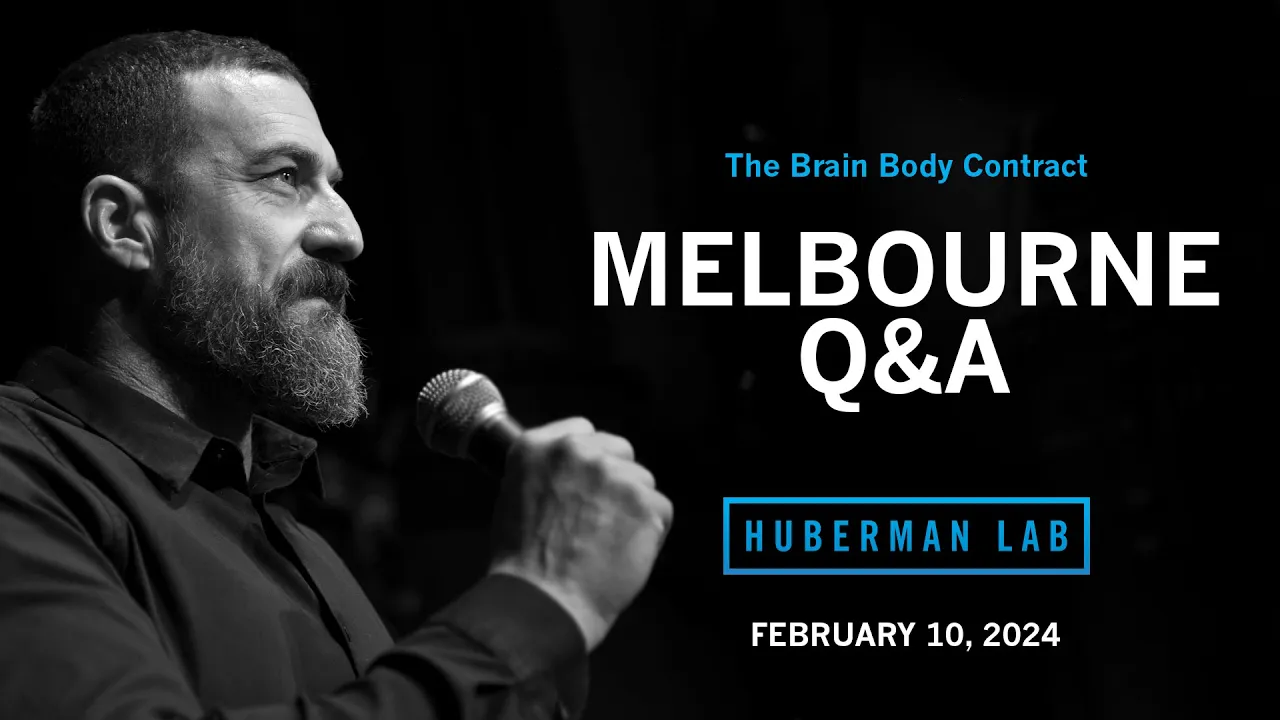
Welcome to the huberman Lab podcast where we discuss science and science-based tools for everyday [Music] life I'm Andrew huberman and I'm a professor of neurobiology and Opthalmology at Stanford School of Medicine recently The Hub Lab podcast hosted a live event at the plenary theater in Melbourne Australia the event was called the brain body contract and Featured a lecture followed by a question and answer session with the audience we wanted to make the question and answer session available to everyone regardless if you could attend so what follows is the question and answer session from the plenary
theater in Melbourne Australia I also would like to thank the sponsors for the event they are eight sleep and ag1 eight sleep makes Smart mattress covers with cooling Heating and sleep tracking capacity now One of the key aspects to getting a great night's sleep is to control the temperature of your sleeping environment and that's because in order to fall and stay deeply asleep your body temperature actually has to drop by about 1 to 3° and in order to wake up in the morning feeling refreshed your body temperature actually has to increase by about 1 to
3° eight sleep makes it extremely easy to control the temperature of your sleeping environment at the beginning Middle and throughout the night and when you wake up in the morning I've been sleeping on an eight Sleep mattress cover for nearly 3 years now and it has dramatically improved my sleep if you'd like to try eightsleep you can go to 8sleep.com huberman to save $150 off their pod 3 cover eights sleep currently ships to the USA Canada UK select countries in the EU and Australia again that's 8sleep.com / huberman the other live Event sponsor ag1 is
a vitamin mineral probiotic drink that also contains adaptogens and other critical micronutrients I've been taking ag1 daily since 2012 so I'm delighted that they decided to sponsor the live event the reason I started taking it and the reason I still take it every day once or twice a day is that it ensures that I meet all of my quotas for vitamins and minerals and it ensures that I get enough Prebiotic and probiotic to Support gut health now of course I strive to consume healthy whole foods for the majority of my nutritional intake every single day
but there are a number of things in ag1 including specific micronutrients that are hard to get from Whole Foods or at least in sufficient quantities so ag1 allows me to get the vitamins and minerals that I need probiotics prebiotics the adaptogens and critical micronutrients to try ag1 go to drink a1.com huberman And you'll get a year supply of vitamin D3 K2 and five free travel packs of ag1 again that's drink a1.com huberman and now for the question and answer session from Melbourne [Music] [Applause] [Music] Australia hey Dr hman uh some some of your listeners are
in or approaching our 50s okay same um and are thinking of doing all we Can to prevent dementia same do you have any additional thoughts or protocols or research we could focus on yes so um for the next two and a half hours no I'm kidding the uh I'm not known for being succinct I didn't go over too much earlier so okay so uh ground truths so let's start with ground truths and then let's move to um emerging let's maybe get to a little bit of speculation let's avoid conjecture um ground Truths um blood circulation
is good for the brain perhaps most important for the brain so anything that is good for cardiovascular health is going to be good for brain health it's not the only thing but that's true we know this so you hear these days a lot about Zone 2 cardio I don't know who gets credit for that petera talks a lot about it I talk a lot about it none of us invented the notion but you know 150 probably more like 180 to 200 minutes of so-called Zone 2 cardio per week is good numbers to shoot for some
of us get more some of us less what is Zone 2 cardio Zone 2 cardio is um cardiovascular exercise could be running could be swimming could be walking depending on your level of Fitness which you can just barely maintain a conversation were you to push any harder or faster you wouldn't be able to complete your sentences with much ease okay so is this zone two cardio for me no but if I were to jog And try and have a conversation at some point I would have a little bit of a hard time that's Zone 2
cardio um so we know that's true why uh well it seems to do a number of things at the level of release of growth factors brain dve neutrophic Factor at the level of um different let's call them I realize the immunologists are going to like roll their eyes but um anti-inflam flammatory cyto kindes and things of that sort you also have inflammatory cyto kindes um And things of that sort um it does seem that increasing blood flow in and through the brain is important for brain health which is not all that surprising there are species
of animals that spend part of their life swimming about and then when they stop um a good port and stick to a rock or something good portion of the nervous system actually degenerates but neurod degeneration and dementia are not necessar neily the same thing and this Is something that we don't often hear about um the age related decline in memory capacity in particular working memory can be related to reductions in dopamine Transmission in the brain so things that increase the catacol amines that we talked about earlier um this could be pharmacology of course but it
doesn't have to be pharmacology it could be um anything that increases the camines um and we talk about this on the podcast we have zeroc cost protocols That you don't have have to sign up for you can just go to our website and go to dopamine regulation and it will list out ways to increase the catac colomines through zero cost and very lowcost ways are known to improve working memory working memory of course the capacity to maintain a string of numbers or information for sake of kind of immediate goals but not information that's passed to
the longer term memory so that's that's different than neurod Degeneration that's simply reductions in the amount of neuromodulators like dopamine being deployed as we get older so modul modulating dopamine through healthy ideally uh means but I do think we are going to see an increase in the use of selective pharmacology for this purpose and here I'm not recommending anyone do drugs or take drugs prescription or otherwise but it does seem that um certain compounds like nicotine believe It or not um even though it increases vasil constriction and blood pressure um Can offs set some of
the age related reductions in dopaminergic and coleric aceto Coline coleric transmission um and you know you don't want to smoke Vape dip or snuff I'm not even recommending people take Zin patches but I think um there is some use cases for uh nicotine provided you're doing it with the you know a your physician knows and you're not getting Into blood pressure dangerous blood pressure range or supplementation with choline donors and things of that sort to increase acetylcholine and dopamine some people are starting to take things like modafanil and adol in older age um but keep
in mind these are not modaal but adderal liant Etc these are amphetamines they're amphetamines so I'm not recommending this but I think that's where we're headed I think you're going to see a number of different cognitive Enhancers that are used to offset some age related um uh cognitive decline AKA dementia now in terms of um so we're going Zone 2 cardio to like prescription drugs we're kind of bracketing here and then behavioral protocols that can increase neuromodulators such as the catac colomines now in terms of um other things that can perhaps decrease the likelihood of
Alzheimer's and other forms of dementia as it relates to neurod Degeneration um currently there are a lot of do not don't hit your head too hard if you hit it really hard don't hit it again hard um the so-call two hit model literally um you know and and we think of football or I guess rugby that's a sport you guys play down here where they use the head as a battering ram um I've seen this right some big necks on those kids and then it boom and they yeah but the problem is not necessarily just
rugby or American Football um or a I was told that someone told me I had to shout out an Australian football team and I know it's a setup so I'm not going to do it they're like when you're in Melbourne tomorrow you got to say that your favorite team is blank and I'm like this feels really dangerous um so I'm not going to do it um I'm not going to do it but what's that do it I can't remember the name of the team sorry um but I watched the document What's that um but I
still don't understand the rugby thing they do they use the guy's head as or G's head as a battering ram cuz I they used to play you see outside the my lab we had this big field and my Bulldog loved watching he was like this this sport makes sense but um they were just like run and then the I I never understood it but anyway what's that got it I need a translator sorry so I need a translator um but I Love the enthusiasm um yeah so we think about um head injuries and brain injuries
mostly in the context of sport but that's not where most the head injuries occur most of them occur construction workers car accidents TBI things of that sort um there's some interesting data on hyperbaric chambers this is getting really into the you know kind of high level stuff here meaning most people don't have access to them I I look Forward to learning more these are playing with different concentrations of oxygen in a little micro environment for traumatic brain injury um and neurod deener ation I mean do I think in 5 years that everyone's going to be
sitting in hyperbaric chambers order to offset neuron loss probably not I think it's not coste effective but um I will say that most of the things that are good for the body are good for the brain um keeping kind of anything that plaques The arteries capillaries and veins of the brain because it's so heavily vascularized um minimal and and minding those neuromodulators um obviously drugs of abuse like methamphetamine can deplete dopamine neurons the data on MDMA by the way I don't know there's drug enforcement in the room um the data you know where they have
most of the safety data or lack of safety data in some cases on MDMA keep in mind MDMA ecstasy Is methylene dioxy methampetamine methamphetamine we know causes neurod degeneration no question it also causes bad teeth do you know how do you know how turns people into mouth breathers dry mouth and the teeth degenerate yeah we have an episode on oral health coming out this this is real that's actually why the teeth degenerates from excessive um dry and it limits saliva production saliva is very important for remineralization of the Teeth they shout out to the dentist
in the house so the the the thing about MDMA is interesting because it turns out that MDMA because it also it increases dopamine just as methamphetamine does remember MDMA methylene dioxy methamphetamine but also huge increases in serotonin seem to be most most of the effect of MDMA the kind of empathogenic effect um there was a study done of um people from the LDS Latterday Saints sometimes referred to as Mormons um why was a study on MDMA done with people from the LDS community and I don't want to imply that everyone from the LDS Community does
MDMA but why they're very interesting um test population because they don't do other drugs but for some reason dma is not on the nfly list so there's is it's a beautiful paper um in which they took people who had only done as any drug not even taking caffeine right either once Or semi frequent or very frequent use of MDMA and they did a bunch of cognitive testing and there were some attention issues when people had taken over what was a couple hundred doses of of MDMA at the 80 milligram dose or more but doesn't seem
to be much neurod degeneration which is not to say that it's all safe there is an abuse and addictive potential there the biggest issue seems to be contamination of batches if we have a feny issue in the US I I I don't know if it's happening down here as well very concerning okay so the point here is that I think very soon you're going to hear about drugs prescription drugs and supplements to augment the release of neuromodulators not for sake of empathogenic states or psychedelic States but to try and keep those dopaminergic neurons online to
offset dementia because that's what the question is about in fact there's a Nobel prize winning neuroscientist at Columbia University whose name I won't tell you or maybe I will who when I went to visit his office chewed no fewer than five pieces of Nicorette in the course of a half an hour and I'm like what's going on he got a Nobel Prize but this looks kind of pathologic and I said why and he said well the nicotine is to offset age related loss of dopaminergic and coleric neurons I thought really he's like yeah when I
quit smoking because I want lung cancer but this is Him this is anic data I'm not sugesting you do this I think there are a number of things that we can do but protect those neuromodulators keep perfusion that is blood flow to the brain strong there's a a case for cardiovascular exercise and it does seem it really does seem that exercise that engages the neuromuscular connections more than cardiovascular exercise so not just resistance training but anything that invol involves coordinated bodily Training learning new physical skills Dance Etc really does seem to offset some of the
loss of cognitive fun functioning in adults so it's kind of interesting that physical exercise is great for cognition and probably cognition may or may not help physical ability but one probably can imagine why there's a bidirectional relationship there your nervous system doesn't really distinguish between physical and Cognitive it's all working as a bunch of functional units I could go on and on about this but um hopefully that um at least gets your um the gears turning around some things that perhaps you've heard about and some things that you haven't and we'll do an episode on
dementia and offsetting dementia in order to get into some of the fine details okay can we increase our willpower just like training a muscle group with your Research into the amcc O I'm so glad that you mentioned the amcc I think of all the new areas of Neuroscience research um that are out there I think the anterior mid singulate cortex is one of the most interesting um structures and and areas of research nowadays you know I think I if I have my way then not only will most people have heard of dopamine and the amydala
I guess you need a Star Wars character named after your brain part um Isn't there one right I only saw the first three I'm of that generation but isn't there a Amidala or something yeah right don't leave me hang in here is there or not if I'm wrong just say no okay anyway the amydala um thanks the um the amydala is a brain structure that is involved in threat detect ction and Novelty detection not just threats the anterior mid singulate cortex is an area of the brain that we know is activated well let me tell
you The best experiment the best experiment was done in my opinion by a neurosurgeon at Stanford Joe pery uh he's probing around in people's brains they got a little piece of skull missing he's stimulating in the brain he's asking them questions how do you feel what's going on how do you feel what's going on and he's got this electrode in the anterior mid singulate cortex and the patient says I feel like something really bad's going to happen Like a storm's coming it's like okay well we can stop stimulating he's like no I'm going into the
storm like oh that's interesting stimulate a little bit further back just by a millimeter or so completely different subjective experience for the patient that's interesting get a different patient in there map to the enter mid singulate cortex stimulate and the person says I like I'm going to get out of my chair and I'm Going to do something hard wild right this is prior to any knowledge of what the interior mid singulate cortex is doing make a long story short people who successfully overcome a physical challenge a cognitive challenge that learn a new skill that um
successful dieters I don't really like that term um their interor mid signate cortex grows or becomes more active under conditions that challenge the inter mid singulate cortex so this brain region seems to be The the brain region that puts us in a forward Center of mass physically and sort of cognitively and emotionally I often like to think that you know the nervous system as sophisticated as it is and psychology as sophisticated as it is as it is excuse me can be bined into kind of three categories things that we like to eat or don't like
to eat or can kind of be bended into yum yuck or me that's kind of what the the nervous system has to do because ultimately you Have to decide do I want to go toward it so-call repetitive Behavior do I want to get away from it do nothing people were either like yum or some cases yum yuck or in some cases like or like me right yum y me yum yum me this is the the sort of three tributaries that we have the option of moving down not moving down or moving away from so the
enter mid singulate cortex because it has inputs from so many different areas and outputs to so many different areas It can access circuits related to dopamine norepinephrine it can access circuits related to memory and context it's a hub it's a hub that by All Views through all lenses of the existing research suggests that when we anytime we do something truly challenging in particular things that we do not enjoy this is key the an mid singulate cortex undergo some sort of plasticity everything's in the research Data now point to the idea that the inter mid singulate
cortex is the seat of so-called willpower which is linked to Concepts like tenacity or grit and Etc and what I love about this research is that it comes from a bunch of different areas human brain Imaging brain stimulation Etc here's what I don't like about the reality but that we all need to accept which is that the anterior mid singulate Cortex is modifiable by experience by leaning into challenges at any stage of life that's great we talked about that earlier plasticity but lest we forget plasticity goes in the other direction too it seems that when
we don't engage in challenges that the an mid singulate cortex it doesn't atrophy but it undergoes sort of a downshift in activation now here's what's really really interesting in relates to the previous Question the anter mid singulate cortex seems to be especially active at Baseline and available for plasticity in what are called superagers superagers you know we've all heard of blue zones the superagers are these people who they don't just exist in blue zones they're spread around the world these are people that seem at least by cognitive measures and other physiological measures of the body
seem to age extremely slowly so they shouldn't really be called Superagers right they should be called super non aers anyway the anid singulate cortex seems to be hyperactive in these superagers as they're called and so it seems that not only do they maintain cognitive function later in life but that seems to be related to their regular engagement in challenging things so remember for so many years years we heard okay like nuns don't get dementia and then there's all sorts of things you can imagine could be related to that and Then we're thinking oh maybe it's
crossword puzzles maybe it's crossword puzzles maybe it's hanging out with other people maybe and you know and then you know that person down the street and she cycling on the weekends like crazy and she's 90 and she looks like she's 50 and she's sharp as attack it's probably leaning into Challenge on a regular basis leaning into Challenge on a regular basis as opposed to one specific cognitive or physical thing which means That if you love cycling or you love the cold plunge or you love a certain form of exercise it's probably not doing that much
for your anterior mid singulate cortex but these super agers also live longer and so there is this notion that because the anterior mid singulate cortex has connectivity to a lot of areas of the brain and body that it is somehow linked to the will to live and this is being examined now in so-called terminal cancer patients So-called you you know terminal cases I don't like the language because there are these amazing instances and Physicians and oncologists have known this for a long time that when people decide they're going to fight cancer they don't always win
that fight unfortunately but often times it's the people who insist on fighting it psychologically that they won't give in that end up still living more months more years and in some cases putting the Cancer into remission with of course other tools right I'm not saying you shouldn't use other tools to combat cancer it's a very interesting structure relates to the question on dementia hopefully that was uh informative Julian thank you how would you recommend shift workers minimize the effects of disruption to their circadian rhythm oh this is so important you know why because like right
now 92 uh 9:40 p.m. we're kind of doing shift work right now Most people are on a shift work schedule now in the world this is true we think of shift workers as only the people who are up in the middle of the night sleeping during the day but most people are doing shift work the criteria for shift work is at least a 2hour varant at least in the US a two-hour variance in the sleep wake cycle more than three nights a week anyone here go to sleep every night same time wake up every morning
the same time never stay up Later than that more than two nights a week okay most people are doing shift work nowadays they're just on their phone or they're on their computer and I'm not going to argue that's NE you know you shouldn't uh and many times that's me as well so here's what we do know and I could we did whole episode on shift work but I'll try and summarize some of the key points you want to have your cortisol elevated early in the day and then Subside across the day that's the ideal pattern
of cortisol release cortisol is a great thing when it's high and then tapers off from early day into the later day it's a bad thing if that cortisol Peak is shifted late that cortisol Peak is coming every 24 hours you don't have a choice question is is it going to be early day or is it going to be late day late day cortisol is Peaks are associated with depression anxiety this was done by my Colleague David Spiegel and the great Robert spolski at Stanford a study about that Robert another great beard amazing and and and
I I always thought it was to blend in with the species that he studies cuz he was like the baboon guy you know I haven't quite figured out how to master that one you know like the Cuttlefish look but the um working on it working on it maybe I just have to no never mind there's a there's a story About you heard remember the earlier story The the made anyway the cuttle fish anyway never mind um again this is why I don't like to speak too late in the day I get myself into trouble but
um the point here um is that having that cortisol Peak early in the day sets you up for mood focus and alertness immune system function and really um in a really great way shift workers have a serious problem which is that late peaks in cortisol are kind of Paramount in all forms of shift work and so what you need to do is to put yourself ideally in lighting conditions that limit the amount of blue light coming in at night or when you're doing that shift work now you have to do your work and I think
in the next two years if I have my way one one idea that I'd like to of embed in people's minds is you you know we hear a lot now about how hyper processed foods and highly processed foods are bad for us sort of Empty calories what are empty calories it's foods that are very calorie dense but micronutrient poor right that's what it it really is it's also the quality of food issues and people get you know like let's please not have the seed oil debate it's like people get really into this and it's unclear
to me still and okay but we we sort of think of empty calories like alcohol sugar Etc calorie dense micronutrient poor light can be viewed in much the same way These days we live in a very blue light Rich World lot of blue light so short wavelength light blue light UV light and by the way in sunlight especially down here it's very UV Rich blue which is great during the day especially when it's offset or or sorry when it includes long wavelength light full spectrum light by the way for everyone that's obsessed with red light
and I love red light and red light therapies remember the best source of red light is the sun It's full spectrum light it includes red it's just there's a bunch of other stuff in there too see it doesn't look like a Red Light Panel um that said if you are going to do shift work one of the best things you can do it's been shown to reduce cortisol levels at night while you're doing that shift work is to filter out some of the blue so that is a use case for blue blockers or even for
glasses that put you into more Reddish conditions provided you can still do the work work you need to do safely you will see a dramatic reduction in cortisol under those conditions this blue and UV pathway picked up by a certain set of neurons in the eye the intrinsically photosensitive melanops and cells Etc is a real thing and it and it's designed to activate you this is why so-called Seasonal effective disorder lamps sad lamps are basically bright blue whsh light so when you're Doing that shift work if you can get into red or orange or light
conditions if that's great you can do this very inexpensively by the way by just getting some party lights it doesn't have to be any fancy red light this is we're not talking about red light panels the other thing of course is when you get back to your nonwork environment you need to do some work to think about when is best to sleep when is not best to sleep you know is it best To sleep all day and be up all night or get that sunlight in the morning and I talk about that in the shift
work episode and I'm tempted to go down that rabbit hole now but I would just encourage you to take a look at that episode and um I'll just cue you all to a resource the hubman lab.com webbsite allows you thanks to our wonderful Engineers to put in multiple topics so you could say shift work red light or shift work dopamine or shift work Sunlight and it will take you to the exact time stamps across all the episodes where those specific topics occur is all zero cost as opposed to having to go and peruse all these
different episodes you a lot of people have said why not shorter episodes it's like well the idea was to create a library of information that now ai is and better engineering of websites can allow you to just pull the relevant information just like you would a book I Used to go with the library for those of you like me old enough to remember he actually took this thing called a book off a shelf he Xerox copied it in any event he very archaic and very expensive and you'd always get the margin of the book in
the middle like the the spine it sucked now you can go to the website and just get that information and then we also just launched an ai. huberman lab.com webbsite again as all zero cost you can say hey what should I do for Shift work but I wanted you here to come here tonight so I didn't tell you that until you got here no I'm just kidding I'm just kidding okay um and there are a few other tools about adjusting eating schedules for and what not for shift work but um hopefully that gets you going
um Julia thank you what's the difference between nsdr and meditation um thank thank you for this question I am a huge huge huge believer and proponent and practitioner of nsdr Nonsleep deep rest what is non-sleep deep rest well to be fair Yoga Nidra which translates to yoga sleep is a thousand-year-old practice um thousands of years little practice in which you lie completely still keep the Mind awake you're not thinking in a structured way it's more of a body scan directed relaxation Etc I discovered this in 2015 when I was doing some research for a book
that I still can't manage to seem to Finish on trauma and addiction and I went I have a friend very talented trauma therapist who's managed to help people with all sorts of addictions he'll be on the podcast in the not to distant future and I went down to this clinic in Florida and everyone there spent the first hour of the day doing Yoga Nidra this is pretty wacky I was still in my pure science quote unquote pure scientist naive scientist lens and I Thought what is this about and he said well you know so much
of addiction is about an inability to regulate impulses um to deal with agitation especially in the early days of trying to get sober or being sober and it just helps people learn to regul self-direct the their nervous system in terms of relax self-directed relaxation it also seems to help with their sleep it also has these components about time and and and sort of if you because he said you know It's kind of interesting if you take a step back you know if you can tolerate craving for a second you just did it so why couldn't
you do it for another second why could you do it for another second another second it's not as if it necessarily increases linearly or over time so you know what's going on and so again sort of our ability to realize and regulate our states across time and to realize there's this funny thing where when we feel terrible we think it's Going to go on forever and when we're happy we we were like certain it's going to stop there's a kind of asymmetry in our nervous system that we don't understand we showed he started talking about
yoga NRA really seems to help addicts recover and stay sober if they do it regularly thought well this is cool what is it I'm a neuroscientist we started studying in my laboratory we discovered that the brain goes into these States during yoga NRA That are similar to sleep body still mind alert and that seems to be very beneficial maybe even accelerates neuroplasticity and learning and indeed there's evidence for that there's evidence that yoga at from a laboratory out of Scandinavia not my laboratory showing that it can increase dopamine levels in the striatum basil ganglia by
up to 60% using human positron emission tomography Imaging so we're talking about how to increase dopamine through non pharmacologic means this something about body still brain active very very powerful way to do that I I made up this term This Acronym non-sleep deep rest because I have tremendous respect for Yoga Nidra and the the yoga Traditions but I was concerned for a lot of people un unfortunately when they hear Yoga Nidra the it sounds esoteric and they're not going to approach that practice also Yoga Nidra includes intentions and some things that are a little bit
on the mystical side and I knew I was going to take some heat for it and I feel badly about it but that bad feeling is offset by I think when you call something non-sleep deep rest it tells you what it is and then more people are likely to come to the practice and I felt like it was worth you know kind of putting myself you know jumping on the grenade for that one so non-sleep deep Rest is very effective at restoring cognitive and physical Vigor and can indeed offset some degree of sleep loss it
also gets you better at falling and staying asleep and it's very simple and very easy to do and it's zero cost and if you want to try it you can go on to YouTube and put nsdr in my last name there's a woman named Kelly boy boys who has a much more pleasant voice than mine um who does them as well these are all zeroc cost protocols she's also in the Waking up app um and there are many of them common deai as another person who has you know Wonderful yoganidra scripts so you can find
these things and they're really about 10 minutes to 20 minutes sometimes 30 minutes long you can do it for an hour but most people won't do that consistently you don't have to do them every day and they're very very effective at restoring mental and physical Vigor when you're feeling depleted and it getting you to be a Better sleeper so I figure that's a zeroc cost tool that is grounded in good mechanistic science and makes sense logically so why not meditation typically and if and there many different forms of meditation but if you're let's just say
kind of um standard if there were such a thing um third eye meditation closing your eyes focusing your concentration on a point just sort of at your forehead concentrating on breathing redirecting Your attention to your breathing if it if your attention drifts we know based on work from Wendy Suzuki's laboratory at New York University and some work out of the University of Wisconsin can improve memory can improve focus and does seem to have some stress offsetting effects but it's more of a focus exercise as opposed to an energy replenishing exercise now some people meditate and
feel better afterwards they Have more energy but then it's sort of like well compared to what um I don't think that's the maor effect of meditation and while we're on these topics I should just say that self-directed hypnosis of the sort that my colleague David Spiegel studies is more about solving a particular problem so hypnosis is more about engaging neuroplasticity remember earlier we said that neuroplasticity in adulthood can be activated by Focus followed by rest it Seems that in the self-directed hypnotic States the brain enters kind of pattern of activity in which neuroplasticity can be
accessed more quickly we think because the brain is both focused and relaxed in a particular way merging that focus and rest State and of course the hypnotic script is not about getting you to do crazy things on stage that's stage hypnosis but self-directed hypnosis is for instance smoking sensation by the way that the Success with smoking Sensation from hypnosis is far greater than the cessation with smoking from pretty much any other protocol but unfortunately it has the name hypnosis which makes people think about stuff that people do on stage that's kind of wacky so we
need a new name for it um because unfortunately names are a problem there there names can be differentiators as opposed to integrators they don't bring PE when people say I'm going to hypnotize you You should try hypnosis people like like yum yuck me they're like yuck so um by the way does everyone here remember how you know if you're highly hypnotizable do you know that the Spiegel eye roll test it's not what teenagers do David Spiegel and his father psychiat discovered the clinical application of hypnosis it's a clinically approved tool there's brain stem neurons that
cause elevations and alertness and focus and they're associated with moving the eyes Up they're brain stem neurons that close the eyelids and push and essentially Drive the eyes down that are associated with parasympathetic states which why you like this when you're tired you're out there I'm sure if you are capable of keeping your ey your gaze upward and closing your eyelids you score on a particular end of the so-called Spiel eye roll test which makes you highly Hypnotizable because that state of hypnosis is one in which you're what alert but very very relaxed so if
you go to Spiegel's laboratory they're going to look at you and they say look up at the ceiling and then close your eyelids and if you can still see the whites of if they still see the whites of your eyes as your eyelids close well then you're in the highly hypnotizable realm kind of interesting right there's all nervous system related and you can see this Stuff is this is like real clinical tools okay how do we stop ourselves from mindlessly scrolling on our phones hard questions um I didn't look at my watch because I'm bored
I'm just thinking how much time do you have um well on the way here to Australia my Rob who you met earlier my friend and podcast producer he said okay guys everyone's deleting social media from your phones for the whole trip the whole trip and I'm like I don't know if I can go on this trip Rob no I'm kidding um uh we got one we have one guy who's kept it on his phone so that we can post things um and we continue to honestly I think that's what it takes um if it's social
media that you're scrolling I think you should do a delete and reinstall if I'm honest a delete and reinstall every day uh because I think and then you have to limit the amount of time and one of the members of my Podcast team experienced this he said I just picked up my phone a minute ago and I went to like hit the Instagram Tab and it wasn't there and I know it's not there and that's where I say yeah at some point it becomes more compulsive than addiction these are just reflexive behaviors it's like walking
in the refrigerator like I did every day of my life all day I just I walk into people's homes and just look in the refrigerator I don't even know I get into people's Cars I look in the glove box I just do this I'm kind of like looking around I'm not going to steal anything but it's like the teenage boy in me you know just kind walk in I'm going to open your refrigerator um so I think it's it gets to the point of reflexive and it's compulsive and it might be addictive but it can't
be good when it's like that um but I think social media can be really useful so I think um if You're you can set timers you can try graying out the screen getting rid of the color thing there's all this stuff but I think if if there are particular apps that you're struggling with I would just delete them from your phone and and do a reinstall because that's enough of a of a behavioral barrier there are enough steps involved enough sequencing to put the thing back on there each day and each time maybe twice a
day that you're going to vastly reduce your use To be honest I think that's probably the best way to do it and there are probably people in this audience that are thinking this seems crazy like just don't turn it on just don't just don't open it and look if I was 65 years old I'd say that too but it doesn't work that way for certainly the younger generation it doesn't I know this because I gave a talk at Santa Clara University a few years ago and I was talking about Limiting social uh social media use
and phones and this kid came up to me afterwards he said you don't get it he like you're like back then I was like 43 he said you don't get it he said for you the phone was a thing that you like integrated into your like post 9s High School life like you watched The Breakfast Club or I don't know how he knew that movie I was like you're right I did watch The Breakfast Club a bunch of Times and he said but for us it's like life I like I rolled my eyes and I
thought wait no listen I'm going to listen because no one knows what it's like to be 16 years old or 24 years old in 2024 unless you're 16 or 24 like okay here we go listen he said when my phone he said when my phone Powers down I feel the energy drain out of me and when it comes back up I feel Life Energy come back into my body and I thought oh my goodness like we are hosed but that's But that's the reality and I'm of the mind you know I was a I was
a camp counselor I worked with at risk kids I was a wild kid and you learn something especially when you work with kids like me when I was a teenager I was a Helen is be a channel not a damn you cannot block the system that's emerged this is here and it's here to stay so I think things like deleting the app is putting it back on there is the only way to go we have to listen I think we have to Listen understand that you know we after all adults created these Technologies and these
kids are using them and I don't think we're going to see a reversal I don't so we have to really I think that what he said to me as scary as it was to me I think reflects the reality it's part of their life energy it's part of their connectivity and we we're going to have to come up with better tools and I doubt those tools are going to be uh to the effect of Eliminating it you could say unfortunately you know all the adult last I checked I'm an adult people in my life have
argued differently but I think we're going to have to learn to be a channel not a dam with this uh I do if resources and ethics were not an issue what would your dream clinical trial to run oh my goodness this is a hard question okay um dream clinical trial what's That oh gosh the accent is killing me more cuddlefish yeah more cuddlefish like cuddlefish I like the idea of more cuddling um physical contact so key um I think we're all still recovering from the years we had a few years of just like no physical
like physical contact so minimal um I mean there's the classic harlo experiments right the wire monkey or versus the cloth monkey I mean primates go to the cloth monkey even if They don't get food there I mean it's such a critical component of you know how our nervous system forms um the I think this is a this is a you know what I'm going to do something I've never done before I'm going to turn the question around I actually would I seriously I'm not trying to avoid answering this but you know we've worked on all
I've worked on cuttlefish we worked on respiration practices we worked on uh Vision we've worked on Neuro regeneration you know I've enjoyed um working on a great number of different things I'm sort of curious what people like what do you think we need more of I've never done this but I really want to know um I don't know how we're going to do this in any kind of non-chaotic format but what the hell um it's late enough in the evening we just do it um like really I mean so now there's trials on psychedelics we
do this by kind of like I'll throw out some Options and then we'll do it so right now it seems that psychedelics are a big thing um do they increase plasticity yeah I'm excited about it I'm a convert but I do think that one has to be careful and there are certain people in populations like people who um suffer from certain types of manic bipolar or schizophrenia that really need to avoid these things kids I mean being a kid is basically being in a psychedelic State the you know lateral connectivity of the Brain is extend
ensive um and you know I don't encourage it I mean that the trials with MDMA and PTSD are incredible what's happening with maps is incredible you know 60 plus perc remission rates done with licensed Physicians of course I don't get Cavalier with this so okay so I'll just ask so I mean it's going to be hard to draw out the denters but more work on psychedelics psilocybin Etc as ways to amarate depression are people like more Like yum yuck or meh is that like yum okay or like yuck don't be afraid to say yuck I
like a good argument is anyone like yuck on psychedelics sorcery it's sorcery I heard that um meh okay all right interesting okay so psychedelics get a strong push I think we have enough evidence that changing patterns of respiration changes brain States but I think that that's an interesting area um I don't know you can you just shout it out just shout it out one all first over Here yes oh God the accent you guys are so good I love the accent listen I listen I I don't drink I don't drink anymore but when I used
to when I used to go to bars I'll just say the Australian accent never fails um in the US yeah time Chambers time Chambers oh hyperbaric chambers yeah hyper that's an interesting one yeah I mean when I think of ways to modify Physiology you think temperature light neurom modulators right you think by the way anytime you want to think about changing something in the body your brain you think mechanical and chemical so this is kind of this is changing the chemistry of the brain and body through hyperbaric chambers thank you appreciate it I think I
re did we run into each other at the gym the other day no anyway um think I recognize you I um the Okay one I'll get to you in one second yeah yeah love that okay so protocols for childhood trauma yeah so I mean I think we're finally at the place where we as a world where like this word trauma actually is Meaningful like because we knew it before but I think before people thought if like if you hadn't lived in a war zone which obviously is trauma um now I think people appreciate that trauma
is inherent to a lot of Life by the way I Love your shirt I that shirt it's like yeah a lawn stale shirt was Against Racism hey I love I love that shirt um you know the history of that shirt right it's like lawdale was co-opted by some Neo-Nazi groups as a brand so lawdale came out with an Against Racism and hate shirt which is like the best like to that which is yeah so anyway little side note there not sponsored by lawdale um but rad shirt yeah I think childhood trauma you know trauma can
be best Defined as an adverse event that changes the nervous system in a way that causes maladaptive functioning going forward it's not every bad thing right but it certainly happens and I think we need to learn to rewire the nervous system let's let's face it whether not psychedelics or it's talk therapy or it's hyperbaric chambers or it's cold plunges what we're talking about is neuroplasticity we're trying to rewire the nervous system so I love that One um we need some very structured um tools there's all sorts of stuff about soaz release for trauma and you
know there's little bits like little Sil of things that are all very interesting breath work you know release work but so far there isn't like a structured framework for for treating trauma different groups doing different things EMDR Etc I think they all have Merit okay there was that shouting out cons Consciousness The Big C yeah um in my House Costello was the big ca he would always remind me of that but Consciousness I think that um and now with AI we have to ask ourselves like what is what is conscious and I think we need
a clear definition of what that is do you guys know this story of like they were going to solve Consciousness a few years ago and and they didn't do it there was this bet in Neuroscience that um it was going to be solved by 2015 or something like that so I think we need and it's not obviously so we need better definition of what that means but I think it's very important uh problem indeed so thank you maybe a free will yeah that's a tough one that's one I usually avoid um R Robert Robert slammed
me on that one on the podcast what was it in the back I heard as an Adaptive technique but oh yeah you know we hear I yeah we hear so much I I'm agreeing with you the Um we hear so much about ADHD these days without an understanding of like what it really reflects except in the extreme clinical cases so I think a better understanding I did two episodes of the podcast by the way on a attention in 88 she one focused mainly on behavioral and nutritional tools it was positively received by about half of
people and then the other half were like this is garbage what about all the drugs that are useful then I did one about all the Drugs that can be useful and people said this is garbage you're putting kids on meth and I'm like wait a second hold on we try and cover it all so um because I I favor balance I heard a excellent things there was were all male voices we kind of got a sampling bias here unless I'm got a high frequency cut off thank you something negotiation sorry science of negotiation yeah so
people being able to Resolve differences better Lord please yes oh my goodness I mean this is yes thank you um if ever there was a call to action it's like um you know this is a big question right I'm a neuroscientist not a historian not a not a futurist or a politician but um thank goodness can you imagine what a terrible job I would do I like being outdoors I hate meetings I like dressing like this and and I and I don't like the news um it'd be the worst but yeah if ever there was
a need and a question it's you know are we just going to continue in these like iterative cycles of like when the economy is good things seem mostly good and then a lot of people are still suffering and then like these cycles of and or are we going to finally just sit back and go okay what are we good at as a species what are we really bad at what are we like Kind of good at and start coming up with some tools to try and function better on the whole with the understanding that there
are Bad actors out there that are constantly trying to you know exploit and manipulate but there are also a lot of good actors too and by good actors I don't mean actors in the in the stage acting sense I mean I think that um look what we're we're we're a smart species we can think in past present and future terms we can look at mechanism we can Communicate better with each other better than any species except maybe the cuddlefish and so I think the question is are we you know is there going to be some
sort of sitting back and finally just saying like enough like let's just figure out a way to dialogue and I love that um you know it it's a it's a science we that there are problems and there are hard problems um and honestly I think it's going to come about if it comes about It's going to come about through groups not through individuals I don't think we're going to get like the world leader or world leaders of 12 people like let's get it done let's get it done right this time I think it's going to
be a a more Collective Consciousness you know I'd like to see fewer individual leaders and more groups and panels leading things but anyway that's that's my bias and you know um Genetics genetics genetics love it yeah okay well there's okay I'll say two things and then I think my team's going to make me close out [Music] wait um rad okay awesome now it's turning into like a like a science punk rock show so um the um genetics well I think the big things is in genetics are We're soon going to be in the place where
we can do genetic well right now you can take human embryos and Screen them for mutations by whole genome sequencing it's very inexpensive compared to a few years ago it's still expensive and you can do selection you can select out based on lack of mutations maybe even based on over representation of certain genes um that's interesting has some ethical considerations but there soon will be You can do crisper um you could in theory you could modify the Genome of of adults um and certainly babies and so that's where we're headed it's already being done in
certain countries it was done in China um it was not looked upon kindly by the International Ethics committees um but it was done a mutation in the in the HIV receptor um so those babies exist so it's happening uh it's going to be interesting times uh the microbiome I think is really exciting Here's my big call to action is that there's a microbiome in the gut but there's also microbiome on the skin and the nose and the mouth and the genitals like these all these little niches and well I guess it depends the little or
not so little niches um depends um I was thinking about the nostrils um the night's getting long um there I go again um the uh they they are all important and and there's a lot more to understand I think The gut microbiome is just one of the microbiomes so and female hormones certainly important topic it's received far less sadly far less attention than male hormone therapy or um understanding and and things are starting to change there it's been slow yeah yeah there's been it's been can you believe it it was like four only like eight
years ago that the National Institutes of Health in the United States was like hey maybe you should start studying female mice too It's like like this I mean we're modern science is very far behind we're very far behind and I think it's a it's a resource issue it's also uh you know there's a bunch of um sociological consider considerations in science anyway I'm trying to change the story there but I'm but one person and you know I hope to live a very long time but you know um should I get hit by a bullet to
bus or cancer um tomorrow I want you to know that it's going to be or late Long time from now I have natural causes sorry I have a morbid sense of humor I work I worked with the Physicians they all talk like that I hope to live a very long time um but it's a collective effort so I just want to um before we wrap want to say a couple of things we can get on with the rest of the night first of all um I it is a collective effort um you know I as
I've mentioned several times this evening I I look no differently on the massage therapy Versus Chiropractic versus uh whole genome sequencing it's just all different lenses to look at the same sort of set of goals through and yes there's a range of quality and rigor and communication Styles and personality but if you can maintain some level of curiosity and discernment about what works for you or doesn't work for you where you think there's Merit um that's great but but it's going to be um a wonderful thing when we can all start to Dialogue and see
where the points of convergence are where we're you're basically talking about two different groups talking about the exact same thing through different language I think that's where things really can move forward um the discourse of public science and health communication obviously is something I'm very passionate about I would love to see more podcasts believe believe it or not not just my podcast but they more Podcasts if you have something to say to the world please say it please put it out there on social media I do think that there's value there so I'm encouraging the
every person not just usually they go the young people but like the every people to um you know get information out there and and to support the efforts and I also want to say thank you so much for coming out on a Saturday night here in Melbourne um and for listening to the podcast and for Yeah it really means a lot to me thank you thank you thank you thank you thank you so much thank you thank you thank you I re I really appreciate it that the podcast is indeed a labor of love I
feel oh so blessed to do it and um and my hope is that the tools protocols and information will radiate out as far and wide as possible I don't need or want Credit I just want people to have the information I really mean that and to share it where you think it can be useful to people and last but certainly not least thank you for your interest in science [Applause] [Music]