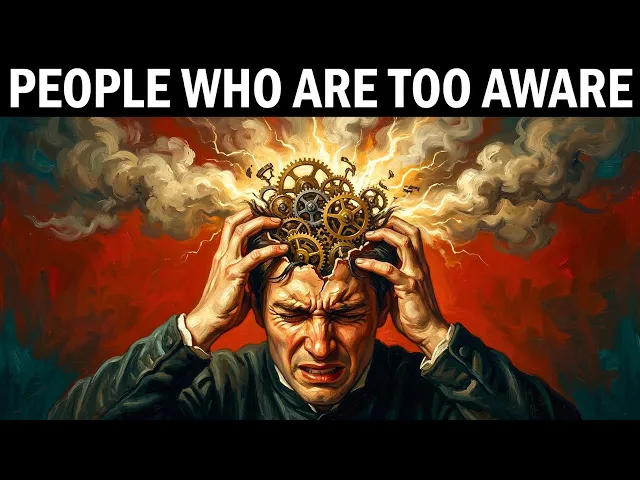
You think your self-awareness makes you superior. You believe that understanding your own flaws, dissecting your triggers, and analyzing your behavior puts you one step ahead of everyone else. It actually makes you a prisoner.
Society preaches that examining your thoughts and knowing your deepest psychological wounds is the ultimate path to evolution. They are lying. Hyperawareness is not a superpower.
It is a psychological parasite. It is a highly sophisticated form of self-destruction dressed up as intellectual superiority. There is a very specific hidden threshold where self-reflection mutates into psychological paralysis.
You cross it every single day. I am going to expose exactly how your intelligence is weaponizing your own mind against you and the one terrifying psychological mechanism required to cut the wires. Phase one, the panopticon of the mind.
Metacognition gone rogue. Most people walk through life asleep. They act on impulse.
They ruin their relationships. And they never question why. You look at them with a mixture of pity and disgust.
You are not like them. You observe. You calculate.
You think, but you do not just think. You think about your thinking. In psychology, this is called metacognition.
Daniel Carnean outlines the architecture of the brain through two systems. System one is fast, automatic, and intuitive. System two is slow, deliberate, and analytical.
You have trapped yourself in system two. You have forced your brain to manually operate functions that were designed to be automatic. It is exhausting.
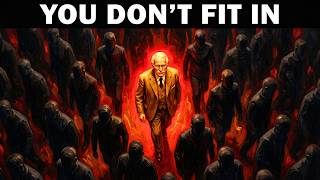
In the late 18th century, philosopher Jeremy Bentham designed a prison called the panopticon. It was a circular building with a single watchtowwer in the center. The cells were illuminated, the prisoners entirely visible, but the watchtower had blinded windows.
The prisoners could never see if the guard was actually watching them because they might be observed at any given second. They began to police themselves. The physical guard was no longer necessary.
The prisoners internalized the surveillance. This is exactly what you have done to your own brain. You have built a panopticon inside your head.
You are both the inmate and the warden. You do not just experience a conversation. You hover above it, analyzing your own tone, adjusting your posture, calculating how your words are being received in real time.
You script your texts. You monitor your pitch. You pathize your own sadness before you even allow yourself to cry.
You are never actually in the room. You are always in the watchtowwer. Fodor dsttoyki captured this specific agony in notes from underground.
His protagonist was a man entirely crippled by his own intellect. He wrote, "To swear to be acutely conscious is a disease, a real honest to goodness disease. He understood that the hyperconscious man cannot act.
Action requires a slight degree of blindness. It requires instinct. But you have killed your instinct.
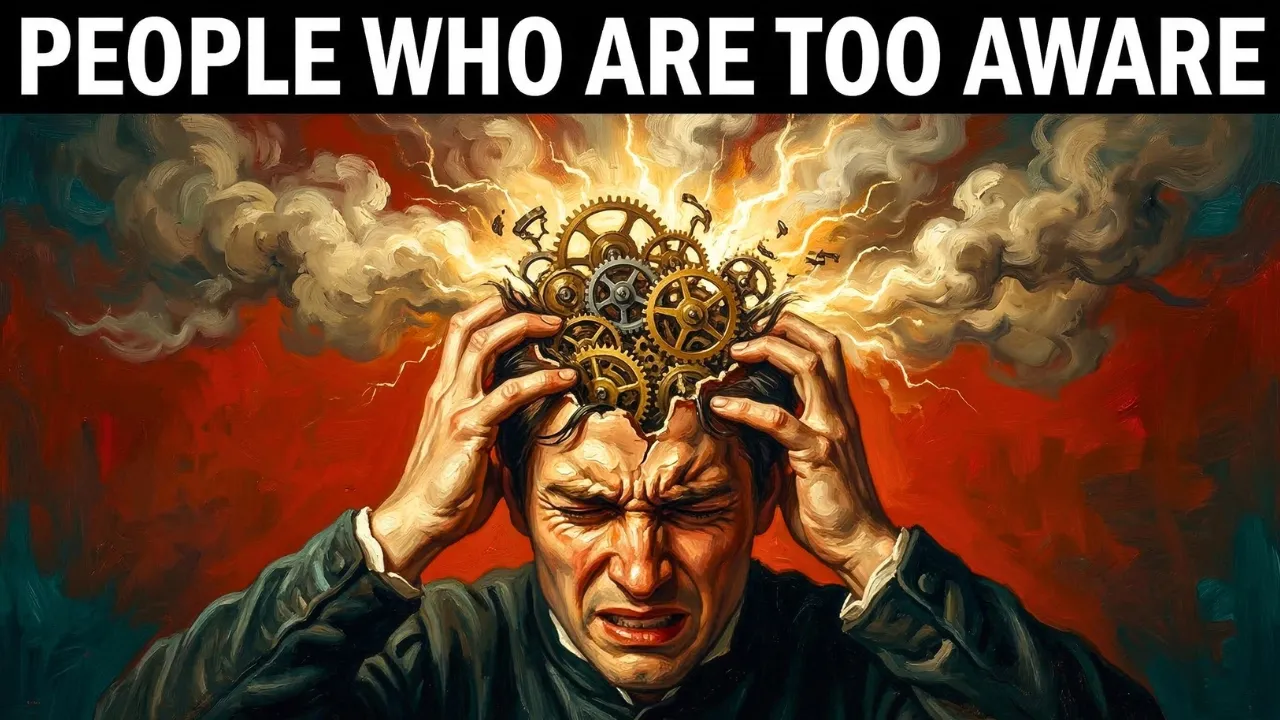
You have replaced it with an endless psychological audit. When you score high on the metacognitive awareness scale, a clinical measure of how deeply you monitor your own thought processes, you do not become a Zen master. You become a stuttering machine.
You overprocess. Think about breathing. It happens naturally.
But the exact second you become hyper aware of your breath, the rhythm breaks. You have to manually force your lungs to expand. It becomes mechanical, forced, uncomfortable.
You have done this to your entire personality. You are constantly editing yourself to avoid making a mistake, to avoid looking foolish, to avoid being misunderstood. But this constant editing drains your cognitive battery.
People think you are quiet because you are shy. You are not shy. You are processing massive amounts of internal data just to exist in a normal environment.
This is the curse. You have traded the raw messy experience of living for the sterile clinical observation of it. You are safe in the watchtowwer, but you are completely isolated from the life happening on the ground.
How did you get this way? You were not born a warden. You were trained.
Phase two, weaponized trauma. The empathy lie. This is the phase that will offend you.
Good. Pay attention. You like to tell yourself that you are highly sensitive.
You have probably read Dr Elaine Aaron's work on the highly sensitive person. You pride yourself on your empathy. You can walk into a room and immediately read the emotional temperature.
You know when someone is lying. You hear the microscopic shift in your partner's tone of voice. You notice the hesitation in your boss's email.
Society praises this. They call it emotional intelligence. Dark psychology calls it what it actually is, threat detection.
Your hyper awareness is not a gift of the soul. It is a biological adaptation to an unpredictable environment. At some point in your life, usually in your formative years, missing a subtle cue was dangerous.
If you did not read the mood of the room perfectly, there were consequences. chaos, anger, disappointment, abandonment. So your brain adapted.
It turned up the dial on your threat detection system to maximum. It forced you to become hyper aware of everyone and everything. You are not an empath.
You are traumatized. Clinical research into the emotional hyperawareness of PTSD survivors reveals a brutal truth. The brain cannot distinguish between a real threat and a perceived emotional shift.
Your amygdala is firing off warning signals because someone took five extra minutes to reply to a message. You construct elaborate, horrifying scenarios out of a single facial expression. Consider the Ptorian Guard of ancient Rome.
They were the elite unit created specifically to protect the Roman emperors. They were the most heavily armed, highly trained, and deeply embedded soldiers in the empire. Their entire existence was based on anticipating threats to the crown.
But hypervigilance always corrupts. Over time, the Pritorian Guard began to see threats everywhere. Their paranoia grew so vast that they eventually became the greatest danger to the emperors themselves.
They assassinated Caligula. They murdered Galba. They auctioned off the Roman Empire to the highest bidder.
The mechanism built for protection became the mechanism of destruction. Your hyperawareness is your Ptorian guard. It was built to keep you safe from rejection and failure.
But now it perceives ordinary human friction as an assassination attempt. It scrutinizes every interaction, scanning for the knife in the dark. Why did they use that word?
Why did they look away when they said that? Are they losing interest? You think this hyperanalysis makes you a mastermind.
You think it prevents you from getting hurt. But look at your life. You are exhausted.
You ruin perfectly good relationships because you dig for problems that do not exist until you create them. You preemptively reject people because your internal guard convinced you they were going to leave anyway. You are fighting a phantom war.
The battle ended years ago, but you are still standing in the trenches, fully armed, analyzing the wind. This is why you are drawn to dark psychology. You want to understand manipulation.
You want to understand power dynamics, not because you want to hurt people, but because you are terrified of being caught off guard. You want to map the minds of others so perfectly that they can never surprise you. But mapping the external world is only half the curse.
What happens when the Ptorian Guard turns its weapons inward? What happens when the threat detection system looks at you? Phase three, the autopsy of the living.
Yungian overload. Psychoanalyst Steven Gross wrote a brilliant book called The Examined Life. It is built on Socrates famous mandate.
The unexamined life is not worth living. But there is a dark correlary that Socrates never mentioned. The overexamined life cannot be lived.
Carl Jung, the architect of the deep unconscious, introduced the concept of the shadow, the hidden, repressed, often dark parts of our psyche. Modern therapy and self-help culture have hijacked this concept. They tell you to do the shadow work.
They tell you to excavate your childhood, analyze your toxic traits, and label your attachment styles. You took this advice. You took it too far.
Most people live in blissful denial of their own flaws. You live in a constant autopsy. The problem is you are performing an autopsy on a living body.
You slice yourself open every single day. You pathize your own grief. If you feel sad, you don't just cry.
You analyze the root cause of the sadness, trace it back to a specific event, and judge yourself for still reacting to it. You know all your own red flags. You have clinical terms for your own suffering.
I'm dissociating. I'm projecting. I'm experiencing an anxious avoidant trigger.
You use the vocabulary of psychology not to heal yourself, but to indict yourself. Let me tell you the story of King Mithrates V 6th of Pontis. He lived in constant fear of being poisoned by his enemies.
To protect himself, he began ingesting microscopic sub-lethal doses of various poisons every single day. Over years, he built up an incredible tolerance. He became entirely immune to assassination by poison.
But decades later, when his empire fell and he was trapped by the Romans, he decided to take his own life rather than be captured. He swallowed a massive dose of poison. Nothing happened.
He had made himself so immune to the toxin that he could not even use it to escape his own suffering. He had to beg a mercenary to run him through with a sword. You are Mithri deities.
You have micro doing self-criticism disguised as accountability. You have ingested so much psychological analysis, so much self-awareness that you have made yourself immune to natural human experience. When a normal person falls in love, they fall.
They feel the rush, the terrifying surrender. When you fall in love, you stand on the edge of the cliff with a clipboard. You calculate the trajectory.
You analyze their behavior for narcissistic traits. You monitor your own affection to ensure you aren't trauma- bonding. You are so obsessed with not making a psychological mistake that you have paralyzed your ability to feel anything raw or unedited.
You have outsmarted your own happiness. You believe that if you can just understand yourself perfectly, you will finally be in control. But total control is a myth.
The human mind is not a math problem. It is a biological organism. You cannot solve a biological organism.
You can only experience it. Your obsessive self-awareness has not made you enlightened. It has made you a spectator in the arena of your own life.
You are sitting in the stands providing brilliant, flawless commentary on a game you are too paralyzed to play. You know exactly what is wrong with you. And yet nothing changes.
The awareness hasn't cured the disease. It has just given you a highdefinition monitor to watch the disease spread. How does it feel to be the smartest person in the room yet the one who is suffering the most?
You are drowning in your own intelligence. You sit there perfectly articulating exactly why you are unhappy, listing the exact cognitive biases that are currently sabotaging your potential and predicting exactly how your current relationships will fail. And you are absolutely right.
Your predictions come true, but they do not come true because you are a psychic. They come true because your hyper awareness forces them into existence. In physics, there is a phenomenon known as the observer effect.
It states that the mere act of observing a particle changes its trajectory. An electron acts differently when it is being watched than when it is unobserved. Your mind operates under the exact same law.
By constantly observing your own mind, you alter its natural state. You do not see who you really are. You only see who you are when you are watching yourself.
You have corrupted your own data. The version of you that exists under the microscope of your own scrutiny is artificial. It is tense.
It is defensive. It is performing. This brings us to the most brutal defense mechanism of the hyperaware mind.
Phase four, the taxiderermy of the soul. Intellectualization. You think you are processing your emotions.
You are not. You are intellectualizing them. There is a massive dark abyss between feeling an emotion and thinking about an emotion.
When a raw terrifying feeling approaches, humiliation, profound grief, the sting of a specific rejection, your threat detection system intercepts it before it can hit your nervous system. It takes that raw bloody experience and kills it. It drains the emotion out of it and then it stuffs it with psychological jargon.
I am not heartbroken. I am just experiencing a disruption in my anxious preoccupied attachment cycle. I am not terrified of failure.
I am just manifesting impostor syndrome due to early childhood conditioning. This is emotional taxiderermy. You take a living breathing pain, kill it, stuff it, and mount it on the wall of your intellect.
It looks exactly like the real thing. You can point to it. You can describe it perfectly to your friends.
You can discuss it in therapy, but it is dead. It has no pulse. You do this because true feeling implies a loss of control.
If you actually feel the grief, you might break down. You might look foolish. You might become unpredictable.
The panopticon does not allow unpredictability. The warden demands order. So you strip the venom from the snake, put it in a glass case, and stare at it, congratulating yourself on how brave you are for looking at the snake.
You are not brave. You are terrified. You use your massive vocabulary as a shield.
You use your profound understanding of human behavior to build a fortress so thick that absolutely nothing raw can ever penetrate it. You have become untouchable. But the price of being untouchable is that you are entirely numb.
The people who hurt you, the ones who betrayed you, the ones who lacked even a fraction of your self-awareness, they have moved on. They felt the mess. They made the mistakes.
They acted blindly. And they are living their lives. You are still standing in the museum of your own trauma, giving guided tours to anyone who will listen.
Phase five, the myth of Argus, death by exhaustion. To understand how this ends, you must look at the Greek myth of Argus Ponoptis. Argus was a giant with a hundred eyes spread across his body.
The goddess Hera tasked him with guarding a sacred prize. He was the ultimate watchman. Because he had so many eyes, he could sleep with 50 of them closed while the other 50 remained wide open, scanning the horizon.
He missed nothing. He saw every threat, every movement, every shadow. He was perfectly self-aware.
He was perfectly secure until Hermes was sent to defeat him. Hermes did not bring a sword. He did not bring an army.
You cannot fight a monster that sees every attack coming. Instead, Hermes brought a flute. He sat down near Argus and began to play a slow, hypnotic, monotonous tune.
He told long winding stories. Slowly, the exhaustion of seeing everything caught up with Argus. One by one, the open eyes began to droop.
The cognitive load of processing every single detail of his environment was too heavy. The music was the final weight. When the hundth eye finally closed in absolute fatigue, Hermes struck.
Your mind is Argus. You have a 100 eyes open at all times. You are watching your career trajectory, monitoring your partner's micro expressions, analyzing your own internal dialogue, calculating the power dynamics of your friend group, and dissecting the hidden meaning behind a text message.
You are exhausted, soul tired, bone deep fatigued, and because you are so exhausted by your own hypervigilance, you are incredibly vulnerable. When the collapse comes, it does not come from a massive external attack. It comes from a slow leak.
A seemingly insignificant comment breaks you. A minor inconvenience ruins your entire week. You snap at the people closest to you over nothing.
You have spent so much energy guarding the gates against imaginary threats that you have no strength left to fight the real ones. The curse of being too self-aware is that it robs you of your execution energy. Action requires a void of hesitation.
When a predator strikes, it does not analyze the philosophical implications of the hunt. It does not monitor its own heart rate. It locks onto the target and everything else in the world ceases to exist.
It goes blind to the periphery. You never go blind. You see the periphery perfectly.
And because you see everything, you do nothing. You suffer from a chronic case of analysis paralysis masquerading as strategic patients. You tell yourself you are waiting for the perfect moment.
You are waiting until you have fully healed. You are waiting until your mindset is perfectly optimized. Lies.
You are waiting because action forces you to step out of the watchtowwer and onto the ground where things are messy, where you cannot control the variables and where you might actually bleed. Phase six, strategic blindness. The Machavevelian execution.
If you want to break this curse, if you want to stop being a brilliant, paralyzed spectator and actually conquer the reality in front of you, you have to do something that violates every modern psychological trend. You must practice strategic blindness. You must learn how to shut the eyes of Argus.
You must kill the warden in the tower. Historical conquerors did not succeed because they overanalyzed their own shadows. They succeeded because they learned how to selectively ignore information that did not serve their immediate forward momentum.
When Alexander the Great arrived in Friia, he was presented with the Gordian knot, an immensely complex, tangled mess of ropes. Prophecy stated that whoever could untie the knot would rule all of Asia. For centuries, brilliant men, philosophers, and strategists had stared at the knot.
They analyzed it. They traced the loops. They tried to understand its complex architecture.
They were paralyzed by its complexity. Alexander looked at it. He did not analyze the threads.
He did not try to understand the trauma of the rope. He drew his sword and sliced it in half. He applied violence to complexity.
He chose action over understanding. And he took the empire. You are staring at the Gordian knot of your own mind.
You are tracing the threads of your childhood, untangling the loops of your past relationships, trying to find the perfect psychological solution to your existence. Drw the sword. Cut the knot.
How? By enforcing strict parameters on your own intellect. When you feel the urge to dissect a human interaction, stop.
Ask yourself one cold Machavelian question. Does analyzing this generate power or does it consume energy? If it consumes energy without yielding an actionable result, you kill the thought.
You starve it. You do not validate it. You do not journal about it.
You drop it completely. When you feel sadness, anger, or rejection, do not label it. Do not define it with therapy terminology.
Let it burn. Let it be a raw, unnamed fire in your chest. Experience the physiological sensation without giving it a vocabulary.
Animals shake off trauma by physically trembling. They do not hold focus groups in their heads. Stop trying to be self-aware.
Start being externally dominant. Shift the spotlight out. Take all that piercing, terrifying analytical power you have been using to dissect yourself and point it outward at the world.
Stop asking, "What does this say about me? " Start asking, "How can I leverage this situation? " You have spent years mapping the labyrinth of your own flaws.
You know every corner. You know the layout. It is time to leave the labyrinth.
The people who run this world, the outliers who shape reality, they are not immune to self-doubt. They have shadows. They have trauma.
They have toxic traits. But they do not let those things become the focal point of their existence. They treat their psychological wounds like a limp.
They acknowledge it is there and then they keep walking. They do not stop the entire march to hold a seminar on the mechanics of the limp. You have a choice to make today.
You can continue to be the smartest person in your own head. You can continue to perfectly predict your own failures. You can remain safe, untouchable, and completely irrelevant.
Or you can step out of the watchtowwer. You can allow yourself to be messy. You can allow yourself to be misunderstood.
You can allow yourself to take action without knowing exactly what your subconscious motives are. It is going to feel reckless. It is going to feel like you are losing control.
Good. That loss of control is the exact sensation of living. The void of hesitation is where power is born.
The next time you catch yourself overthinking a text, anticipating a betrayal that hasn't happened, or diagnosing yourself with a new psychological flaw, I want you to visualize the panopticon. Look up at the watchtowwer, see the warden looking down at you, and then burn it to the ground. Stop watching yourself live.
Execute. If you do this, something terrifying will happen. The people around you will notice the shift.
You will stop being the quiet, overly accommodating intellectual. You will become heavier, denser. Your silence will no longer be the silence of someone who is afraid to speak.
It will be the silence of someone who does not need to explain themselves. You will stop reacting to the world and the world will start reacting to you. The curse of self-awareness is that it convinced you that understanding the lock was the same thing as having the key.
It isn't. You can know the exact dimensions of your cage, the atomic weight of the iron bars, and the psychological profile of the locksmith who built it. But none of that opens the door.
Only a decisive physical turn of the key opens the door. And you cannot turn the key if your hands are busy holding a magnifying glass. Put the glass down.
Step out. But be warned. Once you abandon the safety of constant self-analysis, you will come face to face with the actual darkness of the external world.
You will no longer be fighting phantoms in your own head. You will be fighting real wolves, real manipulators, and real power dynamics. And the rules out there, they are entirely different.
If this opened your eyes, understand this is only what I can show publicly. There are videos I cannot upload for everyone. There are aspects of dark psychology that I simply cannot discuss publicly on YouTube without being censored or demonetized.
The algorithm suppresses the most powerful information. Those exist behind the join button. If you're still here, you're not like the others.
Subscribe if you haven't. But if you want what's hidden, click the join button and step into the architect level. You will unlock exclusive uncensored videos that dive into the deepest parts of the human psyche.
Most won't. That's the point.