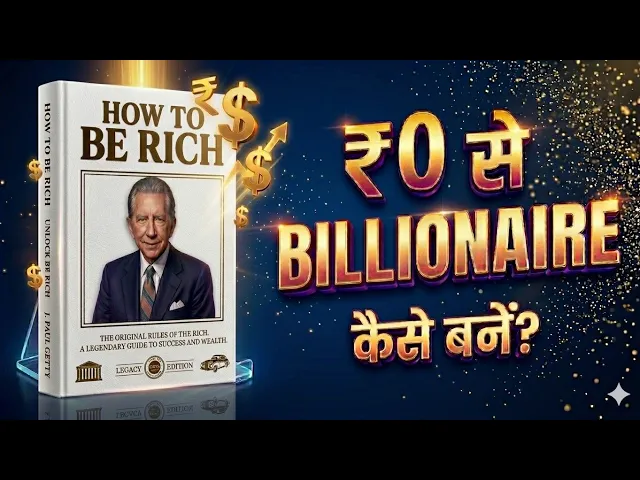
Hello friends, I'm your friend, and you're watching Drams Do Come True. Today, we 'll be talking about the book "How to Be Rich," edited by Patricia G. Horan and written by J.
Paul Getty . We'll talk about the man the world called history's richest commoner. His name was J.
Paul Getty, a billionaire who amassed millions at a time when the world was suffering from a recession. In the next few minutes, I 'll read to you pages from Getty's diary, which can transform middle-class people's thinking overnight . We'll learn why Getty installed a B-phone in his home and how he turned failing companies into gold mines.
If you still want to live in the same old mindset of poverty, stop this video right now. But if you have the fire within you to change the fate of your next seven generations , don't blink for a second, because today we're not talking about looking rich, but about becoming rich. Ready?
So, let's begin with Chapter One: "The Millionaire Mindset. " But before that, mark your presence in the comments and write, "I am born to be rich. " Because whatever you say will be true.
Chapter One: The Millionaire Mindset. Friends, have you ever considered that 95% of the world's people work like oxen all their lives, yet still live a mediocre life. Meanwhile, only 5% possess more than half the world's wealth.
Do those 5% possess a magic lamp? Or are they smarter than you? No.
J. Paul Getty, who was the richest man in his time, reveals a bitter but true secret in the very first chapter of his book, "How to Be Rich. " He says that becoming rich is not a matter of luck, but a matter of mindset.
In this chapter, I'm going to share three secret mantras that J. Paul Getty himself used. If you understand this mindset today, then believe me, no power in the world will be able to stop your dream of becoming rich from coming true.
Don't skip the video even for a second, because what I'll share in the last two minutes will change your entire life. Mantra number one: Break out of the herd mentality. The non-conformist mindset.
Right at the beginning of chapter one, Getty makes a very important point: If you do what everyone else is doing, you'll get what everyone else is getting. Let's understand this with an example. What do most people do?
They find a secure job, buy expensive things on EMIs, and spend their entire lives paying those installments. Getty calls this a slave mentality. A rich person never becomes part of the crowd.
It was the 1930s, when the global economy was collapsing. People were selling their land and businesses out of fear. What did Getty do at that time?
He invested all his savings and started buying oil wells. People called him crazy. But Getty knew that when everyone is afraid, that's when the opportunity to make history arises.
Mantra number two: Determine your own worth . Be your own master. Now listen to the most important thing.
Getty writes, "You can never truly become rich by working for someone else. Understand this deeply. When you work for someone else, you are selling your intelligence, your precious time, and your energy to make someone else's dream come true.
That company will only pay you enough to sustain you so you can return to work the next day. This doesn't mean you should resign today. It means you should have the mindset of an owner.
Remember, every rich person in the world became rich by making a profit, not by taking a salary. Profit has no limit. But salary has a ceiling that you will never be able to cross.
Mantra number three: invest time and money. The wealth multiplier. " The third point that is the heart of this entire chapter is respect for money.
Getty has a famous story. He had billions of dollars. But when guests came to his house, he had a pay phone installed, meaning a coin phone, so that guests wouldn't make long calls at his expense.
The world called him a miser. Getty 's answer was, "I'm not a miser. I'm an enemy of extravagance.
" What does a middle-class mindset do? As soon as they get a little extra money, they buy a new phone and throw a party . What does a rich mindset do?
It first invests that money in a place that will generate more money. Getty says that money is like a seed. If you eat the seed, how will it grow into a tree?
You must learn to invest a portion of your income, even just 10%, in assets. Those assets will one day become your ticket to freedom . Friends, the first chapter of "How to Be Rich" teaches us only one thing: Being rich is a choice.
If you're ready to join that 5% club, then Write it proudly in the comments section right now. I have a millionaire mindset. Your words create your reality.
Chapter Two: How to Be Rich. Three sure rules for starting a business. Chip Getty says that ideas are seeds, but business is the soil where those seeds bear fruit.
Getty earned his first million dollars at the age of 24. How? What rules did he follow that are just as effective today ?
If you're tired of your 9-to-5 job or want to start something of your own, the next seven minutes will be the most precious seven minutes of your life. Let's learn the business secrets of a billionaire. Rule number one: choose a field of your choice.
The passion and knowledge rule. Never venture into something you don't fully understand. What do people often do?
Sharma's son is making a lot of money by opening a restaurant . Let me open one too. This is the first step to ruin.
Getty says you should pursue a field in which you have either a deep interest and passion, or a thorough understanding of it. Getty chose the oil business because he understood it intimately. Lesson: Business isn't about what's trending.
Business is about what you understand better than others. Can you speak about your work with full consciousness even at 2:00 a. m.
? If so, that 's your true calling. Rule number two: balance expansion and savings.
Expansion versus frugality. The biggest mistake people make in business is when they start making a small profit . As soon as they earn their first million, they expand their office or buy a new car.
Getty's rule says to grow your business, not your luxuries. When Gates' company was growing, he kept track of every penny. He said, "The business 's money belongs to the business, not yours.
Invest that money back into the business so it can grow even bigger. " For example, if your small store is doing well, don't use the profits to buy a new phone. Instead, plan to open another store.
Rich people build empires , while middle-class people only increase their expenses. Rule number three: risk and responsibility. Taking the lead.
The third and most important rule: learn to take responsibility. Most people don't go into business because they're afraid. Gates says that a successful businessman is one who takes responsibility for losses and gives credit for victories to his team.
When he made his first big oil deal, it was a huge risk. If he had failed, everything would have been lost. But he didn't let fear overwhelm him.
Lesson: If you want to play it safe, get a job. But if you want to make history, you have to love uncertainty. There are no guarantees in business.
There are only possibilities, and making those possibilities a reality is the job of a true leader. This chapter by Paul Gates reminds us that no job in the world can give you the freedom that a successful business can. Today, I have a question for you: If money and fear were no barriers, what business would you like to start?
Write the name of your dream business in the comments below. When you write it, you send a signal to the universe that you're ready. Now, we'll discuss Chapter Three, where we'll learn why Getty wasn't considered a miser despite saving billions .
Chapter Three is the most controversial, yet most eye-opening, part of this book . Here, we 'll understand the mastermind behind J. Paul Getty's miserly tag .
Chapter Three: Frugality and Investment : The Real Secret of a Billionaire's Frugality? Can you imagine that a man with enough money to buy an entire city installed a coin-only payphone for his guests ? People called him the world's biggest miser.
But J. Paul Getty's answer will send shivers down your spine. He said, " I'm not a miser.
" I'm simply an enemy of wasteful spending because it 's the barrier between you and your freedom. In today's Chapter 3, we'll learn how saving isn't a sign of poverty, but rather the first step to wealth. If you find yourself sitting with empty pockets at the end of the month, these five minutes will be a lifesaver .
Let's understand Getty's mind, which turned coins into billions of dollars . Mantra number one: small savings, big wins, the power of small leagues. Getty has a very powerful quote: "A small hole can sink an entire ship.
" Relate this to today's Gates. We often wonder what difference a ₹500 Netflix subscription or a ₹200 daily coffee out makes. Getty says that's where it all begins.
Your wealth begins with death. A rich person never considers the price of an item . They consider its future value if invested.
For example, if you save just ₹3,000 a month and invest it wisely, you could become a millionaire in 20 years. Getty installed a payphone because he wasn't greedy for saving a few rupees. He firmly believed that thoughtless spending is a mental illness.
Mantra number two is death of show -off. Getty writes that the middle class remains poor while constantly striving to appear rich . When they acquire money, the first thing they do is buy an expensive car or branded clothing to enhance their social standing.
Getty's rule was clear: keep your lifestyle simple until your assets grow enough to afford luxuries . The lesson: If you earn ₹00 and own a ₹400 phone, you're not rich. You're an expensive slave.
True wealth lies in bank balances and portfolios, not in Instagram photos. Mantra number three: investment discipline . Now comes the most important part: what to do with your saved money ?
Getty says that money sitting in a vault is dying. Put it to work. Investing isn't just about the stock market.
Investing means improving your skills, growing your business, or investing in a place where it can multiply. Getty never relied on tips or lucky chances. He always did his research and invested when the market was in a tailspin—a market crash.
He learned that patience is the key to investing. If you want to become rich overnight, you're gambling. But if you invest slowly and consistently, you're becoming a Getty.
Friends, this chapter by J. Paul Getty gives us a huge challenge . Can you stop one unnecessary expense for the next 30 days ?
Be it eating out or unnecessary shopping? If you 're ready to take on this challenge, please leave a comment. Saving is my power.
Chapter Four: Management and Leadership: The Rich Way to Get People to Work. Friends, have you ever considered that a single person has the same 24 hours as you. So how does he manage to run a company of thousands of people?
Is he Superman? No. J.
Paul Getty says that if you do all the work yourself, you'll never become rich. You 'll just end up as a tired laborer. In today's Chapter Four, we'll learn the secret Getty taught thousands of people to work towards their dreams.
He said, "I 'd rather take on the work of 100 people one-by-one than put in 100% of my own effort. " If you want to increase your growth tenfold, the next five minutes will be a leadership masterclass. Let's learn the management skills that will give you true freedom.
Mantra number one: Be a leader, not a boss. Getty's first rule is never to ask your team to do work you're unwilling to do yourself. Let's illustrate this.
If a general flees the battlefield, will the soldiers fight? Absolutely not. Getty himself stood in the dust and sweat of his oil refineries .
He knew that when an employee sees his boss working hard, his respect and passion for work increases tenfold. The lesson: If you want your people to be honest and hardworking, you must first demonstrate that. People work when you command, but loyalty is maintained by following along.
Mantra number two is the right person in the right place. The right man for the right job. Most businesses fail because the owner wants to do everything himself.
He's both the accountant , the salesman, and the peon. Getty says that the truly rich are those who know their shortcomings and hire skilled people to fill them. If you don't know marketing, find the best marketer.
If you have trouble with accounting , hire a good CA. For example, in a football team, the goalkeeper never tries to become a striker. Everyone knows their job.
Getty's mantra was to give people freedom according to their abilities. Don't micromanage them or interrupt them on every matter. Make them feel that this business is theirs too.
Mantra number three: Respect human emotions, the human element. Now listen to the most profound thing. Getty writes that machines run on oil, but people run on praise and inspiration .
Often, rich people consider their employees as mere numbers. But Getty took care of the well-being of his team. He believed that if your If an employee is stressed at home, they won't be able to give their best in the office.
Good leadership means giving your team a sense of security and growth. When people feel safe, they give their all for the company. Learning: Money can bring people to work, but respect connects people to your mission .
Are you giving your team opportunities for growth? If so, your growth will happen automatically. Friends, this chapter by Getty teaches us that you can move fast alone, but together you can go far.
Today I have a question for you: do you want to remain a one-man show or build an empire? If you want to move forward with a team, write in the comments: "I am a true leader. " Chapter Five: The Rules of Investment: The Secret Way to Get Rich in a Recession?
Friends, did you know that when the global stock market crashes and there is chaos everywhere, people like J. Paul Getty celebrate. Why?
Because he knows that wealth lies hidden in the rubble of recession. While the average person is selling everything and running away in fear, a true investor is writing his own destiny. In today's chapter five, we'll learn the three infallible rules of investing that made Getty the richest man of his time.
If you're afraid of investing in the stock market or real estate, the next seven minutes will transform your fear into confidence. Let's learn how the true money-making machine works. Number one: go against the crowd.
The Contrarian Strategy. Getty's first and strictest rule is to always go against the crowd. Understand this carefully.
When everyone is talking about a stock or land and its price is skyrocketing, understand that it's time to flee. And when everyone is saying that the market has collapsed and there will be nothing left, that's the right time to buy. Getty built his entire oil empire when oil prices were a pittance.
The lesson: If you buy what everyone else is buying, you'll never achieve multi-bagger returns. To become rich, you must learn to buy low and sell high, not the other way around. Rule number two is investing deeply.
Research over luck. People often think investing is like gambling, thinking that if they're lucky, their money will double. Getty says that luck only favors those who enter the field fully prepared.
He never invested based on someone's advice or tips. He would personally go to the ground and examine oil wells, read statistics, and predict the future. For example, if you 're buying shares in a company, do you know what it produces?
Who owns it? If not, you're not investing. You're speculating.
Getty's mantra was: Knowledge yields the greatest returns. Rule number three is the power of patience. The third rule, the most difficult, is patience.
Getty writes that investing is like planting a tree. You can't sow seeds today and expect fruit tomorrow. Most people invest , but as soon as the market dips, they panic and withdraw their money , suffering losses.
Getty often held onto his assets for decades. He knew the magic of compounding over time. Lesson: Don't fear market fluctuations.
If your research is sound, your wealth will grow over time. Trying to get rich quickly often makes you poor . Friends, this chapter by J.
Paul Getty teaches us that earning money is easy, but growing it by investing is an art. Today, I have a question for you: Will you resolve to invest 10% of your income in the right place from today? If so, boldly write in the comments, "I am a smart investor.
" Now, we'll move on to Chapter 6, where we'll learn how to preserve your reputation and respect after becoming rich . Don't miss it, because your true wealth doesn't lie solely in money. Chapter 6: The Art of Living Rich.
The Real Challenge After Wealth. Friends, suppose you received 1 billion rupees in your bank account today. Would all your problems be over ?
J. Paul Getty, the richest man of his time, said that earning money is a struggle. But living with that wealth with dignity is an art.
Many people become wealthy, but they lose their reputation, their health, and their relationships . Getty taught that true wealth lies not just in your bank balance, but in your character and your lifestyle. If you want to be honorable and respected, not just wealthy, then this chapter will be an eye-opener for you.
Let's explore the world of wealth . Let's look at the world beyond. Mantra number one: simplicity is true luxury.
Getty's first and most surprising rule is never to live for show. Often, newly rich people want to impress the world by showing off gold watches and shiny cars. Getty considered this a sign of cheap people.
He said that a truly wealthy person doesn't need to prove anything to anyone. His simplicity was his greatest strength . The lesson: use your wealth for your own comfort, not to belittle others.
When you live simply, you escape selfish people who only seek your money. Remember, even if a king sits on a throne, he remains a king. Mantra number two: protect your reputation.
Getty writes that your name is your greatest asset. Business will experience ups and downs. Money will come and go.
But once your reputation, meaning goodwill, is lost, all the wealth in the world cannot restore it. Getty always kept his promises, even if it meant losing money. He taught that a rich person should always be true to their word.
For example, if you give someone your word, keep it. People don't work with you because you have money, but because they trust you . Never trade your integrity for a few rupees.
Mantra number three : Continuous learning. Never stop learning. The third and most profound mantra: A rich person is one whose mind is always hungry.
Getty had all the comforts of the world, but he continued studying until his last breath, learning new languages and understanding new technologies. He used to say that the day you stop thinking you know everything, that's the day your ruin begins. Learning and money can be taken away, but no one can take away your knowledge.
Never stop investing in your intelligence . A rich person always remains a student. Friends, the book "How to Be Rich" teaches us not just to make money but to leave a legacy.
From J. Paul Getty's journey, we learned that becoming rich is a journey, not a destination. As this video concludes, I have one last question: Do you just want to make money?
Or do you want to become someone the world can be proud of? If you're ready to become a great leader and a wealthy person, leave a comment saying "Legendary. " I hope these principles from J.
Paul Getty have changed your thinking. Share this video with your friends who you want to see become rich with you. Don't forget to like and subscribe, because your progress is our mission.
So keep dreaming, friends, because dreams do come true.