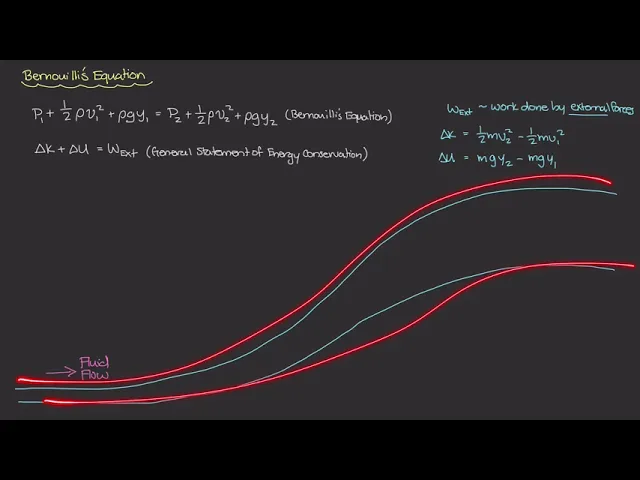
okay in the next set of videos we are going to look at this thing called bernoulli's equation now this might seem familiar to you bernoulli's equation is one of the most important equations in fluid dynamics and i want to extend our discussion on things that we've already been studying things like pressure and flow rate and see how we can figure out what bernoulli's equation is and how to derive it and then after this set of videos we can go and do a few examples using this equation right here so bernoulli's equation which i have written
here is nothing more than a very specific case pertaining to fluids of this general statement of energy conservation so this statement right here you might be familiar with already and that is that the total change in kinetic energy plus the total change in potential energy of a system is equal to the external work being applied to that system so that external work is being done onto the system by external forces so in this next set of videos i want to take this statement right here which is the general case and derive from it bernoulli's equation
which is a specific case for fluid dynamics now on the side here i want to define a couple terms actually i'm going to define all three terms in the general statement of energy conservation so first off is work external so work external is any work done by external forces now this external word in this definition is very important we're not looking at forces internal to the system we're looking at forces external to that system and if that doesn't make sense don't worry in a few minutes i'm going to draw a diagram and hopefully that diagram
will explain the difference between external forces and internal forces now the delta k term which is the change in total kinetic energy you might know as one-half m v2 squared minus one-half m v 1 squared where m is the mass and v is the velocity at that point and for that delta u term that is the change in potential energy and more specifically the change in gravitational potential energy and you might know it as mgh and in our case this is going to be m g times y 2 minus m g y 1. so again
this is the potential the gravitational potential energy at a point two minus mg y or mgh of a point one where again m is the mass g is the gravitational constant and y is the distance from some datum up to that point so let's go back to this equation right here this equation really states that the change in total kinetic energy plus the change in total potential energy is equal to this external work now if there was no external work being applied to the system in other words w external was equal to zero then the
energy in this system will remain the same now this abides by the statement of energy conservation and that is energy in a system is constant it cannot be created nor destroyed only transformed from one form to another so again if there was no external work being applied this kinetic energy and potential energy the sum of those two energies will remain the same the only thing that can happen in that system is that you can have kinetic energy being transformed into potential energy or you could have potential energy being transformed into kinetic energy or some combination
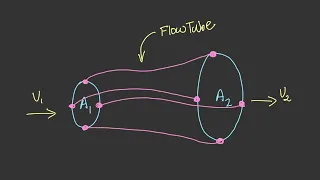
of the two but the important fact there is that that energy will not be destroyed or created it just changes form within that system okay so now let's draw that diagram that i mentioned a few minutes ago so we can understand this external work so imagine you have a pipe that starts somewhere down here and then it ends up somewhere over here on the right now this pipe has fluid flowing inside of it in the direction of the fluid is to the right so this is the fluid flow so for now we can make it
pretty easy and just assume that the liquid inside of this flow tube or this flow is something like water and the system that we're gonna study this kinetic and potential energy and the external forces being applied or the external work being done on that system is just gonna be a small segment of this entire flow in other words let's just define our system to be this very small section right here so this is just a small section within this larger flow that we are going to study the potential and the kinetic energy as well as
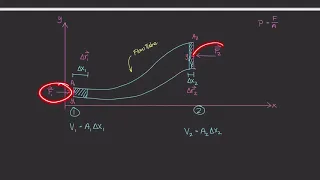
the external work being applied and we're going to use that system and this general statement of energy conservation to come up with bernoulli's equation okay so let's start drawing that out so i'm going to scroll down a little bit and i'm going to draw a graph so we have some sense of direction we can set up a coordinate system here and this is the x-axis which is horizontal this is the y-axis which is vertical and i'm going to draw that same tube here and this flow tube is just a small section of this larger flow
that we had up here so this very large flow we just cut a small section of this flow and i drew it down here because this is what we're going to study this is going to be our system for coming up with bernoulli's equation and this is where we're going to study the energy analysis so we're going to apply this general statement of energy conservation to this tiny piece of the system or this flow tube and this is going to help us derive bernoulli's equation so i'll do that in the next video we'll start looking
at this diagram however i do want to note a couple things first is that the flow is still moving to the right in this system as it is for this entire giant pipe up here the second is that i've drawn these two ends at two different elevations and these are just general elevation i'm not going to give numbers to them because really the energy of concert or the conservation of energy applies to really any elevation it just looks like here at point one it is lower than point two now in the grand scheme of thing
for the entire equation that doesn't really matter and you could certainly do this derivation if i had drawn point two at the same level as point one or even lower but to keep it as general as possible point one is going to be here at y one and point two is going to be here at y two and finally we're going to study this flow at a very very brief snapshot in time so the amount of time that has passed while this flow is going up the system is going to be very very small so
our time is really going to be in increments of delta t okay so i'll leave things there in the next video i want to talk about work being done on this system we're going to start driving some variables and start labeling things and we're going to figure out where our external forces are and those external forces are forces that are caused by the external fluid that is acting on our small system right here so this fluid that we cut out there's forces there induced by pressure for sure and there's also forces on the left and
the right and those forces on the left and the right are the external forces that i'm talking about for this flow tube or this flow system so we'll get to all that in the next video i will see you then