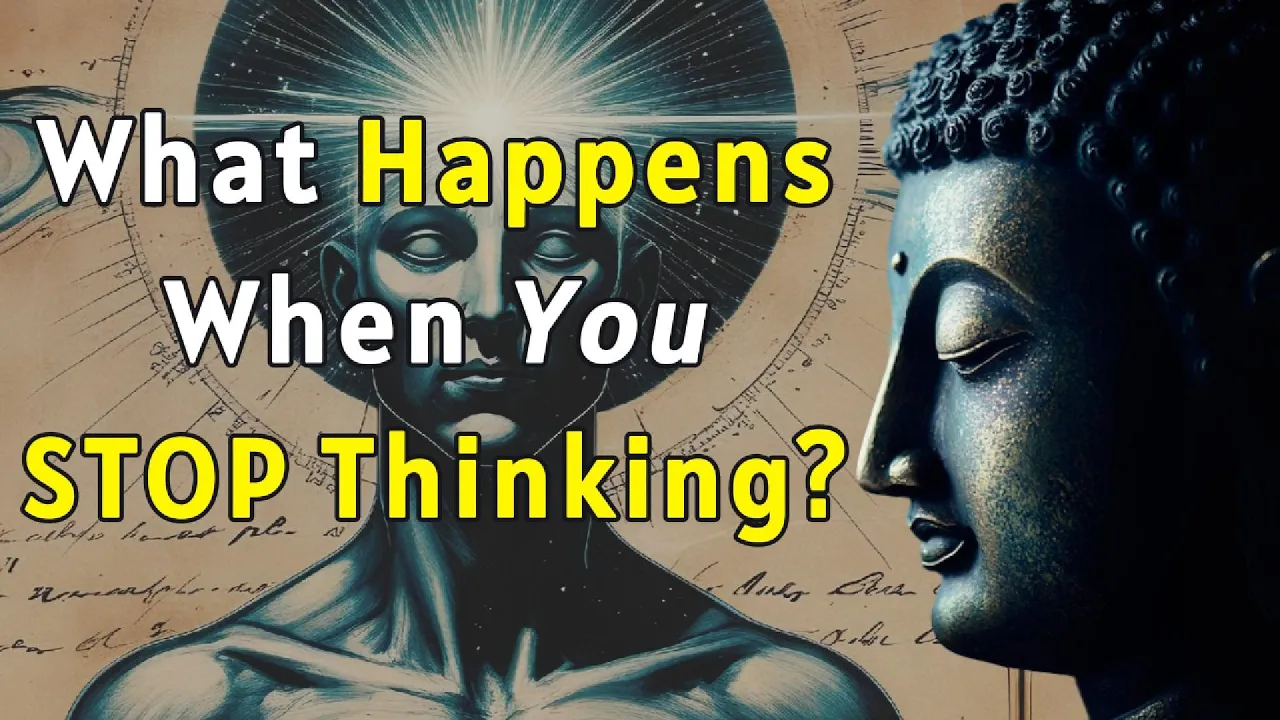
What Happens When You Stop Thinking? Buddhism's Answer Imagine this: It's late at night and you're lying in bed. You want to sleep, but your mind won't stop.
Thoughts keep coming - your job, your family, things you forgot to do. It feels like a busy road where cars never stop moving. We live in a world where this happens all the time.
From the moment we wake up, our thoughts start running. We think about what happened yesterday. What might happen tomorrow?
What we need to do today? It's like there's a voice inside that never stops talking. Most of the time, we don't even notice it, but Buddhism teaches something important.
True peace comes when we stop being controlled by our thoughts and start watching them instead. But is it possible to make this inner voice quieter? Can we stop thinking so much?
And if we can, what does that feel like? The answers are simple and they might change the way you see your own mind. Chapter 1: The Problem of Endless Thinking Have you ever stood in the middle of a busy city street?
Cars honking, people talking, phones ringing - it's loud and overwhelming. Now, imagine that noise is inside your head, happening all the time. This is what an overactive mind feels like.
The moment we wake up, thoughts start rushing in. Maybe we remember a dream or we think about what we need to do today. Some thoughts are useful - like remembering to bring your keys.
But many are just noise. They don't help us and they make it hard to focus. It's like trying to listen to a friend in a crowded café.
You want to hear what they're saying, but there's too much noise. Or imagine watching a beautiful sunset. But instead of enjoying the colors, your mind is stuck on something from work.
"Why did I make that mistake? ", "What will happen now? " Your body is here, but your mind is somewhere else.
This kind of thinking is exhausting. It's like carrying a heavy backpack all day, even when you don't need to. The Buddha once told a story about this.
Imagine someone shoots an arrow at you. It hurts - that's the first arrow. This is the natural pain of life.
But then you take a second arrow and stab yourself with it. That's the second arrow - the pain we create ourselves by overthinking. We all experience the first arrow - things we don't like, things that hurt us.
But the second arrow is different. It's the extra pain we create by thinking, "Why me? This is unfair.
I can't stop thinking about it. " The Buddha said, "Whatever has a beginning has an end. Let go, and find peace.
" But why does our mind do this? Science has an answer. Our brain has something called the Default Mode Network (DMN).
It's like a radio that plays in the background, always reminding us of the past and worrying about the future. This is why silence feels uncomfortable - because our brain is used to always thinking. But here's the secret: You don't have to believe every thought.
The Buddha once asked a student, "Where is your mind right now? " The student answered, "It's thinking about many things. " The Buddha smiled and said, "If you can see your thoughts, then you are already aware.
" This is the key. Thinking is like being inside a fast-moving car. Awareness is like standing on the sidewalk and watching the cars go by.
Imagine watching clouds in the sky. You see them come and go. You don't try to stop them.
Your thoughts are the same. You don't have to fight them. You just have to notice them.
Science agrees. Mindfulness meditation, paying attention to the present moment, can make the DMN quieter. It's like turning down the volume on the brain's radio.
Thoughts are still there, but they no longer control you. And this is the truth. You are not your thoughts.
Peace doesn't mean stopping your thoughts. It means understanding that your thoughts are just clouds, and you are the sky. The sky is always there, calm, open, and free.
Chapter 2: What Happens When Thinking Stops? Do you remember the last time you looked at the sky after the rain? The air was fresh, the world seemed quieter, and everything felt a little clearer.
That's what happens to the mind when thinking slows down. Most of the time, our thoughts are like waves in the ocean - always moving, always changing. But when the wind stops, the water becomes still.
You can see deeper. Your mind is the same. When the endless thinking settles, something amazing happens.
The first thing you might feel is relief - like putting down a heavy backpack you didn't even know you were carrying. The pressure of planning, remembering, and worrying eases. Your body relaxes.
It's like suddenly realizing you've been clenching your fists for hours and finally letting go. Then, the world starts to feel different. Usually, our thoughts act like colored glasses, shaping how we see everything.
But when they quiet down, it's like taking off those glasses. You see the world as it is - without labels, without stories. This is what Zen Buddhism calls "beginner's mind.
" It means seeing the world without preconceptions, just like a child encountering something for the first time. Instead of judging or categorizing, you simply experience- with openness and curiosity. Imagine a child seeing snow for the first time.
They don't think, "Oh, snow is frozen water and it falls because of the weather conditions. " No. They just feel it, touch it, and laugh in pure wonder.
That's the kind of awareness we regain when the mind is silent. But something even deeper happens. The feeling of "I" - the voice in your head that says, "I like this, I don't like that, I am this kind of person, I am not that kind of person"- starts to fade.
Think about social media. People often build an identity based on how they want to be seen. "I am successful," "I am unique," "I am better than others.
" But is that really who we are? Or just a collection of thoughts, memories, and comparisons? The truth is, this "self" we hold onto so tightly is not as solid as we think.
It's just a story we keep telling ourselves. The German philosopher Martin Heidegger talked about this too. He believed that our constant analyzing and categorizing actually hides reality from us.
We are so caught up in our thoughts about life that we forget to experience life itself. But when thinking slows down, something shifts. Have you ever been so lost in beautiful music that you forgot yourself for a moment?
Or so absorbed in a sunset that you didn't think about anything at all? That's what it's like. You don't disappear - you just become more connected.
The Buddha taught that our suffering comes from clinging too tightly to the idea of a separate self. When we let go of that- even for a moment-there is peace. This doesn't mean you become empty.
In fact, you become more alive. Some deep meditation states in Buddhism, like "nirodha samapatti," involve a temporary stillness of thought. But this is not about stopping thought completely.
It's about finding freedom from the noise-not being trapped in it. When thinking stops, we don't become nothing. We become aware.
We see. We feel. We experience-without all the extra weight of past and future, we return to something simple, something real.
And maybe, just maybe, that is what we've been searching for all along. Chapter 3: The Balance Between Thought and Stillness Thinking is not the enemy. It is a tool-one of the most powerful tools we have.
We use it to solve problems, make plans, and understand the world. But just as a knife can prepare food or cause harm, thought must be used with awareness. If it controls us rather than serves us, it becomes a source of suffering.
This is why Buddhism emphasizes the Middle Way- a path between extremes. Some people become trapped in constant thinking, over-analyzing everything until they feel lost in their own minds. Others believe that all thinking is a hindrance and try to suppress it completely.
But neither approach leads to wisdom. True balance comes from knowing when to think and when to be still. This balance is reflected in the Noble Eightfold Path, the guiding framework of Buddhist practice.
One of its key elements is Right Thought (Sama Sankappa)-not merely thinking "correctly," but developing a mind that is free from harmful, unwholesome thoughts. Right Thought encourages three qualities: renouncing attachment, cultivating kindness, and letting go of harmful intentions. It is not about forcing the mind into a certain way of thinking, but about recognizing which thoughts bring clarity and which ones create suffering.
Modern psychology offers a similar perspective. Cognitive Behavioral Therapy (CBT) teaches that not all thoughts are true, nor are they all helpful. Some thoughts strengthen us, while others distort reality and lead to unnecessary suffering.
Just as we choose what food to consume, we can also choose which thoughts to nourish and which to discard. A monk once asked the Buddha, "Should I stop thinking? " The Buddha replied, "Think when it is useful, but do not be a slave to your thoughts.
" This is the essence of wisdom - knowing that the mind is like a river: always flowing, but we do not have to be swept away by every current. When planning an important decision, thinking is necessary. But when dwelling on regrets or fears, thought becomes a burden.
In those moments, the skillful response is not to fight the mind, but to step back, observe, and let go. This process is not about suppression or control, but about awareness. A skilled musician does not play every note available; they choose each one carefully, creating harmony between sound and silence.
In the same way, wisdom is found not in thinking endlessly nor in avoiding thought, but in using the mind with clarity and intention. Chapter 4: What If Thinking Stops Completely? The mind is like an endless river, flowing ceaselessly with thoughts, emotions, and perceptions.
But what if, one day, the river simply stopped? No movement, no ripples - just absolute stillness. What would remain?
Would there still be awareness, or would there be nothing at all? To explore this question, we must first recognize that the absence of thought does not necessarily mean the absence of awareness. There are moments in deep meditation where thinking ceases, yet one is not unconscious.
A quiet mind, free from unnecessary noise, is not the same as a mind that ceases to exist. But is it possible to go even further? To completely stop thinking in every sense?
And if so, what would that mean? Buddhism speaks of a state known as "nirodha samapatti," the cessation of perception and feeling. In this state, all mental activity ceases - no thoughts, no sensations, no awareness of time or space.
The Buddha described this experience in the Udana: "There is amongst that dimension where there is neither earth, nor water, nor fire, nor air. . .
neither this world nor another world, neither coming nor going, nor standing still. . .
This is the end of suffering. " This is not sleep nor unconsciousness, but something entirely beyond ordinary human experience. It is absolute stillness - where even the sense of "I" dissolves.
Those who have entered this state and returned speak of an indescribable peace, a profound silence deeper than any words can convey. But this raises a fundamental question: If all thought were to stop permanently, what would remain? Could a person function in the world without thought?
Even enlightened beings, who have transcended attachment to thought, still think when needed. They still communicate, teach, and navigate daily life. The difference is that their thoughts arise and dissolve without clinging, without creating suffering.
Thought becomes a tool, not a master. Some philosophers have long debated whether the self could exist without thought. René Descartes famously declared, "I think therefore I am.
" He believed that the ability to think was proof of one's existence. But is thinking truly the foundation of being? Jiddu Krishnamurti once challenged this notion, saying, saying: "The ability to observe without evaluating is the highest form of intelligence.
" This suggests that true intelligence does not arise from constant thought but from direct perception - seeing reality as it is, without the mind's interference. If thoughts were to stop, awareness could still remain. But what about the sense of "I"?
Would it disappear along with thought? Buddhist teachings suggest that what we call "self" is nothing more than a collection of thoughts, memories, and perceptions that arise and fade moment by moment. If thought ceases completely, the self - at least as we ordinarily understand it - dissolves.
What remains is not an individual identity but a boundless presence, a state beyond concepts of "me" and "mine. " Some call this "ego death," where all attachments to personal identity vanish, leaving only pure being. From a scientific perspective, the brain never fully stops working.
Even in deep sleep or under anesthesia, some level of neural activity remains. Studies on meditation show that during deep states of stillness, the Default Mode Network- the part of the brain responsible for self-referential thoughts - quiets down significantly. But even in these moments, the brain is not "off"; it simply functions in a different way.
If all brain activity ceased permanently, it would mean biological death. In that sense, complete and permanent cessation of thought is not a realistic goal. But what is achievable is a state where thought no longer dominates our experience - where we are free from its grip.
So what is the final answer? If thinking were to stop completely and permanently, there would be no perception, no self, no awareness - nothing. It would be an abyss, an absolute void.
But perhaps the more important realization is that complete cessation of thought is not the goal. The Buddha did not teach that we must eliminate thought, but that we should not be enslaved by it. True freedom is not the absence of thought, but the ability to let it come and go without attachment.
Instead of seeking to silence the mind entirely, we learn to rest in awareness - an awareness that is deeper than thought itself. Beyond thought and beyond silence, there is a vast openness, untouched by mental noise. In that openness, we do not vanish - we awaken.
It is not extinction, but transcendence.